Haute Black Journal
2 Weeks in Japan: The Luxury Itinerary for 2026

Marlene Azeez
Director, HauteBlack
View all articles →
# 2 Weeks in Japan: The Luxury Itinerary for 2026
August 7, 2026
Two weeks in Japan is not a long trip. It's the minimum window where bad planning becomes expensive, and where the right routing starts to feel like private access instead of tourism. Japan's record inbound demand, with 36,870,148 arrivals in 2024 and premium hotel pressure across the main cities, means the luxury traveler who books late is usually buying inconvenience, not flexibility. That's why the smartest 2 weeks in Japan itinerary is built around transfer friction, not city count.
Why Two Weeks in Japan Demands a Different Kind of Plan
Most guides treat 2 weeks in Japan like a checklist. Tokyo, Kyoto, Osaka, maybe Hiroshima, then a rushed train scramble and a few “must-sees” squeezed between station platforms. That works for backpackers. It's the wrong model for travelers who care about luggage handling, room upgrades, VIP arrivals, and reservation certainty.
The real constraint is sequencing, not ambition
Japan rewards a focused westbound loop, because the country's major travel spine runs cleanly along the Tokaido Shinkansen corridor. If you try to bounce north, south, and back again, you burn hours on transfers and eat into the experience you paid for. If you stay disciplined, you get a trip that feels coherent, calm, and expensive in the right way.
Practical rule: In Japan, every unnecessary transfer is a tax on comfort. If a leg doesn't improve the trip, cut it.
The tourism numbers explain why this matters. The Japan National Tourism Organization reports that inbound visitor arrivals reached 36,870,148 in 2024, a new record and the first time the country passed 32 million arrivals. That scale matters because the obvious luxury corridors, Tokyo, Kyoto, and Osaka, aren't soft-selling destinations anymore. They're advance-planning markets. Premium hotels, good tables, and the best arrival handling disappear early, especially in peak seasons. Japan inbound tourism statistics
The right way to think about a 2-week Japan itinerary is simple. Choose fewer bases, lock the right rooms, and treat every transfer as a design decision. That's the difference between a nice trip and one your guests or family remember for years.
The Geographic Logic Behind Any Japan Route
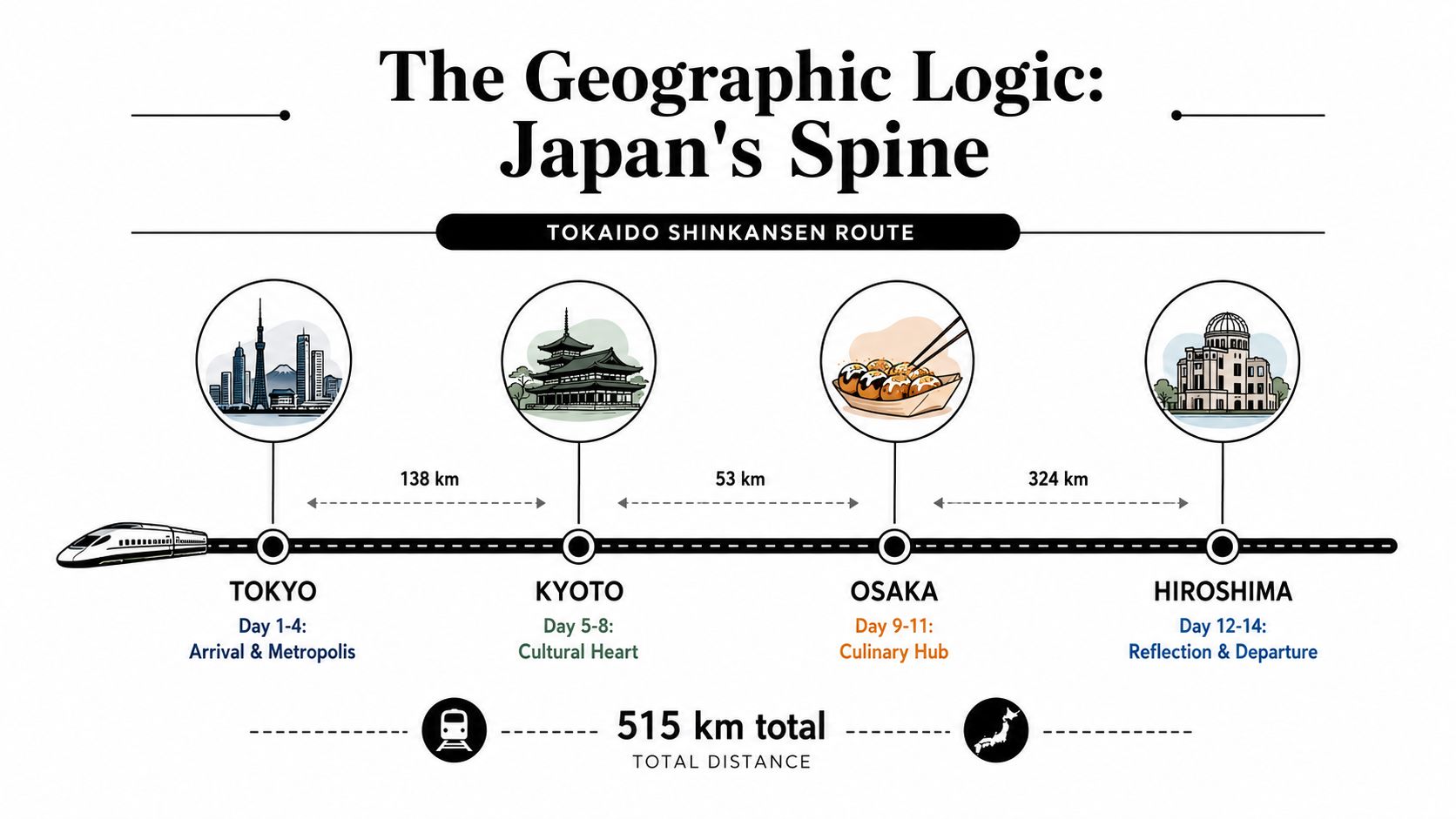
Japan's geography makes some routes elegant and others wasteful. The Tokaido Shinkansen spine ties Tokyo, Kyoto, Osaka, and Hiroshima into a single, highly efficient westbound arc. On the fastest Nozomi service, Tokyo to Kyoto takes about 2 hours 10 minutes, which is short enough to make a four-city loop realistic inside 14 days. National Geographic on planning a classic two-week trip in Japan
Why the east-to-west shape wins
Once you accept that Tokyo and Kyoto are connected that tightly, the route basically designs itself. You arrive in Tokyo, settle in, move west to Kyoto, continue to Osaka, and then decide whether Hiroshima is a meaningful final chapter or a private-transfer extension. That's the structure used by the most credible 14-day itineraries, because it avoids repeated backtracking and keeps the trip moving in one direction.
The other reason this corridor works is that it's supported by multiple transport layers. Domestic flights can make sense for certain island extensions. Limited Express rail helps with places like Kanazawa and Takayama. And for guests carrying large luggage, the highway network makes private car a real option, not a vanity choice. The best itinerary is the one that matches the mode to the leg, not the one that worships a single ticket type.
Luxury planning diverges from standard travel advice. Most generic guides ask, “Can you take the train?” The better question is, “Should you?” If you're moving between a ryokan, a high-service city hotel, and a dinner reservation that matters, the friction of station changes, bag handling, and platform transfers can be worth paying to avoid.
The Classic 14-Day Route Built for Luxury Travellers
This is the route I'd book for a couple, a multigenerational family, or any traveler who wants the country to feel effortless. It starts with arrival comfort in Tokyo, shifts into cultural depth in Kyoto, adds a restorative contrast night, and finishes with dining and departure logistics that don't feel rushed.
Four nights in Tokyo, then move west with intent
Tokyo should not be a frantic sightseeing sprint. Make it your acclimatisation base, with a Four Seasons, Aman, Rosewood, or Ritz-Carlton style arrival, ideally in a quiet district with easy car access. Spend the first days on high-value experiences, teamLab, a private museum appointment, polished dining, and one serious retail block in Ginza if you want it. Then stop. Tokyo is too large to “finish,” so don't try.
Your first transfer west should feel like a reset, not a commute. If the weather is clear and the mood is right, a Hakone or Fuji-side night works beautifully. That one break creates contrast before Kyoto and gives the trip a proper breathing point. Use a ryokan with a strong onsen setup, not a generic hotel that merely claims to be traditional.
Kyoto deserves the deepest stay
Kyoto is the cultural heart and the city where time is either handled well or wasted. Book at least four nights, preferably with one hotel that can anchor your bag movement and dining rhythm. A machiya-style private tea experience, a temple morning before the crowds, and a dinner that feels ceremonial all belong here. If you want the city to land properly, don't hop in and out.
Advisor's note: Kyoto is where travelers over-plan and under-enjoy. Pick fewer sights, but book them earlier and better.
The last stretch belongs to Osaka and a final stop that matches your exit. Osaka is the right place for serious dining, casual energy, and a relaxed finish. If Hiroshima is included, place it as a reflective final day or overnight rather than a rushed midday detour. That gives the trip a proper close instead of an exhausted ending.
| City | Nights | Primary Role |
|---|---|---|
| Tokyo | 4 | Arrival, acclimatisation, culture, shopping |
| Kyoto | 4 | Temples, tea, private cultural access |
| Osaka | 3 | Dining, urban energy, final stay |
| Side stay | 1 to 2 | Hakone, Fuji, Hiroshima, or other contrast night |
For a curated version of the Kyoto piece, this cultural immersion planning resource fits naturally with a luxury route. Use it as the template for experiences, not as a shopping list.
Choosing the Right Transport for Each Leg
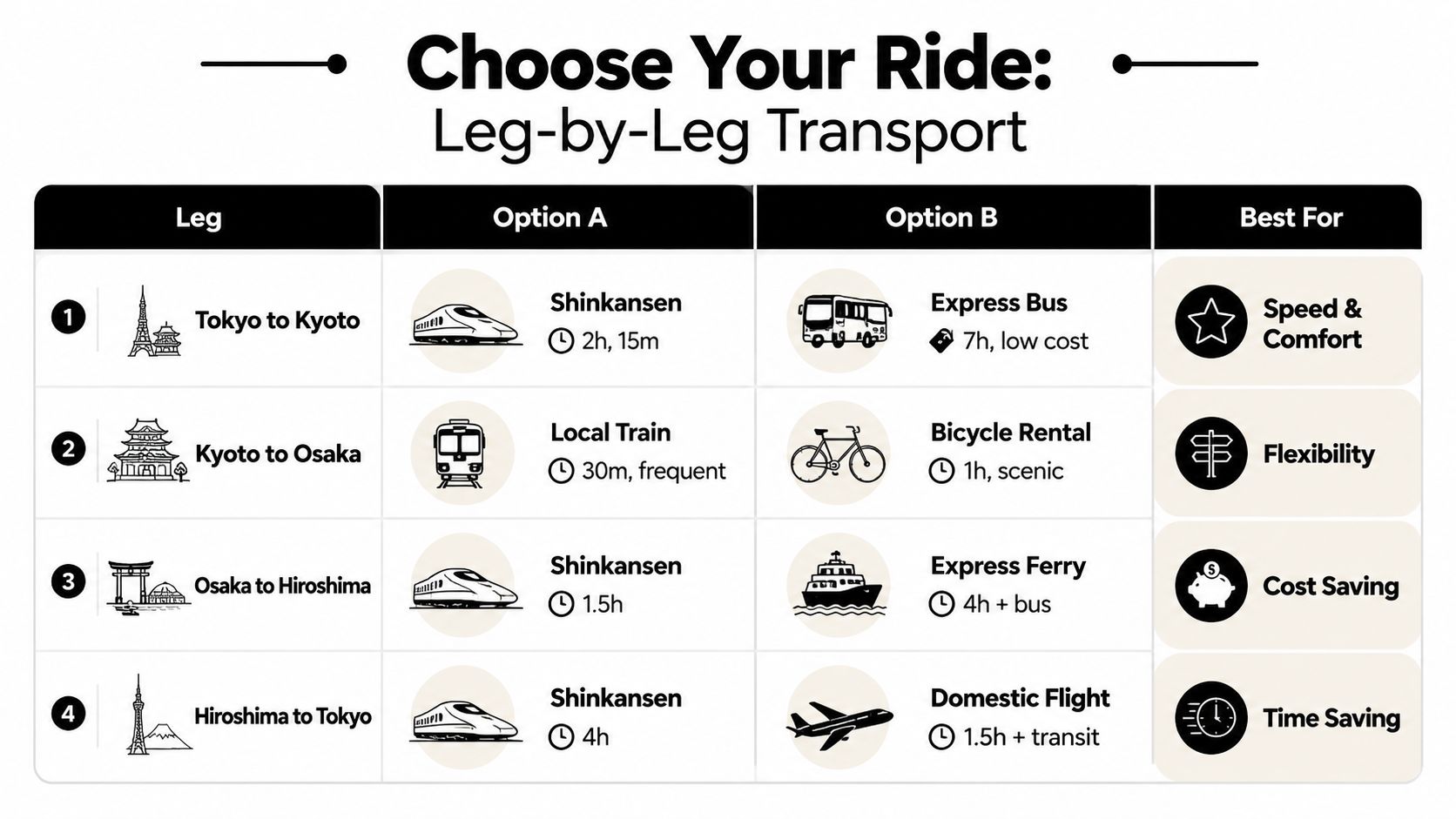
The default answer isn't the right answer. The JR Pass used to be the reflexive recommendation for long Japan trips, but the better luxury question is whether rail serves your pace, luggage, and arrival style. On a 14-day trip, the answer changes by leg.
Use rail where rail is elegant
For Tokyo to Kyoto, the shinkansen is still the cleanest solution. It's fast, predictable, and civilized, and on the classic corridor it preserves the rhythm of the trip. Kyoto to Osaka is even simpler, local rail is efficient and unglamorous in the best way, and there's no reason to make that leg dramatic.
Osaka to Hiroshima is where the conversation gets more interesting. If the traveler wants speed and the route is straightforward, the train remains sensible. If the traveler is moving with family, oversized bags, or a more polished hotel sequence, the case for a private car or a split-mode transfer becomes stronger. The goal is not to brag about using luxury transport, it's to prevent the trip from feeling chopped up.
Pay for friction removal, not for novelty
Private car is worth it for short, awkward, or luggage-heavy transfers, especially airport to hotel, hotel to rail station, or ryokan-to-ryokan moves. Use it for door-to-door service when the alternative is a slow procession through stairs, ticket gates, and platform changes. For many UHNW travelers, that convenience is the product.
Domestic flights only make sense when the route breaks the rail logic. An island extension, a far-south add-on, or a compressed return leg can justify it. Helicopter transfers are niche, but they can be smart for specific luxury combinations, especially around Hakone-style resets or tightly scheduled day access where time matters more than optics.
The best rule is blunt. Use shinkansen for the main spine, private car for friction points, and flights only when geography forces the issue. Anything else is transportation theater.
Alternative Routes for Families, Honeymooners, and Slow Travellers
The classic Tokyo, Kyoto, Osaka loop works for some travellers, but it is not the right answer for everyone. A better 2-week Japan plan depends on whether the trip is meant to feel romantic, intergenerational, seasonal, or deliberately less urban. For travellers who want the classic route with a sharper design lens, this cultural immersion planning resource is a useful reference point before finalizing the itinerary.
Honeymooners should slow the whole trip down
For couples, I would keep the pace slower and build around Tokyo, Hakone, and a refined Kyoto stay, then decide whether to add a tropical contrast. The focus should be privacy, not mileage. Private onsen suites, ryokan dinners, and one or two well-chosen transfers beat a packed schedule every time.
A honeymoon route should feel like a sequence of arrivals, not a tour. That means fewer hotel changes, more room-service dinners that do not feel like compromises, and more quiet mornings built into the stay. For couples who want the luxury version of Japan, this is the right formula.
Families need less movement and more predictability
Families do better with a Kyoto-centered plan and targeted day trips. Nara and Uji are easy additions, and Hakone can work as the contrast night if the season is right. For school breaks or summer trips, a Hokkaido-style extension can make sense for families who want a colder, more outdoor second half.
Keep children and grandparents out of unnecessary station churn. If a transfer looks annoying on paper, it will feel worse in real life.
The outlier routes are worth considering
If you want something less obvious, the Alpine Route loop through Matsumoto, Takayama, and Kanazawa is the strongest inland alternative. It gives the trip more texture, but it also increases transfer complexity, so it suits travellers who care more about atmosphere than ease. A second strong option is a beach finish in Ishigaki or Okinawa, which turns the second week into a true warm-weather contrast and usually requires domestic flight planning.
The Tokyo leg can also be built around a different design brief. Tokyo luxury planning guide is the right reference if the stay is being used as a city-focused anchor rather than just a transit stop. If the family is drawn to art or coastal culture, Naoshima is the kind of add-on that works only when the rest of the trip is disciplined.
Matching the Season to the Right Two Weeks
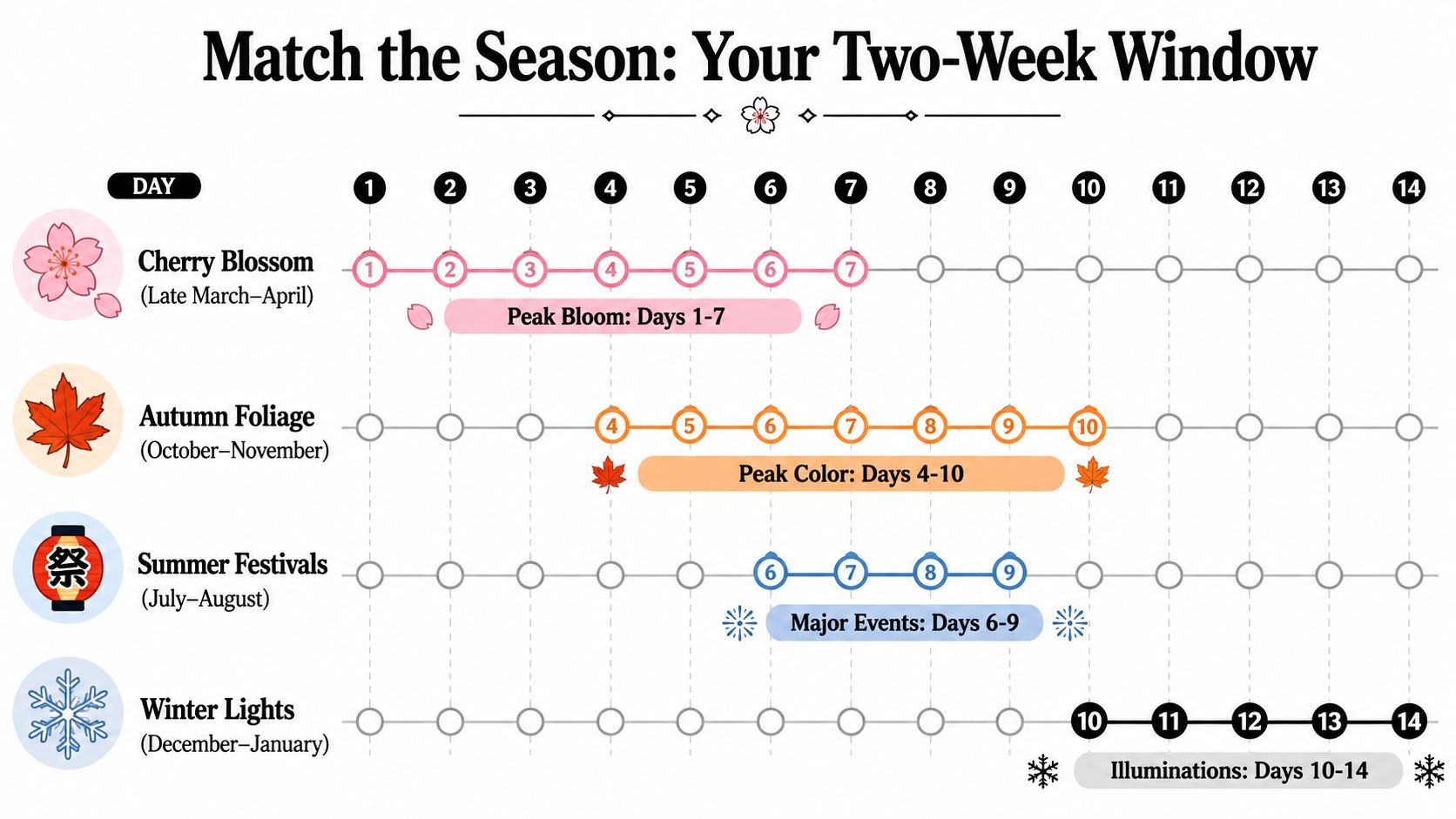
Japan changes character by season, and the same 14-day itinerary can feel radically different depending on when you go. The mistake most travelers make is chasing the prettiest dates without checking whether the hotels, trains, and restaurants can support them.
Peak seasons demand earlier commitment
Cherry blossom season and autumn foliage are the obvious luxury windows, but they're also the most competitive. Japan's accommodation market is tight in those periods, which is why the high-end route needs to be locked early, not improvised later. For cherry blossoms in particular, use a dedicated forecast and reserve with flexibility, because the best dates move quickly and the good rooms disappear first. Cherry blossom forecasting for Japan 2026
Autumn works the same way, just with a different palette. Kyoto becomes a much more dramatic city when the foliage is right, while Tokyo and the surrounding regions can feel unexpectedly refined under good weather and clear light. Summer is different, louder, warmer, and more festival-driven, so it suits travelers who want energy and don't mind humidity.
Use the season to decide the route, not the other way around
Winter is underrated for luxury travelers. That's when ski-oriented stays, hot springs, and quieter city hotels can feel more rewarding than the headline seasons. Hakone and Niseko become much more compelling in that window, especially if the trip leans toward wellness and private dining.
The honest advice is simple. If you can flex, travel in shoulder periods. If you can't, book early and expect the best properties to move first. Japan is one of the easiest countries to enjoy badly if you arrive late to your own trip.
Where Haute Black Changes the Experience
A serious Japan itinerary stops feeling generic when the hotel chain, transfer mode, and on-the-ground introductions are designed as one system. Haute Black changes that piece of the trip by combining Virtuoso-affiliated booking support with preferred partner status at over 500 properties, including Four Seasons, Aman, Rosewood, Belmond, and Ritz-Carlton. That setup is what makes upgrades and VIP arrivals possible where availability exists. Haute Black Japan luxury cultural immersion
The difference shows up in the first 48 hours
A standard booking gets you a room. A properly handled booking gets you a cleaner arrival, stronger recognition at check-in, and a better handoff between airport, car, and hotel. In Japan, that matters because the trip often begins with long-haul fatigue, a packed transfer day, and luggage that needs to disappear into the system before the city can be enjoyed.
Haute Black can also handle the parts of the trip that generic agencies usually flatten. That includes private jet support through Haute Jets, helicopter transfers where they are useful, and high-touch ground transport for travelers who do not want to manage station logistics themselves. For a Tokyo to Okinawa style leg, that kind of routing is a practical solution, not a decorative one.
Culture matters as much as room type
The strongest Japan itineraries pair access with context. If you are spending time around temples, Buddhist art, or shrine culture, a good advisor should shape the rhythm of the day so the experience feels intentional and never crowded. For a useful outside reference before you book, explore Japanese Buddhist art gives a clear starting point for understanding the visual language behind many of the country's sacred spaces.
For travelers who want the city side of the trip designed with the same care, the Tokyo luxury guide is the natural companion piece. Each city should have a clear reason to exist in the itinerary, rather than serving as a link-collection exercise.
Booking Timeline and What to Do Next
Luxury Japan booking follows a real calendar. For cherry blossom and peak autumn dates, lock the trip roughly 12 months out. For shoulder seasons, 9 months is usually the safer target. For off-peak trips, 6 months can work, but the better rooms and specific restaurant requests still benefit from earlier action.
Restaurants are often handled later than hotels, since many open booking windows closer to arrival. Ryokan should be requested far earlier than most travelers expect, especially if you want private baths or a specific room type. Final transport, car service, and domestic flight details should be confirmed before departure, not after you land.
Decide the season, choose the route, name the three experiences that matter most, and remove every transfer that doesn't improve the trip.
If you want a clean finish, build the trip around those four decisions and leave the rest to a specialist who knows the difference between a nice booking and a properly handled one.
Haute Black can shape the hotel chain, transfer strategy, and cultural access around your exact pace instead of forcing you into a generic route. If you want 2 weeks in Japan planned with the right hotels, the right legs, and the right VIP handling, visit Haute Black and start with a route that respects your time.
Explore Our Guides
Signature Experiences