Haute Black Journal
When Do the Cherry Blossoms Bloom in Japan: 2026 Forecast

Marlene Azeez
Director, HauteBlack
View all articles →
# When Do the Cherry Blossoms Bloom in Japan: 2026 Forecast
June 17, 2026
A surprising number of Japan trips begin with the wrong question. Travelers ask when the cherry blossoms bloom in Japan, then assume the answer will be a neat date they can drop into a calendar.
That isn't how sakura works, and it certainly isn't how a high-touch spring journey should be planned. The bloom moves across the country, conditions shift by region, and the difference between a pleasant trip and an exceptional one often comes down to whether you secured the right room, the right neighborhood, and the right private experiences before everyone else started chasing the same few dates.
The Art of Timing Your Sakura Journey
A client lands in Tokyo on what looked like the perfect week for cherry blossoms. The flights are right. The hotel is beautiful. The city is full. Then the bloom arrives three days later than expected, the best garden-view suites were booked months earlier, and the private hanami dinner they wanted was never realistically available on short notice.
That is the key challenge of sakura season. The question is not only when blossoms appear. The better question is how to place yourself in the right city, in the right room, with the right access, during a very short window when demand is at its highest.
Why the question is bigger than bloom dates
Cherry blossom timing shifts across Japan, and those shifts affect far more than sightseeing. They shape which hotels can still offer their best-category rooms, which ryokan can confirm consecutive nights, which guides are still available for dawn temple visits, and which restaurants can pair a blossom-facing table with the rest of your itinerary.
For luxury travelers, timing is a supply problem as much as a seasonal one.
A Tokyo and Kyoto journey requires one booking strategy. A route built around a later spring finish in the north requires another. Multi-generational travel adds another layer entirely, because connecting rooms, suite inventory, and private transfers disappear faster than standard arrangements.
Practical rule: Plan around access, not just petals. Bloom matters, but so do room category, neighborhood, pacing, and who can still deliver private experiences once the season firms up.
What works and what does not
The strongest sakura itineraries start with a priority. Some travelers want Tokyo at its most polished, with top-tier hotels, discreet service, and evenings built around dining. Others want Kyoto at first light, before the lanes fill and the temple precincts lose their calm. Others prefer a later-season route that gives them more margin and less pressure than the usual late-March rush.
Each choice has a trade-off.
Tokyo offers convenience, range, and a deep bench of fine hotels, but the best rooms move early and the city rewards precise planning. Kyoto delivers atmosphere that no other city can match in spring, yet availability is tighter and the gap between a well-positioned property and an inconvenient one is enormous. A northern routing can reduce timing risk, but it changes the tone of the trip and may matter less to travelers who had their hearts set on Kyoto's classic spring scenes.
The mistake is treating sakura as a single date on a calendar. The smarter approach is to choose the version of spring you want, then build the itinerary around the inventory and access that will make it feel rare.
Understanding The Sakura Front
A client lands in Tokyo on the perfect spring weekend, only to realize Kyoto is still a few days behind and Hokkaido is weeks away. That mismatch is the sakura front in practice. It is the northward progression of cherry blossom season across Japan, shaped by latitude, elevation, and local temperatures.
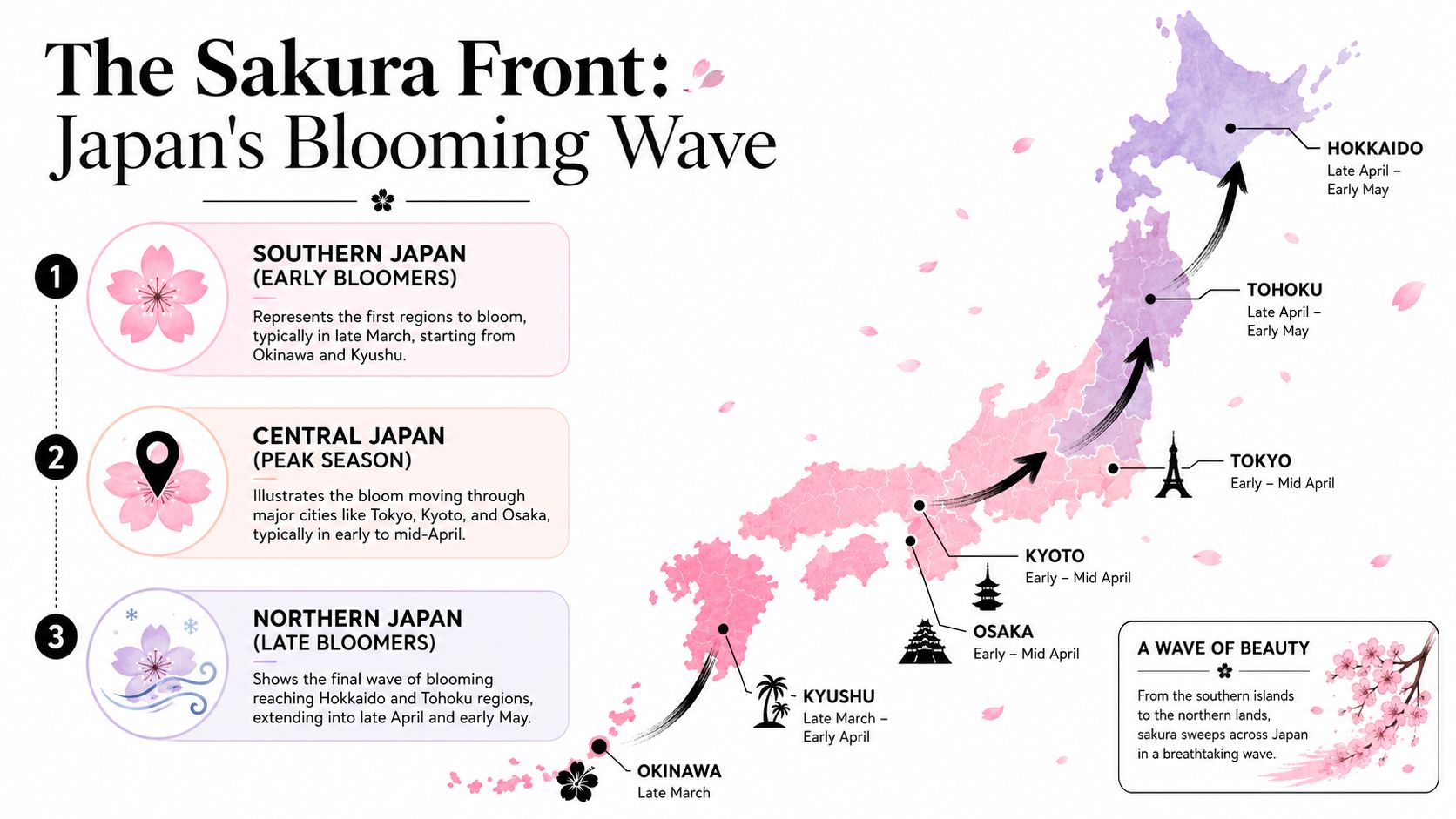
The pattern matters because Japan does not bloom at once. Southern areas open first. Central Japan follows. Northern Japan closes the season later, often giving travelers a second window after the classic Tokyo and Kyoto rush has passed.
For trip design, that changes everything. A late-March arrival can be well judged for Tokyo and still miss the mark elsewhere. A May departure can feel too late for Kyoto but beautifully timed for Hokkaido.
How the bloom travels
The sakura front starts in the warmer south and moves steadily north. Okinawa enters the conversation much earlier than the major cities most international travelers prioritize. Tokyo and much of Kyushu generally come into focus in late March. Kyoto and Osaka often follow in early April. Hokkaido sits on a different clock and becomes relevant much later in spring.
That spread is why broad timing language causes expensive mistakes. “Japan in spring” is not a usable planning window if you care about suite inventory, private guides, and the difference between catching first bloom and arriving after petals have already fallen.
A quick visual helps anchor that movement:
What this means for route design
The sakura front is not just a weather pattern. It is a routing tool.
A focused itinerary works well for travelers who want one city done properly. Tokyo is often the cleanest choice because it combines strong hotel stock, serious dining, and polished logistics. Clients pairing blossom timing with urban sophistication usually do best by studying a refined Tokyo luxury travel guide before adding other stops.
A dual-city itinerary can work, but only if the sequence respects how close, or how far apart, each destination tends to be in seasonal timing. Done well, it feels curated. Done poorly, it becomes a transfer-heavy chase with weak room categories and poor viewing windows.
Northern Japan offers a different advantage. It gives travelers a later season option, which can be useful when central Japan's prime dates are already under pressure. The trade-off is atmosphere. Hokkaido can be beautiful and far more forgiving on timing, but it does not replicate the cultural texture of Kyoto in early spring.
The sakura front answers a practical question, not a poetic one. Which part of Japan should you book for your exact dates if you want the trip to feel precise rather than lucky?
That is the distinction experienced planners make early. The goal is not merely to arrive during blossom season. The goal is to choose the right bloom window for the version of Japan you truly want, then secure the hotels and private access that make it worth the flight.
A Regional Guide to Peak Bloom Timing
You land in Japan for a six-night spring trip and discover the flowers are technically out, but your hotel is wrong for the rhythm of the city, your transfers eat half the daylight, and the best viewing windows are already crowded. That is usually not a date problem. It is a regional planning mistake.
Peak bloom means different things in different places. Tokyo gives you range, access, and strong recovery options if weather shifts. Kyoto gives you atmosphere at a higher operational cost. Sapporo gives you a later season and more breathing room, but a very different emotional register.
The dates that shape your shortlist
Averages are useful for narrowing the map, not for finalizing a high-value itinerary. Tokyo generally peaks in late March, Kyoto tends to follow just after, and Sapporo sits much later in the season, often in early May. Hakone and Kanazawa belong in the conversation too, but I only discuss them by exact date once live forecasts are out and the hotel market is clear.
That distinction matters. Luxury spring planning is less about finding any blossoms and more about choosing the city where your preferred room category, dining access, and pace of travel still work in your favor.
Tokyo
Tokyo is the strongest choice for travelers who want blossom viewing without handing the entire trip over to blossom logistics. The city has depth. If one garden is off-peak, crowded, or washed out by weather, the day can still hold up through another neighborhood, a private guide, a serious lunch, or a well-placed suite with a view.
It is also the easiest market in which to protect standards. Top hotels have more inventory across room types, the restaurant scene is stronger at the top end, and movement across the city is more predictable than many first-time visitors expect. For clients who want sakura as part of a polished urban itinerary, I usually start with Tokyo.
For hotel positioning, neighborhood trade-offs, and property strategy, review this Tokyo luxury travel guide alongside your spring dates.
Kyoto
Kyoto is the prize location for travelers who want spring in Japan to feel cinematic, disciplined, and unmistakably seasonal. It can also be the easiest city to get wrong.
The best version of Kyoto depends on restraint. Leave early. Keep distances short. Build each day around one or two strong viewing periods instead of trying to cover the city. A rushed Kyoto itinerary often produces expensive room nights and very little pleasure.
Hotel choice matters more here than in Tokyo. In Kyoto, the property is not just where you sleep. It is where you reset between early departures, midday congestion, and evening returns. The right ryokan or luxury hotel gives you privacy, service that anticipates spring pressure points, and a location that reduces transfer time when the city is busiest.
Sapporo and the northern alternative
Sapporo serves a different client brief. It works for travelers whose dates miss central Japan, for repeat visitors who have already done Kyoto in spring, or for those who want a later bloom window without competing for the same narrow band of demand.
The trade-off is straightforward. You gain flexibility and often a calmer booking environment. You give up the particular cultural atmosphere that makes Kyoto so coveted in late March and early April.
For the right traveler, that is a smart exchange. A later northern itinerary can feel composed and exclusive, especially when blossoms are one element within a broader trip rather than the sole reason for travel.
Decoding Forecasts From Kaika to Mankai
A client lands in Tokyo on the first day blossoms start to open, only to find the parks still reading as early spring rather than the full sakura scene they had in mind. That mistake usually starts with a simple misunderstanding. Kaika marks the first opening of flowers. Mankai marks full bloom, and that is usually the point most travelers are trying to buy.
The gap matters because it shapes how you place your best room nights, private guiding, and hardest-to-book meals. As noted earlier, the interval between first bloom and full bloom is often about a week, but no experienced planner treats that as a guarantee. Temperature shifts can compress or stretch the window, and a trip built too tightly around one forecast update can become expensive to correct.
Why the forecast language matters
Kaika is a signal. Mankai is the spectacle.
For most luxury travelers, that distinction determines whether arrival feels well-timed or slightly premature. If the brief is iconic sakura views, photographically strong gardens, and the atmosphere people associate with Japan in spring, planning around kaika alone is usually too early. If the brief is quieter walks, softer crowd levels, and a more restrained mood, arriving in the days between those two markers can be the better decision.
I often advise clients to choose the mood first, then use the forecast terms accordingly. That produces better outcomes than chasing the broad idea of "peak season" without defining what peak should look like on the ground.
How to read forecasts without letting them control the trip
Use forecasts to adjust the edges of the plan, not to rebuild the core of it.
1. Choose the city before you choose the exact day. A strong regional decision matters more than reacting to every revision.
2. Treat kaika as an early alert. It tells you movement has started, not that the whole visual experience has arrived.
3. Place your marquee experiences in the middle of the stay. That protects them from flight delays, weather, and departure-day compression.
4. Keep one movable element. A flexible guide day, a reserve morning, or a backup garden can save the trip.
That discipline is what separates a pleasant spring holiday from a properly structured one.
For travelers planning a luxury trip to Japan, forecast literacy also helps with decisions that have nothing to do with flowers at first glance. A kaiseki booking, tea ceremony, or private host visit may be better scheduled just before or just after your prime blossom day, especially if the city's top venues are operating under spring pressure. The same applies to cultural courtesies. If your itinerary includes a private invitation or a visit where a gift is appropriate, it helps to master Japanese gift etiquette before you arrive.
What holds up in real planning
The strongest sakura itineraries create several good viewing opportunities instead of depending on one perfect afternoon.
That matters because high-end travel has fixed points the blossoms do not. Signature suite categories sell out. The best guides commit early. Exclusive dining times rarely move at the last minute. Forecasts should help you fine-tune a well-built trip, not push you into constant revisions.
Calm judgment usually costs less and delivers more. Panic buying almost never does.
Strategic Planning for the Luxury Traveler
Sakura travel is often won long before spring arrives. By the time everyone is asking when do the cherry blossoms bloom in Japan, the most desirable inventory in the strongest locations may already be under pressure.
That's the practical reality of this season. Timing the bloom is only half the job. Securing the trip architecture around it is the part that determines whether your experience feels smooth or compromised.
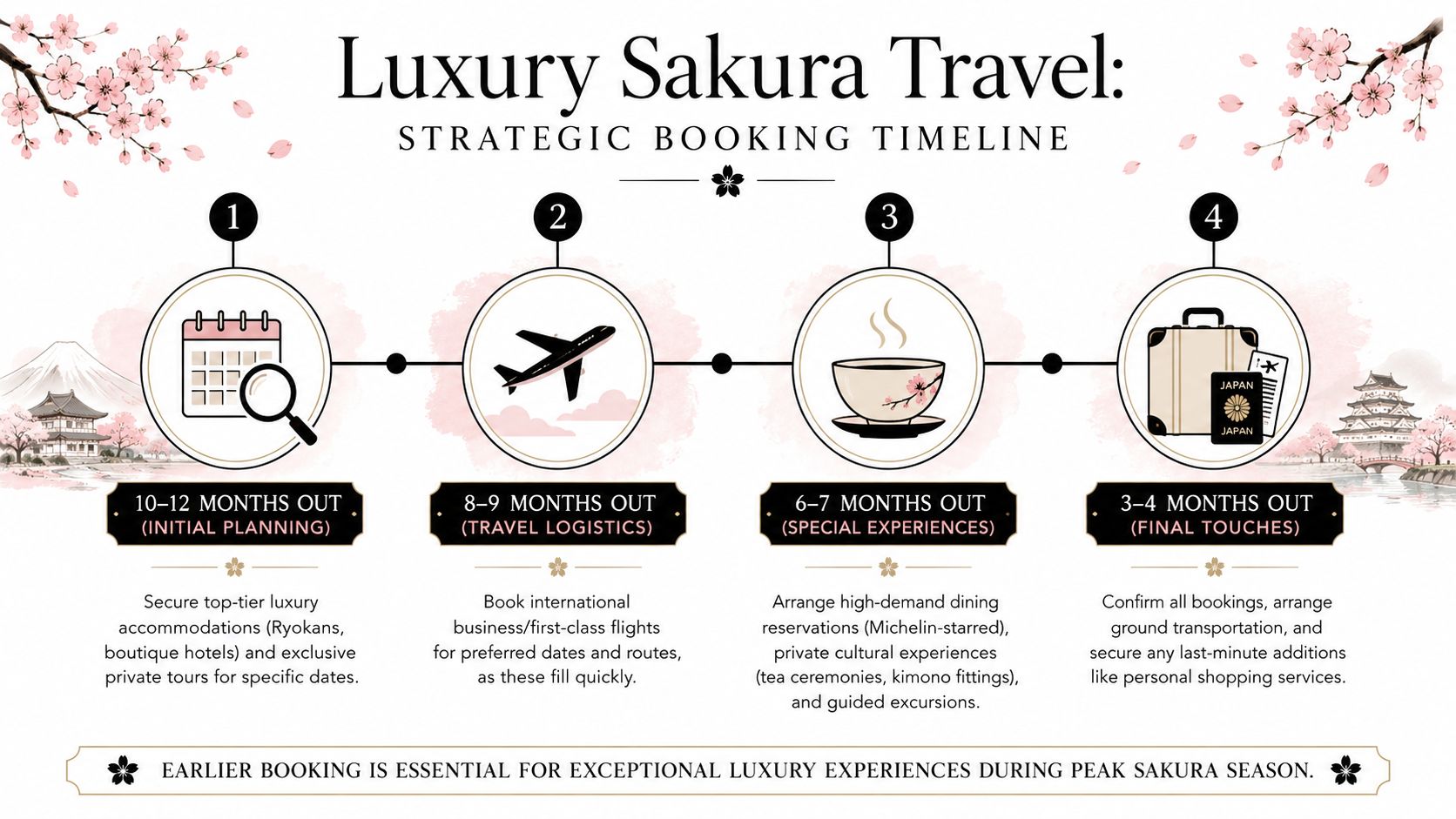
Where luxury travelers lose leverage
They wait for certainty.
That instinct makes sense emotionally, but it usually weakens your options. If you hold off until forecasts feel more concrete, you may find that the exact suite category you wanted is gone, the most elegant ryokan has minimum-stay friction, and the private guide with the right cultural fluency is already committed elsewhere.
The smarter move is to secure position early, then refine the details later.
A booking sequence that protects the trip
The infographic above outlines one practical rhythm. In high-demand spring periods, I'd use it as a planning discipline rather than a suggestion.
- Accommodation first: Prioritize your exact room category in your preferred neighborhood. A good hotel in the wrong location can erode the entire mood of a sakura itinerary.
- Air next: Once your dates and route are credible, secure the flights that support proper arrival timing and manageable transfers.
- Experiences after that: Private guides, special-access cultural appointments, and destination dining should be layered in while there's still choice.
- Final calibration: Use closer-in forecast movements to fine-tune timing, not to rebuild your entire structure.
The experiences worth planning early
The distinction between standard luxury and specialized luxury becomes visible. During blossom season, ordinary demand rises, but exclusive access narrows.
Consider the kinds of experiences that benefit from early design:
- Private cultural access: Temple-adjacent experiences, tea ceremonies, or garden moments that feel intimate rather than staged.
- Aerial perspective: Helicopter transfers or scenic flights that turn the scenery itself into part of the experience.
- Dining with timing: Restaurants where the reservation hour matters almost as much as the reservation itself.
- Gift-aware hosting: If your itinerary includes private meetings, hosts, or family introductions, it's worth taking a few minutes to master Japanese gift etiquette so the gesture lands with polish.
The highest-value spring trips don't try to do everything. They secure a small number of high-impact moments and execute them flawlessly.
What to prioritize if you can't do it all
Not every traveler wants an itinerary packed with access points. If you're editing for elegance, I'd protect these first:
| Priority | Why it matters |
|---|---|
| Signature hotel or ryokan | It shapes recovery, service quality, and how insulated you feel from peak-season intensity |
| Private transport on key days | It removes friction when cities are crowded and timing is sensitive |
| One top guide day | It transforms blossom viewing from wandering to curated discovery |
| One standout evening | A memorable dinner or cultural experience gives the trip its anchor moment |
For broader context on how to structure a premium spring itinerary, this perspective on a luxury trip to Japan is a useful starting point.
At this level, one planning partner can also coordinate the moving parts across hotels, transfers, and experiences. Haute Black, for example, arranges bespoke travel planning and private journey logistics in Japan as one available option among others for travelers who want that support.
Beyond the Bloom Crafting a Bespoke Journey
Cherry blossom timing is the visible part of the trip. The invisible part is what determines whether the experience feels effortless. Airport handling, station transfers, luggage choreography, restaurant timing, and the judgment to know when a quiet detour is worth more than the obvious landmark all sit behind the scenes.
That's why the most well-planned sakura itineraries rarely obsess over blossom dates alone. They use bloom timing as the framework, then build a journey with enough calm, access, and flexibility to absorb the realities of peak season.
The difference between seeing sakura and traveling well
A standard trip asks, “Will we catch the bloom?” A bespoke trip asks better questions.
- Where will the mornings feel most beautiful?
- Which hotel lets us retreat properly after crowded hours?
- What can be booked privately so the day feels composed rather than public?
- How do we build grace into the schedule if conditions shift?
That mindset changes everything. It turns sakura from a race into a curated season.
Why advisory judgment matters
Japan rewards preparation, especially in spring. It also rewards subtlety. There's often more value in one perfectly timed garden visit than in three famous stops fought through at the wrong hour.
For travelers who like to understand how concierge-level planning has evolved more broadly, these MLR Worldwide luxury travel insights offer a helpful outside perspective on what high-touch support can look like when access and logistics matter.
A Japan itinerary built around culture, privacy, and timing also benefits from a strong experiential lens. If your spring trip is meant to go beyond blossom viewing into ceremonies, craftsmanship, and local context, this Japan cultural immersion experience shows the kind of layered travel design worth aiming for.
The bloom gives the journey its season. Thoughtful planning gives it its standard.
The right answer to when the cherry blossoms bloom in Japan is useful. The right answer to how you want to experience them is what shapes the trip you'll remember.
If you're planning Japan for sakura season and want help aligning the timing, hotels, access, and on-the-ground details, Haute Black can help design a customized itinerary that fits how you travel.
Explore Our Guides
Signature Experiences