Haute Black Journal
Water Garden Sigiriya Guide for Luxury Sri Lanka Escapes

Marlene Azeez
Director, HauteBlack
View all articles →

You're refining a Sri Lanka itinerary, and Sigiriya already has a place on it. The question is whether to treat the gardens as a passing view on the way to the rock or give them attention of their own. If you care about architecture, atmosphere, and understanding what you're looking at, that choice changes the visit.
The most rewarding approach is to follow the water. Not just the visible pools, but the decisions behind them: where water entered, how it traveled, and why royal planners placed particular features together. That perspective also offers a useful principle for luxury travel: arrange the day around the experience you want, rather than the number of stops you can fit into it.
Discovering the Water Garden Sigiriya
With Sigiriya's vertical drama before you, it's natural to keep looking upward. Then your attention drops. A pool edge establishes a horizontal line, a terrace changes the level underfoot, and the relationship between water and stone becomes more compelling than another photograph of the rock.
Approach the Water Garden Sigiriya as a place to observe, not cross. Notice how your eye moves between the near detail and the distant silhouette. Pause where the arrangement feels balanced, then ask what produces that balance.
Begin with the ground beneath the spectacle
The garden view offers a useful starting point for recognizing the relationship between the water features and their monumental setting.
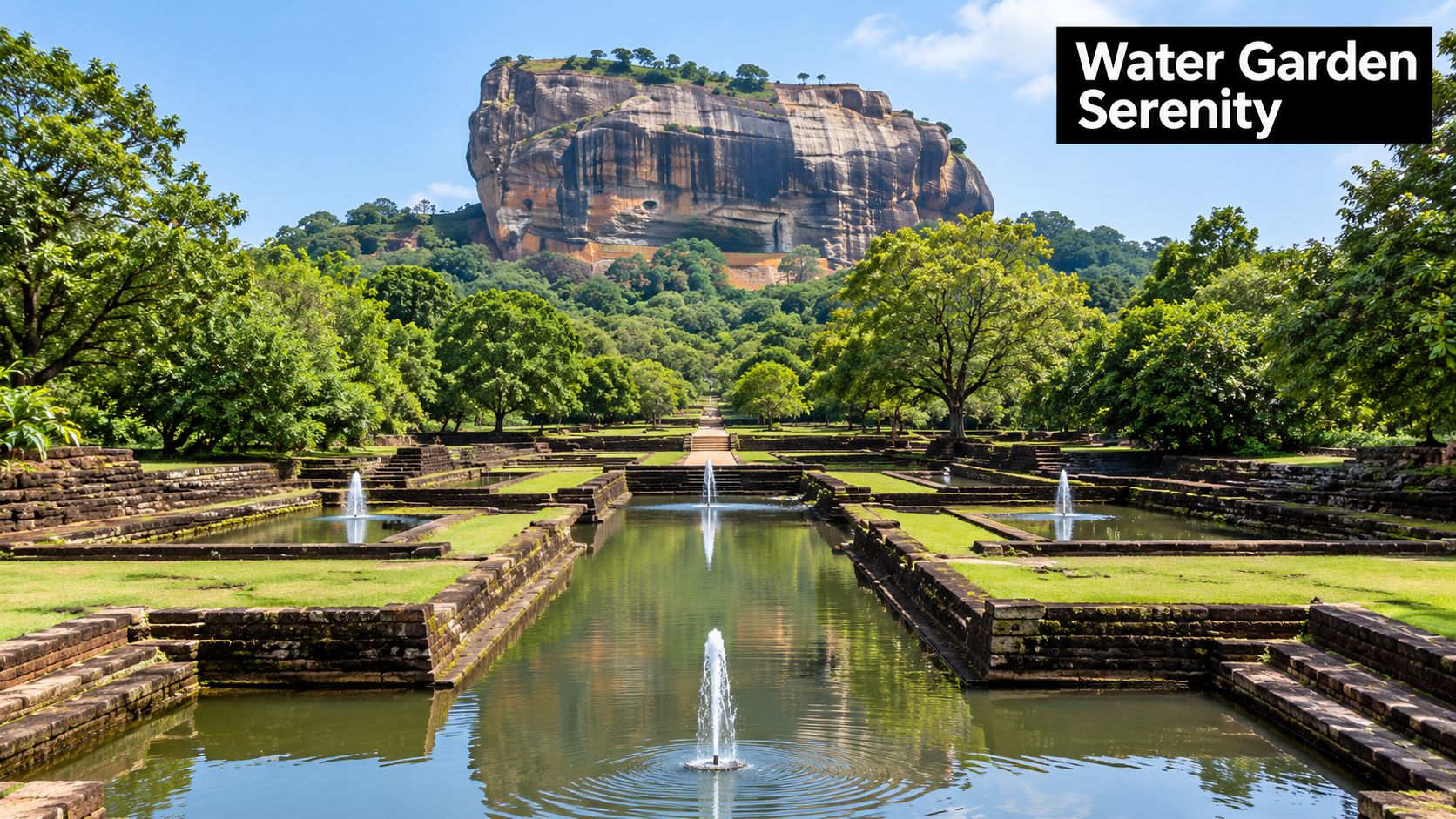
A helpful distinction is between seeing a garden and reading a terrain. Seeing might mean noticing an attractive basin. Reading means considering its level, its connection to neighboring features, and the view available from its edge.
The most revealing question isn't simply what a pool looked like. It's why the designers needed it there.
You don't need specialist vocabulary to enjoy this approach. Start with ordinary observations: straight or curved, open or enclosed, raised or low. Those contrasts give you something concrete to discuss with a guide.
Leave room for uncertainty, too. A surviving structure can reveal its physical arrangement more readily than every activity that once surrounded it. Precise interpretation should deepen the atmosphere without filling the gaps with invented royal scenes.
The reward is a more attentive encounter. Instead of collecting isolated views, you begin to recognize choices made by people who understood how visitors move, pause, and look.
Understanding Sigiriya's Royal Water Setting
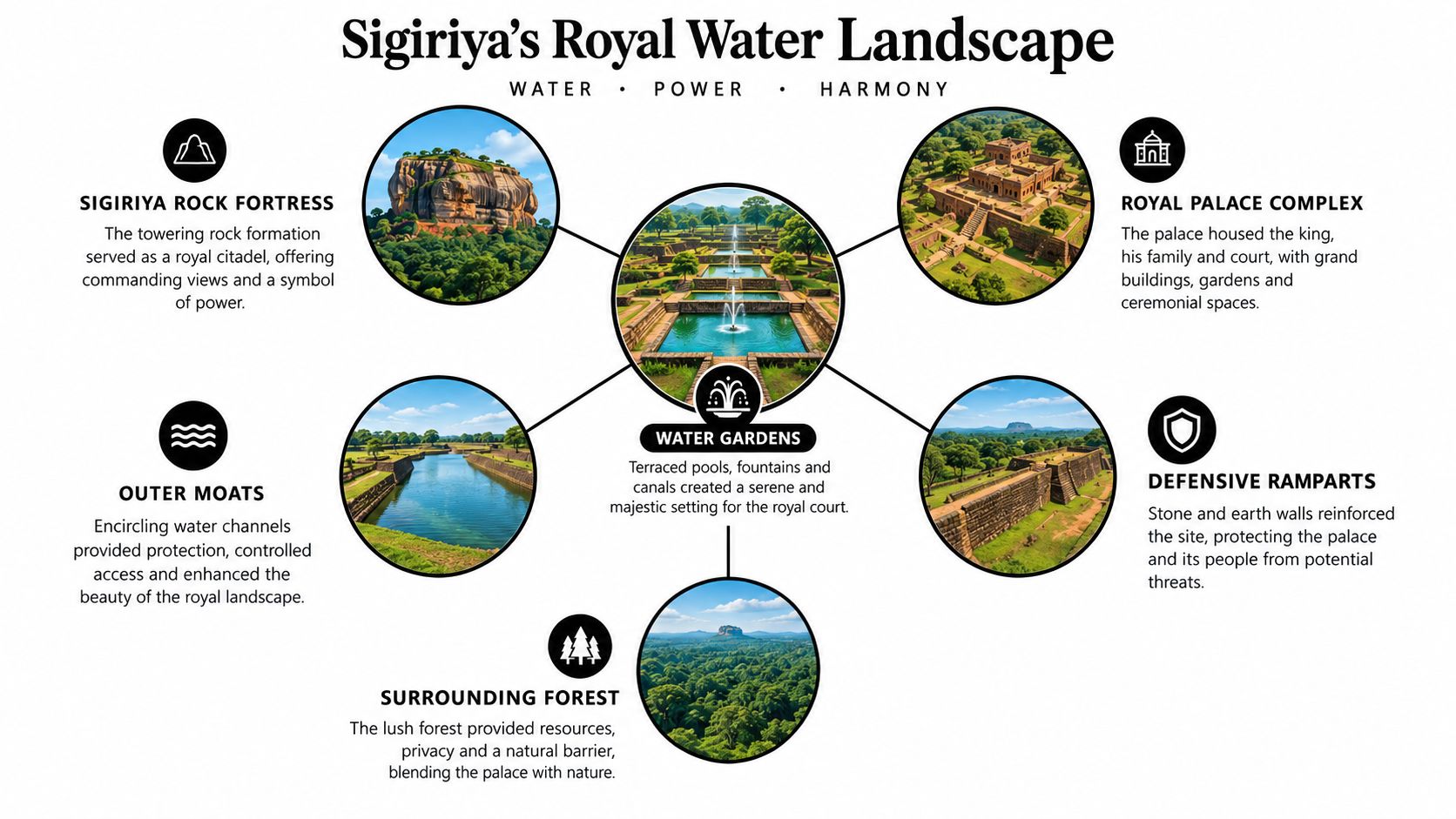
The gardens were designed as part of a royal setting rather than an isolated ornamental enclosure. Their pools, terraces, channels, fountains, moats, and underground conduits formed a deliberately planned environment combining garden design, urban planning, and hydraulic engineering.
Created during the reign of King Kashyapa I, conventionally dated to 477–495 CE, that setting supported royal ceremonial and recreational life. UNESCO recognized Sigiriya in 1982, acknowledging its architectural, historical, artistic, town-planning, hydraulic, and cultural-setting significance, as described in Archaeology.lk's introduction to Sigiriya.
A stage built for royal encounters
The gardens functioned as a stage for royal encounters: architecture established the setting, while changes in level and arranged water features shaped the experience. Coordination mattered more than decoration.
The concept map places the gardens within that broader royal setting.
A useful comparison is a pond added to an existing park versus a garden planned around water from the outset. In the first case, water is an attractive extra. In the second, its presence determines how spaces are arranged and how they relate to one another. Sigiriya belongs firmly to the second category.
Interpretive lens: Treat the visible remains as connected decisions rather than separate monuments.
Separate evidence from interpretation
Symmetry might communicate order, and a reflective surface might heighten an architectural view. Those are reasonable interpretations of design, and they differ from proof of a particular ceremony, belief, or royal routine.
That distinction matters when discussing symbolism. A good guide should separate an observable feature from an inference about its meaning, so ask what survives, what archaeologists can establish, and what remains uncertain.
For a traveler who appreciates thoughtful design, this is Sigiriya's deeper appeal. The planners brought practical infrastructure into a royal environment and made that infrastructure part of the experience itself. Slowing down enough to notice that choice is what turns a sightseeing stop into a considered visit.
How Ancient Water Moved Through Sigiriya
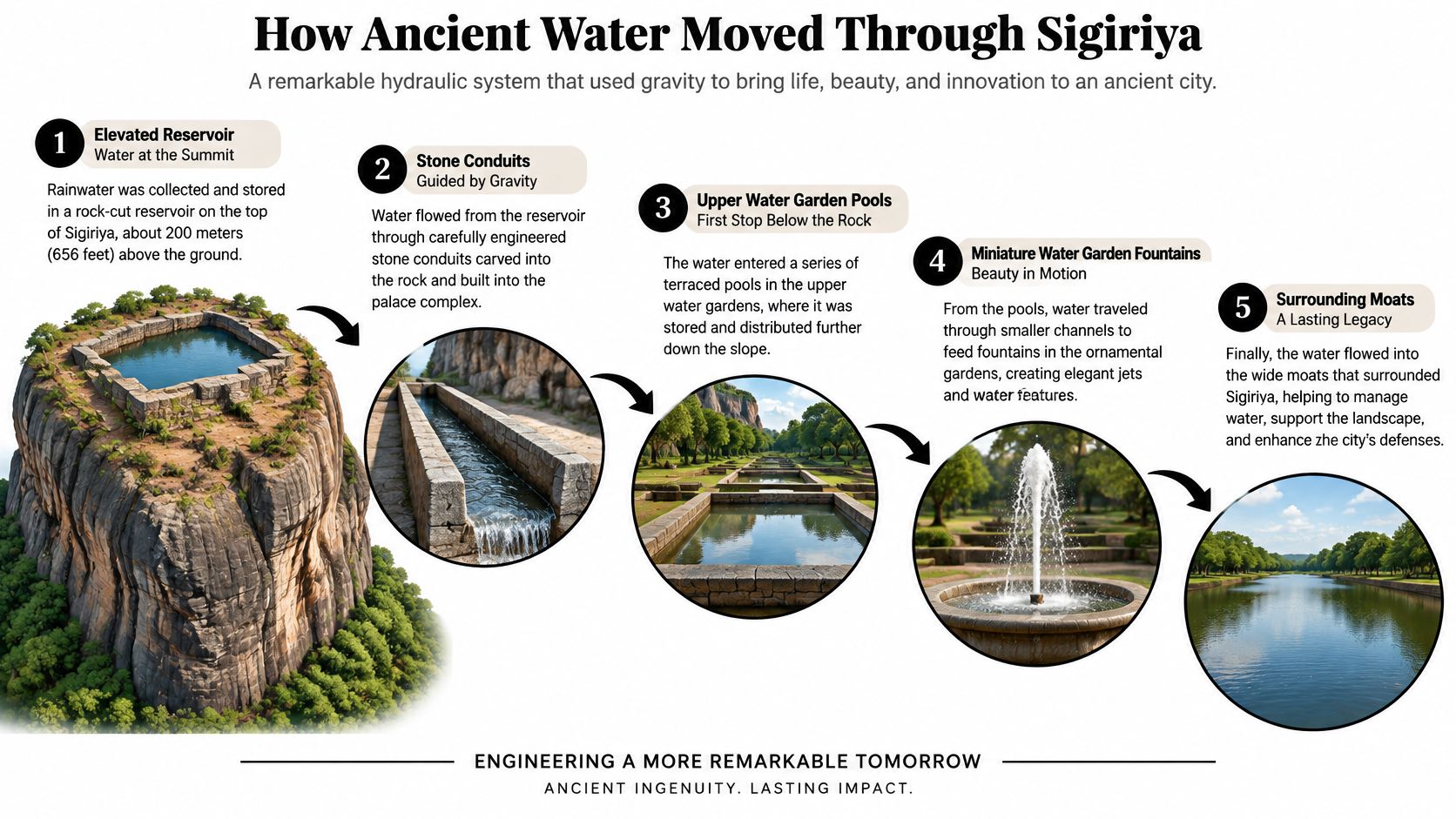
The fountains only make sense once you trace where the water came from. Sigiriya's hydraulic network drew supply from a higher-elevation tank through underground terracotta conduits, driven by gravity and pressure rather than mechanical pumps. Linked reservoirs, drains, bypasses, and loop connections distributed that water and reduced overflow risk, according to BBC Travel's explanation of Sigiriya's ancient water gardens.
One distinction deserves care. The raised tank supplying the gardens and the rainfall-collecting summit cisterns served complementary purposes, and treating them as a single source produces a muddled picture of the whole system. The process illustration offers a simplified view of downward movement through the connected network.
Why water can rise without a pump
A filled pipe connecting a raised container to a lower outlet behaves predictably. Water moves toward the lower point, and the height difference generates pressure within the enclosed route, enough to push water upward when it reaches an opening.
Engineers call that available elevation difference hydraulic head. A fountain's upward jet therefore doesn't mean the system was moving water uphill. The designers converted an overall drop in level into localized upward movement.
The video provides another visual reference for the site's water engineering.
More than a route from source to outlet
A working network has to receive, store, convey, and release water. At Sigiriya, summit cisterns captured rainfall as a supplementary resource, while drainage and connected channels managed distribution. The visible feature was one endpoint of a larger arrangement.
- Source elevation: Stored water needed an appropriate height relative to the features it supplied.
- Conduit continuity: Underground connections had to carry water along the intended route.
- Clear inlets: Obstructions could interfere with supply even when a visible basin remained intact.
- Available storage: Fountain performance depended on water being present, not merely on surviving masonry.
Conserving a fountain therefore means more than repairing its surface. The concealed connections and the water supply itself matter just as much, which is why a modest opening or shallow channel deserves a second look. What you're seeing is the visible trace of decisions made elsewhere in the grounds.
Recognizing the Garden's Key Features
Begin with relationships rather than names. Look across a pool toward its opposite edge, then compare its level with the adjacent terrace. Trace any visible channel as far as the permitted route allows, and resist assuming that every connection will be exposed.
A dry feature can still be informative. Its shape, position, and relationship to neighboring elements can help you understand the plan even when there's no visible water movement. You're observing physical evidence, not judging whether the site has delivered a fountain show.
Key elements of the Water Garden Sigiriya
| Garden element | Primary role | What to look for |
|---|---|---|
| Symmetrical pools | Organize water within a balanced layout | Corresponding edges, alignments, and relationships across the garden |
| Terraces | Structure changes in level | How a raised or lowered position changes your view |
| Channels | Convey water between features | Direction, gradient, and apparent connections |
| Fountains | Express pressure through visible water movement | The relationship between the outlet and its supplying system |
| Moats | Form part of the wider water network | How the garden connects conceptually with its surrounding landscape |
| Rock-cut drains | Collect and direct water | Their practical purpose rather than an assumed decorative role |
Use this as an observation guide, not a promise that every element will be equally legible from every path. Some connections are underground, and a feature's function may require explanation rather than immediate recognition.
Avoid importing meanings from elsewhere
Water invites symbolic interpretation, especially when it appears in a historic Asian setting. For comparative reading, HD Asian Art's discussion of water feature Buddha garden symbolism offers a separate perspective, but it shouldn't be treated as evidence for the intentions of Sigiriya's royal designers.
Keep your questions specific. Ask whether a feature belonged to the broader complex or to the miniature garden, and whether its proposed function follows from its construction or from interpretation.
A good guide should welcome that distinction. It creates a richer conversation than attaching a symbolic meaning to every pool, and it helps you appreciate the engineering without reducing the garden to a technical diagram.
Walking Through the Miniature Water Garden
The word miniature can set the wrong expectation. This garden measures approximately 30 meters by 90 meters, covering about 2,700 square meters, or 0.27 hectares, and is divided into five sections incorporating pools, channels, streams, and other water elements, as documented in the Sigiriya overview and garden description.
Its snake-shaped stream is particularly revealing: a curved course required deliberate structural planning and careful control of gradient and flow. The significance lies not just in its outline, but in making water behave within that outline.
Follow a sequence rather than a checklist
Use the diagram as a conceptual aid to the garden's organization, rather than a substitute for identifying surviving features with your guide.
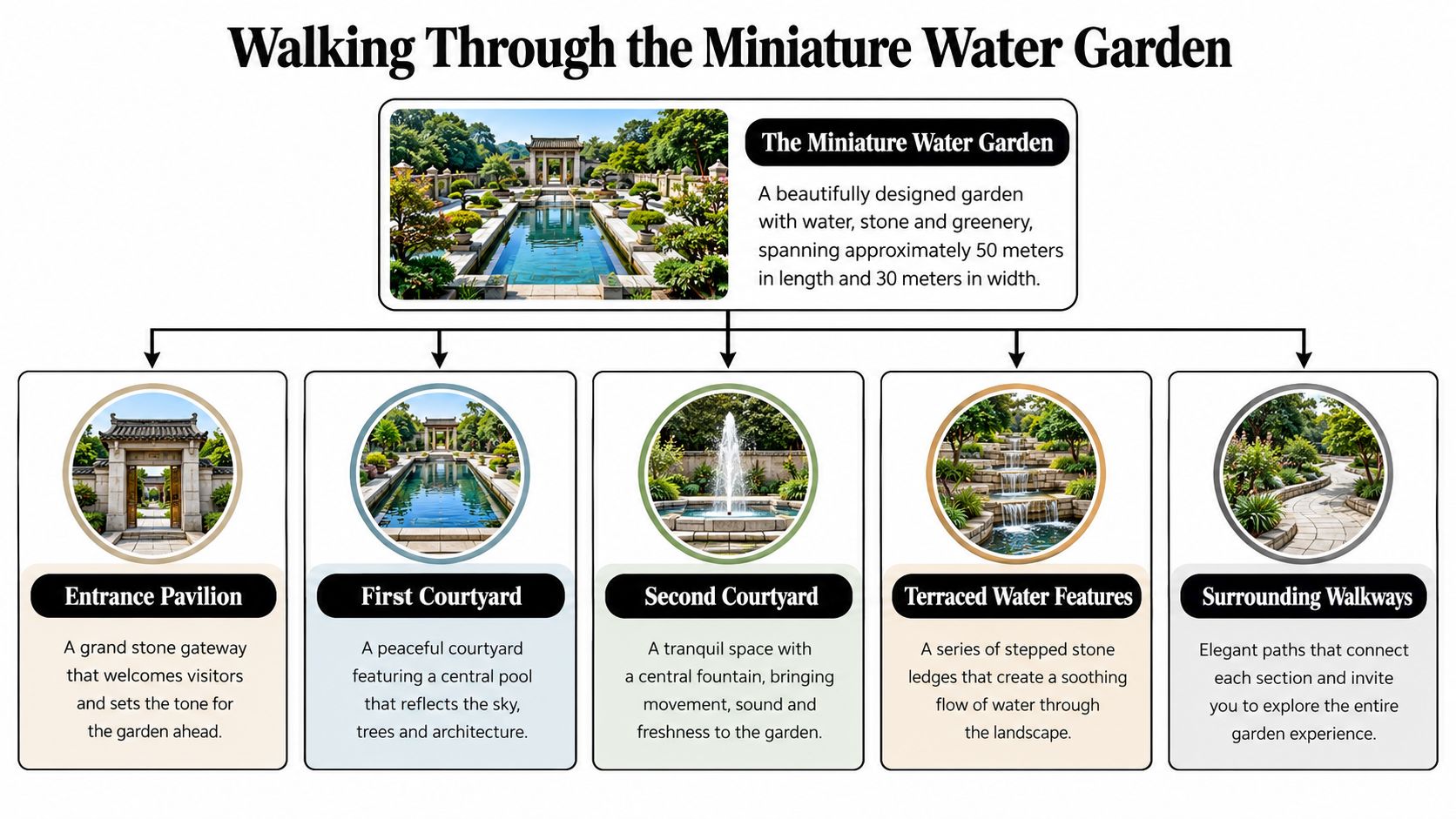
For a useful observational walk, begin by choosing a visible channel. Follow its line with your eyes, then move to a permitted position where you can compare it with a pool. Notice how differently you read a narrow route for water and a broader surface intended to contain it.
At a terrace, pause before moving on. A small change in your own elevation can make an edge or connection easier to understand. Looking back is often as useful as looking ahead because it changes which lines overlap.
Follow the course before photographing the feature. The relationship may be more memorable than the close-up.
Read the curve carefully
A straight channel makes direction easy to recognize. A winding stream asks you to look more closely at its changing course and its relationship to the surrounding space.
Avoid assuming that curved means natural or casual. Here, the documented planning behind the snake-shaped stream makes it a particularly useful example of designed movement.
The miniature garden rewards this close attention because its interest isn't confined to a single centerpiece. Its scale and organization encourage you to compare adjoining spaces, while its water features demonstrate that the designers planned circulation across a site, not merely the storage of water inside separate containers.
Planning a Thoughtful Garden Visit
Protect observation time before adding more stops. Tell your advisor that you want to understand the gardens, not pass through them. Ask for a plan that allows you to pause, ask questions, and photograph details without feeling that you're delaying the rest of the day.
Seasonal water behavior should shape expectations, not become a guarantee. Some fountains can operate during the rainy season, roughly 1,500 years after construction, as documented in the historical account cited earlier. Treat visible flow as a possible bonus rather than the condition for a worthwhile visit.
Prepare for comfort and attention
Plan conservatively for heat, walking, wet weather, and uneven surfaces. These are practical preparation considerations, not reasons to avoid the experience. Suitable footwear and a manageable bag help you keep your attention on the site.
- Hydration: Bring drinking water and make pauses part of the plan.
- Weather awareness: Check the forecast close to your visit and discuss a flexible approach.
- Comfortable footwear: Choose secure shoes with dependable grip rather than footwear selected only for photographs.
- Reliable interpretation: Arrange a guide who can distinguish archaeological evidence from reconstruction.
- Observation and photography: Leave space for both, instead of expecting every stop to serve both purposes simultaneously.
For broader destination reading, maxijournal.com travel guides can sit alongside your planning materials. Confirm access arrangements, entry requirements, and current visitor conditions with the relevant operator before traveling rather than relying on an older itinerary.
Brief the guide before arrival
A useful brief might ask for clear explanations of the water network, time to inspect small details, and flexibility if someone needs a rest. The considerations in this private guided tours planning guide can help you decide what to request.
Don't equate private guiding with unrestricted access. Ask explicitly what can be arranged, which routes are permitted, and whether any proposed privilege is confirmed. Thoughtful planning makes the ordinary visit more rewarding without implying exceptions to site rules.
Building a Luxury Sigiriya Itinerary
The strongest reason to build a journey around Sigiriya is depth, not prestige. Give the garden a clear role in the trip, then select transport, guiding, and accommodation arrangements that support that role. A complicated day with polished vehicles can still be a poorly paced day.
Consider the wider route through this luxury Sri Lanka journey guide, but choose additions selectively. A destination's appeal doesn't automatically make it a sensible companion to every cultural visit.
For couples who prefer architecture and leisure
An architecture-focused couple might request a private guide briefed on garden design, an unhurried garden exploration, and a separate period of leisure afterward. That separation matters: relaxation shouldn't depend on racing through the cultural experience first.
Keep romantic expectations grounded in what can be arranged. Privacy in transport and a personalized pace are planning choices; an empty archaeological site or exclusive entry shouldn't be assumed.
A useful request is simple: preserve room to stay longer if the garden captures your attention. Let the rest of the day remain light enough to accommodate that interest.
For families and executive travelers
Families may benefit from concise explanations tied to visible examples. Rather than deliver a long historical introduction, a guide could begin with a question about how water might rise from an outlet without a pump.
Executive travelers may want a focused interpretive brief and dependable coordination around onward commitments. Both groups benefit from an agreed priority: understand the essential features first, then extend the visit only if energy and interest allow.
| Planning choice | What to specify |
|---|---|
| Private driver | Collection arrangements, communication, and flexibility around departure |
| Specialist guide | Subject knowledge, explanation style, and the group's interests |
| Transfer timing | Realistic connections and room for changes |
| VIP arrangements | Precisely what is confirmed, conditional, or unavailable |
Luxury here means reducing avoidable friction. The purpose of careful coordination is to protect your attention, not to surround a historic site with unnecessary ceremony.
Choosing Your Sigiriya Experience
Choose the visit according to your curiosity, your companions, and the place it occupies in the wider journey. There isn't a universally superior level of service. There's a better match between what you want to understand and the support you need.
A general visit suits travelers who want the broad context and an opportunity to appreciate the setting. A focused architectural exploration suits those who enjoy examining relationships between structures. A fully curated journey is most useful when transport, differing energy levels, and onward arrangements need close coordination.
Decide what deserves protection
Ask yourself what you'd regret missing. It might be an informed explanation of the engineering, time to study the miniature garden, or the freedom to stop without watching the clock.
If rest is equally important, consider a contrasting setting elsewhere in the itinerary rather than compressing everything into the same day. This Ceylon Tea Trails planning guide offers another destination perspective to assess with your advisor, not an automatic addition.
Decision rule: Request services that preserve the experience you value, rather than benefits you're unlikely to use.
The defining choice is to regard Sigiriya's gardens as an engineered cultural experience rather than a scenic background. Once you make that choice, the planning becomes clearer: identify your interests, establish a comfortable pace, and ask for arrangements that let you remain attentive to the place.
HauteBlack offers bespoke travel planning and a private membership world for travelers seeking dedicated advice, coordinated transfers, and carefully curated experiences. Visit HauteBlack to request a Sri Lanka journey centered on Sigiriya's water gardens, discuss membership, and have an advisor clarify guiding options and available VIP arrangements.
Explore Our Guides


Signature Experiences


