Haute Black Journal
Private Guided Tours: The UHNW Insider Guide

Marlene Azeez
Director, HauteBlack
View all articles →
Most affluent travelers don't spend their experience budget on a suite upgrade. In one U.S. traveler survey, 54% said they were most likely to splurge on an experience such as a private tour, while just over half reserved tours two to twelve months before departure. ToursByLocals' 2025 travel trends point to a clear conclusion: the valuable part of a luxury tour isn't the vehicle or the printed itinerary. It's the access secured before you arrive.
That distinction matters in 2026. Private guided tours have become a meaningful premium-travel category, with one market estimate valuing the segment at $11.4 billion in 2025 and projecting $19.2 billion by 2034. MarketIntelo's private tour market analysis also identifies cultural touring as 28.5% of the market, while Asia Pacific holds 35.2% of revenue share. The traveler who treats a private tour as a scarce-capacity access product will make better decisions than the traveler who compares brochures by sightseeing stops.
What a Private Guided Tour Means in 2026
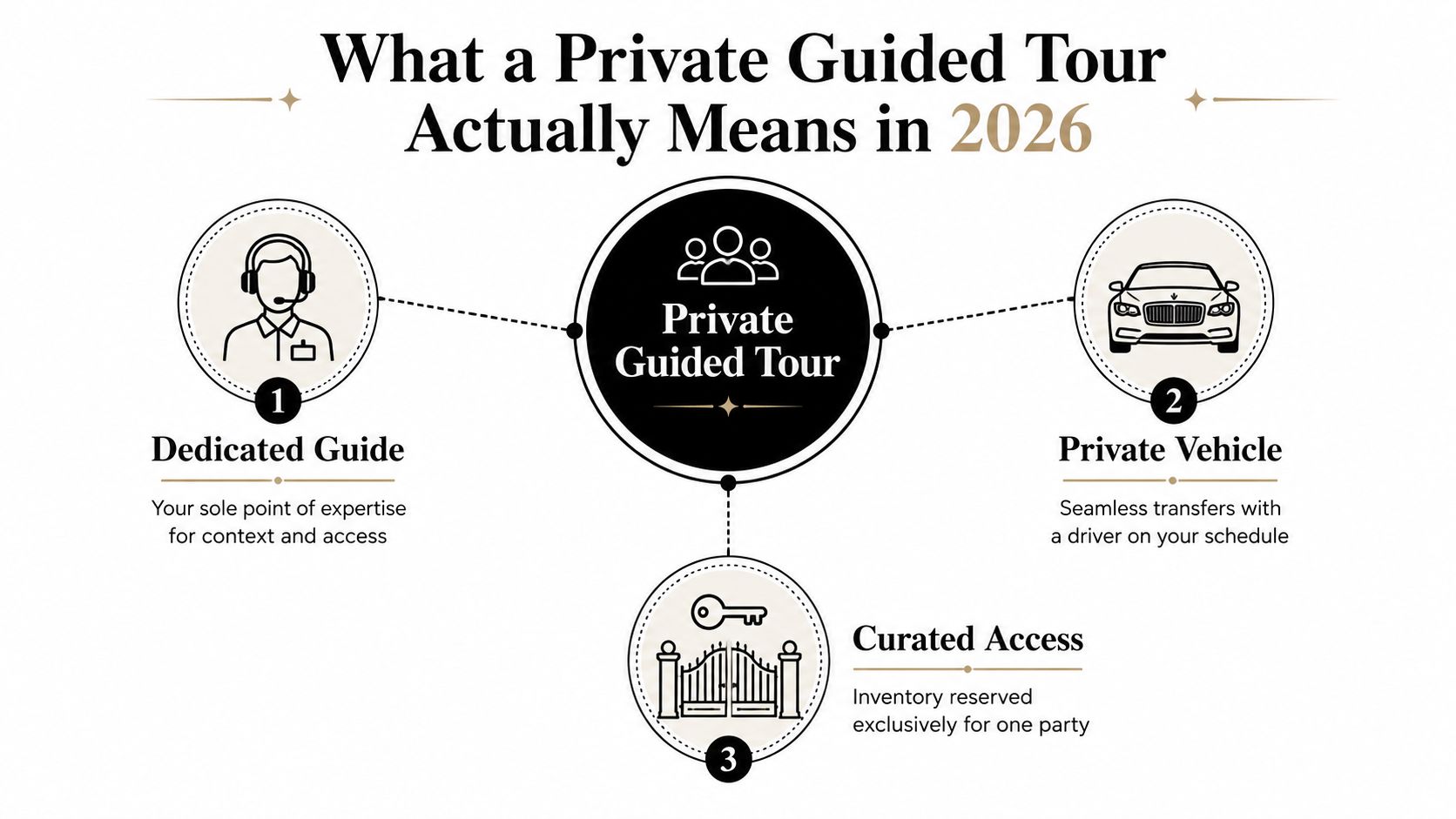
A private guided tour is an access product, not a longer sightseeing booking. For a UHNW traveler, the deliverable should combine a dedicated guide, private vehicle, and curated access inventory reserved for one party. The guide shapes interpretation and pace, the vehicle removes transfer friction, and the access plan determines whether you enter a destination intimately or follow the same queue as everyone else.
Capacity is limited. Strong guides accept only a small number of private assignments because preparation, local relationships, and personal availability set a hard ceiling on their work. After-hours museum access may require curator approval. Villa-style properties can demand months of advance planning during popular periods. Paying at the last minute does not remove those constraints.
Start with access, not sightseeing
A licensed guide can explain a site competently. A Virtuoso-vetted private guide, selected through an experienced advisor, may also help secure a room, chef, cellar, atelier, or reservation that public booking platforms do not display. Both may appear online as “private tours,” but they are different products.
Ask these questions before approving an itinerary:
1. Who is the guide? Request a biography, language ability, licensing where applicable, and evidence of relevant subject expertise.
2. What access is confirmed? Distinguish reserved access from a guide's promise to submit a request.
3. Who controls the vehicle and timing? A private guide without suitable transport can leave you handling the logistics you meant to avoid.
4. What happens if plans change? The operator should identify who can reroute, rebook, and absorb the operational burden.
Lead time matters because an advisor can approach limited-capacity suppliers before public inventory disappears. A Virtuoso-affiliated advisor also brings relationship knowledge that a self-booking platform cannot reliably show: which guide suits your interests, which venue will respond, and which arrangements are confirmed.
Pricing reflects that structure. You pay for credentials, access rights, transport, reservations, contingency planning, and orchestration, not only hours of narration. Compare the structure with specialized experiences such as private dining at Clos Pegase, where setting, coordination, and exclusivity carry much of the value.
Advisor's rule: If the quote only states how long the guide will be present, it has not explained what you are buying.
Private Guided Tours vs Group Tours and Self Booking
The alternatives look cheaper or simpler because they separate the visible purchase from the hidden work. A group tour sells a seat. Independent travel leaves access to the hotel concierge. A marketplace guide sells a time slot. A properly designed private guided tour assigns one accountable party to the entire experience.
| Dimension | Private Guided Tour (Advisor) | Group Tour | FIT + Concierge | Self-Booked Private Guide |
|---|---|---|---|---|
| Privacy | Exclusive to your party, subject to venue rules | Shared with strangers | Private travel, but public access may remain | Usually private during the guide's hours |
| Pacing control | High, with pre-planned and in-destination adjustments | Low | Moderate, dependent on concierge and venue availability | Depends on the individual guide |
| Access depth | Can be built around reserved and relationship-led access | Usually standardized | Variable, often limited by public inventory | Variable and difficult to verify |
| Guide vetting | Advisor can review credentials and suitability | Supplier-led | Concierge-led, with inconsistent visibility | Marketplace profile and reviews may be the main evidence |
| Accountability | One advisor coordinates suppliers and recovery | Tour operator handles the group product | Traveler may coordinate multiple vendors | Guide may be responsible only for the guide service |
| All-in cost | Higher, but includes orchestration and access planning | Lower headline price | Variable, with separate arrangements | Variable, with logistics often extra |
Where each alternative breaks
Group tours fail first on discretion. Fixed departure times, shared conversation, and a preset route make them unsuitable for travelers who want to linger in a private collection, leave a crowded market, or change the day around a family member's energy.
FIT with a hotel concierge can work well for straightforward sightseeing. It becomes less effective when the traveler wants access that requires advance relationships, multiple suppliers, or a fast response outside the hotel's immediate network.
Self-booked private guides offer convenience, but the traveler should examine what happens when a vehicle is late, a museum cancels, or weather closes the planned route. A profile and reviews don't necessarily establish who owns the wider itinerary.
An advisor can also attach preferred-partner benefits, such as room upgrades when available, late checkout, welcome amenities, or property credits. Those benefits may sit outside the guide fee, but they change the value of the total journey. For operators and travel businesses managing the administrative side, resources such as manage city tour payments can clarify payment workflows, though they don't replace the judgment required to select the right guide.
Private guided tours win where privacy, access, pacing, and single-point accountability intersect. If you only need a competent explanation of a famous landmark, book directly. If the trip carries professional, family, or security consequences, use an accountable advisor.
How Tailoring and Personalization Really Work
Personalization begins by identifying scarce inventory, reserving the right people and places, then arranging them around the traveler's energy, privacy, dietary needs, and cultural interests. A private guided tour becomes distinctive when the advisor secures the right access before building the day around it.
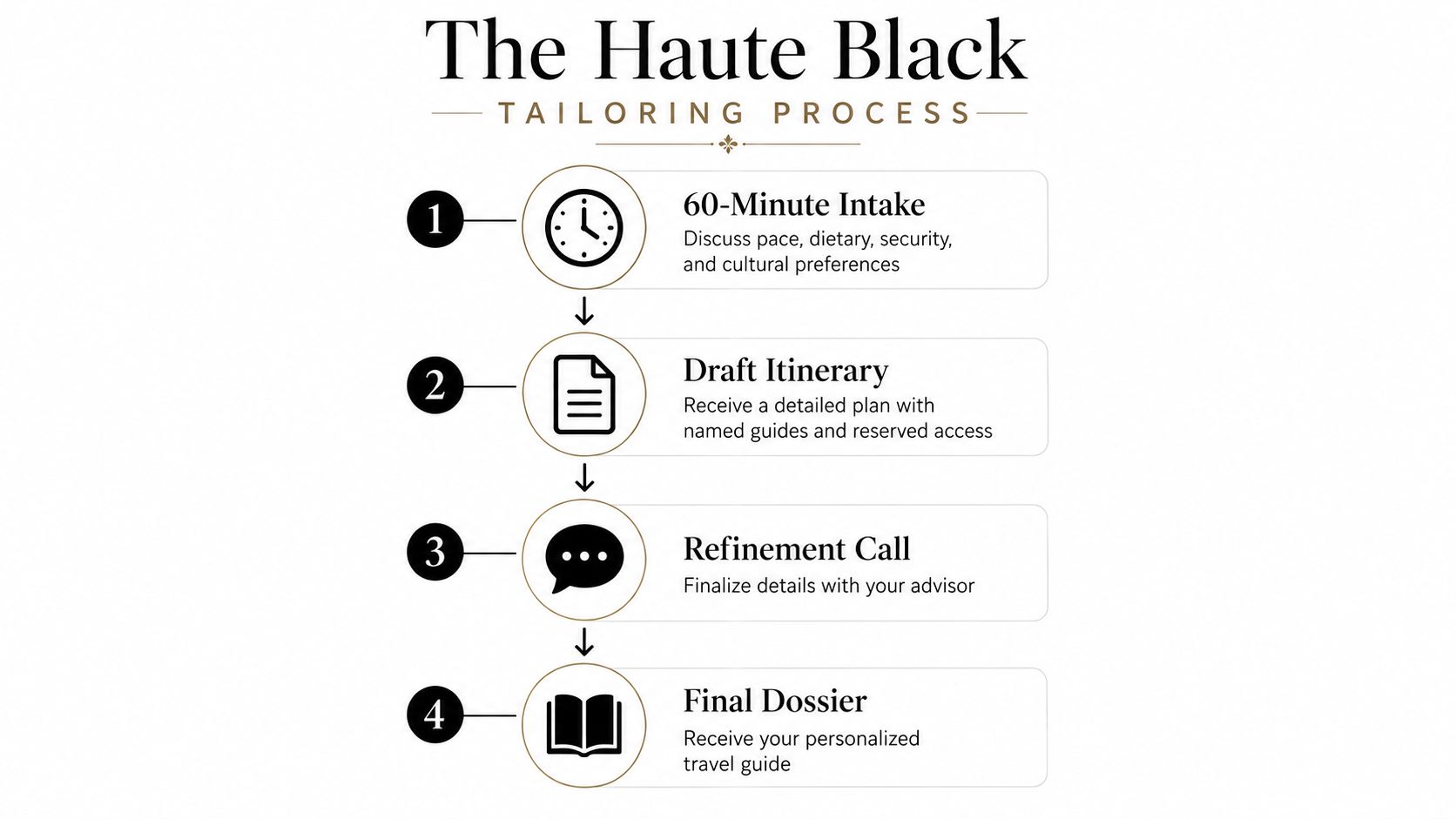
HauteBlack's advisory process should start with a 60-minute intake covering pace, dietary requirements, security considerations, cultural preferences, mobility, sleep patterns, and previous travel disappointments. “Luxury” means different things to different clients. One traveler wants long lunches and no early starts. Another prefers a tightly edited sequence of private collections and chef-led visits. These details determine which guides are suitable, how far ahead reservations must be made, and where an advisor's relationships can outperform a self-booking platform.
The tailoring sequence
1. Intake: Establish what the traveler values, avoids, and expects from the day's structure.
2. Draft itinerary: Present named guides, proposed reservations, access conditions, transport, and realistic travel times.
3. Refinement: Replace a generic museum visit with cellars, an atelier, a private collection, or a slower neighborhood walk when that better fits the client.
4. In-destination pivot protocol: Give the guide clear authority to reroute when weather, energy, crowds, or a newly available opportunity changes the day.
A strong draft makes uncertain elements visible. “Private Uffizi after-hours opening” differs materially from “Uffizi visit with a guide.” A sommelier-led vertical, closed-shop atelier visit, or private chef encounter should be marked as confirmed, requested, or subject to approval.
Preferred-partner relationships may add hotel upgrades, welcome amenities, resort credits, and exclusive experiences when available. The advisor should sequence those benefits with the touring program, rather than present them as decorative extras. A late checkout can prevent a rushed departure after a demanding final touring day.
For further guidance, read HauteBlack's tailor-made luxury travel guide. Match the scarce element first, then build the itinerary around it.
VIP Logistics That Turn a Tour Into a Journey
A private guided tour earns its VIP character through logistics secured before the guest arrives. The guide should act as conductor, focusing on interpretation and guest care while transport, reservations, and contingency planning are handled separately. That division protects the quality of the guiding and prevents a specialist from becoming a dispatcher.
The scarce elements come first. Villas, estates, restricted cultural access, reservation-only dining, and preferred vehicles may have limited capacity, so confirm them before building the day around less distinctive stops. The tailor-made luxury travel guide offers the right planning principle: secure the defining experience, then arrange the itinerary around it.
Private aviation sets the geographic rhythm. Haute Jets can align aircraft selection with the route, using light jets for shorter European hops and ultra-long-range aircraft for longer connections such as Asia or the Seychelles. Aviation earns its place when it protects usable time and keeps a multi-destination program coherent.
Transfers need the same level of specification. A Maybach-class vehicle may suit a discreet urban itinerary, while an armored vehicle may fit a security brief. Before the first pickup, the guide should have the arrival details, luggage plan, vehicle standard, passenger preferences, and a named contact for operational issues.
| Logistics Layer | Typical Lead Time | Interface With Private Guide |
|---|---|---|
| Private aviation | Route and aircraft dependent | Supplies arrival windows and contingency timing |
| Chauffeured transfers | Confirm before final itinerary lock | Keeps guide focused on interpretation and guest care |
| Villas and estates | Peak weeks often require 9 to 12 months of planning | Briefs the guide on staff, security, access, and guest routines |
| Reservation-only dining | Secure as soon as the route is approved | Places meals at sensible points around touring intensity |
| Restricted cultural access | Approval dependent | Ensures the guide knows entry rules and guest expectations |
Sequence the fragile pieces first
A villa must match privacy, security, staffing, geography, and the guide's ability to reach the guest efficiently. A beautiful property in the wrong location can consume touring time and weaken the entire program.
Dining is part of the itinerary. A chef's table, reservation-only cellar, or after-hours cultural meal should follow a sensible touring rhythm, with timing, dress expectations, dietary requirements, and cancellation exposure clearly briefed.
Regional transfers deserve equal scrutiny. Travelers combining Zimbabwe, Zambia, and Botswana should review safari transfer options in the Victoria Falls region before finalizing the route. For airport planning, HauteBlack's premium airport transfer guide explains how to treat the first and last miles as part of the experience.
What Private Guided Tours Cost
A bespoke program reveals why each stop appears, who controls it, and how the day can change without damaging the journey. The quote reflects that access model, including guide pedigree, guide-to-guest ratio, access rights, vehicle standard, accommodation, aviation, and contingency capacity held behind the scenes.
A top-tier private guide may command roughly $1,200 to $3,500 per day before logistics. A fully built 7 to 14-day program can land between $35,000 and $250,000 per couple once villas, jets, transfers, and access fees are included. These planning ranges come from the supplied luxury-tour brief. Use them for orientation, not as a universal tariff.
| Region | 7-Day Range | 10-Day Range | 14-Day Range |
|---|---|---|---|
| Europe | $35,000 to $75,000 | $50,000 to $110,000 | $70,000 to $160,000 |
| Japan | $45,000 to $95,000 | $65,000 to $135,000 | $90,000 to $190,000 |
| Galápagos | $60,000 to $125,000 | $85,000 to $175,000 | $115,000 to $225,000 |
| Antarctica | $85,000 to $160,000 | $120,000 to $210,000 | $160,000 to $250,000 |
Read the quote line by line
Four pricing levers deserve close attention:
- Guide pedigree: A specialist historian, naturalist, curator-connected guide, or multilingual operator costs more than a generalist. Vetting matters because expertise shapes what guests notice and which doors may open.
- Guide ratio: A one-to-one or very small party structure creates more interaction and higher labor cost per traveler.
- Included access: After-hours sites, private openings, specialist tastings, and closed-door visits can materially change the total.
- Accommodation exclusivity: A staffed villa or estate carries a different cost structure from a luxury hotel room.
A $48,000 Marrakech week may be sensible if it includes an exceptional guide, private vehicle, carefully selected riad or villa, meaningful access, and responsive support. A $185,000 Bhutan-and-Tokyo itinerary may also be rational if the quote includes complex routing, rare access, high-touch lodging, private aviation, and substantial operational coverage. Price alone proves nothing about value.
Ask the advisor to separate guide fees, transport, lodging, access, dining, aviation, taxes, deposits, cancellation terms, and contingency arrangements. Compare what is confirmed, what is requested, and what is merely recommended. A lower quote often means less reserved capacity, fewer access protections, or more work left for the traveler. A Virtuoso-affiliated advisor can also use established relationships to vet guides and secure scarce capacity that self-booking platforms rarely expose.
Sample Bespoke Itineraries by Traveler Type
A brochure itinerary tells you where you'll go. A bespoke program shows why each stop appears, who controls it, and how the day can change without damaging the journey.
For the honeymooner
An 11-day Portugal loop can begin in Lisbon with a private historian who understands architecture, court culture, and the couple's interest in design. Rather than rush through Sintra with the general sightseeing crowd, the advisor can request after-hours palace access, then leave enough space for a slow return and an intimate dinner.
The route continues north through the Douro Valley, where a private yacht day replaces a sequence of roadside viewpoints. The couple can spend the morning on the water, pause for a vineyard visit, and reserve dinner with chef Henrique Sá Pessoa in Lisbon or another carefully selected culinary setting according to the confirmed route.
The guide's value lies in knowing when to speak and when to disappear. The itinerary should protect privacy, avoid unnecessary hotel changes, and leave room for spontaneous stops that fit the couple's interests. A honeymoon doesn't need constant activity. It needs the right access, at the right pace, with no avoidable friction.
For the multi-generational family
A 9-day Kenya and Zanzibar program needs separate design logic for adults and children. One guide can lead adults through a private conservancy experience while a specialist guide engages younger travelers with age-appropriate wildlife interpretation, tracking, and field activities.
The accommodation should support family privacy and staff needs, not just provide attractive rooms. A private conservancy stay creates a stronger base for flexible game viewing, while a dhow charter in Zanzibar can be timed around school calendars, sleep routines, and the family's preferred pace.
The advisor should brief every guide on dietary requirements, medical considerations, sibling dynamics, and the adults' need for quiet time. Children don't merely change the activity list. They change transfer timing, meal planning, room configuration, and the definition of a successful day.
For the executive traveler
A 6-day Geneva-to-Zürich itinerary can accommodate two board meetings without turning the trip into a succession of airport lounges and hotel conference rooms. The advisor might place a private Schindler factory visit between meetings, with the guide briefed to deliver a concise, technically informed experience rather than a lengthy general tour.
Michelin dining belongs in the gaps, but only when the timing is realistic. The guide and driver need the exact 90-minute call windows, arrival buffers, security expectations, and clothing requirements for each venue. A missed meeting is unacceptable, but so is wasting the short windows between professional obligations.
Bespoke planning earns its fee. The traveler doesn't need more attractions. They need a route that protects concentration, provides meaningful access, and allows the advisor to adjust the cultural program if a board session runs late.
Booking a Private Guided Tour With HauteBlack
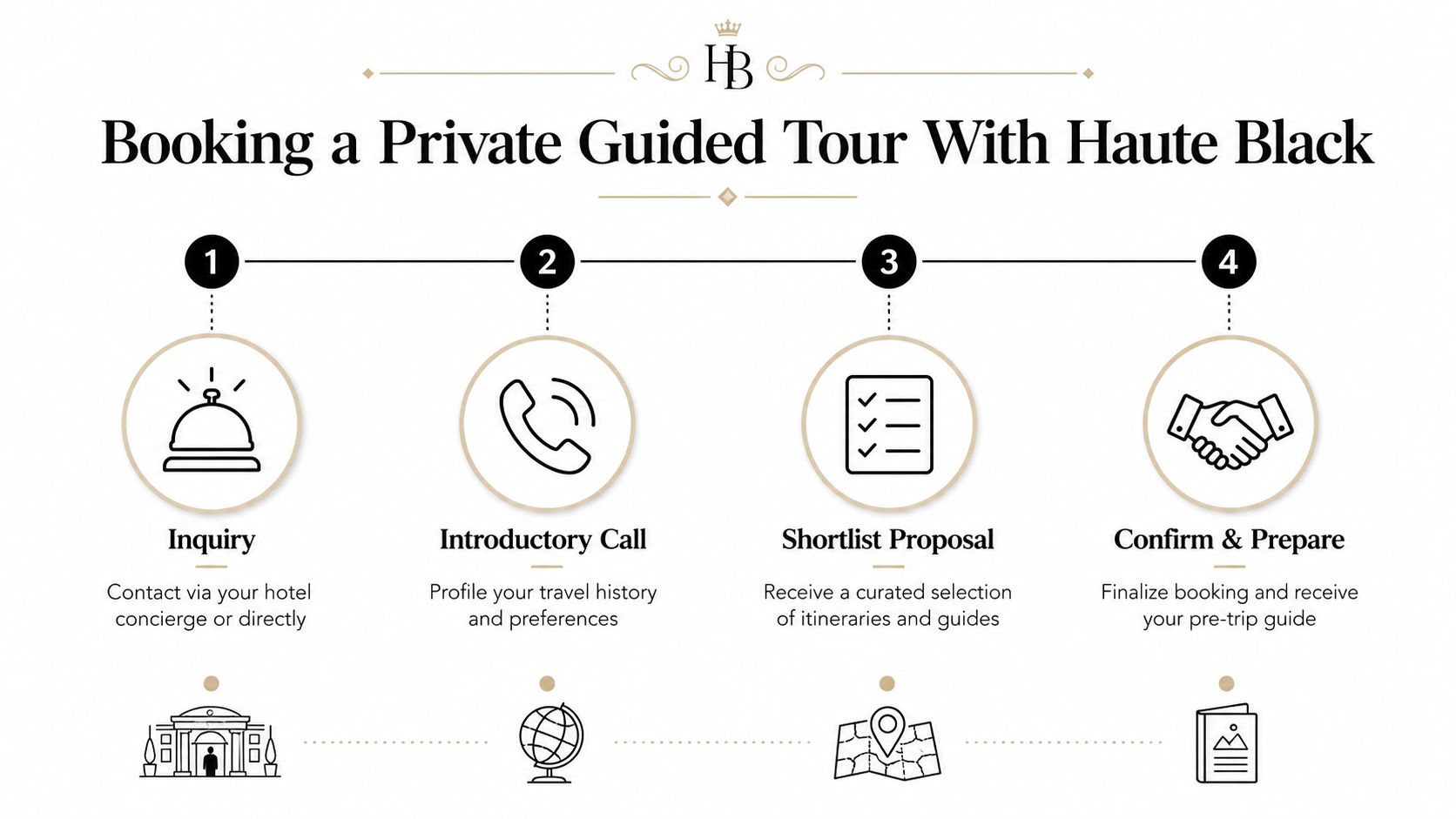
The booking process should feel like a briefing, not a checkout page. Start with the concierge desk or direct inquiry, then use the introductory call to explain previous trips, preferred hotels, disliked experiences, dietary needs, privacy expectations, and the reason for travel.
The advisor should return with two or three private guided tour options, not a long catalog. Each option needs named guides where possible, proposed access, transport assumptions, hotel standards, dining logic, and clear distinctions between confirmed inventory and pending requests.
What happens after the shortlist
Refinement is where the itinerary becomes personal. Replace a site that looks impressive on paper but doesn't suit the traveler. Adjust start times, change the vehicle standard, revise dining, and test the route against real transfer times. The advisor should compare quotes line by line before requesting a deposit.
Confirmation may use Virtuoso or preferred-partner inventory, with the relevant hotel benefits and supplier conditions stated plainly. The traveler should receive guide biographies, dining confirmations, access notes, packing guidance, emergency contacts, and a clear explanation of cancellation terms.
The non-member journey often begins with public availability checks and standard supplier rates. A member journey can include a dedicated advisor, pre-held guide allocations where available, preferred-property access, and a person authorized to pivot the itinerary without forcing the traveler to renegotiate each change.
HauteBlack provides bespoke itinerary design, private guides, premium arrangements, and a dedicated advisory relationship. Its membership model also includes access to a wider private-travel ecosystem, including aviation, villas, dining, and concierge support. For a broader explanation of the advisor model, consult HauteBlack's guide to choosing a VIP travel agency.
The essential question is ownership. From briefing through return, one advisor should know the traveler, the suppliers, the access conditions, and the recovery plan.
Packing Etiquette and Common Questions
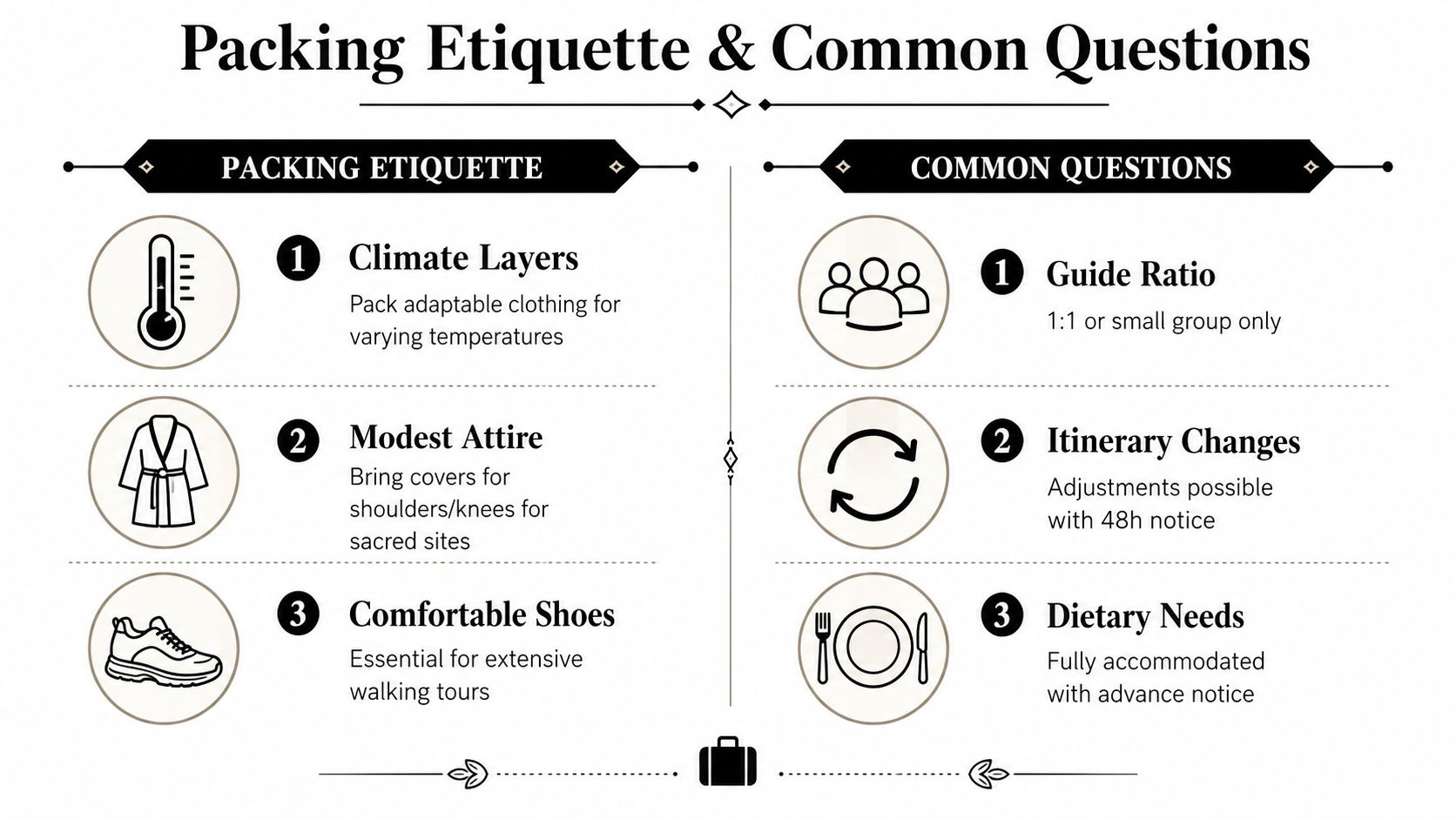
Preparation protects access. The wrong shoes, unsuitable clothing, or careless photography can create more friction than an imperfect itinerary.
Pack in layers for changing climates, especially when a day combines vehicle transfers, exposed archaeological sites, cool interiors, and warm dining rooms. Bring modest clothing for religious sites such as Angkor Wat or the Vatican, and choose footwear that can handle cobblestones without announcing discomfort. Discreet jewelry is usually wiser than conspicuous pieces when the day involves markets, public monuments, or complicated transfers.
Etiquette that protects the relationship
- Tipping: Ask the advisor for regional guidance before departure. Practices vary, and a guide should never be left to interpret a traveler's intentions.
- Photography: Follow restrictions in museums, sacred spaces, private homes, and communities. A private booking doesn't override local rules.
- Gifts: Use restraint and cultural judgment. A thoughtful, appropriate gesture can be welcome, but it shouldn't create obligation.
- Private homes and tribal communities: Follow the host's lead, ask before photographing, and accept that some spaces or stories aren't available for consumption.
Questions clients ask
How far ahead should I book? Book as early as the route and access requirements justify. Scarce guides, villas, private openings, and peak dining reservations can disappear before the traveler has finalized every detail.
Do children change the design? Yes. The advisor should adjust guide selection, activity length, meal timing, room configuration, transport, and the balance between shared family time and separate programming.
What happens during weather or political disruption? The advisor and guide should maintain a pivot plan, identify alternative venues, and explain which changes can be made immediately and which require supplier approval.
How are dietary and accessibility needs handled? State them during intake, repeat them in the final dossier, and confirm them directly with hotels, restaurants, vehicles, and guides. “Noted” isn't the same as confirmed.
Do Virtuoso amenities stack with private guide fees? They're generally separate components, but eligible preferred-partner benefits may apply to participating properties and bookings. The advisor should show the guide fee and hotel benefits independently so the traveler can evaluate the complete value.
A private guided tour succeeds when preparation feels invisible during the journey. Ask HauteBlack to design a program around vetted guides, reserved access, private logistics, and a clear pivot plan, then visit HauteBlack to begin a confidential travel conversation customized to your next destination. Their advisors can turn a broad wish list into a precisely sequenced itinerary with one accountable point of contact from first inquiry to return.
Explore Our Guides


Signature Experiences


