Haute Black Journal
Tailor Made Luxury Travel: The Complete Guide for 2026

Marlene Azeez
Director, HauteBlack
View all articles →

Published August 24, 2026 by Marlene Azeez
You've booked the right hotels, secured the preferred room categories, and perhaps even arranged a private transfer. Yet the trip still feels strangely fragile. A late arrival could collide with a museum reservation, a child may need a slower morning, an executive may have to take a confidential call, and a long-haul connection might leave everyone exhausted before the first meaningful experience begins. Tailor made luxury travel solves that problem by treating time, energy, privacy, and transitions as carefully as accommodation and access.
The best journeys don't place travelers in expensive surroundings. They coordinate the entire experience so the itinerary feels natural, flexible, and personally relevant. That requires discovery, judgment, relationships, and active oversight before and during the trip.
Redefining the Meaning of Tailor Made Luxury Travel
A couple arrives in Europe after an overnight flight. Their driver takes them to a quiet hotel rather than placing a formal dinner immediately after arrival. The room is prepared for an early check-in, and the first evening stays open. A later morning begins with a private market visit shaped around the chef's interests. The guide knows they prefer conversation over scripted commentary, while the restaurant has received their dietary requirements in advance.
The result feels effortless precisely because nothing was designed to look designed. Tailor made luxury travel is the deliberate design of a journey around how people live, recover, move, eat, and spend attention. The hotel matters, but so do wake-up times, transfer lengths, privacy preferences, personal interests, and the pace between major experiences. Each decision protects time and energy, which is where bespoke planning earns its value.
The difference between premium and bespoke
A premium booking improves visible components. A bespoke journey connects those components into a workable sequence. It considers whether a villa's layout suits a multigenerational family, whether a private guide can adjust the day when energy drops, and whether the route leaves room for an unplanned lunch or quiet afternoon.
A booking engine can identify availability. It cannot assess whether three consecutive early departures will weaken the trip, or whether a second city adds value when time is limited. A skilled advisor translates preferences into practical decisions, then coordinates suppliers, timings, and contingencies so the plan holds together in real conditions.
Practical rule: If the itinerary only records where you're going, it isn't finished. It should also record how you want to feel while getting there.
For a broader framework, this complete guide to bespoke travel explains the planning philosophy in greater detail. The principle is straightforward: luxury comes from relevance and control, rather than adding expensive elements without purpose.
The Global Rise of Bespoke Experiences
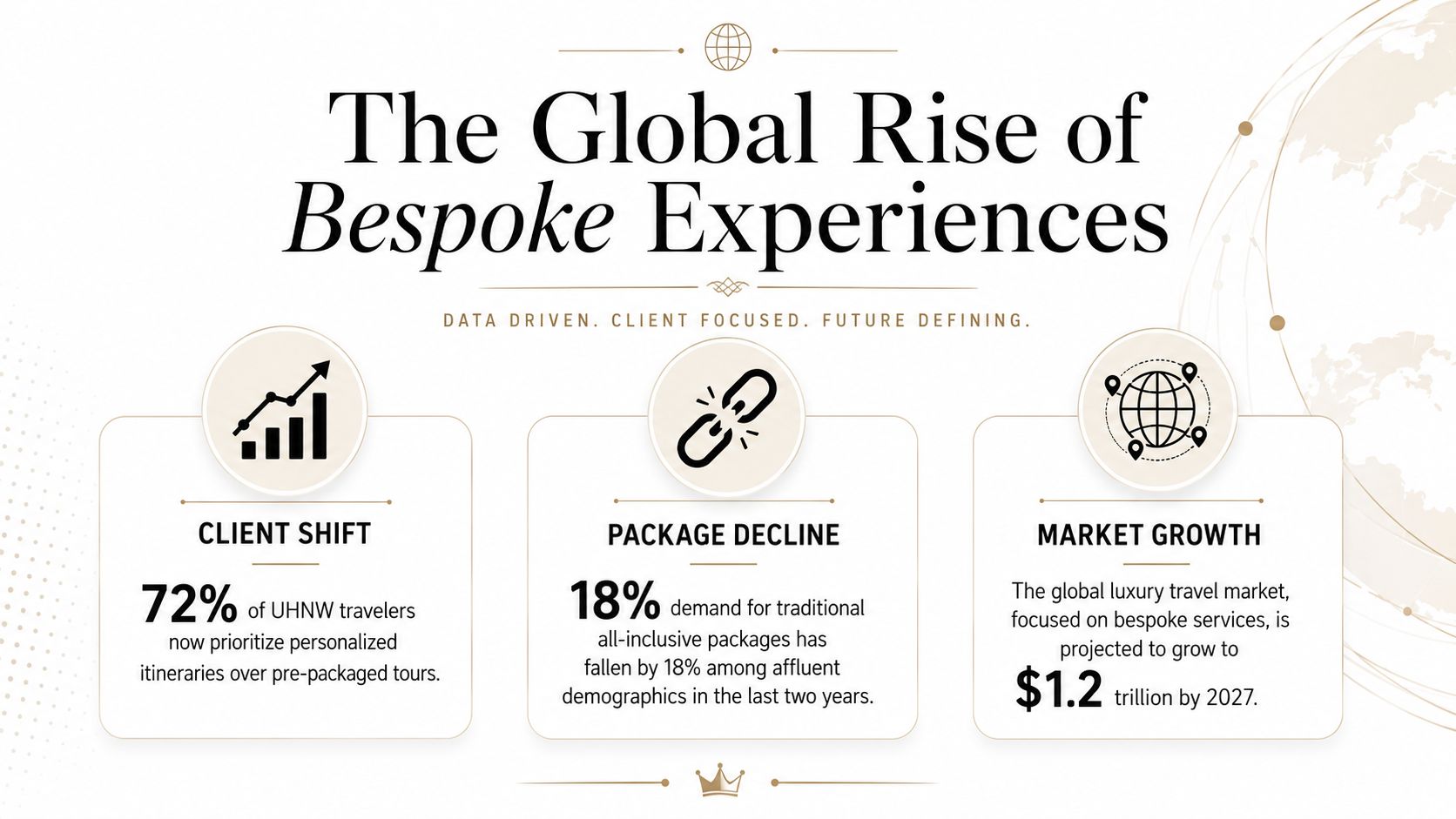
The luxury travel market is expanding, but the more important change is qualitative. Travelers increasingly want journeys that reflect their priorities rather than packages assembled around a destination's most obvious attractions.
The global luxury travel market was valued at USD 1.59 trillion in 2025 and is projected to reach USD 3.04 trillion by 2033, with an 8.5% CAGR from 2026 to 2033, according to Grand View Research's luxury travel market analysis. Europe held 33.8% share in 2025, while safari and adventure led by tour type at 33.3%, a pattern that points toward high-touch, experience-led travel rather than static premium lodging alone.
Why flexibility now carries more value
In the United States, the market was estimated at USD 428.48 billion in 2025 and is forecast to reach USD 783.06 billion by 2033, growing at 7.8% annually from 2026 to 2033, as reported by Grand View Research's U.S. luxury travel market report. Customized and private vacations represented 27.21% of the U.S. market in 2025. Direct bookings represented 48.89%, and travelers aged 41 to 60 accounted for 38.92%.
Those figures describe a traveler who wants agency. A private vacation can be shaped around school calendars, business commitments, preferred flight times, health requirements, and family dynamics. It also gives an advisor more room to manage the trade-offs between location, room category, routing, and time on the ground.
The commercial case is equally clear. The ATM Travel Trends Report 2025 found that 85% of hoteliers see personalization as a key commercial driver, while customized experiences can generate up to 5% additional revenue, as reported in the academic record for the personalization research. For travelers, personalization improves fit. For suppliers, it can increase the value of a well-designed itinerary.
HauteBlack's editorial coverage of the luxury travel network and how it works reflects this broader shift toward relationship-led access and coordinated planning. Bespoke travel isn't a niche alternative to the market. It's increasingly the operating model for clients who value time more than itinerary volume.
How Tailor Made Itineraries Are Built
A successful itinerary starts before any suite is confirmed or driver assigned. The advisor first maps the traveler's operating reality, then tests the destination against it. That process is closer to time management and logistical orchestration than to selecting attractive places from a catalogue.
Discovery comes before destination
The opening conversation establishes the trip's purpose, the travelers' rhythms, and the constraints that could disrupt the plan. Questions should cover departure times, sleep patterns, dietary needs, mobility, heat tolerance, preferred structure, and the gap between what each person hopes to do and what they will realistically accept.
A family may request culture, wildlife, and beach time. The workable design could require private guides, connected rooms, flexible meals, and a recovery day after a long transfer. An executive might want an intensive cultural program while also requiring dependable connectivity, discreet transport, and protected work windows. Those details determine the route, pacing, and service level.
Curation and assembly
Once the brief is clear, the advisor selects properties, guides, restaurants, transport providers, and experiences that function as one schedule. HauteBlack's preferred partner network includes over 500 properties, including Four Seasons, Aman, Rosewood, Belmond, and Ritz-Carlton. Potential benefits may include upgrades, resort credits, and flexible inclusions when available.
The result comes from sequencing the right elements. A private arrival service can preserve energy, while a local guide can make a familiar attraction more personal. The schedule also needs buffers for traffic, weather, baggage, and fatigue. A polished itinerary leaves enough structure to protect key moments without turning every hour into an obligation.
Execution and risk control
Before departure, the advisor confirms names, dietary notes, arrival procedures, payment arrangements, vehicle details, guide expectations, and emergency contacts. Privacy receives the same level of attention. The plan may limit information shared with suppliers, specify discreet vehicles, and separate public activities from private time.
During the trip, arrangements should remain adjustable. AI recommendation systems can refine suggestions from guest behavior, while luxury-hotel personalization frameworks commonly track conversion, satisfaction, revenue, ROI, and engagement, as discussed in this research on AI and personalized luxury tourism. Technology supports judgment. It does not replace an advisor who understands context, knows which compromises are acceptable, and can reorganize a day when conditions change.
For a practical example of how travel products can be structured and presented, see HauteBlack's coverage of customized package tours. The strongest itinerary records the details that protect the experience while leaving travelers free to remain present.
Choosing Between One-Off Bookings and Private Memberships
A one-off booking makes sense when the need is specific. You may want a honeymoon, a milestone birthday, or a single family trip with private guides and carefully selected hotels. A private membership becomes more valuable when travel is recurring, complex, or handled across multiple people and destinations.
The difference is continuity. With a one-off arrangement, the advisor must learn your preferences for that trip. With an ongoing relationship, the advisor can build a working record of room choices, dietary requirements, preferred aircraft arrangements, family dynamics, and the level of structure you enjoy.
| Benefit | One-Off Booking | Private Membership |
|---|---|---|
| Planning relationship | Focused on one journey | Dedicated advisor with ongoing context |
| Trip design | Tailor made for the stated dates | Refined through previous travel history |
| Preferred access | Requested for the individual booking | Supported by an established relationship |
| Planning fees | May apply according to the engagement | HauteBlack members receive waived planning fees |
| Beyond-travel support | Usually limited to the booked itinerary | Can extend across travel, events, dining, and transport |
| Best fit | Occasional or clearly defined travel | Frequent, high-complexity, or privacy-sensitive travel |
When the transactional model works
One-off planning is efficient when you already know the destination and need expert execution. It can also be appropriate if you want a single set of benefits, such as a preferred room request, resort credit, or coordinated private transfers, without maintaining a longer advisory relationship.
Membership requires a different mindset. The value builds through familiarity and access to a broader service ecosystem. HauteBlack describes its private travel and concierge positioning in this guide to exclusive travel clubs, including dedicated advisory support and member-oriented benefits.
The wrong choice is paying for continuity you won't use. The right choice depends on how often your travel changes, how many decision-makers are involved, and whether you need one advisor to coordinate the whole picture.
Why UHNW Clients Choose Bespoke Planning
Ultra-high-net-worth travelers rarely struggle to find a luxury hotel. Their difficulty is protecting limited time while coordinating people, preferences, and risk across several locations.
A family may include young children, adults with different activity levels, and older relatives who want comfort without being excluded. A couple may want privacy, wellness, and meaningful culture in the same journey. An executive may need a quiet room for confidential work, reliable transport, and the ability to change plans without exposing the disruption to everyone else.

Time is the primary design constraint
Audley's 2026 trend framing describes the “true currency of luxury travel” as time, and highlights “Port +” extensions that add land experiences to cruise itineraries, as reported by GlobeTrender's coverage of tailor-made travel trends. Virtuoso's 2026 Luxe Report also describes a move from “FOMO” toward slower, deeper stays, with advisors reporting that 45% of clients are changing plans because of climate concerns and 76% of those travelers choosing shoulder-season or off-peak travel, according to the same report coverage.
That changes the planning question. Instead of asking how many places can fit into a trip, the advisor asks which sequence preserves energy, climate comfort, and emotional return. Recovery days, sensible transfer windows, and less crowded periods become part of the luxury product.
Marriott's 2025 Intentional Traveler Report found that 93% of respondents consider customized experiences essential, up from 83% the previous year, as covered by Luxury Travel Report's summary of the report. Personalization now extends beyond room upgrades into sleep, nutrition, recovery, privacy, and family harmony.
The advisor's value is often felt most clearly when plans change. A trusted professional can present a calm alternative, coordinate suppliers, and keep the traveler focused on the experience rather than the disruption.
The following video offers another perspective on the role of consultation in shaping a luxury journey.
Signature Journeys and Sample Itineraries
A culinary journey through Europe can begin with a private arrival in a major city, continue through a regional food market with a specialist guide, and culminate in a private chef dinner. The planning decision concerns the order and pace as much as the reservations. Sufficient time between meals lets travelers understand the region rather than move from one booking to the next.
An Asian cultural itinerary might combine a quiet property, a local historian, a private craft workshop, and access to a site outside its busiest visiting hours. Timing gives each element room to work. The right guide and setting then reflect the traveler's interests instead of creating a generic cultural program.
The itinerary is a sequence, not a list
A wellness retreat may require late starts, nutrition planning, sleep support, and treatments spaced far enough apart to feel restorative. An executive retreat can combine private aviation, a secluded estate, reliable connectivity, and discreet meeting spaces. A family journey may use one base for several nights before introducing a contrasting environment, avoiding daily repacking and unnecessary transfers.
In the American Southwest, a private Grand Canyon plan might include a carefully timed viewpoint visit, a helicopter transfer where appropriate, and a luxury stay matched to the traveler's tolerance for heat and activity. This guide to VIP Grand Canyon experiences helps distinguish a standard sightseeing excursion from a more curated plan.
The strongest signature journeys have a recognizable rhythm. They build anticipation, create a central emotional moment, and allow enough time afterward for the experience to settle. Access creates the opportunity. Sequencing determines whether that opportunity becomes memorable or merely expensive.
Planning Lead Times and Investment Guidance
Bespoke travel rewards early clarity. High-demand villas, private estates, specialist guides, and seasonal events can require planning several months ahead, while peak periods and unusually specific requests may need more than a year of preparation.
That doesn't mean every journey must be planned far in advance. A flexible traveler can often secure an excellent trip with less notice, particularly when dates, destinations, and room types remain open. The trade-off is choice. Late planning may require changing the route, accepting a different property, or replacing a highly sought-after experience with a strong alternative.
What shapes the investment
Pricing reflects the structure of the journey rather than a single luxury label. Key variables include:
- Travel dates: Peak demand affects availability and supplier pricing.
- Routing: Multiple destinations require more transport, coordination, and contingency planning.
- Accommodation: Villas, suites, private islands, and estates carry different rates and operational requirements.
- Access: Specialist guides, private venues, chartered transport, and exclusive activities add complexity.
- Service level: Dedicated vehicles, aviation, security, wellness support, and on-trip assistance change the scope of the engagement.
A transparent advisor should explain these trade-offs rather than present a single total without context. If the budget is fixed, the most productive conversation is often about priorities. Protect the room category, reduce the number of stops, or choose a shoulder-season date. Cutting the recovery day to preserve an additional destination usually saves money at the expense of the experience.
The most expensive mistake in luxury travel is paying for a journey whose pace makes the traveler too tired to enjoy it.
Starting Your Own Bespoke Journey
Begin with the purpose of the trip, not the destination. A honeymoon, family reunion, executive retreat, and milestone celebration each require different decisions about privacy, pacing, accommodation, and support.
Then prepare a candid brief. Include dates, likely travelers, essential preferences, health or dietary considerations, preferred flight times, tolerance for transfers, and the moments you want to remember. Mention what you don't enjoy as clearly as what you do. “No early mornings” can be more useful than a long list of attractions.
A capable advisor will challenge the first draft when necessary. They may recommend fewer destinations, a different arrival point, a longer stay in one base, or a season that better suits the climate and crowd levels. That judgment is part of the service. A tailor made luxury travel plan should improve the original idea, not just format it attractively.
What to expect from the first conversation
You should leave the initial discussion with a clearer sense of priorities, not a generic brochure. Ask who will manage the details, how changes are handled, which suppliers are being considered, and what support exists during the journey. The right process makes complex travel feel calm because someone has already considered the fragile points.
HauteBlack's news page remains the appropriate place to review its current luxury-travel editorial coverage, including recent material on bespoke journeys, executive retreats, and destination experiences. Its service model combines custom itineraries with private concierge support, preferred hotel relationships, private aviation, villas, dining, and ground transportation.
The finished journey should feel personal without becoming over-engineered. You'll know the planning worked when the trip has enough structure to run smoothly, enough flexibility to breathe, and enough relevance that no major element feels borrowed from someone else's vacation.
HauteBlack offers bespoke itineraries, private aviation, preferred hotel access, villas, dining, and coordinated ground transportation for travelers who need more than standard upgrades. Visit HauteBlack to share your dates, priorities, and preferred pace, and begin shaping a journey around the way you want to travel.
Frequently Asked Questions
Explore Our Guides


Signature Experiences