Haute Black Journal
Your Ultimate Safari Trip in Africa: A Luxury Guide

Marlene Azeez
Director, HauteBlack
View all articles →
# Your Ultimate Safari Trip in Africa: A Luxury Guide
May 11, 2026
Most luxury safaris fail in one predictable way. They spend heavily on visible indulgence and far too little on the decisions that ultimately shape the experience.
A first-rate safari trip in africa is an exercise in curation. The reserve determines privacy. The guide determines depth. The aircraft routing determines how much of the day you lose in transit. The villa or exclusive-use camp determines whether the trip feels intimate or merely expensive. Get those calls right and the journey feels effortless. Get them wrong and even the highest nightly rate cannot rescue it.
That distinction matters. The modern safari has split into two categories: costly and bespoke. Costly buys beautiful rooms, polished service, and a familiar version of luxury. Bespoke buys access, timing, and control. It means private conservancies over crowded circuits, houses and camps taken in full over standard suites, and flight planning built around your family, your schedule, and the reason for the trip in the first place.
The best safaris are designed for a specific life moment. Honeymoon. Multi-generational celebration. Quiet reset after an intense business cycle. Executive retreat with real privacy. Each requires a different rhythm, a different standard of accommodation, and a different logistical structure. That is the part generic safari advice misses.
Wildlife matters, of course. What stays with you is how intelligently the experience is arranged around it. A proper safari is not a string of game drives. It is a private, well-paced journey that gives you rare sightings, calm, and the kind of memory that becomes part of a family's history.
An Introduction to the Modern Safari
A modern safari isn't about collecting animal photos. It's about access, rhythm, and memory.
The old cliché still lingers: khaki uniforms, dusty game drives, and a checklist of the Big Five. That version exists. It's just not the one worth prioritizing if you care about privacy, service, and the intelligent use of time. The best safari today combines private conservancies, world-class guiding, serious design, and a level of operational polish that rivals any elite beach or city stay.
What makes safari different from other luxury travel is the emotional return. You can charter the finest yacht in the Med and still have a day that blurs into the next. On safari, a single morning can stay with you for decades. The light changes. The air cools. A guide reads a track you'd never notice. Breakfast appears under an acacia tree. By lunch, you've had no notifications, no pointless noise, and no one asking for your attention.
Why safari has become a legacy trip
The strongest safari itineraries are built around a life moment. Honeymoon. Milestone birthday. Family passage trip. Quiet executive reset. That's why the modern format matters. You're not buying accommodation alone. You're buying a setting in which conversation changes, children pay attention, couples slow down, and overstretched people finally exhale.
A safari earns its value by changing how you spend time, not by adding more things to do.
This is also why bespoke planning matters more here than in most destinations. The wrong lodge can make a natural setting feel crowded. The wrong routing can waste a full day in transit. The wrong season can turn anticipation into compromise. Safari rewards specificity and punishes generic booking.
What refined safari planning looks like
At the highest level, every strong itinerary answers five questions clearly:
- What is the emotional brief: romance, family bonding, privacy, restoration, or celebration.
- What wildlife style suits you: dramatic migration, dense predator country, water-based exploration, or slower tracking on foot.
- How much movement is acceptable: some travelers want one extraordinary base, others want a tightly choreographed circuit.
- What level of exclusivity is necessary: shared lodge, private villa, or full sole-use camp.
- What should sit around the safari: beach, wellness, culture, conservation access, or private aviation.
If you get those answers right, the safari starts to look less like a trip and more like a private architecture of experience.
Choosing Your Premier Safari Destination
The first decision is the one many travelers handle poorly. They ask where safari is “best.” Wrong question. Ask which terrain and style best fits your reason for going.
South Africa, Kenya, and Tanzania collectively command 60 to 64% of global interest in African safaris. South Africa leads with 24% of enquiries in 2025, followed by Kenya at 21% and Tanzania at 19%, according to Go2Africa's annual African safari travel report. That concentration makes sense. These are the strongest starting points for a luxury traveler because they combine wildlife credibility with tested infrastructure.
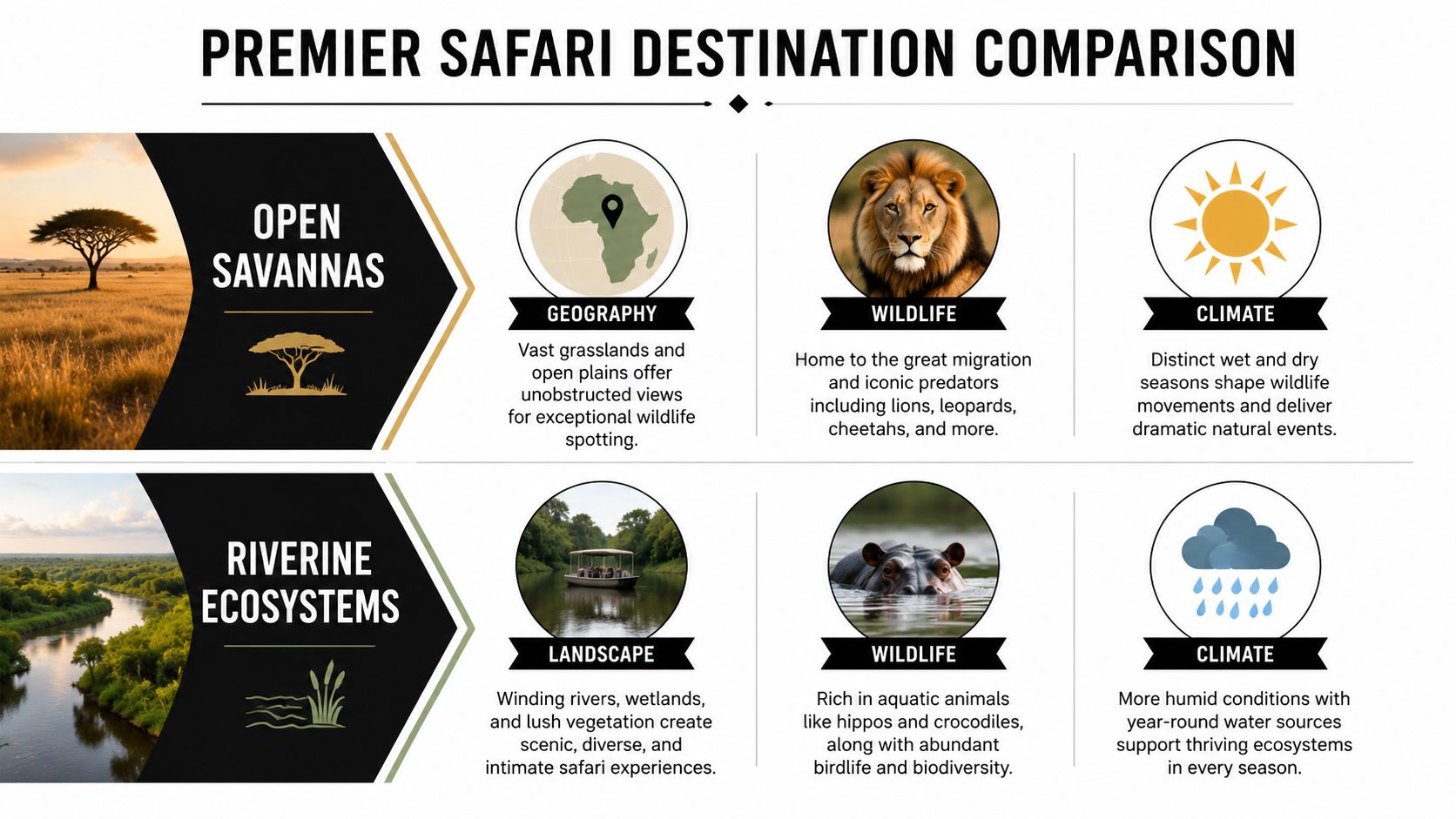
East Africa for drama and scale
If this is your first safari trip in africa and you want the iconic visual language of safari, choose East Africa.
Kenya and Tanzania deliver the great panoramic version of the continent. Open plains. Long horizons. Herd movement. Big skies. The experience feels cinematic because it is. You're in the geography most travelers imagine before they've ever set foot on the continent.
This is also the right circuit for travelers drawn to the migration story. If that's your priority, start with a Great Migration safari strategy rather than a generic country-first search. River crossings get attention, but the true value is understanding which phase of movement suits your tolerance for drama, unpredictability, and seasonal positioning.
Use East Africa if your brief is any of the following:
- Classic first safari with maximum visual impact
- Honeymoon with spectacle
- Photography-led travel where open terrain matters
- Multi-stop itineraries that pair safari with Indian Ocean beach time
Southern Africa for polish and diversity
If you want the most operationally refined experience, choose Southern Africa.
South Africa is the easiest luxury entry point because the system works. Lodges are polished, guiding is strong, and the private reserve model often creates a more customized rhythm. It's especially effective for couples who want comfort without giving up wildlife density, and for families who need a safari that feels controlled, safe, and smooth from start to finish.
Southern Africa also gives you more stylistic range. One trip can combine high-touch lodge living, water-based wildlife viewing, and walking-oriented experiences. That matters if you've already done a standard game-drive-heavy safari and want more variation.
Practical rule: Choose East Africa for grandeur. Choose Southern Africa for precision.
A quick decision table
| Travel priority | Best fit | Why |
|---|---|---|
| First safari with iconic scenery | Kenya or Tanzania | Open plains and migration-scale landscapes |
| Family trip with easy logistics | South Africa | Strong infrastructure and family-friendly private reserves |
| Romance and seclusion | South Africa or Tanzania | Excellent lodge stock and strong private-use options |
| Wildlife plus water-based contrast | Southern Africa | Better fit for mixed-terrain itineraries |
| Big visual payoff in fewer frames | East Africa | Landscape does a lot of the work |
Timing matters more than branding
Many travelers fixate on lodge names before they settle the season. That's backwards. The right month shapes animal concentration, vegetation density, road conditions, and the overall feeling of the trip.
The same Go2Africa report notes that July is the peak month for bookings, which aligns with prime dry-season viewing in several top safari areas. That doesn't mean July is automatically your best month. It means competition for the best rooms rises fast. If you care about specific villas, guides, or exclusive-use setups, decide far earlier than you think you need to.
One more useful signal from the same report: 47% of safari travelers are couples, while families represent 31%, which explains why some lodges excel at romance and others are designed for multi-generational ease. Destination choice isn't just about animals. It's about choosing the social architecture of the trip.
The Echelon of Safari Accommodations
On safari, accommodation isn't support infrastructure. It is the experience.
Choosing the wrong property reduces a safari to scheduled drives and generic luxury. The right choice turns the entire day into a continuous encounter with the wild surroundings. You wake to movement outside the suite. Lunch has a sense of place. The pool isn't decorative. It's part of the view. Even the silence feels designed.
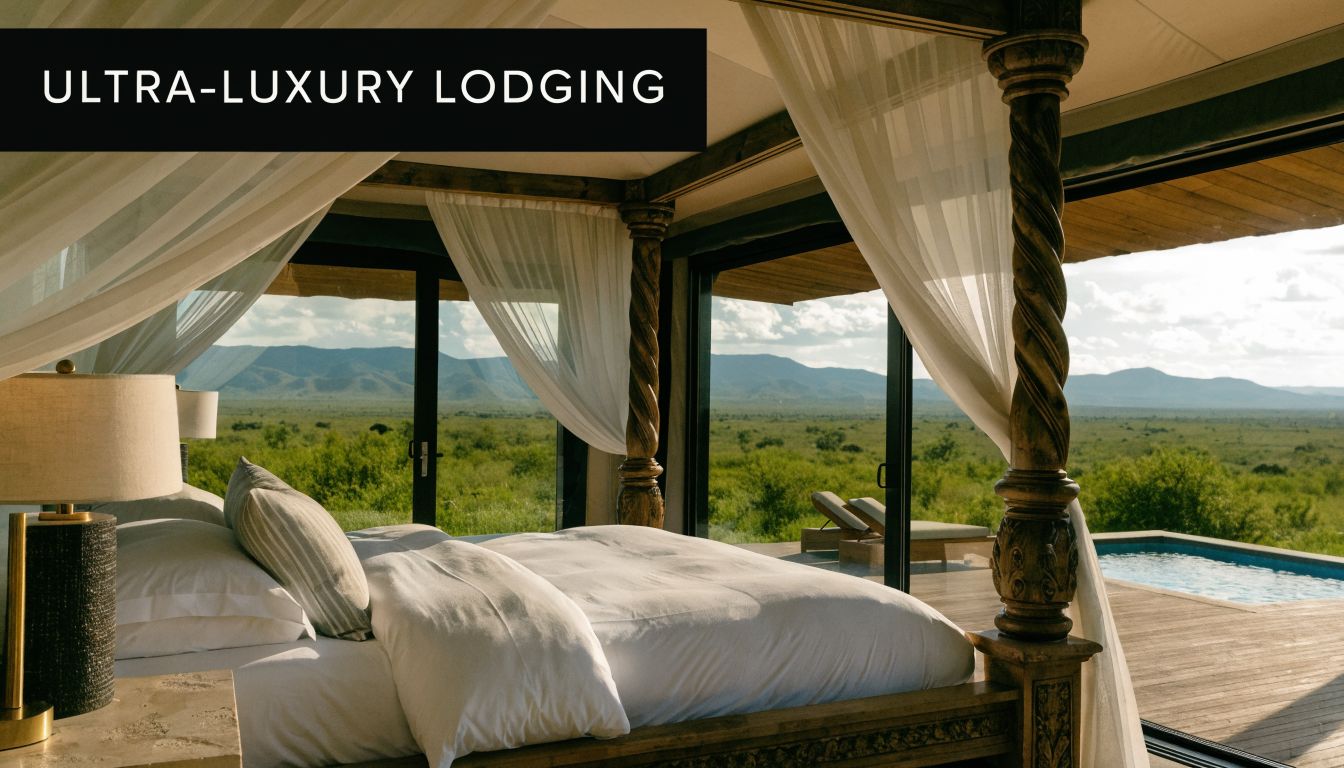
Flagship lodges for first-rate service
Start here if you want safari at its most polished and least complicated.
Flagship lodges are the names that dominate serious luxury safari planning for a reason. They have mature service cultures, excellent guiding teams, high design standards, and the ability to make a demanding traveler feel looked after without fuss. Properties associated with brands such as Singita, Royal Malewane, Four Seasons, Aman, and Belmond tend to understand that luxury in the bush is about calm competence, not decoration.
This tier suits:
* First-time safari guests who want zero guesswork
* Couples who care about aesthetics and fluid service
* Travelers mixing safari with urban or beach stays and expecting consistency
For travelers comparing properties in Kenya specifically, this guide to luxury safari camps in Kenya is a useful place to sharpen the shortlist.
Private villas for control
Private villas are where safari starts to feel decisively different from luxury hotel travel.
A private villa gives you what shared lodges can't: your own timing, your own table, your own vehicle arrangement, and a more residential sense of ease. Breakfast can run late. Children can reset without disturbing anyone. Security-conscious travelers don't need to manage visibility. High-profile guests can disappear properly.
This is the right category for:
- Families spanning multiple generations
- Groups of friends
- High-profile individuals who value discretion
- Travelers celebrating something important
The strongest villa stays also solve an unspoken problem. They remove the friction of other guests. That matters more on safari than people expect. Shared lounges, fixed departure times, and compromised dining can flatten a trip quickly.
Mobile camps and sole-use setups for purists
For some travelers, the pinnacle isn't a permanent lodge. It's a highly serviced mobile or sole-use camp positioned with intent.
This format works best for those who want immersion without sacrificing comfort. You still have beautiful linens, excellent food, proper staffing, and rigorous operations. What changes is the feel. The experience becomes more immediate, more focused on the natural surroundings, and less architectural. It's ideal for migration-focused itineraries and for seasoned safari travelers who've already done the marquee lodges.
Expensive safari buys nice rooms. Bespoke safari buys freedom over the day.
How to choose the right format
Use this framework and you'll avoid the most common mistake, which is selecting for appearance instead of fit.
1. Choose a flagship lodge if service consistency matters more than complete privacy.
2. Choose a private villa if the trip includes children, staff, security concerns, or milestone celebrations.
3. Choose a mobile or sole-use camp if wildlife positioning and immersion outrank spa menus and architectural scale.
A final point. Don't let anyone convince you that roughing it is by nature more authentic. Authenticity on safari comes from guiding quality, access, and setting. Not from inconvenience.
Bespoke Itinerary Blueprints for Discerning Travelers
The best itineraries aren't built around availability. They're built around purpose.
That's where most safari planning online falls apart. It gives you a list of parks and lodges but almost nothing about trip design for real people with different emotional needs. That gap matters because a 2025 Virtuoso report notes that 68% of UHNW clients now seek life-changing wellness safaris blending game drives with spa treatments and cultural exchanges, yet only 12% of online guides address this, as noted in Go2Africa's feature on Africa's most unique safaris. Standard safari advice is still too narrow.
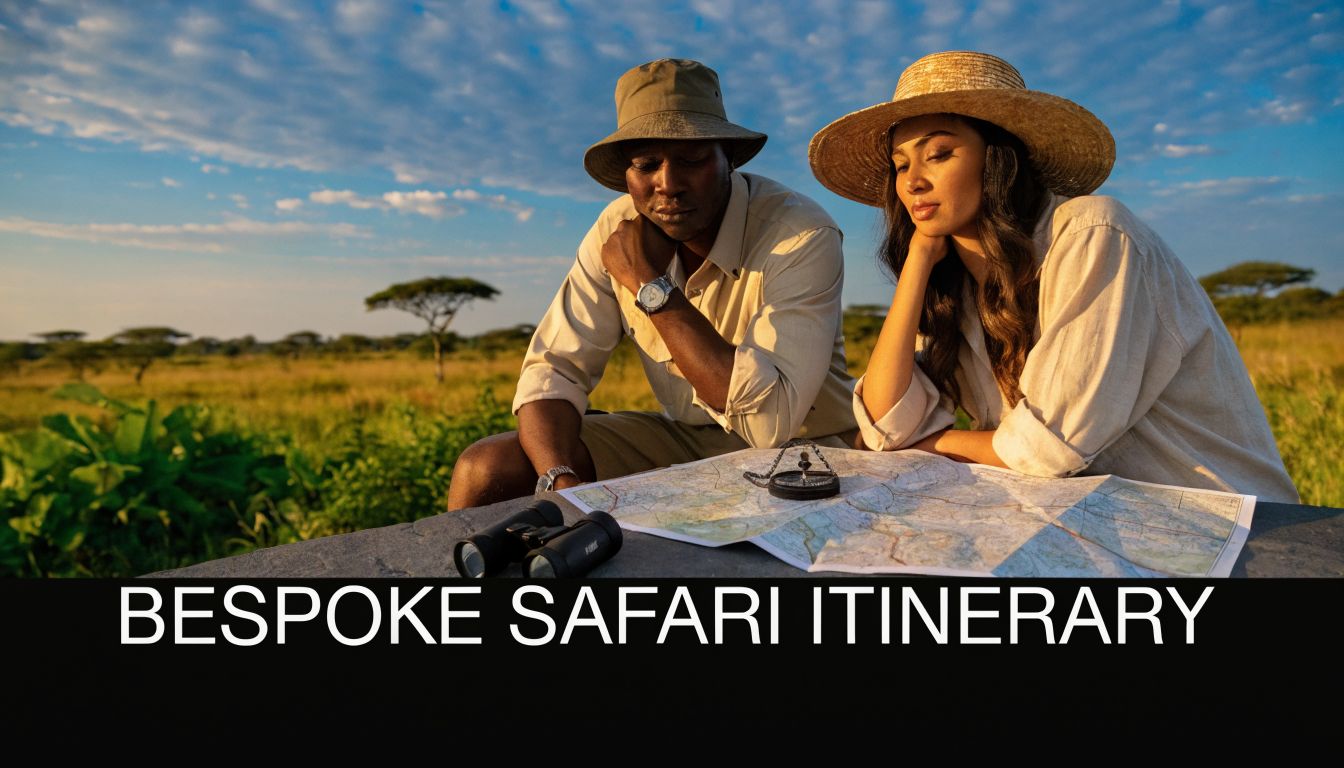
The honeymoon itinerary
A honeymoon safari should be sensual, not busy.
Start in a reserve known for strong guiding and elegant lodge life. South Africa works especially well here because the arrival process is smoother and the transition into the safari rhythm is gentler. Build in enough nights to stop feeling like you're in transit. Then pair the safari with a beach ending that changes the pace completely.
What matters most:
- Privacy over volume of activities
- Suites with outdoor living and plunge pools
- Private dining with no theatrical overproduction
- A clean handoff from bush to island
For honeymooners, the win isn't seeing everything. It's never having to think. The day should glide. Morning drive, long lunch, spa treatment, sundowner, dinner under the stars. If the itinerary starts to look packed, it's wrong.
The family legacy itinerary
A family safari shouldn't try to make everyone travel the same way. It should let different generations engage at their own pace.
South Africa is often the strongest fit because family-friendly private reserves can support both structure and flexibility. Grandparents may want slow drives and excellent wine. Younger children may need shorter activities and junior ranger programming. Parents usually want one thing above all: no logistical stress.
The right design includes an exclusive-use villa, dedicated guiding, and enough private space for the group to separate without fragmenting. Add one cultural component that is intimate and well mediated, not performative. Add one conservation touchpoint that gives the trip meaning beyond wildlife.
A good legacy itinerary usually has these features:
| Family need | Best safari response |
|---|---|
| Different sleep schedules | Private-use accommodation |
| Varying energy levels | Flexible drive timings |
| Educational value | Ranger-led learning and conservation immersion |
| Shared memory | Private meals and one standout group experience |
The executive retreat itinerary
Executives don't need more activity. They need distance from noise and a setting that restores clarity.
That means stripping out wasted movement. Use direct aviation where possible. Choose a reserve with low density. Build in experiences that feel privileged but not performative, such as private conservation briefings, guided walking elements, or a considered wellness layer. The same Go2Africa feature notes that Singita lodges report a 40% booking increase for wellness packages, which makes sense. Burned-out people don't need a harder trip. They need a better one.
The right executive safari removes decisions from the day and replaces them with attention.
This style of itinerary works especially well when you include:
- A remote conservancy with minimal visual clutter
- Private briefing opportunities with field experts
- A serious wellness component, such as bush yoga, massage, or guided recovery time
- A communications-light environment that allows selective availability rather than constant responsiveness
What bespoke actually means
Bespoke doesn't mean adding random upgrades. It means aligning each element to the traveler's reason for going.
For one client, that means helicopters and conservation access. For another, it means no helicopters at all, just one extraordinary lodge and enough stillness to hear the birds at dawn. For a third, it means a family villa where every meal works for three generations without anyone discussing logistics.
That's the architecture competitors usually miss. They sell inventory. A serious safari is edited around the moment.
Seamless Logistics Private Jets and Transfers
Luxury safari planning is mostly a logistics problem disguised as a dream purchase.
Anyone can reserve a lodge. The hard part is making the entire safari trip in africa feel frictionless from home departure to final wheels down. If your routing includes commercial bottlenecks, uncertain baggage handling, awkward road transfers, and long dead hours between connections, the trip loses altitude before it begins.

Why private aviation changes safari
Private aviation isn't just about status. It's about geometry.
Safari routes often involve remote airstrips, weather dependencies, and regions that do not connect elegantly through scheduled service. A private aircraft fixes that by collapsing wasted transit. You avoid crowded hubs, reduce overnight positioning, and keep the trip emotionally coherent. That is especially important on multi-country itineraries where the romance of the concept can otherwise be undermined by the awkward connection chains encountered in practice.
For travelers considering this level of movement, Haute Jets private aviation reflects the kind of air support that makes difficult safari routing feel simple.
The invisible layer matters more
Elite safari logistics aren't only about aircraft. They depend on disciplined handling at every handoff.
That includes:
- VIP airport coordination so arrivals and departures don't become administrative marathons
- Meet-and-greet support that shortens immigration and customs friction where available
- Pre-cleared ground movement with the right vehicles for each terrain
- Medical and security planning handled discreetly in advance
- Lodge-to-airstrip timing choreographed so you're never waiting in the wrong place
Most poor safari experiences aren't caused by the reserve. They're caused by the joins.
Helicopters, not just for speed
Helicopter transfers can be practical, but their best use is selective.
They work when the aerial perspective adds to the journey or when terrain makes road movement feel needlessly blunt. In the right places, they convert a transfer into part of the experience. In the wrong places, they're just expensive theatrics. Good planning knows the difference.
This short visual captures the appeal of aerial safari movement well:
A simple logistics test
If an itinerary can't answer these questions cleanly, it's not ready:
1. How many handoffs happen between international arrival and first sundowner?
2. Where is the trip vulnerable to delay or missed baggage?
3. Which transfer is purely functional and should be upgraded or removed?
4. Where will the traveler feel exposed, tired, or unnecessarily visible?
Smooth safari logistics should be felt only by their absence.
That's the standard worth paying for.
The Art of Safari Packing and Etiquette
Packing for safari is an editing exercise. Travelers often struggle because they pack for fantasy, not reality.
A luxury safari doesn't reward oversized wardrobes, hard-shell vanity, or gear you'll never touch. It rewards a compact system that works across aircraft weight limits, temperature shifts, dust, and long game drives. If you handle this properly, you'll look polished and travel lightly. If you don't, every transfer becomes annoying.
Pack for movement, not variety
Expert operators benchmark a 20 to 30L daypack for game drives, and that bag should hold essentials such as a DSLR with telephoto lens at roughly 1.4kg and 8x42 binoculars, while keeping the total load under 5kg to reduce heat stress, according to Safari Experts' preparation guide.
That one guideline tells you almost everything you need to know. Safari packing should be modular. One neutral palette. Technical fabrics. Layers that photograph well and perform well. Nothing that needs babysitting.
A strong system includes:
- Soft, neutral clothing in olive, stone, sand, or muted brown
- UPF-rated layers for sun management
- A structured daypack that doesn't sag or overheat
- One excellent pair of field shoes and one lodge sandal or loafer
- Optics you'll use, not an overambitious gear kit
Weight is strategy
The same Safari Experts guidance notes that neutral-tone, UPF50+ clothing can reduce wildlife detection by up to 30%, and pre-arranging camp laundry can slash baggage weight by 10kg, which matters on light aircraft sectors with strict limits.
That last point is the easiest win in safari packing. Stop packing for the full trip. Pack for a few days and let the camps reset the wardrobe. High-end lodges do this well. Use them.
Field note: Laundry access is more valuable than a second suitcase.
A practical footwear principle helps here too. You don't need trekking boots for every safari. You need shoes you can wear for transfers, lodge walking, and light off-vehicle moments without fatigue. The same qualities that make European vacation shoes with multi-layer cushioning useful for long urban days also apply to safari routing, especially when your trip combines airports, lodge pathways, and pre- or post-safari city time.
Etiquette in the bush
Safari etiquette isn't formal. It's observational.
Your guide reads weather, tracks, animal mood, and vehicle position in real time. Don't fight that by treating the drive like a private stage. Ask questions. Be engaged. But let the guide control approach, silence, and timing around sightings. That's how better encounters happen.
Three rules matter most:
1. Respect quiet. Wildlife encounters improve when the vehicle remains calm.
2. Tip with intention and clarity. Ask your advisor or camp for the property's preferred structure and follow it cleanly.
3. Dress for the setting. Bush elegance should look effortless, not urban and overstated.
Good etiquette also applies to photography. Don't turn every sighting into a production. Put the camera down when the moment asks for your eyes instead.
The Haute Black Safari and Your Investment
The essential question is not whether a safari is expensive. It is whether the spend buys access, control, and precision.
At this level, price reflects scarcity. The best reserves limit bed count. The best guides are booked well ahead. The best camps operate in remote areas where every bottle, sheet, and skilled staff member must be moved in and supported without compromising the guest experience. Yet high pricing alone proves nothing. Plenty of safari trips are expensive and still poorly assembled.
A serious buyer should judge value by trip architecture.
What the investment actually secures
A well-priced luxury safari usually includes five things that are difficult to replicate on your own.
- Priority access to the right wildlife areas, often in private conservancies or low-density concessions
- Guiding that changes the trip, with trackers and hosts who know how to read timing, animal behavior, and vehicle positioning
- Operational discipline, from airstrip pickups to room readiness to accurate handoffs between camps
- Privacy and space, which matter far more than oversized suites once you are in the bush
- A stronger conservation model, where fees support the land, wildlife protection, and local employment around the reserve
That is why nightly rate is a weak comparison tool. A cheaper itinerary can cost more where it counts: lost game time, poor inter-camp routing, average guides, and too many people in the wrong places.
The difference between expensive and bespoke
Expensive safari is a collection of luxury parts. Bespoke safari is a system built around the reason you are traveling in the first place.
That distinction decides whether a honeymoon feels intimate or performative. It decides whether a multi-generational trip creates shared memory or logistical fatigue. It decides whether an executive retreat protects privacy or turns into a parade of avoidable friction. The best itineraries are designed around the moment, not around a list of famous camps.
For a honeymoon, I would bias toward fewer stops, stronger privacy, and properties with a clear sense of romance rather than generic prestige. For a family legacy trip, I would favor exclusive-use houses, flexible meal timing, private vehicles, and a rhythm that gives children and grandparents room to enjoy the trip differently. For executive travel, I would prioritize direct aviation routing, low-visibility arrivals, excellent communications infrastructure, and camps that understand discretion without being asked twice.
That is the difference competitors often miss. The highest level of safari planning is not about adding more. It is about aligning private aviation, ground handling, camp selection, guide quality, and pacing into one coherent journey.
Why the best clients use an advisor
The best clients use an advisor to remove waste.
They do not need fifty options. They need three that are right, with a clear recommendation and a defensible reason behind it.
Good advisory work should provide:
| What matters | What good advisory work does |
|---|---|
| Time | Cuts weak options early and shortens decisions |
| Privacy | Chooses routing and properties that reduce exposure |
| Access | Secures preferred treatment, stronger room allocation, and priority during high-demand periods |
| Execution | Coordinates flights, transfers, camp handoffs, dietary requests, and private arrangements without gaps |
| Judgment | Filters out fashionable but unsuitable choices |
The point is quality control. Every join in the trip matters. Commercial arrival to private air transfer. Airstrip greeting to camp check-in. Morning game drive to breakfast to spa to onward flight. Ultra-luxury safari fails in the joins long before it fails in the suite.
A well-built safari should feel calm, precise, and inevitable. The right reserve. The right camp. The right guide. The right amount of privacy. That result comes from disciplined planning, not luck.
If you want a safari trip in africa designed with that level of precision, Haute Black can curate the full journey, from reserve selection and exclusive-use stays to private aviation, VIP handling, and the quiet extras that turn a luxury trip into a defining one.