Haute Black Journal
An Unrivaled Guide to the Great Migration in Africa

Marlene Azeez
Director, HauteBlack
View all articles →
Witness a force of nature so immense it redefines the horizon. This is the Great Migration, an annual pilgrimage of nearly two million animals moving in a relentless, year-long cycle across East Africa. For the world's most discerning travelers, this isn't merely a safari; it's a front-row seat to the raw, unfiltered power of the planet.
The World's Greatest Wildlife Spectacle
Forget static images from a documentary. The reality is far more visceral. Imagine the ground trembling as a thunderous river of wildebeest, zebra, and gazelle flows across the vast Serengeti-Mara ecosystem. This is not a single, isolated event but a continuous, clockwork procession driven by the ancient rhythm of the rains.
This is the largest overland animal migration on Earth. The sheer scale is staggering: over 1.5 million wildebeest, joined by hundreds of thousands of zebras and gazelles, march up to 2,900 kilometers in a clockwise loop through Tanzania's Serengeti and Kenya's Masai Mara. It's an ever-shifting drama of survival and rebirth.
To comprehend the sheer scale of the Great Migration in Africa, one must understand the key players and their numbers.
The Great Migration: Key Figures
- Total Animals: Over 2 million
- Wildebeest: ~1.5 million
- Zebra: ~200,000+
- Gazelle: ~300,000+
- Daily Calves Born (Jan-Mar): ~8,000
- Annual Distance Traveled: Up to 2,900 km (1,800 miles)
These figures only hint at the spectacle. Experiencing it firsthand is an entirely different matter—an event that redefines the very meaning of "wild."
The Protagonists of the Plains
While the wildebeest are the undisputed stars, they are far from the only actors in this epic. This is a complex cast, each with a crucial role in the ecosystem's grand theater.
- The Wildebeest: The relentless engine of the migration. Their staggering numbers and constant search for grazing land dictate the pace and direction of the entire journey.
- The Zebra: The astute navigators. Often seen mingling with the wildebeest, zebras possess superior memory and help guide the herds. They also graze on the tougher, longer grasses, clearing the way for the wildebeest to feed.
- The Gazelles: The elegant followers. These smaller, more delicate antelope trail the main herds, feeding on the short, fresh grass shoots exposed by the larger grazers.
- The Predators: A constant, menacing presence. Lions, leopards, cheetahs, and hyenas stalk the herds on land, while colossal crocodiles lie in wait at river crossings. Their survival is inextricably linked to this moving feast.
This is more than a journey from point A to point B; it is a living, breathing ecosystem on the move. Every scene, from the life-affirming calving season to the heart-stopping tension of a river crossing, reveals nature's brutal yet beautiful balance.
A Cycle of Life and Peril
The migration is a story written in life and death on a truly epic scale. The cycle begins with a population explosion on the southern Serengeti plains, where from January to March, an estimated 8,000 wildebeest calves are born each day. It's a time of profound beauty and acute vulnerability, drawing predators for an unparalleled display of wilderness drama.
Yet, the journey is fraught with danger. This is a rite of passage where only the fittest survive. Each year, roughly a quarter of a million wildebeest will fall to predation, thirst, exhaustion, or drowning. This culling, while harsh, maintains the health of the herds and the vitality of the entire ecosystem, ensuring the Great Migration in Africa will endure for generations.
Following the Herd: A Month-by-Month Guide
Timing is everything. To truly witness the Great Migration is to possess the intelligence of where two million animals will be and, more importantly, why. This is not a mere schedule but an executive briefing for one of the planet's last great movements—a year-long cycle of birth, survival, and instinct played out across the Serengeti-Mara ecosystem.
This timeline provides the strategic overview, from the explosive life of calving season to the raw drama of the river crossings.
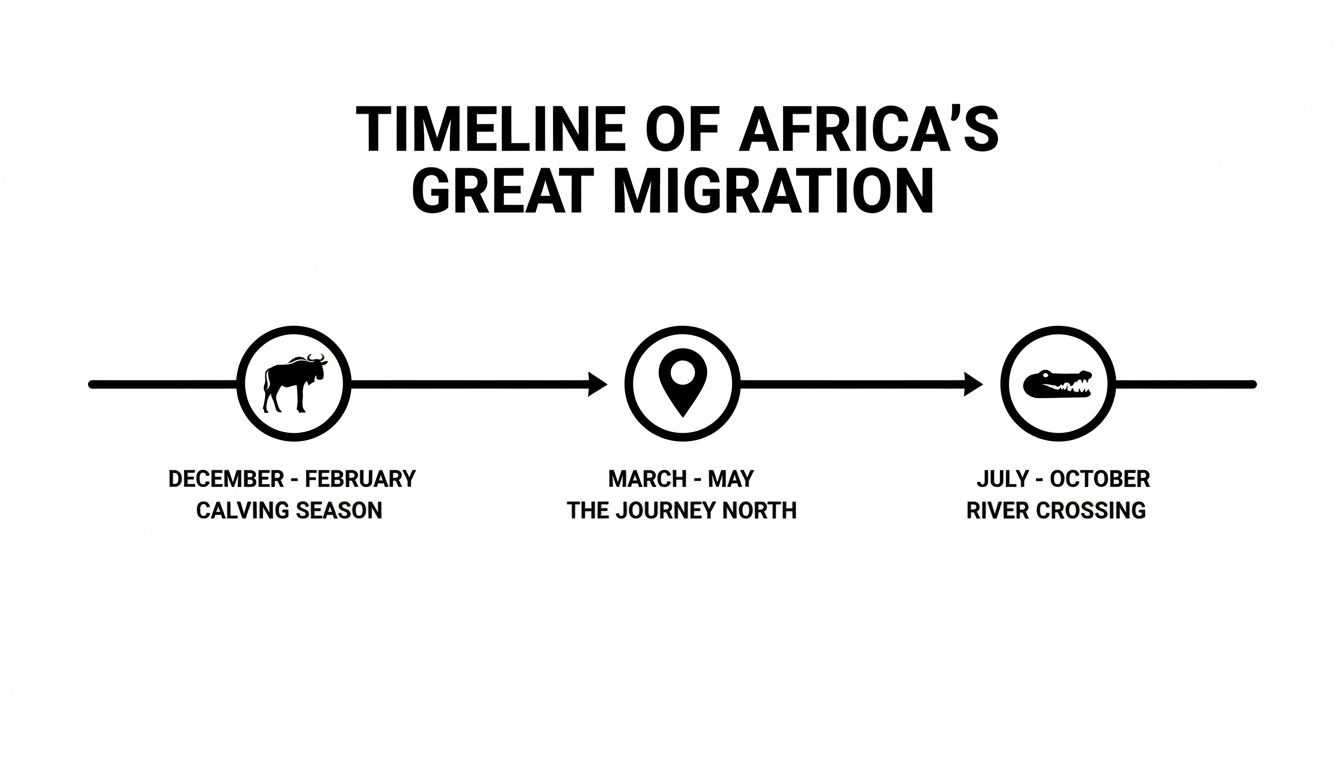
The key takeaway is that the migration is never static. It's a fluid, continuous search for resources, and each chapter offers a distinct and powerful experience for the traveler who knows where to look.
January to March: The Calving Season
- The Spectacle: A population boom of breathtaking scale. The immense, short-grass plains of the southern Serengeti become a sprawling nursery, rich with volcanic soil that fuels the grass for expectant mothers. In a remarkably synchronized window, an estimated 500,000 wildebeest calves are born.
- The Drama: The sheer numbers—peaking at 8,000 births per day—are a strategy to overwhelm predators. Yet, this abundance of vulnerable life draws Africa's top hunters, turning the plains into a theater of life and death.
- The Location: Southern Serengeti & Ngorongoro Conservation Area, Tanzania.
- The Experience: Unrivaled predator action set against the profound beauty of new life.
April to June: The Northward Journey Begins
- The Spectacle: The exodus. As the long rains recede and the southern plains dry out, a primal trigger sends the herds moving. A vast, fractured column of animals begins the long trek north and west, chasing the promise of fresh grass and water.
- The Drama: The first major obstacle. Their path takes them through the Serengeti's Western Corridor, where they face the Grumeti River. Its deep channels and resident crocodiles present a formidable and often lethal test.
- The Location: Central to Western Serengeti, Tanzania.
- The Experience: Witnessing the immense scale and determination of the herds on the move.
The migration is driven entirely by the rhythm of the rains. The herds will leave an area as late as possible and return as soon as they can, meaning every year—and every week—presents a different scenario.
July to October: The Great River Crossings
- The Spectacle: The main event. The dramatic, chaotic spectacle that defines the Great Migration in the world's imagination. The herds pour into the Northern Serengeti and Kenya's Masai Mara, where they confront their greatest challenge: the Mara River.
- The Drama: The tension on the riverbanks is palpable. Thousands of wildebeest gather, hesitating before the desperate, life-or-death plunge into the crocodile-filled currents. It is a moment of pure instinct and panic.
- The Location: Northern Serengeti, Tanzania & Masai Mara, Kenya.
- The Experience: One of the most profound and sought-after sights in the natural world.
November to December: The Return South
- The Spectacle: The homecoming. As the short rains begin to fall in November, the cycle turns. The scent of new grass from the south pulls the herds back toward Tanzania, moving down through the northeastern Serengeti and the Lobo area.
- The Drama: A slow, steady procession. This leg of the journey is less of a frantic scramble and more of a grand parade. The herds spread out, grazing and regaining their strength.
- The Location: Eastern Serengeti, Tanzania.
- The Experience: A more serene, expansive view of the herds as they complete their colossal clockwise circuit.
Securing Your Front-Row Seat to the Spectacle
There's a profound difference between simply seeing the Great Migration and experiencing it. One involves crowds and fixed schedules; the other is about seclusion, freedom, and an unrivaled position for nature's greatest drama.
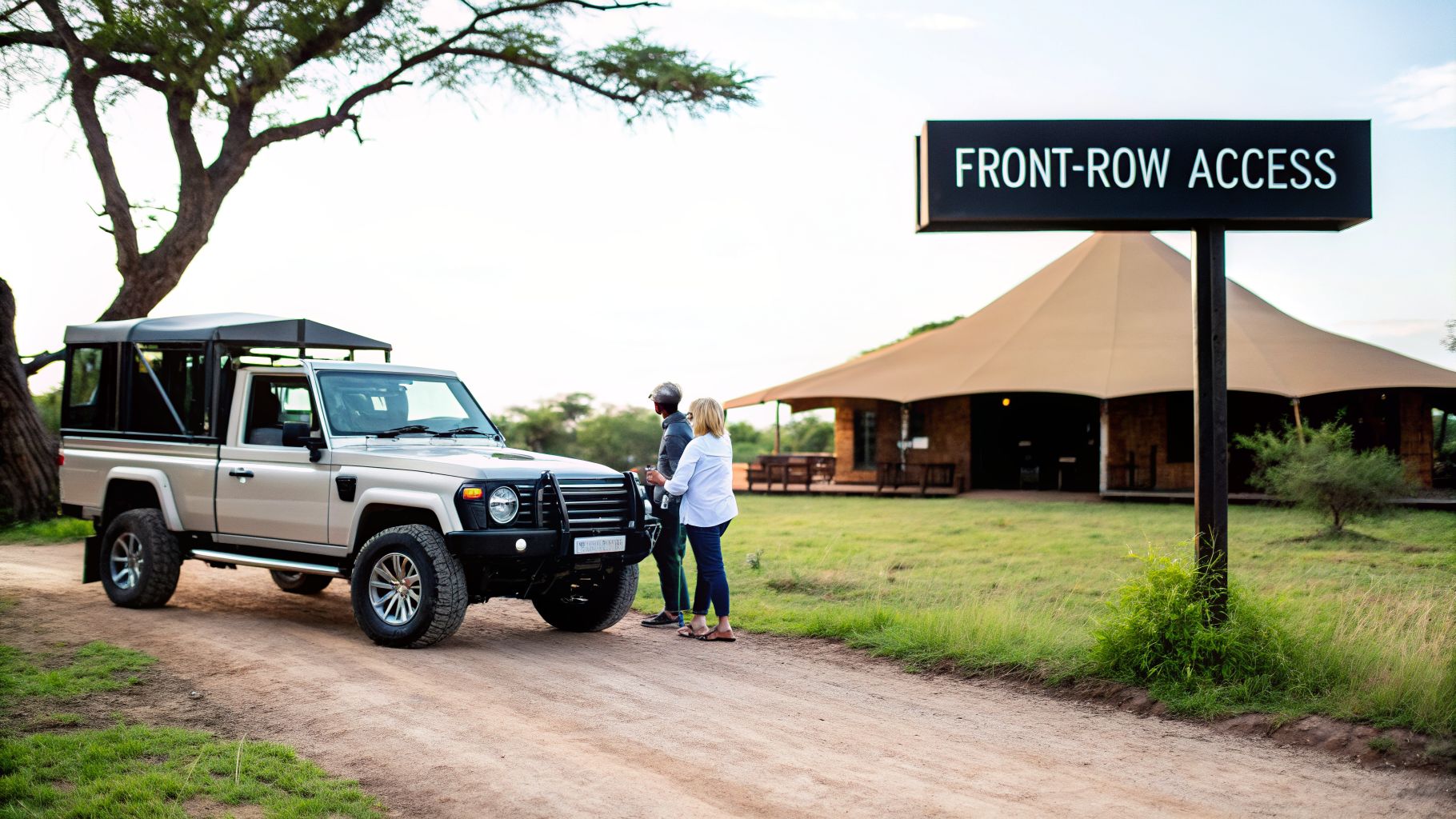
The secret? It all comes down to a single word: access. While most safari-goers are confined to the public roads of the national parks, our clients enter a different world altogether—the vast, unfenced private conservancies that border them.
The Conservancy Advantage: A Tier Above
Think of a private conservancy as your personal slice of the Serengeti or Masai Mara, reserved for just a handful of discerning guests. Here, the rules of engagement are rewritten, allowing for a far more intimate and flexible safari.
- Off-Road Driving: In a national park, your vehicle must stay on the path. In a conservancy, your guide can drive off-road to position you perfectly as a leopard descends from a tree or a lioness stalks her prey through the long grass.
- Night Drives: The bush reveals a second, hidden life after sunset. Night drives are forbidden in the national parks, but in a conservancy, they offer a rare window into the world of nocturnal hunters like hyenas and civets.
- Walking Safaris: To truly connect with the savanna, you must feel it under your feet. A walking safari with an armed guide is a powerful, sensory experience—the scent of wild sage, the feel of the earth, the distant calls of the wild—that a vehicle can never replicate.
These are not just activities; they are privileges that transform your role from a mere spectator into an active participant in the ecosystem.
The Power of Elite Partnerships
Our ability to place you in these exclusive settings is built on decades of personal relationships. As a member of the Four Seasons Preferred Partner and Belmond Bellini Club programs, we unlock a level of service and access that is simply not available to the public. This means:
- Securing the best-located suites with views over the plains.
- Pairing you with the most accomplished private guides.
- Gaining entry to prime wildlife areas away from any other vehicles.
For a journey of this magnitude, many find that exploring travel agency payment plans helps make the commitment more manageable.
We don't just book rooms; we secure vantage points. Our status ensures our clients are recognized as VIPs, receiving the kind of intuitive service and quiet attention that defines the Haute Black experience.
This access also extends to intelligence. Recent data, using AI analysis of satellite imagery, has revised the wildebeest count to just under 600,000 individuals. This doesn't diminish the spectacle—the columns of animals are still immense—but it refines our strategy, allowing us to pinpoint smaller, under-the-radar concentrations of wildlife with incredible accuracy.
Seamless Logistics, Flawless Execution
Getting you to the heart of the action is only half the battle; moving between these remote, exclusive locations must be equally effortless. This is where our deep expertise in private aviation becomes indispensable.
We replace long, bumpy road transfers with private charter flights, moving you swiftly from one luxury camp to the next. Not only does this maximize your time on safari, but it also offers breathtaking aerial perspectives of the vast herds on the move below. You can learn more about how we choreograph these transitions in our guide to luxury air travel services.
By weaving together exclusive-use properties, trusted partnerships, and flawless logistics, we ensure your view of the Great Migration is exactly where it should be: far from the crowds, deep in the heart of the wilderness.
Crafting Your Bespoke Migration Safari
An exceptional safari isn't an off-the-shelf product. It's a journey orchestrated around your specific desires, moving beyond a simple timeline and into a personal story, where every day delivers a distinct and powerful experience.
This is where true expertise in curation comes into play. We design itinerary concepts that are masterpieces of logistics and exclusive access, built for the traveler who demands more than just a view—they demand an unforgettable narrative.
The River Crossing Specialist
For the traveler who thrives on adrenaline and demands a front-row seat to nature's most dramatic spectacle, this itinerary is laser-focused on the Mara River crossings between July and October. The journey is defined by three pillars:
- Pillar 1: Aerial Access. A private charter flight directly into the Northern Serengeti or a private conservancy bordering the Masai Mara, offering a breathtaking first glimpse of the immense herds spread across the plains below.
- Pillar 2: Mobile Luxury. Your base is a luxury mobile camp—elegant, canvas-walled suites that are strategically moved to follow the herds, ensuring you are always in the heart of the action.
- Pillar 3: Strategic Patience. Days are spent with your expert private guide on the banks of the Mara, observing the massive build-up of wildebeest, feeling the tension rise before the chaotic plunge into crocodile-infested waters.
A signature moment we arrange is a private bush breakfast at a secluded viewpoint overlooking a known crossing point. While others jostle for position, you dine in splendid isolation, waiting for the spectacle to unfold.
The Calving Season Connoisseur
Designed for the discerning photographer and wildlife purist, this itinerary focuses on the profound beauty and raw drama of the calving season from January to March. The journey takes you to the southern Serengeti's endless short-grass plains, where new life begins on a staggering scale. This experience is curated through:
- Intimate Drama: The focus shifts from chaos to intimacy. The landscape transforms into a vast nursery where over 500,000 wildebeest calves are born, attracting an unparalleled concentration of predators.
- Supreme Comfort: We position you in one of the few permanent luxury lodges or exclusive-use villas in the Ndutu region. Our relationships with properties like the Four Seasons Safari Lodge Serengeti ensure you have the best guides, who possess an almost supernatural ability to predict where the action will unfold. Exploring our curated collection of luxury hotel partnerships reveals the caliber of accommodations we secure.
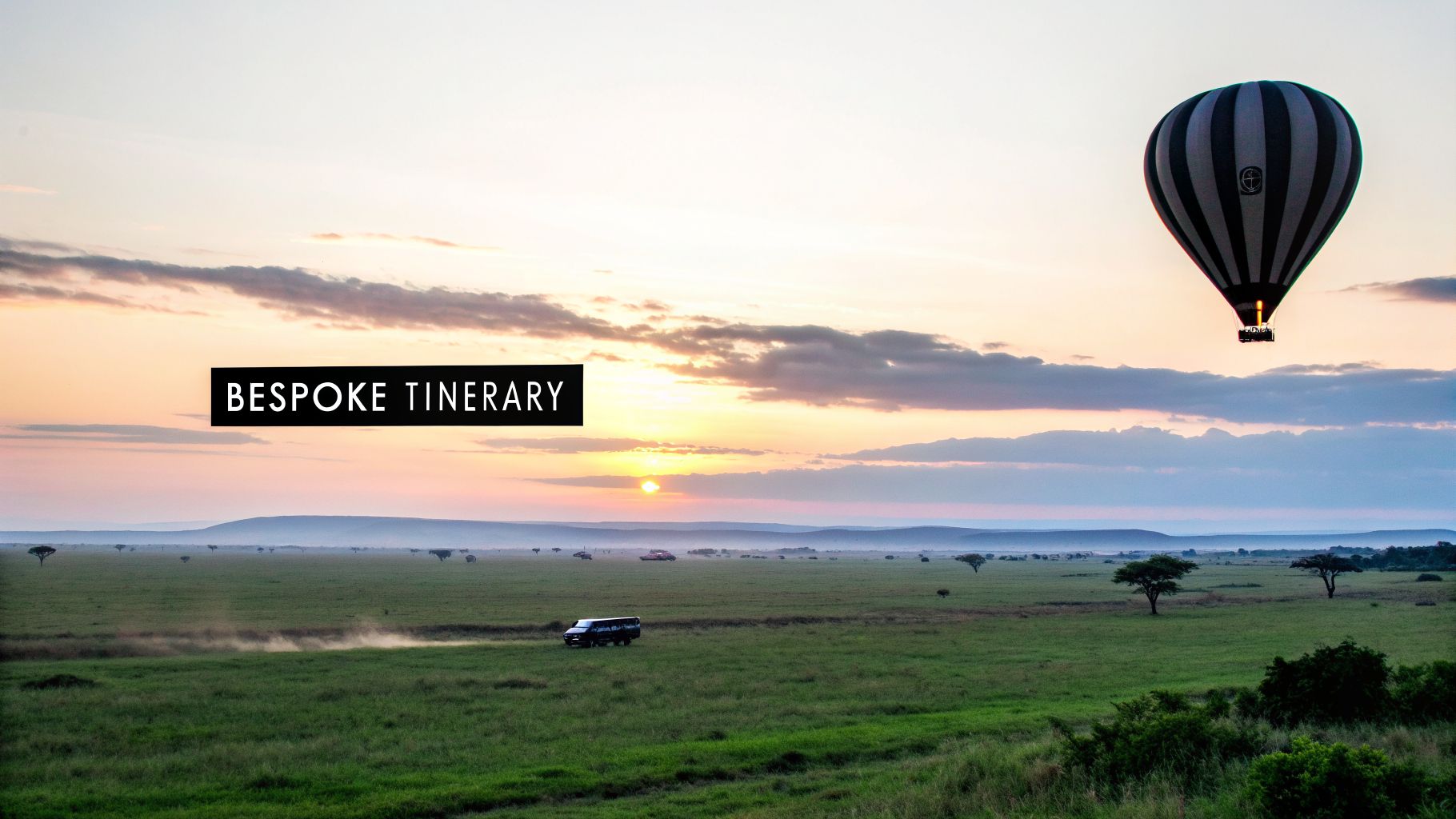
- Unrivaled Perspective: A signature experience for this itinerary is a private sunrise hot-air balloon safari. Float silently above the plains as the first light illuminates tens of thousands of mothers and their calves. Upon landing, a champagne breakfast awaits you in the middle of the bush.
Sample Bespoke Itinerary: The River Crossing Specialist
This 10-day concept illustrates how we weave together seamless logistics, exclusive access, and high-end comfort to create the ultimate river crossing safari.
- Days 1-3: Arrive via private charter to Kogatende, Northern Serengeti. Settle into your luxury mobile camp. Begin daily game drives focused on tracking herd movements toward the river. Exclusive: Sundowner cocktails at a private viewpoint overlooking the Mara River Valley.
- Days 4-7: Full-day game drives dedicated to witnessing river crossings. Your guide uses a network of intelligence to predict the most likely crossing points, avoiding crowded areas. Exclusive: A private, lantern-lit bush dinner under the acacia trees, far from any other camp.
- Days 8-10: Fly to a private conservancy in the Masai Mara for a different perspective. Enjoy off-road driving and night drives—privileges not allowed in the main reserve. Depart via private charter. Exclusive: A guided walking safari along the escarpment with a Maasai warrior, offering an intimate connection to the land.
Each itinerary, whether centered on the river crossings or the calving season, is merely a starting point. We build upon these concepts, incorporating your personal interests to design a journey that is deeply personal and utterly unforgettable.
Conservation: The Heartbeat of the Ecosystem
For the modern traveler, luxury is no longer just about thread counts and vintage champagne; it's about purpose. A journey's true value lies in its impact, and the Great Migration is more than a wildlife spectacle—it is the very pulse of a vast, fragile ecosystem. To witness it is to also become a steward of its future.
The Four Pillars of Your Impact:
- Direct Funding: Park fees and conservancy levies directly fund anti-poaching patrols and habitat preservation.
- Community Empowerment: Your presence creates a sustainable economic model where wildlife is worth more alive than dead.
- Scientific Research: Tourism revenue supports critical research to protect the migration's future.
- Cultural Preservation: It provides a powerful incentive for local communities, like the Maasai, to protect their ancestral lands.
The Human Story of the Land
The story of the migration is inextricably woven with the human story of the land, particularly that of the Maasai people. For centuries, these pastoralist communities have coexisted with the wilderness, their lives moving to the same seasonal rhythms that drive the great herds.
A truly meaningful safari must honor this cultural heritage. Our itineraries are designed to create respectful, authentic cultural encounters that go far beyond a simple village tour. Through trusted local partners, we arrange private visits to a Maasai community, offering a genuine glimpse into their daily lives—not a staged performance, but an opportunity for real connection.
A Deeper Connection Through Responsible Travel
Engaging with the cultural and conservation side of the Great Migration enriches the experience immeasurably. It transforms a trip from passive observation into active participation in the region's story. For those seeking an even more profound connection, exploring opportunities in ethical wildlife conservation volunteering can provide invaluable experiences that extend far beyond a typical safari.
This idea of movement—both animal and human—inspires our approach. Beyond the thundering wildebeest, Africa's own Great Migration of people tells a parallel story, with 40.6 million African migrants worldwide in 2020 shaping global economies. You can read more about these complex migration dynamics on the Mo Ibrahim Foundation's site. We channel this inspiration into journeys that blend wildlife lore with VIP access, such as private flights over the wildebeest trails followed by exclusive dinners with Maasai elders.
By choosing a safari that actively supports conservation and respectfully engages with local cultures, you are not just a tourist. You become a patron of preservation, ensuring that the thunder of hooves continues to echo across these plains for centuries to come.
Your Migration Safari Questions, Answered
Planning a journey of this magnitude always brings up important questions. We've found that a few key details make all the difference, so we've answered the most common inquiries we receive from our clients.
When Is the Best Time to Witness the Migration?
There is no single "best time." Instead, we plan around strategic windows that align with the specific spectacle you want to witness.
- For River Crossings: The only time to see the dramatic Mara River crossings is between late July and October. The herds are concentrated in the Northern Serengeti and Kenya's Masai Mara.
- For Calving Season: The prime window to see the southern plains transformed into a massive nursery is January through March. This is when thousands of wildebeest are born each day.
How Far in Advance Should I Book?
We advise our clients to plan a Great Migration safari 12 to 18 months in advance. This is not a suggestion; it's a necessity.
The most exclusive camps—those with commanding views and unparalleled guide access—are small, intimate, and booked more than a year out. Securing them requires foresight. For more context on planning your first journey of this kind, our [African safari guide for first-timers](https://www.hauteblack.com/guides/african-safari-first-timers) is an essential read.
The most coveted safari experiences are never last-minute opportunities. They are the direct result of meticulous, long-range planning that secures the best resources before anyone else can.
Can We Bring Our Family?
Absolutely. A migration safari can be a profound, life-shaping experience for children when designed with their needs in mind. We curate family journeys around lodges that offer dedicated children's programs, private vehicles that allow for complete flexibility, and guides who excel at engaging younger minds, ensuring a seamless and inspiring adventure for all.
The Great Migration is more than a trip; it is a life-defining experience. At Haute Black, we don't just book safaris—we curate access to the heart of the action. Let us design your bespoke migration journey.
Explore Our Guides
Signature Experiences