Haute Black Journal
Trips to Ghana Africa: The Luxury Travel Guide for 2026

Marlene Azeez
Director, HauteBlack
View all articles →

# Trips to Ghana Africa: The Luxury Travel Guide for 2026
Published August 12, 2026 by Marlene Azeez
You've probably had this trip sitting in the background for a while, somewhere between “I should finally do Ghana properly” and “I don't want a messy logistics week.” Good. That's the right starting point. Trips to Ghana Africa work best when you stop treating the country like a quick coastal add-on and start treating it like a layered, multi-center journey, one where Accra, Cape Coast, Kumasi, and the north each earn their place.
Done well, Ghana feels like a private arrival, not a standard holiday. The car is waiting at Kotoka, your room is prepped, your guide is already briefed on the pace you want, and the trip immediately feels more considered than the usual West Africa first-timer itinerary. The country's rebound has given luxury travelers more reason to pay attention, with the Ghana Tourism Authority reporting 1,288,804 international arrivals in 2024, about $4.82 billion in tourism receipts, and an average stay of 13 nights. That's not a niche stop, it's a destination with enough depth to justify real planning, especially for travelers who want culture, coastline, heritage, and wildlife in one trip. Ghana's 2024 tourism report summary
If you're the kind of traveler who wants the right room, the right guide, and no wasted movements, Ghana is worth a serious look. The best version of this trip isn't improvised. It's designed.
Why Ghana Belongs on a Luxury Travel Map in 2026
A proper Ghana arrival starts with control. Your driver meets you at Kotoka, the bags move fast, and you're in a quiet residence in Cantonments or Airport Residential before the city noise gets a vote. That first evening matters because Ghana isn't a place to arrive tired and then figure out on the fly. It rewards travelers who want the trip choreographed from the airport door onward.
Ghana now belongs in a luxury rotation because it supports a real private-travel pattern, premium air access, longer stays, and itineraries that can move cleanly between city, heritage, and interior regions. The tourism reporting already points to stronger demand and broader traveler motives, including family visits, holidays, and study or teaching, which is exactly why a one-note sightsee-and-leave plan feels thin here. Ghana tourism data coverage

The arrival tells you everything
If your first night is handled properly, the rest of the trip gets easier. A good advisor won't just book Accra, they'll assign the right neighborhood, the right arrival timing, and a residence that can absorb jet lag, family baggage, and a late dinner without friction. That is why the right advisor changes everything in Ghana.
Practical rule: If the trip starts feeling complicated before you leave, it is under-planned. Ghana should feel busy on the ground, not messy in the setup.
For travelers used to safari circuits, Ghana feels more urban, more social, and more emotionally layered. One evening might be cocktails in Accra, the next day a castle visit, then a move into the Ashanti interior or the savanna. That mix is exactly why a coastal weekend frame is too small for the country. The smarter read is multi-center luxury, and Ghana is one of the few West African destinations where that model works.
If you want a broader view of African destinations worth building into a private itinerary, the editorial overview at places to visit in Africa is a useful companion, but Ghana deserves its own plan, not a side mention.
Entry Requirements and Health Preparation
Do the admin first, and do it early. Visa posture, yellow fever proof, malaria prevention, and payment readiness are the four things that can turn a polished trip into a stressful one if you leave them too late. Ghana is not a place to wing the pre-departure paperwork.
Your departure-week checklist
Start with the document basics. Government travel advice says travelers should have proof of yellow fever vaccination on arrival, and some travel-health guidance states the certificate is required for travelers nine months or older. The vaccine should be handled well before departure, not at the airport. Ghana also has a widespread chloroquine-resistant malaria profile, so chemoprophylaxis and mosquito avoidance aren't optional details, they're operational necessities. Government of Canada travel advice for Ghana and Ghana travel health reference
Then move to practical contact details. Ghana's international calling code is +233, and Accra is the capital, so put both into your phone now, along with your driver, hotel, and concierge contacts. If you're carrying multiple passports, keep the one used for entry in a secure, easy-to-reach place. A full grain leather passport case from Grain Mark Leather is the kind of small travel object that keeps documents together without turning your pocket into a mess.
Payment planning matters too. In urban areas, cards can work well, but cash still makes many local transactions smoother, especially for drivers, tips, markets, and smaller expenses. Carry a mix, and don't assume every venue will be card-first just because you're staying in a polished neighborhood.
Bring more than one way to pay. Private travel fails fastest when the card machine is the only plan.
What to do before you fly
Thirty days out, confirm your visa status, schedule any required shots, and ask your doctor about malaria medication. Seventy-two hours out, reconfirm airport transfers, check your arrival terminal, and make sure your phone can handle roaming or an eSIM. In hand luggage, keep the passport, vaccination proof, insurance details, cards, and a small reserve of cash together.
For planning around luggage, documents, and coordination, the practical route is to build a real pre-departure pack list, not a last-minute folder dump. Ghana doesn't punish careful travelers, but it does expose sloppy ones quickly.
Choosing the Right Season for Your Trip
The best time for trips to Ghana Africa depends on what kind of trip you're taking. If you want a beach escape, one season makes more sense. If you want wildlife, another window is smarter. If you're traveling for heritage or family connection, your timing should reflect the emotional rhythm of the journey, not just the weather.
Dry season is the cleanest all-around choice
For the most reliable end-to-end trip, choose November to March. That's the dry window, and it's the easiest period for moving between Accra, Cape Coast, Kumasi, and the north without weather interruptions complicating road time or outdoor plans. If you're doing a first trip and want the least friction, this is the safest recommendation.
If your focus is cultural travel, April to June can work well because the pace is softer and the country feels less compressed than peak festive periods. That makes it a strong choice for museum visits, palace access, gallery time, and private heritage sequencing. You'll still want a good driver and a flexible schedule, but the mood suits travelers who care about depth over scene-making.
For travelers who want Accra's creative energy and nightlife at full volume, September to November is a smart sweet spot. It's also a useful window for slower, locally grounded travel, especially if you want a more immersive route with local restaurants, guesthouses, and private guides.
My view: If this is your first serious Ghana trip, pick the dry season. If it's a return trip and you care more about atmosphere than perfection, shoulder season can be better.
Festive December is its own category. Availability tightens, private access gets more expensive, and the city becomes much more active. That's great if you want energy, but it's the wrong month if you're looking for calm. July and September carry more rain risk, yet they can work for travelers who value quieter camps and more flexible private access.
The right answer isn't “best month.” It's best month for your version of the trip.
The Three Regions That Anchor a Luxury Trip
Ghana works when you stop thinking in single-city terms. A serious itinerary usually lives in three different identities, the coast, the Ashanti interior, and the north. Those regions don't compete with each other, they create the trip's rhythm.
| Region | Travel Time from Accra | Signature Experience | Best For |
|---|---|---|---|
| Southern Coast | Shortest and easiest, with Cape Coast and western beaches reached more comfortably than interior routes | Castle visits, beach time, Kakum canopy walks, first-trip pacing | First-timers, couples, shorter luxury breaks |
| Ashanti Interior | Requires a deliberate transfer from Accra | Manhyia Palace access, kente heritage, royal and craft traditions | Heritage travelers, family groups, culture-first itineraries |
| Northern Ghana | The longest and most strategic move | Mole National Park and savanna safari logic | Travelers who want Ghana to include wildlife, not just coastline |
Coast, court, and savanna each do a different job
The Southern Coast is where you start if this is your first visit and you want a clean mix of city, history, and beach. Accra gives you the urban introduction, Cape Coast gives you historical gravity, and the western shoreline can add a softer resort finish. This region suits travelers who want elegance without overcomplication.
The Ashanti Interior is the emotional and cultural center of the trip. Kumasi and its surrounding craft and palace network make Ghana feel richer than the usual coastal narrative. If your interest is heritage, family history, or royal context, this is the region that gives the journey depth.
Northern Ghana changes the whole tone. Mole National Park gives the trip a safari logic, and that matters for travelers who don't want Ghana to feel like a museum corridor with a beach attached. If you've got enough time and the right level of mobility, the north makes the itinerary feel complete.
Use the regions deliberately. Don't try to “see all of Ghana” in one week. That approach creates tired travelers and shallow memories.
A 7 to 10 Day Private Itinerary Framework
A well-built Ghana trip should move like a private commission, not a checklist. The sequence matters, the handoffs matter, and the properties matter. Accra should warm up the trip, Cape Coast should deepen it, Kumasi should give it texture, and Mole, if included, should finish it with space.
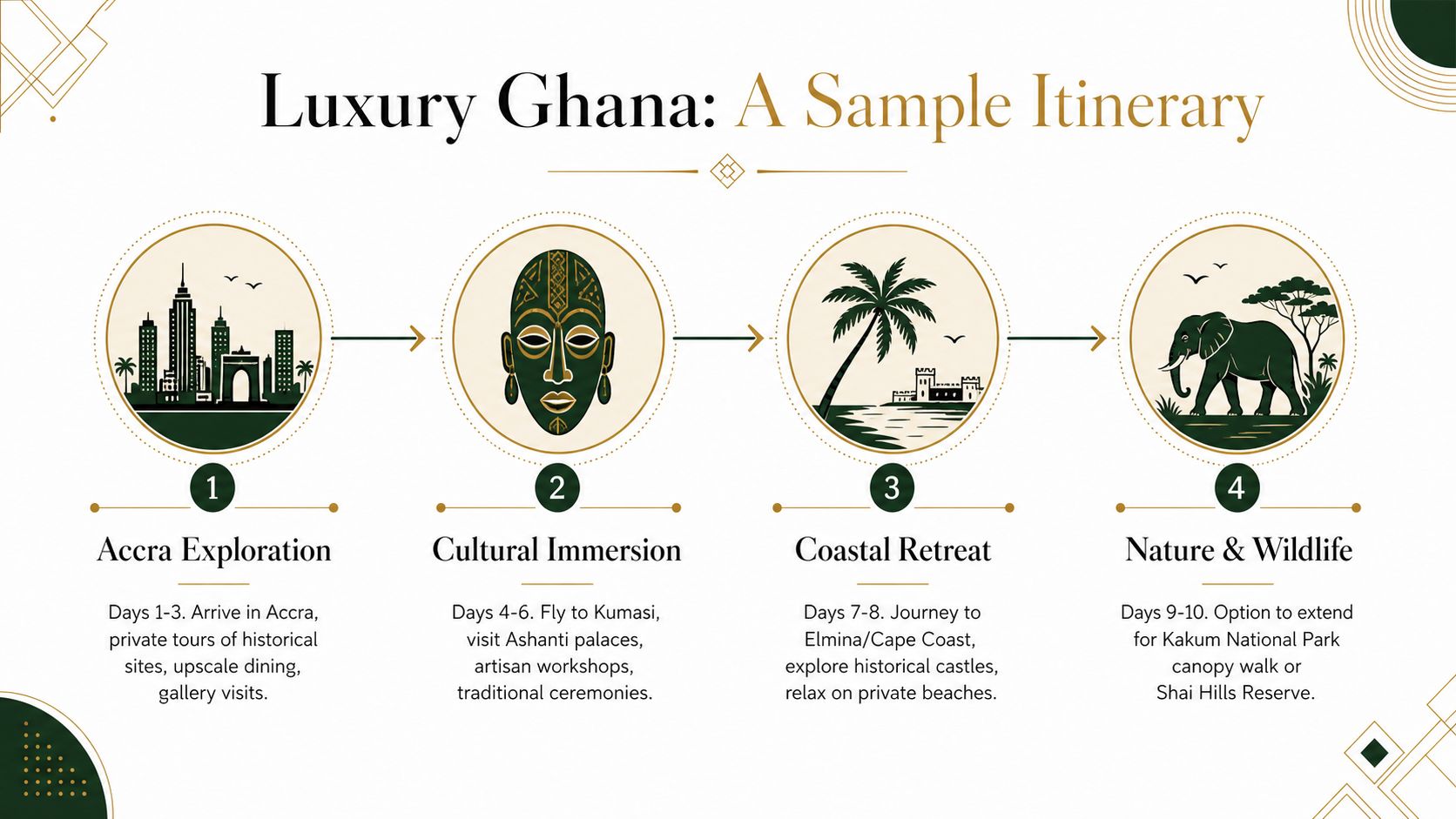
Days 1 to 3 in Accra
Start with three nights in Accra, ideally in Cantonments, Airport Residential, Osu, or Labone. Pick a residence that handles early check-in, private transfers, and dining without drama. Your guide should hit the National Museum, Jamestown, and the high-end culinary and music scene with enough breathing room to keep the day from feeling overpacked.
Accra works best when the itinerary mixes history and style. One afternoon can be museum-led, another can be a gallery walk, and the evening can move to a polished dinner reservation. If you're with family, these days should be your soft landing.
Days 4 to 5 on the coast
Move to Cape Coast for the castle sequence and a private day around Kakum National Park. The canopy walk is the obvious name, but the true value comes from how the day is arranged, the transfer timing, a private heritage visit at Cape Coast Castle, and a quieter coastal lunch or dinner after the emotional weight of the site.
A coastal estate or discreet beach property works best here. This isn't the time for a noisy resort scene. You want space, good service, and a setting that lets the day breathe.
Days 6 to 7 in Kumasi, then north if needed
Visit Kumasi for Manhyia Palace and Ashanti craft visits. If the itinerary is heritage-heavy, it deepens here. If you've got the time and energy, continue north for Mole National Park and build in a private safari with a single-vehicle tracker.
If you want a deeper customization framework for private routing, customized travel itineraries and bespoke journeys is the right idea to keep in mind when the standard package won't do.
Add a buffer day if the trip includes the north. Ghana rewards slack in the schedule, especially when weather, road time, or family pacing enters the picture.
VIP Experiences That Define a Private Journey
The difference between a normal Ghana trip and a proper private one is access. Anyone can visit a castle or buy a market souvenir. True luxury is how the day is arranged, who opens the door, and whether the experience feels personal.
Ask for access, not just admissions
If you care about heritage, ask for after-hours private access at Cape Coast Castle or Elmina Castle. That changes the tone completely. With fewer people around, the site feels more reflective and less transactional, which matters for diaspora travelers and family groups who don't want the day to feel performative.
For Ashanti heritage, a courtesy meeting at Manhyia Palace arranged through the right channels is the kind of detail that gives the trip authority. Pair that with a private kente-weaving masterclass in Bonwire, and the region stops being a sightseeing stop and becomes an actual cultural encounter.
Accra deserves its own curated treatment too. A chef's table in one of the city's better dining rooms, followed by a private gallery walk or a guided highlife music session, turns the capital into a polished opener rather than a logistical stopover. That's the move for couples and executive travelers who want a refined evening without a club scene.
Sequence the emotional weight properly
Heritage travel demands pacing. Don't stack every heavy site back-to-back. Put lighter days around the most emotionally charged visits, especially if you're traveling with parents, teens, or grandparents. The best advisors understand that an ancestral or memorial trip can feel powerful without being exhausting.
Private travel rule: Heritage trips should be curated like fine dining, not rushed like museum tourism.
Some experiences are worth the cost because they change the quality of the trip. Private access, trusted guides, and proper sequencing are high-value. Anything that feels packaged just to sound exclusive usually isn't. For travelers who want emotionally grounded travel, Ghana works beautifully when the advisor respects that balance.
Logistics, Security, and Local Etiquette
Mobility is where luxury in Ghana gets tested. You can have an excellent itinerary and still get a poor trip if transfers are sloppy, drivers aren't briefed, or security habits are casual. The U.S. Embassy advises travelers to exercise increased caution because of crime, poor health infrastructure, violence against women, and violence against lesbian and gay travelers. That's not background noise. It's the framework for how you move. U.S. Embassy Ghana security advisory
How to move without attracting unnecessary attention
For arrivals into Accra, private aviation via Kotoka is straightforward when handled by the right team, and ground support should be waiting before wheels down. If your trip includes coast or north connections, helicopter transfers can make sense for select itineraries, but they should be used for efficiency, not theater. Most travelers are better served by secure chauffeur-driven vehicles with disciplined handoffs between regions.
If the route requires a higher level of protection, then executive protection services become relevant. The point isn't paranoia; it's removing friction where the itinerary or profile justifies extra control.
Etiquette that actually helps
Dress modestly for royal or traditional settings, especially in the Ashanti interior. Ask before photographing people or ceremonial spaces, and don't assume every cultural site is a free-for-all with your camera. Tipping should be handled discreetly and consistently, not dramatically.
A few ground rules keep the trip smooth:
- Keep valuables out of sight. Don't advertise watches, jewelry, or devices.
- Use your guide as the first point of contact. They should handle the social pace.
- Stay low profile at night. The safest traveler is the one who doesn't look obvious.
- Respect elders immediately. Ghanaian etiquette rewards polite deference.
The luxury version of Ghana is not about being insulated from local life. It's about moving through it with good timing, good posture, and the right support.
Booking, Concierge, and Traveling With Impact
A Ghana booking should read like an operations brief, not a room list. A generic DMC will sell you hotels and transfers. A serious advisor will specify room categories, private guides, private vehicles, dietary handling, and security preferences before the quote goes out. That is the difference between a trip that looks acceptable on paper and one that works on the ground.
What to ask for when you request a quote
Use the same discipline you would apply when reviewing online tour booking platforms compared. The booking engine matters less than whether the itinerary has the right handoffs, the right pacing, and one accountable person when plans change.
A Virtuoso-affiliated advisor usually brings preferred-partner access, stronger property relationships, and better influence around upgrades or extra amenities when they are available. A generic operator may still get the routing done, but the experience tends to feel transactional. For travelers who want this trip managed with fewer calls and faster decisions, a dedicated advisor is the cleaner path. For travelers who want the planning side handled at a higher standard, a guide to luxury travel concierge services is the right place to start. Haute Black is one option for bespoke planning and VIP travel support across destinations, and Ghana fits that model well when the trip needs private transfers, concierge coordination, and a higher-touch arrival.
Travel with impact should be practical, not theatrical. Choose locally owned beach retreats where it makes sense, buy from Ashanti craft cooperatives directly, and, if the trip is heritage-centered, include thoughtful donations or visits that support the institutions you are engaging with. That approach matters more than generic responsible-travel language that does nothing.
Families do well in Ghana when the plan respects energy levels. Couples can use Ghana for a short honeymoon, but only if they are realistic about moving between regions. Budgeting should also be grounded. The airfare and on-the-ground spend ranges used in major travel guidance place the trip in a broad middle ground, not a bargain-bin category, as noted in Goway's Ghana cost guidance.
For a custom-designed version of this journey, including resort selection, private routing, and concierge coordination, start with Haute Black. If you want Ghana designed as a serious private trip, not a stack of disconnected bookings, that is the level of planning to ask for.
Explore Our Guides

Signature Experiences


