Haute Black Journal
Travelling to Borneo: Luxury Travel Guide 2026

Marlene Azeez
Director, HauteBlack
View all articles →

# Travelling to Borneo: Luxury Travel Guide 2026
Published August 10, 2026 by Marlene Azeez
You're probably looking at Borneo because you want the rare thing, not the obvious one. That's the right instinct. Travelling to Borneo well is about matching ambition to logistics, because the island rewards travelers who treat it like a multi-country expedition, not a beach escape with a few jungle add-ons.
Borneo is not a single polished circuit. It's a vast island split between Indonesia, Malaysia, and Brunei, and that scale is why the smartest trips feel bespoke from the moment you land. The difference between a frustrating itinerary and a flawless one is usually not the lodge you book, it's whether your routing, transfers, power setup, and weather timing are handled with precision.
Introduction to High-End Travelling to Borneo
You step off the aircraft into warm, wet air, and the tarmac already tells you the truth about Borneo. This isn't a place where luxury means predictability. It means someone has already arranged the helicopter, the river boat, the backup car, and the cold towel before you even ask.
That's the standard worth demanding. In Borneo, remote nature and discreet service can work beautifully together, but only if the itinerary is engineered for it. The island's geography is too large and too divided to leave to improvisation, especially if you're moving between Sabah, Sarawak, Kalimantan, and Brunei.
Luxury here should feel calm, not complicated. Your lodge can be deep in rainforest and still deliver polished service, but the experience depends on advance planning for the gaps between the polished moments. That means choosing the right gateway, locking in realistic transfer times, and assuming you'll need more than one transport mode.
Practical rule: if a Borneo itinerary sounds simple on paper, it's probably underplanned.
The appeal is obvious once the logistics are handled. Borneo delivers old-growth rainforest, river systems, wildlife, and a sense of distance that's hard to fake elsewhere. For affluent travelers, that is the draw, because the island still feels remote while remaining accessible to a well-run private itinerary.
Understanding Borneo Scale Seasons
The island is bigger than most travelers expect
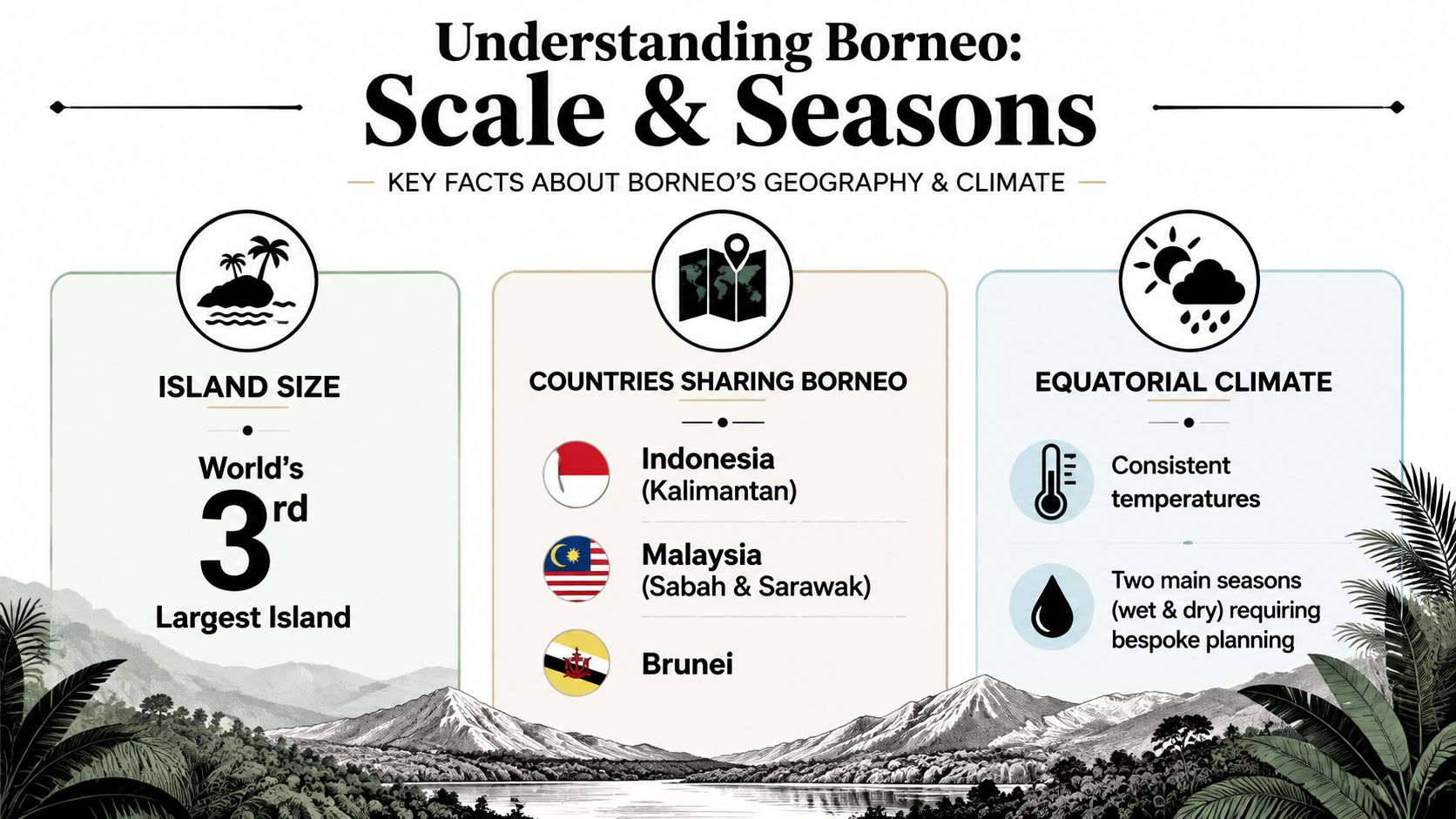
Borneo is the third-largest island in the world, spread across Indonesia, Malaysia, and Brunei (factsanddetails.com). That scale changes the way you plan. You are not booking one compact destination, you are building a route across several gateways, with each country demanding its own routing logic.
For luxury travelers, domestic flights and river transfers are not add-ons, they are the structure of the trip. A well-run itinerary connects Sabah, Sarawak, Kalimantan, and Brunei through a mix of air, road, and boat movement, because the distances are too large to rely on overland travel alone. The island's size also explains why the most rewarding nature areas can feel far apart even when they look close on a map.
Borneo's low population density is part of the appeal. It also explains why the island still feels unusually wild, and why high-end travel here depends on specialist handling rather than standard tour logic. For clients who want the trip done properly, this is the kind of destination where route design matters as much as the lodge selection. A useful reference for route planning across the archipelago is this Indonesia luxury travel guide from Haute Black.
Seasons shape the trip as much as the geography
Borneo's climate is equatorial, with heat, humidity, and frequent rain as constant companions through the year (oysterworldwide.com). Pack for wet conditions regardless of when you travel. The island is often described as having a drier stretch from March to September and a wetter monsoon period from October to February (oysterworldwide.com).
The seasonal pattern matters most in the field. The northeast monsoon generally runs from November to March, while the southwest monsoon/drier period runs from May to October, with no hard boundary between the two (Bradt Guides). Use the drier months for easier river access, smoother lodge arrivals, and more reliable coastal movement. Shoulder periods still have value if you want thicker jungle atmosphere and do not mind more weather volatility.
If your priority is smooth logistics, choose the drier months. If your priority is lush forest energy, shoulder periods can be compelling, provided you accept more weather volatility.
This island rewards clients who respect its scale and its weather. Move slowly, book transfers carefully, and let the itinerary reflect the terrain instead of forcing a generic island template onto it.
Planning Logistics Visas Health Transfers
Build the entry plan before you book the lodges
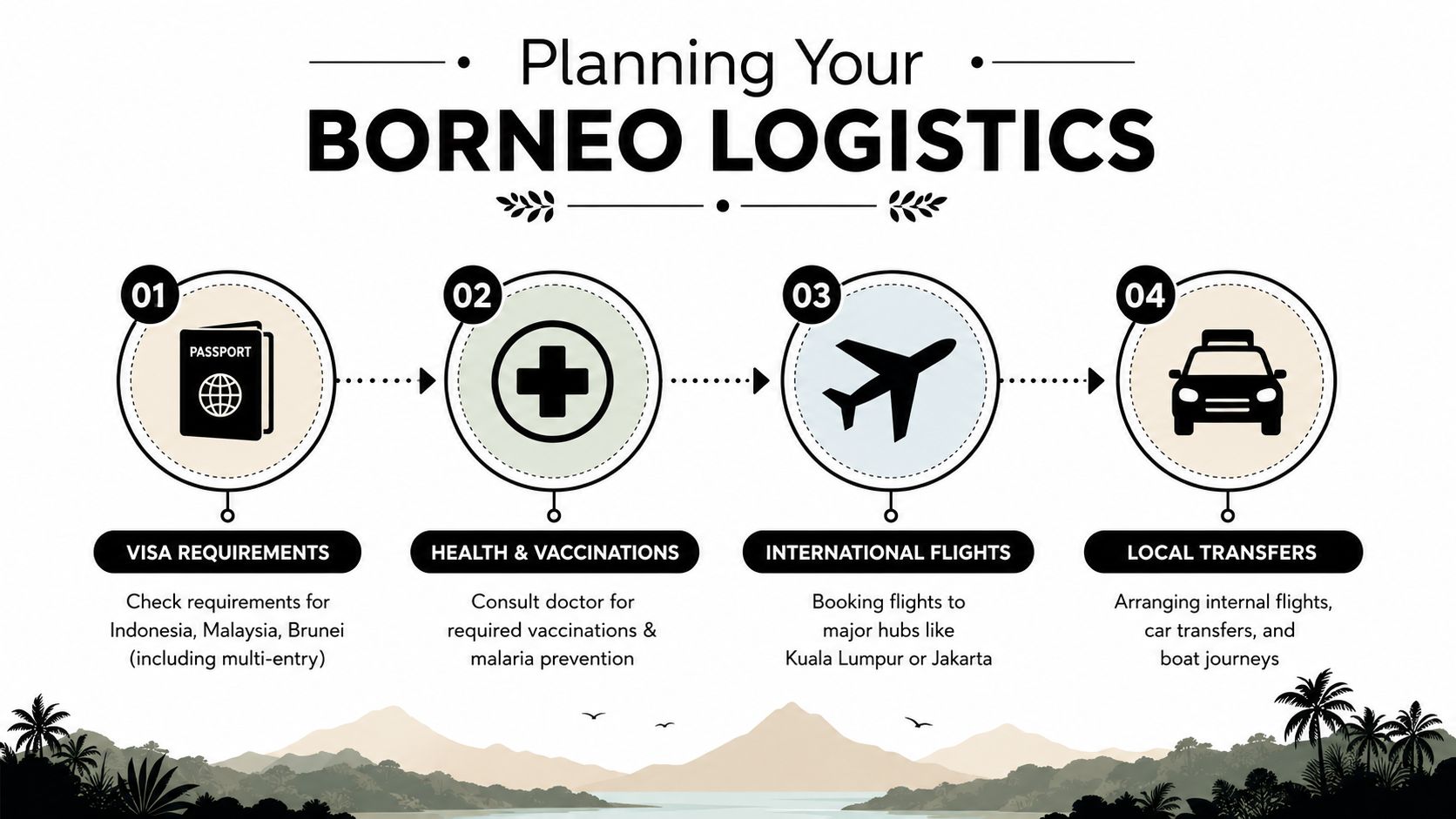
Start with borders, not hotels. Multi-country travel across Borneo becomes awkward fast if visas are treated as an afterthought. Indonesia, Malaysia, and Brunei each use different entry rules, and any route that crosses borders more than once should be checked before you commit to internal flights. If you are stitching together Sabah, Sarawak, Brunei, and Kalimantan, fix the border plan first, then place the lodges around it.
Health planning deserves the same discipline. Speak to a travel clinician early, especially if you are weighing vaccinations, malaria prevention, and hydration for remote rainforest days. A practical starting point is this overview of travel vaccines UK from Haven Medical, which gives useful context before you lock in dates.
Accept that the island runs on mixed transport
Travel across Malaysian Borneo, Brunei and Indonesian Kalimantan often requires a mix of overland routes, domestic flights and chartered helicopters (Flash Pack). That is not a flaw. That is a consequence of a vast island with scattered access points, and premium itineraries work best when one team coordinates every handoff.
Use flights for the long jumps, private transfers for city-to-airport segments, and boats where the water is the road. That keeps the trip efficient without pretending Borneo is connected like Singapore or Bangkok. For travelers who value comfort, concierge support earns its keep here, because missed connections in Borneo are usually a routing problem, not a booking problem.
I would also sort power and connectivity before departure. Malaysia and Brunei use 230/240V, 50Hz electricity with Type G sockets, while Indonesian Borneo uses 230V, 50Hz with Type C/F plugs (Borneo Adventure). Remote lodges can have limited connectivity, so camera batteries, satellite devices, medical gear, and plug adapters all deserve their own packing checklist.
Operational rule: do not count on finding the right adapter or a stable signal once you are in the interior.
Airport movement needs a dedicated ground team. If you already use a premium transfer service, align it with the flight schedule and the lodge arrival window instead of letting cars or helicopters sit idle. A dedicated airport transfer plan only works if it is timed to the island's actual geography, which is why this airport transfer guide fits Borneo planning better than a generic chauffeur booking.
Regional Highlights Luxury Lodges
Sabah and the value of depth over distance
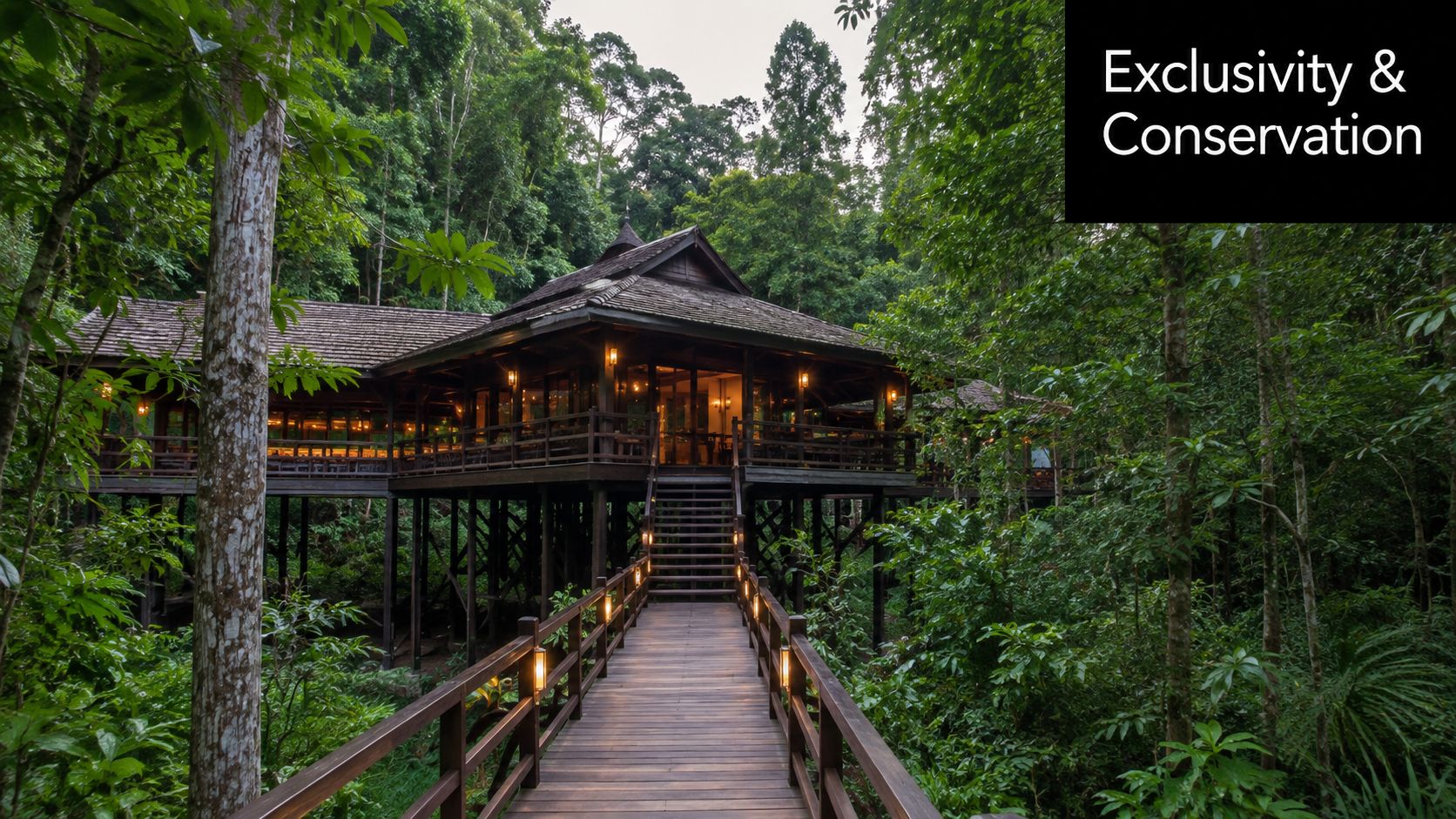
Sabah is where Borneo's scale becomes impossible to ignore. One day can begin in a polished city base, then end in a rainforest lodge that feels cut off from everything except the sound of the jungle. Treat that contrast as the point. The smartest itineraries keep the scope tight instead of trying to stitch together too many regions in one stay.
A strong Sabah lodge choice should favor silence, access, and dependable staff over showy design. The properties worth your time do not need to advertise themselves. They give you room to recover between dawn wildlife outings, river excursions, and long transfers, which is exactly what this part of Borneo asks of a luxury traveler.
Sarawak rewards travelers who want culture with their comfort
Sarawak moves at a different pace. The luxury here is softer, more layered, and better suited to travelers who want nature without losing cultural texture. The most satisfying stays shift easily from river mornings to elegant dinners without making the day feel over-programmed.
For broader routing logic, this Indonesia luxury travel guide is a useful comparison point. Borneo does not behave like a standard resort region, and Sarawak is no exception. That is why lodge selection matters as much as the place name on the booking.
Brunei is small, polished, and strategically useful
Brunei often gets overlooked, which makes it useful for travelers who understand pacing. It works well as a calm contrast to the wilder parts of the island, especially when you want one segment of the journey to feel more composed and less demanding on logistics. Use it as breathing room, not as a filler stop.
The gear problem is bigger than the brochure problem
The unglamorous details are what separate a smooth luxury journey from a clumsy one. Malaysian Borneo and Brunei use Type G sockets, while Indonesian Borneo uses Type C/F plugs, and remote lodges often have limited connectivity. Power planning belongs in the room choice, not just the packing list.
If you are carrying cameras, chargers, humid-weather clothing systems, or medical equipment, build redundancy into the luggage plan. Bring adapters, spare batteries, offline maps, and a realistic expectation that some properties are built for remoteness first and convenience second.
Wildlife Cultural Immersion Experiences
The strongest wildlife moments happen when the trip slows down
Borneo's real advantage is scale. The island is too large for rushed, box-ticking travel, and the rainforest rewards patience far more than pace. Wildlife encounters here are not something to cram between transfers. They work best when the day is built around them from the start.
That means early river runs, quiet boardwalks, and guide-led walks at the right hour, not a crowded schedule that treats nature as a side activity. Luxury does not make these moments louder. It removes friction, keeps the group small, and lets the setting do the work.
Culture lands better when access is curated properly
Borneo's cultural experiences deserve the same discipline as its wildlife program. A longhouse visit, a local meal, or a private ceremony only feels worthwhile when it is arranged with respect, context, and proper timing. The difference between a genuine encounter and a staged stop is usually the quality of the introduction and the care taken around the visit.
I place far more value on one well-run cultural exchange than on a long sequence of shallow photo stops. That is the high-end approach here. Borneo offers enough on its own, so the guide's job is to slow the moment down and protect the setting rather than overproduce it.
The right guide talks less and arranges more. That is what makes the moment feel real.
The wildlife needs that same restraint. Orangutan sightings, river excursions, and night walks are strongest when operators keep groups small and respect animal behavior. Luxury should mean better observation, not better intrusion. If you want a model for responsible coastal travel outside the rainforest, start with your guide to sustainable ocean tourism.
Sample Bespoke Itineraries
Honeymooners and couples
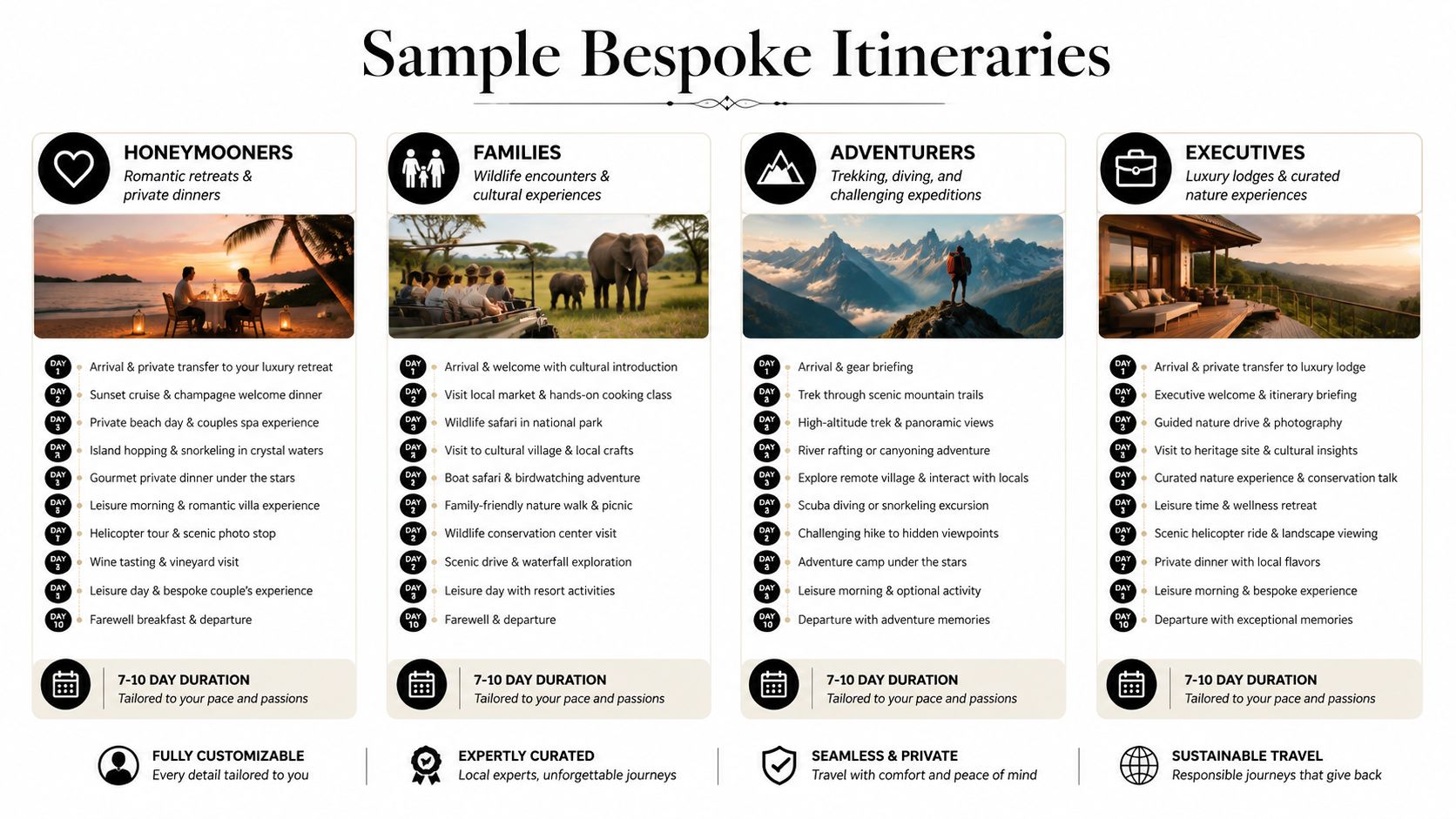
For couples, I'd keep the route elegant and contained. Choose one rainforest base, one river segment, and one polished coastal finale, then leave room for unstructured time. The goal isn't activity volume, it's atmosphere.
A strong version looks like this, arrival into a private-transfer city base, two nights in a refined jungle lodge, then a final pair of nights where dinner can be arranged privately and movement is minimal. Keep the mood intimate, with early starts for wildlife and late afternoons reserved for spa time, reading, or a sunset deck meal.
Families who want nature without chaos
Families need predictability more than novelty. I'd prioritize easier transfers, shorter wildlife outings, and lodges that can handle varied ages without forcing everyone into the same pace. That means fewer hops and more time in one region.
A family-friendly Borneo route should include river wildlife, gentle boardwalks, and cultural stops that don't run too long. Build in downtime after each transfer day, because children and parents both do better when the trip has a rhythm instead of a scramble.
Adventurers who want real remoteness
Adventurers should lean into Borneo's harder edges, where helicopter insertions, remote towers, and deeper jungle stays make sense, as long as the operator is strong on safety and timing. Don't waste this style of trip on soft sightseeing.
Use the island's interior for trekking and river access, and keep the logistics lean. If you're chasing a more demanding trip, the key is to let the terrain set the pace rather than trying to bend it into a resort schedule.
Executives who need comfort and control
Executives need the cleanest version of Borneo. That means minimal hotel changes, strong communications planning, and transfers that happen without discussion. The best itinerary is the one that removes decision fatigue.
A polished executive route might pair one luxury lodge with one coastal or city stop, then use private aviation or helicopter support to reduce dead time. If you're traveling with assistants or security considerations, the schedule should be built around privacy, recovery time, and dependable movement rather than around maximizing stops.
Sustainability Safety Considerations
Borneo rewards travellers who treat sustainability and safety as part of the itinerary, not as a polite afterthought. For premium travel, that means choosing low-impact access, respecting community boundaries, and using operators that understand conservation rules on the ground. In a place this ecologically fragile, anything less looks careless.
Season choice matters more than many itineraries admit. TravelLocal notes that shoulder periods in Borneo can bring stronger jungle conditions and more active wildlife, which makes the default obsession with the driest months too simplistic (TravelLocal). If your priority is the quality of the experience, not just clear skies for photos, I would treat that as a serious planning point.
Safety needs the same level of discipline. The eastern Sabah coast and nearby islands require caution because security risks there are not the same as in the rest of Malaysian Borneo, so flights, boats, and road transfers need to be built around that reality rather than patched together casually. That is exactly why route design matters here, especially for travellers who expect private movements to be dependable.
For guests who want to travel lightly, the right move is to choose operators already working with conservation and local communities, then ask how they handle waste, marine access, and local employment. A useful reference for that mindset is your guide to sustainable ocean tourism, which sets out the standards worth applying before you book. The same discipline should shape a Borneo trip from start to finish.
Safety first, then aesthetics. In Borneo, the route should be secure, responsible, and well managed before it is beautiful.
How Luxury Travel Service Elevates Your Journey
High-touch planning matters more in Borneo than in most destinations because the island's complexity is the experience. Haute Black can handle the moving parts that matter here, from route design and premium ground transfers to access-driven hotel selection and coordination with private aviation and helicopter support. That's not a luxury add-on, it's the difference between a trip that flows and one that stalls.
Value lies in the handoffs. A polished advisor can align domestic flights, lodge arrivals, and cultural appointments so the trip feels smooth even when the geography is not. If you want to see how that wider service model works, this guide to luxury travel concierge services shows the kind of support that translates directly into a smoother Borneo journey.
Haute Black also fits this destination because it can build the trip around privacy, timing, and preferred-property access rather than forcing you into a generic package. In a place like Borneo, that level of orchestration is what protects both comfort and momentum.
If you want Borneo planned the right way, with the transfers, lodge sequence, and access points handled without guesswork, talk to Haute Black about a custom itinerary. Start with Haute Black and ask for a route built around your dates, your pace, and the level of remoteness you prefer.
Explore Our Guides


Signature Experiences