Haute Black Journal
Tours to Southeast Asia: A Luxury Insider's Guide

Marlene Azeez
Director, HauteBlack
View all articles →

# Tours to Southeast Asia: A Luxury Insider's Guide
August 8, 2026
The best tours to Southeast Asia are not the ones that cross the most borders. They're the ones that use the region's rebound to your advantage, lock in the right gateways, and keep you out of the airport for as much of the trip as possible. The old cliché of Bangkok, Angkor, and Halong Bay still sells because it's familiar, but familiarity is not the same thing as a better journey.
What Luxury Really Means in Southeast Asia
Luxury in Southeast Asia has very little to do with oversized bathrooms and very much to do with privacy, access, and pace. A suite matters, but a quiet arrival lane, a table that's reserved, and a day that doesn't collapse into transfers matter more. That's the difference between a polished trip and a high-end one.
A custom suit follows your body, while off-the-rack clothing only fits if you're lucky. The same rule applies here, a private dining room, a discreet guide, and a route that respects climate windows will always outperform a crowded highlights loop.
The region's strongest luxury itineraries are built around fewer bases with deeper experiences. That means one strong city, one beach or island, and one cultural or nature stop, not a racing line across half the map. If you want a practical framework for planning that kind of trip, the luxury travel planning guide is useful because it treats design, timing, and logistics as part of the product, not an afterthought.
A good Southeast Asia itinerary should answer three questions immediately. When should you go, how should you route it, and who is making the hard calls when flights, weather, and hotel inventory don't line up? That's the luxury standard.
For Thailand-specific inspiration that fits this approach, this Thailand guide is a solid companion piece.
The State of Southeast Asia Luxury Travel
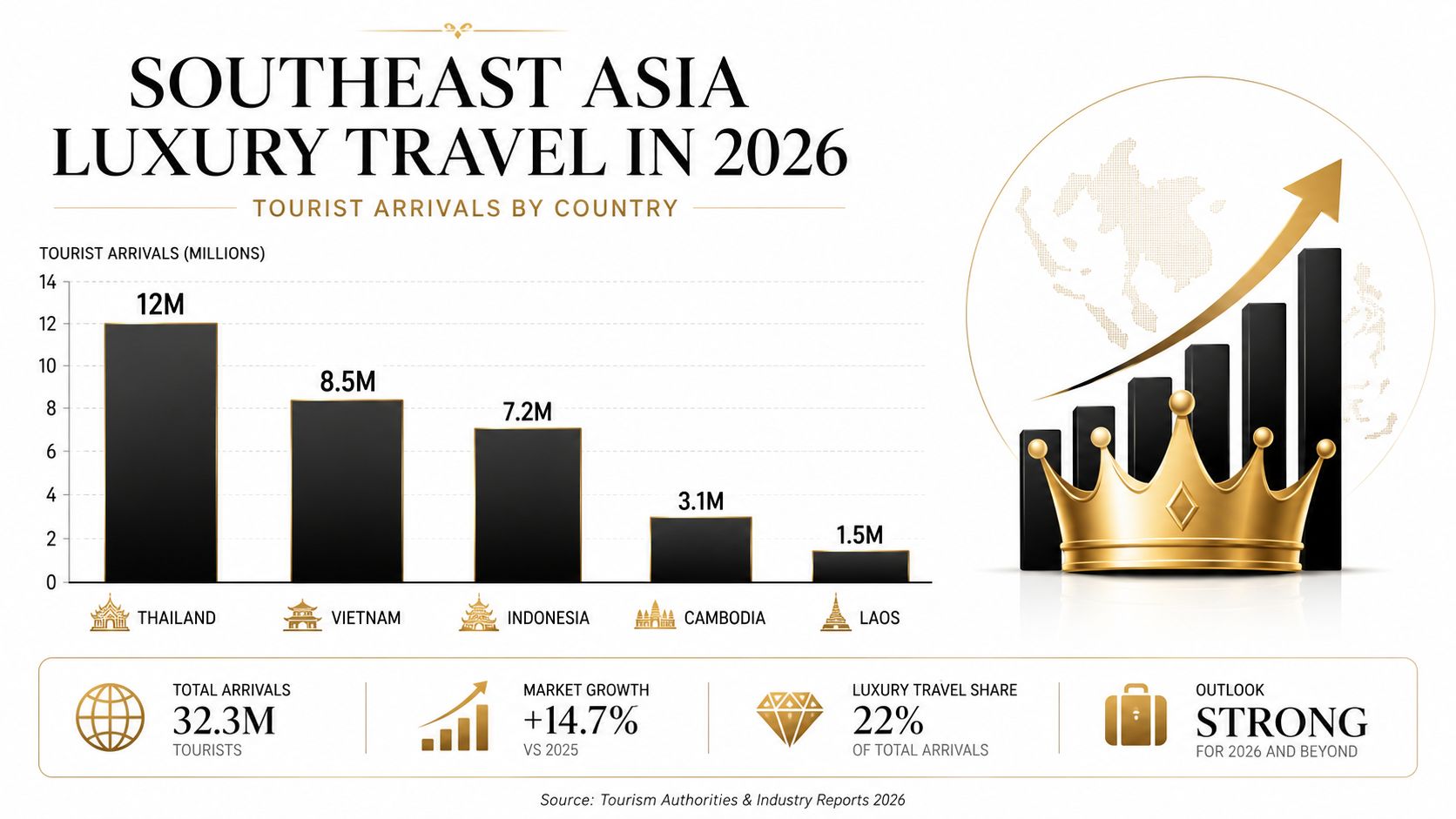
The regional picture is simple. Demand has come back, but it hasn't come back evenly. The six major markets, Singapore, the Philippines, Vietnam, Thailand, Indonesia, and Malaysia drew more than 127 million foreign tourists in 2019 and about 114 million in 2024, or roughly 89% of pre-pandemic volume, according to the regional recovery analysis in The Diplomat. ASEAN-wide, 2024 destinations welcomed 121 million international tourists, about 88% of the 2019 benchmark of 143.6 million arrivals, as summarized in the ASEAN tourism outlook materials.
That matters because premium inventory has naturally concentrated where demand returned fastest. Bangkok, Singapore, Bali, and Vietnam's main gateways are now the places where peak-season competition is most obvious, and where good airlift, strong hotels, and reliable VIP handling are most developed. Vietnam is especially interesting, because it reached 17.5 million inbound tourists in 2024, or 98% of its pre-pandemic level, nearly a full rebound in the context of the region's slower recovery.
What the numbers mean for affluent travelers
You can't plan luxury travel in Southeast Asia as if every destination has the same availability profile. It doesn't. In a concentrated market, the best rooms, the best guides, and the best arrival experiences get pinned to the same gateways at the same time.
Practical rule: if your dates are fixed, your routing needs to be flexible. If your routing is fixed, your hotel expectations need to be flexible.
The broader lesson is that Southeast Asia is no longer a place to improvise at the last minute. It's a market where timing and routing shape the trip as much as the destination itself. The next decision is whether you want a city-led journey, a beach-led one, or a culture-led one, because each cluster behaves differently under pressure.
Country Clusters and What Each One Does Best
Southeast Asia Country Clusters at a Glance
| Cluster | Signature Strength | Best For | Ideal Window | Access Complexity |
|---|---|---|---|---|
| Thailand and its islands | Strong hotel depth, easy luxury flow, polished service | First-timers, couples, multigenerational trips | Seasonally specific by coast | Moderate |
| Vietnam | Fast-rising luxury circuit, strong culture-to-coast contrast | Design-minded travelers, food lovers, deep itineraries | Date-specific, route-dependent | Moderate |
| Cambodia and Laos | Quietness, temple access, cultural depth | Travelers who want privacy and slower days | Best when weather is cooperative | Moderate to higher |
| Indonesia with Bali | Resort strength, villas, wellness, island variety | Families, honeymoons, retreat-style travel | Route and island specific | Moderate |
| Singapore and Malaysia | Gateway efficiency, urban luxury, smooth connections | Stopovers, executive travel, multi-country setups | Year-round positioning | Lower |
| Philippines islands | Strong natural beauty, under-visited islands, bigger payoff for effort | Repeat travelers, beach seekers, privacy hunters | Best when logistics are planned carefully | Higher |
Thailand is the easiest place to do luxury well because the infrastructure understands premium travel. It's also the easiest place to do badly, because everyone else knows that too. Bangkok-plus-islands works when you want polish, but it can feel predictable if you don't push beyond the standard route.
Vietnam is the sharper choice if you want contrast. The country gives you urban energy, heritage, and coast in a way that feels dynamic rather than packaged. Cambodia and Laos are for travelers who value quieter days, but they reward people who understand that the best experience there is often found away from the obvious circuit.
Indonesia, with Bali at the center, remains the strongest place for villas, wellness, and long-stay ease. Singapore and Malaysia are not the headline act, they're the connectors, the places that make a multi-country journey cleaner. The Philippines is the sleeper option, especially for clients who want islands with more space and less obvious traffic, but it asks more of the planner.
Advisor's verdict: choose the cluster that matches your tolerance for movement, not the one that looks best on a map.
Why Fewer Countries Usually Beats a Grand Tour
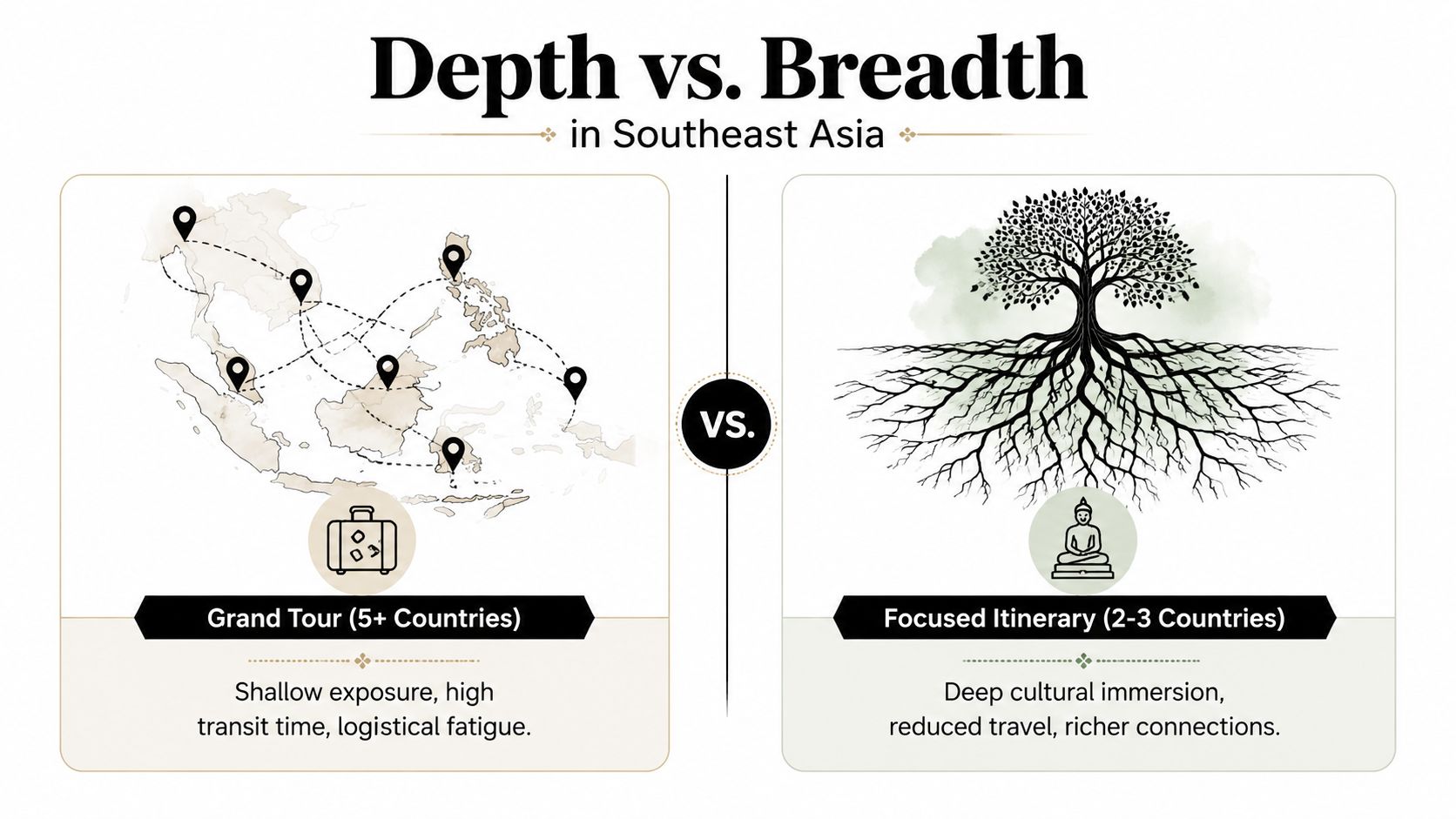
The default sales pitch for Southeast Asia is still “do more.” More countries, more flights, more stamps, more bragging rights. That's bad advice for affluent travelers because the region is geographically compact but operationally fragmented, and the premium experience degrades the moment the trip becomes airport-heavy.
Every added border crossing has a cost. A fifth short-haul leg doesn't just add time, it adds a missed dinner, a compressed afternoon, a bag to repack, and another arrival that needs to be rescued by logistics. By the time you're on your fourth airport transfer, the trip starts to feel managed by the timetable rather than by the traveler.
The rule I use with clients
Two bases are almost always enough for a very good trip. Three bases can work beautifully if the routing is clean and the traveler wants contrast. Four or more is where the trip often starts to behave like a tour product instead of a luxury journey.
That's especially true for couples and families, because each move has a hidden emotional cost. Children lose rhythm, couples lose spontaneity, and executives lose the one hour in the day that would have made the itinerary feel restorative instead of merely impressive. The more legs you add, the less each arrival matters.
The smarter play is to build around depth. Stay long enough to have one unplanned lunch, one private experience that isn't rushed, and one evening where you don't have to check out at dawn. That is where the memory lives.
Timing and Seasonality for the Right Climate
In Southeast Asia, good routing starts with climate, not ambition. Southern Thailand's monsoon makes June and July a poor choice for beach-first plans, while March and April can bring smoky conditions to northern Thailand and Laos, which is exactly why a beautiful route can fail if the dates are wrong. The best luxury itineraries treat weather as a design constraint, not a footnote.
How to think about the calendar
If your priority is the north, aim for the cleaner weather windows there and avoid the smoky stretch when air quality can spoil the countryside. If your priority is islands and beaches, don't assume every coast behaves the same way. Southeast Asia rewards travelers who match the route to the month instead of forcing the route onto the month.
A smart arc usually works like this, city first, then inland, then island, or the reverse if the season supports it. That sequencing keeps you from trying to do every environment at its worst moment. It also gives your advisor a better shot at linking the trip together without weather-related friction.
Best practice: pick the experience first, then let the climate decide the order.
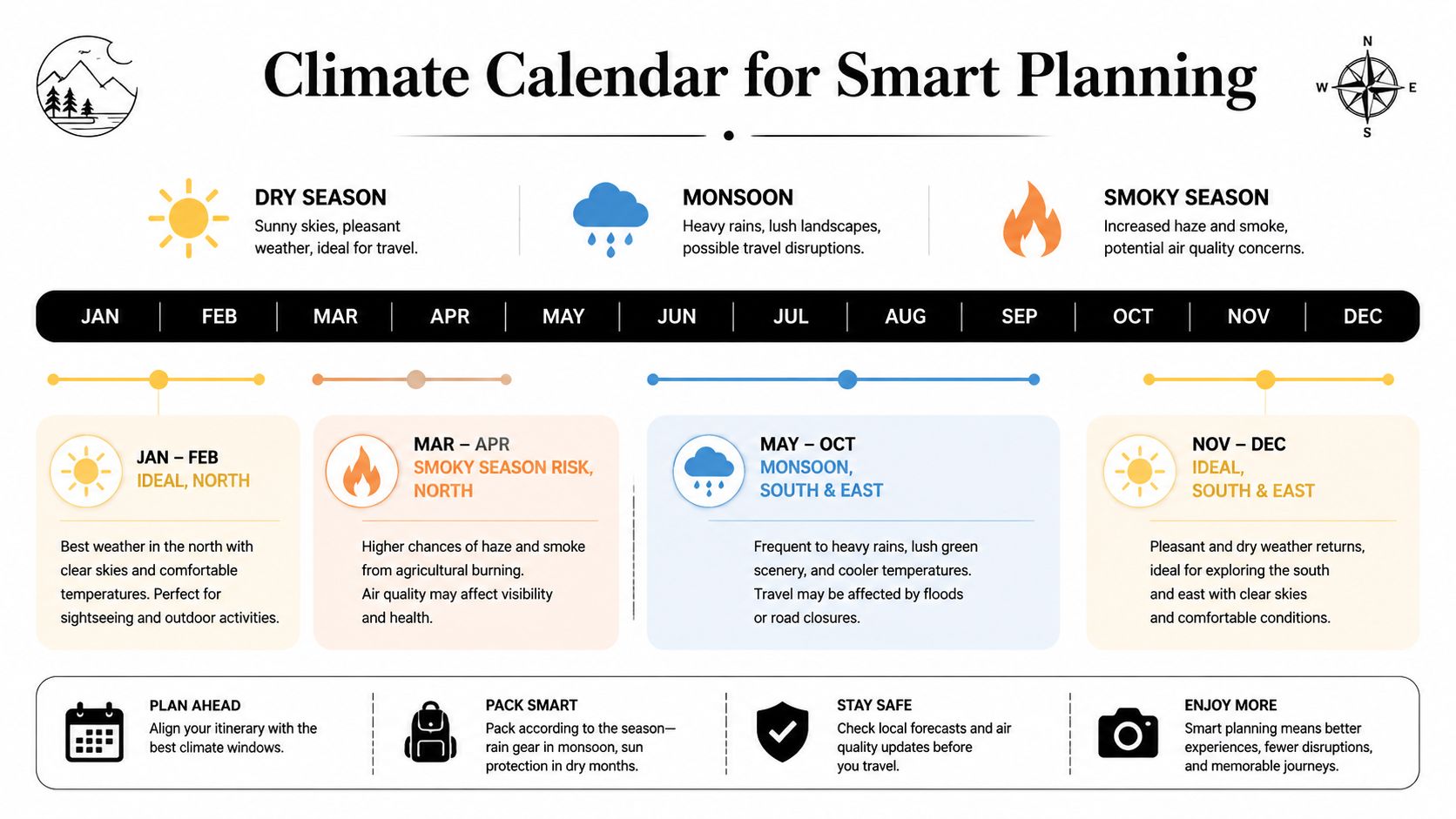
The practical warning is straightforward. The most desirable windows are also the most capacity-constrained ones, especially around the best beach and city combinations. If you wait until your calendar is “perfect,” you'll usually end up with the hardest rooms to find and the least elegant routing choices.
Sample Bespoke Itineraries Done Right
A strong Thailand pairing starts in Bangkok, where the first nights are used for arrival ease, private dining, and a slower introduction than most first-time visitors expect. Then the rhythm shifts to a private island resort, where the point is not to do more, but to stop being available to the rest of the world. The advisor's value is in making those two halves feel like one journey, not two unrelated bookings.
A Vietnam route works best when it moves north to south with intention. You begin with Hanoi's intensity, then open the trip into the coast, then finish on an island finale that gives the traveler a proper release rather than another city checkpoint. For clients who like depth, Vietnam is one of the rare places where cultural texture, food, and beach time can coexist without feeling forced, and this Cambodia and Vietnam trip guide is a good example of how those transitions can be shaped.
What a well-paced itinerary actually feels like
It doesn't feel crowded. It feels composed. The days change character without the traveler having to fight the schedule.
A multi-generational Bali and Singapore loop needs a different logic. Singapore handles the clean entry, the shopping, the dining, and the urban reset, while Bali carries the villa time, the family togetherness, and the cultural layer. The mistake is trying to squeeze both cities and islands into the same tempo, when the better answer is to let each place do what it does best.
The strongest itineraries also leave space for one or two moments that can't be replicated independently. A private boat at the right hour, a closed-door meal, a guide who knows the quieter entrance, or a transfer that avoids the obvious choke point all change the feel of the trip. That's what makes the itinerary feel bespoke rather than assembled.
VIP Logistics, Partners, and the Haute Black Edge
Luxury in Southeast Asia lives and dies on logistics. A great hotel is only great if the arrival is smooth, the upgrade is honored when available, and the transfer doesn't leave the guest standing in the wrong lane with a driver who can't find the right entrance. That's where preferred-partner status starts to matter.
A Virtuoso-affiliated agency with preferred status at over 500 properties, including names such as Four Seasons, Aman, Rosewood, Belmond, and Ritz-Carlton, can provide practical advantages like complimentary upgrades when available, resort credits, flexible benefits, and better recognition on arrival. Those aren't vanity perks. They're what keep a high-demand trip from turning brittle when everyone else is also trying to book the same suite.
What that means in practice
The traveler doesn't need to negotiate each property alone. The advisor makes the request, frames the stay correctly, and pushes for the right outcome before the guest lands. In a busy season, that kind of advantage is the difference between a confirmed premium experience and a hopeful reservation.
For travelers who want a deeper service layer, the advantage is continuity. A dedicated advisor, private aviation support, first-class and helicopter transfers, private villas and estates, and concierge dining and transport all reduce the number of moving parts the client has to manage. For anyone comparing options, the differences are clearer in a private jet luxury travel guide, because the same logic applies, less friction, more control.
Non-members can still book signature journeys and tailor-made trips, which is the baseline most travelers need. Membership adds the extra layer, the dedicated advisor relationship, waived planning fees for members, and the accumulated weight of relationships that can improve the outcome. In this region, that matters more than in most places because the best dates, best rooms, and best arrivals are all under pressure at the same time.
Health, Visa, and Packing Notes for a Seamless Arrival
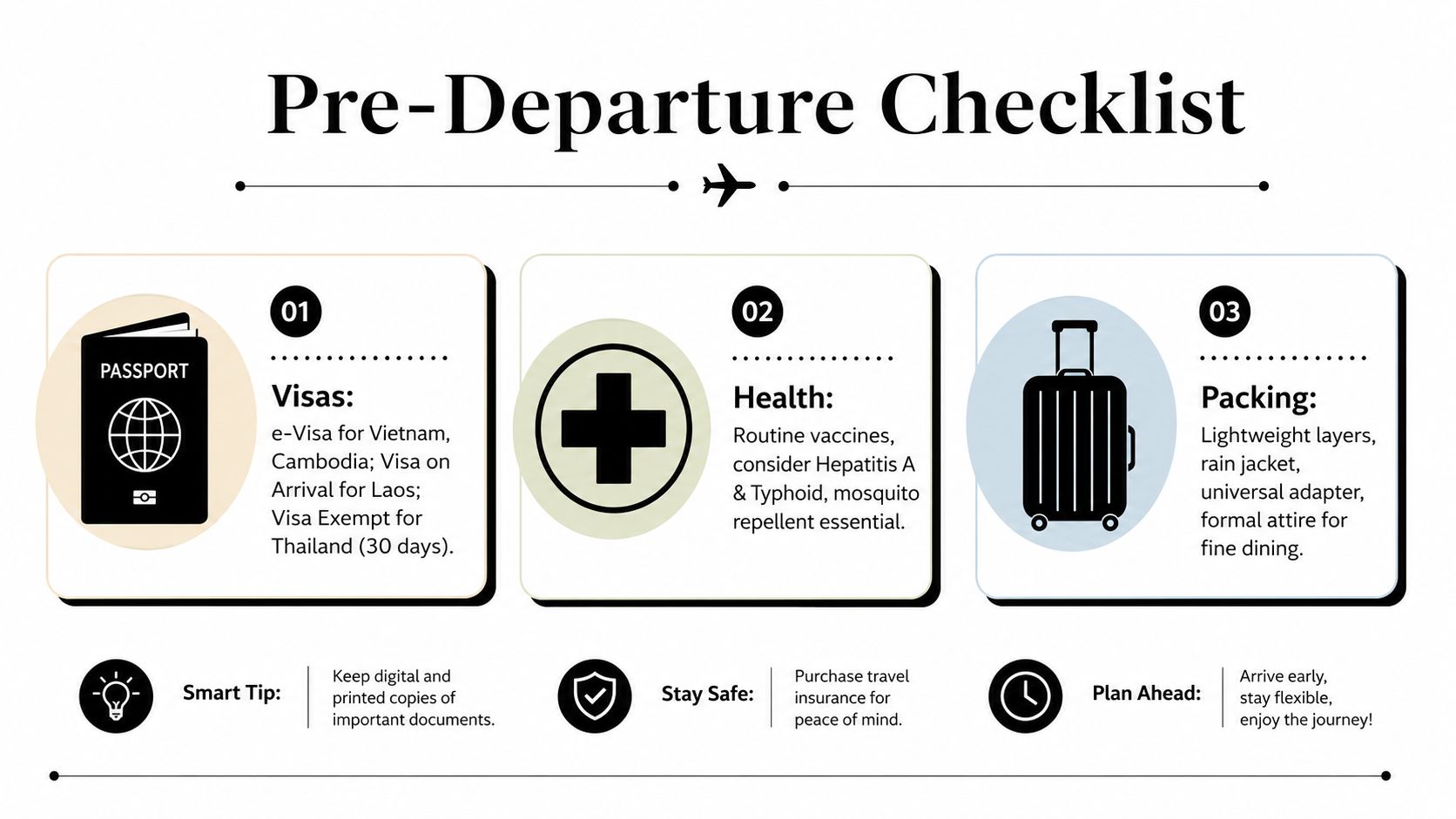
The unglamorous part of a Southeast Asia trip is still part of the luxury standard. Thailand is visa exempt for 30 days, and the checklist here also points to e-Visas for Vietnam and Cambodia, plus visa on arrival for Laos. That's the kind of detail that should be checked before tickets are issued, not after the car is already booked.
Health planning should be practical, not dramatic. A travel-medicine consult is sensible, especially if you want to talk through routine vaccines, Hepatitis A, Typhoid, and mosquito precautions. In this climate, mosquito repellent isn't a nice-to-have, it's part of proper packing.
Pack for climate and venue, not just for comfort
Lightweight layers work better than a suitcase full of resort-only clothing. You'll want a rain jacket, a universal adapter, and formal attire that fits the dining room you've booked, because Southeast Asia's best hotels still expect polish at dinner even when the day has been humid and informal.
A good pack list is simple:
- Lightweight layers: useful for city evenings, air-conditioned transfers, and temple visits.
- Rain protection: necessary if your route overlaps with wetter months or island transfers.
- Formal pieces: important for fine dining, private events, and upscale hotel settings.
- Medication and repellent: worth carrying rather than sourcing on arrival.
A single point of contact makes this easier because the same advisor can coordinate the visa logic, check the hotel expectations, and warn you when the itinerary needs a small but important adjustment. That's the difference between being technically prepared and being travel-ready.
If you want this level of planning handled end to end, Haute Black builds Southeast Asia journeys around fewer, better bases, the right climate window, and the hotel and transfer advantages that keeps premium trips smooth. Visit Haute Black to start a conversation about a route that fits your dates, your style, and your standards.
Explore Our Guides


Signature Experiences


