Haute Black Journal
Ultimate Luxury Cambodia and Vietnam Trip

Marlene Azeez
Director, HauteBlack
View all articles →
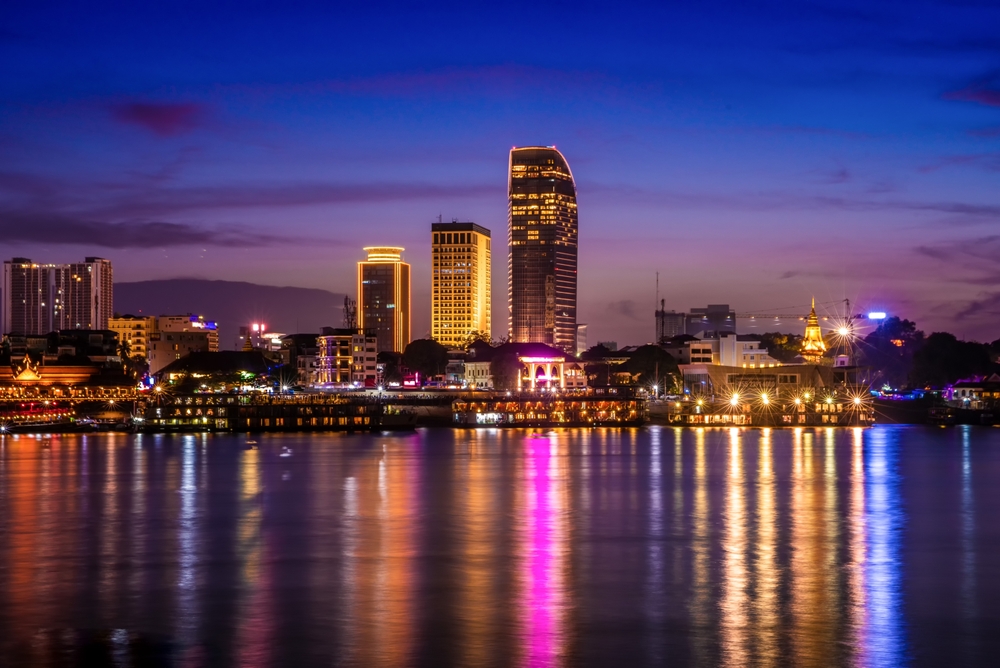
Most travelers approach a cambodia and vietnam trip backwards. They treat it as a convenient two-country add-on. That's the budget mindset dressed up in nicer hotels.
The superior approach is to treat Vietnam and Cambodia as one continuous Indochina narrative shaped by proximity, power, religion, river trade, war, reinvention, and extraordinary hospitality. That view isn't sentimental. It's practical. The shared land border between Cambodia and Vietnam stretches over a significant distance, rooted in over 1,000 years of intertwined history, which is exactly why a combined journey feels coherent rather than stitched together.
If you want beaches alone, go elsewhere. If you want temples alone, go elsewhere. If you want one of Asia's most layered luxury journeys, do both countries together and do them: private transfers, strong historical framing, the right sequencing, and enough time to absorb the contrast between Ho Chi Minh City, central Vietnam, Phnom Penh, and Angkor.
The Art of the Indochina Journey
A great cambodia and vietnam trip should feel composed, not crowded. The best version moves like a private brief, not a checklist.

Why these two countries belong together
Vietnam gives you momentum. Cambodia gives you perspective.
Vietnam's draw is range. Ho Chi Minh City delivers energy and colonial residue. Central Vietnam gives you coast, cuisine, and polished resort living. The country rewards movement. Cambodia does the opposite. It asks you to slow down, in Siem Reap and Phnom Penh, where the emotional and spiritual register is deeper.
That contrast is the point.
A private Mekong routing is often the smartest expression of this pairing. The river physically connects the experience and turns a border crossing into part of the journey rather than an interruption. When done well, you move from urban Vietnam into Cambodia with continuity, context, and no sense of administrative friction.
Most luxury trips still undersell the region
The market is saturated with high-end group departures and generic "best of" itineraries. I don't recommend them for discerning travelers. They flatten the experience.
What's missing is the bespoke version built around:
- Pacing that respects the sites so Angkor isn't reduced to a sunrise photo stop.
- Context-rich guiding that connects Khmer history, French colonial legacy, and modern Vietnam.
- Private access strategies that remove the dead time, queueing, and generic crowd flow.
- Multi-generational design so grandparents, parents, and children can travel together without compromising comfort or depth.
My view: if your trip treats Cambodia as "just Angkor" or Vietnam as "just beaches plus food," it's under-designed.
The right mindset
This region rewards travelers who want substance with polish. You're not coming only for a suite, a spa, or a boat. You're coming for a rare combination of beauty and historical density.
That's why I advise clients to think in layers:
1. Historical layer with Angkor, Phnom Penh, and Vietnam's wartime and colonial sites.
2. Sensory layer with river journeys, rail, coastal resorts, and refined dining.
3. Access layer with private timing, curated routes, and exclusive-use options.
Do that, and a cambodia and vietnam trip stops feeling like a holiday. It becomes one of those journeys people reference for years.
Strategic Foundations for Your Trip
The first strategic decision is route direction. I favor Vietnam first, Cambodia second. Vietnam's pace is faster, its geography is longer, and its transport network naturally supports onward movement. Cambodia lands better at the end, if you want Angkor to feel like a culmination rather than a rushed opening act.
Choose the trip architecture first
There are three route structures that work at the top end.
- South to west — Best for couples and first-timers. Ho Chi Minh City into the Mekong, then Phnom Penh and Siem Reap feels smooth and intuitive.
- Vietnam longitudinal then Cambodia — Best for clients with more time. Hanoi, central coast, Ho Chi Minh City, then Siem Reap gives you full contrast.
- Dual-hub private air plan — Best for time-constrained executives. Focus on one Vietnam city and Angkor, cutting lower-value transit.
The wrong move is overcommitting to domestic hops. Just because you can add another stop doesn't mean you should.
Flights, jets, and what not to waste time on
For long-haul arrival, use first-class suites or private aviation depending on schedule sensitivity and privacy requirements. If your calendar is rigid, private air wins. If you can tolerate a little structure for the long-haul and reserve private movements inside the region, that can be the smarter allocation.
For specific flight planning within the trip, Haute Black air travel services gives a useful overview of how private aviation, first-class routing, and helicopter transfers can be combined into one integrated framework.
I recommend breaking internal transport into four categories:
- Long regional jumps: Use private aviation or premium nonstop commercial segments.
- Scenic interludes: Use rail or river when the journey itself is part of the experience.
- Final-mile cultural arrivals: Use helicopter only when it improves timing or access.
- Urban transfers: Keep these tightly choreographed with VIP meet-and-greet and lounge handling.
Practical rule: Don't use helicopters to impress yourself. Use them when they remove a poor road transfer or secure a superior arrival window.
Timing and season strategy
You don't need generic weather advice. You need operational timing.
The key question isn't "When is dry season?" It's "When will the sites feel elegant rather than overrun?" For temple-heavy travel, your timing should prioritize manageable visitor flow, early private access windows, and enough recovery time at the resort level. For coastal Vietnam, the ideal period depends on your chosen coastline, so the trip should be built around the strongest weather segment instead of forcing the same pattern across every region.
A disciplined luxury itinerary also protects energy. Don't stack a red-eye arrival, a same-day domestic flight, and a major cultural visit. That's amateur planning.
Border handling and visa administration
For high-touch travel, visa administration should be delegated. Your assistant shouldn't be piecing together entry rules one screenshot at a time.
My recommendation is simple:
- Have all entry documents pre-cleared and reviewed before ticketing final internal segments.
- Match passport validity and blank-page requirements early.
- Build contingency for changing entry procedures, especially if multiple passports are involved in one family group.
This matters more on a cambodia and vietnam trip than on a single-country holiday because one weak administrative link affects the whole chain.
The most elegant internal transfer choices
If you want movement with atmosphere, use a private Mekong cruise between Vietnam and Cambodia. It gives continuity and softens the border transition.
If you want speed, charter selectively. If you want scenery with service, use rail where it adds something memorable. The point is not maximal luxury signaling. The point is choosing the right mode for each segment.
The best itineraries don't just remove inconvenience. They convert transit into part of the pleasure.
Bespoke Itinerary Blueprints for 7 to 21+ Days
The strongest cambodia and vietnam trip is the one built around traveler type, not destination count. I'd rather see a couple do fewer stops with precision than chase an overstuffed route with no breathing room.
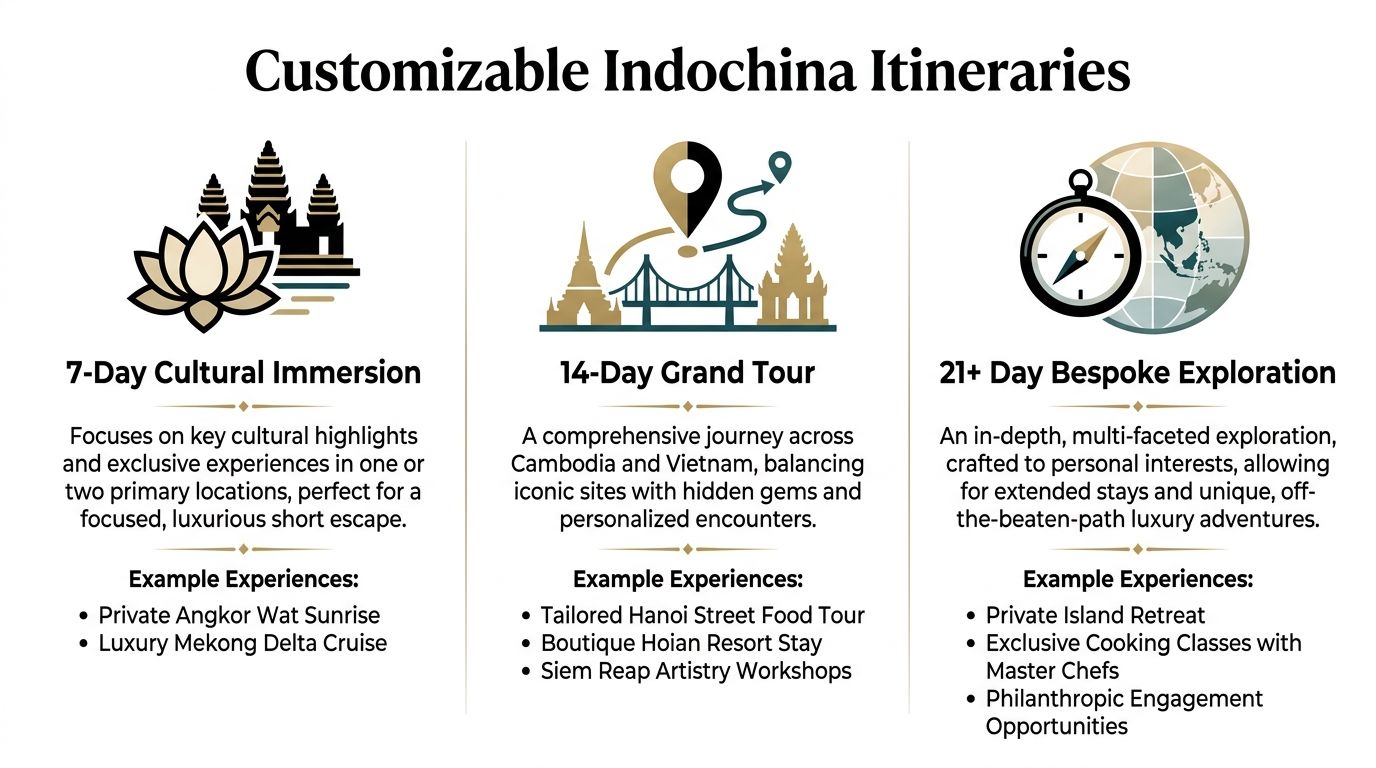
For travelers comparing private route styles, customized package tours from Haute Black is a useful reference point for how custom journeys are structured.
The 7-day cultural immersion
This is the short-form version for clients who want depth, not coverage.
Best for: founders, chairs, and couples stealing a focused week between larger commitments.
Recommended flow:
- Ho Chi Minh City
- Mekong transition
- Phnom Penh
- Siem Reap
Why this works: southern Vietnam and Cambodia connect naturally. You avoid the mistake of trying to force Hanoi and central Vietnam into a one-week plan.
What I'd prioritize
- A polished arrival in Ho Chi Minh City with a light first day.
- A curated city program focused on architecture, food, and wartime context.
- A private Mekong segment rather than a rushed flight where possible.
- Phnom Penh handled with sensitivity, not as a throwaway overnight.
- Siem Reap with private temple timing and a resort that can absorb the heat and rhythm of temple mornings.
Property style to consider
- Park Hyatt Saigon for old-school city poise.
- Rosewood Phnom Penh for urban altitude and efficient service.
- Phum Baitang if you want privacy and a softer resort mood near Angkor.
Less time means fewer decisions. Don't dilute a seven-day trip with beach add-ons.
The 10-day romantic escape
For honeymooners or couples who value privacy, the journey begins to breathe here.
A good version would pair central Vietnam with Siem Reap. That gives you sea air, refined resort time, and then a move into spiritual and architectural grandeur.
I'd structure it this way:
1. Danang or nearby coast for arrival decompression
2. Hoi An for texture, tailoring, and dining
3. A scenic rail or private transfer segment
4. Siem Reap for Angkor done properly
5. Final resort-led reset before departure
Best experiences for this profile
- Private dinner design rather than restaurant hopping.
- Temple access timed away from the obvious windows.
- Spa and wellness built into the middle of the trip, not just the end.
- One major scenic transit experience that feels cinematic, not merely efficient.
Property direction
- Amanoi if the brief leans wellness and seclusion.
- Anantara Quy Nhon Villas if you want a softer coast-and-service combination.
- Phum Baitang for a romantic Siem Reap finish with a village-style setting.
The 14-day multi-generational family adventure
This is the sweet spot for many affluent families. It's long enough to be substantive and short enough to remain cohesive.
The reason it matters is simple: private family demand is outpacing what standard operators build. A serious family journey has to accommodate grandparents' stamina, children's attention span, teen boredom thresholds, privacy, and logistics for staff or nannies if needed.
Recommended route
- Hanoi or central Vietnam
- Coastal reset
- Ho Chi Minh City
- Siem Reap
What makes this version superior
- Activities run in parallel rather than forcing everyone into the same schedule.
- Temple touring is broken into shorter, high-quality sessions.
- Resort time is protected.
- Dining is flexible, with private room options and child-friendly timing.
A few examples:
- Grandparents can take a gentler morning cultural program while younger travelers do a hands-on workshop.
- Parents can slip into a spa or private tasting while children have supervised activities.
- One night can be fully private, with an in-villa meal and no social energy required.
Properties that work well
- Amanoi for restorative time and space.
- Park Hyatt Saigon for smooth city logistics.
- Rosewood Phnom Penh when you want a strong urban base.
- Phum Baitang for families who want villa-style breathing room in Siem Reap.
The 21-day connoisseur's grand tour
This is the best version if you care about art, cuisine, history, and controlled pacing. It's also the only format where I'd say yes to seeing Vietnam in a fuller geographic range before crossing into Cambodia.
Suggested structure
- Hanoi
- Ha Long Bay or a private yacht charter
- Central Vietnam
- Quy Nhon or another quieter coast
- Ho Chi Minh City
- Phnom Penh
- Siem Reap
This blueprint works because it allows each chapter to do its job. Hanoi gives intellectual density. The bay gives visual release. Central Vietnam brings style and craft. The south adds urban energy. Cambodia closes with gravity and grandeur.
Who should choose this
- Collectors
- Multi-repeat Asia travelers
- Clients who care about culinary curation
- Families splitting the trip into distinct "acts"
- Anyone who hates feeling hurried
Quick comparison
- 7 days — Best for time-poor couples or executives. Focused and efficient tone. Main warning: don't try to add northern Vietnam.
- 10 days — Best for honeymooners. Romantic and scenic tone. Main warning: keep the number of hotels low.
- 14 days — Best for families. Balanced and adaptable tone. Main warning: schedule independent tracks.
- 21+ days — Best for connoisseurs. Deep and layered tone. Main warning: requires disciplined pacing, not excess.
The wrong itinerary chases coverage. The right one protects rhythm.
The Pillars of Culture Angkor and Beyond
Luxury without context is forgettable. The best cambodia and vietnam trip doesn't just show you beautiful places. It puts you in the right emotional order to understand them.

Angkor done properly
Angkor Wat, constructed during the 11th and 12th centuries, stands as the centerpiece of the vast Angkor Archaeological Park. It began as a Hindu temple and later transitioned to Buddhist use, a spiritual arc that gives the site much of its force.
That history matters because Angkor isn't just photogenic. It's civilizational.
The standard experience is poorly handled. Too many people arrive at the same time, stand in the same place, and leave with the same images. I advise the opposite. Use staggered entry, a guide who can explain symbolism rather than recite dates, and a route that alternates major monuments with quieter spaces.
What to prioritize at Angkor
- Angkor Wat first, but not blindly. The main temple deserves its due, but only if your timing is controlled.
- Preah Khan for atmosphere. It often delivers a more intimate experience than the headline sites.
- Temple pacing over temple count. Three carefully chosen visits can be richer than an exhausting sweep.
Phnom Penh needs maturity
Many itineraries mishandle Phnom Penh by treating it as an obligation. That's a mistake.
The city has elegance, but its historical weight is what makes it indispensable. A privately guided visit to the Tuol Sleng Genocide Museum and the Killing Fields should be approached with discretion and seriousness. This is not "dark tourism." It's part of understanding modern Cambodia on adult terms.
What changes the experience is framing. A strong guide doesn't overload you with theatrical detail. They help you process the continuity between trauma, resilience, and the sophistication of present-day Cambodia.
Some places should challenge you a little. That discomfort is part of why the journey stays with you.
Vietnam's cultural counterweight
Vietnam should not be reduced to scenery and service. It earns its place in this pairing because its historical layers sharpen your reading of Cambodia.
A well-curated visit to the War Remnants Museum in Ho Chi Minh City is particularly important. It introduces the wartime legacy that sits behind modern Vietnam's energy and polish.
That context changes how you see the trip. The region's beauty doesn't erase its scars. It sits beside them.
Beyond monuments
The cultural highs aren't limited to headline landmarks.
Consider adding:
- Hoi An tailoring with a master atelier instead of quick tourist fittings.
- A private bay charter in Vietnam rather than a shared overnight boat.
- A curated Khmer meal in Siem Reap that foregrounds heritage recipes over generic hotel interpretations.
Cultural pillars and best approaches:
- Angkor — Private timing, expert guide, selective routing. Avoid temple marathons.
- Phnom Penh — Sensitive private guiding. Avoid treating it as a quick stop.
- Ho Chi Minh City — Historical framing with contemporary contrast. Avoid reducing it to nightlife and shopping.
- Hoi An — Craft-led experiences. Avoid mass tailor turnover and rushed fittings.
The point isn't to "cover culture." It's to encounter it at a level that changes your understanding.
Exclusive Experiences and Insider Access
The difference between luxury and access is simple. Luxury buys comfort. Access buys perspective.
The transport that becomes the experience
One of the smartest inclusions in a high-end cambodia and vietnam trip is The Vietage by Hoi An Express. It covers a considerable distance over several hours, has just 12 seats, and is designed around immersive viewing rather than speed. The journey includes a six-course gourmet meal and free-flowing premium beverages, making it a legitimate luxury experience rather than a novelty transfer.
That's exactly why it works. It slows the trip down at the right moment.
For the right client, I'd go a step further and build the surrounding days around it:
- Resort check-out timed so there's no rush.
- Lounge-style pre-boarding rather than station chaos.
- Arrival into a villa property rather than a standard city hotel.
- Dining that complements, rather than duplicates, the onboard culinary tone.
Access that changes the day
Many "VIP experiences" are minor upgrades marketed aggressively. Effective ones materially improve the day.
Examples worth pursuing:
- Private temple windows with alternate routing rather than standard entry flow.
- After-hours or restricted workshop visits with serious artisans, not retail demonstrations.
- Private river or bay chartering where the vessel, crew, and meal pacing are built around you.
- Spiritual encounters arranged with cultural sensitivity and no performative spectacle.
If you want to browse categories of premium travel design, Haute Black experiences is one reference for the kind of curated access serious travelers now expect.
Access should either deepen meaning or remove friction. If it does neither, it's just expensive packaging.
Sustainable luxury for clients who care about impact
A modern luxury trip should also answer the question, "What is this journey supporting?"
That doesn't require sanctimony. It requires discernment.
Good options in this region include:
- Properties with a visible conservation or community ethos
- Private aviation planning that accounts for lower-impact choices where feasible
- Journeys that avoid overused patterns and spread value more thoughtfully across the itinerary
- Locally rooted culinary and craft experiences that benefit real practitioners
A regenerative lens is especially valuable in Cambodia, where clients often want their spending to connect with cultural preservation and community benefit. In Vietnam, it can mean selecting quieter coastal or countryside chapters instead of defaulting to the most over-trafficked circuits.
What insider planning looks like
It isn't just one glamorous booking. It's a chain of small decisions executed correctly.
1. Arrival windows are protected so you don't hit a major site at its worst moment.
2. Guides are matched to subject matter. Archaeology, cuisine, wartime history, and family travel require different strengths.
3. Hotels are chosen for role, not brand alone. Some properties are excellent for recovery. Others are better for city access.
4. Privacy is designed in through villa inventory, dining rooms, vehicles, and route timing.
That's where insider access stops being a buzzword and becomes tangible.
The Haute Black Difference Effortless Bespoke Unforgettable
A cambodia and vietnam trip looks simple on a map and complicated in execution. That's why most itineraries fail in the details.
Flights line up poorly. Border timings get treated casually. The wrong guide is assigned to the most important day. A family ends up in a beautiful hotel that doesn't suit three generations. A couple books "luxury" and gets polished sameness instead of access.
A key advantage of a top-tier travel architect is orchestration. Not one booking. The whole chain.
What top-level execution changes
At Angkor Archaeological Park, daily visitors can be very numerous, which is exactly why access strategy matters. With VIP fast-track protocols, wait times can be significantly reduced, and route planning using thermal imaging drone data and private guides can avoid much more crowd overlap than standard tours.
That kind of planning changes the emotional quality of the visit. You're no longer reacting to a crowd. You're moving through the site with composure.
Why this matters more in Indochina
This region rewards relationships. Preferred-partner status at brands such as Aman, Rosewood, Belmond, Four Seasons, and Ritz-Carlton matters because it can translate into:
- Complimentary upgrades when available
- Resort credits
- VIP recognition on arrival
- More flexible handling of requests and preferences
Those aren't cosmetic perks. On a multi-stop journey, they create continuity.
The best luxury travel feels easy to the client because someone else handled every difficult decision in advance.
The practical edge
For UHNW travelers, the benchmark isn't whether a trip runs. It's whether it runs elegantly under pressure.
That includes:
- integrating private aviation and helicopter segments when useful,
- securing the right suite inventory at the right properties,
- building high-touch dining and transport support,
- and protecting the trip when plans shift late.
That's the difference between a travel agent and a private travel architect. One books. The other designs, pressures-tests, and opens doors.
Essential Pre-Travel Briefing
Handle the practicals early and your cambodia and vietnam trip will feel smooth from departure to return.
Visa and document handling
Use a dedicated advisor or executive assistant to manage this in one pass. Entry requirements can change, and multi-country routing increases the chance of a small mistake affecting the whole itinerary.
Best practice is straightforward:
- Review passport validity well in advance
- Confirm requirements separately for each nationality in the traveling party
- Align visa approvals before finalizing internal air and private transfer timings
Currency and tipping
Keep spending simple. Use cards at top hotels and major restaurants, and carry local cash for smaller gratuities, markets, and lower-friction day-to-day purchases.
In high-end settings, tipping should be discreet and consistent, not theatrical. I recommend setting a gratuity framework before departure so family members, assistants, and security staff don't improvise.
Health and comfort
For a high-value trip, arrange extensive medical and evacuation coverage, carry a physician-reviewed travel kit, and make sure your hotels can support dietary, mobility, and wellness requests effectively.
Final checklist
- Keep one printed and one digital copy of key travel documents.
- Pre-advise hotels of allergies, celebrations, and bedding preferences.
- Use lightweight daywear that still works for temple etiquette.
- Build in one unscheduled half-day every few days. That's where luxury starts to feel like freedom.
Haute Black designs cambodia and vietnam trip itineraries at the level serious travelers expect: private aviation and first-class routing, Virtuoso-backed hotel privileges, VIP recognition, and bespoke access across every stop. If you want a journey that is private, historically intelligent, and flawlessly run, start with Haute Black.
Frequently Asked Questions
Explore Our Guides

Signature Experiences