Haute Black Journal
The Private Jet Experience: What VIP Travelers Should Expect

Marlene Azeez
Director, HauteBlack
View all articles →

You may be considering a private jet because the commercial alternative has become the least efficient part of an otherwise important trip. Perhaps you need to leave after a board meeting, land close to a private residence, carry a pet or young children, and arrive ready to work rather than exhausted by the airport. The appeal isn't only a quieter cabin. It's the possibility of making the entire journey feel deliberate.
That promise is delivered only when the details are coordinated properly. A private aircraft with excellent finishes can still produce a frustrating day if the wrong airport is selected, catering is assumed rather than confirmed, or the car service isn't waiting when the aircraft arrives. The private jet experience is a continuous operational flow, from the first booking conversation to the final handoff on the ground.
What a First Private Flight Actually Feels Like
A first-time flyer often expects the aircraft to create the memorable moment. In practice, the most striking change happens before boarding. You arrive at a near-empty FBO lounge, finish an unscripted meeting in a quiet corner, and walk outside when the crew is ready. A short drive across the ramp brings you to the aircraft, where the temperature has already been set to your preference.
The flight attendant greets you by name because the operator received the passenger brief before departure. Your preferred sparkling water is chilled, your laptop can come straight out of its bag, and nobody asks you to find a boarding pass. The boarding process is quiet and almost uneventful, which is precisely why it feels so different from a commercial terminal.
An FBO, or Fixed Base Operator, is a dedicated private aviation facility. Many travelers arrive only shortly before departure, with the exact recommendation depending on the airport, route, security requirements, and operator. The practical benefit is not theatrical VIP treatment. It is the removal of repeated queues, public gate areas, and unnecessary transitions.
The real luxury is continuity. You move from car to lounge to aircraft without repeatedly surrendering control of your time.
A commercial first-class ticket improves the cabin. It doesn't remove the terminal choreography. You still work around fixed departure times, public security procedures, gate changes, and a boarding process designed for a large passenger volume. Private aviation changes the sequence itself, although passengers still follow the applicable identity, security, customs, and manifest requirements.
The journey has four operational stages. Booking determines whether the aircraft, airport, and access model suit the trip. Pre-flight coordination handles catering, documents, luggage, pets, and transport. In-flight service turns the aircraft into a useful environment rather than a polished room. Ground coordination protects the arrival, the onward vehicle, and any later flight legs.
That is the standard I use when evaluating a private jet itinerary. The aircraft matters, but the handoffs matter just as much. The guidance below focuses on what you should request, what you should verify, and which pieces of luxury aviation are mostly marketing noise.
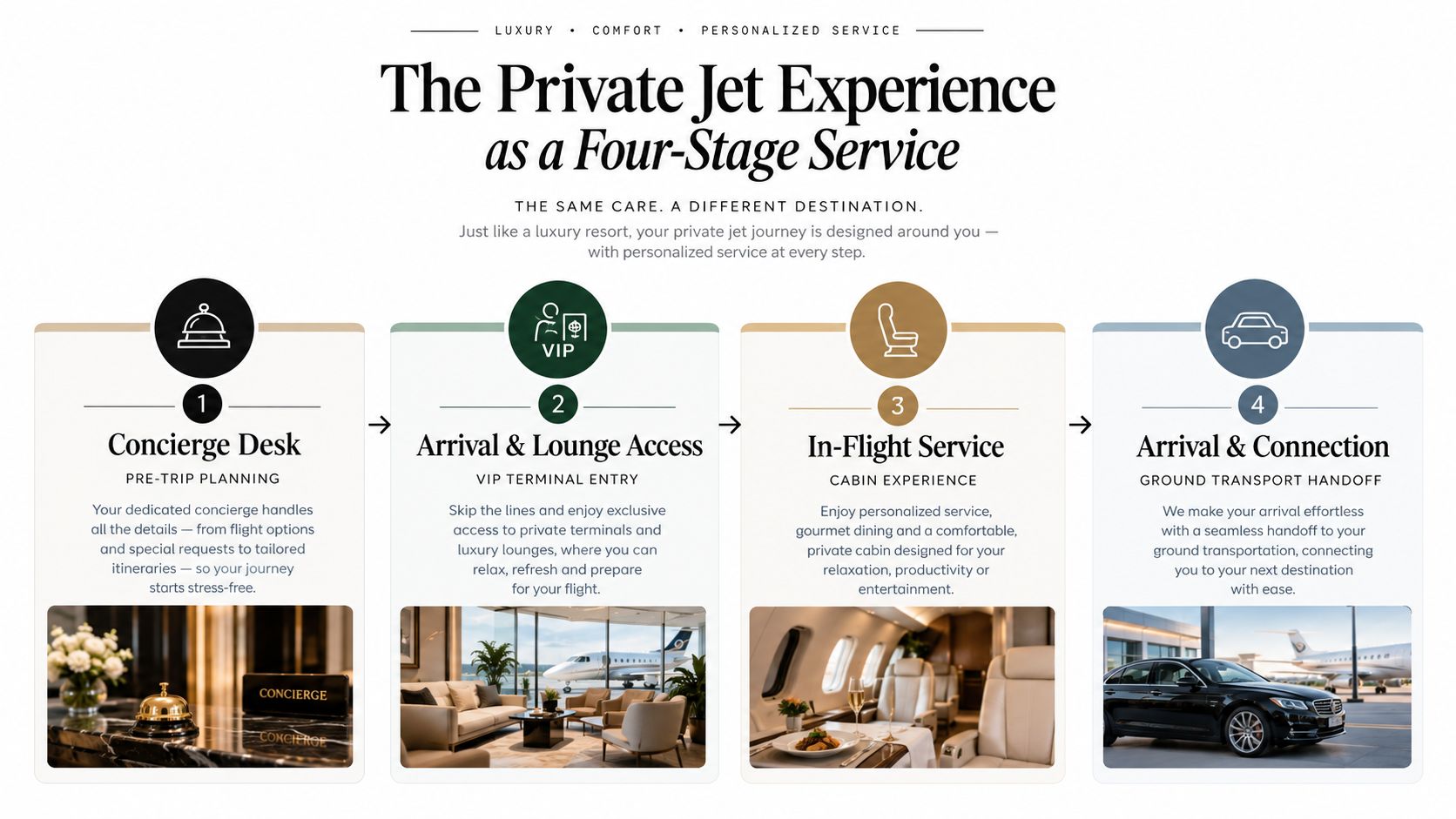
The Private Jet Experience as a Four-Stage Service
Treat private aviation like a well-run resort, not like an expensive seat. The concierge desk handles the planning. The arrival ritual gets you through the property without friction. The room delivers comfort and function. The departure team makes sure the experience doesn't collapse at checkout.
The four stages work in the same way:
1. Booking and membership setup establish the travel pattern, aircraft category, preferred airports, passenger requirements, and commercial terms.
2. Pre-flight concierge and FBO handling coordinate the practical details before you leave home and move you from vehicle to aircraft.
3. In-flight service covers the cabin, crew, catering, connectivity, sleep arrangement, and family configuration.
4. Post-flight ground coordination connects the aircraft with the residence, hotel, meeting, driver, next leg, or final destination.
Each stage carries comparable weight. A flawless cabin won't compensate for a car that arrives at the wrong FBO. A responsive booking team won't rescue a flight if the aircraft's runway performance doesn't support the planned payload in the prevailing conditions. A good driver can't fix an itinerary that leaves no margin for a delayed meeting or a weather-related reroute.
Operational discipline beats decorative luxury
A competent operator asks questions early. How many bags are traveling? Does anyone need a separate meal? Is a pet joining the trip? Will the passengers work during the flight? Does the destination airport have the right runway, operating hours, customs capability, and ground access?
These questions protect the service flow. Business aviation planning systems evaluate declared runway distances, terrain, obstacles, departure procedures, engine-out procedures, flap settings, power settings, anti-ice requirements, runway surface condition, wind, and allowable takeoff weight. A clean, dry runway and favorable wind can support more payload or fuel. Heat, contamination, or tailwind can require a change in the plan.
The remaining decisions follow this architecture. First, select the access model that matches the way you travel. Then build a pre-flight brief that removes avoidable uncertainty. After that, specify the cabin experience instead of accepting defaults. Finally, coordinate every ground handoff, including the changes that may occur while you're in the air.
Booking and Membership Models That Fit Your Travel Pattern
There isn't one correct way to access private aviation. The right model depends on how often you fly, how flexible your dates are, how much control you need over the aircraft, and whether you want to manage operators yourself.
Five models, five different travelers
On-demand charter is the cleanest choice for occasional flyers. You request a specific itinerary, receive an aircraft proposal, and pay for that trip rather than carrying a continuing commitment. It suits travelers whose routes change frequently. The friction comes from variable availability, repositioning charges, peak-demand pricing, and the need to review each quote carefully.
Jet cards suit frequent regional business travelers who value a more repeatable booking process. They can offer clearer terms for defined aircraft categories, but you need to inspect expiration rules, peak-day restrictions, blackout exposure, service-area limits, and what happens when the requested aircraft isn't available. A lower headline rate isn't useful if the card is difficult to use on the dates that matter.
Fractional ownership may fit an owner who needs regular access and wants a structured program without managing a complete aircraft operation. It can make sense for consistent usage and predictable routes. It can overcomplicate travel for someone whose schedule, passenger count, or destinations change constantly.
Whole aircraft ownership belongs with an ultra-high-net-worth traveler who flies extensively and values control over configuration, availability, branding, and crew continuity. It also brings the broadest responsibility for management, maintenance, crew, hangarage, compliance, and capital. Ownership is a lifestyle and operational decision, not just a premium booking method.
Luxury travel agency or membership programs suit travelers who want one advisor to curate operators, aircraft, routing, accommodation, and ground transport. The value is judgment and coordination. The wrong program becomes expensive if it adds a membership layer without improving aircraft access or reducing the client's workload.
| Model | Typical Hourly Cost | Minimum Commitment | Best-Fit Traveler | Key Friction Points |
|---|---|---|---|---|
| On-demand charter | Quote varies by aircraft, route, and operating requirements | Trip by trip | Occasional flyer with changing routes | Repositioning, peak pricing, aircraft availability |
| Jet card | Contract-specific | Card or program commitment | Frequent traveler seeking repeatable access | Expiration, blackout dates, peak restrictions |
| Fractional ownership | Contract-specific | Ownership share and program terms | Consistent traveler needing structured access | Fixed obligations, limited flexibility, resale terms |
| Whole aircraft ownership | Full operating cost of the aircraft | Aircraft purchase and ongoing management | High-utilization owner seeking control | Crew, maintenance, hangarage, compliance |
| Luxury agency or membership program | Advisory or trip-specific terms | Program-specific | Traveler wanting one coordinating advisor | Membership value depends on execution and access |
Don't evaluate a quote by hourly rate alone. Ask whether the proposal includes repositioning, crew costs, airport charges, taxes, de-icing where relevant, catering, ground transport, and waiting time. A useful primer for executive assistants and business travelers is this guide for corporate executives booking jets, especially when several passengers and schedule constraints are involved.
A specialist advisor should compare your actual travel pattern before recommending a card, share, or ownership structure. The relevant questions are simple: which routes recur, how firm are the dates, how many people travel, and how much inconvenience can the group tolerate when the preferred aircraft isn't available? A useful reference for evaluating recurring access is this private jet charter membership guide.
Pre-Flight Concierge and the FBO Arrival
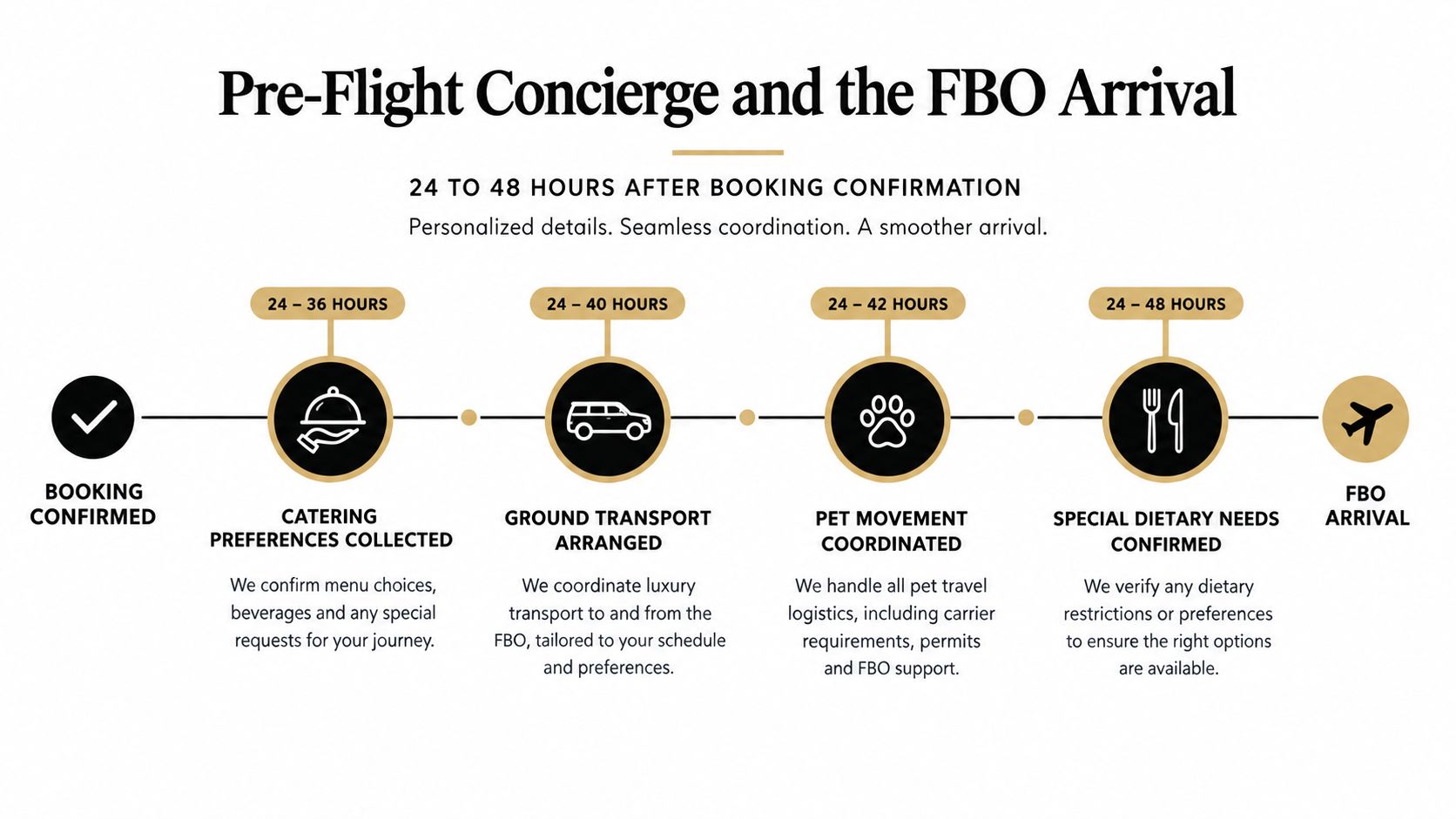
The experience is usually won or lost after the booking confirmation. A strong concierge team contacts you in advance to confirm catering, ground transport, pet movement, medical requirements, special diets, luggage, passenger names, and any timing constraint that could affect the flight.
The conversation should be practical, not ornamental. If you request a particular dish, the advisor should confirm the menu and supplier in writing. If a pet is traveling, the team should explain the required documentation and arrange any signed waivers. If a child needs a specific meal or seat arrangement, that request belongs in the trip brief, not in a last-minute note to the flight attendant.
At the FBO, the arrival should feel compressed without feeling rushed. Your driver pulls into the private terminal, staff verify the manifest, and luggage moves through the facility with minimal public exposure. Depending on the airport, you may walk directly toward the aircraft or take a short ramp transfer. The point isn't the number of steps. The point is that the route has been prepared before you arrive.
Commercial first class still requires a sequence of check-in, security, lounge movement, gate monitoring, and boarding. The private terminal keeps the journey more continuous. You can finish a call in the lounge, walk to the aircraft, and continue working once seated, rather than restarting the travel process at every checkpoint.
What the advisor should handle quietly
- Catering confirmation: The final menu should reflect the passenger's preferences, allergies, dietary restrictions, and timing. Don't accept “standard catering” as a complete answer.
- Luggage control: Ask who receives the bags, where they're loaded, and whether they remain in the passenger's sight between the car and cabin.
- Pet coordination: Confirm carrier requirements, documentation, handling responsibility, and the destination procedure before the travel day.
- FBO selection: The preferred terminal may depend on fuel arrangements, runway access, customs capability, opening hours, and the onward drive.
- Passenger manifest: Names and documents should be checked before departure, particularly for international routing or a complex passenger group.
Ask for a written pre-flight brief. It should state the aircraft, FBO, departure recommendation, catering, ground transport, passenger requirements, and the person responsible for changes.
This is also where runway and aircraft performance enter the conversation. A smaller airport may be closer to the final destination, but the aircraft must have the performance margin to use it with the intended fuel, passengers, baggage, temperature, wind, and runway condition. The most beautiful itinerary is irrelevant if the operational plan doesn't support it.
Once the ground team has removed those points of friction, the cabin can deliver what private aviation promises: a controlled environment built around the passenger rather than a standard service pattern.
Inside the Cabin and What to Actually Request
Cabin design is visible. Cabin altitude, catering execution, connectivity, sleep quality, and family configuration determine whether the flight is useful.
Modern business jets can offer a lower effective cabin altitude than traditional commercial and corporate aircraft. For example, the technical comparison of low cabin altitude aircraft lists 2,691 feet for the Bombardier Global 8000 at 41,000 feet, 2,840 feet for the Gulfstream G700 at 41,000 feet, and about 5,950 feet for the Citation Latitude at 45,000 feet. Traditional commercial cabins are commonly discussed around an 8,000-foot equivalent. Lower cabin altitude is associated with less physiological oxygen stress and dehydration, but don't compare published figures without checking the cruise condition used for each aircraft specification.
Request the cabin you need
Catering is where many private aviation promises become generic. A sandwich box may be perfectly appropriate for a short daytime sector. It isn't appropriate when the passengers expect a proper dinner, need a strict dietary preparation, or are using the flight for a client meeting. Name the preferred caterer or menu style, confirm sourcing, and specify serving time.
Connectivity deserves the same discipline. Ask for the installed system, expected coverage on the route, and realistic performance for email, messaging, voice calls, or heavier work. “Wi-Fi available” doesn't tell you whether the connection will support your actual agenda.
Sleep arrangements also vary sharply by aircraft category. Ultra-long-range cabins may provide a genuine flat bed, while other aircraft offer angled berths or reclining seats. If sleep matters, request the aircraft layout and bedding plan rather than relying on photographs.
| Aircraft Category | Cabin Altitude | Wi-Fi | Sleep Setup | Catering Tier |
|---|---|---|---|---|
| Light and midsize business jet | Varies by aircraft and cruise condition | Confirm system and route capability | Reclining seats or limited berth options | Simple meal or tailored light catering |
| Super-midsize business jet | Varies by aircraft and configuration | Confirm coverage and realistic use | Reclining seats, divans, or angled berths | Expanded meal service |
| Heavy business jet | Varies by aircraft and cruise condition | Confirm system, coverage, and bandwidth expectations | More generous rest arrangements | Multi-course service can be arranged |
| Ultra-long-range business jet | Published specifications must be compared under matching conditions | Confirm service for the full route | Flat-bed capability may be available | Full tailored dining service |
For families, specify the details that glossy aircraft photography rarely shows:
- Separate lavatory: Confirm whether the lavatory is enclosed and how the layout works for children.
- Cabin separation: Ask whether a divider can create a quieter sleeping or working zone.
- Child meals: Provide age-appropriate preferences and allergy information in advance.
- Luggage placement: Verify where strollers, car seats, and larger bags will travel.
- Crew briefing: Share routines and sensitivities without expecting the crew to guess.
A useful reference for understanding cabin service responsibilities is this private flight attendant role guide. The central rule remains straightforward: request the experience in operational language. “Comfortable” is a sales adjective. “A quiet work zone, confirmed connectivity, a warm meal served after departure, and a flat sleeping surface” is a usable brief.
Ground Transfers, Multi-Leg Trips, and Real-Time Coordination
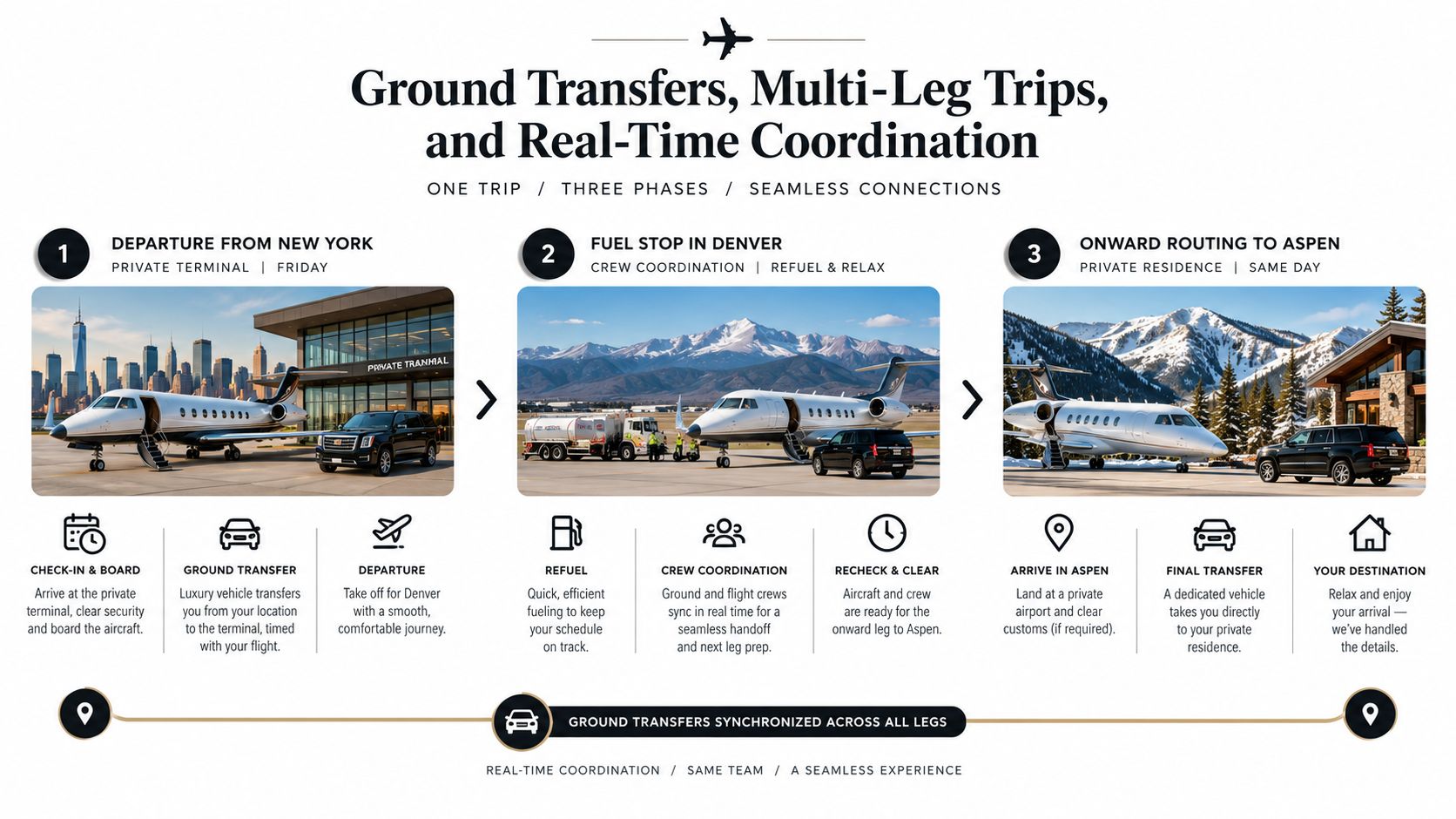
Consider a Friday afternoon departure from New York to Aspen, with a fuel stop in Denver and onward travel to a private residence. The polished version of the itinerary shows three destinations. The operational version shows several handoffs that must occur in the right order.
The SUV is scheduled to meet the passengers at the New York FBO. Luggage is transferred directly from the aircraft to the vehicle. The arrival team receives the updated landing estimate, the residence is prepared for the expected arrival, and the second-leg catering is reset during the Denver stop rather than treated as an afterthought.
The changes passengers shouldn't have to manage
A meeting can run late. Weather can close a preferred route. A slot-restricted airport can become unavailable. The advisor's job is to work on those problems while the passenger stays focused on the meeting, family, or destination.
Teterboro and London Farnborough illustrate why airport access must be treated as an operational question rather than a branding choice. The preferred airport may offer the best ground location, but slots, operating procedures, runway constraints, weather, and aircraft performance all affect whether it remains viable.
The same principle applies to the return. If the client meeting extends, the advisor should reassess the departure slot, crew duty implications, aircraft availability, catering, and vehicle timing. If weather requires a reroute, the client should receive a clear recommendation, not a stream of fragmented calls from different suppliers.
Ground transport deserves its own brief. Specify vehicle type, luggage capacity, child seats, security requirements, passenger names, meeting point, and the destination contact. For complex arrivals, this private transfer services guide provides useful context for treating the vehicle as part of the itinerary rather than a separate reservation.
The private jet experience ends at the final handoff, not at touchdown. If the car is late, the residence isn't ready, or the second leg hasn't been reset, the aircraft has only solved one part of the journey.
Trade-Offs and Misconceptions Worth Knowing
Private aviation isn't automatically the better choice. It wins when time control, airport access, privacy, passenger configuration, or schedule sensitivity outweigh the total cost and operational complexity. It loses when a premium commercial itinerary already solves the route cleanly.
Start with the invoice. The quoted hourly figure may not represent the full trip cost. Ask about crew overnight charges, repositioning, Federal Excise Tax, de-icing, airport and handling charges, catering minimums, waiting time, and ground transport. A transparent quote should show which items are included, which are estimated, and which can change.
Don't buy the hourly number. Buy the complete movement of the aircraft and passengers.
Empty legs are another overused promise. A genuine empty leg can be attractive, but it requires flexibility on timing, routing, aircraft, and availability. It rarely aligns neatly with a fixed board meeting, school calendar, or return commitment. Treat it as an opportunistic possibility, not as the foundation of a travel strategy.
Sustainability claims require equal scrutiny. A Sustainable Aviation Fuel certificate, a carbon offset, and a reduction in actual fuel emissions aren't interchangeable. Ask what is being purchased, whether the claim concerns the specific flight or a broader accounting framework, and whether the operator can explain the mitigation in plain language.
Commercial premium cabins often win on dense transcontinental routes, on ultra-long-haul journeys where a flat bed and excellent lounge already meet the need, and on short sectors where the ground experience dominates the total trip. Private aviation is most persuasive when the commercial itinerary forces an inconvenient airport, connection, schedule, or passenger compromise.
Finally, assess the operator, not just the upholstery. Part 135 operators can vary in operating discipline and service consistency. Review independent safety audits, aircraft age and maintenance standards, crew experience, insurance, and the identity of the actual operating carrier. A beautiful cabin is not a substitute for safety oversight.
Elevating the Experience Beyond the Aircraft
The most valuable requests are rarely the most glamorous. Arrange ground transport at both ends before the flight is confirmed. Ask for a named trip director who can be reached by text. Give the catering team a passenger-sourced dietary brief rather than accepting the operator's default. Confirm Wi-Fi with realistic expectations for the work you need to complete.
Then add the quiet refinements. Load brand and beverage preferences into the cabin brief. Ask whether the FBO can arrange the appropriate security and customs process. Time a hotel arrival kit, medication delivery, or residence preparation to the expected wheels-down time. These details turn a charter into a travel system.
HauteBlack offers private aviation coordination alongside bespoke itineraries, ground transport, and broader luxury travel planning. The right starting point is a candid conversation about your typical routes, passenger patterns, schedule pressure, and essential requirements, not a generic aircraft request.
Private aviation isn't selling luxury alone. It's selling time, certainty, and taste.
HauteBlack can coordinate the private jet, aircraft requirements, catering, Wi-Fi confirmation, FBO handling, and ground connections as one itinerary rather than separate bookings. Visit HauteBlack to discuss your typical routes and build a private aviation plan around the details you refuse to compromise.
Explore Our Guides


Signature Experiences


