Haute Black Journal
Private Jet Travel Companies: A Concierge Comparison Guide

Marlene Azeez
Director, HauteBlack
View all articles →

Your executive assistant has found an aircraft that can make the route. The villa has confirmed the arrival date. A helicopter transfer is available, and the hotel says it can arrange VIP check-in. Yet nobody has clearly accepted responsibility for connecting those pieces if the departure time changes, weather disrupts the route, or the aircraft is substituted.
That is the test of private jet travel companies. The aircraft matters, but the outcome depends on who controls the handoffs, verifies the operating carrier, explains the total price, and stays accountable from departure airport to final arrival. A premium booking should feel like one coordinated journey, not a chain of suppliers that the traveler must personally supervise.
Why the Right Private Aviation Model Matters
An executive assistant arranging a multi-city trip is rarely solving a simple flight problem. The itinerary may involve a board meeting in one country, a private event in another, and a weekend at a villa reached through a smaller regional airport. The aircraft must fit the route, but the coordinator must also align ground transport, baggage, catering, hotel timing, and the arrival window.
That distinction changes the buying decision. A broker may source an aircraft efficiently, while an aviation operator may control the flight directly. A luxury travel platform may add villa coordination, helicopter transfers, and hotel recognition. These are different responsibilities, and the traveler should know which company owns each one before paying a deposit.
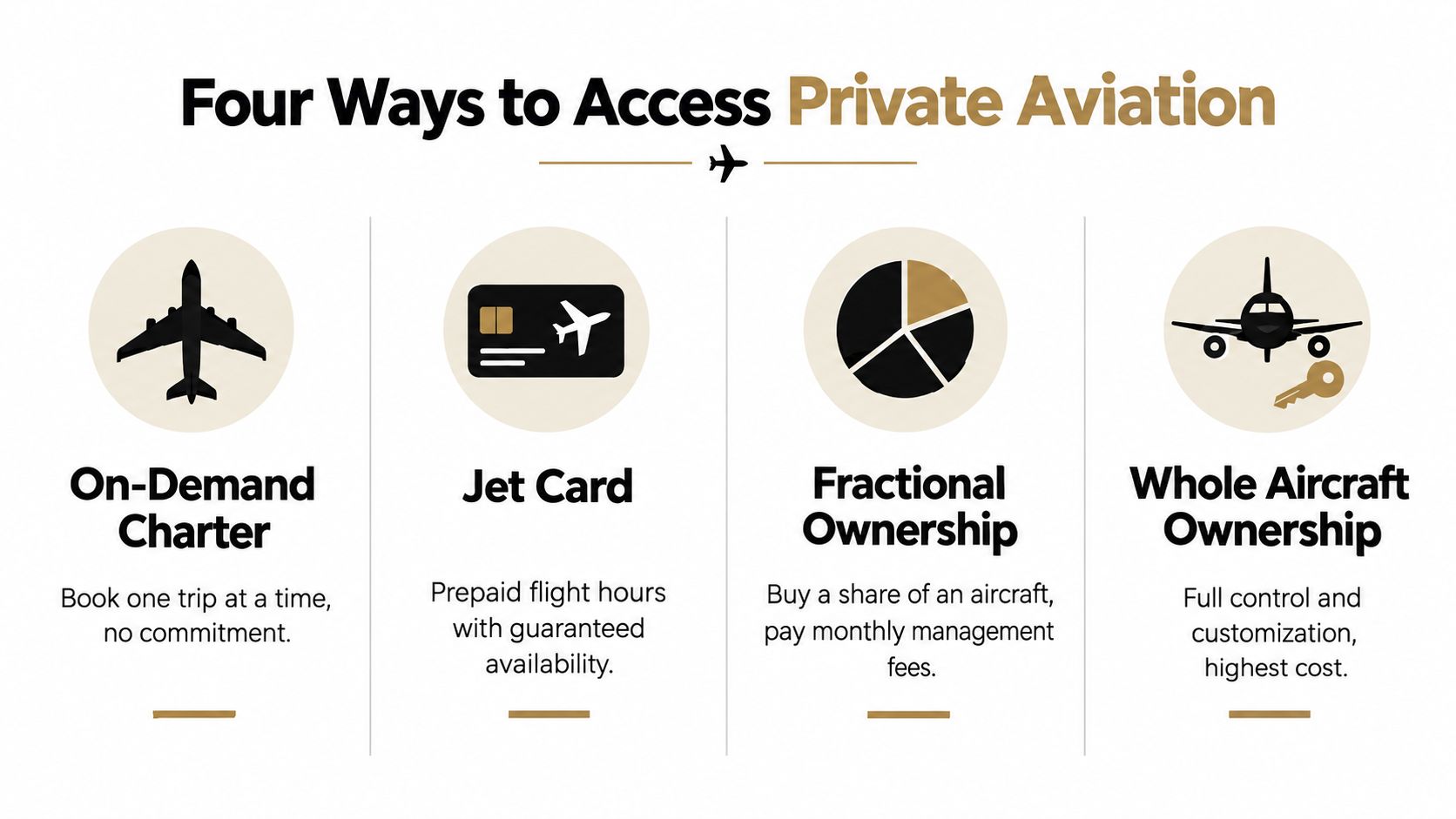
The access model matters just as much. On-demand charter suits a traveler who wants to book one trip without a continuing commitment. Jet cards trade some flexibility for structured access, prepaid hours, or defined availability. Fractional ownership introduces a longer financial relationship around a share of an aircraft and its management. Membership programs may combine aviation with broader travel or lifestyle services.
Practical rule: Choose the access structure that absorbs your actual travel pattern, not the one that sounds most prestigious.
A founder who flies irregularly shouldn't buy a complex commitment merely to secure status. A company with recurring executive travel may value predictable access and a dedicated operations team more than the apparent simplicity of one-off charter. A family taking occasional multi-stop journeys may benefit most from an advisor who can coordinate the entire itinerary rather than from a narrow aviation membership.
Private jet travel companies aren't interchangeable. The right question is not, "Which aircraft is available?" It is, "Who is accountable when the aircraft, transfer, property, and schedule must work together?"
The Four Principal Access Models Explained
Private aviation offers four principal access structures. Each solves a different problem, and each creates a different form of friction.
On-demand charter
On-demand charter is the cleanest choice for occasional or highly varied travel. You request a specific itinerary, receive aircraft options, and pay for that journey without buying hours or an aircraft share. The advantage is flexibility. You can match cabin size, range, passenger needs, and airport access to each trip.
The trade-off is quote variability. Aircraft availability, repositioning, operating restrictions, and seasonal demand can change the offer. Your advisor should identify the actual operating carrier and explain what happens if the proposed aircraft becomes unavailable.
Jet cards
A jet card is designed for travelers who want more predictable access. Programs may use prepaid hours, fixed-rate structures, or availability commitments. That predictability can help an executive team plan recurring travel, but the contract deserves close reading.
Check callout requirements, peak-day rules, blackout dates, minimum flight time, service-area restrictions, and refund or expiration provisions. A fixed hourly rate doesn't automatically mean a fixed total-trip cost.
Fractional ownership
Fractional ownership gives the client a share in an aircraft, with the operator handling management, scheduling, maintenance, and crew arrangements. It may suit a traveler whose routes and usage are consistent enough to justify a longer relationship.
Ownership adds obligations that charter avoids. The buyer should assess monthly management charges, aircraft replacement terms, resale mechanics, availability rules, and the treatment of maintenance or repositioning costs. The aircraft may be familiar, but familiarity doesn't remove operational complexity.
Whole aircraft ownership and membership
Whole ownership provides the greatest control over cabin configuration, availability, and customization. It also places the greatest responsibility on the owner, including crew, maintenance, insurance, hangar, regulatory, and management decisions.
Membership programs sit between pure charter and ownership. Some focus on aviation access, while others bundle travel planning or lifestyle benefits. Before joining, determine whether the membership provides a genuine operational advantage or routes your booking through a different commercial structure.
For a detailed comparison of how access structures affect planning and cost, review this private aviation solutions comparison.
How Leading Private Jet Travel Companies Compare
The visible features of a private aviation company can be misleading. A large fleet list doesn't tell you who operates the flight. A polished membership page doesn't tell you how the company handles a missed connection to a villa. A broker can provide broad access without operating aircraft, while an operator may provide tighter control but less variety.
Compare the structure behind the booking.
| Access Model | Typical Commitment | Best Suited To | Service Coordination |
|---|---|---|---|
| On-demand charter | One itinerary at a time | Occasional leisure, executive, or mixed travel | Depends on the broker, operator, and assigned advisor |
| Jet card | Prepaid hours or membership terms | Frequent travelers seeking structured access | Usually centralized, subject to program rules |
| Fractional ownership | Aircraft share plus management relationship | Recurring travel with consistent usage | Operator-led, with ownership and scheduling conditions |
| Whole aircraft ownership | Long-term ownership and management | Maximum control and customization | Owner and management company share responsibility |
What the traveler actually experiences
Membership structure determines how much flexibility you retain. Ask whether the program supports multi-city travel, international routing, last-minute changes, and different aircraft categories. A program built for predictable executive routes may be less suitable for a family itinerary with unusual airports and changing passenger needs.
Fleet breadth matters only when it supports the mission. A long-range aircraft may be unnecessary for a short regional trip, while a smaller jet may not carry the required baggage or provide the nonstop capability the schedule demands. Aircraft selection should follow passenger count, payload, routing, runway access, and arrival timing.
Safety credentials must attach to the operating carrier, not just the booking brand. Request the exact certificate, audit evidence, maintenance controls, and crew standards for the proposed flight. A company that answers precisely is easier to assess than one that offers general assurances.
Coordination depth separates a transaction from a travel service. The strongest setup gives the traveler one accountable advisor who can arrange catering, ground transport, helicopter connections, cabin preferences, and property arrival. HauteBlack describes a model that combines aircraft arrangements with transfers, accommodations, and VIP arrival services through a dedicated advisor and vetted operator partners, as outlined in its private jet interior and itinerary coordination guide.
Geographic reach also has a practical meaning. Access to smaller airports can reduce ground travel, but only if the company understands runway limitations, customs requirements, local handling, and onward transport. International coverage should be judged by execution, not by a map filled with destination names.
Operator Safety and Regulatory Standards
Safety screening begins with the actual operating carrier. A broker's brand, aircraft photographs, or membership language can't substitute for verifying the company that holds operational responsibility for the flight.
Historical comparisons show why the distinction matters. NTSB-referenced analysis reported 0.903 accidents per 100,000 flight hours for on-demand FAA Part 135 operations versus 0.188 for Part 121 scheduled airlines in a cited 2019 comparison, roughly a fivefold difference (operational safety analysis). These categories aren't identical, and broad private-aviation statistics can also combine professionally managed charter with owner-flown general aviation.
The screening file to request
Ask for the following before booking:
- Exact certificate: Confirm the operator holds the relevant FAA Part 135 certificate, or the applicable authority for an international flight.
- Recent audit credentials: Request current third-party audit information and understand which entity was evaluated.
- Safety-management evidence: Ask how the operator identifies hazards, reports incidents, and manages operational risk.
- Crew records: Confirm training, type ratings, currency, and experience on the aircraft proposed for the trip.
- Maintenance controls: Identify who manages inspections, parts, logbooks, deferred items, and return-to-service decisions.
- Subcontracting policy: Establish whether the booked carrier can transfer the flight to another operator and how that change will be disclosed.
Safety isn't a branding category. It's a file of documents connected to a specific aircraft, crew, and operating carrier.
An executive assistant should keep this information with the itinerary, especially when several legs involve different operators. If the company resists reasonable questions or responds only with a general safety rating, continue screening.
What a Private Jet Trip Actually Costs
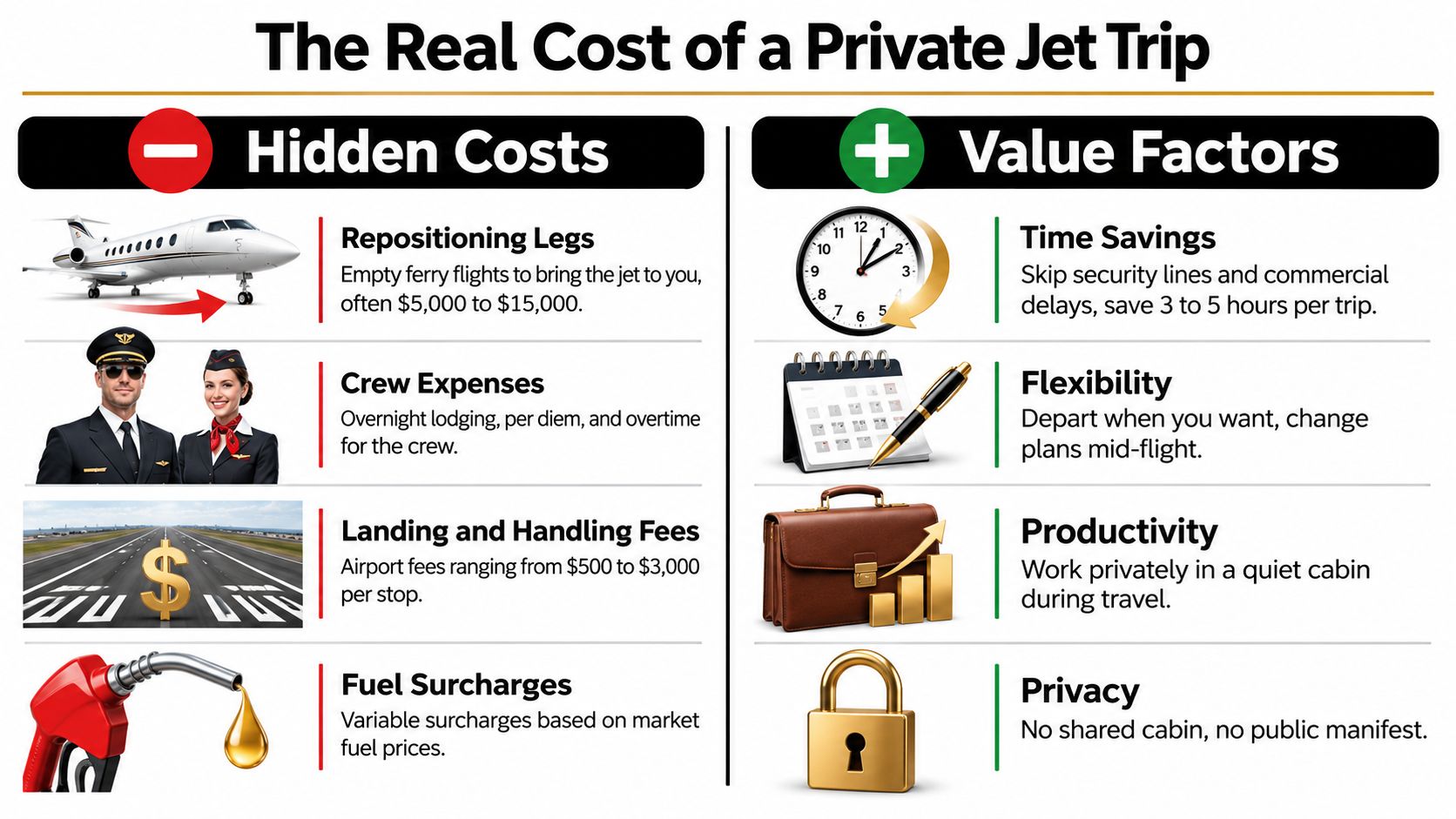
The hourly rate starts the commercial discussion. The itinerary outcome determines the bill. Two companies can quote the same route and produce different totals because one may include repositioning, crew expenses, landing and handling fees, de-icing, peak-day premiums, minimum flight time, fuel surcharges, or cancellation exposure while the other excludes them.
Compare the quote, not the headline
Request a written, all-in schedule of charges. It should identify the aircraft, operating carrier, route, estimated flight time, repositioning treatment, crew expenses, airport charges, catering, ground transport, taxes, cancellation terms, and conditions that could change the final invoice. Ask who coordinates the villa arrival, helicopter transfer, and VIP check-in. A premium operator or capable advisor owns those handoffs rather than leaving them to the chief of staff.
Peak-day exposure requires close review. A quote that looks attractive on an ordinary date may carry different terms during a high-demand period. Jet cards can provide more predictable rates, while restrictions may shift cost into minimum hours, blackout dates, or limited availability.
Empty-leg opportunities can reduce the price when the route matches an aircraft's existing repositioning plan. They offer less flexibility than a dedicated charter and may fail when timing must remain fixed or plans may change quickly. The lower fare usually buys less control over timing, so it is rarely a like-for-like saving.
Market location affects the final amount. North America represented an estimated 57.3% of global private-jet market revenue in 2025, while Europe represented about 22.4%, according to the private aviation pricing research. Taxes, airport charges, customs arrangements, handling rules, and cross-border operating requirements can alter the invoice.
For aircraft comparison, assess payload, cabin needs, passengers, and nonstop requirements before treating a small rate difference as decisive. A published comparison found nearly identical eight-passenger range for the Gulfstream G700 and Bombardier Global 7500, 7,765 versus 7,770 nautical miles, with estimated variable operating costs of $7,779 and $7,501 per hour, respectively. On a 6,000-nautical-mile mission, estimated direct cost was approximately $12.25 per nautical mile for the G700 and $12.26 for the Global 7500 (G700 and Global 7500 comparison).
Maintenance records provide another screening point. The guide on why logbooks matter explains how aircraft records support maintenance accountability and informed evaluation. Ask who maintains them and whether the relevant information is available for the aircraft you are booking.
For a fuller breakdown of quote components, consult this private jet charter cost guide.
Matching the Right Model to Real Travel Patterns
A frequent executive traveler with predictable routes should start with a structured program. A jet card or managed arrangement may reduce repeated negotiations, provided its booking windows, aircraft substitutions, and peak-period terms fit the calendar. The priority is dependable lift and a team that can support changes, not the prestige of owning a share.
A family planning only a few complex journeys has a different requirement. It may need a larger cabin for luggage, pets, or children, a smaller airport near a villa, and a driver waiting at the correct arrival point. On-demand charter lets the family choose the aircraft for each itinerary, while a capable advisor coordinates property staff, transfers, catering, and special requests.

Four practical matches
- Predictable executive travel: Favor a structured access model when recurring routes and timing make availability more important than aircraft variety.
- Occasional multi-stop family travel: Use on-demand charter and insist on one coordinator for airports, baggage, pets, ground transport, and property arrival.
- A one-off international journey: Compare aircraft and operators specifically for the route. Don't accept a generic fleet recommendation without checking range, payload, customs, and arrival logistics.
- A broader luxury relationship: Choose a travel platform only if it can connect aviation with villas, hotels, helicopter transfers, dining, and VIP arrival services through a clear point of accountability.
Private aviation can reduce travel time through ground-side efficiency rather than faster flight speeds. HauteBlack reports an independent analysis estimating an average saving of 127 minutes per flight, alongside access to approximately 5,000 U.S. airports for private aviation versus about 500 served by commercial airlines (private jet versus commercial travel analysis). Those gains matter only when the receiving team is ready at the other end.
The same coordination principle applies to personal wellbeing. If the itinerary crosses time zones, a travel advisor can help align arrival plans with sleep and recovery needs. Travelers who want a practical explanation of melatonin timing for flights should review the guidance before building an aggressive schedule.
The Environmental Question Answered Honestly
Private aviation shouldn't be described as sustainable merely because a newer aircraft consumes less fuel or a booking includes an offset option. Aircraft efficiency matters, but total impact also depends on flight activity, passenger load, distance, routing, and empty repositioning legs.
Independent climate research estimated that private jets produced 19.5 million tonnes of CO2-equivalent globally in 2023, a 25% increase over the prior decade, with private aviation emissions reported at roughly 2 to 4 tonnes of CO2 per flight hour (private aviation climate research summary). European private-aviation emissions were reported at approximately 15.6 million tonnes in 2025, 46% above 2019 levels, while carbon costs and regulatory treatment vary by route and jurisdiction.
Ask for itinerary-level disclosure
A credible provider should explain:
1. The estimated emissions for the specific aircraft and route.
2. Whether the estimate includes repositioning legs.
3. How passenger load affects the calculation.
4. Which emissions are covered by regulation or fees.
5. Whether sustainable aviation fuel claims are traceable to a documented volume and supplier.
6. Whether an offset or mitigation program provides independent verification.
The practical levers are clear. Choose an aircraft that fits the passenger and payload requirement, avoid unnecessary empty positioning where possible, select sensible routing, and compare nonstop efficiency with the operational realities of the trip.
A mitigation claim should identify the standard, accounting method, project or fuel source, and verification process. If a company offers only broad language about being green, treat it as marketing rather than evidence. The useful question isn't whether private travel is sustainable or unsustainable. It's whether the provider will disclose the impact of this itinerary and show which lower-impact choices are available.
Questions to Ask Before You Book
A strong private jet travel company should answer these questions directly. Use them with the booking advisor, the operating carrier, and anyone responsible for the wider itinerary.
Access and commercial terms
- Which model fits this trip: Is this on-demand charter, a jet card, fractional ownership, whole ownership, or a broader membership?
- What am I committing to: Are there prepaid hours, minimum flight times, renewal terms, expiration rules, blackout dates, or restricted service areas?
- What is included in the quote: Does the total include repositioning, crew expenses, landing and handling, de-icing, catering, ground transport, taxes, and fuel-related charges?
- What can change the price: Which peak-day, cancellation, delay, substitution, or route-change conditions apply?
Operator and aircraft verification
- Who operates the flight: Provide the legal name of the carrier and its exact certificate.
- What safety evidence is available: Can you provide recent audit credentials, safety-management-system documentation, crew training records, and maintenance controls?
- What aircraft am I receiving: Confirm the aircraft type, cabin configuration, baggage capacity, age information, and substitution policy.
- Who controls maintenance records: Establish how inspections, defects, logbooks, and return-to-service decisions are managed.
Coordination and disruption handling
- Who owns the handoffs: Identify the person responsible for the departure airport, transfers, hotel or villa, catering, and VIP arrival.
- What happens if the plan changes: Ask who rebooks the aircraft, informs the driver, updates the property, and communicates with passengers during a disruption.
- Can the itinerary include more than the flight: Confirm whether the company can arrange helicopter connections, first-class transfers, accommodations, and cabin preferences.
- Who is reachable after booking: Get the escalation contact and the hours of live operational support.
An executive assistant should record the answers in the travel file, not rely on verbal assurances. The executive guide to private jet booking provides a useful reference point for organizing that conversation.
The decisive comparison is the provider's ability to connect verified aviation operations with the rest of the journey. If the company can explain the aircraft, carrier, price, safety file, disruption plan, and villa arrival in one coherent response, you have a serious candidate. If each answer belongs to a different subcontractor, keep looking.
HauteBlack offers bespoke travel planning through Haute Jets, with aircraft matched to itinerary, range, passenger needs, and price, alongside coordinated catering, ground transport, helicopter connections, cabin preferences, and VIP arrivals. Review HauteBlack when you want one advisor to evaluate the flight and the wider journey together.
Explore Our Guides


Signature Experiences