Haute Black Journal
Private Jet Rental: Your Complete Guide to Charter Options

Marlene Azeez
Director, HauteBlack
View all articles →
You're leaving a Manhattan boardroom at 4 p.m., have a dinner commitment in London, and want a straight answer before anyone starts comparing aircraft screenshots. The question isn't whether a private jet rental feels more comfortable than a commercial flight. It's whether the complete trip cost, including positioning, fuel, airport services, crew logistics, and changes, earns its place in your itinerary.
That distinction matters. A headline hourly rate can make a charter look straightforward, while the final invoice reflects the aircraft's entire operating mission. My advice is simple: evaluate private aviation as a managed travel solution, not as a seat with wings.
Why More Travelers Are Choosing Private Jet Rental
A commercial itinerary can turn a single evening commitment into terminals, queues, connections, and waiting. A well-arranged private jet rental gives you control over departure timing, airport choice, cabin environment, and the people sharing the journey. The benefit becomes practical when the recovered hours protect a meeting, simplify a family trip, or keep a multi-city schedule intact.
Private jet rental grew from postwar air charter, and the history of private jet charter traces the modern private aviation era through the Learjet 23 and the rise of individual-flight bookings.

Time is the first calculation
The strongest case for private travel is usually time control. Regional airports can shorten ground transfers, while a private terminal removes much of the terminal-side delay associated with commercial travel. An executive team can work together, a family can preserve its routines, and sensitive conversations remain away from a crowded public setting.
That flexibility carries more weight when the itinerary includes several cities, remote destinations, pets, security requirements, or last-minute changes. It can also simplify travel for households managing children, nannies, medical needs, or specialized luggage.
The invoice still needs scrutiny. A headline hourly rate rarely captures every operating detail, and a luxury travel advisor's relationships with operators can affect aircraft availability, repositioning terms, airport fees, and change conditions. Those negotiations can materially change the final price, so compare the complete trip cost rather than approving the lowest advertised figure.
A solo traveler on a simple route may find commercial business class more sensible. A group, multi-city itinerary, or trip where a missed meeting carries a serious cost can justify charter more convincingly.
Advisor's view: Ask whether the total price buys enough schedule certainty, privacy, and recovered time for this specific trip.
The market includes one-off charter, jet cards, and membership or fractional programs. Each handles flexibility, commitment, and pricing differently. For a broader comparison of the two travel modes, read this guide to private jet versus commercial travel.
The Three Main Ways to Access a Private Jet
Private jet access isn't one product. You're choosing between a trip, a pricing structure, or an ongoing aviation arrangement.
On-demand charter
On-demand charter is the cleanest starting point. You request a specific itinerary, compare available aircraft, approve an operator, and pay for that trip rather than committing to future flying. It suits occasional travelers, unusual routes, and clients who want to select the aircraft for each mission.
The trade-off is variability. Aircraft availability and pricing can change around holidays, major events, and high-demand travel days. If the aircraft must reposition to collect you, that operational requirement can matter more than the advertised hourly rate.
Jet cards
A jet card typically involves buying flight hours in advance or accepting a contracted hourly structure through a program. Depending on the provider, you may receive access to defined aircraft categories, more predictable pricing, cancellation terms, or fleet availability.
Read the agreement carefully. Hourly minimums, peak-day rules, round-trip provisions, taxes, repositioning, and cancellation windows can change the value of the card. A fixed hourly number means little if the program applies restrictive usage rules to your actual routes.
Fractional ownership and membership
Fractional ownership gives you an equity share in an aircraft, along with allocated flight hours and ongoing management obligations. Membership programs generally provide access to a managed fleet without giving you ownership of the aircraft.
Both approaches suit travelers with consistent, substantial flying patterns. They can reduce repeated decision-making, but they introduce contractual commitments, recurring charges, and usage rules that occasional travelers may not want.
| Access model | How you pay | Typical commitment | Best for | Main trade-off |
|---|---|---|---|---|
| On-demand charter | Per trip | Minimal | Occasional or irregular travel | Variable availability and pricing |
| Jet card | Prepaid hours or contracted rates | Medium | Frequent travelers seeking repeatability | Program restrictions and unused-hour exposure |
| Fractional ownership or membership | Equity or recurring access fees | Long term | High-volume, predictable flying | Ongoing contractual and management obligations |
The practical distinction is straightforward. Charter buys a trip, a jet card buys access and pricing structure, and ownership or membership buys an ongoing aviation solution. If aircraft size is your immediate concern, a useful companion resource is how to choose a midsize jet, particularly when cabin space and route capability matter more than the lowest rate.
What a Private Jet Rental Really Costs in 2026
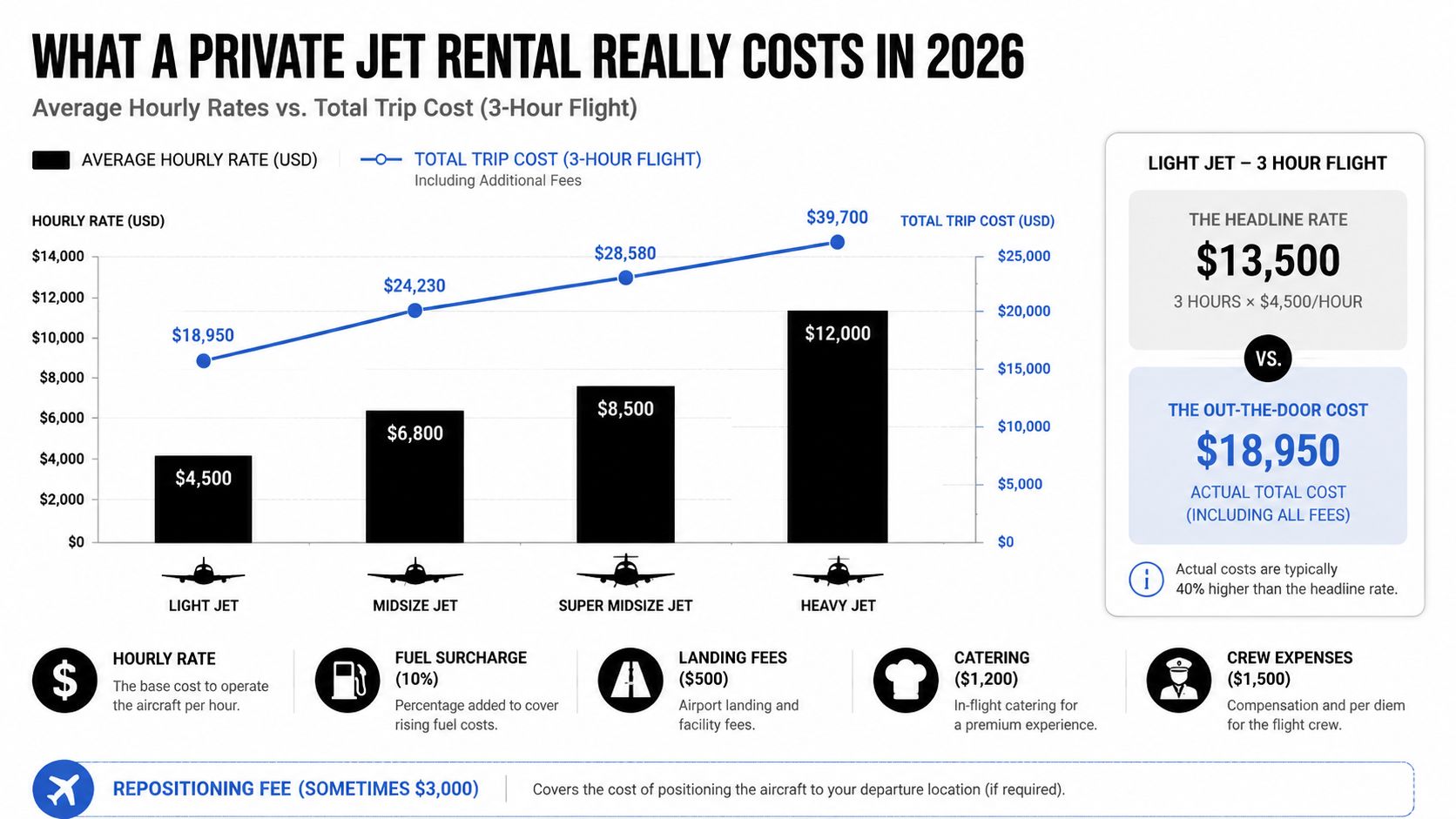
You find a jet advertised at an attractive hourly rate, then receive an invoice shaped by positioning, airport charges, crew logistics, and fuel. The headline number describes only one part of the trip. A reliable estimate starts with flight time and accounts for every movement and service needed to place the aircraft at your departure airport and complete the itinerary.
Published planning ranges vary sharply. One industry guide lists entry-level turboprops at about $4,000 to $4,900 per hour and ultra-long-range jets at about $15,200 per hour. Another places the broader range at approximately $2,300 to $23,000 per hour, based on aircraft category. Treat these figures as reference points, not quotations. Aircraft age, cabin layout, operator, crew requirements, route, and availability can move the final price substantially. This private jet maintenance cost guide explains why aircraft economics extend beyond passenger flight time.
The cost stack behind the quote
Require a written estimate that separates:
- Flight time: Expected billable operating time, including applicable minimums.
- Positioning: Empty flights needed to bring the aircraft to you or return it to base.
- Fuel: A major variable affected by aircraft efficiency, route profile, and current fuel pricing.
- Airport services: Landing, handling, parking, hangarage, and facility charges.
- Crew logistics: Accommodation, meals, transport, and duty-related expenses for overnight itineraries.
- Trip services: Catering, Wi-Fi, ground transfers, international permits, and special handling.
- Weather operations: De-icing and related winter-operation charges where applicable.
Fuel can change the economics quickly. Private jets may burn roughly 60 to 540 gallons per hour, depending on aircraft class, and total trip fuel is commonly 10% to 25% higher than cruise-only consumption after taxi, climb, descent, and reserves, according to this private jet fuel-use analysis. At $4 to $10 per gallon, fuel alone can add thousands of dollars per hour. A Gulfstream G450, for example, is cited at about 330 gallons per hour, or approximately $2,475 per hour in fuel alone under that price assumption. Operators may also add fuel surcharges of $500 to $2,000 per trip when fuel markets rise.
Compare missions, not rate cards
A round trip can reduce positioning exposure when the aircraft remains nearby. A one-way itinerary may require the operator to recover it elsewhere. Short flights can also trigger minimum operating times, so airborne duration may understate the bill.
Flexible travelers can consider empty legs. Industry sources estimate that approximately 30% to 40% of private jet flight hours involve repositioning, while empty-leg pricing commonly discounts full-charter pricing by 25% to 75%, as described in this empty-leg charter guide. The deepest discounts often appear on short-haul routes under two hours, but departure times are fixed and availability can vanish quickly.
A luxury travel advisor can materially change the final invoice by using established operator relationships, comparing positioning options, and negotiating fees that a one-off caller may accept. Ask for an all-in estimate listing aircraft category, flight time, passengers, baggage, airports, cancellation terms, positioning, taxes, and every assumed charge. Comparing operators by hourly rate alone is not a meaningful comparison.
Matching the Right Program to Your Travel Pattern
Your travel pattern should determine the access model. Frequency, route predictability, and aircraft control matter more than the appeal of a membership label or a low advertised hourly rate. A single weekend in Aspen calls for a different arrangement than repeated international travel.
| Trip Scenario | Best-Fit Model | Why It Wins | Watch-Out |
|---|---|---|---|
| One-off weekend to Aspen | On-demand charter | You can select the aircraft and airport based on current availability, while avoiding a long-term commitment | Repositioning may dominate the quote if the aircraft isn't nearby |
| Recurring New York to London route | Jet card or fractional program | Repeat flying can make predictable access and aircraft categories valuable | Review international operating rules, peak dates, and cancellation terms |
| Multi-leg European family holiday | On-demand charter | The itinerary can be built around changing cities, luggage, and family preferences | Every extra leg can alter crew, airport, and positioning costs |
| Seasonal Palm Beach and Hamptons rotation | Jet card or membership | A recurring pattern benefits from an established booking relationship and known aircraft preferences | Peak demand can tighten availability and increase pricing pressure |
| Same-day transcontinental business flight | On-demand charter, then jet card if repeated | Charter lets you match cabin, range, and departure timing to the meeting | A short-notice request may leave fewer aircraft choices |
The occasional traveler
For one weekend, on-demand charter usually offers the clearest economics. Choose a light or midsize aircraft according to passenger count, baggage, range, and airport access. A program commitment adds little value if your flying remains irregular.
Aspen shows why the aircraft's starting position matters. An aircraft already nearby may produce an efficient quote. If it must fly empty to collect you, repositioning can outweigh the apparent benefit of a lower hourly rate.
Review the full invoice, not just the flight time. Ask your advisor to identify positioning, airport charges, taxes, cancellation terms, and other assumed costs before you approve the trip.
The repeat traveler
A recurring New York to London itinerary changes the calculation. Consistent aircraft categories, established crew standards, predictable booking procedures, and fewer repeated negotiations may justify a jet card. Fractional ownership can suit a client with a substantial, dependable annual pattern and a stronger need for ongoing aircraft access.
The Hamptons and Palm Beach rotation also rewards advance planning. Peak-day demand, limited aircraft availability, and schedule changes can affect the final cost even when a program advertises predictable pricing. An advisor with established operator relationships can compare alternatives and negotiate terms that a one-off caller may accept without question.
The complex family itinerary
A European family holiday with several stops generally benefits from on-demand charter. The aircraft must accommodate luggage, children, pets, and changing city pairs, while each airport can introduce separate operating requirements. A fixed program may restrict those choices or leave you paying for access that does not match the itinerary.
Map every leg before selecting a contract. Include likely changes, baggage needs, and preferred airports so the quoted structure reflects the actual trip. Your flying pattern should determine the contract you sign.
How the Booking Process Actually Works
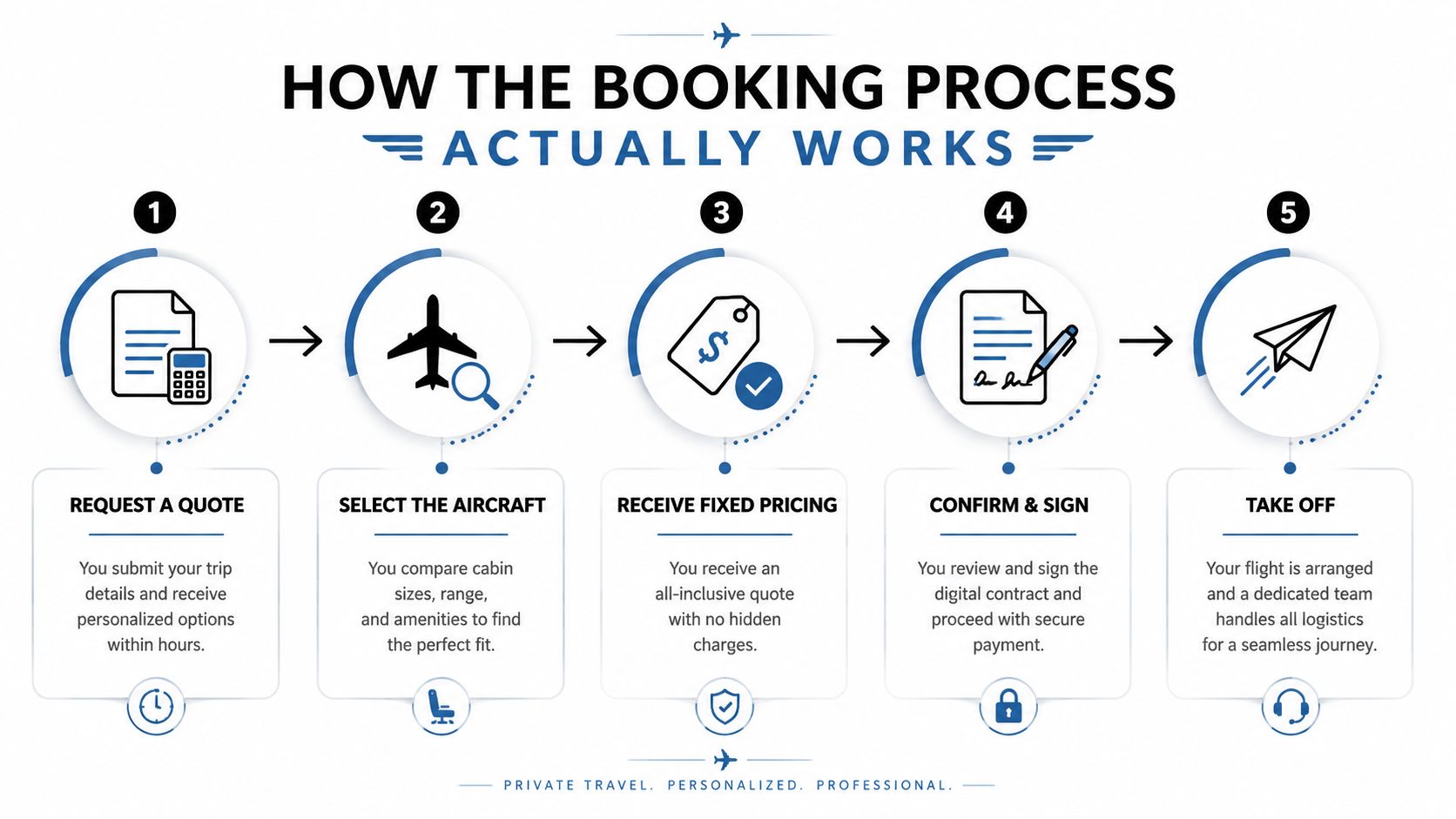
Your New York departure is tomorrow morning, the aircraft looks right, and the headline hourly rate seems acceptable. Then the invoice adds positioning, airport fees, taxes, catering, and schedule-related charges. Approve only a proposal that shows the full cost and the assumptions behind it.
Start with the mission
Give the advisor or broker the operating details first: departure and arrival cities, preferred airports, dates, timing, passengers, baggage, pets, catering, and special requirements. State whether the trip is one-way, round trip, multi-city, or likely to change.
The first proposal should name the aircraft category, estimated flight time, operator, inclusions, exclusions, positioning, airport charges, taxes, and cancellation terms. Ask who pays each cost and which assumptions could change the invoice. A quote showing only an hourly rate is incomplete.
A luxury travel advisor can compare aircraft already near your departure point and use established operator relationships to question handling fees, repositioning, and change terms before you approve payment.
Select the aircraft and operator
Choose the aircraft for the mission, not for its marketing photos. Check cabin dimensions, baggage capacity, range, passenger layout, runway access, connectivity, and crew requirements against the actual itinerary.
Ask who operates the aircraft, who holds operational control, and what safety-audit information is available. The operator should explain the aircraft's status, crew assignment, and contingency plan clearly.
Review the contract before paying
The contract should state the total price or pricing method, payment schedule, cancellation terms, weather provisions, aircraft substitution rights, passenger responsibilities, and change fees. For international flights, provide passenger names and travel-document details exactly as requested.
Coordinate catering and ground transport within the same itinerary. Confirm dietary needs, vehicle type, pickup location, luggage handling, and arrival FBO. These details can affect the final invoice and should not be left to separate last-minute vendors.
Review this executive guide to private jet flight booking before sending your first request.
Confirm the final details
Before departure, verify the manifest, aircraft, crew, FBOs, catering, ground transfers, weather plan, and contact numbers. Use the final confirmation call to resolve changes while alternatives remain available.
The best booking process leaves no important assumption buried in a rate sheet.
The Case for Booking Through a Luxury Travel Advisor
A private jet rental can look affordable until the full itinerary is priced. A luxury travel advisor can improve that final invoice through operator relationships, careful comparison, and intervention when the trip changes. The value lies in relationships, judgment, and intervention when the trip stops behaving as planned.
Negotiation starts before the quote reaches you
Preferred-operator relationships can create room to negotiate the all-in structure, rather than focusing only on the hourly rate. An advisor may compare aircraft already positioned near your departure city, ask an operator to clarify or absorb specific handling terms, or use repeat booking volume to improve catering, upgrades, or repositioning conditions.
Every request will not produce a discount. The benefit is experienced scrutiny of the operator's cost assumptions, with attention to the terms that can move the final invoice.
A polished hourly rate means little if positioning, handling, or service conditions remain unclear.
Availability extends beyond a public listing
Public marketplaces show aircraft that have been made visible. Advisors often work through direct operator relationships and can request aircraft absent from a basic search result. That access matters when the itinerary requires a particular cabin, baggage capacity, departure window, or airport.
Good judgment matters just as much as access. An advisor knows when to stop pursuing an unsuitable aircraft, because a low rate on the wrong cabin or an inconvenient FBO is no saving.
Problems are where the relationship earns its keep
Weather, maintenance, crew duty limits, airport restrictions, and schedule changes can disrupt a carefully planned charter. A direct-booking client may have to manage each conversation alone. An advisor can coordinate the operator, ground team, catering provider, and replacement aircraft while keeping one person accountable to the traveler.
HauteBlack offers private aviation coordination through Haute Jets, including aircraft matching and arrangements for catering, ground transfers, and in-flight preferences. It belongs in the consideration set for travelers who want one relationship managing those details.
A knowledgeable client can book direct, particularly with a trusted operator and a straightforward route. For irregular itineraries, high-demand dates, or multi-leg travel, I prefer an advisor. The value comes from the quality of decisions before departure and the speed of action when plans change.
Common Pitfalls and How to Avoid Them
A quote that looks attractive on paper can become expensive once the aircraft, route, and operating assumptions are fixed. The headline hourly rate may exclude positioning, crew overnight expenses, taxes, catering, airport services, de-icing, or weather-related charges.
Require a written, all-in estimate. Have each assumption shown separately, including billable hours, repositioning, landing and handling fees, and last-minute availability. This private jet charter pricing guide explains the cost items travelers should question before approving a quote.
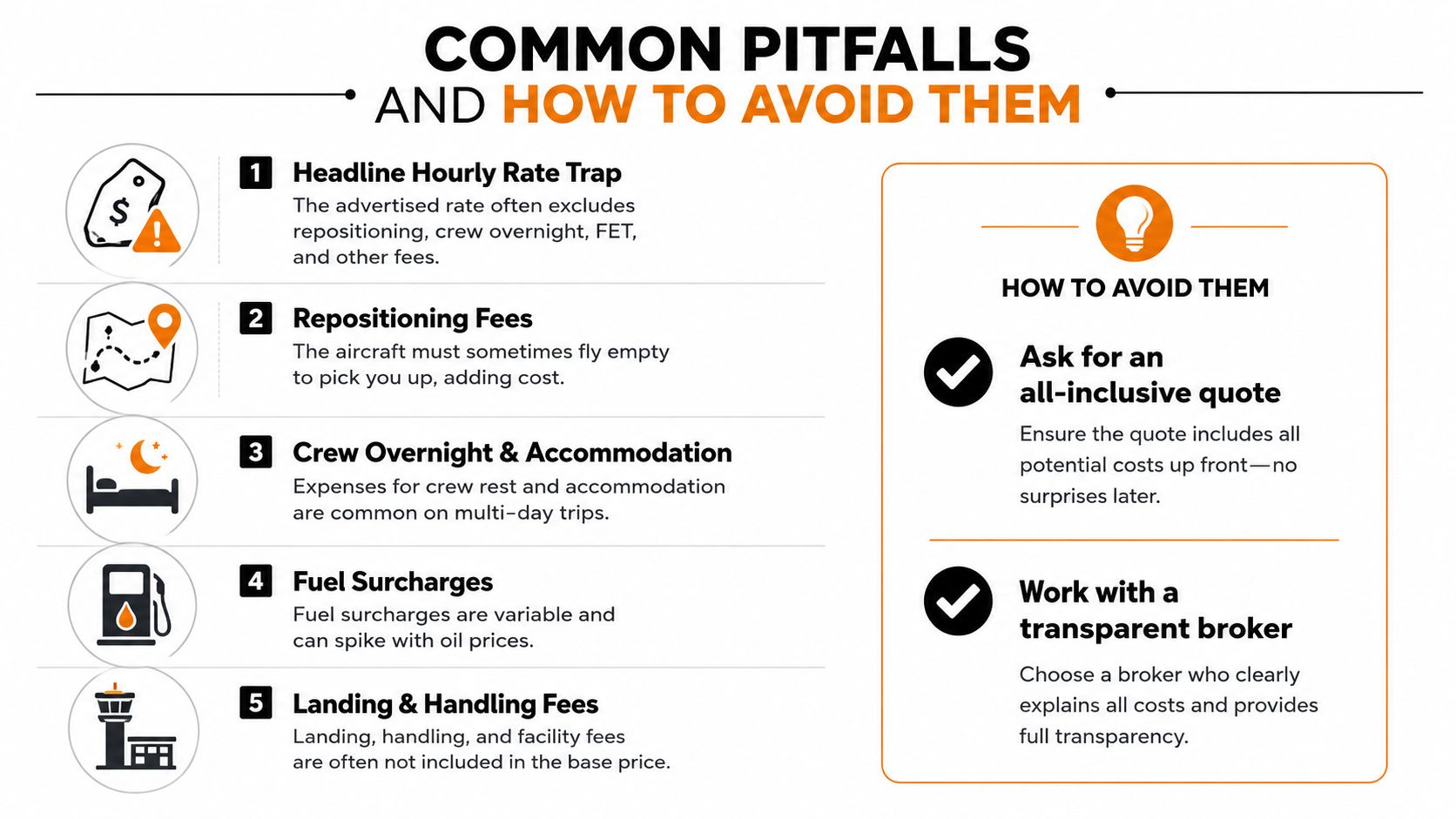
Aircraft category deserves the same scrutiny as price. A light jet with limited cabin or baggage space may be the wrong choice for a longer mission, even if its hourly rate is lower. The compromise can mean discomfort, restricted luggage, or an unnecessary technical stop.
Empty-leg offers reduce cost by sacrificing control. Departure time, routing, and replacement options may all be limited, so accept one only when your schedule can absorb those constraints.
Have your advisor price the mission you need, then use established operator relationships to challenge positioning costs, aircraft substitutions, and service fees. A cheap category is no saving if it fails the baggage, range, or timing test.
Negotiating rule: Require the quote to cover the real mission, not an attractive aircraft category with missing operating costs.
A Short Checklist Before Your Next Private Flight
Before approving a private jet rental, confirm the mission in writing. List passengers, luggage, pets, catering, special requirements, route, and timing. Your advisor should price that exact itinerary, not a cheaper aircraft category with missing operating costs.
Request an all-in estimate with billable hours, repositioning, fuel assumptions, landing and handling charges, crew costs, taxes, and onboard services shown separately. This private jet charter pricing guide outlines cost items worth questioning before approval.
Check cabin dimensions, baggage capacity, range, substitution terms, departure and arrival FBOs, parking, and ground transfers. Ask for available ARG/US, Wyvern, or IS-BAO audit information, plus crew experience on type. Read cancellation, rerouting, weather delay, aircraft substitution, and passenger-change terms before signing.
Reconfirm catering, Wi-Fi, transfers, and onboard preferences before departure. Keep one advisor responsible for the booking. Established operator relationships can reduce positioning costs, challenge service fees, and secure better replacement options when availability changes.
Negotiating rule: Approve the complete mission price, not an attractive hourly rate.
HauteBlack can arrange private aviation through Haute Jets, coordinating aircraft, catering, ground transfers, and in-flight preferences. Visit HauteBlack to compare the complete trip cost with a travel advisor.