Haute Black Journal
How Much Does It Cost to Maintain a Private Jet

Marlene Azeez
Director, HauteBlack
View all articles →
August 28, 2026
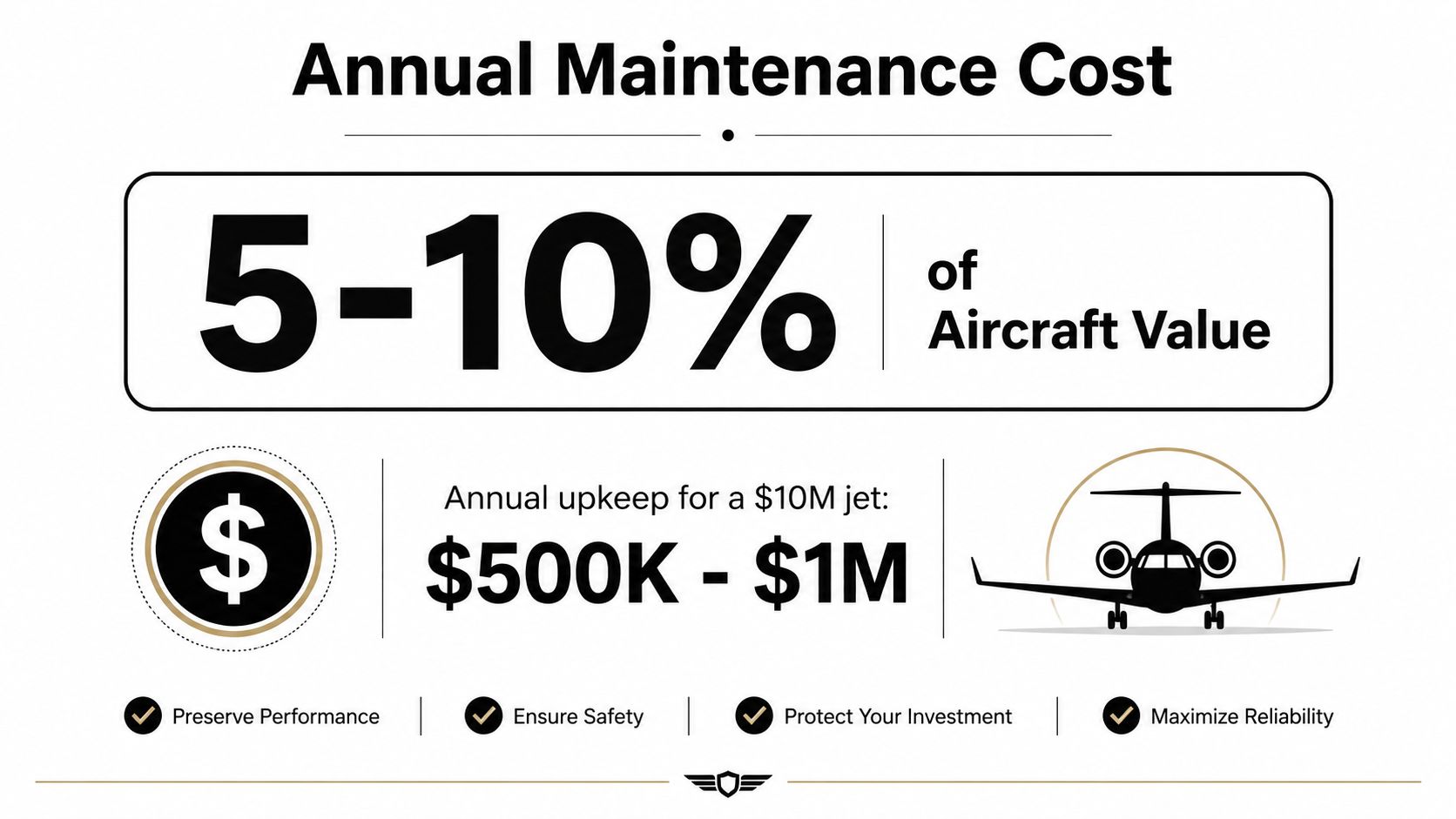
Maintenance alone typically runs 5% to 10% of a private jet's value each year. For a $10 million aircraft, that means roughly $500,000 to $1 million annually, before fuel, crew, hangarage, insurance, and financing.
That's the number prospective owners should keep beside their glass before they start comparing cabin layouts or paint schemes. The core question isn't just, “How much does it cost to maintain a private jet?” It's whether your ownership structure can absorb scheduled inspections, surprise repairs, engine reserves, and periods when the aircraft can't fly.
Private jet maintenance behaves like a lifecycle cash-flow problem, not a tidy annual subscription. A younger light jet may sit near the lower end of the market, while an older large-cabin aircraft can move into seven-figure maintenance years when engines, landing gear, avionics, or heavy inspections come due. The private aviation news section on HauteBlack is also actively maintained, with recent coverage including private jet charter and luxury travel subjects, a useful reminder that ownership is only one way to access the category.
The Maintenance Anchor Most Owners Misread
A maintenance percentage is useful only when it becomes a cash-flow stress test. Start with the aircraft's realistic current market value, then ask whether your ownership plan can absorb a high-maintenance year alongside fuel, crew, hangarage, insurance, financing, and periods when the aircraft cannot fly. Flycraft's private jet cost overview provides the benchmark used to compare maintenance exposure across aircraft classes.
Aircraft value is only the starting point. Engineering complexity, engine condition, avionics, inspection schedules, component support, and parts availability determine how that exposure arrives. A light jet and a large-cabin aircraft may fly similar hours, yet the larger aircraft can require more specialist labor, costlier parts, and larger scheduled events.
Use the percentage as a stress test
Apply the maintenance benchmark to the aircraft's present market value, not the purchase price you hope to negotiate. Then model the upper end against your available annual cash. If that scenario forces you to cut operating reserves, delay other commitments, or rely on optimistic charter revenue, the aircraft does not fit the ownership plan.
The percentage also requires context. In certain cases, the largest cabins may sit closer to 3%, while the absolute maintenance bill remains enormous. A smaller percentage reflects a much higher aircraft value, not inexpensive ownership.
Advisor's rule: If the upper end of the maintenance range makes you uncomfortable, the aircraft is too expensive for your ownership plan.
Utilization, age, and event timing determine when the cash leaves your account. Low utilization can reduce some hourly wear, but calendar inspections and component replacement dates still arrive. An older aircraft may offer a lower acquisition cost, then require substantial capital as aging systems, inspections, and major events begin stacking up.
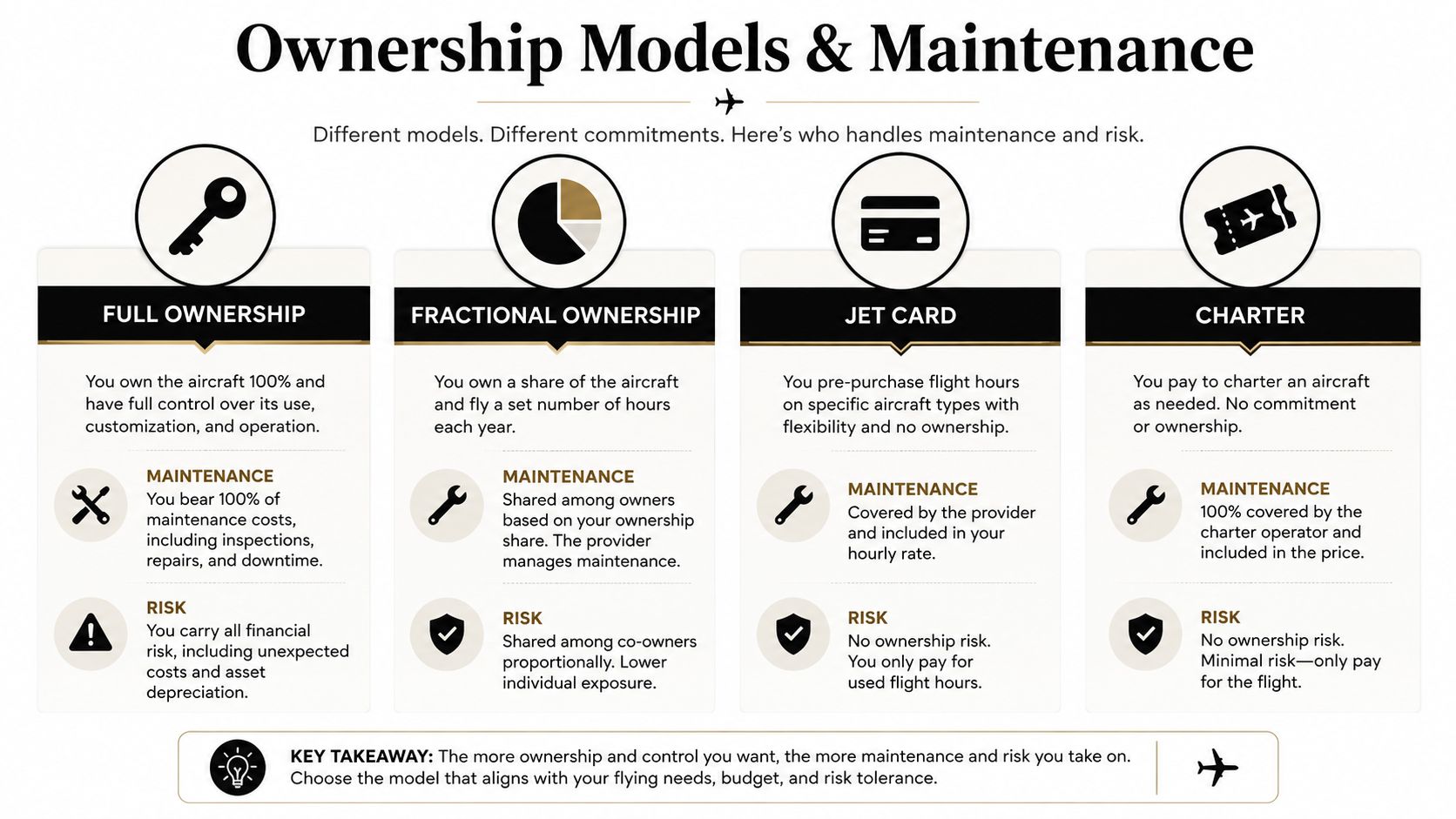
Ownership model changes the timing as well as the total. Full ownership leaves every inspection, repair, reserve, and downtime exposure with you. Managed, fractional, or charter arrangements can spread or shift those costs, sometimes changing annual cash flow by hundreds of thousands of dollars. Price the structure, not only the aircraft.
Use this anchor before reviewing individual maintenance lines. It keeps labor, parts, inspections, and reserves in one lifecycle cash-flow view, instead of treating each large invoice as an isolated surprise.
Anatomy of the Annual Maintenance Bill
A private jet's annual maintenance bill has five cost lines, and they do not rise together. Treating them as one predictable expense is how owners underfund the aircraft, then face a large cash call when a major event comes due.
The five lines that matter
Scheduled inspections create the most predictable exposure, but not a smooth annual pattern. Phase inspections and other checks follow calendar dates, flight hours, or cycles. Routine years can look manageable, then a major inspection concentrates labor, parts, and downtime into one period. Budget for the long-interval events rather than relying only on normal annual spending.
Unscheduled repairs begin with squawks, component failures, and aircraft-on-ground events. Age and system complexity increase both the frequency and the consequences. A recurring avionics fault may require diagnosis before replacement, while a hydraulic or landing-gear problem can force an immediate operational decision.
Parts and consumables cover filters, seals, tires, batteries, fluids, and larger replacement components. Cost depends on availability, manufacturer support, certification requirements, and approved alternatives. A scarce part can turn a straightforward repair into an extended grounding.
Labor is the human input behind every inspection and repair. Independent and manufacturer-affiliated facilities commonly charge approximately $80 to $200 or more per labor hour, while turbine-capable shops commonly sit around $145 to $195 per hour. Specialist European pricing can reach roughly €240 to €450 per hour. Premier Private Jets' maintenance cost guide provides those shop-rate benchmarks.
Engine reserves require their own line because an engine event can overwhelm the rest of the annual budget. Owners and operators set aside money per flight hour for future overhauls and related work. Treating that reserve as optional only postpones the bill.
| Line Item | Typical Share of Annual Spend | What Drives Variability |
|---|---|---|
| Scheduled inspections | Changes sharply when a major check falls due | Calendar intervals, flight hours, cycles, inspection scope |
| Unscheduled repairs | Rises with age and system complexity | Squawks, AOG events, component failures |
| Parts and consumables | Moves with utilization and parts availability | Aircraft type, supply pipeline, approved alternatives |
| Labor | Tracks technician hours and specialist capability | Shop rates, labor intensity, avionics and engine expertise |
| Engine reserves | Can equal or exceed other maintenance categories | Engine type, flight hours, overhaul timing, program structure |
Owners organizing records can review a visual guide to separating operating expenses from capital events. That distinction matters because routine operating costs and larger capital events affect cash flow differently.
The 5% to 10% value anchor remains a useful sanity check. It does not create five separate budgets. It shows which mechanisms produce the annual total, and which can push a normal year sharply higher. Use the five lines to test whether your ownership structure can fund the aircraft across its full maintenance cycle, not merely cover an average invoice.
Maintenance Reserves and the Per-Hour Model
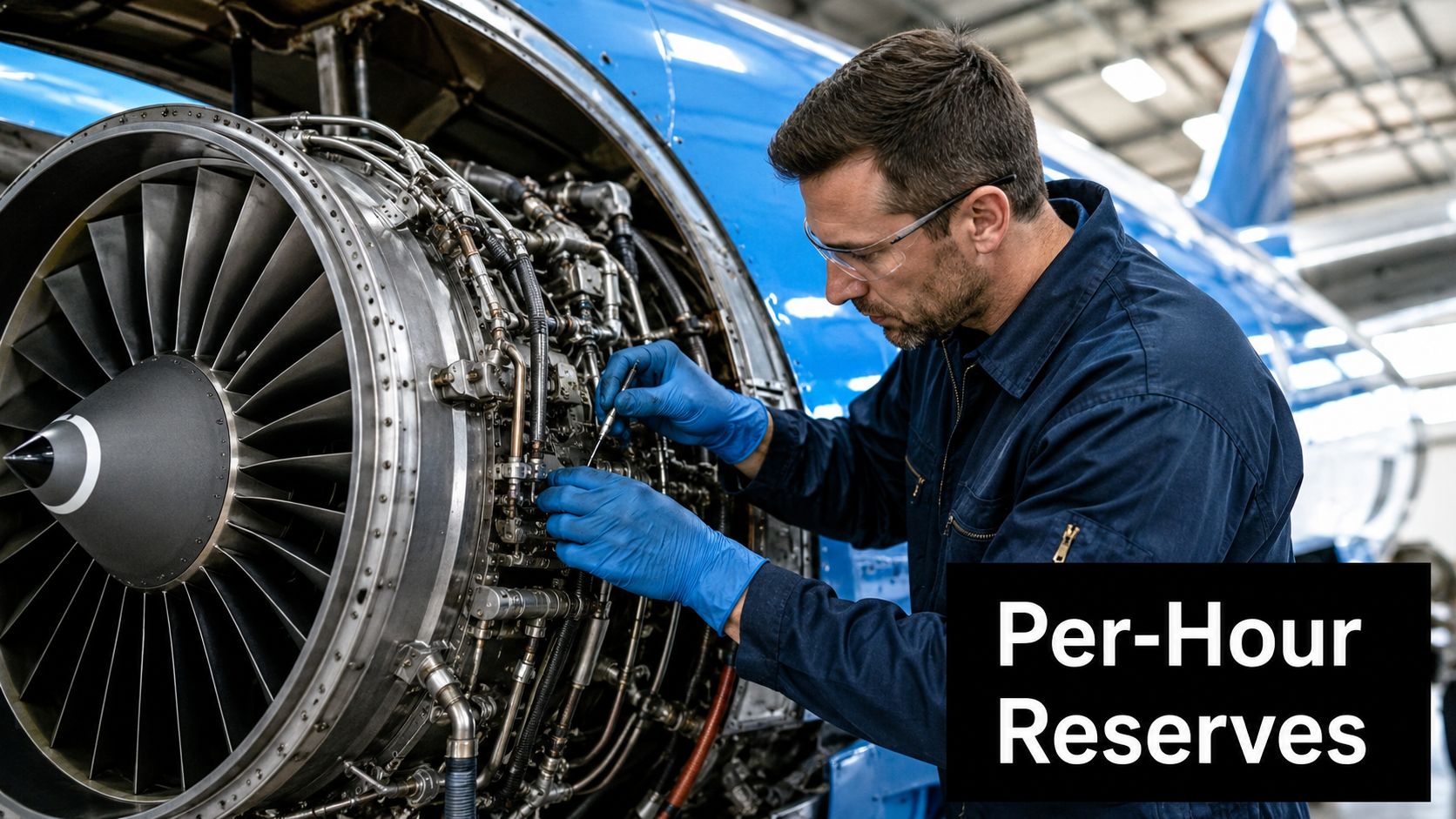
A maintenance reserve is money assigned to future maintenance based on each flight hour. Operators use it to smooth expensive lifecycle events, including engine overhauls, airframe checks, landing-gear work, and component replacement.
Public industry guidance places reserve rates at roughly $300 to $800 per hour for midsize jets and $1,000 or more per hour for heavy jets. For a business jet flying 300 to 400 hours annually, scheduled checks alone may total approximately $80,000 to $250,000, while larger aircraft can face periodic heavy-maintenance events costing $500,000 or more. AOPA's reserve guidance outlines the logic behind hour-based reserves.
How owners should fund the reserve
Fund reserves monthly or after each flight, but track them against actual hours. A management company may collect the reserve through an hourly charge, while a self-managed owner can move the amount into a dedicated maintenance account.
The reserve gets drawn down when an eligible event occurs. That might be an engine overhaul, a landing-gear replacement, an inspection with extensive findings, or a component replacement program. The accounting treatment matters less than the discipline. The money must exist before the invoice arrives.
A practical example makes the risk clear. Suppose your aircraft's reserve is set at $800 per flight hour, and it flies 300 hours in a year. The planned reserve accumulation would be $240,000, before considering how the operator structures other maintenance charges. If a major event costs $500,000 or more, the reserve may cover only part of the invoice, leaving a substantial cash requirement.
That gap is why owners face surprise six-figure bills even when they believe they've budgeted responsibly. They've reserved for routine activity, but not for the full lifecycle cost of the aircraft.
For a broader view of travel economics, HauteBlack's guide to how much it costs to charter a private jet in 2026 is useful when comparing reserve exposure with a pay-as-you-fly model.
Annual Maintenance Ranges by Aircraft Class
Aircraft class gives you the first useful budget bracket. The ranges below are maintenance planning benchmarks, not purchase recommendations, and they should be adjusted for age, utilization, maintenance programs, and the aircraft's inspection status.
| Aircraft Class | Representative Models | Typical Acquisition Value | Annual Maintenance Range | Primary Cost Drivers |
|---|---|---|---|---|
| Light jet | Phenom 300, Citation CJ4 | Varies by aircraft and market condition | $200,000 to $400,000 | Single or twin-engine systems, parts support, inspection cycles |
| Midsize jet | Citation Latitude, Learjet 75 | Varies by aircraft and market condition | $350,000 to $700,000 | Cabin systems, engine reserves, avionics, utilization |
| Super-midsize | Challenger 350, Citation Sovereign | Varies by aircraft and market condition | $500,000 to $900,000 | Larger engines, airframe checks, component availability |
| Large-cabin | Falcon 7X, Gulfstream G550 | Varies by aircraft and market condition | $800,000 to $1.5 million | Complex avionics, engine programs, heavy inspections |
| Ultra-long-range | G650, Global 7500 | Varies by aircraft and market condition | More than $1.5 million, potentially above $3 million during major events | Multiple engines, long-range systems, mid-life overhauls |
The published class benchmarks support a clear pattern. Light jets are often estimated around $200,000 to $500,000 per year, midsize aircraft around $500,000 to $700,000, and heavy jets can exceed $1 million annually. Broader owner guides place midsize and super-midsize aircraft around $500,000 to $1.5 million, large-cabin aircraft at $1 million or more, and high-utilization or aging aircraft as high as $1.5 million to $4 million. LatestCost's private jet maintenance pricing guide provides these class-level benchmarks.
Why the range widens
Engine count is an obvious driver, but it isn't the only one. Parts Manufacturer Approval coverage, airframe inspection intervals, avionics architecture, composite structures, and parts-pool scarcity all affect the final invoice.
Utilization changes the result as well. A large-cabin aircraft flying 600 hours a year will accumulate substantially more consumable wear and hourly reserve obligations than one flying 200 hours, and the difference can reach two to three times for those usage-driven items. The aircraft's age matters just as much. A newer jet may have better program support, while an aging airframe can accumulate findings, modifications, and obsolete-component issues.
Heavy inspections can arrive every 5 to 10 years, creating a capital-expenditure cycle that ordinary annual averages conceal. 305 Sky's maintenance breakdown highlights the distinction between normal upkeep and major events, including engine overhauls that can add $1 million or more per engine and major inspections costing $500,000 to $2 million or more.
How Ownership Model Changes the Maintenance Math
Maintenance exposure changes radically depending on who owns the aircraft and who controls the maintenance program. The same aircraft can represent a volatile capital burden for one traveler and a predictable hourly expense for another.
Full ownership
With full ownership, every scheduled check, unscheduled repair, engine reserve, parts decision, and downtime consequence sits with you. You control the maintenance philosophy, facility, records, and program participation, but you also carry the risk of choosing poorly or underfunding the reserve.
This structure makes the most sense when you need consistent access, have a credible utilization pattern, and are prepared to manage aviation operations professionally. Large-cabin owners often place the aircraft with a management company because the administrative and technical workload is too consequential to handle casually.
Managed ownership
A management program converts much of the maintenance burden into a monthly management fee and hourly charge. The operator coordinates facilities, technicians, parts, records, compliance, and reserves. That convenience comes with overhead, commonly described in public guidance as 10% to 20%, depending on the arrangement and services included. Treat the fee as payment for control and execution, not as proof that maintenance has become cheaper.
Fractional ownership
Fractional programs, including providers such as NetJets, Flexjet, and PlaneSense, generally embed maintenance into the occupied hourly rate. The shareholder gives up direct control over the aircraft's maintenance decisions but gains access to a managed fleet and a more predictable cost structure.
This is attractive when your travel demand is regular but doesn't justify carrying an entire aircraft's lifecycle burden. The trade is less customization and less direct influence over the specific tail assigned to a trip.
Charter and jet cards
Charter and jet-card users don't fund engine reserves, heavy inspections, or hangar costs directly. The operator absorbs those obligations and prices them into the trip or hourly rate. You pay for access rather than capacity ownership, which makes this model particularly compelling when annual usage is uncertain or maintenance volatility would distract from the value of travel.
The HauteBlack private aviation offering is relevant for travelers who want private aviation access without taking on the maintenance account, aircraft management workload, and lifecycle reserves attached to full ownership.
The ownership decision should be made on identical utilization assumptions. Compare the same routes, passenger needs, aircraft category, and availability expectations. Otherwise, the apparent savings between models are usually a comparison error.
Hidden Costs Beyond the Sticker Price
Maintenance is often presented as an accounting line. That's incomplete. The expensive question is frequently not “What did the repair cost?” but “What did the aircraft's unavailability force us to do?”
An aircraft grounded by a missing component can create replacement charter costs, missed meetings, disrupted family travel, and repositioning complications. Those consequences don't appear in the maintenance invoice, but they belong in the ownership decision.
Downtime is a financial exposure
Parts availability and technician capacity determine how quickly an aircraft returns to service. A 2025 aviation maintenance benchmark report identified technician shortages as the top concern for 44% of respondents, a signal that labor availability is affecting planning as well as hourly rates. The Aviation Maintenance Benchmark Report documents that finding.
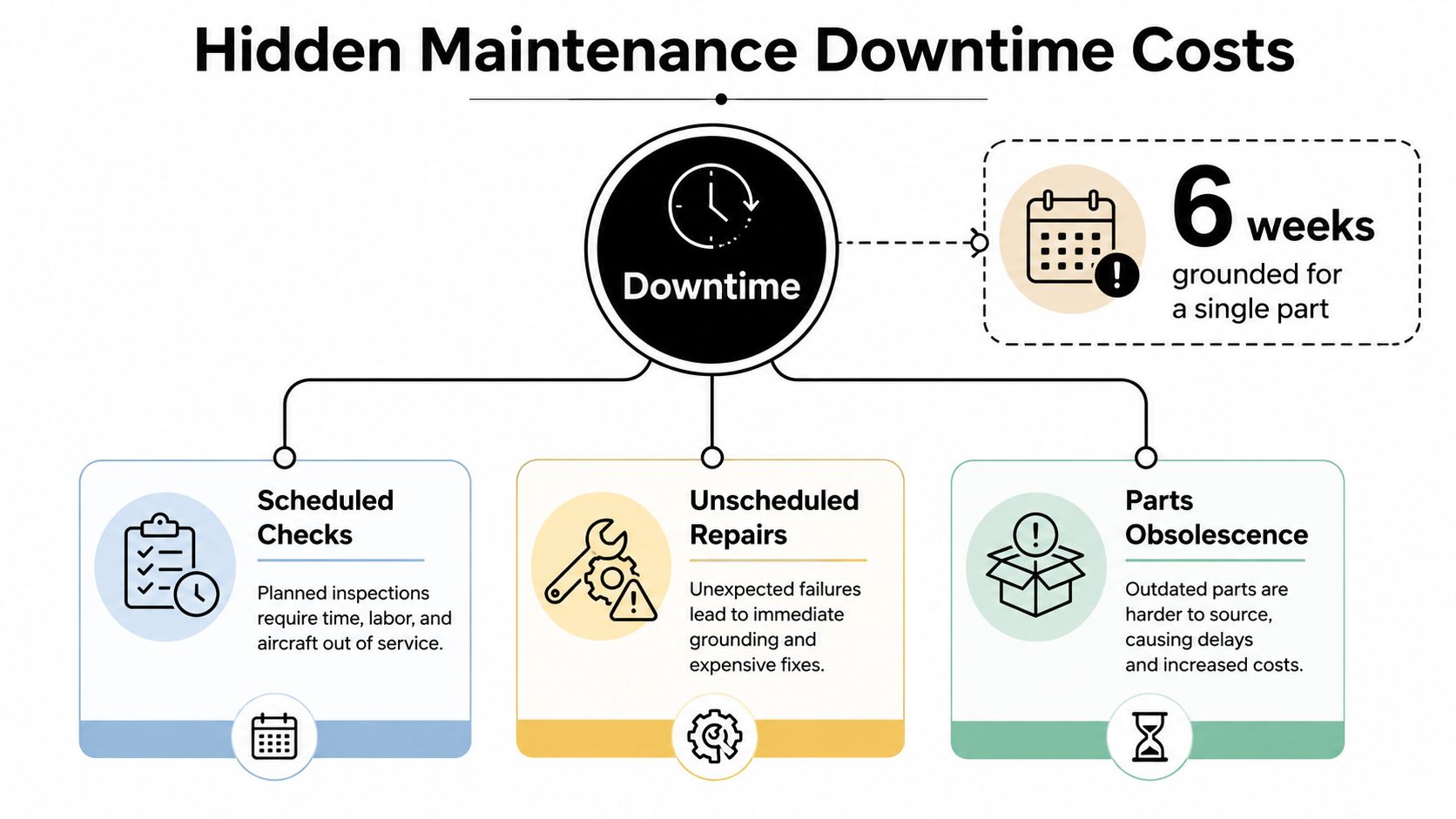
A grounding period can also expose weaknesses in your home-base strategy. If your preferred facility lacks capacity, you may need to ferry the aircraft elsewhere, arrange alternate transportation, or accept a delayed inspection slot. A maintenance plan that ignores calendar availability isn't a plan. It's a hopeful estimate.
Operational security and access infrastructure can matter during extended maintenance periods, especially for private hangars and controlled facilities. Owners reviewing facility operations may find this resource on what to look for in a gate access system useful when evaluating reliability and access control around an aircraft base.
Aging aircraft create unplanned work
Older airframes can trigger supplemental structural inspections, mandatory service bulletins, airworthiness directive compliance, and replacement of components that are no longer easy to source. A mid-life engine inspection can also change character quickly when borescope findings reveal a more serious hot-section issue.
International flying adds another layer. Crew qualifications, customs handling, and region-specific compliance can complicate both scheduling and maintenance logistics. Insurance deductibles and temporary hangar-rate increases can further expand the annual number without appearing under the maintenance heading.
The candid advice is simple. Budget for the invoice, then budget separately for the aircraft being unavailable. The second account protects your travel schedule.
Practical Ways to Reduce Costs and Your Decision Checklist
Cost control doesn't mean buying cheap parts or stretching inspections. It means planning the work early enough that you can choose the facility, timing, and program instead of accepting the first available option.
Control the maintenance process
- Consolidate facility work: Use one properly authorized facility where practical, so technicians understand the aircraft's history and recurring discrepancies.
- Use a maintenance program: A structured program can absorb unscheduled labor coordination and smooth reserve funding, though you must read exclusions and parts treatment carefully.
- Schedule around low use: Place heavy inspections during periods when you're least dependent on the aircraft, reducing the operational cost of downtime.
- Train the crew: Better operating discipline can reduce avoidable damage and improve the quality of maintenance reporting.
- Protect engine reserves: Pre-buying engine hours or maintaining a funded reserve can keep a hot-section finding from becoming a liquidity crisis.
Pre-purchase checklist
1. Verify hangar availability at the home base. A suitable aircraft is less useful if the facility can't protect it or support its maintenance schedule.
2. Confirm the parts pipeline. Ask how quickly the airframe's common and critical components can be sourced.
3. Request 12 months of maintenance logs. Look for recurring squawks, deferred items, inspection findings, and evidence of incomplete follow-through.
4. Model realistic flight hours. Use actual mission plans, not an optimistic utilization assumption.
5. Stress-test one unplanned engine hot-section event. Your reserve should be tested against a credible surprise, not only routine expenses.
6. Compare three ownership models on identical utilization. Include full ownership, managed ownership, fractional access, and charter or jet-card alternatives where appropriate.
Recent guidance continues to place light-jet maintenance around $200,000 to $500,000 annually and large-cabin maintenance at $1 million or more, while engine overhauls and major inspections can reshape cash flow. The HauteBlack definitive guide to private jet charter services in 2026 can help frame the access alternative without pretending that ownership and charter solve the same problem.
Decision rule: If annual maintenance exceeds the value your missions create, charter or a jet card will usually win on cash flow and convenience.
HauteBlack connects clients with private jet charter access through Haute Jets, fixed flight pricing, and a global fleet of more than 3,500 aircraft, without asking travelers to carry aircraft reserves or maintenance downtime. Visit HauteBlack to compare private aviation access with the full lifecycle cost of owning a jet.
Explore Our Guides


Signature Experiences


