Haute Black Journal
Private Chef Cooking Lessons: The Complete Luxury Guide

Marlene Azeez
Director, HauteBlack
View all articles →
You've invited guests to your home, chosen the wine, and decided that another restaurant dinner won't make the occasion feel personal enough. Then the practical questions arrive. Will the chef teach or just cook? Can your kitchen support the menu? What exactly does the quoted fee include, and will your guests leave with a memorable skill or only a photograph of dinner?
Private chef cooking lessons can be extraordinary, but only when you book the chef as an educator, event host, and operational partner, not merely as a talented cook. The difference lies in the decisions made before the first knife is lifted.
Why a Private Chef Cooking Lesson Is Different
The booking moment usually starts with a trigger, a milestone birthday, a villa stay, a family gathering, or a group of friends who want something more intimate than a chef's table. You're not buying food. You're deciding whether the evening should produce another polished meal or a shared experience with a story attached to it.
A private chef lesson outperforms a restaurant when control and participation matter. Your guests can ask questions without interrupting a service team, work at a pace that suits the group, and learn inside the kitchen where they'll eventually repeat the technique. The chef sees your equipment, your counter layout, and your actual habits. That context makes the instruction more useful than watching a professional work in an unfamiliar teaching kitchen.
Group cooking schools bring energy and structure, but they also impose a fixed menu, fixed timing, and mixed skill levels. Supper clubs emphasize sociability and discovery, while restaurant chef's tables prioritize access to a finished performance. A private lesson offers something those formats can't combine as effectively: personalized pacing, intimate conversation, menu control, and a host-led sense of occasion.
The decision you're really making
You're also accepting trade-offs. A hands-on format takes longer than a demonstration. Your kitchen may become busy. Guests who expected a purely social evening may feel uncomfortable if the chef hasn't explained their role. Luxury isn't the absence of logistics. It's the removal of surprises.
The broader cooking class market has been estimated at USD 272.39 billion in 2026 and projected to reach USD 497.25 billion by 2035, with a reported 10.5% compound annual growth rate during 2026 to 2035. The same market source reports that personal classes account for 62% of participants and in-person sessions hold a 65% share by type, which supports the appeal of high-touch, face-to-face instruction for premium learning. Business Research Insights describes the cooking class market in those terms.
Treat the booking as six connected decisions: format, chef, learning objective, commercial terms, kitchen flow, and guest experience. Each one can transform the evening or undermine it.
Choosing the Right Lesson Format
There are three formats worth considering, and they serve different hosts.
| Format | Best For | Engagement Level | Typical Group Size | Common Weakness |
|---|---|---|---|---|
| Hands-on lesson | Team-building, enthusiastic cooks, technique practice | High | Small groups | Can feel slow or stressful with a larger party |
| Demonstration | Entertaining non-cooks, older guests, relaxed hosting | Moderate | Small to medium groups | Guests may feel passive |
| Hybrid lesson and tasting | Milestone celebrations and luxury gatherings | Selective, high-impact | Small groups | Can run long without disciplined sequencing |
A hands-on lesson is the right choice when guests want to make something together. Fresh pasta, filled dumplings, laminated pastry, handmade sauces, and knife work all reward participation. Give every guest a defined task, however. “Help wherever you like” sounds relaxed, but it leaves confident guests taking over while quieter guests watch.
A demonstration suits a group that wants conversation, tasting, and access to the chef without the pressure of cooking. It also works well when guests have different physical abilities or when the kitchen is too compact for several people. The chef should still build interaction into the evening through ingredient tastings, short technique explanations, and questions at natural pauses. Otherwise, you've booked a dinner show rather than a lesson.
Match the format to the occasion
The hybrid is my preferred format for a milestone celebration. The chef demonstrates the technical elements, invites guests to complete one meaningful signature dish, then serves a composed menu. This preserves the rhythm of a luxurious dinner while giving the group a genuine achievement.
Don't default to the most participatory option. Hands-on lessons are best for guests who want to do something. Demonstrations are best for guests who want to be hosted. Hybrids are best when the evening must satisfy both groups.
Price normally rises with customization, staffing, ingredients, and the amount of chef time required, but reputable providers should explain the quote rather than hide behind a format label. Ask whether the fee is based on the chef's time, the guest count, the menu, or a combination. That answer tells you more than a generic “premium class” description.
Vetting the Chef Who Will Teach You
A chef who can produce a flawless plate may still be a poor teacher. Cooking under pressure relies on instinct, speed, and muscle memory. Teaching requires the opposite, deliberate explanation, patience, observation, and the ability to break a complex action into repeatable steps.
Source candidates through an elite culinary agency, a trusted hotel concierge, culinary school alumni networks, or a platform that verifies professional profiles and references. Use a hotel concierge referral for a high-stakes celebration when discretion and backup support matter. Alumni networks can be excellent for specialist cuisines and pastry. Platforms offer breadth, but you must perform the verification yourself.
Ask questions that expose teaching ability
During the interview, ask:
- Adaptation: “How would you change this lesson for a confident home cook who lacks formal training?”
- Error handling: “What do you do when a guest over-salts a sauce or mishandles a knife?”
- Pacing: “Which elements would you prepare before arrival, and which would you teach live?”
- Participation: “How will you give every guest a useful role without crowding the kitchen?”
- Retention: “What will guests be able to repeat at home after the lesson?”
Listen for concrete answers. “I keep things fun” isn't enough. A capable instructor will discuss mise en place, task sequencing, visual cues, heat management, sanitation, and ways to recover from mistakes without embarrassing anyone.
Credentials deserve consideration, but they aren't decisive. A Michelin background can indicate disciplined technique. A teaching certification can indicate instructional preparation. Food media exposure may signal confidence in front of a group. None of those replaces warmth, language fluency, discretion, or the ability to read a room.
Practical rule: Book the chef who can explain what guests will learn, not the chef who only describes what guests will eat.
Request a tasting, sample menu proposal, or short planning call before signing. Review the chef's approach to dietary restrictions, equipment, cleanup, and recipe materials. For background on how service models differ, consult this guide to personal chef and private chef services.
Walk away if the chef won't share references, gives vague pricing, refuses reasonable customization, or treats allergies as a casual preference. A chef who can't clarify the teaching plan before booking won't become more organized once guests arrive.
Building the Menu and Customizing the Lesson
Build the menu backward from the learning objective, not forward from a list of cravings. Decide whether guests should leave with stronger knife skills, a reliable pan sauce, a regional cooking method, or pastry fundamentals. Then choose dishes that make the chef teach that technique in a visible, repeatable way.
A menu with too many courses often looks impressive on paper and performs poorly in the kitchen. Each course should earn its place by reinforcing a skill, creating a tasting contrast, or providing a useful rest point while another component cooks. A single-focus menu can produce deeper learning. A tasting menu can create more theatrical variety, but only if the chef keeps the instruction concise.
Send one clear guest brief
Give the chef a single written brief covering:
- Skill level: beginner, confident home cook, or experienced enthusiast.
- Restrictions: allergies, intolerances, religious requirements, and preferences.
- Objective: the technique or cuisine guests want to understand.
- Atmosphere: energetic workshop, relaxed demonstration, or formal tasting.
- Service details: children, wine, seating, and whether guests need to leave on time.
Include a hands-on component for every guest, even if that component is small. One person can emulsify a sauce, another can shape dough, and another can finish a garnish under supervision. Children need tasks with visible outcomes and safe tools, not token participation that keeps them away from the action.
Wine should support the lesson rather than compete with it. Pairing a flight to the techniques, such as an aromatic white with a sauce exercise or a fortified wine with a dessert demonstration, creates a stronger narrative than pairing solely to the final menu. If you're exploring spirits in the kitchen, this resource on why to cook with whiskey offers useful context for choosing a bottle that contributes flavor rather than novelty.
Luxury appears in the finishing details: personalized recipe cards, a printed menu, a take-home portion of what the group prepared, or a small tasting of a component that needs to rest overnight. Those touches turn instruction into an object guests can revisit.
Understanding Pricing, Contracts, and What to Negotiate
A private chef quote should read like an event budget, not a single mysterious number. One provider lists private in-home lessons starting at USD 175 per hour, with a two-hour minimum and additional guest fees, while another says private classes commonly start around USD 369 for two people in the same kitchen. These listings show why you must ask what the price covers rather than compare headline rates alone. Untamed Chef's private class listing illustrates the first structure.
| Cost Line Item | Typical Range (USD) | Negotiable? |
|---|---|---|
| Chef instruction and preparation | Varies by chef and scope | Sometimes |
| Ingredients and shopping | Varies by menu | Yes, through menu design |
| Travel and parking | Varies by location | Sometimes |
| Assistant or server | Varies by staffing plan | Sometimes |
| Sommelier or beverage service | Varies by service | Often |
| Equipment and rentals | Varies by kitchen needs | Often |
| Gratuity | Confirm in agreement | Clarify before booking |
The chef's day rate may cover planning, shopping, travel, teaching, cooking, and cleanup. Per-person pricing may separate ingredients and staffing. Ask directly about shopping time, travel time, assistants, rental equipment, beverage support, and gratuity expectations.
Insist on a written agreement
Luxury bookings need a contract because clarity protects the mood of the event. Insist on cancellation tiers, a substitution policy, a food-cost cap or approval process, allergen responsibilities, and image rights. Confirm who owns photographs and whether the chef or agency may use images from your home or event.
Insurance and hygiene certification aren't bargaining points. Timing, off-peak dates, shorter lesson blocks, and bundled return visits may offer flexibility, but never trade away basic safety or professional accountability. A contract can also specify the deposit, final payment date, guest-count deadline, and what happens if the chef becomes unavailable.
Don't negotiate by demanding a cheaper chef. Negotiate by removing waste. A focused menu, efficient prep, and a return booking can create value without stripping away staffing or quality. Pay a deposit only after the scope is documented, and make sure the final invoice matches the agreed guest count and inclusions.
Logistics, Kitchen Prep, and Day-Of Flow
Treat the evening as a curated event, not a cooking class that happens to include dinner. The kitchen is the venue, the chef is the instructor and host, and the timing must protect both concentration and conversation.
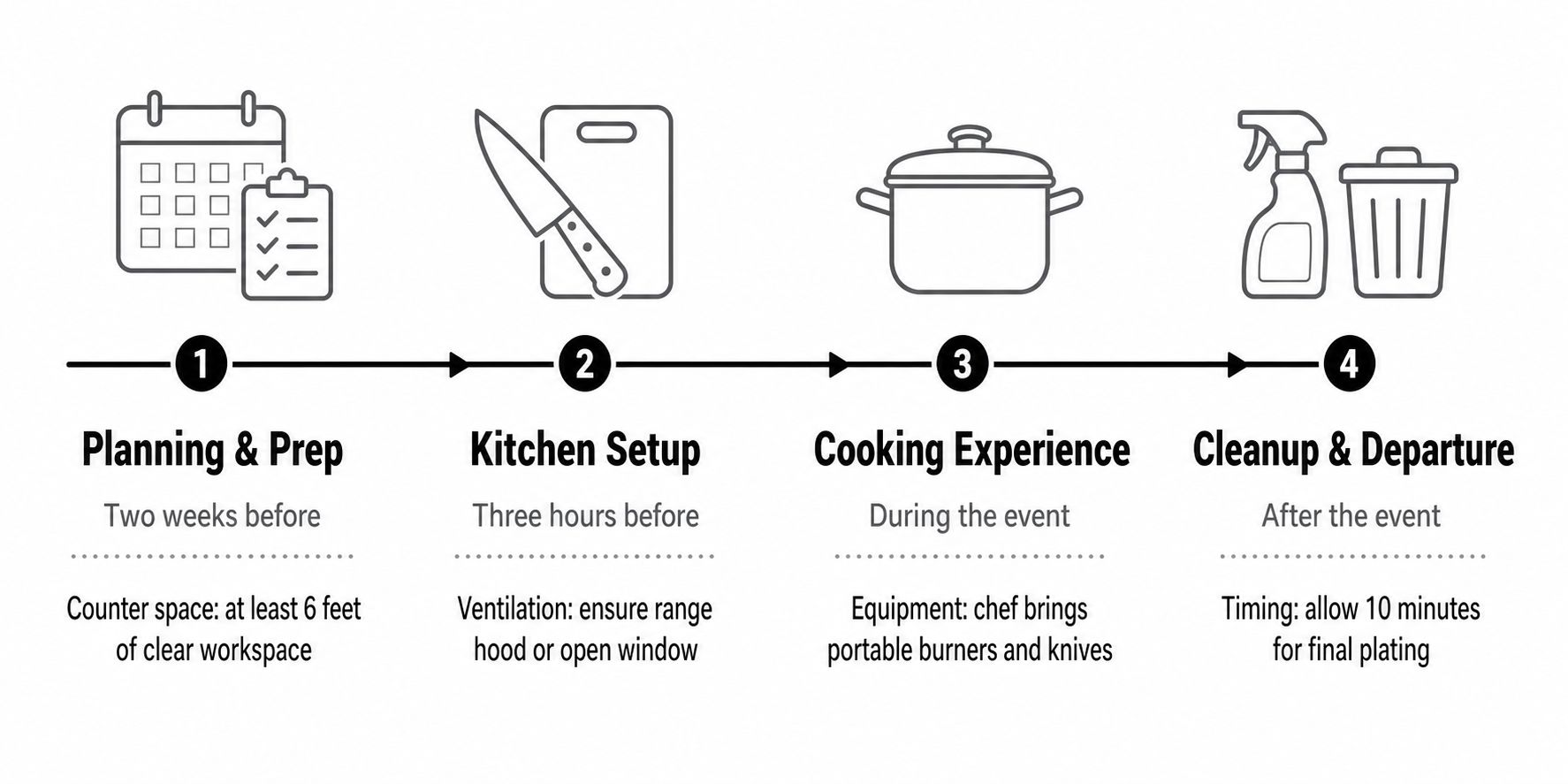
Consider a realistic evening. Three hours before guests arrive, the chef or assistant unloads ingredients, checks the range, establishes a clean work zone, and confirms which equipment is available. During the event, guests rotate through defined tasks while the chef controls heat, seasoning, and food safety. After service, the team clears the workspace without leaving the host with a second event to manage.
Use this operational sequence as the working brief:
Prepare the room, not just the ingredients
Ask the chef how much clear counter space is required, what ventilation the menu needs, and which knives, pans, thermometers, portable burners, or mixers will arrive with the team. A beautiful kitchen can still fail if the island is decorative, the extractor is weak, or the oven is occupied by warming plates.
For groups above four, an assistant or server often earns its place. The chef can teach while another professional manages clearing, pours, ingredient replenishment, and final plating. Add a sommelier only when wine education is a central part of the evening, not as an automatic luxury surcharge.
Guests should arrive within a defined window, not in a steady stream that interrupts the first demonstration. Account for the awkward gap between finishing a dish and sitting down to eat. A short amuse-bouche, tasting station, or guided beverage moment keeps the evening intentional.
Handle parking, building access, elevator rules, noise, pets, and children before the day. If baking is involved, review bakery-grade equipment for home bakers so you can identify which home tools may limit the lesson. For villa-based hosting inspiration, review the private chef villa guide.
Before arrival, hand staff this checklist:
- Access: Confirm parking, entry codes, elevators, and loading instructions.
- Workspace: Clear counters, sinks, and the primary cooking zone.
- Equipment: Identify what the chef brings and what the residence supplies.
- Guests: Share allergies, children's needs, arrival timing, and seating.
- Service: Confirm who pours wine, clears plates, and handles cleanup.
- Departure: Set the time by which the kitchen must be restored.
Elevating the Guest Experience and Maximizing VIP Value
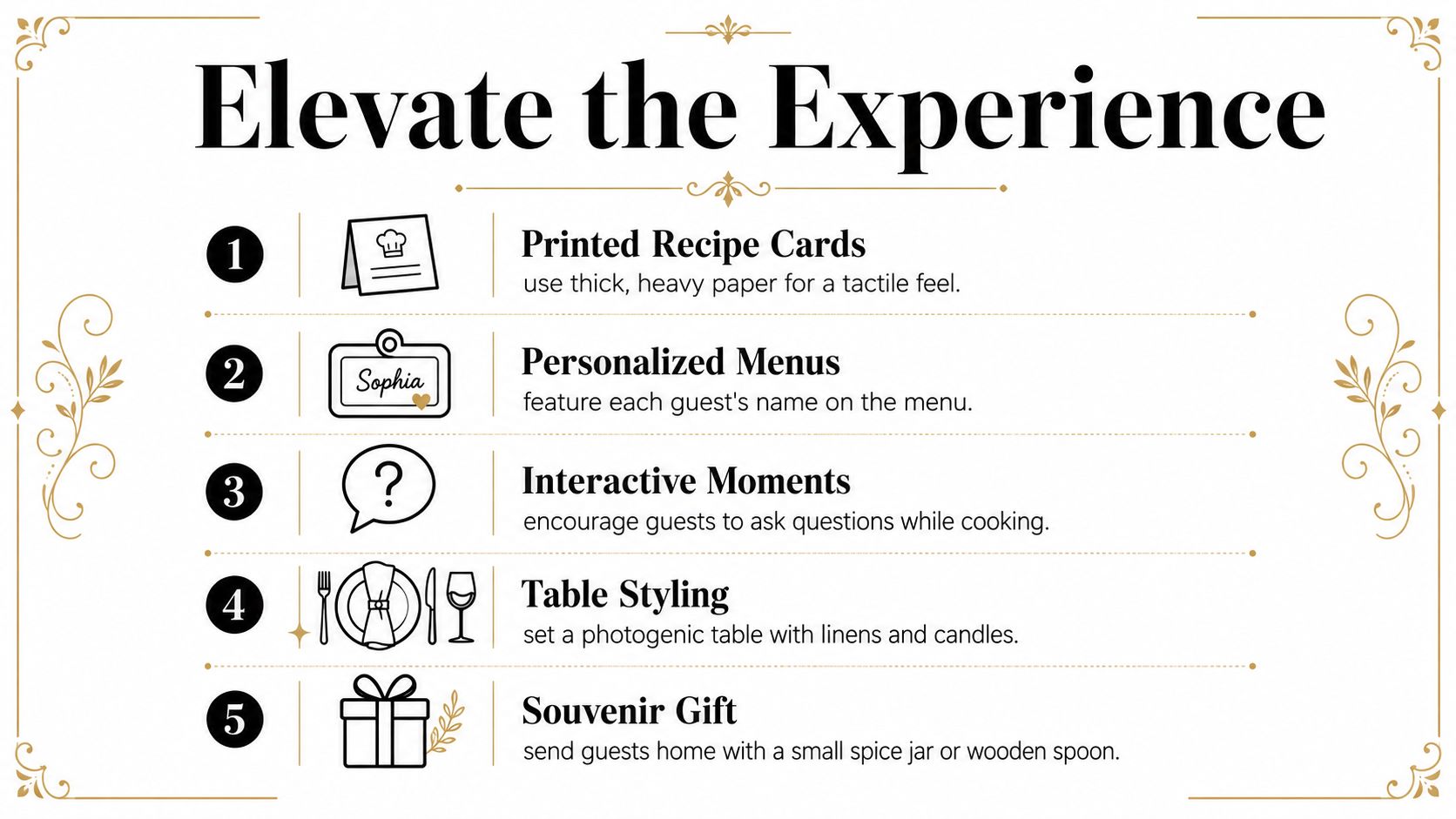
The lesson succeeds or fails on its framing. A six-course technical marathon can exhaust guests, while a shorter experience with a printed recipe card, a welcome amuse-bouche, and one signature dish assembled together can feel generous and complete.
Make the chef the evening's host and emcee. Ask for a concise introduction, a short question-and-answer moment during the cook, and a plated dessert reveal that gives the night a clear finish. The chef should know when to teach, when to serve, and when to let the group talk.
Spend on memory, not unnecessary complexity
Commission a printed menu with each guest's name, use heavy-stock recipe cards, and consider simple branded aprons if the event has a corporate or celebratory purpose. A curated wine flight paired to the lesson can be more engaging than a costly bottle selected only for prestige.
Photography needs boundaries. Decide whether guests may take pictures, whether the chef may use images, and who manages shared files. Hosts planning a business gathering can use these guides for corporate event photo management to keep guest consent and image distribution organized without turning the evening into a production.
A small takeaway often creates more lasting value than another course. Give guests signed recipe cards, a tin of finishing salt, a spice jar, or a wooden spoon. These items reinforce what they learned and extend the evening beyond the dining table.
Your pre-booking checklist is simple: choose the format, verify the chef's teaching ability, define one clear objective, document every fee and responsibility, inspect the kitchen flow, and design a guest-facing finish. HauteBlack's private chef dinner coverage reflects how culinary experiences can sit within a broader luxury travel and events program, particularly when the host wants the meal to feel connected to a destination or private gathering.
HauteBlack can arrange bespoke culinary journeys, private chef dinners, and high-touch travel experiences through its concierge network, with options for members and non-members. Visit HauteBlack to discuss a private chef cooking lesson that matches your destination, guest list, kitchen, and desired level of VIP service.
Explore Our Guides


Signature Experiences


