Haute Black Journal
Luxury Safari Honeymoon: How to Plan a Bespoke Escape

Marlene Azeez
Director, HauteBlack
View all articles →
You've probably reached the stage where every safari camp looks perfect, every beach extension promises paradise, and your honeymoon spreadsheet has started to resemble an air-traffic map. That's the danger point. A luxury safari honeymoon doesn't fail because you chose the wrong country. It fails when you try to force too many excellent places into a trip that never gives you time to enjoy any of them.
The right itinerary has an emotional rhythm: anticipation, immersion, quiet, discovery, and a genuine exhale. You'll spend less time changing camps and more time in the places that suit you, with private access, thoughtful pacing, and a clear reason for every transfer.
Why a Luxury Safari Honeymoon Feels Different From Any Other Escape
A couple once sent me a dream itinerary built around every image they'd saved: Kenya, Tanzania, South Africa, a private island, and a final city stay. Each property was exceptional. The routing was not. They'd have been repacking every few days, taking repeated flights, and arriving at each camp just as they needed to leave the last one.
That's not a luxury safari honeymoon. That's an impressive list of logistics.
Safari operates on a different tempo from a beach or city honeymoon. Early drives begin before breakfast, wildlife sightings reward patience, and the richest moments often happen when nobody is trying to hurry the day along. The privacy of a secluded suite matters, but so does having enough time to settle into a place, recognize your guide's instincts, and enjoy an unplanned pause beneath an open sky.
Safari has become a romance category
Honeymooners are a defined customer segment within luxury safari tourism, making the wider category a useful proxy for demand. The global luxury safari tourism market was valued at USD 1.46 billion in 2025, is projected to reach USD 1.5754 billion in 2026, and could approach USD 3.123 billion by 2035, at a projected 7.9% CAGR from 2026 to 2035, according to Global Growth Insights' luxury safari tourism market analysis. Luxury safari lodges account for more than 54% of traveler spending, while North America and Europe together represent more than 58% of luxury safari travelers, which helps explain why affluent couples from the United States and Europe remain central to this market.
The honeymoon signal is even clearer. Fora Travel coverage reported that bookings among honeymoon-focused travelers rose 295% for Kenya, 287% for Tanzania, 295% for Seychelles, and 287% for South Africa from March 2025 to February 2026 in its coverage of Africa's growing honeymoon appeal. Couples aren't treating safari as a standalone wildlife excursion. They're combining East or Southern Africa with Seychelles, Mauritius, or Zanzibar to create an itinerary that moves from exhilarating mornings to ocean-level stillness.
My planning rule: Choose the feeling you want to repeat, not the number of countries you want to mention.
What bespoke planning should deliver
A bespoke trip should answer practical questions before you ever look at room categories. Will you have a private vehicle? Does the camp sit inside a private concession? Are the transfers proportionate to the length of the stay? Can the lodge create a private dinner without pulling you away from the wildlife rhythm?
For couples who want discreet recognition and access-led planning, HauteBlack's romantic getaway guidance is a useful reference point. The principle is simple: luxury comes from the quality of access and the ease of the day, not merely from a higher thread count.
This guide is for couples who want Africa to feel intimate rather than rushed. By the end, you'll know how to select an anchor region, match it to seasonal wildlife mechanics, choose the right level of privacy, build a sensible itinerary, and spend more confidently on the elements that change the experience.
How to Choose Your Destination and Season Without Guessing
There isn't one universal “best month” for a safari honeymoon. The correct choice depends on what you want to see, how much solitude you value, whether you want a beach finish, and how comfortable you are trading viewing reliability for greener scenery and fewer visitors.
Dry-season conditions, roughly May to October in many major safari markets, often bring animals toward water sources and make wildlife viewing more reliable. Green-season travel, roughly November to March, can bring thicker vegetation and a quieter atmosphere, while some markets can be up to 50% cheaper during that period, as outlined in this Serengeti seasonal guide. Those are broad patterns, not guarantees. Local rainfall, migration routes, water levels, and conservation rules still matter.
Compare the major honeymoon regions
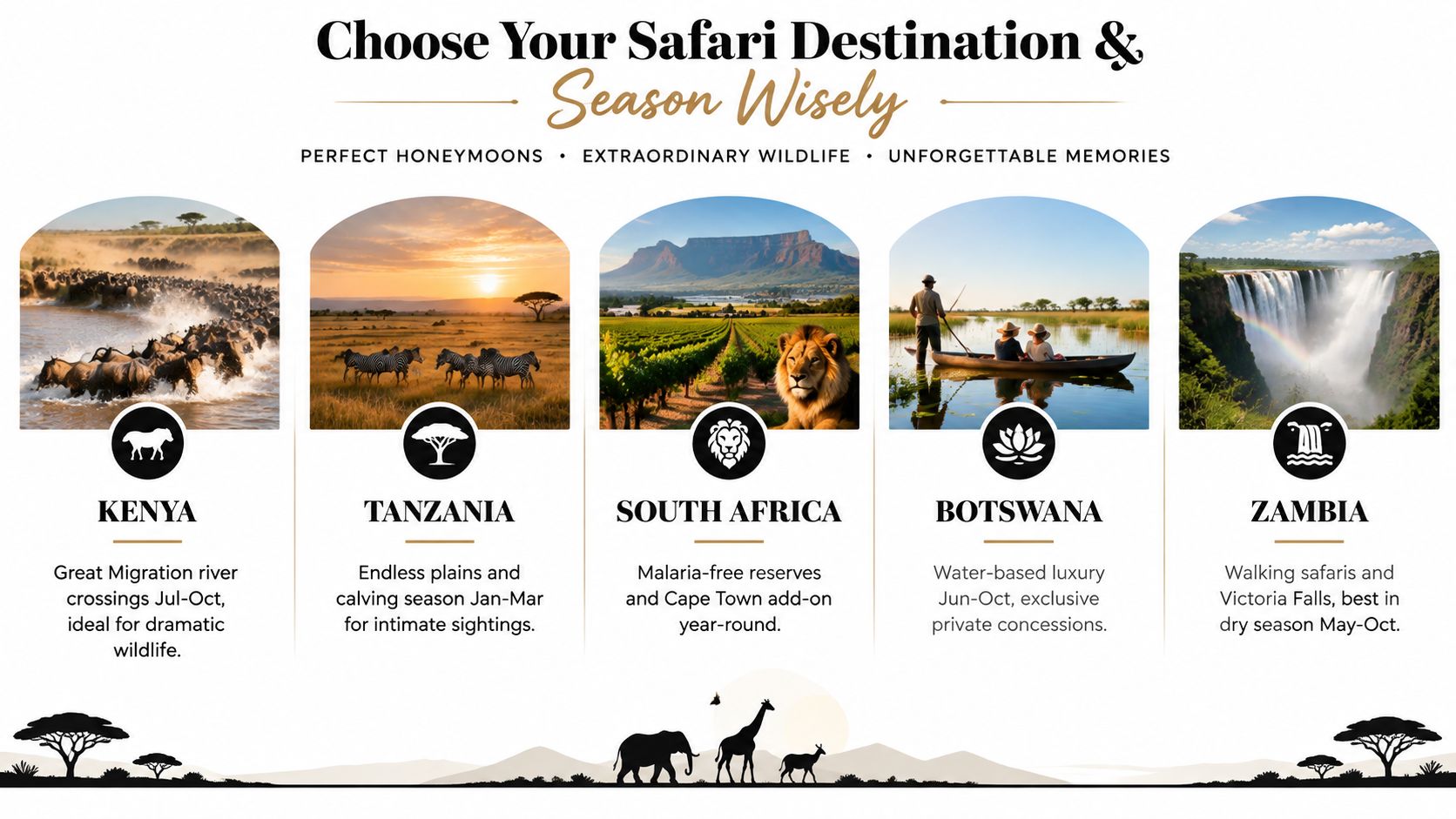
| Destination | Prime Honeymoon Window | Signature Experience | Best For |
|---|---|---|---|
| Kenya | July to October for migration drama, with other seasonal options depending on region | Mara landscapes, private conservancies, and migration viewing | Couples wanting classic East African scenery and strong romantic camp design |
| Tanzania | January to March for calving landscapes, with dry-season options for concentrated viewing | Serengeti plains and expansive wildlife immersion | Couples prioritizing space, iconic scenery, and a deeply immersive safari |
| South Africa | Flexible timing, with regional conditions shaping the best fit | Big Five reserves, Cape Town, and wine country | First-time safari travelers who value polished logistics and varied experiences |
| Botswana | June to October for water-based experiences | Okavango Delta mokoro outings and private concessions | Couples seeking seclusion, water, and low-density luxury |
| Zambia | May to October for dry-season walking and river experiences | Walking safaris and Victoria Falls | Active couples who want a more physical, guide-led adventure |
Kenya and Tanzania are the natural choices for couples drawn to broad plains and migration-focused travel. South Africa suits couples who want safari paired with Cape Town, food, wine, or a more structured first safari. For a refined pre- or post-trip wine experience, couples can also review Viansa winery events and visits when building a broader celebration around their journey.
Botswana is my choice for couples who define luxury as quiet access. A private concession and water-based exploration can feel more personal than adding another famous reserve. Zambia is better for travelers who want walking and a stronger sense of participation rather than viewing every experience from a vehicle.
Treat predator sightings as probability, not a promise
Wildlife is wild. One expert source notes that many predator hunts succeed only about 20% to 30% of the time, while wild dog hunts can reach as high as 80%, as reported in the seasonal Serengeti planning guide. That distinction should change how you plan. Multiple drives, enough nights in one area, and buffer time give your guide more opportunities to work with changing conditions.
For Tanzania-specific timing, the Tanzania safari planning guide can help you think beyond a generic calendar recommendation. I'd choose one anchor region first, then decide whether a beach extension improves the emotional arc. Seychelles, Mauritius, and Zanzibar work because they let the couple stop performing logistics and be together.
Choosing Ultra Luxury Camps Villas and Private Experiences
Ultra-luxury on safari isn't defined by a chandelier in the lounge. It's defined by what the property makes possible in the field, and how much control you have over your day.
Start with access, not décor
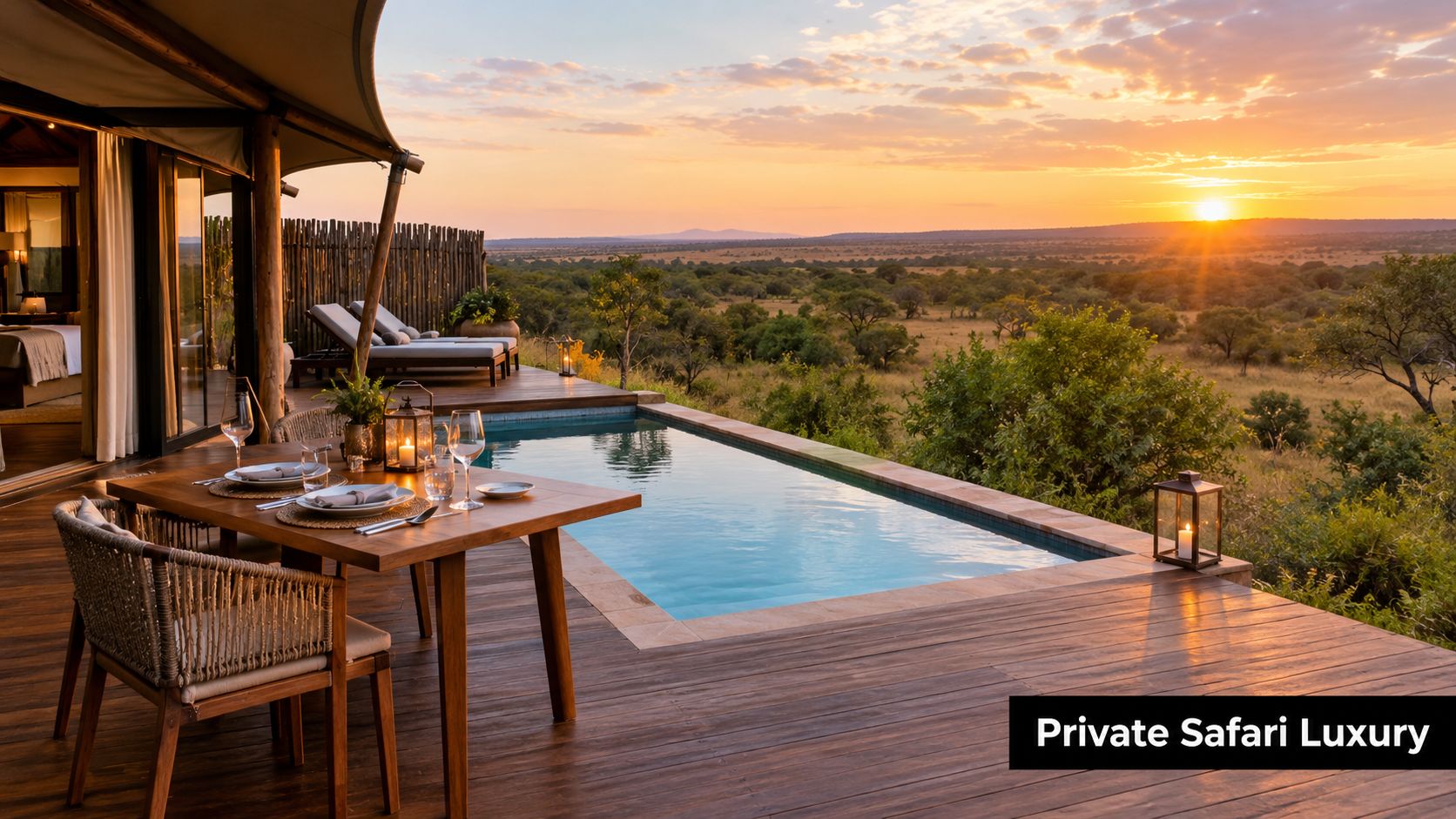
A beautiful tent with a private plunge pool is wonderful after a long drive. It won't compensate for a shared vehicle that leaves when you're watching an extraordinary sighting, or for a camp whose location creates exhausting transfer patterns.
Assess each camp against four questions:
- Private vehicle: Can you set the pace, linger at a sighting, and return when you choose?
- Dedicated guiding: Will your guide understand your interests, photography comfort, and appetite for early starts?
- Location: Does the camp place you near the habitat or activity you came to experience?
- Privacy: Are rooms and dining areas secluded, or only visually separated?
A private villa makes sense when you want unstructured time, in-room dining, a pool, and a stronger sense of retreat. A smaller tented camp may be better when you care more about guiding, convivial service, and immediate access to the reserve. Don't pay for a villa to spend every waking hour away on drives.
For a more focused property search, HauteBlack's guide to luxury safari camps in Kenya offers a useful starting point.
Layer romance into the natural rhythm
The best romantic touches don't interrupt the safari. A private sundowner works because it grows naturally from an evening drive. A bush dinner feels special when it follows a day that already had enough downtime. A spa treatment belongs in the afternoon, not wedged between a rushed landing and a scheduled game drive.
Ask about the camp's conservation model before you book. Eco-luxury has become a central purchase consideration for many travelers, rather than a decorative extra, and the strongest properties connect design, local employment, habitat protection, and guest experiences in a credible way. You should be able to understand what your stay supports without accepting vague sustainability language.
A private vehicle is usually a more meaningful splurge than a larger suite. So is a skilled guide. The room is where you sleep. Access determines what you remember.
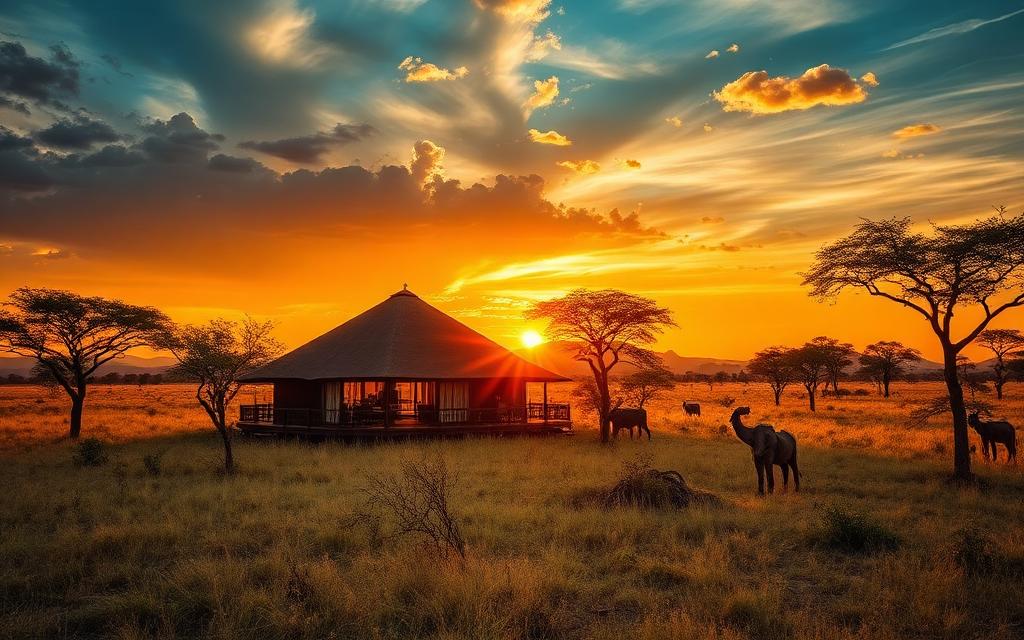
A short visual reference can help you compare the atmosphere of safari accommodation before you decide what belongs in your itinerary.
Sample Itineraries That Balance Wildlife Rest and Romance
The most useful itinerary question isn't “How many places can we visit?” It's “How many transitions can we absorb before the trip stops feeling restorative?”
Recent luxury safari honeymoon guidance places the practical minimum at 8 days, with 10 to 14 days offering a more comfortable pace, as explained in this candid planning guide. I agree. Seven days can work, but only when the routing is disciplined and the couple accepts that the trip will be concentrated.
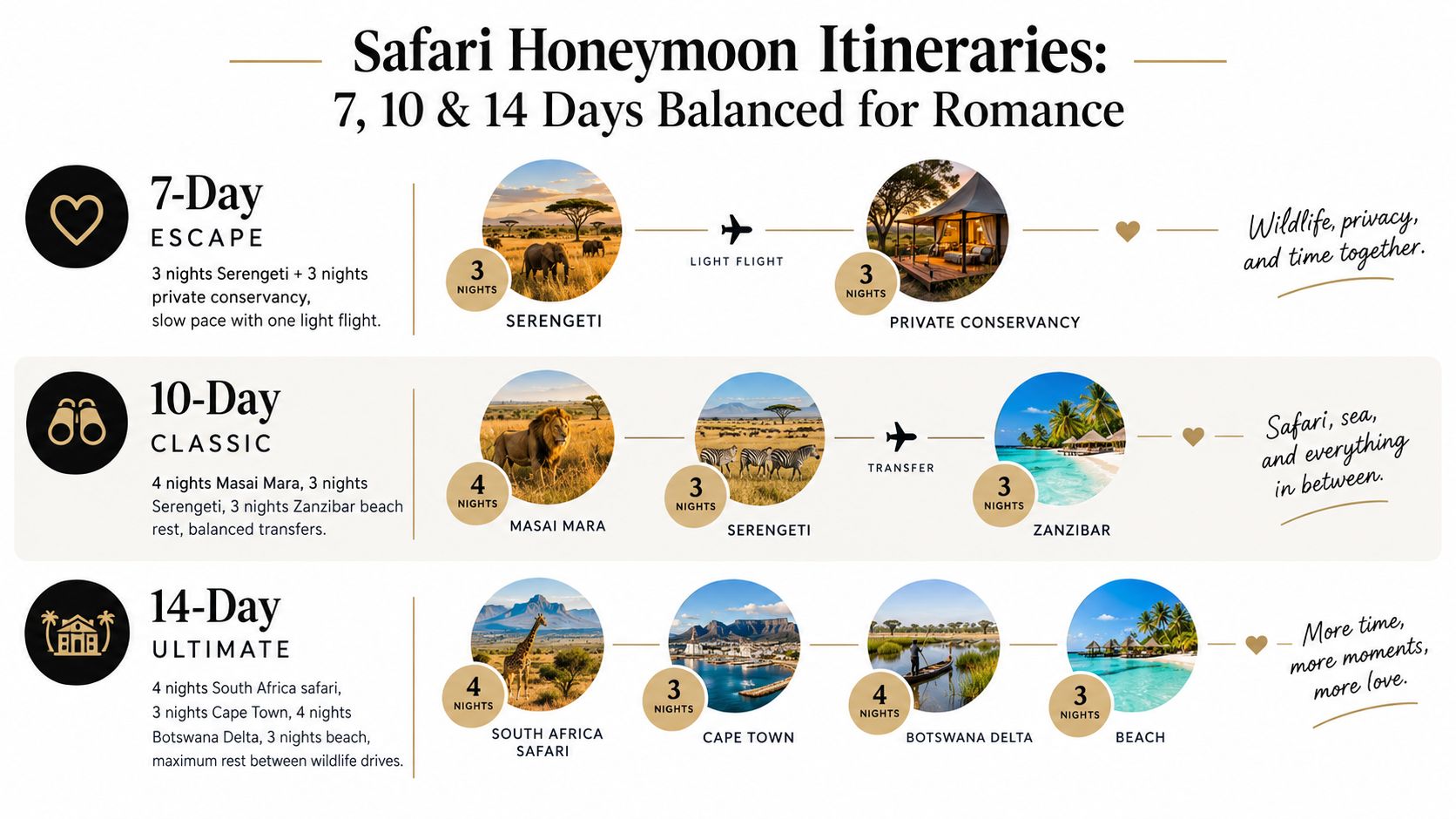
A focused seven-day escape
Use seven days for one coherent wildlife story, not a country-collecting exercise.
A strong structure is:
- Three nights in the Serengeti: Settle into the terrain, build a relationship with your guide, and allow several drives without treating each outing as a final chance.
- Three nights in a private conservancy: Change the texture of the experience through walking, private viewing, or a more secluded camp setting.
- One light flight day: Keep the transfer simple and avoid adding a beach leg unless it's operationally effortless.
This works for couples with limited time who want safari to remain the center of the honeymoon. I wouldn't add three different regions because they appear close together on a map.
A balanced ten-day classic
Ten days lets you introduce contrast without turning every morning into a departure.
Consider four nights in the Masai Mara, three nights in the Serengeti, and three nights on Zanzibar. The first two stays provide enough time to settle into wildlife viewing, while the beach leg creates an intentional recovery period rather than an afterthought.
Keep the internal routing clean. If a transfer consumes a meaningful portion of the day, make sure the following night is long enough to justify it. A private dinner, a slow breakfast, or a spa ritual should replace a drive occasionally, not compete with every drive.
A fourteen-day ultimate journey
Fourteen days creates room for a richer Southern African sequence, provided each stop has a distinct purpose. One option is four nights on safari in South Africa, three nights in Cape Town, four nights in Botswana's Okavango Delta, and three nights on a beach.
This structure alternates intensity and rest. South Africa gives you a polished entry into safari, Cape Town changes the pace and adds culinary or cultural depth, Botswana returns you to a quieter wilderness setting, and the beach provides the final release.
Helicopter transfers, conservation visits, and private dining can work beautifully here when they replace friction or deepen your connection to the region. They shouldn't be added as status markers. The most successful itinerary has empty space that you can enjoy.
Pacing principle: One country done properly is more luxurious than two countries experienced from airport lounges and luggage rooms.
Logistics Made Simple From Transfers to Packing and Etiquette
The operational details aren't glamorous, but they determine whether your honeymoon feels effortless. Safari flights often use light aircraft, and luggage allowances can be more restrictive than on international routes. Confirm the allowance before you buy luggage, and use soft-sided bags when the operator requires them.
Handle health and documents early
Speak with a qualified travel-health professional well before departure. Ask about destination-specific vaccinations, malaria precautions, prescription planning, and what to do if either traveler has an existing medical condition. Requirements vary by routing, so don't rely on advice meant for a different country.
Your document file should include:
- Passports and visas: Check entry rules for every country, including transit points and beach extensions.
- Insurance: Choose coverage that addresses remote medical care, evacuation, cancellation, and disruption.
- Medication: Carry prescriptions in original packaging and keep essential medication in hand luggage.
- Emergency contacts: Save your advisor, insurers, airlines, camps, and local operators offline.
Pack for two climates and one respectful standard
Safari mornings can feel cool, while afternoons may be warm. Pack breathable layers, comfortable trousers, a light fleece or jacket, sun protection, sturdy walking shoes, and a neutral outer layer that won't distract wildlife. Add swimwear and lighter resort pieces for the beach portion, but don't pack as if you're moving between formal hotels.
A compact camera, spare batteries, and a reliable power solution matter more than a large wardrobe. So does a small day bag for drives. Ask your camp whether laundry is available, since that can reduce what you need to bring.
Protect the animals and your privacy
Listen to your guide around wildlife. Keep voices low, don't demand that a driver approach an animal for a photograph, and follow instructions about remaining inside the vehicle or walking only in approved areas. The most romantic sighting is one you experience without turning it into a production.
At camp, respect the property's quiet hours and local customs. Private dining should feel private, not disruptive. Good etiquette protects the environment, the staff, and the atmosphere you came to enjoy.
Budget Booking Timeline and VIP Upgrade Strategies That Secure the Best
Luxury safari pricing makes more sense once you separate the room from the operating model. Country choice, conservation or park fees, private vehicles, internal flights, guide arrangements, and permit-heavy activities can all change the total.
Public guidance places luxury safaris at around $750 per person per night at the starting end, while Botswana can begin around $1,250 per person per day. Rwanda gorilla permits are about $1,500 for international visitors, and seven-to-ten-day luxury safari honeymoons commonly land around $8,000 to $15,000 per couple, with ultra-luxury versions exceeding $20,000 before international flights, according to Town & Country's safari honeymoon planning guide. Treat these figures as planning ranges, not promises. The final quote depends on the routing and inclusions.
Spend where the experience changes
I'd prioritize spending in this order:
1. Private vehicle and guide, especially if wildlife access and flexibility matter.
2. Time in the right concession, rather than adding another destination.
3. A well-positioned camp, which reduces transfer fatigue and increases time in the field.
4. A beach or restorative finish, if the safari leaves you needing a genuine exhale.
5. Room embellishments, once the operating structure is already right.
A private villa is worth the premium when you'll use its space. It isn't worth sacrificing a night in a prime wildlife area to secure a larger bathroom.
Book according to inventory, not wishful thinking
Begin planning 9 to 15 months ahead for a luxury safari honeymoon. If you're targeting the most sought-after camps or Great Migration dates, start 12 to 15 months ahead, as advised in this safari planning timeline. Shorter lead times can work for flexible couples, but premium availability tends to disappear as peak windows fill.
Use this booking sequence:
- First, define the dates and emotional priorities. Decide whether wildlife drama, privacy, beach recovery, food, or walking matters most.
- Next, secure the anchor camp. Build the rest of the itinerary around its availability and location.
- Then, confirm flights and transfers. Don't assume internal aviation is included in a lodge rate.
- Finally, add celebrations. Arrange private dining, spa rituals, or special transfers only after the core rhythm works.
HauteBlack can coordinate bespoke safari journeys, private villas, first-class and helicopter transfers, and preferred-partner benefits such as upgrades when available and resort credits. For continuing destination perspective, the HauteBlack Travel Intelligence journal is the appropriate place to follow its published travel insights.
Start with your dates, your preferred pace, and the one wildlife experience you won't compromise on. Visit HauteBlack to have a dedicated advisor shape the routing, camp selection, private access, and beach finish into a luxury safari honeymoon that feels unrushed from the first flight to the final sunset.
Explore Our Guides
Signature Experiences


