Haute Black Journal
Luxury Honeymoon Suite Guide

Marlene Azeez
Director, HauteBlack
View all articles →
You've chosen the destination, approved the dates, and started comparing rooms that all look impressive online. Then the differences become harder to see: one has a larger bathroom, another has a better view, and a third is called a “honeymoon suite” despite offering little more than a decorated premium room. The decision isn't really about which space photographs best. It's about whether the room gives you privacy, quiet, and enough separation to enjoy each other without feeling confined.
A well-chosen luxury honeymoon suite should function as a private retreat, not just an expensive place to sleep. The strongest options combine discreet service, thoughtful zoning, and a booking strategy that reaches beyond the inventory visible to the general public.
The Evolution of the Modern Luxury Honeymoon Suite
A couple arrives at a five-star hotel after a long journey. Their room has champagne, flowers, a generous bed, and a dramatic view. It feels celebratory for the first hour. By the next morning, they discover that housekeeping passes directly outside the entrance, the lounge is an armchair beside the bed, and the terrace faces a shared pool. The room is expensive, but it doesn't feel private.
That distinction explains how the modern luxury honeymoon suite has changed. Earlier versions often treated romance as decoration layered onto a standard room. Today, the most compelling suites are designed as standalone sanctuaries, with controlled access, protected outdoor space, and an interior arrangement that supports both togetherness and personal downtime.
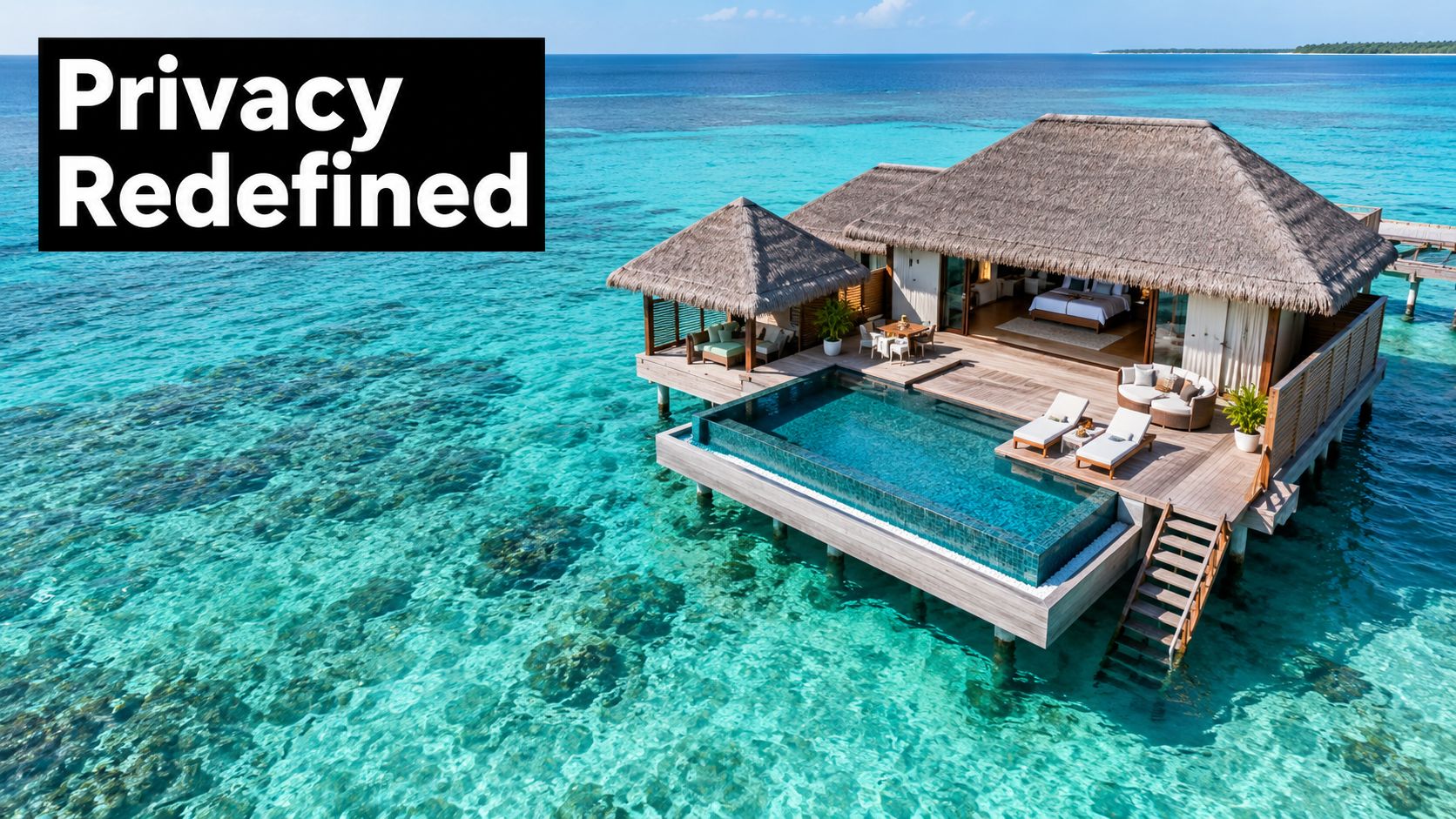
An overwater villa in the Maldives demonstrates the difference clearly. The value isn't only the ocean view or the private infinity pool. It's the ability to step outside without crossing a public corridor, dine without entering a restaurant, and spend an afternoon in complete seclusion. A private villa in South Africa offers a different expression of the same principle. Its appeal may come from a secluded setting, a private entrance, and a relationship with the surrounding environment rather than from conventional resort theatrics.
The broader romance-travel market gives this shift commercial weight. The global honeymoon tourism sector was estimated at $125.3 billion in 2022 and is projected to reach $179.3 billion by 2030, with Europe representing around 30% of the market and America about 35%, according to the Centre for the Promotion of Imports market analysis. The same source notes that 29% of European honeymoons last three weeks or more, while 45% of honeymoons globally are planned for one to two weeks, creating a stronger case for suites that remain comfortable beyond a single romantic night.
Luxury has also moved beyond the idea of a simple room upgrade. Historical reporting from The Knot's luxury honeymoon statistics release placed luxury honeymooners at 15% of the market, with spending above $7,000, while later industry reporting described premium itineraries, private villas, butler service, and much higher levels of personalization. For couples furnishing a private retreat at home, practical ideas for how to create a love nest can also clarify why atmosphere works best when it supports comfort and intimacy rather than visual excess.
Defining Core Features and Privacy Needs
The word “suite” tells you less than the floor plan. A large room with a bed, sofa, and dining table in one open rectangle may carry a premium rate, yet it can offer less usable privacy than a smaller suite with distinct areas.
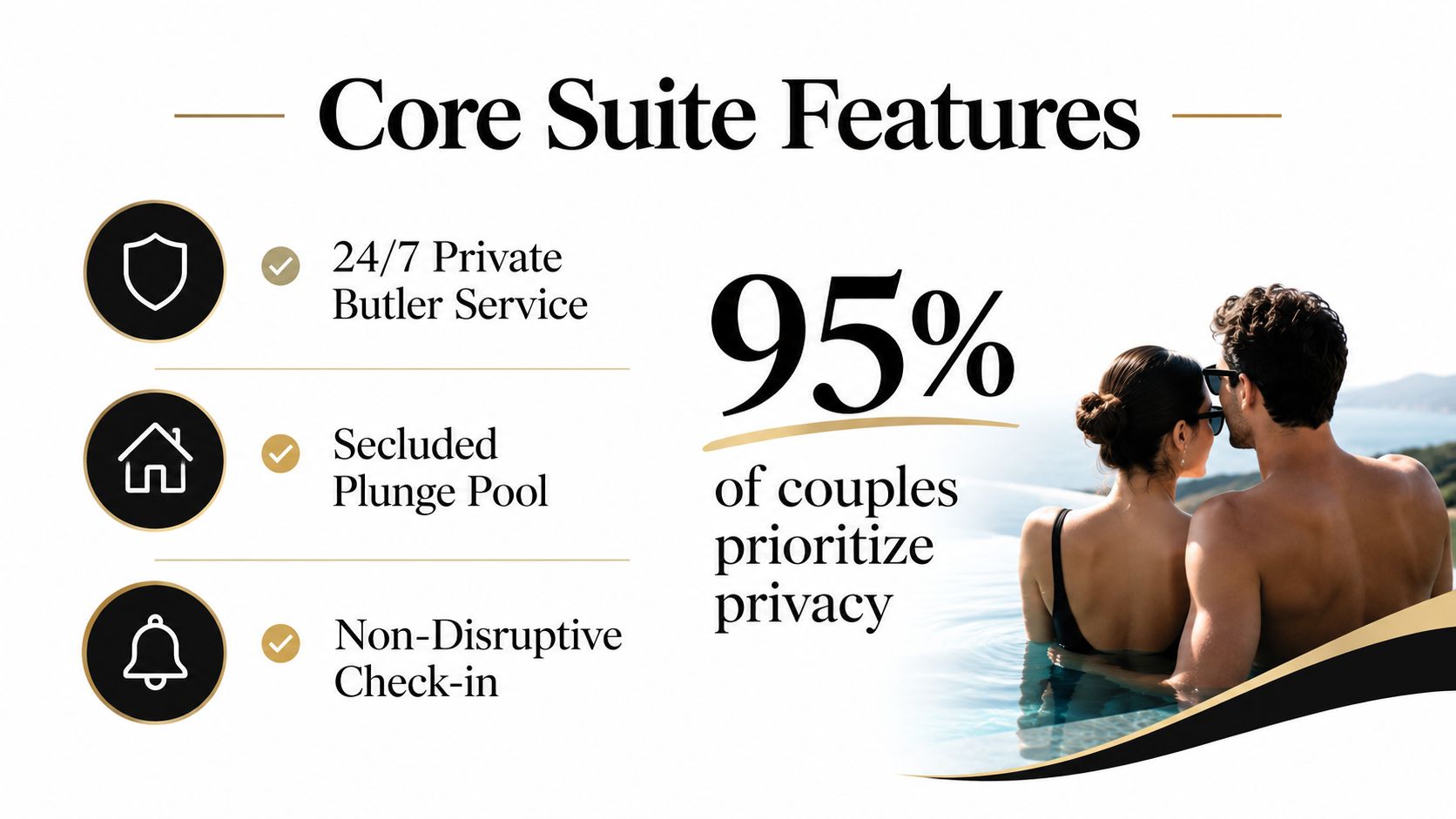
A 2026 survey found that 83.2% of couples rated privacy as extremely or very important on a honeymoon or romantic anniversary trip, and 61.2% identified a private villa or suite with a pool or hot tub as the most romantic quiet experience, according to Jayway Travel's quiet honeymoon trend analysis. The same analysis reports that 78% of couples expressed higher satisfaction in suites with separate sleeping and lounging zones, even when the overall room was smaller.
That evidence changes the way I assess a luxury honeymoon suite. I look first at movement, sightlines, and sound. A couple should be able to read, work, order breakfast, or sit outdoors while the other person sleeps. The bedroom should feel protected from service activity, and the bathroom shouldn't force one partner to cross the entire suite during the night.
What to inspect before paying a premium
- Separate sleeping and lounging zones: A proper sitting room, screened terrace, or connecting arrangement creates flexibility. A sofa at the foot of the bed doesn't provide the same separation.
- Protected access: Ask whether the suite has a private entrance, dedicated elevator access, or a corridor that limits passing traffic. A spectacular room loses much of its value if guests and staff regularly pass the door.
- Outdoor privacy: A plunge pool or terrace should be screened from neighboring villas and service paths. An uninterrupted view isn't enough if the space is visible from another room.
- Acoustic control: Solid doors between zones, quiet mechanical systems, and distance from restaurants, lifts, and service areas matter more than decorative finishes.
- Service flow: Find out whether breakfast, luggage delivery, and turndown can happen without staff crossing the main living area. Discreet service should feel coordinated, not invisible by accident.
The practical test is simple. Ask how the suite works at 8 a.m., 3 p.m., and 11 p.m., not only how it looks at sunset. If the answer reveals that every activity happens beside the bed, the property is selling size and styling rather than functional luxury.
Essential Amenities and Butler-Style Services
A private plunge pool is valuable when it removes the need to share a crowded facility, but it shouldn't be treated as an automatic sign of quality. Check its position, temperature control, privacy screening, and whether staff can service it without interrupting the terrace. A smaller pool attached to a secluded villa can be more satisfying than a larger one exposed to a neighboring suite.
The same logic applies to dining. In-suite breakfast and dinner create privacy only when the hotel handles the experience properly. Ask whether the meal arrives course by course, whether the table can be cleared without noise, and whether the kitchen can accommodate a personal chef or custom menu. A tray left outside the door isn't equivalent to an in-room dining service that understands timing and presentation.
The service details that make the difference
Dedicated butler service should begin with a clear communication preference. Some couples want one named contact who manages reservations, unpacking, spa appointments, and transport. Others prefer a quiet team that acts without repeated calls. Explain the preferred level of interaction before arrival so the service feels anticipatory rather than intrusive.
A strong butler can coordinate:
- Private arrival: Arrange a discreet transfer, expedited registration, and direct routing to the suite when the property offers those options.
- Dining in residence: Organize menus, wine, table settings, and service pacing around the couple's schedule.
- Housekeeping preferences: Set turndown times, replenishment routines, and privacy signals before the first evening.
- Celebration details: Place flowers, handwritten notes, a preferred spirit, or a meaningful meal without turning the room into a staged display.
- Local access: Secure private guides, boat charters, wellness appointments, and restaurant tables while keeping the itinerary flexible.
The best service doesn't create a constant performance of luxury. It removes friction. A butler who remembers that one guest sleeps late, keeps calls off the room phone, and arranges breakfast on the shaded side of the terrace is delivering more value than a generic welcome amenity.
Technology should support that discretion. A dedicated messaging channel, silent doorbell, adjustable lighting, and clear do-not-disturb controls can prevent avoidable interruptions. The suite should also offer lighting that changes with the day. A technically considered design uses warm color temperatures of 2700 to 3000K, dimmers, and low-glare fixtures, with practical targets of roughly 50 to 100 lux for ambient evening light and 200 to 300 lux at the bedside for reading or grooming, as described in this technical guide to honeymoon suite lighting. Those details preserve both intimacy and usability.
Strategies for Booking and Securing VIP Upgrades
A standard premium room and a true honeymoon suite solve different problems. The premium room may provide a better view, a larger bathroom, or club access. The luxury honeymoon suite should provide a different operating model, with more privacy, more controllable service, and a layout that supports extended time indoors.
| Booking option | What it usually prioritizes | The trade-off |
|---|---|---|
| Premium room | Location, view, or upgraded finishes | Often remains part of the main guest flow |
| Junior suite | Extra seating and a larger footprint | Sleeping and living areas may still be visually connected |
| Private villa or signature suite | Seclusion, outdoor space, and tailored service | Limited inventory and greater planning pressure |
| Advisor-requested upgrade | Preferred recognition and possible added benefits | Availability depends on the property and stay dates |
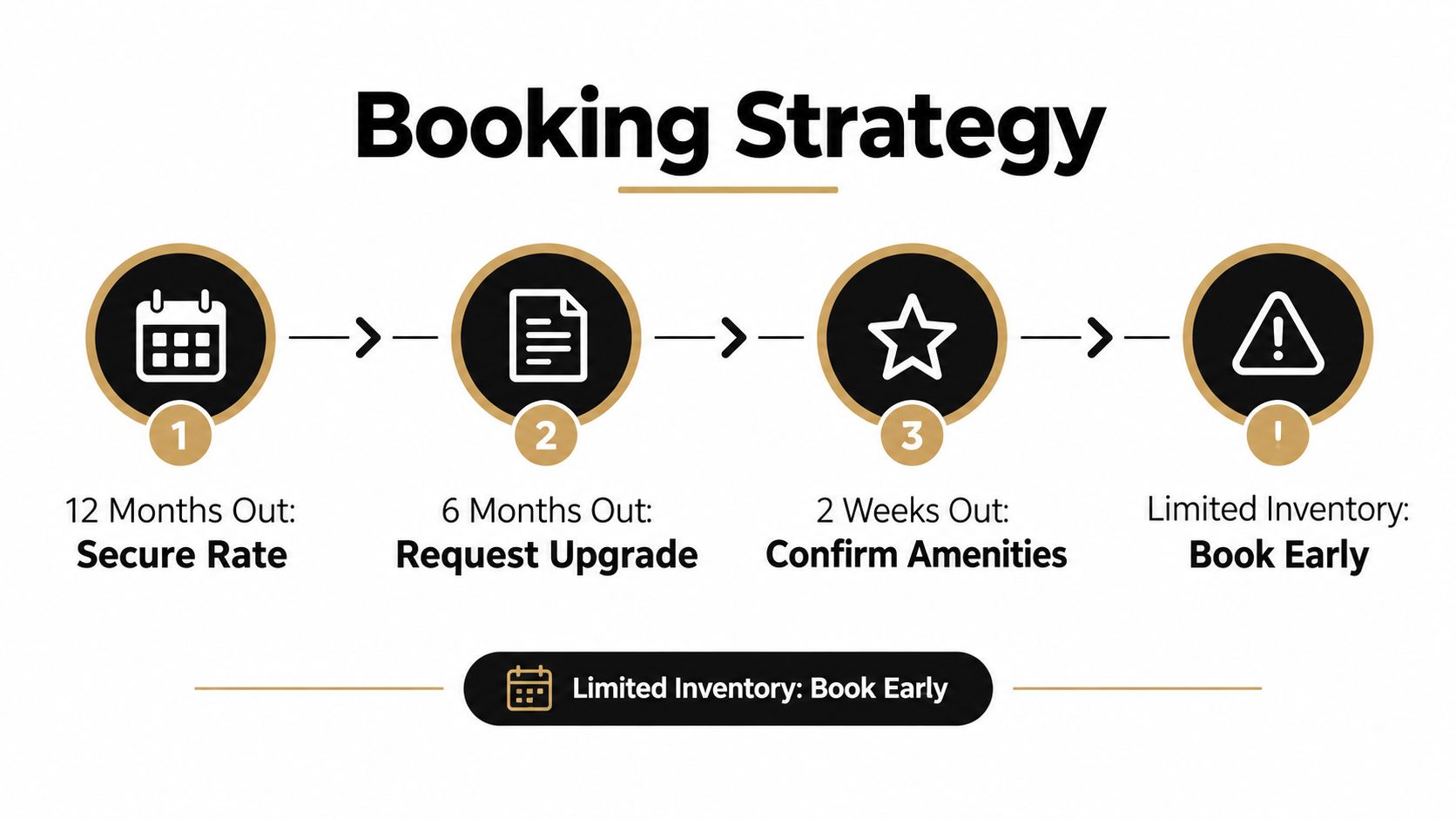
The practical booking window for a scarce villa or signature suite is 8 to 12 months in advance, according to Condé Nast Traveler's guide to hotels with honeymoon suites. That isn't a guarantee, but it gives the property and advisor room to work with the small number of genuinely private accommodations. Waiting until flights are confirmed can leave you choosing between a beautiful but exposed room and a less convenient alternative.
A practical timing sequence
1. Start with the room, not the destination shortlist. Identify the exact suite category, entrance arrangement, outdoor privacy, and zoning you require. A destination can remain flexible if the accommodation brief is precise.
2. Reserve a viable base option early. Secure a room that works rather than assuming the signature suite will appear later. Your advisor can then monitor cancellations, preferred inventory, and upgrade opportunities.
3. State the functional request clearly. “Romantic suite” is too broad. Ask for a separate lounge, private access, a concealed pool, quiet positioning, and non-disruptive service.
4. Confirm the operational details before arrival. Recheck transfer timing, dining arrangements, celebration preferences, and the suite's privacy features rather than relying on a generic reservation note.
An earlymoon or mini-moon can be a smart alternative when the wedding calendar collides with peak demand. It allows couples to claim a private escape before or soon after the ceremony, then plan a longer journey around better availability. The audience for these rooms also extends beyond newlyweds. One recent source says 37% of bookings for so-called honeymoon suites come from couples trying to reconnect, not just newlyweds, which reinforces the broader demand for private couple travel.
A public booking engine shows what can be purchased at that moment. An experienced advisor can investigate what may be released, protected, or arranged through preferred relationships. Guidance on securing hotel upgrades in luxury travel is useful when you're comparing a visible room category with a more discreet request.
The Role of a Luxury Travel Advisor
A luxury travel advisor adds value before the reservation is confirmed. The important work isn't only selecting a property. It's translating personal preferences into the language a hotel's reservations, guest relations, and management teams can act on.
Start with a concise accommodation brief. Include the occasion, preferred level of interaction, sleeping habits, dining expectations, and privacy requirements. “We want romance” gives a hotel very little to work with. “We need a separate lounge where one guest can work undisturbed, a terrace not visible from neighboring rooms, and breakfast served without entry into the bedroom” creates a usable request.

How to brief the advisor
Give the advisor enough lead time to compare properties and pursue the right room category. Share the dates, destination flexibility, preferred suite features, celebration details, and any concerns about stairs, boat transfers, exposure, or service access. A good advisor will also challenge an attractive but unsuitable recommendation.
The advisor's relationship with the property can influence how the reservation is handled. A Virtuoso-affiliated advisor may be able to request preferred partner benefits, suite upgrades when available, resort credits, flexible arrangements, or VIP recognition. Those benefits aren't automatic, and they don't replace the need to reserve the correct room. They become useful when the advisor has clearly documented your priorities and follows up with the hotel before arrival.
Practical rule: Ask for a specific room strategy, not a vague request for “something special.”
At the confirmation stage, request the room description in writing. Verify whether “private pool” means fully screened, whether the lounge has a closing door, and whether the suite sits near a service route or public walkway. If the property can't answer those questions, the advisor should present an alternative rather than relying on attractive marketing language.
A short conversation can also reveal whether you need a luxury travel specialist at all. This guide to choosing a luxury travel expert offers a useful framework for assessing communication style, destination knowledge, and the advisor's ability to manage complex preferences.
The service relationship continues after booking. A capable advisor confirms VIP notes, checks arrival logistics, monitors room changes, and coordinates with the property when the couple's plans shift. For travelers who want a room that functions with precision and care, that follow-through is often more consequential than another decorative amenity.
Selecting the Ideal Destination and Suite Type
Choose the experience you want to have inside the suite before choosing the scenery outside it. A Maldivian overwater villa suits couples who want uninterrupted seclusion, water access, and a self-contained rhythm. A South African private villa suits travelers who want privacy combined with natural settings, guided experiences, and a stronger sense of place. HauteBlack's luxury honeymoon coverage of South Africa is a useful starting point for comparing that style of journey with an island retreat.
A desert glamping suite can work for couples who value atmosphere and expansive surroundings, provided the bathroom, climate control, and service pathway meet their standards. A historic European manor may be better for those who want architecture, dining, and cultural access, but the most romantic room may not be the largest. Confirm sound insulation, elevator access, and whether the property can protect your privacy during busy periods.
For a slower Mediterranean escape, researching the best Puglia towns for couples can help match a historic setting with the right pace of travel. The decision should ultimately rest on three questions:
- How private should the stay feel?
- How much time will you spend inside the suite?
- Which services must happen without interruption?
Reviewing updated luxury honeymoon resort options can help narrow the field, but the final choice should be made from the floor plan, access pattern, and service model. Price comes after those criteria. A beautiful destination becomes far more compelling when the suite gives the couple the exact kind of closeness and independence they want.
HauteBlack arranges bespoke journeys with luxury hotel access, suite upgrade requests, VIP recognition, private transfers, villas, and custom honeymoon experiences. Visit HauteBlack to discuss the privacy, layout, destination, and service details you want your luxury honeymoon suite to deliver.
Explore Our Guides


Signature Experiences


