Haute Black Journal
How to Get Hotel Upgrades: Luxury Travel Tips

Marlene Azeez
Director, HauteBlack
View all articles →

# How to Get Hotel Upgrades: Luxury Travel Tips
June 15, 2026
You've checked into a beautiful hotel, handed over your card, exchanged a few polished pleasantries, and then waited for the sentence everyone wants to hear: “We've upgraded you.” Sometimes it happens. Most of the time, it doesn't.
That's because upgrades aren't random gifts. They're inventory decisions. The travelers who get them most often usually haven't left the moment to chance.
They've booked in the right channel. They've made themselves legible to the hotel before arrival. They've given the property a reason to recognize them, whether through loyalty, a booking relationship, a special occasion, or a well-timed request. If you want to know how to get hotel upgrades consistently, start by dropping the fantasy that charm alone will do it.
Luxury travelers who do this well understand the hotel's side of the desk. Premium rooms are finite. Staff members are balancing guest satisfaction, loyalty obligations, occupancy pressure, and revenue targets in real time. The trick is not pushing harder. It's aligning your request with how hotels allocate rooms.
The Unwritten Rules of the Hotel Upgrade
You arrive at a sold-out luxury hotel on a Friday afternoon. One guest steps up and asks whether there is “anything better” available. Another arrives on a reservation the hotel already recognizes, with clear notes, the right booking history, and a pre-arrival profile that gives the property a reason to prioritize them. Both guests want the same outcome. Only one has made an upgrade easy to approve.
That is the first rule. Upgrades are not handed out on charm or confidence alone. They go to the guests who fit the hotel's decision-making in that moment.
What hotels are deciding
A hotel is balancing revenue, room control, repeat-guest recognition, and service recovery all at once. A better room may be physically empty and still be held back for a paid sale, a VIP arrival, or a last-minute operational need. Front desk teams are not just asking whether they can upgrade you. They are asking whether giving you that room is the smartest use of inventory.
That is why experienced travelers stop treating the upgrade as a check-in performance. Work starts earlier, and the strongest position comes from being known to the property before you arrive.
Relationship matters more than many travelers realize. Loyalty status helps. So does prior stay history. But one of the strongest signals is booking through an advisor channel the hotel already trusts. Preferred programs often place your reservation in a different category from the start, with notes, amenities, and internal recognition that carry more weight than a generic direct or third-party booking. For example, Four Seasons Preferred Partner benefits can put a stay on a very different track before the guest ever reaches the lobby.
Practical rule: The easiest upgrades to approve are the ones that make sense for the hotel, not just the guest.
That means giving the property three things. A credible relationship signal. A reservation worth noticing. A request framed with good timing and restraint.
The guests who get upgraded most often
The travelers who do well here are rarely the loudest. They are the clearest. Their booking source is clean. Their profile is attached. Their stay has context. If there is a special occasion, it is noted discreetly and truthfully. If there is flexibility, they make that easy for the hotel to use.
This is also where luxury advisors have an advantage that public tips cannot replicate. Good advisors do not just pass along a request. They book inside programs, maintain supplier relationships, and know which properties honor recognition consistently and which ones protect inventory more tightly. That does not guarantee a suite. It does improve the odds in a way a polite desk request often cannot.
Hope can still produce the occasional surprise. Consistency comes from positioning.
The Strategic Foundation Before You Book
A guest books a standard room through an online travel agency, adds no profile details, and hopes to charm the front desk on arrival. Another books the same hotel through a preferred channel, has a recognizable guest history attached, and enters the system with the right notes already in place. Those two reservations do not look equal to the hotel, even if the rate is similar.
That difference starts before arrival.
Start with a reservation the hotel can act on
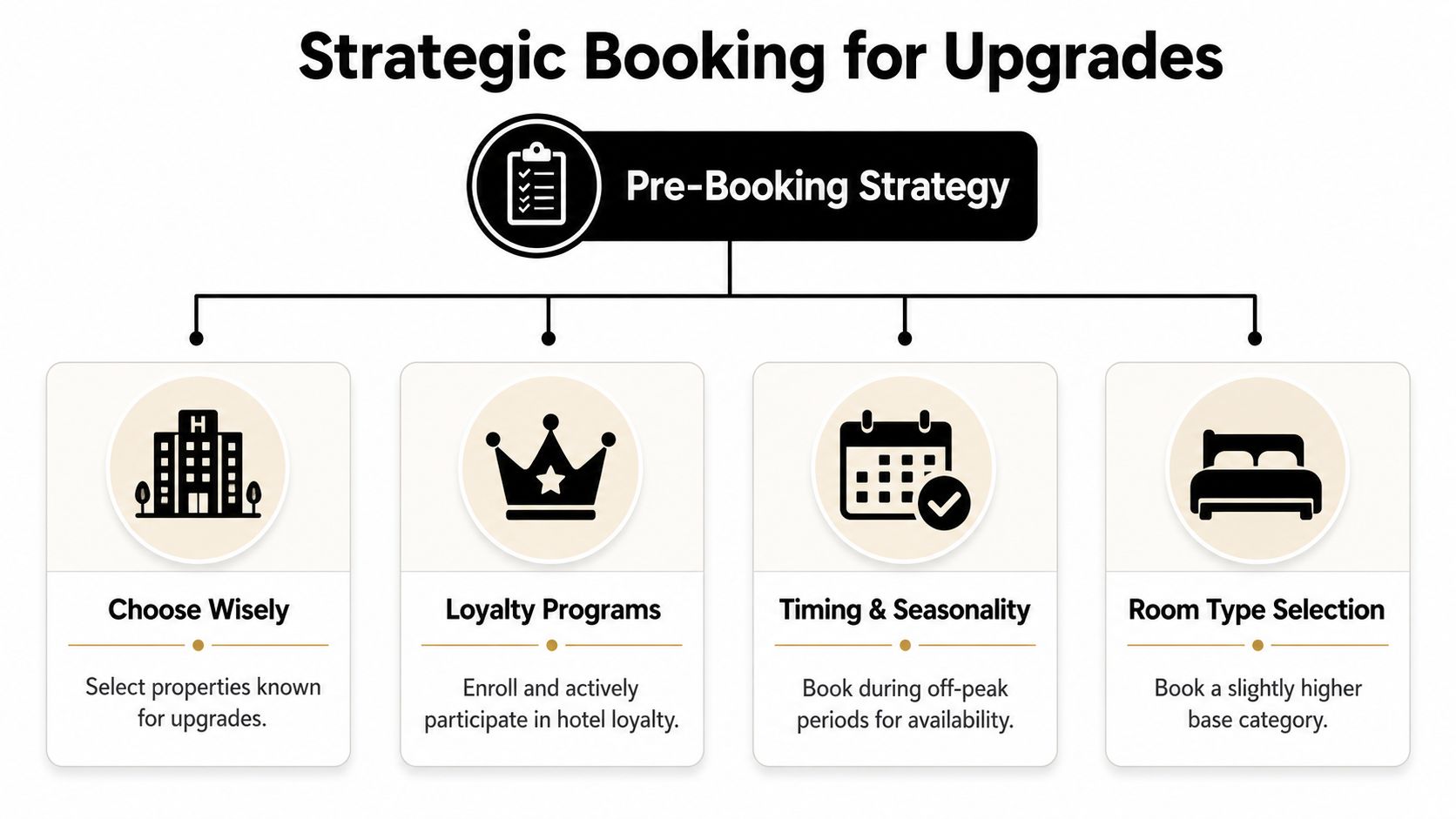
If upgrades matter, avoid booking paths that reduce your visibility. Third-party sites can be useful for simple one-night stays or rate shopping, but they often leave the hotel with less context and less incentive to prioritize the reservation. Direct bookings, loyalty-linked bookings, and advisor bookings give the property a clearer reason to pay attention.
Advisor channels carry even more weight at the luxury level. Preferred-partner reservations often arrive with benefits, internal coding, and a relationship signal the hotel recognizes immediately. At certain brands, that can change how the stay is reviewed before rooms are assigned. For example, Four Seasons Preferred Partner benefits can place a guest in a category the hotel treats very differently from a generic booking.
Understand how the hotel reviews upgrade potential
Hotels assign upgrades through inventory control, guest history, and revenue judgment. A property may have better rooms available and still decline a complimentary move if those rooms are likely to sell at a premium. Industry guidance on hotel room upgrade workflow describes the same operational pattern advisors see every day. Staff review booking source, profile strength, stay context, and expected occupancy before deciding whether an upgrade makes business sense.
The practical implication is simple. Give the hotel a reservation it can recognize and justify rewarding.
A few details matter more than travelers expect:
- Use one consistent profile: Match your name, email, phone, and loyalty number across bookings.
- Attach your history: Repeat guests are easier to recognize when prior stays are connected.
- Book through a channel the property values: Direct and preferred-partner bookings usually receive more internal attention than anonymous OTA reservations.
- Add relevant context early: A real anniversary, return stay, or short note about preferences can help if it appears before room planning begins.
Choose hotels with upgrade logic that works in your favor
Some properties protect premium inventory tightly. Others are more willing to improve room placement for the right guest profile. Brand standards matter, but hotel culture matters too. A city hotel running near full occupancy behaves differently from a resort with more category spread and more room to move guests around.
This is one of the clearest trade-offs in luxury travel. The cheapest available rate at the wrong property can cost more in missed value than a slightly higher rate at a hotel known for honoring partner recognition and treating upgrades as part of the guest experience.
Book a base room that gives the hotel room to move
Upgrades are easier when the jump is logical. If you reserve the very lowest category at a high-occupancy luxury hotel, the next meaningful room may sit several tiers above you. That makes a complimentary move harder to approve. Booking one step up can improve your odds because the hotel only needs to make a modest inventory decision, not give away one of its highest-yield room types.
This is not an argument for overspending. It is a reminder to book strategically. The right starting point often matters more than the request itself.
A reservation that is visible, valuable, and easy to justify will usually outperform a cheaper booking that looks interchangeable.
The Art of Communication Pre-Arrival and at Check-In
You arrive at a beautiful hotel, the lobby is calm, and a better room may still be in play. By that point, though, much of the essential work has already happened. Upgrades are often shaped before you ever step to the desk, through the notes attached to the booking, the clarity of your preferences, and the way the property reads your reservation.
Use the pre-arrival window
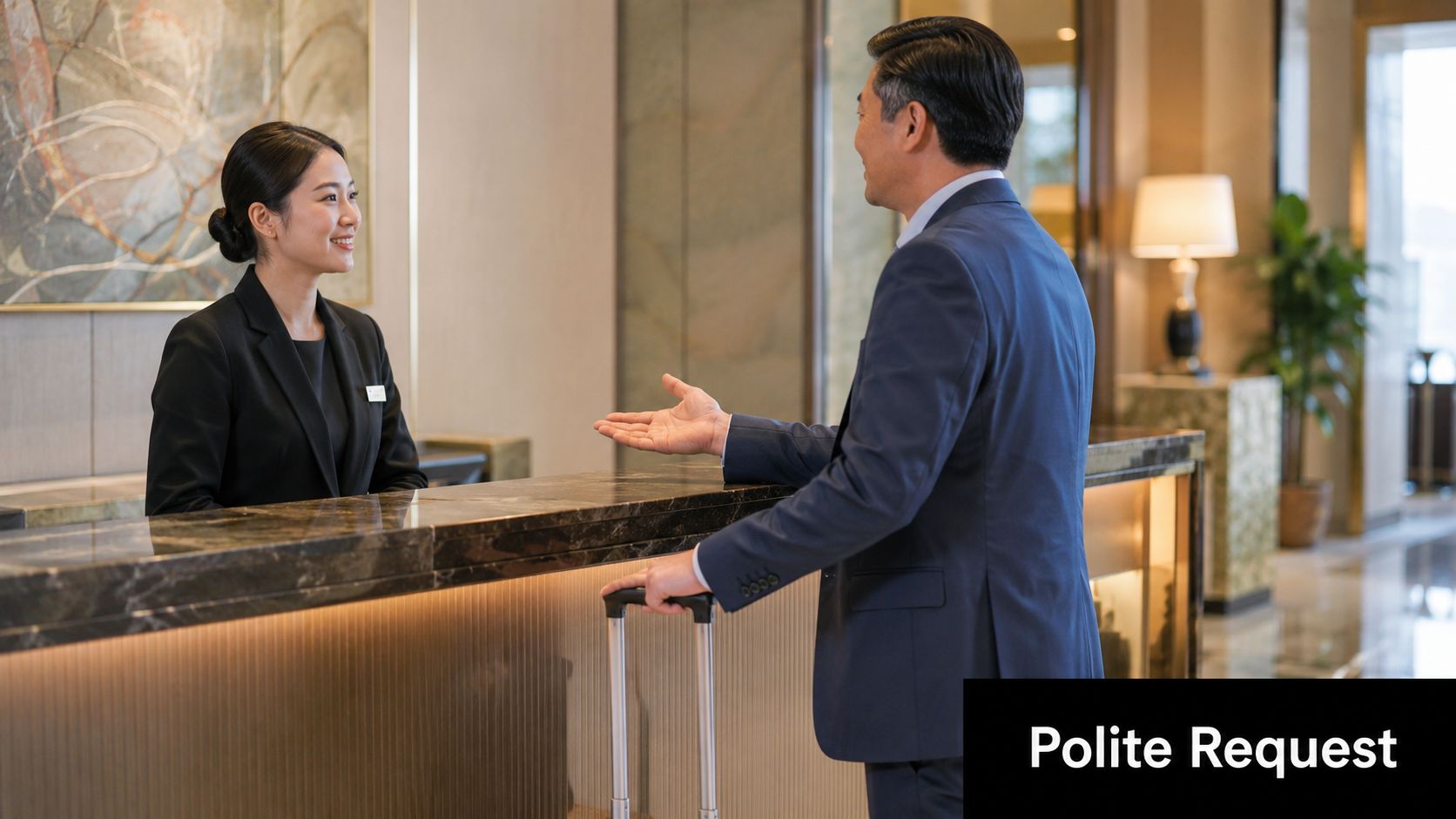
The strongest requests usually start before arrival. A short message in the final days before check-in gives the hotel time to note preferences, review availability, and decide where your reservation fits once room assignments begin to settle.
This is also where independent travelers and advisor-booked travelers start to separate. Anyone can send a polite note. A well-placed booking from an advisor often arrives with context the hotel already trusts, which can make the request easier to prioritize. That is part of the practical value described in this guide to luxury travel concierge services. It is not about promises. It is about cleaner communication and stronger positioning.
What to say before arrival
A good pre-arrival message is short, specific, and easy to action. It should confirm the stay, mention the room characteristics you care about, and show that you understand availability decides the outcome.
Use language like this:
We're looking forward to our upcoming stay. If a room upgrade becomes available, we'd be grateful to be considered. Our preference would be a higher floor, a quiet location, and the best view available within the hotel's inventory.
That phrasing works because it helps the hotel solve a problem. The front office can often improve placement more easily than category, and specific preferences give them options. “Any upgrade appreciated” is serviceable. “Higher floor, away from the elevator, with a better view” is much more useful.
What to say at the desk
Check-in is the confirmation point, not the opening move. If you handled pre-arrival communication well, the desk may already see notes on the reservation or a room that has been set aside. The right approach is calm and brief.
A polished ask sounds like this:
- Direct ask: “If there are any upgrade options available tonight, I'd be glad to be considered.”
- Preference-based ask: “If anything with a better view or a larger layout has opened up, I'd be very interested.”
- Flexible ask: “If nothing complimentary is available, I'd also be happy to hear about paid options.”
Then stop talking.
That pause matters more than many travelers realize. Front desk agents are checking inventory, reading notes, and deciding what they can offer without creating problems elsewhere in the house. Long explanations, repeated requests, or trying to negotiate before they finish typing usually lowers your odds.
A quick visual walkthrough helps make the front-desk dynamic clearer:
What usually hurts your chances
Some requests fail because the hotel cannot approve them. Others fail because the guest makes the request hard to say yes to.
- Asking for the top suite immediately: This signals inexperience with how inventory is controlled.
- Giving a long personal pitch at a busy desk: Staff need a clear request, not a speech.
- Treating the agent like the obstacle: The front desk is often your best ally if you make their job easier.
- Ignoring paid options: In some cases, a modest paid move can deliver far better value than waiting for a complimentary jump that never comes.
The unwritten rule is simple. Hotels respond best to guests who are easy to place, easy to please, and worth taking care of. Advisor relationships strengthen that position because the hotel is not judging a one-off request in isolation. They are often responding to an established booking channel, a known client profile, and a guest story that was presented properly from the start.
Leveraging Special Occasions and Perfect Timing
Special occasions and timing are both useful, but they're often handled badly. Travelers either mention a birthday as if it's a password, or they arrive at a random hour and wonder why no one can commit to anything.
Why late afternoon often works better
Travel guidance commonly points to check-in around 5–6 pm, when more rooms have been cleaned and the front desk has a clearer picture of what the day's inventory looks like. The same guidance notes that upgrades are more likely on non-peak days, and it frames birthdays and anniversaries as useful signals because staff can use them to prioritize goodwill within a managed guest experience, as described in this advice on timing and special-occasion signaling.
The logic is simple. Earlier in the day, the hotel may still be waiting on departures, housekeeping clearance, or room reassignments. By late afternoon, more uncertainty has cleared.
Use occasion signaling with restraint
A meaningful occasion helps when it's real and communicated naturally. It should be part of your reservation story, not the entire strategy.
Good phrasing sounds like this:
- Natural mention: “We're celebrating our anniversary during this stay and are very much looking forward to it.”
- Low-pressure request: “If there are any special touches or room placements you'd recommend, we'd be grateful.”
Bad phrasing sounds transactional. If your message reads like a demand for free extras, staff members will usually recognize it immediately.
A special occasion is a reason to remember you. It isn't a reason the hotel owes you anything.
Match your ask to the stay pattern
Timing and occasion work best when they align with softer demand. A Sunday arrival often gives the hotel more room to be generous than a peak holiday weekend. A genuine anniversary note is more persuasive when the property isn't protecting every premium room for sale.
Many travelers get confused. They treat upgrades as if they're won through technique alone. In practice, the strongest requests fit the hotel's operating reality.
The Advisor Advantage The Ultimate Upgrade Tool
You arrive at a beautiful hotel with a polite request ready. Another guest arrives with a reservation that already carries preferred partner status, clear stay notes, and a known advisor attached to it. Those two bookings do not enter the system the same way, and they rarely receive the same level of pre-arrival attention.
That is the gap most upgrade advice misses.
The difference between asking and arriving recognized
General tactics still matter. Booking a suitable room category, communicating well, and choosing your timing carefully all improve your position. But if you do not hold elite status and the hotel has no reason to prioritize your reservation, you are still making a cold request.
An advisor changes that context before check-in.
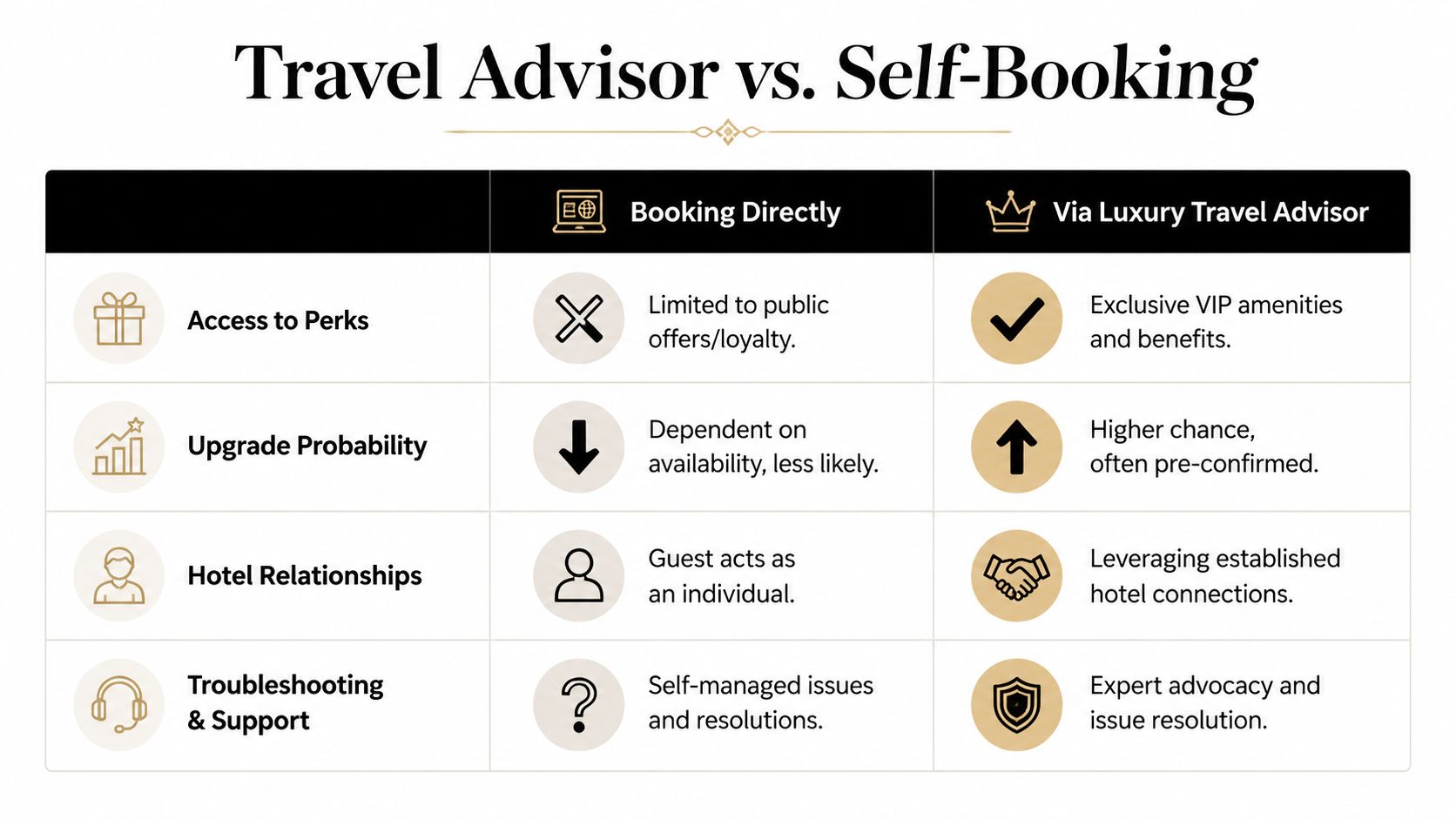
At luxury properties, preferred partner programs and advisor channels signal that the guest is coming through a relationship the hotel values. That often shapes how the reservation is reviewed, how preferences are handled, and where the guest sits in the pecking order for discretionary upgrades. It does not guarantee a suite. It does mean your stay is more likely to be considered with intent.
What the advisor is actually doing
A strong luxury advisor does not just place a booking. They are shaping the stay so the hotel knows who is arriving, why the guest fits the property, and where there may be room to improve the experience.
That usually includes a few practical steps:
- Choosing the right rate channel: Some bookings include VIP recognition, breakfast, hotel credits, and upgrade priority from the start.
- Sending useful pre-arrival notes: Preferences, arrival timing, and relevant context reach the hotel in a format staff can act on.
- Steering clients to the right property: Some hotels are generous and consistent with advisor bookings. Others are stricter with inventory and less flexible.
- Intervening when needed: If a better room assignment is possible, the request comes from an established partner, not a stranger at the desk.
For readers comparing options, this guide to what a Virtuoso travel agent is explains why booking through an advisor network differs from booking the same room online.
Why this matters more in luxury than midscale
In the luxury tier, inventory control is tighter and internal priority matters more. Premium rooms are often protected for paid demand, repeat guests, top-tier elites, and partner channels the hotel wants to reward. The guest who gets improved placement is often the guest the property has a reason to recognize before arrival.
That is why advisor access can matter so much here.
Haute Black is one example. It operates as a Virtuoso-affiliated luxury travel company with preferred partner access across many high-end hotel groups. In practice, that can mean the reservation reaches the hotel with VIP context attached instead of appearing as a standard direct booking.
The advantage is not magic. It is positioning, access, and credibility applied before the front desk ever sees you.
That insider track is what turns a hopeful ask into a stay the hotel is already inclined to handle well.
Upgrade Etiquette and The Long Game
Even with perfect timing and a strong booking, the answer may still be no. High occupancy, protected inventory, and last-minute operational changes can shut the door on a complimentary upgrade.
How you respond matters.
What to do when the answer is no
Accept the answer gracefully. Don't negotiate as if the associate is withholding a personal favor. If a hotel is tight on inventory, pressing harder rarely helps and can easily mark you as difficult before you've even reached the room.
Instead, shift to the practical fallback. One useful piece of guidance is to ask about paying the difference for a confirmed upgrade when a better room type is still available for sale. This approach acknowledges inventory reality and can be the smartest next step, as noted in this advice on paying the room-rate difference for a confirmed upgrade.

The guest hotels want back
Hotels remember patterns. They remember the guest who was warm to staff, clear about preferences, and gracious under pressure. They also remember the guest who treated every request like a test of status.
If you want better recognition over time, act like someone worth recognizing:
- Be precise: Ask for what matters, such as layout, floor, view, or quiet.
- Be reasonable: Understand that availability is real.
- Be memorable for the right reasons: Courtesy compounds.
A single stay is a transaction. Repeated stays create reputation. That's why the most effective approach to how to get hotel upgrades isn't about squeezing one free suite out of one trip. It's about becoming the kind of guest a property wants to take care of next time, too.
If you want your hotel bookings positioned for recognition from the start, Haute Black can help coordinate luxury stays through advisor and preferred-partner channels that are designed to surface VIP benefits, upgrade consideration when available, and a more polished arrival experience.
Explore Our Guides


Signature Experiences


