Haute Black Journal
Luxury Danube River Cruises: Top Ships & Suites

Marlene Azeez
Director, HauteBlack
View all articles →

# Luxury Danube River Cruises: Top Ships & Suites
Published August 1, 2026 by Marlene Azeez
You're probably staring at two tabs right now, one for a polished Danube itinerary, another for a private land program through Vienna, Budapest, and the Wachau, and you're trying to decide which one justifies the premium. That's the right question. On the Danube, the expensive mistake isn't booking the wrong cabin, it's booking the wrong kind of luxury.
A true luxury Danube river cruise is not just a prettier version of a standard sailing. It's a different product, built for travelers who want the river to do the logistics while they keep the comfort, service, and access of a high-end trip. The problem is that many brochures blur the line between premium and luxury, so clients end up paying for a word instead of a meaningful upgrade.
What Defines a True Luxury Danube River Cruise
A couple I'd place on the Danube this year might be choosing between a sleek mainstream “suite ship” and a more expensive all-inclusive brand. I'd tell them to ignore the adjectives and ask one blunt question, what exactly are they buying that they can feel every day on board? If the answer is just nicer decor, that's not enough.
The difference you should care about
A genuine luxury product puts the guest experience ahead of the ship brochure. That means suite-grade cabins as the baseline, not the exception, plus inclusions that reduce friction, beverages, gratuities, transfers, and well-run shore programs. It also means a crew that can handle small problems before they become your problem.
On the Danube, that matters because the route attracts a very specific audience, honeymooners, multi-generational families, and executive travelers who want culture without logistics. The river rewards people who want Vienna, Budapest, the Wachau Valley, and UNESCO-linked towns in one continuous line. It does not reward travelers who want beach time, wilderness, or a sense of remoteness.
Practical rule: if the itinerary depends on you paying extra for basics that should already be covered, you're not really in the luxury tier.
The market itself is strong enough to support that distinction. The Danube-region cruise tourism report cited in the brief places Danube cruise tourism at 693,200 passengers in Europe, and the broader European river-cruise market reached 1.49 million passengers in 2024, with 8% year-over-year growth and €3.728 billion in revenues and 10.72 million passenger nights in 2025 (Danube cruise tourism report). This isn't niche hobby travel, it's a mature premium market.
Haute Black fits into this world as an advisor-led option, not a cruise line. For clients who want one point of contact to line up pre- and post-cruise stays, private transfers, and special access around the voyage, that's the core value proposition.
The Danube as a Route and Why It Matters
The Danube isn't one river cruise market, it's several different trips pretending to be one. It's the second-longest river in Europe, it starts in Germany's Black Forest, runs through 10 countries, and ends at the Black Sea (Danube basics). That geography is exactly why smart buyers think in terms of route design, not just ship branding.
Upper Danube versus lower Danube
Upper Danube itineraries usually focus on Germany, Austria, and sometimes Slovakia. They're the cleanest fit for travelers who want cultural capitals, tighter pacing, and a more polished boutique feeling. Think Vienna, Budapest, and the Wachau, with time spent in cities people want to revisit on land later.
Lower Danube itineraries are a different proposition. They stretch farther into Hungary, Croatia, Serbia, Romania, and Bulgaria, which makes them more of a grand journey. They tend to be longer, more port-heavy, and more about range than refinement.
The route split affects ship choice too. Some vessels are built to feel intimate and city-centric, while others are designed for the longer, more expansive stretches of the river. If a client wants one elegant week with strong urban anchors, I steer them toward the upper river. If they want scale, breadth, and a more geographic story, the lower river earns its keep.
The Danube market has also expanded in a way that makes this route logic even more important. Passenger transport on the Upper Danube grew 72% from 2012 to 2017, and pleasure cruises on European inland waterways expanded from 70 ships to 170 ships between 2010 and 2015 (Danube Commission data in the report). That kind of growth usually means more choice, but it also means more noise. Route clarity cuts through it.
The Leading Luxury Operators on the Danube
The big names matter less than the specific Danube ship, but some brands still define the tier. On this river, I look at AmaWaterways, Crystal, Scenic, and Uniworld first, then I consider private charter-style arrangements for clients who want something more bespoke. The decision is rarely about whether a line is “good.” It's about which one aligns with the traveler's tolerance for structure, service style, and onboard social energy.
| Luxury Danube Operators at a Glance | |||
|---|---|---|---|
| Operator | Danube fleet | Top suite category | Inclusions |
| AmaWaterways | Mixed Danube deployment within a broader European fleet | Suite-led categories and select higher-end accommodations | Strong dining, curated excursions, premium beverage structure |
| Crystal | Select luxury river presence | High-end suites and polished service | More fully inclusive positioning |
| Scenic | Luxury-focused river program | Larger suite-style accommodation tiers | Strong all-inclusive framing |
| Uniworld | Distinctive boutique fleet | Signature suites and themed design | Broad inclusions and immersive styling |
| Private charter-style arrangements | Custom vessel or takeover model | Tailored to the charter brief | Highest flexibility, highly customized inclusions |
How I'd sort the brands
For honeymooners, I lean toward the brands that feel the most refined and adult. For multi-generational families, I care more about suite configuration, dining flexibility, and whether everyone can live comfortably in the same onboard rhythm. For repeat river cruisers stepping up from premium into luxury, the question is whether the line delivers a visibly better day, not just a nicer marketing deck.
Scenic and Crystal usually appeal to clients who want the highest level of built-in ease. Uniworld works for travelers who like a strong visual identity and a more curated onboard personality. AmaWaterways can be a smart move for clients who want a broader set of excursions and a lively, well-run product.
My advice: don't buy the brand first. Buy the specific Danube ship and the exact cabin category you're getting on that departure.
For readers who also compare other river itineraries, I'd treat the luxury Nile river cruise guide as a useful contrast. The buying logic is similar, but the Danube gives you more city-to-city density and less archaeological destination compression.
Ships, Suites, and the Engineering Behind the Experience
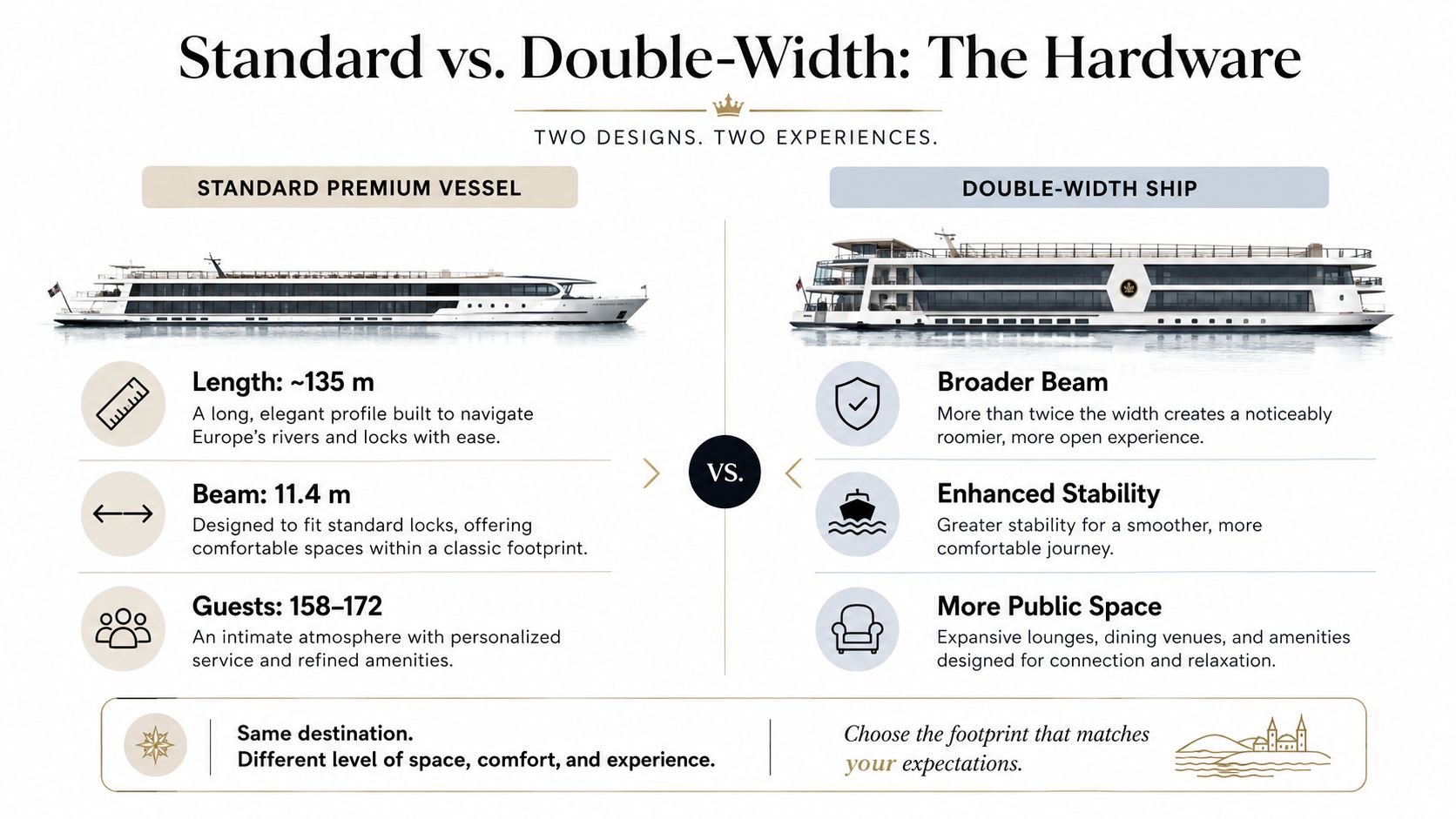
The hardware is where luxury Danube river cruises separate from expensive ones. Standard premium vessels on the route are typically about 135 m long, 11.4 m wide, and carry roughly 158 to 172 passengers, while double-width ships such as AmaRudi expand to roughly 72 ft, about 22 m, in beam and 196 passengers (Lueftner Cruises brochure). That extra width is not a cosmetic upgrade. It changes how the ship feels, how the suites are shaped, and how generous the public areas can be.
Why beam matters more than marketing copy
A wider ship gives designers room for larger suites, bigger public spaces, and a more resort-like layout. On the Danube, that matters because clients want comfort without losing sightlines. The trade-off is engineering. The wider the hull, the more carefully the ship has to be built for locks and bridges, which is why these vessels are purpose-built for European inland waterways.
Cabin layout matters just as much. Riviera's Danube fleet uses beds sized at 160 cm × 200 cm or 180 cm × 200 cm, and over 75% of Spirit of the Danube's cabins have French balconies (Adventure Life ship details). Other luxury ships advertise suites up to 710 sq ft and standard cabins around 205 to 252 sq ft. That spread tells you where the luxury lives, in space, light, and usable viewing angles.
I tell clients to favor French balcony or balcony-suite layouts whenever possible. On a river like the Danube, the scenery comes fast, and port windows can be short. If you want the river in the room, not just outside it, the cabin configuration is not optional.
The best Danube suite is the one that lets you enjoy the passing river without feeling trapped below deck.
For readers who compare ship design across Europe, this Italy river cruise guide is a useful reference point. The engineering conversation is different on the Danube, but the lesson is the same, ship geometry shapes the trip more than most travelers realize.
Signature Danube Itineraries and How to Choose Between Them
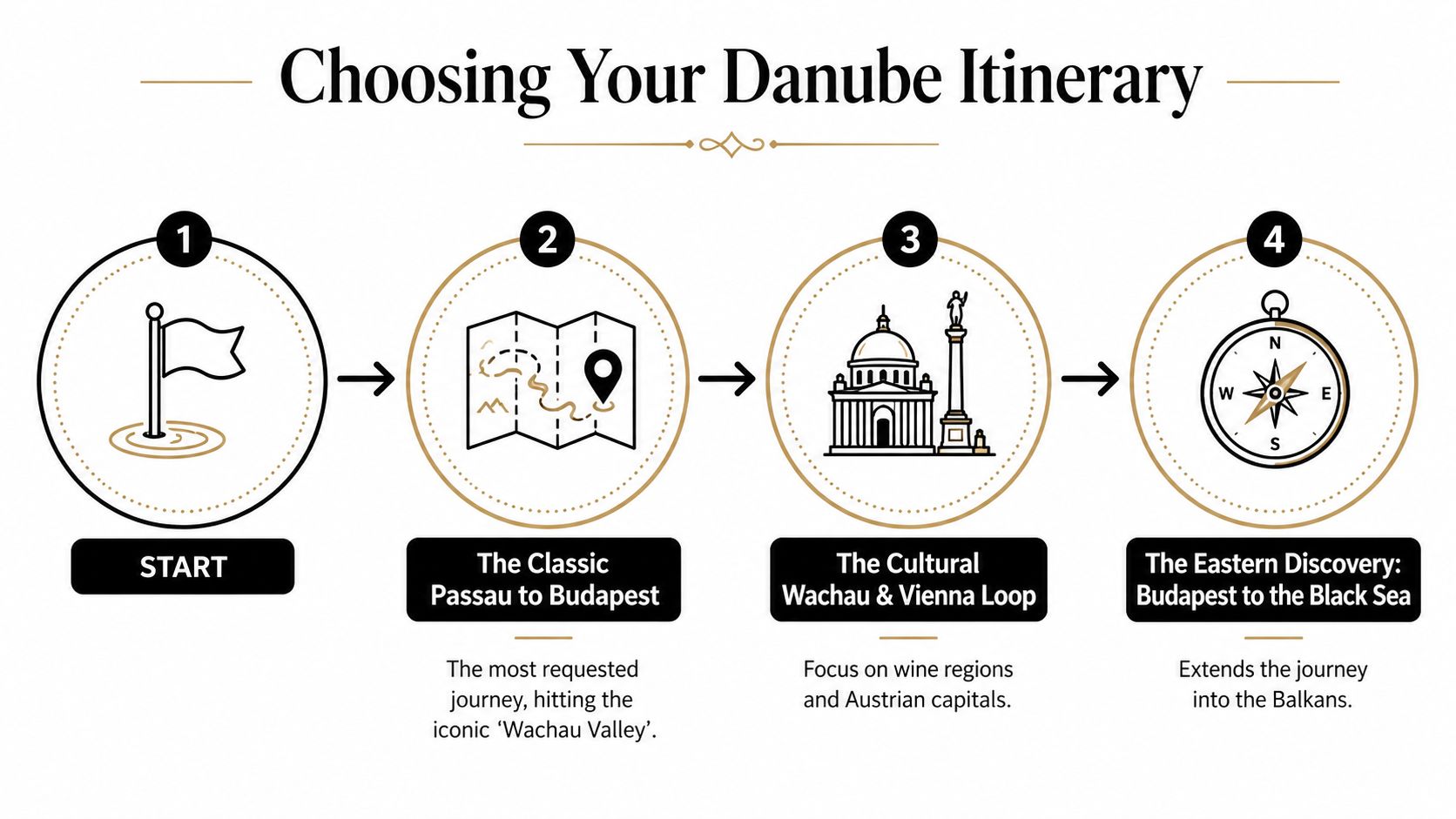
The most requested Danube journey is still the classic Passau to Budapest run, because it compresses the river's greatest hits into a manageable week. It's the right choice for travelers who want a dense cultural calendar, not a long transit story. I like it for first-timers because the rhythm is easy to understand quickly.
Three itinerary types, three different buyers
The classic week works for clients who want Vienna, Budapest, and the Wachau without a lot of logistical drag. It's a strong fit for couples, first-time luxury cruisers, and families who want a clean premium experience with minimal decision fatigue. The days feel full, but not frantic.
The grand Danube stretches longer and reaches deeper into the lower river, often adding Belgrade, the Iron Gates, and sometimes Bucharest. That's the better choice for seasoned travelers who want a broader eastern European story and can handle more time in transit. It's a bigger commitment, and I think it earns its price only when the traveler wants that scale.
Seasonal Christmas-market departures are a different emotional product altogether. They trade some daylight sightseeing for festive city programming, which works beautifully for repeat visitors who care more about atmosphere than box-ticking every port sight. If someone wants the warmest, most social version of the Danube, that's the sail to look at.
The route choice also needs to fit the traveler's real habits. A client who likes long, quiet mornings and one excellent excursion a day should not book the most port-dense voyage. A client who wants a sense of movement and variety will get bored on an itinerary that feels too short.
For those building a wider city itinerary around the cruise, luxury Prague, Budapest, and Vienna tours for 2026 pair naturally with the Danube. I like pre-cruise land time most when the traveler wants depth in the cities and ease on the water.
Bespoke Shore Experiences and Private Excursions
The ship matters, but the shore program is where a luxury Danube cruise becomes memorable. A good operator gives you a polished excursion. A serious advisor provides after-hours access, private guides, and timing that avoids the group-tour crush. That difference is why affluent travelers keep asking for better orchestration, not just nicer cabins.
What the best private days actually look like
In Vienna, the strongest requests are for palace access, private classical music, and museum time before or after public hours. Schönbrunn and the Belvedere both make more sense when a client isn't moving with a full coach load. In Budapest, curator-led visits to the opera houses or the Hungarian National Gallery give the day real depth instead of just sightseeing-by-checklist.
The Wachau is where the Danube feels most naturally luxurious. Vintner-led tastings work there because the scenery is compact, elegant, and easy to experience without rushing. Chauffeured transfers also matter more than people think, because they let you skip the motor-coach choreography that can flatten an otherwise special day.
Practical rule: if a shore experience can't be described in one specific sentence, it's probably generic, not luxury.
Some clients want something even less linear. That's where the river-to-city hybrid model works. They cruise for the core stretch, then add two or three nights in a proper city hotel before or after the sailing, which is common for honeymooners and executives who want control without losing the ease of the river.
Haute Black can handle that kind of stitching when it's needed, along with private transfers and pre-booked stays around the voyage. I only mention it as one option because the point is continuity. Luxury on the Danube should feel coordinated, not assembled in pieces.
Pricing, Booking Windows, and How to Actually Get Value
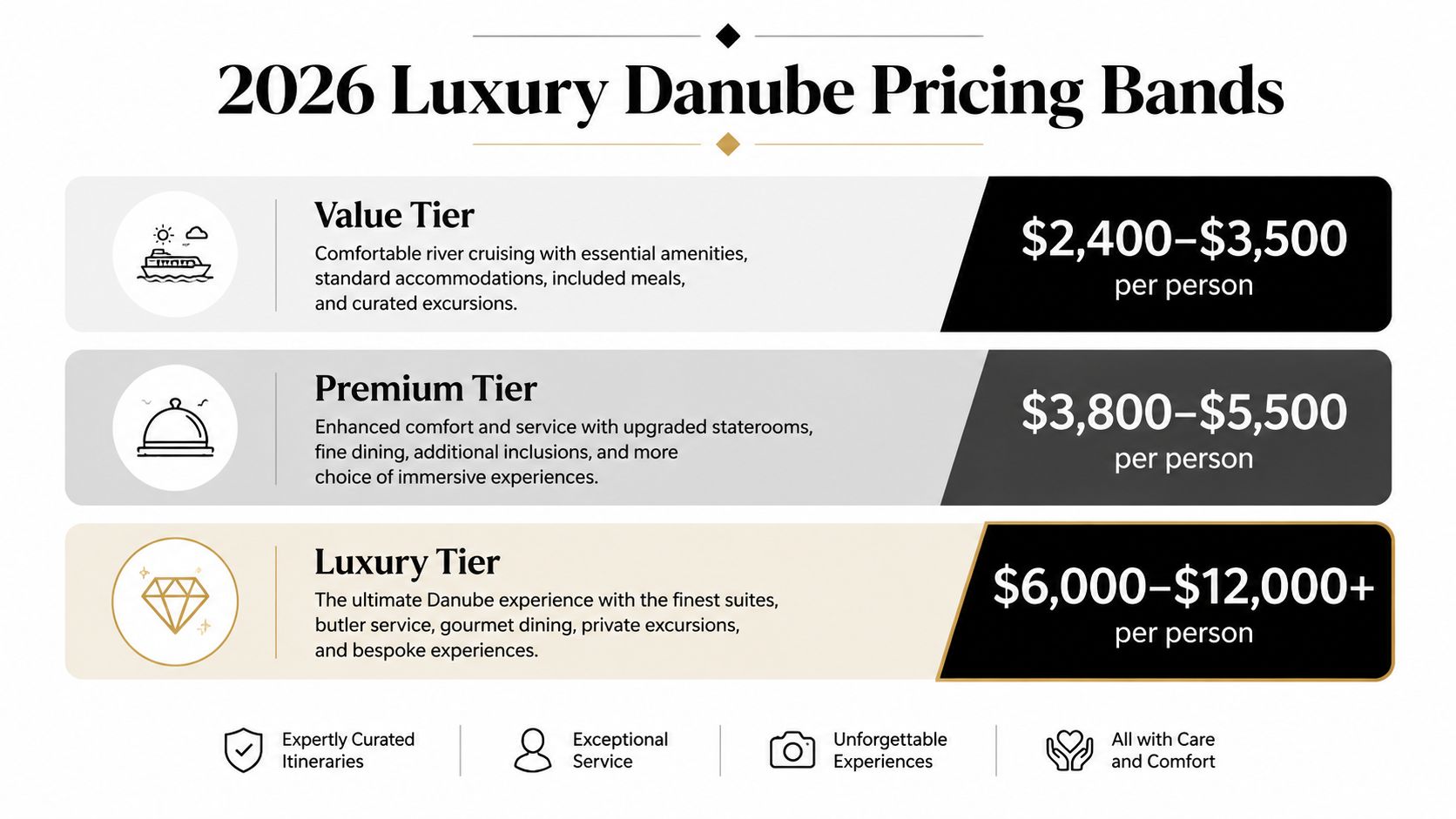
The sticker price on a Danube cruise tells you almost nothing until you know what tier you're looking at. A 2026 pricing guide puts value-tier itineraries around $2,400 to $3,500 per person, premium-tier cruises around $3,800 to $5,500, and true luxury-tier sailings at about $6,000 to $12,000+ per person for a standard 7-night itinerary (Danube pricing guide). That spread is the market telling you exactly where the luxury sits.
What drives the price
Cabin category is the biggest lever. Sail date comes next, with festive departures and high-demand windows pricing differently from shoulder-season sailings. Ship class and inclusions matter too, because an inclusive product compresses the cost of drinks, gratuities, and transfers into the headline fare.
The broader market also shows why premium pricing has room to exist. One industry statistics compilation places the luxury segment at 35% of river-cruise revenue and says Europe holds over 70% of global river-cruise revenue share. That concentration helps explain why the Danube can support such strong upscale demand without becoming overcrowded.
Booking strategy should be simple. If you want Christmas markets, book early and accept that you're paying for timing as much as the ship. If you want more value, look at shoulder-season departures and ask where the suite upgrades sit in the inventory, because that's where advisors can sometimes move the needle.
Preferred-partner status changes the equation too. With the right agency affiliation, clients can sometimes access complimentary upgrades when available, along with resort credits and flexible benefits. I'm not impressed by brochure promises. I'm impressed when a quote clearly shows what's included, what's protected, and what can still be improved by the advisor.
When a Luxury Danube Cruise Is the Wrong Choice
The biggest mistake I see is assuming every affluent traveler wants the same kind of effortless travel. They don't. A luxury Danube cruise is the right choice when the traveler wants curated movement, a polished cabin, and a tightly managed route through major capitals. It is the wrong choice when they need more control than a fixed-departure sailing can give them, or when the river itself becomes the weak point in the trip.
The cases where I'd push land first
Low water risk is the first deal-breaker. Travel Weekly reported that low water levels in Europe have disrupted river cruise itineraries and forced cruise lines to adjust sailings during drought and heatwave conditions, and 2025 coverage kept flagging this as an ongoing Danube risk rather than a one-off event (Travel Weekly on low water disruptions). If a traveler is paying for predictability, they need to ask the operator how it handles substitutions, hotel swaps, and communication before they book. If that answer is vague, the cruise is the wrong product.
Mobility is the next issue. River cruising can be easy, but it still assumes guests can move through gangways, locks, and occasional walk-throughs between docked ships. A private land itinerary is simpler for anyone who wants total physical ease, no deck changes, and no dependence on the ship's docking situation.
Some clients also want privacy that a ship cannot fully deliver. Honeymooners who want their own pace, families who need late starts and flexible dining, or executives who need to shift plans at the last minute are often better served by a private car, driver, and hotel sequence. The Danube gives shared elegance, not total control, and that distinction matters once the trip has to work around real life.
Do not pay a luxury premium unless the operator can explain the backup plan in plain language.
For advisors, the contract matters as much as the cabin. Force-majeure language, contingency planning, and hotel substitutions should be reviewed before money changes hands. A strong travel advisor spends time on those details because the value of luxury drops fast when the itinerary changes and nobody owns the fix.
A membership-style advisor can make a difference here. A good program can coordinate VIP transfers, pre- and post-cruise hotels at brands like Four Seasons, Aman, Rosewood, Belmond, or Ritz-Carlton, and private aviation touches through Haute Jets when the trip calls for it. Some travelers also prefer the waived planning-fee model and dedicated advisor relationship, while others just want signature journeys booked cleanly without joining anything.
If you want to start a Danube conversation with real options, not brochure language, visit Haute Black. Bring your dates, your ideal cabin style, and the kind of trip you would rather have if the river runs low. That is how a useful recommendation starts.
Explore Our Guides


Signature Experiences


