Haute Black Journal
Luxury Prague Budapest Vienna Tours 2026

Marlene Azeez
Director, HauteBlack
View all articles →

# Luxury Prague Budapest Vienna Tours 2026
June 3, 2026
You're probably staring at the same question most smart luxury travelers hit after the first round of research. The cities are obvious. The route looks simple. The tour pages all blur together. And yet the difference between a polished Central Europe journey and an exhausting one comes down to details most standard itineraries barely address.
That's why Prague Budapest Vienna tours deserve more scrutiny than they usually get. These three capitals belong together culturally, historically, and logistically, but they shouldn't be treated like a checklist. If you book them as a generic trio, you'll spend too much of the trip moving, waiting, and following everyone else toward the same crowded landmarks at the same hours.
A strong itinerary in this part of Europe is less about how many monuments you can name and more about sequencing, access, timing, and how the days feel on the ground. You want enough room for private guiding, slow breakfasts, late starts after a concert, and evenings that don't end with a rushed transfer back to a hotel chosen for convenience instead of character.
Crafting Your Central European Masterpiece
Prague, Vienna, and Budapest form one of Europe's cleanest luxury itineraries. The appeal is obvious. Prague gives you Gothic drama and a storybook skyline. Vienna delivers imperial polish and culture at a world-class level. Budapest brings scale, energy, river views, and a more cinematic sense of contrast.
What most travelers miss is that this trip isn't hard because the cities are far apart. It's hard because people approach it like a shopping list. They ask whether they can see all three, when the more useful question is whether the order and pacing create a trip that feels elegant rather than fragmented.
That's the key gap in most Prague Budapest Vienna tours. As noted by Insight Vacations on its Budapest Vienna Prague itinerary, “the key planning question is not ‘Can I see all three?’ but ‘Which sequence minimizes transit waste and maximizes premium experiences?’” That's exactly right.
The luxury version of this trip isn't about adding more. It's about removing friction.
A poorly composed itinerary usually fails in predictable ways:
- Too many hotel changes: You spend more time checking in and out than settling into each city.
- Wrong travel order: Transfers look manageable on paper but break the rhythm of the trip.
- Peak-hour sightseeing: You pay for luxury and still experience the cities at their most crowded.
- No room for spontaneity: Every day is so tightly packed that the trip starts to feel escorted, even when it isn't.
The best version of this journey has a narrative arc. Prague works beautifully as an atmospheric opening. Vienna acts as the refined center. Budapest lands with more visual drama and evening energy. But there are cases for reversing that order, especially depending on arrival logistics, hotel priorities, and whether rail or private road transfers matter more to you than symmetry.
That's why this trip should be composed, not purchased.
The Art of Pacing Your Imperial Capitals Tour
The intelligent minimum for this journey is 10 days and 9 nights, not a rushed week. That structure isn't arbitrary. A standard Budapest Vienna Prague circuit is commonly sold as a 10- to 11-day escorted itinerary, and a frequently recommended structure is 10 days / 9 nights with 3 nights in each city, which gives each capital enough breathing room without compressing the experience into constant motion, according to JayWay Travel's Prague Vienna Budapest trip design.

Why three nights in each city works
Three nights gives you two full working sightseeing days plus arrival or departure flexibility. That matters more in luxury travel than people admit. You're not just trying to stand in front of the major landmarks. You're trying to enjoy the city at a civilized pace.
With three nights, you can do things properly:
- Prague: One day for the castle district and Old Town, another for private art, quieter neighborhoods, or a more thoughtful culinary day.
- Vienna: One day for the grand imperial circuit, another for museums, music, shopping, or a slower café and design-focused program.
- Budapest: One day for the riverfront and architecture, another for baths, private tastings, and a stronger evening experience.
Cut any city to two nights and the tone changes immediately. The trip starts feeling transactional.
Practical rule: If you want room for fine dining, a meaningful cultural evening, and a little unstructured time, don't book fewer than three nights per capital.
The best routing for most travelers
For pure logistics, Prague, then Vienna, then Budapest is hard to beat. The transfer logic is simple. The rail leg between Vienna and Prague is roughly 4 to 4.5 hours, and the leg between Vienna and Budapest is about 2.5 hours, according to a routing discussion on Rick Steves' travel forum covering Vienna, Prague, and Budapest connections.
That makes Vienna the hinge city. It sits in the middle naturally. It also means you can avoid flights entirely, which is exactly what most premium travelers should do here unless a wider itinerary forces a different plan.
When to extend beyond the standard frame
Not everyone should stay with the classic structure. Some travelers need more room.
A longer version makes sense if you want:
1. Day-trip capacity for places such as Český Krumlov or the Wachau.
2. Recovery time after a long-haul arrival.
3. Event-based planning built around opera, concerts, or private museum access.
4. A fourth stop like Krakow, if the broader narrative matters more than keeping the trip sleek.
But extension should be deliberate. One broader Central Europe version adds Krakow and stretches to 18 days, which shows how quickly this route shifts from elegant tri-city journey to a bigger regional circuit. That's not wrong. It's just a different trip.
What escorted tours reveal about market expectations
Even if you never intend to join a group, escorted tour structures tell you how the market packages this route. A Go Ahead version includes 9 nights, 9 breakfasts, 3 dinners, and 3 sightseeing tours, while a Smithsonian Journeys tailor-made 10-day version starts from $6,530, as shown on EF Go Ahead's Budapest, Vienna & Prague trip page. The takeaway isn't that you should buy either product. It's that this route sits firmly in the premium category and rewards curation over improvisation.
Four Bespoke Itineraries for the Discerning Traveler
The best Prague Budapest Vienna tours aren't defined by city order alone. They're defined by what the trip is for. Romance, family legacy, culture, and river cruising all demand different pacing, different rooms, and different access strategies.
The Romantic Escape
This version works best for couples who want intimacy without isolation. Prague opens the trip with mood. Early private walking hours matter here, especially before the bridge corridors and castle approaches fill up. Vienna shifts the tone toward elegance. Budapest closes with river views and after-dark glamour.
The point isn't to “do” all the famous places. The point is to make them feel personal. A sunrise walk, a private car at the ready rather than a scheduled pickup, a dinner timed after an evening performance, and a suite with enough privacy to make the hotel feel like part of the trip rather than just where you sleep.
The Family Legacy Journey
This is the right structure for multi-generational travelers who want substance but can't tolerate friction. These cities are rich in imperial history, Jewish heritage, architecture, music, and food culture, which means the trip can satisfy grandparents, parents, and older children if the daily rhythm is controlled.
A family version needs less moving around and more thoughtful tempo. You want guides who can tell stories rather than recite dates. You want cars available for flexible returns. You want restaurants that understand pacing and dietary variation. And you want hotel layouts that make adjacent rooms or connecting configurations practical.
A family itinerary succeeds when nobody feels dragged through someone else's version of culture.
The Connoisseur's Cultural Immersion
This is the strongest format for travelers who measure a city through collections, performance, architecture, and private access. Vienna usually becomes the intellectual center of the trip, but Prague often delivers the strongest atmosphere and Budapest the strongest emotional finish.
This traveler should lean into:
- Private guiding: Better for context, timing control, and entry sequencing.
- Performance planning: Concerts, opera, chamber music, or salon-style evenings.
- Collection-based days: Fewer stops, more depth.
- Architectural contrast: Gothic Prague, Habsburg Vienna, and layered Budapest reward comparison.
For broader inspiration beyond Central Europe alone, Haute Black's Europe Grand Tour ideas are useful as a reference point for how culture-led itineraries can be stitched together with more precision.
The Danube River Cruise Reimagined
This version is for travelers who like the comfort of a river cruise but don't want the standard pre- and post-cruise experience. The cruise itself can handle the middle stretch. What matters is upgrading the land component on both ends.
Prague often makes the strongest pre-cruise opening because it deserves focused time that most cruise add-ons don't give it. Vienna and Budapest can then be framed as either cruise cities or extended with private overland nights after disembarkation. Done well, the cruise becomes one chapter of the journey rather than the whole concept.
Here's how these styles differ in practice:
| Itinerary Style | Pace | Primary Focus | Haute Black Highlight |
|---|---|---|---|
| Romantic Escape | Slow and atmospheric | Privacy, mood, memorable evenings | Suite-first planning and discreet, couple-focused access |
| Family Legacy Journey | Structured but flexible | Shared history, comfort, easy logistics | Multi-generational pacing and high-touch ground handling |
| Connoisseur's Cultural Immersion | Intellectually dense, never rushed | Art, music, architecture, private guiding | Culture-led access and refined scheduling |
| Danube River Cruise Reimagined | Hybrid | Cruise comfort plus upgraded land experience | Elevated pre- and post-cruise orchestration |
The mistake is choosing one style halfway. Pick the trip you prefer, then let every booking support it.
Seamless Transitions Private Transfers and Charters
A luxury traveler shouldn't treat transfer days as dead time. In Central Europe, the journey between capitals is part of the design. Rail works well here, but it isn't automatically the best choice once you factor in hotel-to-station handling, luggage, timing rigidity, and the opportunity cost of losing control over your day.
When rail is the right answer
Rail makes sense when you want clean city-center to city-center movement and you're comfortable with a fixed schedule. The underlying geography supports it well. As noted earlier, the route is often built around rail legs of roughly 4 to 4.5 hours between Prague and Vienna and about 2.5 hours between Vienna and Budapest, making this one of Europe's better no-flight combinations.
For some travelers, that's enough reason to choose first-class rail and leave it at that.
Why private road service often wins
For many high-end travelers, a chauffeured transfer is the better tool. Once the train ride itself is only part of the door-to-door day, the equation changes. A car gives you privacy, luggage simplicity, and total control over departure time.
It also creates opportunities that rail can't.
- Countryside detours: You can stop for lunch, wine, or a private estate visit en route.
- Flexible pacing: If breakfast runs long or a child needs more downtime, the day doesn't collapse.
- Direct arrivals: You step out at the hotel, not onto a platform with bags and timing pressure.
- Better continuity: The transfer feels like an extension of service, not an interruption.
If ground movement matters to your experience, private ground transportation options through Haute Black show the level of door-to-door handling that makes these transitions feel polished.
A private transfer isn't indulgent when it protects the most limited asset in the itinerary, which is your time.
Where charters fit
Private aviation belongs at the long-haul edges of the trip or when you're combining these cities with countryside estates, ski properties, or a wider European circuit. Helicopter transfers are even more niche, but they can make sense when the goal is to land straight into an estate stay or remove a complicated road segment.
The important point is this. Don't separate transport from experience design. In Prague Budapest Vienna tours, transitions shape the tone almost as much as the cities themselves.
Strategic Timing for an Uncompromised Experience
The default assumption is summer. For luxury travelers, that's often the wrong call.
These are heritage cities with dense historic cores and concentrated landmark zones. When too many visitors arrive at once, the most desirable parts of the experience degrade first. Entry sequences slow down. Riverfronts lose atmosphere. Old Town lanes become traffic flows. Hotel pricing rises just as serenity drops.
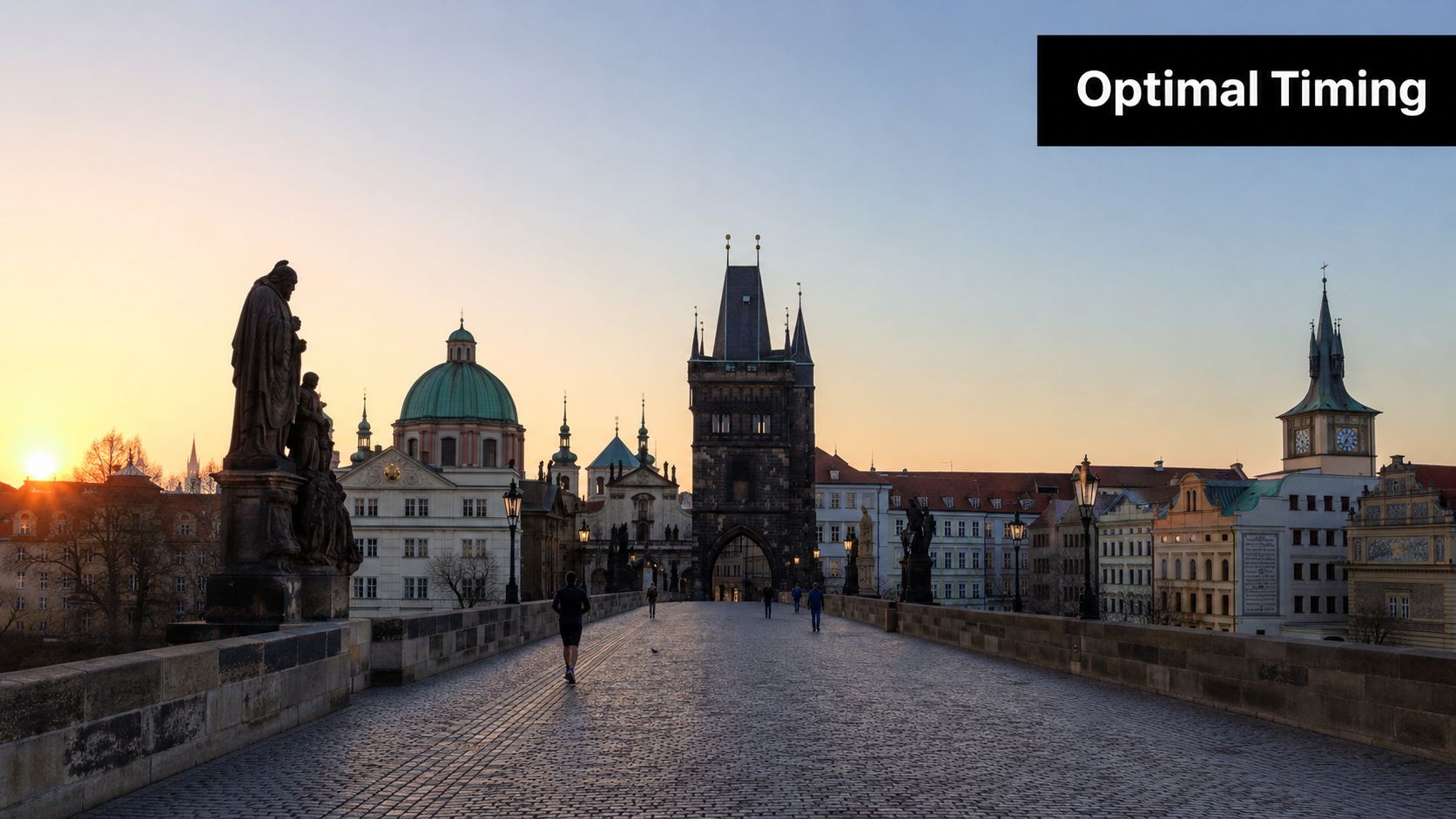
A useful corrective comes from Fora's guide to touring Prague, Budapest, and Vienna, which notes that tour content often ignores when these cities become less enjoyable because of crowding, and that shoulder seasons are a superior luxury option.
Why shoulder season wins
If your priority is access, not just weather, aim for the shoulder periods. You'll usually get a more composed city experience, a more responsive service environment, and a better chance at the specific rooms and reservations that matter.
That means:
- Less crowd compression around the obvious monuments
- More comfortable walking conditions for city-based days
- Stronger dining flexibility at places that are harder to secure in peak periods
- A calmer visual experience in districts that lose charm when overrun
The luxury advantage of timing isn't abstract. It affects whether your expensive trip feels exclusive or merely expensive.
The months I'd recommend first
I'd prioritize late spring and early autumn over high summer for most clients. The cities feel more balanced then. You're far more likely to enjoy long walks, terrace lunches, and evening programs without the city fighting back.
If weather is central to your decision-making, this Europe-in-May luxury travel guide is a useful companion read for understanding why spring can work so well for this style of itinerary.
Handle seasonal events carefully
Not every festive period improves the experience. Some events add atmosphere. Others add noise, inflated rates, and booking pressure.
A smart approach is to decide what kind of energy you want:
1. Cultured and polished: Better around performance calendars and refined city life.
2. Festive and atmospheric: Better if you enjoy seasonal ambiance and don't mind denser public spaces.
3. Quiet and elegant: Better in shoulder windows when cities are active but not overwhelmed.
Summer is popular because it's easy to default to, not because it's the most sophisticated choice.
Timing changes what luxury means
Luxury in these cities isn't just a larger suite or a harder-to-book table. It's whether you can move through Prague, Vienna, and Budapest without feeling like you've joined a public procession.
That's why timing is strategy, not a footnote.
The Haute Black Rolodex VIP Hotels and Dining
Hotels determine your energy. Dining determines your memory. In a route like this, both need to be chosen with more intent than “best address in the city.”
Start with hotel philosophy. In Prague, a river-facing or Old Town-adjacent property can be wonderful, but only if it also gives you a sense of retreat. In Vienna, location matters less than service precision and the ability to move easily between cultural districts. In Budapest, views can be spectacular, but they shouldn't come at the expense of calm, privacy, and polished arrivals.
How to choose the right hotel in each city
Specific names matter, and so does fit. In this trio, properties like Four Seasons Prague, Rosewood Vienna, and Four Seasons Gresham Palace Budapest are obvious for a reason. They pair strong service culture with prime urban positioning and the kind of room inventory that can materially improve the trip when booked well.
But the smartest booking strategy isn't just choosing the right brand. It's choosing the right room category, the right arrival notes, the right stay sequence, and the right property personality for the traveler in front of you.
A few rules I use:
- Prague needs atmosphere: Prioritize quiet elegance over buzz.
- Vienna needs refinement: Choose the property that matches your cultural agenda and preferred neighborhood rhythm.
- Budapest needs vantage and service: The city rewards strong visual positioning, but only when the service level keeps pace.
The best hotel isn't the one everyone recognizes first. It's the one that supports the way you actually travel.
Dining should be programmed, not improvised
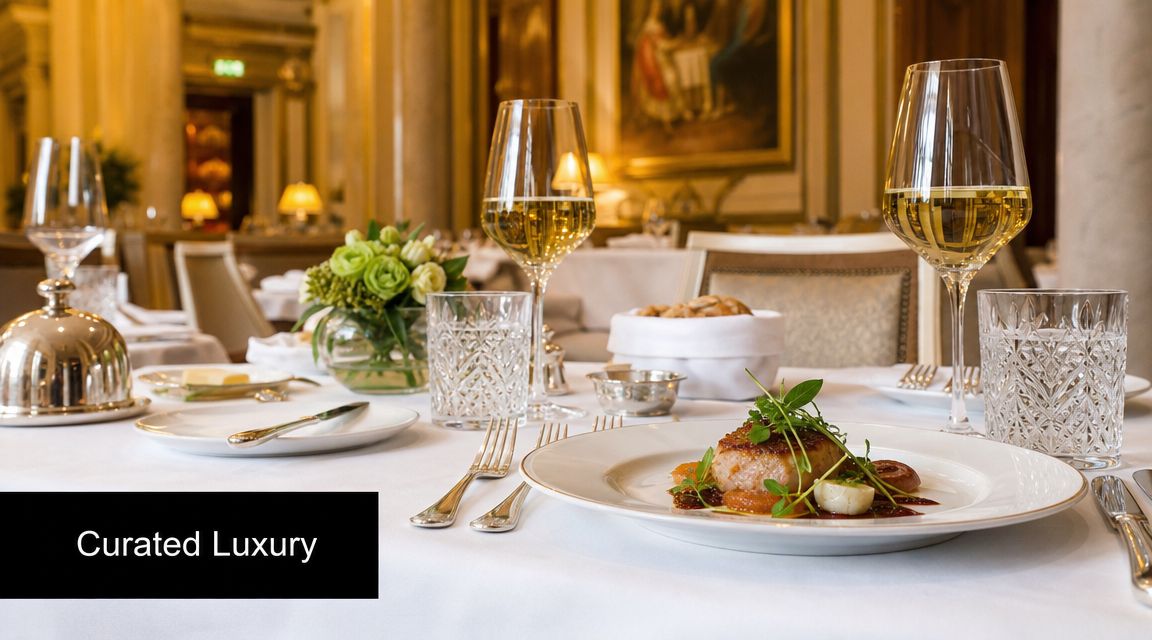
Most travelers over-rely on lists. Fine dining in these cities works better when the dining plan reflects the mood of each stop. One evening should be ceremonious. Another should be local and relaxed. Another should be driven by setting rather than prestige alone.
That can mean a formal tasting menu one night and a private wine-led dinner the next. It can mean a pastry-focused afternoon in Vienna, a refined river-view dinner in Budapest, or a tucked-away Prague table where the room matters as much as the menu.
If you like comparing hotel-and-dining destination strategy across very different regions, this guide to best Pacific Coast Highway accommodation is a surprisingly useful contrast in how setting, pace, and overnight choices shape the entire feel of a luxury route.
The details that separate a strong booking from a forgettable one
Hotel and restaurant access isn't just about getting a reservation. It's about context.
Consider the difference between:
| Booking Layer | Standard Outcome | Better Outcome |
|---|---|---|
| Hotel arrival | Generic check-in | Recognized arrival with preference notes already in place |
| Room selection | Category only | Specific room logic based on light, views, noise, and layout |
| Dining reservation | Table secured | Table timed and positioned around the day's energy |
| Concierge support | Reactive suggestions | Proactive orchestration with cultural and logistical alignment |
A city like Vienna especially rewards this kind of planning because the day can pivot from museum to shopping to concert with almost no wasted movement if the groundwork is right.
For a sense of destination atmosphere and visual reference, this short clip captures the kind of polished urban mood many travelers are after:
What to prioritize if you only upgrade a few things
If budget isn't the issue but discernment is, I'd put the emphasis here:
1. Upgrade the hotel room before adding more activities.
2. Secure one standout dining experience per city instead of overbooking meals.
3. Book private guiding selectively, where context changes the experience.
4. Protect evenings. Don't pack them all with obligations.
That's how the trip keeps its shape. You don't remember a luxury journey because every hour was full. You remember it because the best hours were handled exceptionally well.
The Seamless Journey Orchestrated by Haute Black
The difference between a good Central Europe trip and an exceptional one is coordination. Not glamour. Not even budget. Coordination.
Prague, Vienna, and Budapest are easy to misunderstand because they look simple on a map. In practice, the trip only works at a high level when the pacing is disciplined, the routing is intentional, the transfer days are designed properly, the travel window is chosen with crowd pressure in mind, and the hotels and dining are selected to support the exact kind of traveler taking the trip.
That's why the best Prague Budapest Vienna tours rarely look dramatic on paper. They look clean. They move well. They leave margin in the right places. They feel calm from the moment you land to the final departure.
A discerning traveler doesn't need more options. They need better judgment applied to the options that matter. Which city comes first. Which arrival time protects the first evening. Which suite category is worth paying for. Which transfer should be by rail and which should be by car. Which nights deserve cultural programming and which should be left open.
That level of orchestration is what turns a popular route into a private-feeling experience.
If you want your Prague, Vienna, and Budapest journey handled with that level of precision, speak with Haute Black. Their advisors design high-touch Central Europe itineraries around pacing, access, preferred hotel partnerships, private aviation, and smooth ground execution, so your trip feels composed from the first booking to the final arrival.
Explore Our Guides


Signature Experiences


