Haute Black Journal
Is It Cheaper to Go Through a Travel Agent in 2026

Marlene Azeez
Director, HauteBlack
View all articles →

For simple, standardized trips, a travel agent is almost never cheaper on the headline price, and fees alone can run from $30 to $150+ depending on the booking and planning scope. But for complex, premium, or international itineraries, the total value can swing the other way fast. Consumers in one trade study said agents saved them an average of $452 per trip and about four hours of planning time, while negotiated booking channels have also shown lower room rates in some cases.
Most advice on this topic is too simplistic. “Always book direct” is lazy advice. “Use an agent and save money” is also lazy advice. If you're asking is it cheaper to go through a travel agent, the honest answer is that you're asking the wrong version of the question.
Affluent travelers shouldn't measure this only by the first number on the checkout page. You should measure it the way you'd assess any serious purchase: total outlay, what you receive, what could go wrong, and who fixes it when it does.
Why Cheaper Is the Wrong Question
The cheapest trip on paper is often the more expensive trip in practice.
A lower hotel rate means very little if you end up in the worst room category, miss breakfast, lose flexibility, spend hours comparing options, or have nobody to call when an airline disruption blows up your arrival. For mass-market travel, that trade may be acceptable. For luxury travel, it usually isn't.
Think like a CFO, not a bargain hunter
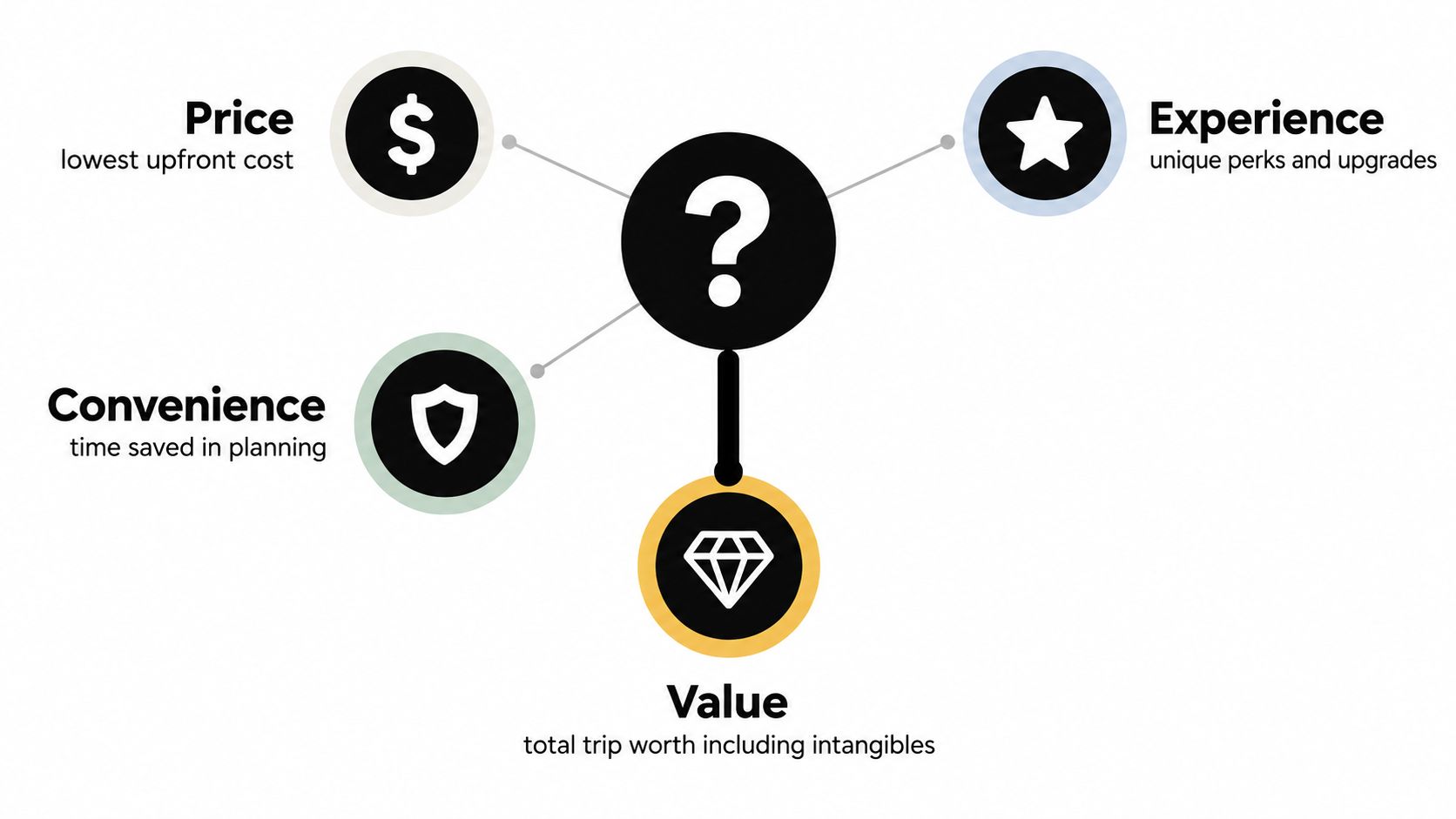
I look at trip value through four lenses:
- Base cost: What the room, flight, cruise, or villa costs.
- Fees and commissions: What the advisor charges you, if anything, and where supplier compensation sits.
- Perks and experience: Upgrades, credits, breakfast, late checkout, priority status, and recognition.
- Risk mitigation: Rebooking help, problem-solving, and protecting the trip when logistics start breaking.
That framework matters because sticker price hides real costs. One consumer benchmark noted that agencies may still receive hotel commissions of roughly 5% to 10% on some bookings, while client service fees can range from $30 to $150+, meaning the total booking cost can exceed self-booking when the base hotel rate is unchanged (Checkbook travel agency pricing guidance).
Why affluent travelers get tripped up
Many high-net-worth travelers still compare travel buying like they're shopping for printer paper. Lowest visible price wins. That works for a one-night airport hotel. It fails for a honeymoon at an Aman resort, a family villa transfer chain in Italy, or a business-class international itinerary with multiple fare rules.
Practical rule: If two bookings cost the same, the better booking is the one with stronger terms, more inclusions, and a human advocate attached to it.
Here's the part that surprises people. Sometimes DIY is plainly better. Sometimes an advisor wins without changing the headline rate at all. The value can sit in breakfast, room priority, flexibility, or not wasting your Saturday night trying to untangle airline schedule changes across three apps.
How Travel Agents Actually Get Paid Now
The old model is gone. That's why so many travelers are confused.
Historically, travel agents were often paid by airline commissions rather than by travelers, which meant booking through an agent wasn't necessarily more expensive to the customer. In the U.S., average commission rates on tickets processed through the industry settlement plan rose from 8.3% in 1978 to 9.6% in 1981, and industry sources note commissions were generally around 10% through much of the 1980s and early 1990s. Then the model changed sharply. Delta capped domestic commissions at $50 per ticket in February 1995, airline payments to agencies fell 57% from $370 million to $159 million between 1999 and 2002, and by 2005 the official position of all U.S. and most foreign carriers was that they paid no commissions at all (airline commission history and collapse).
What replaced the old airline model
Today, most advisors are paid in one of two ways:
| Modern Travel Agent Compensation Models | Typical Range | Paid By | Common In |
|---|---|---|---|
| Supplier commission | Qualitative, varies by supplier | Hotel, cruise line, tour operator | Hotels, cruises, packaged travel |
| Ticketing or service fee | $30 to $50 domestic flight | Client | Air-only bookings |
| Ticketing or service fee | $30 to $100 international flight | Client | International air bookings |
| Cruise booking fee | $0 to $150 | Client or none | Cruise planning |
| Research and planning fee | $75 to $150 per hour | Client | Complex custom itineraries |
Those fee ranges come from independent consumer guidance summarized in this HauteBlack article on travel agent service fees, which cites Checkbook's fee examples.
Why fees aren't a red flag
A fee doesn't mean you're overpaying. It usually means the advisor is charging for design, access, and execution instead of pretending the work is free.
For affluent travelers, that's often healthier. It aligns the relationship around strategy and accountability, not around chasing whichever supplier happens to pay the highest commission. It also explains why strong on-the-ground operators invest in building travel agent partnerships. The best experiences often come from a chain of trusted local suppliers, not from a generic booking engine.
If an advisor won't explain how they're paid, keep looking. Transparent compensation is part of competent luxury service.
Travel Agent Versus DIY Booking Side by Side
DIY booking wins on apparent simplicity. It loses once the trip gets layered.
You open Google Flights, an airline app, a hotel site, maybe an online travel agency, maybe a credit card portal. Each screen looks efficient in isolation. The trip as a whole usually isn't.
The side-by-side reality
| Travel Agent vs DIY Booking at a Glance | Travel Agent | DIY / OTA Booking |
|---|---|---|
| Base price | Often same public rate, sometimes access to negotiated inventory | Often lowest visible public rate |
| Traveler-paid fees | May include service or planning fees | Usually no advisor fee, but time cost is yours |
| Time investment | Outsourced research and booking management | You handle search, comparison, and coordination |
| Disruption handling | Human advocate can step in | You deal with airline, hotel, or OTA yourself |
| Perks and upgrades | May include breakfast, credits, late checkout, and priority requests | Usually limited to published inclusions |
| Booking cohesion | One party sees the whole trip | Trip often split across multiple platforms |
Where DIY looks better than it is
For a simple round-trip economy ticket and a chain hotel for two nights, DIY often is cheaper and faster. I'd book that myself too.
But luxury clients rarely travel that way. They want the right room, not just a room. They care whether a connecting room request is noted, whether the transfer company knows their inbound tail number, whether the hotel GM sees an anniversary arrival, and whether the booking sits inside a preferred-partner channel that flags the stay properly.
A well-run advisor booking also solves a coordination problem. Flights, hotels, transfers, touring, dining, and backup plans live in one strategy rather than six confirmation emails.
Why support matters more than people think
When flights cancel or hotels oversell, the weakest booking structure gets exposed first. Travelers who book piecemeal often discover there is no single owner of the problem.
A useful outside read on that trade-off is this Involuntary reroute agent guide, which gets into what happens when disruption handling becomes the product.
DIY works best when the trip is disposable. Advisor support matters most when the trip is important.
What the Pricing Evidence Actually Shows
The evidence is mixed. That's exactly why blanket advice is unreliable.
A 2023 Which? investigation found that booking the same holidays through high-street travel agents could cost more than booking directly online. A couple could have saved an average of £252 on a one-week Spain holiday and £162 on a two-week Dominican Republic holiday by booking online instead (Which? holiday price comparison).
That is the cleanest proof that agents are not automatically cheaper. For standardized package holidays, they often aren't.
The strongest case for intermediaries
The strongest measurable savings case isn't “agents are cheaper.” It's that certain booking channels can access better inventory. Independent industry analysis found hotel prices booked through an online intermediary were, on average, $18.43 per night cheaper across 90 quotes in 10 global destinations, and the cheapest four-star hotel rate studied was 31% below the hotel-direct price (online intermediary hotel rate analysis).
That matters because negotiated or net inventory can beat direct booking on room rate alone. It doesn't prove every advisor booking will be cheaper. It proves booking channel matters.
The practical reading of the data
| Pricing Evidence at a Glance | DIY/OTA Average | Agent Average | Evidence Source |
|---|---|---|---|
| Standard package holiday | Lower in the Which? comparison | Higher in the Which? comparison | Which? |
| Consumer-reported trip savings | Not stated | $452 per trip plus about 4 hours saved | Which? reporting on ASTA findings |
| Hotel room rate through intermediary | Hotel-direct can be higher | Intermediary averaged $18.43 less per night in the study | Self.inc |
| Travel agent service costs | Self-booking avoids advisor fee | Fees can be $30 to $150+ depending on scope | Checkbook |
The verdict is straightforward. DIY often wins for commoditized travel. An advisor can win when they control a better booking channel, package the trip more intelligently, or prevent expensive errors.
Real-World Scenarios Where the Math Changes
Luxury travel decisions don't happen in spreadsheets alone. They happen in context.
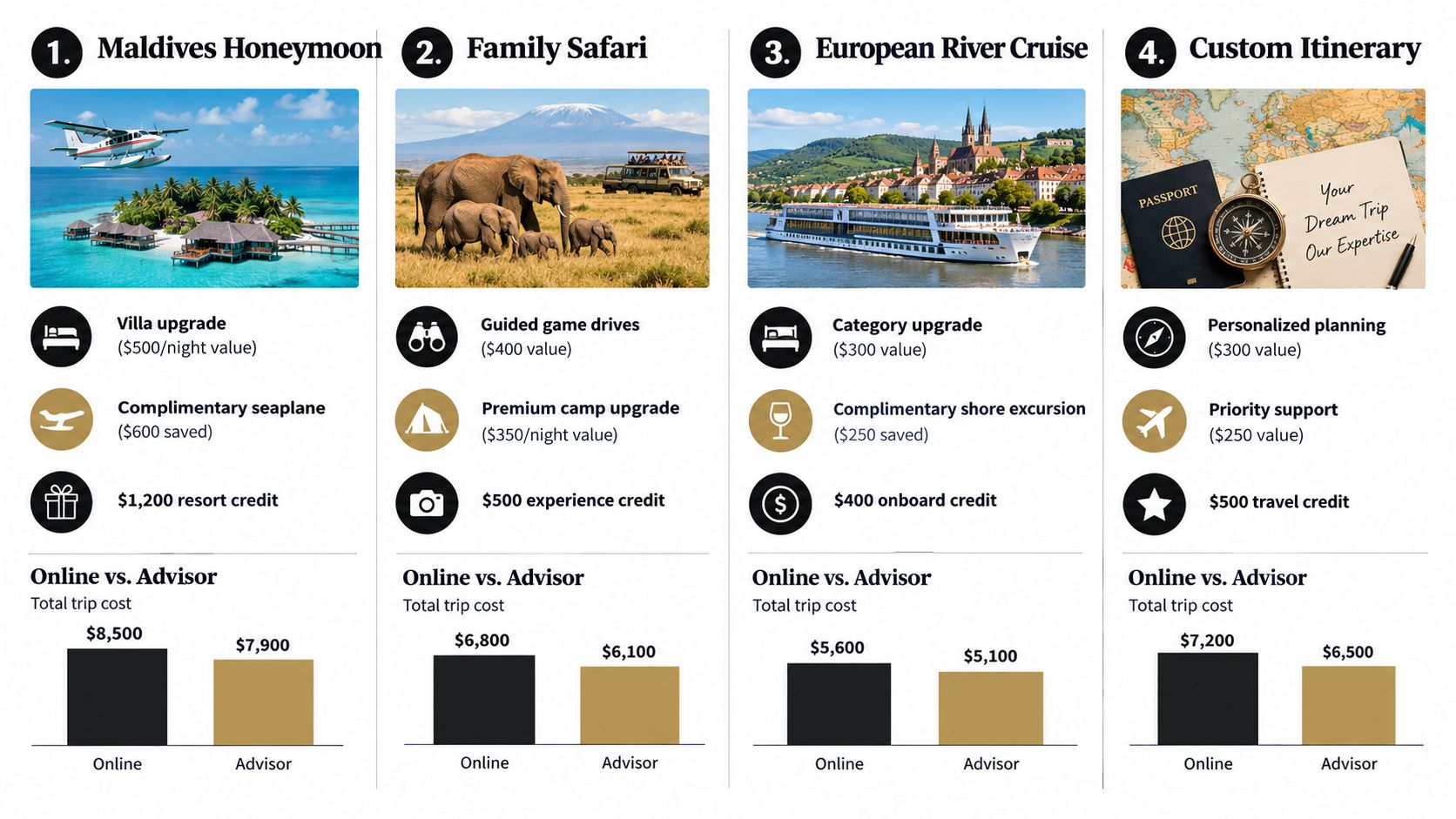
The patterns are predictable even when every itinerary is custom. Simple trip, simple answer. Complex trip, very different answer.
Honeymoon and milestone travel
A honeymoon is where “cheapest” usually becomes self-sabotage. The room category matters. Arrival experience matters. So do backup plans if weather or missed connections interfere with the opening days.
An advisor may not beat the public headline rate on the hotel. But they can improve the booking conditions, attach partner amenities, and make sure the property sees the stay as a priority arrival rather than as another anonymous reservation. For a couple spending heavily on a once-in-a-decade trip, that can be the difference between buying a room and buying an experience.
Premium air and international complexity
Long-haul business-class and multi-city international itineraries are another category where sticker-price logic breaks down. Search results and trade reporting point to a split in the market. Online booking is often cheaper for simple trips, while advisors can sometimes access consolidator fares, unpublished airfares, or private negotiated rates on premium cabins and complex routings. Reporting also shows professional fees are now mainstream, with surveys indicating 55% to 56% of agencies or advisors charging fees, while another recent industry piece reported 44% of agencies charging fees in a 2024 survey (industry discussion of fees and premium fare access).
That doesn't mean every premium ticket is cheaper through an advisor. It means this is one of the few areas where checking with a serious advisor is worth the effort.
A short explanation helps more than another paragraph.
Family logistics and villa travel
For multigenerational travel, private villas, or destination-heavy itineraries, the value often sits in coordination. Transfers, local timing, dining holds, rooming lists, and special requests all need a single owner.
That's one reason some clients use agencies such as HauteBlack for itinerary design and preferred-partner hotel bookings while still choosing to book certain flights directly. On the right trip, splitting the booking strategy is smarter than pretending one channel should handle everything.
The Hidden Value Most Comparisons Miss
The average consumer comparison misses the part that wealthy travelers care about most. Friction.
Nobody buying a serious trip wants to become their own call center at midnight when a connection is canceled, a transfer no-shows, or a hotel suddenly claims the suite category is unavailable. The financial cost is one issue. The loss of control is the bigger one.
What doesn't show on the invoice
The hidden value usually lives in five places:
- Time protection: Busy travelers don't need another research project.
- Escalation power: Advisors know who to call when frontline support stalls.
- Priority handling: Preferred-partner and relationship-based bookings often get more attention.
- Booking coherence: One person sees the full chain of dependencies.
- Emotional bandwidth: Someone else owns the problem while you keep moving.
This matters more in luxury than in mass travel because the trip itself is more layered. You're not just protecting a fare. You're protecting dining reservations, chauffeured transfers, occasion notes, deposit structures, and limited-availability accommodations.
Why network access changes outcomes
A good luxury advisor isn't valuable because they can type faster than you can. They're valuable because they operate inside a network of preferred sales managers, destination teams, and property contacts. That's the logic behind how a luxury travel network works.
The advisor's product isn't a reservation. It's leverage.
When people ask me if it's cheaper to go through a travel agent, they usually mean “Will I pay less today?” The sharper question is “Will I come out ahead by the time the trip is over?” For meaningful travel, that's the only question worth asking.
When an Advisor Pays for Itself
Here is the blunt answer.
An advisor pays for itself when the trip has enough complexity, cost, or emotional importance that one mistake is more expensive than the planning fee.
Use an advisor when these conditions apply
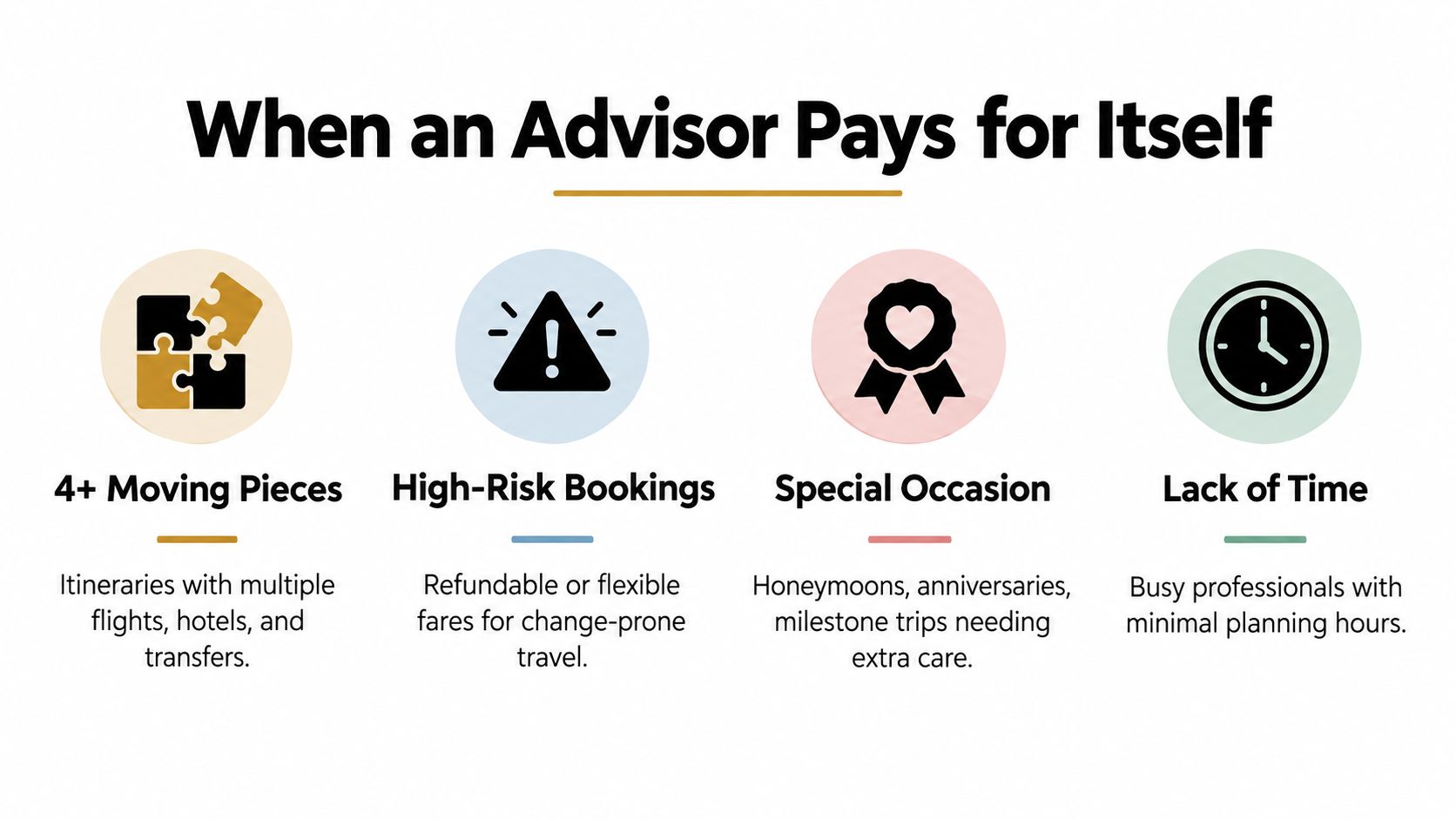
- Four or more moving pieces: Multi-city, multi-country, cruise plus pre- and post-hotel, or anything with private transfers and timing dependencies.
- Higher-spend travel: When you're spending roughly $15,000 per person or more, protecting the outcome matters more than trimming a small visible fee.
- Peak-demand dates: Festive season, school holidays, major events, and periods when room categories and upgrades are scarce.
- Meaningful trip risk: Remote destinations, visa-sensitive itineraries, accessibility needs, milestone celebrations, or elderly family travelers.
Book it yourself when the trip is simple
DIY almost always wins on cost and speed for a point-to-point economy flight, a single-brand hotel stay under three nights, or a last-minute domestic road trip. Don't overcomplicate those.
If you enjoy travel research and the downside of a mistake is small, self-booking is rational. If the trip matters, or failure would be expensive, get help.
My rule of thumb
Below $1,500 per person, DIY is usually the right starting point.
Above that line, call an advisor.
That doesn't mean surrender every booking. It means applying the right level of planning to the importance of the trip. For luxury clients, the advisor fee, when there is one, is usually small compared with the value of better rooms, smarter routing, stronger support, and fewer preventable mistakes.
Common Questions From Affluent Travelers
Do travel agents charge a fee for international or first-class flights?
Sometimes. Many advisors are paid by supplier commission on broader trips, but air-only work often carries a service fee. Confirm the fee in writing before anything is ticketed.
Why can an advisor sometimes beat an online price?
Because not every booking channel has the same inventory or the same bundled value. An advisor may have access to preferred-partner rates, agency-only promotions, or a better room category outcome than the public booking path.
Will I pay more for the same hotel if I use an advisor?
Not necessarily. In many luxury hotel cases, the rate is the same as the public flexible rate, but the advisor layers in benefits. If a lower prepaid public rate exists, a good advisor should tell you that plainly.
How do I verify preferred-partner status?
Ask which network or direct partner program the advisor books through, and ask exactly what amenities attach to your reservation. If you're comparing firms, this guide on what a VIP travel agency is and how to choose one is a useful filter.
What if my advisor is unavailable mid-trip?
Serious agencies have backup coverage, an on-call structure, or a designated teammate who can step in. Ask that question before you book, not during a disruption.
Do advisor bookings still earn hotel points and airline miles?
Often yes, but it depends on the rate type and supplier rules. A competent advisor will tell you where loyalty earnings apply and where a special rate trades off against points.
Can I split the booking and only use an advisor for part of the trip?
Absolutely. That's often the smartest move. Many travelers book hotels, cruises, villas, and complex ground arrangements through an advisor while handling simple flights directly.
HauteBlack arranges bespoke itineraries, preferred-partner hotel bookings, VIP recognition, and high-touch trip support for travelers who care about the outcome more than the checkout-page illusion. If your trip is expensive, layered, or important enough that mistakes would cost you more than a planning fee, visit HauteBlack and book it with the right level of expertise.
Explore Our Guides


Signature Experiences