Haute Black Journal
How to Plan a Family Vacation That Actually Works

Marlene Azeez
Director, HauteBlack
View all articles →
You may be trying to pin down a family trip while everyone has different dates, ideas, and definitions of a relaxing holiday. The destination is often the easy part. The work is making the room setup, travel days, budget, meals, and pace function for the people who are going.
After coordinating multigenerational trips, I've learned that a beautiful property can't rescue a plan built in the wrong order. Start with constraints and priorities, then choose the destination and the rooms. That's how to plan a family vacation that still works after the welcome drinks and the brochure-perfect arrival.
Why Most Family Trips Fall Apart Before They Start
A family can arrive at a beautiful resort and discover that the grandparents are exhausted from the journey, the toddler's room is a long walk from the kids club, and the suites described as "connected" aren't adjoining. Then the one dinner everyone agreed to falls on the night the private chef is unavailable. None of these problems is about choosing the wrong destination. They're coordination failures that could have been caught before anyone booked.

Family travel has competing demands even before the first flight is booked. In the 2025 U.S. Family Travel Association survey, 73% of respondents called affordability the most difficult planning factor, up from 59% in 2023; 51% faced school-break timing constraints, and 40% struggled to find activities everyone would enjoy (survey findings). For a large family, those pressures meet practical questions about rooms, transport, privacy, food, and how much activity people can manage.
Treat the trip as a coordinated system
A family vacation works like an operating system: the parts have to fit together. A room can be luxurious and still be wrong if it forces an older relative to cross a large property for breakfast. A private transfer can be comfortable but poorly timed if the children have to wait hours for their rooms after an overnight flight.
So don't start with a destination list. Start by collecting everyone's fixed constraints, then agree on what the trip should deliver. Only after that should you compare places and properties. The sequence matters because it filters out appealing options that won't work for your actual group.
The test isn't whether a property looks right online. It's whether the family can use it comfortably, together and separately.
This approach is particularly important when several households are traveling. Parents may want downtime, grandparents may need easy access and a predictable pace, and children may have strong opinions about what makes a holiday fun. A successful trip doesn't require everyone to want the same thing. It requires a plan that acknowledges those differences before they become daily negotiations.
The Constraint-First Planning Sequence
Don't shortlist destinations until you know what the trip has to accommodate. Use this sequence to turn a crowded group conversation into clear decisions.
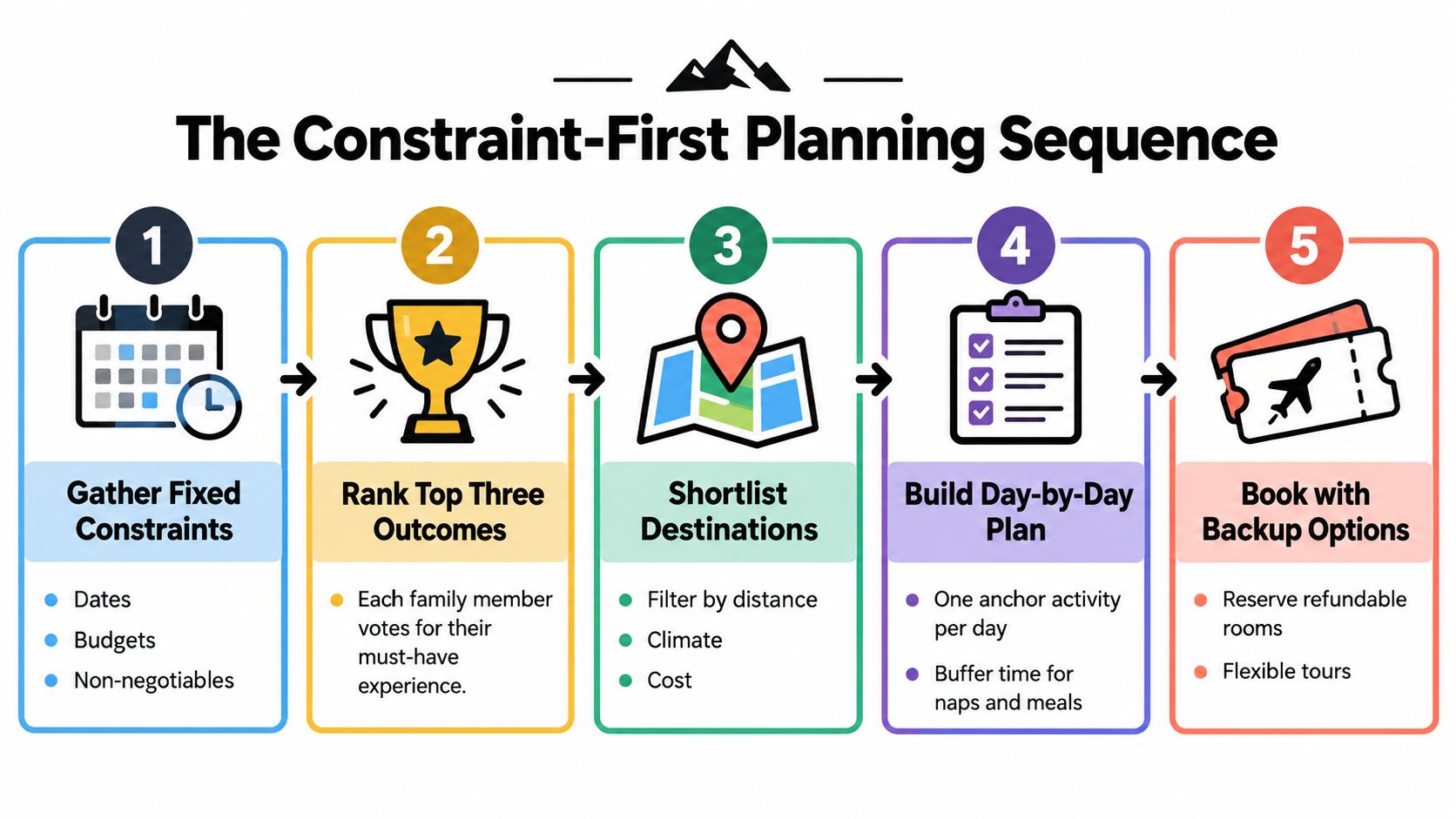
1. Gather fixed constraints. Ask every household for school calendars, passport validity, dietary and medical needs, mobility requirements, preferred sleep schedules, and the maximum door-to-door travel time they'll accept. A destination that works during one school break but not another isn't a real option.
2. Rank the group's top outcomes. Ask people to name and rank what they most want from the trip, then agree on the group's three priorities. These might be rest, cultural access, time outdoors, or time together. Don't confuse “nice to have” with something essential.
3. Shortlist only destinations that fit. Filter for the fixed constraints first, then compare the remaining choices on travel burden, climate, cost, and the experiences that matter to the group. If school calendars limit the dates, don't spend time considering destinations that require a different season.
4. Build the days around one anchor. Schedule no more than one principal activity per day for younger or mixed-age groups. A boat outing, museum visit, or nature excursion can be the day's anchor. Keep meals, naps, pool time, and unplanned hours flexible around it.
5. Keep recovery capacity. Prefer cancellation-compatible reservations where possible. Leave room to change the plan when a child is overtired, an older relative needs rest, or weather disrupts an outing.
Match the process to the occasion
| Planning decision | Regular school break | Milestone celebration |
|---|---|---|
| First filter | School dates, travel time, and group needs | Attendees, celebration dates, and must-have experiences |
| Destination test | Does it fit the group's practical constraints? | Can it support the gathering and still offer downtime? |
| Schedule | One anchor outing a day, with open time | One celebration anchor, plus flexible time around it |
| Reservations | Compare options early and protect core bookings | Start earlier if the group needs specific rooms, access, or coordinated services |
A two-stage booking window gives the planning a practical rhythm. The 2025 U.S. Family Travel Association survey found that 35% of respondents most commonly booked two or three months before departure, while another 31% booked four to six months in advance. The same survey found 63% had taken a summer vacation during the previous year (survey report). Begin comparing dates, flights, accommodation, and activities at least four to six months before travel, then aim to secure core reservations around two to three months out. Start earlier for peak periods, villas, adjoining rooms, accessible inventory, and trips that require several households to align.
Use the sequence for every trip, but widen the planning runway when the group or the room requirements are more complex.
Building a Total-Trip Budget That Actually Holds
A headline room rate is not a family-trip budget. Price the trip as a whole, and separate costs that are largely fixed from those that change with the length of stay, party size, or daily choices.
Fixed costs usually include flights, accommodation, and planned private transfers. Variable costs include meals, activities, gratuities, resort fees, taxes, and child-related charges. Add insurance and a contingency reserve as their own lines. Keep the reserve separate from the spending budget so a weather delay or unexpected transfer doesn't force a family to cut an experience they care about.
For multigenerational travel, don't assume one person or household will pay for everything. One family might fund a shared villa while adult children cover their flights. Another might split accommodation evenly but have grandparents pay for a special outing. Agree on the contribution method before booking, and price by household and by experience so everyone understands what they're committing to. A practical way to work through shared expenses is to browse the item-by-item bill splitter, particularly when some costs benefit only part of the group.
Compare the cost structure, not just the rate
The table below shows what to examine for a hypothetical eight-person, eight-night trip. It's a comparison framework, not a quote: actual inclusions depend on the property and booking terms.
| Cost Line | All-Inclusive Resort | Private Villa + Staff | Residence Club + Experiences |
|---|---|---|---|
| Accommodation | Room or suite rate, plus any excluded fees | Villa rental, staffing, and property charges | Residence rate and any club fees |
| Meals | Often bundled, but check what and where | Groceries, chef, and meals out | Mix of in-residence meals and dining out |
| Activities | Some may be included; confirm which | Usually arranged and priced separately | Often selected à la carte |
| Transport | Transfers may be extra | Transfers and local travel are separate lines | Property transfers and excursions may vary |
| Best budget question | What's genuinely included? | Which services need separate staffing or booking? | What does the base rate include, and what's an add-on? |
Don't compare these options by the first number you see. Compare the complete cost, including meals, transfers, taxes, service charges, cancellation exposure, and the time required to coordinate each setup. A lower nightly rate can become the more expensive choice when you add services the family assumed were included.
Set the budget before browsing. Then decide what the trip is meant to deliver and spend accordingly: a private transfer may be more valuable than an extra excursion, especially when it removes a stressful travel leg for children or older relatives.
Rooming and Accommodation Configuration
Room configuration can make or break a multigenerational trip. Choose a setup based on how the group sleeps, gathers, and moves through the property, not on a room category's name.
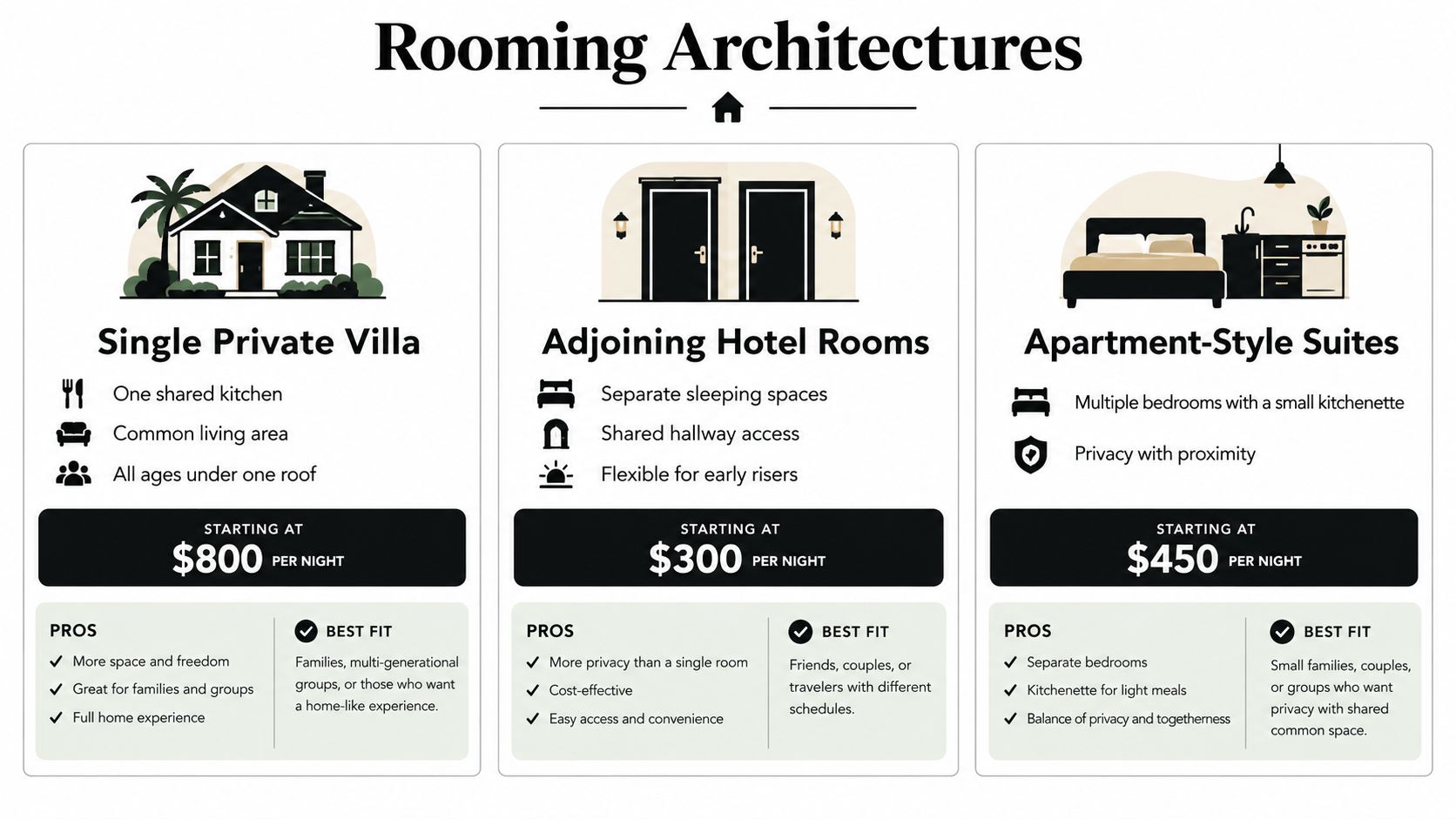
| Rooming architecture | When it works | Verify before booking |
|---|---|---|
| Single private villa or estate | The group wants a shared kitchen and living area, privacy, and space to gather without hotel corridors | Exact bed setup, bathroom count, outdoor access, staffing, and whether the dining area seats everyone |
| Interconnecting hotel suites | Households want hotel service with private sleeping spaces close together | Confirm the rooms physically connect, check bed types, and ask about distances to dining, pools, and kids facilities |
| Primary residence plus nearby rooms | Some people want a shared base while others need a separate sleep schedule or more privacy | Confirm walking distance, access arrangements, and whether the secondary rooms are in the same property |
For a beach trip, a beach estate can make practical sense: parents can reach sand and shade easily, children can move naturally between the house and the beach, and grandparents can avoid long jetties. If older children are confident swimmers, you might change the feel of the stay mid-trip by moving to a multibedroom overwater residence. That only works if the transition itself suits the family, so check what the move involves before treating it as a simple upgrade.
A property's photographs won't tell you whether the kitchen table seats the whole group or whether the grandparents' room is up a flight of stairs. Confirm bed types, bathroom count, door-to-door distances inside the property, outdoor space, and the kitchen and dining setup directly with the property. If your search includes a different style of stay, you can also compare Caddo Lake campsites to see how a simpler base changes the group's needs.
Book the home base before filling the calendar
Book the residence first. Then arrange childcare or a dinner sitter before arrival, and plan to handle breakfast and at least two dinners in-house. Those decisions cut down daily transfers and give the family a reliable option when energy runs low. HauteBlack's guide to luxury villa rentals offers another lens on choosing a private base for a group.
HauteBlack's family-travel guidance also recommends securing the residence, arranging childcare or a dinner sitter ahead of time, and bringing key meals in-house to suit different ages and energy levels (family travel concierge guide). A beautiful house becomes a workable family base when its layout and services match the way the group will live.
Accessibility as an Engineered Verification Protocol
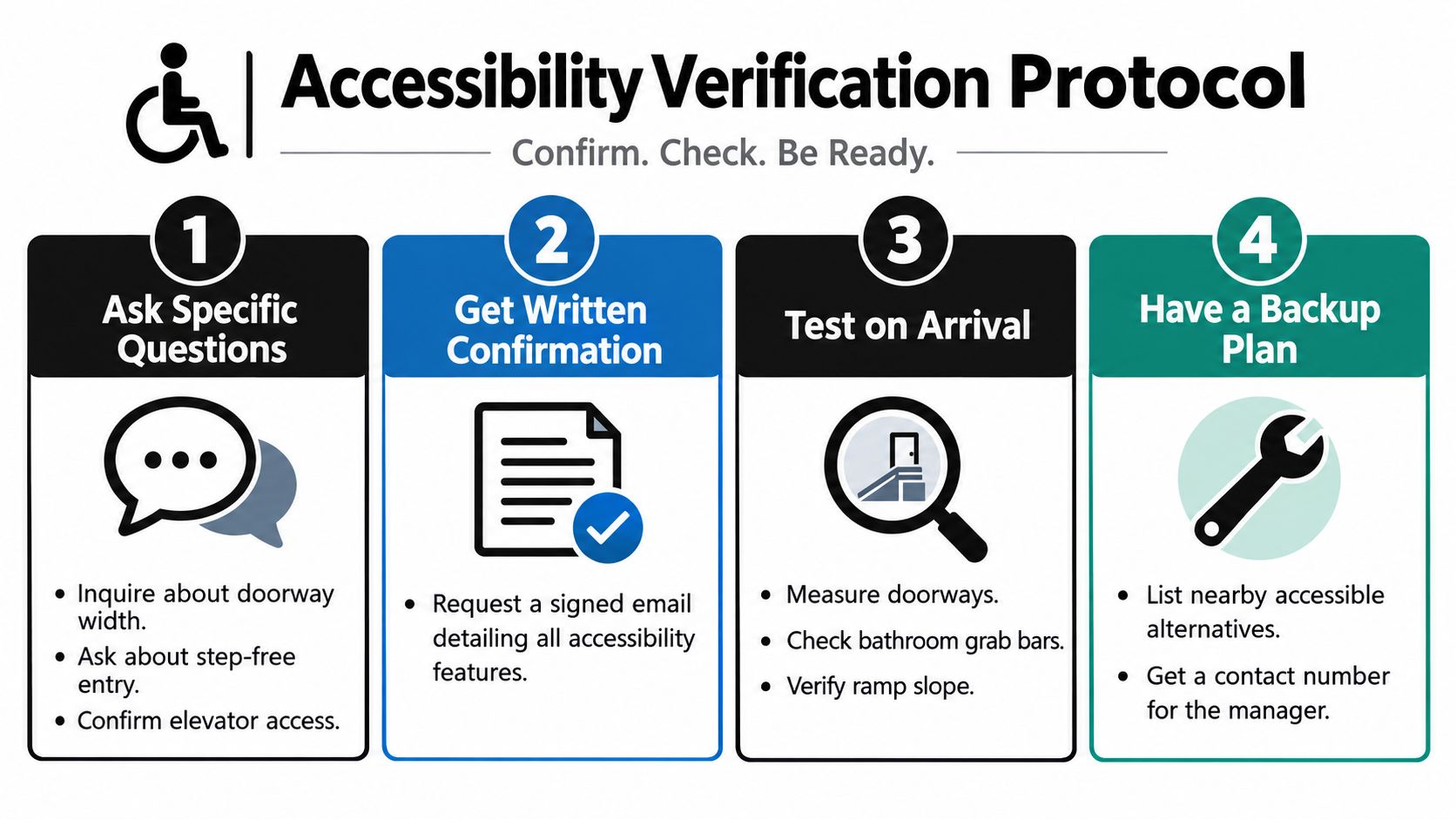
A premium property isn't automatically usable for every traveler. Accessibility has to be verified across the whole itinerary, from the airport and transfer to the room, restaurant, and activity. Treat it as a written protocol, not a single question asked at booking.
The need is broader than wheelchair access. More than 13% of families reported having children with special needs, and those families rated travel-industry inclusivity at C−. Among families planning multigenerational trips, 55% said at least one traveler needed an accommodation, and 78% said they'd pay more for accessible travel (survey on family travel and accessibility). A relative recovering from surgery, a child with sensory needs, and a parent managing a chronic condition can all need different arrangements on the same trip.
Ask, confirm, test, and keep a fallback
Ask suppliers specific questions rather than relying on broad labels such as “accessible” or “family friendly.” For a hotel, confirm doorway widths, step-free routes, elevator access, bathroom configuration, and whether the room layout works for the traveler. Ask whether medication can be refrigerated. For transfers, confirm that the vehicle and boarding process suit the traveler's mobility needs. For airlines, check how assistance works from terminal entry through boarding, not only at the gate.
Get the answers in writing and share them with everyone responsible for delivering the arrangements. For sensory, dietary, and neurodivergence-related needs, specify practical requirements: a quiet dining time, low-stimulation space, suitable meal options, or a predictable route through an attraction. “Can accommodate” is not a usable confirmation. You need to know what will be in place and who will provide it.
Practical rule: Put the same written requirements in front of the hotel, airline, transfer provider, and activity operator. A single unverified handoff can break an otherwise thoughtful plan.
At arrival, check that the agreed features are present and usable. Keep a backup option and the relevant manager's contact details in the shared trip packet. Families preparing mobility needs can consult this guide for seniors and caregivers as part of their planning. Paying for a premium stay doesn't replace this verification. It makes the checks more important, because the family may be relying on several providers to deliver one connected experience.
Designing an Itinerary That Respects Every Generation
The hardest choice is often not where to go. It's how to make room for different ideas of a good holiday without turning every day into a group vote. The survey data found that 57% of families planned trips involving grandparents and children, 74% of parents involved children aged 7 to 18 in travel planning, and 40% struggled to choose a destination or activity everyone would enjoy (multigenerational travel survey findings).
Don't make constant togetherness the measure of success. Build a shared anchor into the day, then leave free time for smaller groups and individual plans. Grandparents might take a quiet morning, parents may go out alone while a sitter stays with the children, and cousins can spend time together without asking every traveler to follow the same schedule.
Use a shared anchor and protected free time
For a mixed-age group, put the most demanding outing in the morning when the family is rested. Plan pool time or a nap around midday, then choose a gentle late-afternoon option if people still have energy. Dinner can bring the group back together without requiring everyone to share every hour before it.
A beach estate is often useful when young children need easy access to sand and shade and older relatives want to avoid long walks. A city hotel may suit a group whose priority is museums, architecture, or restaurants, provided the itinerary gives people a quieter base between outings. A safari camp can offer a compelling shared experience, but the schedule and activity suitability need to be checked carefully for the children's ages and the needs of older relatives.
Give each generation a protected activity or block of time. That doesn't split the trip; it prevents one person's preferred pace from becoming everyone else's obligation. A sitter arranged in advance can let parents have an unhurried dinner, while a low-key afternoon at the property can give older relatives a genuine rest rather than a forced excursion.
Involve children in choosing from a short list of viable options, not in reopening every decision. For additional ideas that can help a family compare trip styles, browse multigenerational family vacation ideas. The plan should leave room for the people on the trip to enjoy it in different ways, then come together when it matters.
Pre-Departure Checklist and Why an Advisor Earns the Fee
Use the weeks before departure to check health, documents, and the parts of the itinerary most likely to fail under pressure. Don't leave these details until the airport.
Complete the operational checks
Four to eight weeks before travel, screen destination-specific health risks and vaccination requirements with a qualified clinician. Verify passports, visas, transit rules, and entry requirements for every traveler, including infants. Assemble a shared digital and printed packet with identity documents, insurance details, emergency contacts, prescriptions, and itinerary confirmations.
Travelers with chronic conditions should seek medical advice before departure, carry enough medication in original labeled containers, and pack it in cabin baggage rather than checked luggage. The same family-safety guidance recommends reviewing cancellation and refund policies; 49% of surveyed families said they'd pay closer attention to those terms (family vacation safety guidance). Leave a buffer between arrival and the first nonrefundable activity, and avoid tight same-day connections for children or older relatives. For road trips, service the vehicle, check roadside assistance and the weather, and pack basic emergency supplies. On international trips, keep copies of passports and return tickets separately from the originals.
A Virtuoso-affiliated advisor earns the fee when the job is more than making reservations. Coordinating adjoining rooms, accessible inventory, private transfers, in-villa staffing, and a sensible daily pace across several households takes follow-through, clear communication, and supplier verification. HauteBlack describes the role of a luxury advisor in its overview of luxury travel advisory services.
HauteBlack is a luxury travel company offering bespoke itineraries, a dedicated advisor for members, and coordination across hotels, villas, transfers, and other trip details. If your family needs a plan that accounts for rooming, access, and different generations' priorities, visit visit HauteBlack to discuss a custom family journey.
Explore Our Guides

Signature Experiences


