Haute Black Journal
Luxury Villa Rentals: The Complete UHNW Guide

Marlene Azeez
Director, HauteBlack
View all articles →

You're choosing between a polished five-star suite and a secluded estate with its own entrance, staff, pool, and rhythm. The nightly rate tells only part of the story. Once connecting rooms, private dining, transfers, security, and the cost of losing control over your schedule enter the calculation, the apparently expensive villa can become the more rational choice, particularly for families, principals, and executive groups.
The right villa isn't just larger than a hotel room. It changes how the trip operates. You arrive without a lobby, breakfast without a timetable, work without strangers nearby, and move through the day with a team that knows the difference between visible service and useful service. But that advantage exists only when the estate, staffing model, and commercial terms match the purpose of the journey.
The Evolution of Ultra-Luxury Living
A five-star hotel lobby is designed to impress on arrival. Marble, scent, flowers, discreet uniforms, and a reception desk create a controlled sense of perfection. That environment has its strengths, especially when you value immediate restaurant access, a full operational infrastructure, and the reassurance of a known brand.
A private estate makes a different promise. The driver passes through a gate, a member of the villa team greets you by name, and the first drink appears on a terrace facing the water rather than at a crowded hotel bar. Your children can swim without an audience. A principal can take a call without crossing a public corridor. The house feels less like accommodation and more like a temporary residence that has been calibrated around your preferences.

From guest to resident
That distinction matters. A hotel gives you access to a service system. A villa gives you control over a private environment, but only if the service system behind it is competent enough to remain almost invisible.
The best luxury villa rentals remove friction that hotels often manage through formal procedure. Breakfast can follow the household's schedule. A chef can adjust meals around allergies, children, training, or late arrivals. A concierge can coordinate a boat, a beach club, a birthday dinner, and a last-minute change without forcing the group to divide its attention between several hotel departments.
The useful test: If the property looks extraordinary but the operating team reacts slowly, you're renting architecture, not an ultra-luxury experience.
The market's expansion reflects this change in expectations. Private accommodation now appeals to travelers who want privacy, autonomy, and high-touch support in the same product. It also suits longer stays, multi-generational groups, and guests who treat travel as an extension of their home life rather than a sequence of hotel services.
The new definition of luxury
Gold fittings and high thread counts still have their place, but they no longer define the category. A meaningful luxury standard includes arrival privacy, dependable connectivity, staff discretion, thoughtful provisioning, and the ability to adapt the day without negotiation.
That's why the best estate decisions begin with operational questions, not aesthetic ones. Ask who will run the house, who controls the kitchen, how requests are escalated, and whether the property can support your group's actual habits. A spectacular view may secure the booking. Invisible competence earns the recommendation.
Classifying the Modern Luxury Estate
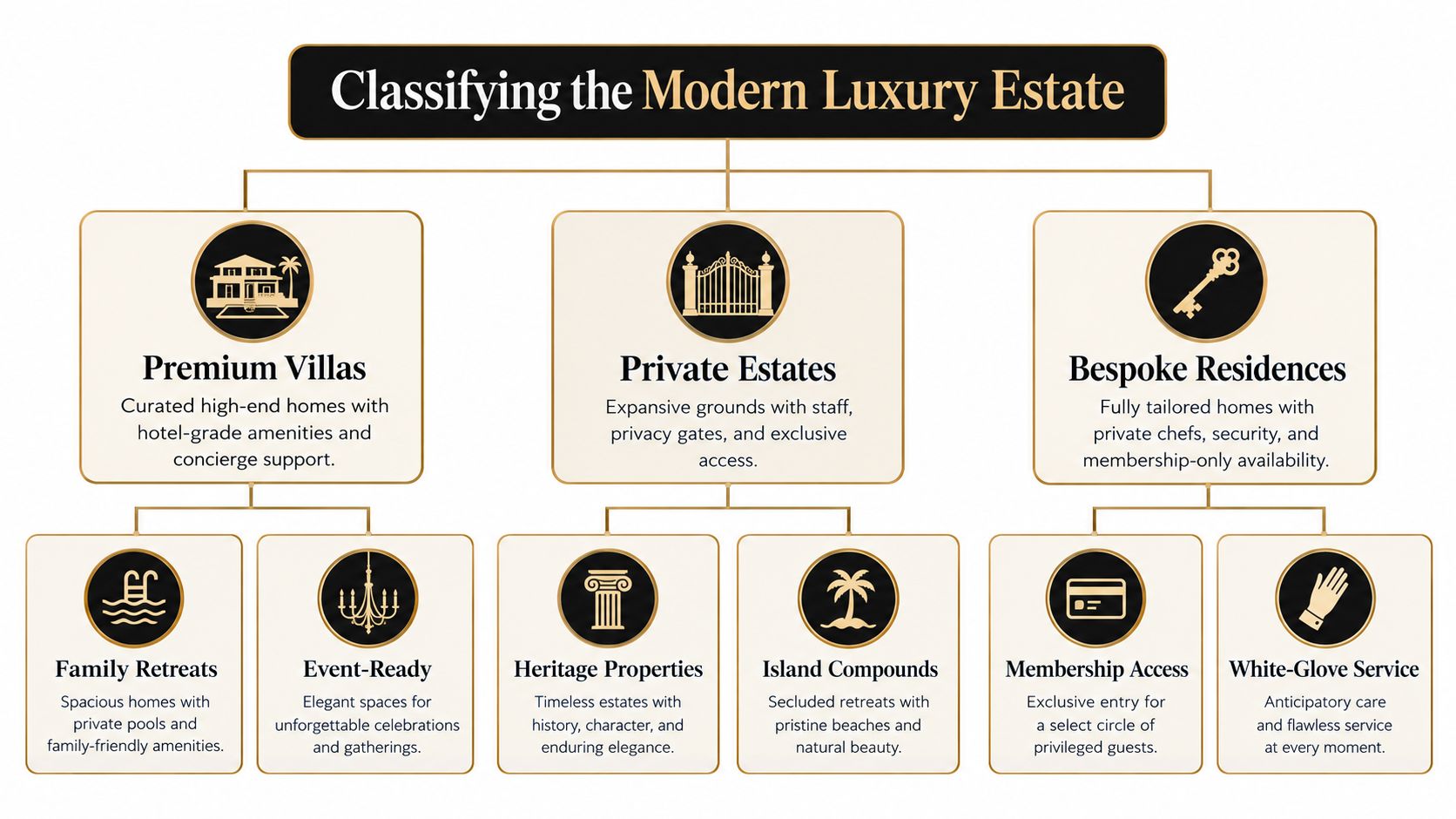
Not every private rental belongs in the same category. A premium villa may offer excellent design and a concierge contact, while a private estate provides multiple buildings, dedicated staff, security controls, and a much greater degree of separation from the surrounding destination. A bespoke residence goes further, often relying on relationships and restricted access rather than open-market availability.
The commercial scale explains why this distinction matters. The global luxury vacation rental market was estimated at USD 26.5 billion in 2024 and is forecast to reach USD 63.7 billion by 2034, implying a 9.3% compound annual growth rate over that period, according to Global Market Insights' luxury vacation rental market analysis. Luxury villas and estates represented the dominant property type, with about 49% of market share in 2024, and that segment is expected to grow at roughly 10% CAGR from 2025 to 2034 according to the same analysis.
Three estate classes
| Estate class | What you're buying | Where it works best |
|---|---|---|
| Premium villas | A curated home with strong amenities, private space, and concierge support | Couples, families, and small groups that want independence |
| Private estates | Larger grounds, more substantial staffing, privacy gates, and greater separation | Multi-generational groups, celebrations, and principals requiring discretion |
| Bespoke residences | A fully tailored environment with private chefs, security, and restricted access | High-profile travel, executive use, and clients with exacting service expectations |
Premium villas are the broadest class, but they vary sharply. One may be a beautiful family retreat with housekeeping and chef coordination. Another may be event-ready, with architectural scale and spaces designed for entertaining. The phrase “fully staffed” must always be unpacked. It can mean a housekeeper and a local contact, or it can mean a coordinated team responsible for meals, transport, wellness, maintenance, and security.
Private estates occupy a different commercial position. In the United States, which represented about 82% of the North American luxury vacation rental market and generated USD 9.6 billion in revenue in 2024, scarce villa-style inventory serves major wealth markets where privacy and high-service accommodation can command scale, as reported in Global Market Insights' market overview. Trophy assets in locations such as St. Barts, Mykonos, and Aspen command premiums because the combination of setting, architecture, access, and service cannot be replicated easily.
Scarcity sets the ceiling
A four-bedroom luxury villa typically costs roughly $7,000 to $25,000 per week in most destinations, while trophy beachfront St. Barts, cliff-edge Mykonos, and ski-in Aspen properties can reach $50,000 to $200,000 or more per week in peak season, according to Lux Getaway's comparison of luxury villa rental companies. Bedroom count is therefore a poor pricing shortcut. Location exclusivity, seasonality, staff depth, privacy features, and the service stack matter more.
For your shortlist, classify each property before comparing prices. If the estate class and your expectations don't match, no amount of attractive photography will repair the experience. A curated private villa service can help translate an abstract brief into the appropriate inventory class.
Beyond Amenities and the Service-First Approach
A pool, spa, cinema, and ocean view are entry requirements in the upper tier. They don't prove that a villa can run a complex stay. Service depth is the differentiator, and you should evaluate it with the same seriousness you apply to the floor plan.
At the lower end of the luxury spectrum, the property may provide housekeeping, a local manager, and optional chef services. That can be perfectly adequate for an independent couple who plans to dine out and spend most days away from the house. The model fails when a larger group expects restaurant-quality meals, daily itinerary changes, wellness support, airport coordination, and complete discretion from the same limited team.
What the price band signals
A 2025 guide from HauteBlack on private villa pricing places private villa prices into three broad bands: about $800 to $2,500 per night for entry-level properties, $2,500 to $8,000 for premium villas, and $10,000 to $80,000 or more for ultra-premium estates in peak season. These bands aren't a substitute for due diligence, but they help frame the likely service conversation.
| Service question | Premium rental | Ultra-luxury estate |
|---|---|---|
| Food | Chef coordination or optional private meals | Dedicated culinary planning and a chef aligned with the household |
| Concierge | Local recommendations and reservations | Proactive itinerary management with real-time adaptation |
| Wellness | Spa facilities or visiting practitioners | Integrated wellness programming and specialist coordination |
| House operations | Scheduled housekeeping and maintenance | A team managing the property around the guests' routines |
| Privacy | Private grounds | Controlled access, staff protocols, and stronger separation |
The distinction is practical. A private chef who arrives for one dinner isn't equivalent to a culinary team that plans provisioning, manages dietary requirements, serves children early, and prepares a late meal for principals. A concierge who sends restaurant names isn't equivalent to an advisor who understands seating preferences, transport timing, and the consequences of a delayed boat.
Technology can improve the hotel experience through mobile access, digital concierge tools, and connected room systems. A useful overview of how tech transforms hotel stays provides context, but technology doesn't replace human judgment in a private estate. The villa team still needs to anticipate the request before the guest has to repeat it.
Audit the service before arrival
Ask for the staff structure in writing. Confirm whether staff live on-site, whether the chef is included or charged separately, who handles night-time issues, and how the team protects guest information. Request a sample arrival schedule and a realistic explanation of what happens when plans change.
Luxury villa rentals work best when the service layer is designed around the group rather than added after the booking. If a property can't explain that layer clearly, treat the uncertainty as a commercial risk, not as part of the charm.
Selecting the Right Estate for Your Journey
Choose the estate according to the trip's purpose. A honeymoon, family gathering, and executive retreat may all require privacy, but they need different forms of privacy and different operating capabilities.
Match the house to the occasion
For a honeymoon, prioritize visual seclusion, a private outdoor bathing area, bedroom separation, and discreet dining. A large estate with several entertaining zones may look impressive but feel unnecessarily exposed. The better choice is often a smaller residence with a strong view, a private arrival route, and staff who understand when to disappear.
For a multi-generational stay, inspect the circulation between bedrooms and shared areas. Grandparents may want quiet access to breakfast, parents may need sightlines to the pool, and younger guests need entertainment that doesn't dominate the main living space. Ask for the actual floor plan, not only a room count. A villa with bedrooms scattered across steep paths can create daily friction even when the grounds are beautiful.
Executives need a different brief. Confirm high-speed internet in the work areas, backup connectivity, acoustic privacy, reliable power, proper desk ergonomics, and transport timing. A glamorous open-plan lounge isn't a work suite. If confidential calls matter, test the room's separation from staff circulation and shared terraces before you commit.
Use a four-part booking filter
1. Start with the group profile. State who is traveling, how they sleep, whether anyone needs accessibility support, and how much time the group expects to spend at home. The advisor should recommend a property class, not just send a portfolio.
2. Then test the location. Beach access, town access, airport transfer time, and road quality influence the experience more than a map suggests. An isolated estate is valuable for privacy, but it becomes a liability if every meal, activity, and medical need requires a long transfer.
3. Review the staffing model. Identify the lead contact, chef arrangement, housekeeping schedule, security provision, and escalation process. “Concierge available” is too vague to approve.
4. Request the complete cost sheet. Include taxes, transfers, chef fees, groceries, deposits, minimum-stay rules, cancellation terms, and any event or security charges. The headline rate is only the starting point.
Booking rule: Choose the estate that makes your normal behavior effortless, not the one with the longest amenities list.
Ask for evidence behind sustainability and wellness claims as well. If a listing mentions solar power, water recycling, an organic garden, a private spa, or wellness experts, request a clear description of what operates on-site and what requires an outside supplier. “Wellness-ready” can mean a functioning program or a beautiful room waiting for a booking.
The True Economics of Private Villa Stays
The villa-versus-hotel decision becomes clear when you compare the total operating cost of the trip, not the nightly headline. A hotel may look simpler because many services are bundled into the room rate. A villa may offer more control and space, but staffing, provisioning, transfers, security, and minimum-stay conditions can sit outside the advertised price.
A useful break-even framework starts with the hotel alternative. Price the number of suites required, add the cost of meals and private transportation, and account for the value of shared space. Then price the villa using the same assumptions. Include the estate rate, taxes, cleaning, chef and staff charges, groceries, transfers, security, activities, and any required minimum stay.
The four questions that expose the real value
How many people share the space? A villa becomes more economically compelling as the group grows, provided everyone uses the communal areas. A couple who spends every day at restaurants may gain more from a hotel suite. A family that eats breakfast, works, swims, and relaxes together may extract much more value from an estate.
How long will you stay? Longer stays can distribute fixed transfer, planning, and staffing costs across more days. Market coverage reports that average booking duration rose from 8.3 days in 2022 to 11.7 days in 2025, while another estimate places average luxury villa stays at 9.1 nights in 2025 compared with 6.2 nights in 2019, as described in Market Intelo's luxury rental analysis. Those figures point to a commercial reality: villas make more sense when guests use them as a temporary home rather than a base for a short itinerary.
What service do you need? If your group requires daily chef service, drivers, wellness practitioners, or enhanced security, the villa may carry substantial additional costs. That doesn't make it poor value. It means you're comparing a serviced estate with a hotel, not a bare property with a hotel room.
What does privacy replace? A villa can eliminate multiple hotel rooms, public dining, elevator exposure, and fragmented family time. For a high-profile group, that operational control has a real value even if it doesn't appear as a line item.
Premium villa rates also require disciplined timing. One market study reported that average nightly rates for premium villas across top destinations rose approximately 14.3% between 2023 and 2025, according to Dataintelo's luxury villa rental market report. The same source reported 119% booking growth, nearly a threefold year-over-year increase in revenue value, and a 5.23% year-over-year rise in average daily rates for upscale listings. Demand and pricing are moving together, so late selection can turn a good estate into an expensive compromise.
The recommendation is direct. Use a villa when the group will occupy the house, needs privacy, and benefits from shared service. Use a hotel when you value built-in infrastructure, short stays, multiple independent schedules, or predictable bundled pricing. Obtain both quotes on identical assumptions before deciding.
Navigating Privacy and Security Standards
For a prominent guest, privacy isn't decorative. It determines whether the property is usable at all. A villa can have high walls and a remote address yet offer weak discretion if staff access is uncontrolled, neighboring properties overlook the pool, or delivery routines expose the household.
Start with the physical perimeter. Ask who can enter the grounds, how vendors are screened, whether cameras cover guest areas, and where staff and maintenance routes sit in relation to bedrooms and terraces. Review the arrival sequence. A private gate is useful only if drivers, luggage teams, and suppliers can operate without creating an audience.
Verify the people, not just the walls
Request written privacy protocols and confirm whether staff sign confidentiality agreements. Ask who has access to guest names, travel dates, dietary information, and itinerary details. The strongest properties separate operational knowledge so that each supplier receives only what they need.
Staffing also affects security. A thinly staffed villa may leave one person responsible for housekeeping, guest requests, deliveries, and night-time issues. That arrangement can work for a quiet stay, but it doesn't provide the same resilience as a property with clearly assigned roles and an escalation chain.
Remote work needs its own assessment. Check whether the office has a closable door, whether calls can be held without being overheard, and whether wellness facilities share the same circulation as staff or visitors. Families should also inspect pool access, stairways, balconies, and staff visibility around children. A luxury finish doesn't remove ordinary safety risks.
Discretion standard: A property earns trust when it can explain its access rules before you ask, not when it promises discretion after a concern arises.
Mainstream luxury and ultra-luxury increasingly sit beside each other in the market. The difference is operational proof. For unusually sensitive travel, an independent technical review may be appropriate, and specialist TSCM bug sweep services in London illustrate the kind of professional security support principals may consider when communications privacy is material.
Private membership relationships can add another layer because the advisor knows how the property operates, not only how it presents online. That knowledge helps distinguish polished marketing from a residence capable of protecting a family, a board discussion, or a principal's recovery time.
The Advantage of Bespoke Travel Memberships
The difference between an available villa and the right villa often sits outside the booking platform. A trusted advisor knows which estates maintain their service standards, which owners accept complex requests, and which destinations can support a discreet arrival without improvisation.
A membership model can also coordinate the parts that villas don't own. The estate, private aviation, helicopter or first-class transfers, restaurant access, wellness appointments, and cultural schedule need to work as one itinerary. If each supplier operates independently, the guest becomes the project manager.

Relationships create practical value
HauteBlack operates as a private membership world and luxury travel company, with preferred partner status at over 500 properties, including Aman, Four Seasons, Belmond, Rosewood, and Ritz-Carlton. Its model combines bespoke itinerary design, VIP recognition, preferred benefits where available, private villas and estates, transport coordination, concierge dining, and dedicated advising for members.
That access matters when the request is specific. A family may need adjacent bedrooms, a chef comfortable with several generations, a boat day that returns before an early dinner, and a discreet birthday arrangement that doesn't disrupt the household. An executive assistant may need a villa brief, aviation coordination, working connectivity, and a clear cancellation position before presenting options to a principal.
The difference is not theatrical. It's the reduction of decisions the guest has to make after arrival.
The guide to exclusive travel clubs provides useful context for understanding why private relationships can matter more than a broad inventory list. For a villa stay, the advisor's judgment should narrow the field, expose the hidden costs, and reject properties that can't support the service standard.
A curated itinerary might begin with a quiet estate, continue with a chef-led lunch, place a private boat transfer between two coastal reservations, and reserve the evening for the family rather than another scheduled event. The house becomes the anchor, while every external element respects its rhythm.
The video below offers additional context on the private travel experience and the role of coordinated service.
Luxury villa rentals deliver their strongest value when the property, people, and itinerary have been selected as one system. If you're comparing a private estate with a five-star hotel, ask not only which room is more beautiful, but which option gives your group more control, more privacy, and fewer decisions to manage.
HauteBlack sources private villas and estates, coordinates chefs, transfers, concierge support, and bespoke itineraries, and matches each residence to the way your group travels. Visit HauteBlack to request a considered villa shortlist and design a stay where the service level is decided before arrival.
Explore Our Guides


Signature Experiences


