Haute Black Journal
Family Travel Concierge: Luxury Family Travel

Marlene Azeez
Director, HauteBlack
View all articles →
# Family Travel Concierge: Luxury Family Travel
Published August 13, 2026 by Marlene Azeez
Most advice about a family travel concierge gets it wrong. It treats the service like a polished shortcut for dinner reservations, airport pickups, and better tables at the beach club. That's not the use case. For families moving with children, grandparents, nannies, and changing schedules, the value shows up when something breaks, and someone has to fix it fast.
That's why I see this as an operational resilience service first and a luxury service second. The best concierge doesn't just make a trip prettier. It absorbs disruption, coordinates the mess, and keeps one problem from turning into five.
Why Family Travel Concierge Is About Resilience Not Just Luxury
The common pitch for a family travel concierge is soft. Better hotels, smoother transfers, less hassle. That misses the reason UHNW families keep paying for it. They use it because the service matters most after the itinerary breaks.
A missed connection is never a small inconvenience for a family of eight. It shifts pickup times, room access, meal windows, childcare coverage, and sometimes medical plans for the child who is already worn down. Add a grandparent who needs mobility support, or a toddler who cannot sit in a terminal for another two hours, and the whole plan starts to strain. The primary value is recovery speed, not surface polish.
Practical rule: If a provider only talks about planning, they are selling convenience. If they can explain exactly how they handle cancellations, swaps, and same-day reroutes, they are selling resilience.
That distinction matters more than many families admit at the start of the search. A good planning platform can design a strong trip. A true concierge keeps the trip alive when the day goes sideways. If you want a useful parallel outside travel, look at how about this London property service structures support around client demands, access, and problem-solving rather than one-off transactions.
The strongest concierge relationship also changes how families operate. They stop overloading one parent with every logistics decision. They stop relying on chat threads and scattered confirmations. They use one accountable point of contact, which is the only sane way to manage high-stakes family travel across time zones.
The Surging Demand for Multi-Generational Family Travel
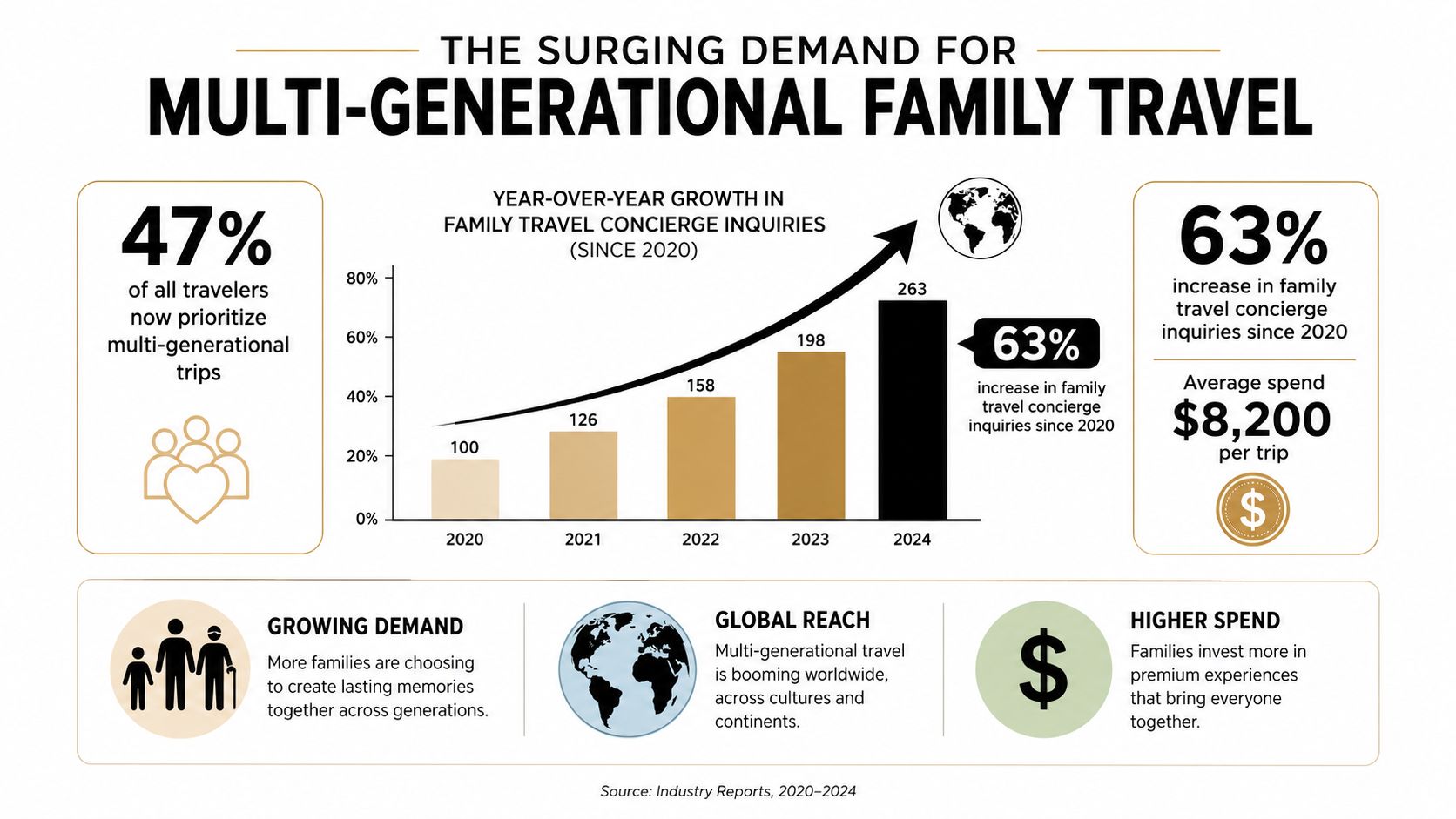
The market is being pulled by family behavior, not pushed by marketing. In 2025, 47% of travelers said they choose multigenerational family trips, up 17% from 2024. The same data set says 58% of Millennials and Gen Z parents planned to bring extended family on vacation, 62% of parents traveled with children under five, and 68% of families went abroad in 2024, with 35% booking overseas holidays through a travel professional, while family travel spending reaches an average annual $160 billion according to the cited data set. Condor Ferries family travel statistics
Those numbers explain why DIY planning breaks first in family travel. A trip for two adults is one set of preferences. A trip with grandparents, toddlers, and teenagers is a logistics stack. School calendars, accessibility needs, suite adjacencies, pediatric routines, and intercity timing all have to line up, and they rarely do without help.
Why complexity pushes families toward professional help
The concierge market is expanding for the same reason. Grand View Research estimates the concierge services market at USD 773.3 million in 2025 and projects it to reach USD 1,375.2 million by 2033, with a 7.6% CAGR from 2026 to 2033. The same market reporting says travel and hospitality represent 48% of luxury concierge market value in 2025, while family office and wealth-services concierge is the fastest-growing area at 15.2% CAGR. Grand View Research concierge services market
That matters because family travel has crossed the threshold where complexity is normal. For affluent families, the question isn't whether the trip is possible without support. It's whether it should be attempted without support.
The tipping point is usually not budget. It's the first time a family realizes that one change affects everybody.
Once you're coordinating separate arrivals, multiple bedrooms, child gear, dietary requirements, and mobility concerns, professional help stops looking indulgent. It looks like the rational way to keep a trip coherent.
What a Family Travel Concierge Actually Handles
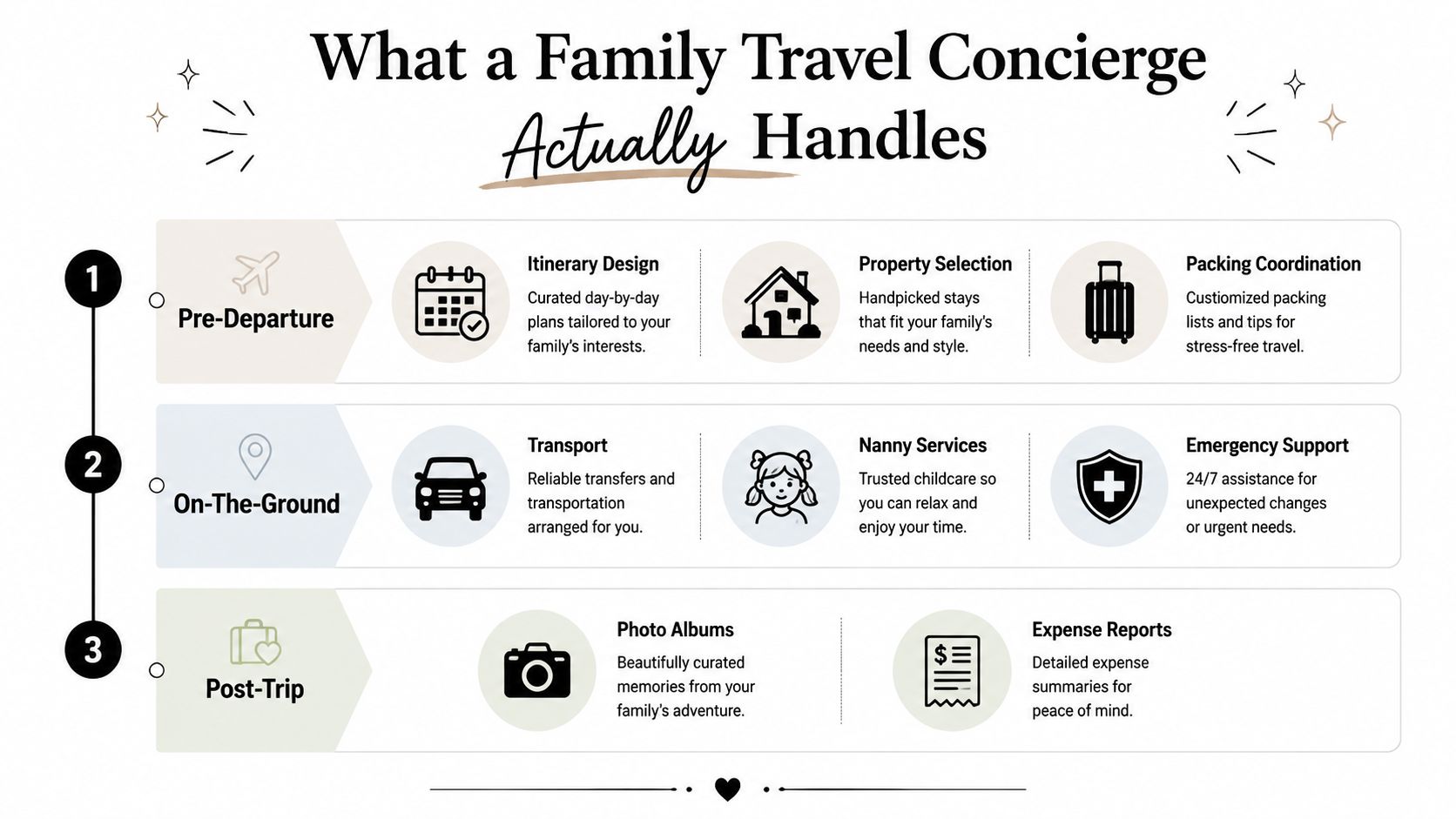
A real family travel concierge is not a glorified booking assistant. It's a single operator coordinating the parts that families usually end up managing across four different inboxes and three messaging apps. The best ones handle the trip from the first planning call through the last expense summary.
Pre-departure decisions that matter
Before anyone boards a plane, the concierge should be shaping the trip around the family's actual behavior. That includes property selection, room configuration, itinerary design, transfer planning, and the little details that make a multi-gen trip work instead of merely happen. A good provider also understands preferred partner benefits at brands like Four Seasons, Aman, Rosewood, and Belmond, which can provide complimentary upgrades when available, resort credits, and smoother VIP arrivals.
This is also where privacy starts. The family shouldn't be fielding vendor calls, comparing drivers, or repeating the same allergy notes to six different people. The concierge should do that once, accurately, and keep the family out of the middle.
On-the-ground execution
The active trip phase is where a concierge earns the fee. That's when private aviation, helicopter transfers, childcare coordination, private chef requests, after-hours museum access, and medical support across borders matter. It's also when a true concierge separates from a standard travel agent. A travel agent books. A concierge manages the moving parts while the family is already traveling.
If you want a clean internal reference point for this kind of service model, the guide to luxury travel concierge services shows how a more complete service stack looks when travel support is treated as a system, not a transaction.
Use this test: if your provider can't explain how they handle vendor coordination after the family is in transit, they're not running concierge operations.
Post-trip follow-through
The best service doesn't stop at departure. It closes the loop with expense consolidation, preference capture, and feedback that shapes the next trip. That might sound small, but it's how a concierge gets smarter with every journey. A family that travels often should not have to re-teach the same child preferences, arrival habits, or room setup rules every time.
Membership Retainer Versus One-Off Booking
A lot of affluent families hesitate here, and they should. The right model depends on how often you travel, how complex your family is, and whether you want a relationship or just a transaction.
A UK private membership package for family concierge services can start at £4,500 per year, while a bespoke membership package cited in the same source starts at £14,000 per annum. The article also notes that some providers handle ad hoc holiday planning as project-based work. Citizen Femme private concierge teams for families
How to choose the right structure
| Model | Best for | Trade-off |
|---|---|---|
| Retainer | Families who travel repeatedly, want faster response, and value continuity | Higher upfront commitment |
| One-off booking | Families who travel once or twice a year and want project pricing | Less relationship depth |
Retainers make sense when you want someone who knows your family without being reintroduced every trip. That continuity helps with proactive recommendations, preference memory, and faster decision-making under pressure. It also tends to reduce the friction of planning fees because the relationship is already in motion.
One-off bookings are better if your travel is occasional and predictable. If you just need a specialist for a single trip, a project basis keeps the spend tight and the commitment low. The trade-off is obvious. You won't get the same continuity, and in a disruption, that can matter.
My view: if you travel as a family more than once a year and the trips are never simple, the retainer usually wins.
For families exploring membership, Haute Black membership is one example of a model built around dedicated advisor access and ongoing service rather than one-time trip handling. If you only need a single trip, book the trip. If you want the concierge to learn your family, the retainer is the cleaner structure.
Sample Itineraries That Show Concierge Value in Action
A lot of providers can make a trip sound elegant on paper. The test is what happens when the family itinerary becomes a live problem set.
Japan with three generations
A three-generation family of ten going through Japan needs more than hotel reservations. They need room strategy, luggage timing, rest windows, and a rhythm that respects both the grandparents and the children. A concierge would choose ryokan stays that can be adapted for mobility needs, line up private tea ceremonies, and secure after-hours temple access so the family isn't fighting crowds while managing children and elders.
The tricky part is not the sightseeing. It's the segmentation. Teenagers need activity. Toddlers need pacing. Grandparents need comfort and predictable movement. A strong concierge builds separate tracks inside one trip so nobody feels trapped by the slowest pace or overloaded by the fastest one.
Then the trip turns. A child develops an ear infection in Kyoto. That's when the service earns its keep. The concierge coordinates medical support, adjusts dining, moves the next transfer, and updates the family without forcing anyone to rebuild the plan from scratch.
Caribbean villa compound with three families
The second scenario is a multi-family villa stay in the Caribbean. One family is flying from New York, another from Los Angeles, another from London. The concierge secures the property, staffs it with a private chef and nanny team, and schedules arrivals so the families land into a working house, not a chaotic check-in window.
Then a hurricane warning shifts the travel window. The concierge doesn't debate the weather. It restructures the whole trip. Flights move, the villa plan changes, backup timing is activated, and the family gets a revised schedule that keeps the trip intact instead of letting it unravel.
If you want that kind of orchestration on a broader luxury scale, Haute Black's family travel service is one place where private jets, villas, dining, and ground transport are coordinated as one travel system rather than separate bookings.
The lesson is simple. Families don't need a prettier itinerary. They need a provider who can keep the trip coherent when the original plan stops working.
How to Vet and Choose the Right Family Travel Concierge
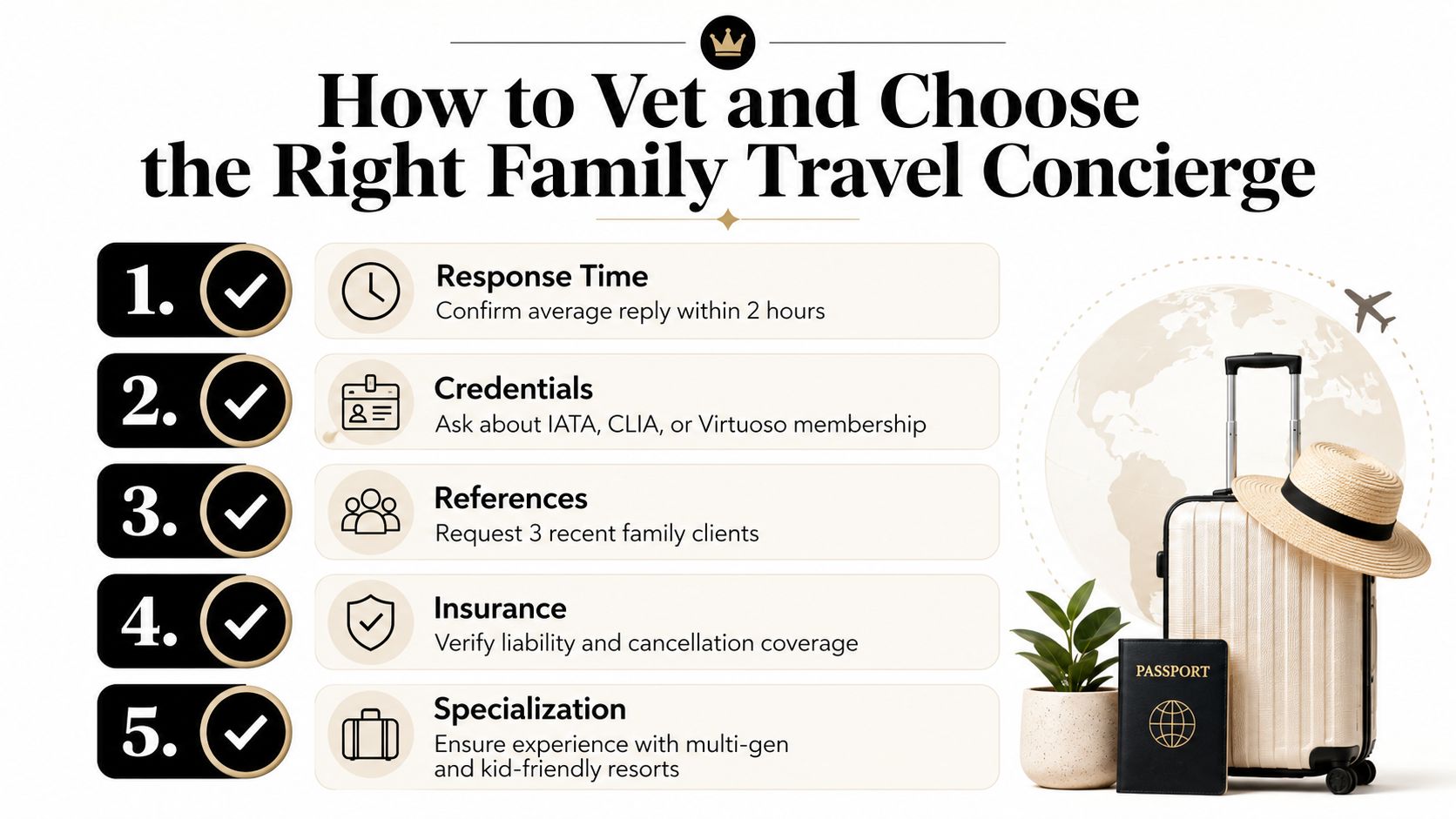
The fastest way to separate a real concierge from a booking desk is to ask hard questions early. Don't ask what they can reserve. Ask what happens when the trip starts breaking.
The questions that matter
- Response time: Ask how fast they reply once you're already traveling, not just during the sales process.
- Escalation paths: Ask who handles emergencies after hours and how they move decisions upward.
- Supplier depth: Ask which hotel and airline relationships they use, not just which names they mention.
- Privacy handling: Ask how they protect family data, guest profiles, and vendor contact exposure.
- Relevant experience: Ask for recent examples involving multi-generational trips, children, and mobility or medical needs.
Virtuoso affiliation and preferred partner status at major luxury hotel groups are useful trust signals, but they're not enough on their own. Ask for references from families whose travel patterns match yours. If the provider can't explain fees clearly, that's a red flag. You should know what sits inside the retainer, what gets billed separately, and whether vendor markups are part of the model.
A true concierge sounds operational. They talk about routing, coordination, escalation, and contingency handling. A weak one talks mostly about access and inspiration.
If the first conversation feels like a sales pitch, keep looking.
Start with one trial trip. Let the provider prove they can handle your family's actual complexity before you commit to a longer relationship.
The Technology Behind Coordinated Family Travel Experiences
The invisible part of a strong family travel concierge is the system behind the person. The best service runs on a multi-tier architecture that separates the user interface from business logic, data storage, and third-party integrations, so bookings, confirmations, and service updates move without exposing the family to operational clutter. That structure matters because once itinerary logic is separated from inventory and fulfillment layers, the concierge can react in real time instead of manually re-entering changes across every vendor.
What the Family Feels
The family feels one channel. Behind that channel, the provider should be using native PMS/CRM integration, real-time syncing, and department-level task routing so requests do not get lost between teams. That is how a note about room setup, child timing, or transfer changes stays consistent from the first confirmation to the last handoff.
AI-driven conversational support is useful when it does real work, not when it just chats. Microsoft's travel-concierge reference design shows the pattern clearly, an AI agent can answer travel-related inquiries while integrating with business systems, which is exactly what families need when they want 24/7 access to basic information without waiting for someone to wake up and start triaging messages. Microsoft travel customer concierge reference design
What to look for in the provider
- Real-time messaging for active-trip requests.
- Structured upsell tracking so upgrades and add-ons are handled cleanly.
- Performance dashboards so the provider knows where delays are happening.
- Payment gateway support so transactions do not turn into a manual bottleneck.
The strongest operators use technology to keep one source of truth across the trip. That prevents the family from hearing one thing from the hotel, another from transport, and a third from the concierge. In luxury family travel, consistency is the product.
If you want a family travel concierge that treats complex travel like an operations problem, not a lifestyle accessory, start with Haute Black. Their team can coordinate bespoke family journeys, private aviation, villas, dining, and ground transport with the level of control UHNW families need. Visit Haute Black and see how they handle travel when the margin for error is close to zero.
Explore Our Guides

Signature Experiences


