Haute Black Journal
The 7 Best Safaris in Tanzania: A Luxury Guide for 2026

Marlene Azeez
Director, HauteBlack
View all articles →
# The 7 Best Safaris in Tanzania: A Luxury Guide for 2026
June 6, 2026
Tanzania's safari reputation isn't built on marketing gloss. It's built on scale. One major safari reference notes that the country holds Africa's largest mammal population and about 1,500 bird species, which is why Tanzania remains one of the continent's defining wildlife destinations rather than a niche choice for safari veterans alone (Natural Habitat Adventures on Tanzania). For a luxury traveler, that matters because the best trip isn't merely about seeing animals. It's about choosing where that abundance feels effortless, private, and beautifully handled.
That's where many safari lists fall short. They rank camps or name famous parks, but they don't explain the luxury ecosystem that turns a good safari into a flawless one. Air logistics, private vehicles, crowd avoidance, advisor relationships, exclusive-use villas, and the ability to combine iconic game viewing with quieter, more bespoke experiences are what separate the merely expensive from the exceptional.
Tanzania can do both. The Northern Circuit remains the commercial and experiential anchor for first-time and repeat travelers who want the classic East African safari. At the same time, the country's southern and more remote regions offer lower-density experiences that feel far more private. The best safaris in Tanzania take advantage of both realities rather than pretending one style fits every traveler.
Timing the Unforgettable
The best Tanzania safaris are won or lost on timing long before a guest steps onto a bush plane. Peak wildlife months matter, but so do aircraft schedules, camp buyouts, guide quality, road transfers, and how much privacy a traveler expects once they arrive.
The dry season, usually June through October, is the easiest sell because wildlife viewing is straightforward and vegetation is thinner. That does not make it the automatic right choice for every luxury itinerary. The finest trips are timed around a specific objective, then routed to support it properly.
A client chasing the Great Migration crossing in the north needs different logistics from a couple who wants calving season photography in the south, or a family that values exclusive-use space over headline sightings. For these reasons, a high-touch advisor earns their fee. The work is not just choosing a camp. It is aligning dates, aircraft lift, inter-camp connections, private vehicle access, and the right guiding team so the experience feels calm rather than overbuilt.
Great Migration windows that matter
- December to March: Southern Serengeti and Ndutu suit travelers focused on calving season, strong predator activity, and beautiful early-morning light. This period works particularly well for photographers and repeat safari guests who care more about behavior than box-ticking.
- April to May: The long rains change the trip completely. Some camps close, some offer excellent value, and the travelers who go at this time usually do so on purpose. Green season can be very rewarding if you accept rain, softer road conditions, and a less predictable flight and transfer rhythm.
- June to July: Movement shifts west and then north. Demand rises fast for camps with the right migration position, and the best inventory often goes to guests who book well ahead or work through advisors with direct operator relationships.
- August to October: Northern Serengeti draws the most attention, especially from travelers focused on river crossings. The trade-off is obvious. You get the iconic spectacle, but often with higher rates, tighter availability, and more vehicle pressure in the most talked-about areas.
One practical rule holds up across the board. “Best time” in Tanzania depends on what you are optimizing for: migration drama, low-density game viewing, family-friendly pacing, easier air connections, or the privacy that comes from taking over a small camp.
That distinction matters even more on shorter luxury itineraries. A six- or seven-night trip can look impressive on paper and still feel rushed if it stacks too many parks and too many transfers. Analysts at Horizon Guides in their Tanzania safari overview note how choices between parks shape the character of the trip. In practice, the question is not how many names fit into the itinerary. It is whether each stop earns its place.
For many travelers, the strongest approach is fewer bases, better camp positioning, and tighter air logistics. That is especially true if the trip includes private guiding, exclusive-use villas, or a staged arrival through Arusha so the safari starts smoothly. Travelers planning around migration timing can also benefit from understanding how movement patterns affect routing and camp selection across the year, as outlined in this guide to the Great Migration in Africa.
A polished itinerary should feel deliberate from the first landing to the final departure. In Tanzania, timing is not a calendar question alone. It is the framework for the entire luxury ecosystem.
1. Haute Black
The difference between a good Tanzania safari and an exceptional one is rarely the suite alone. It is the quality of the routing, the timing of each air movement, the strength of the camp match, and the judgment behind every handoff. Haute Black stands out here because it operates as an advisor-led booking and access platform, with a focus on designing the full luxury system around the safari rather than treating the lodge as the whole story.
That model suits Tanzania unusually well. The country rewards travelers who plan holistically. Park choice affects flight patterns. Camp style affects privacy. A single weak transfer can flatten the first two days of an otherwise expensive trip. Travelers who have reviewed the best time to plan a Tanzania safari already understand that timing shapes the itinerary. The advisor's job is to turn that timing into a smart sequence on the ground.
Why Haute Black fits the top end of the market
Haute Black brings a dedicated advisor, waived planning fees for members, and access to a preferred property network across a wide international portfolio. In practice, that matters before and after the bush as much as it does in it. The strongest Tanzanian itineraries often include a well-judged Arusha overnight, a private villa or exclusive-use camp, and a beach finish that feels considered rather than obligatory.
Its private aviation arm, Haute Jets, is one of the clearest differentiators. In Tanzania, air logistics are not cosmetic. They shape how much game time you get, how tiring the trip feels, and whether a family or high-profile traveler can move with privacy. A private charter, a better-timed bush hop, or a cleaner international connection can be the difference between a polished itinerary and one that feels patched together.
Where the value shows up
Direct booking can work for a simple, lodge-led trip. Haute Black is better suited to travelers who want someone accountable for the whole chain of decisions.
- Advisor-led orchestration: The value is not only access to camps. It is choosing the right camp in the right zone, then pairing it with sensible staging, flight planning, and the right pace.
- Preferred relationships: Haute Black works through established luxury travel relationships that can improve room allocation, arrival handling, and other soft benefits that matter on high-spend trips.
- Private and exclusive-use planning: This is a strong fit for travelers booking private villas, full camp buyouts, or multi-generational safaris where vehicle strategy, guide quality, and privacy need to be aligned from the start.
- Broader trip design: The platform also covers villas, cultural programming, dining, events, and wider lifestyle travel, which helps when Tanzania is one part of a longer East Africa or Indian Ocean itinerary.
- Membership options: Non-members can still book bespoke travel. Access membership is priced at $299 per year, while The Black Card remains invitation-only at $10,000 per year plus a $2,500 initiation fee.
There is a real trade-off. This approach is best for travelers who value judgment, access, and time saved more than bargain hunting. Some preferred benefits depend on season, partner participation, and availability. That is standard at this level. The upside is having an experienced layer between you and the operational weak points that tend to show up in Tanzania first, especially on complex itineraries with multiple flights, remote camps, or high privacy requirements.
The best advisor does not only reserve Tanzania. They configure it so the trip holds together from wheels down to the final departure.
2. Singita Serengeti
For travelers who want one of the most polished private-concession safari experiences in East Africa, Singita Serengeti remains a benchmark, bringing together Tanzania's blockbuster wildlife reputation with a rarefied operating style.
Singita's advantage is its private concession model adjacent to the national park. That gives guests a lower-density feel than they'll find in busier public-game-drive zones, and it changes the emotional quality of the safari. You're not chasing sightings. You're enjoying space, pace, and a service culture that understands why discretion matters.
What works especially well
The accommodation portfolio is broad enough to suit different luxury styles without compromising standards. Sasakwa Manor speaks to villa-minded travelers who want grandeur and dedicated staff. Faru Faru and Sabora appeal to guests who prefer a more camp-forward expression of luxury, with strong design and a more immediate bush atmosphere.
The guiding is one of the reasons Singita justifies its reputation. This is a smart choice for clients who care about photographic positioning, private vehicle flexibility, and the quality of interpretation, not just the lodge itself. If your safari is centered around the migration, it also pairs well with a more detailed read on the Great Migration in Africa.
The real tradeoff
Singita is not for travelers trying to optimize value. It's for travelers trying to optimize experience quality.
- Best for: Couples, families, photographers, and privacy-driven travelers who want a concession-based Serengeti stay.
- Standout strength: Fewer vehicles, strong guiding, and very refined service.
- Potential drawback: It sits at the top end of Tanzania pricing and peak periods can feel restrictive because availability tightens quickly.
If your budget allows only one marquee Serengeti splurge, this is one of the few names where the premium usually feels visible in the field, not just in the room.
3. andBeyond Tanzania
andBeyond is one of the few operators in Tanzania I trust for a high-value itinerary with multiple moving parts. It has the ground handling, air coordination, and accommodation range to connect the Serengeti, Ngorongoro, and Zanzibar without the trip feeling stitched together by different suppliers who do not share standards.
That matters more in Tanzania than many first-time safari travelers expect. The northern circuit and southern parks ask for different pacing, logistics, and guiding styles. An operator can be excellent in one region and merely adequate once the itinerary expands. andBeyond is strongest when the brief is broader than a single camp stay and the client wants one team responsible for the whole journey, from bush flights and VIP airport handling to room allocation and backup planning when schedules shift.
Its portfolio also gives an advisor more tools to shape the trip properly. Ngorongoro Crater Lodge delivers drama and ceremony. Serengeti Under Canvas brings mobility and front-row migration access. Grumeti Serengeti River Lodge feels more settled and private. Used well, those contrasts keep a 10 to 14-night safari from flattening into the same game-drive pattern every day.
For travelers still deciding what style of trip fits them, this guide to planning your first African safari is a useful starting point before stepping into a more personalized Tanzania program.
The trade-off is straightforward. andBeyond is usually better at orchestration than at delivering the last word in exclusivity at any single stop. Travelers who want an exclusive-use house, private guide throughout, or a highly customized private aviation schedule may outgrow the standard framework and do better with a more bespoke operator or an advisor-built hybrid using several partners.
- Strongest use case: Travelers who want one operator to manage a polished Tanzania journey across several ecosystems, with fewer handoff risks.
- Best feature: Consistent service standards and the infrastructure to handle complex routing well.
- Main limitation: The most desirable dates and mobile-camp departures tighten early, and some camp setups are intentionally flexible rather than fixed-lodge predictable.
If the goal is a Tanzania safari that runs well from arrival to departure, not just one standout camp, andBeyond remains one of the most dependable luxury choices in the market.
4. Legendary Expeditions
Legendary Expeditions is for travelers who don't want their Serengeti experience to feel public. Its best trips lean into privacy, seasonal intelligence, and a style of safari that feels more customized than scheduled.
The standout name here is Mwiba Lodge, but the broader appeal lies in Legendary's comfort with exclusive areas and private-style execution. That matters in Tanzania because many affluent travelers say they want “the Serengeti,” when what they want is the feeling of the Serengeti without the traffic patterns associated with headline sightings.
Why seasoned travelers rate it highly
Legendary is especially compelling for the southern Serengeti period and shoulder windows. It works well for guests who want to trade some broad-brush convenience for a more intimate safari rhythm. Walking, cultural visits, and more flexible daily shaping all help the trip feel less like a standard drive-based program.
For travelers still learning what style of African trip fits them best, this first-timer safari guide helps clarify the basics before stepping up into this more private tier.
The tradeoff is part of the appeal
Legendary doesn't usually win on simplicity. It wins on feel.
- Best for: Repeat safari guests, honeymooners, and privacy-first travelers.
- Why book it: More bespoke pacing and strong access to less-trafficked areas.
- What to watch: Inventory is limited, and pricing is typically handled on request rather than in an easy published format.
This isn't the operator I'd choose for someone who wants maximum predictability. It's one I'd choose for someone who wants a more personal Serengeti.
5. Asilia Africa
Asilia Africa is one of the most interesting operators for travelers who want Tanzania beyond the obvious greatest-hits version. It still covers marquee migration territory, but its real value appears when you want to combine headline parks with wilder, less formulaic extensions.
That makes it one of the better answers to a gap in the market. Many Tanzania itineraries still focus heavily on standard game drives, while cultural access and slower, more varied safari design are often treated as side notes rather than the core of the trip. Established luxury brands do mention options like Maasai village visits or other local experiences, but they're often framed as add-ons rather than a richer safari model (Abercrombie & Kent on Tanzania experiences).
What Asilia does better than most
Asilia's footprint makes it easier to build contrast into a trip. You can move from migration-focused Serengeti camps like Sayari, Dunia, or Namiri Plains into places that feel more remote, such as Ruaha or Nyerere, or even add specialist primate-oriented time on Rubondo Island. For travelers who don't want every day to revolve around vehicle sightings, that range is valuable.
The operator also tends to appeal to clients who want comfort without the overly mannered atmosphere some ultra-luxury travelers now try to avoid. It's refined, but it still feels like safari.
Best use cases
- Ideal traveler: Someone who wants iconic wildlife plus at least one less expected wilderness component.
- Standout experiences: Walking, boating in Nyerere, and specialist extensions that break up the classic game-drive rhythm.
- Watchpoint: Seasonal camps and limited specialist activity slots can reduce flexibility during key windows.
Asilia is often a smart choice when a traveler says, “I want Tanzania, but I don't want a copy-and-paste safari.”
6. Thomson Safaris
Thomson Safaris serves a different kind of luxury traveler. Not every affluent client wants hyper-bespoke complexity. Some want a specialist with deep Tanzania focus, transparent planning, and strong support before departure. Thomson does that well.
It's especially well suited to North American travelers and families who want a fully managed experience without leaning into the rarefied style of the most expensive operators. The confidence factor is part of the product here. Published departures, clear trip structures, and accessible planning support can be more valuable than theatrical luxury if the traveler is prioritizing ease.
Why it remains relevant
Tanzania's safari appeal still centers on a handful of famous regions, particularly the Serengeti and the broader Northern Circuit, because those areas combine demand with very dependable game viewing. Thomson's strength is making those core experiences feel manageable and well supported for travelers who don't need every element reimagined from scratch.
That clarity also helps with expectation setting. You know what kind of trip you're getting. For many first-time safari clients, that's not a compromise. It's exactly what they want.
Where it fits best
- Best for: Families, first-time safari travelers, and planners who like seeing published structures in advance.
- Advantage: Tanzania-only specialization and straightforward prep.
- Limitation: It doesn't operate in the same ultra-luxury lane as brands built around exclusive-use villas, private concessions, or highly customized aviation-heavy journeys.
A transparent safari can still be an excellent safari. Not every luxury traveler wants mystery built into the process.
If your version of luxury includes clarity, responsiveness, and a lower-risk planning experience, Thomson earns its place.
7. SkySafari Tanzania by Elewana
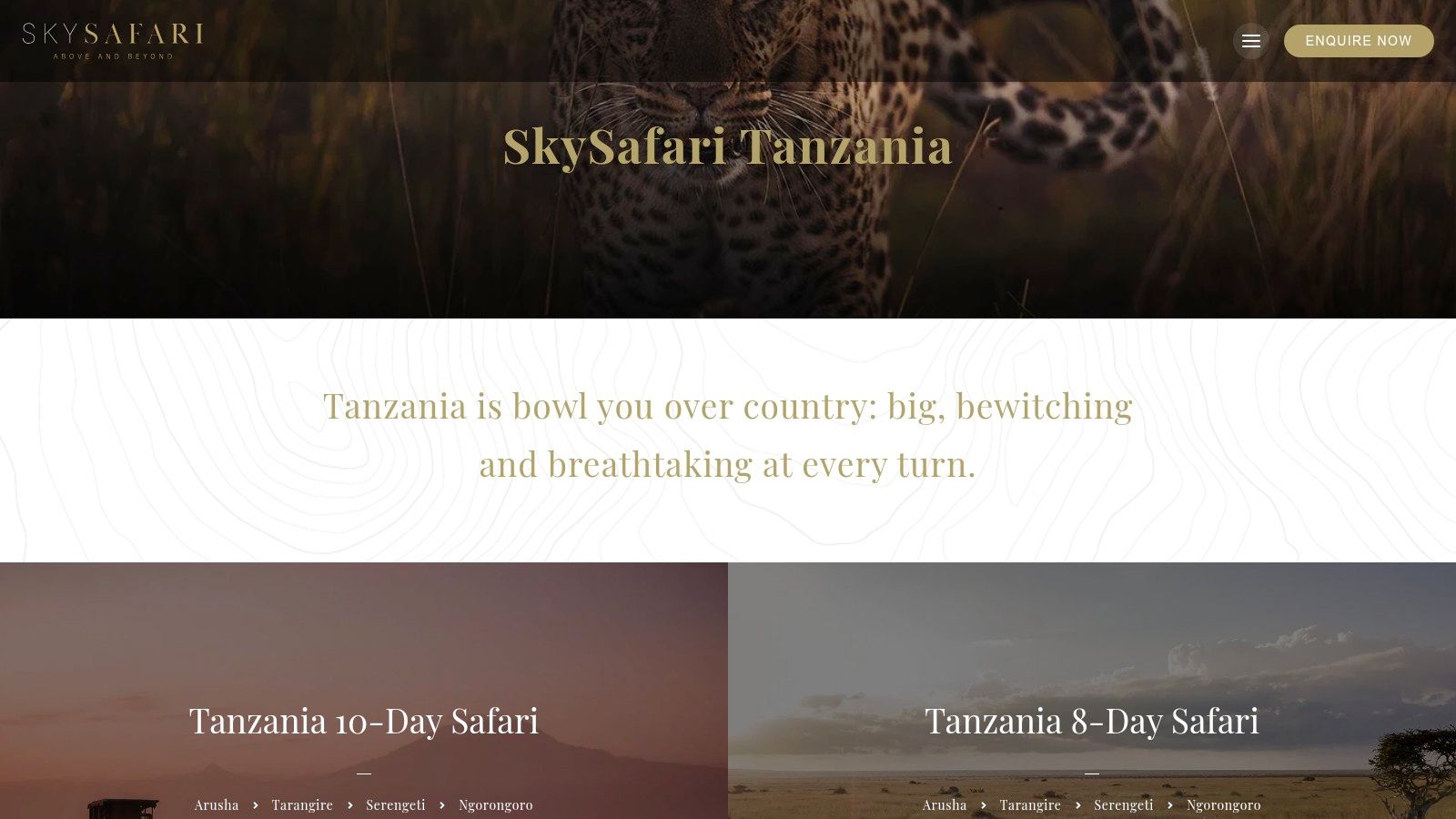
SkySafari Tanzania is the most obvious choice here for travelers who dislike safari transit days. If your idea of indulgence is spending less time on rough roads and more time arriving fresh to the next lodge, this model makes immediate sense.
Its executive-style fly-in concept is built around routing efficiency. That's not a minor benefit in Tanzania. Long overland transfers can eat into the elegance of a high-end trip, especially for honeymooners, older family members, or travelers trying to fit several ecosystems into a shorter calendar.
Why the format works
The operator curates a circuit rather than pretending every trip needs to start from zero. For many busy travelers, that's a strength. Tarangire, Ngorongoro, and Serengeti can all sit within a smooth fly-in structure that reduces fatigue and decision friction.
This also aligns with a larger Tanzania reality. Demand remains concentrated in the Northern Circuit, and Ngorongoro alone recorded 1,061,620 visitors in 2024/25, a useful signal that the marquee northern parks still dominate mainstream safari demand (Tanview Safaris tourism statistics overview). For luxury travelers, that often means the smartest trip isn't avoiding icons entirely. It's accessing them in a more insulated way.
What to know before booking
- Best for: Time-poor luxury travelers who want a proven circuit with minimal transit friction.
- Big advantage: Predictable quality and efficient inter-lodge movement.
- Main drawback: Fixed routing limits customization, and light-aircraft baggage constraints require discipline.
SkySafari isn't the most bespoke answer on this list. It's one of the most efficient. For the right client, that's exactly why it works.
Top 7 Tanzania Safari Operators Comparison
| Provider | Implementation Complexity 🔄 | Resource Requirements ⚡ | Expected Outcomes ⭐📊 | Ideal Use Cases 💡 | Key Advantages ⭐ |
|---|---|---|---|---|---|
| Haute Black | High, concierge coordination, membership tiers affect process 🔄 | Very high, membership fees (Access $299/yr; Black $10k+/yr), private aviation options, network spend thresholds ⚡ | Exceptional personalization and relationship-driven access; partner-dependent benefits ⭐📊 | Affluent travelers seeking VIP access, private jets and curated networking events 💡 | Relationship-based entry, dedicated advisors, private‑jet integration, invite‑only events ⭐ |
| Singita Serengeti | Moderate, direct lodge booking with seasonal planning 🔄 | Very high, premium rates, limited inventory, excludes budget travelers ⚡ | World‑class guiding and prime Migration viewing with low vehicle density ⭐📊 | Ultra‑luxury Migration viewing and conservation‑minded guests 💡 | Private concession access, superior guiding, strong conservation impact ⭐ |
| andBeyond Tanzania | Moderate, extensive operations simplify multi‑stop logistics 🔄 | High, varied pricing, offers better value in shoulder seasons ⚡ | Reliable luxury standards and seamless routing across regions ⭐📊 | Multi‑park itineraries (crater, Serengeti, coast) requiring smooth logistics 💡 | Wide operational footprint, private guides, sustainability programs ⭐ |
| Legendary Expeditions | Moderate–High, bespoke requests and bespoke planning; limited availability 🔄 | Very high, premium pricing, small inventory, request‑only rates ⚡ | Highly private, tailor‑made game viewing in less‑trafficked areas ⭐📊 | Privacy‑focused travelers, Southern Serengeti calving season and bespoke safaris 💡 | Exclusive‑use options, bespoke guiding, emphasis on privacy ⭐ |
| Asilia Africa | Moderate, broad portfolio enables flexible routing 🔄 | Medium–High, multiple price tiers; specialist permits/seasonality for activities ⚡ | Consistent guiding with authentic wilderness experiences across parks ⭐📊 | Travelers combining headline parks with off‑grid wilderness and specialist activities 💡 | Wide geographic coverage, specialist activities (walking, boating, chimp tracking) ⭐ |
| Thomson Safaris | Low–Moderate, published departures and US support simplify booking 🔄 | Medium, transparent pricing and published departures; appeals to North Americans ⚡ | Dependable, family‑friendly safari experience with clear logistics ⭐📊 | First‑time safari travelers, families and planners preferring set dates 💡 | Transparent pricing, US‑based support, clear departure schedules ⭐ |
| SkySafari Tanzania (Elewana) | Low, fly‑in circuit with fixed itineraries and guaranteed logistics 🔄 | High, executive air transfers, luggage/weight limits ⚡ | Maximizes time in the bush with consistent accommodation quality ⭐📊 | Travelers prioritizing minimal transit time and predictable luxury circuits 💡 | Seamless fly‑in routing, consistent standards, time‑efficient travel ⭐ |
The Art of Arrival Planning, Etiquette, and Impact
The best safaris in Tanzania are built long before the first game drive. What separates a polished trip from an overpriced one is the full operating chain: international air strategy, VIP airport handling, bush-flight timing, baggage management, private vehicle allocation, room placement, and the pace of the itinerary itself.
In this context, experienced planning pays for itself.
Families and honeymooners may both want privacy, but they need it in different forms. Families usually do better with exclusive-use villas, a private vehicle, and guides who can shift the rhythm of the day without disrupting anyone else. Honeymooners often benefit more from fewer camp changes, stronger physical separation between suites, and enough unstructured time to enjoy the setting rather than spending every daylight hour in a vehicle. The tradeoff is part of the appeal. A trip with fewer moves may cover less ground, but it often feels more refined and far less tiring.
Arrival design matters just as much. Some clients should route through Arusha with a night to recover before flying into the bush. Others are better served by private air or a tightly managed light-aircraft connection that protects prime safari time. There is no single right answer. The right answer depends on tolerance for transit, luggage profile, age of children, sleep habits, and whether the trip is meant to feel social, romantic, or very private. Luxury in Tanzania is often about reducing friction before it appears.
Etiquette matters too, and discerning travelers notice the difference immediately. Good safari behavior means keeping voices low at sightings, respecting the guide's judgment on vehicle position, putting the wildlife before the photograph, and understanding that not every moment should be chased. In sensitive ecosystems such as Nyerere, dry-season wildlife concentrations around the Rufiji River make restraint even more important. The standard is simple: leave a light footprint, choose operators with credible conservation and community commitments, and avoid treating wild animals as a staged experience.
Lead times deserve more attention than many travelers expect. Prime migration dates, top suite categories, and exclusive-use camps can disappear well in advance, especially once private guiding and preferred flight timings are layered in. That is why the strongest itineraries are usually assembled from the outside in. Start with air logistics and the few pieces that cannot be replicated, then build the lodge sequence around them.
The most memorable Tanzanian safaris also step beyond the default formula. A strong trip might combine classic Serengeti game viewing with slower camp life, a well-run walking program, meaningful cultural access, or time in a less crowded southern park. That approach creates shape and contrast. It also supports more thoughtful travel habits, including practical eco-friendly adventure tips that reduce impact without compromising comfort.
Judgment is the luxury product here. Which park deserves four nights instead of two. Which camp has genuine privacy rather than good marketing photography. Which flight upgrade saves meaningful time, and which one adds cost without improving the experience. A high-touch advisor earns their place by answering those questions early, coordinating operator fit with air strategy, and protecting the details that clients only notice when they go wrong.
If you want a Tanzania safari shaped around access, privacy, and flawless execution, Haute Black is a strong place to start. Their advisors design bespoke journeys that extend well beyond lodge selection, pairing the right operator with preferred hotel relationships, private aviation options, and on-the-ground planning that makes the trip feel easy from departure to return.
Explore Our Guides

Signature Experiences