Haute Black Journal
8 Luxury Wine Tour Italy Experiences

Marlene Azeez
Director, HauteBlack
View all articles →
A polished tasting holiday can be enjoyable. A private Italian wine journey is something else entirely. It begins with direct producer relationships, limited-capacity cellar access, estate-based accommodation and transfers that remove every rural transport problem, then shapes the itinerary around the traveler rather than around a standard route.
Italy gives you several distinct forms of discovery. Tuscany offers Brunello, historic estates and a naturally slow rhythm. Piedmont brings Barolo, Barbaresco, truffles and serious cellar culture. Veneto connects sparkling wine, Amarone and elegant cities. Sicily adds volcanic vineyards, coastal cuisine and a more exploratory sense of place. Italy's production scale supports this breadth. In 2023, the country exported approximately 21.4 million hectoliters of wine, the world's leading export volume, while export value reached about €7.7 billion.Italy's wine export profile and production base
The right luxury wine tour in Italy should also solve the practical details that ordinary guides ignore: who drives after a tasting, how a remote estate connects with a five-star hotel, where to stay between appointments and how to protect time for unplanned discoveries. HauteBlack can tailor signature journeys, preferred-property benefits and private aviation or helicopter logistics for travelers who value discretion. These are the eight experiences I recommend, organized by the reason you want to travel.
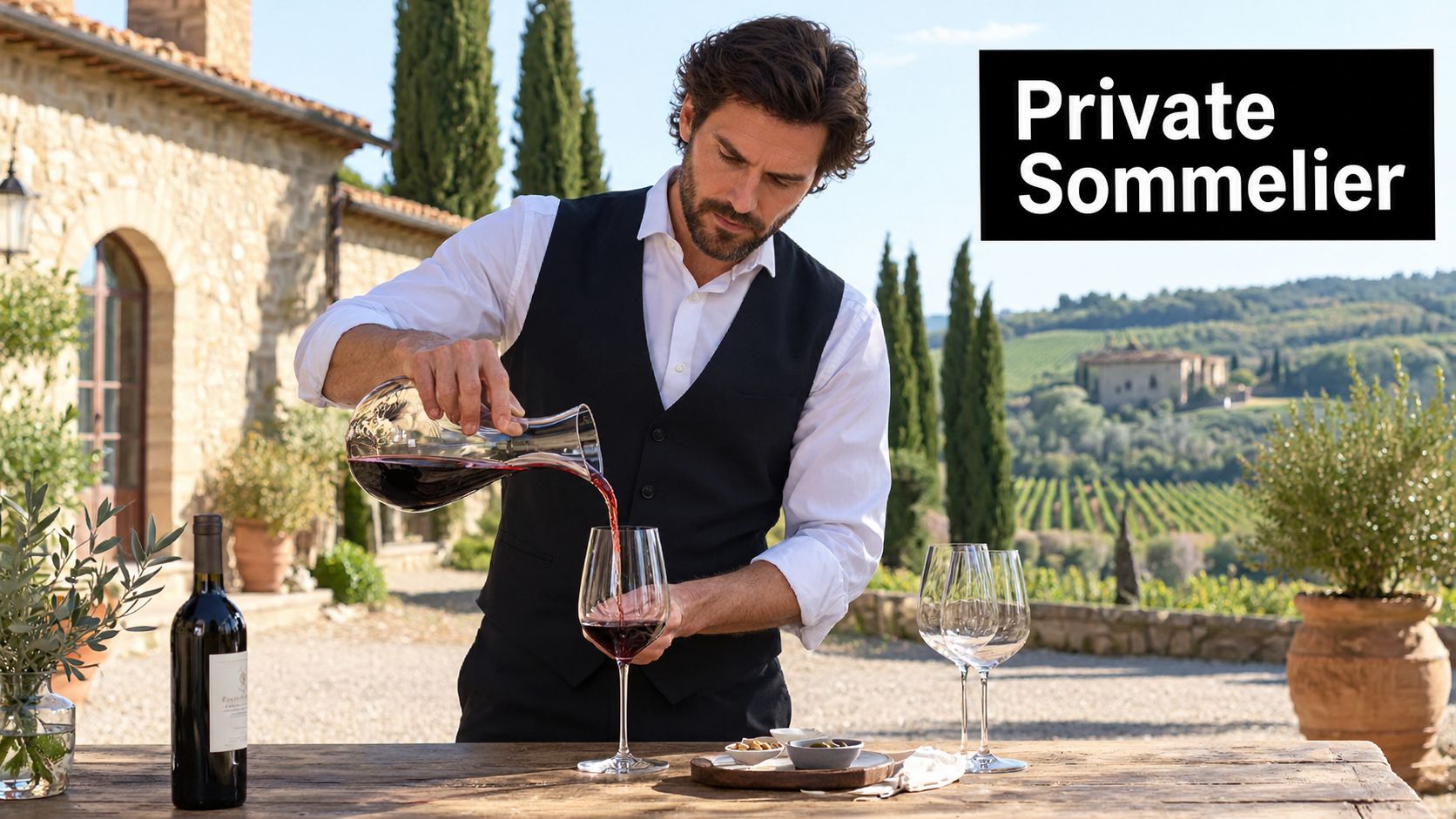
1. Tuscan Vineyard Estate Experiences with Private Sommelier Access
Tuscany is the strongest choice for travelers who want depth without unnecessary movement. Build the journey around Brunello di Montalcino and Vino Nobile di Montepulciano, then let the scenery set the pace. Private tastings should be arranged as hosted conversations with the producer or estate sommelier, not as quick stops added between sightseeing appointments.
Accommodation matters here. A luxury agriturismo places you inside the countryside, while a property such as Rosewood Castiglion del Bosco offers a more complete resort structure for guests who want refined service, privacy and time to pause between tastings. Antinori family tastings at the Florence headquarters can suit travelers who want a stronger connection to the history of a major house. Banfi's multigenerational vineyard setting can work well for families who want wine, scenery and shared learning in one day.
Choose access over volume
A private sommelier should know your preferences before arrival. Share the styles you collect, the bottles you already understand and the wines you don't enjoy. That preparation makes a tasting more personal and avoids spending valuable time on a generic sequence.
The best route uses a dedicated vehicle throughout. Rural estates can be difficult to connect by taxi, and tasting schedules rarely align neatly with public transport. Travel research identifies access as a major weakness in Italian wine tourism, with only about 13% of surveyed wineries nationally organizing private transfers.Wine-tourism accessibility and transfer planning Arrange airport-to-estate transportation through Haute Jets, and ask your advisor to confirm every transfer, waiting time and fallback option before arrival.
For serious students, a personal sommelier for WSET students can complement the estate experience. Start with Tuscany countryside planning, request a wine-profile consultation and secure limited-capacity appointments well ahead of travel.
2. Piedmont Prestige with Barolo, Barbaresco and Langhe Cellars
Choose Piedmont when regional immersion and serious wine access matter more than a packed sightseeing schedule. The Langhe rewards travelers who want detailed producer conversations, vineyard walks and bottles with a clear sense of origin. Barolo and Barbaresco feel more contemplative than a broad touring itinerary, especially when appointments include small-production wines and older cellar selections.
Base yourself in or near Alba for the shortest routes into the hills. Turin works better when the itinerary also includes architecture, private dining and urban culture. Aman and Four Seasons properties may suit travelers who value polished service, but the producer schedule should determine the hotel, not the reverse. Confirm appointment times, travel windows and lunch locations before booking, since cellar visits can sit far apart across the Langhe.
Build the day around the cellar
A Gaja Estate tasting, a Luciano Sandrone barrel selection or a family-run appointment can anchor an entire day. Book one substantial visit rather than stacking several prestigious names into a schedule with no time for questions. Follow it with a long lunch and a private chef dinner built around Langhe produce. That rhythm gives the region room to register.
November is a strong choice for travelers combining wine with truffle season. The pairing is culinary as well as geographic, giving newcomers a direct route into Piedmont's culture. A 2026 survey of Italian wineries reported in Broader participation in Italian wine tourism found that 58% of wine-tourism visitors are non-experts, so an itinerary should explain the region without assuming specialist knowledge.
Tell a wine advisor whether the priority is enjoyment, collecting or cellar building. Communicate library-vintage preferences before arrival, because availability varies by producer. Executive travelers may prefer a private dinner at the accommodation to another restaurant reservation. Couples should choose one intimate estate appointment, then leave the following morning for Alba's markets, walking and unhurried dining.
3. Veneto Wine and Culinary Immersion
Veneto is the right choice for travelers who want regional variety without constant repacking. Prosecco, Amarone and Soave reveal different grapes, terrain and production methods, while Verona, Treviso and Venice create a natural multi-city route. Build the itinerary around regional immersion, then use food and accommodation to give each stop a distinct character.
Begin in the hills associated with prestigious Prosecco production, continue to Verona for Amarone, and finish with Soave or Venice. Verona works best as the practical base for private cellar appointments, with a carefully chosen hotel or private residence offering easier departures than a city-center stay. A Venetian palazzo creates a strong final contrast, especially for travelers who value architecture and service after several days among vineyards. Belmond properties may suit guests seeking historic character, but confirm transfer times between vineyard districts and the cities before fixing reservations.
See how Amarone is made
Amarone warrants a production-focused visit rather than a standard tasting. During the September to October period, request access to a drying loft where the producer permits it and operating schedules allow. The appassimento process gives the wine its identity, and seeing that stage adds context that a tasting room cannot provide.
For Amarone, ask specifically about producers in Valpolicella Classico such as Quintarelli or Bertani, whose appassimento methods reward a private visit. Masi Agricola can also suit travelers seeking a private production appointment, while a family-owned estate may provide more personal hosting. Choose the producer according to the geography and method you want to understand, then reserve a meal built around local ingredients.
A private culinary class with chef participation works particularly well for couples and families. It gives non-experts a practical entry into Veneto's food culture and keeps the day engaging for guests who care more about cooking than technical tasting language. Wine-tourism spending also reaches accommodation, dining, transportation and retail beyond winery admissions, as described in The wider economic role of wine tourism.
Use a dedicated vehicle from Milan or Venice, and leave a generous buffer after every tasting. The best schedule allows time for cellar conversations, a proper lunch and the transfer to the next base.
4. Sicilian Wine Heritage and Mount Etna Terroir
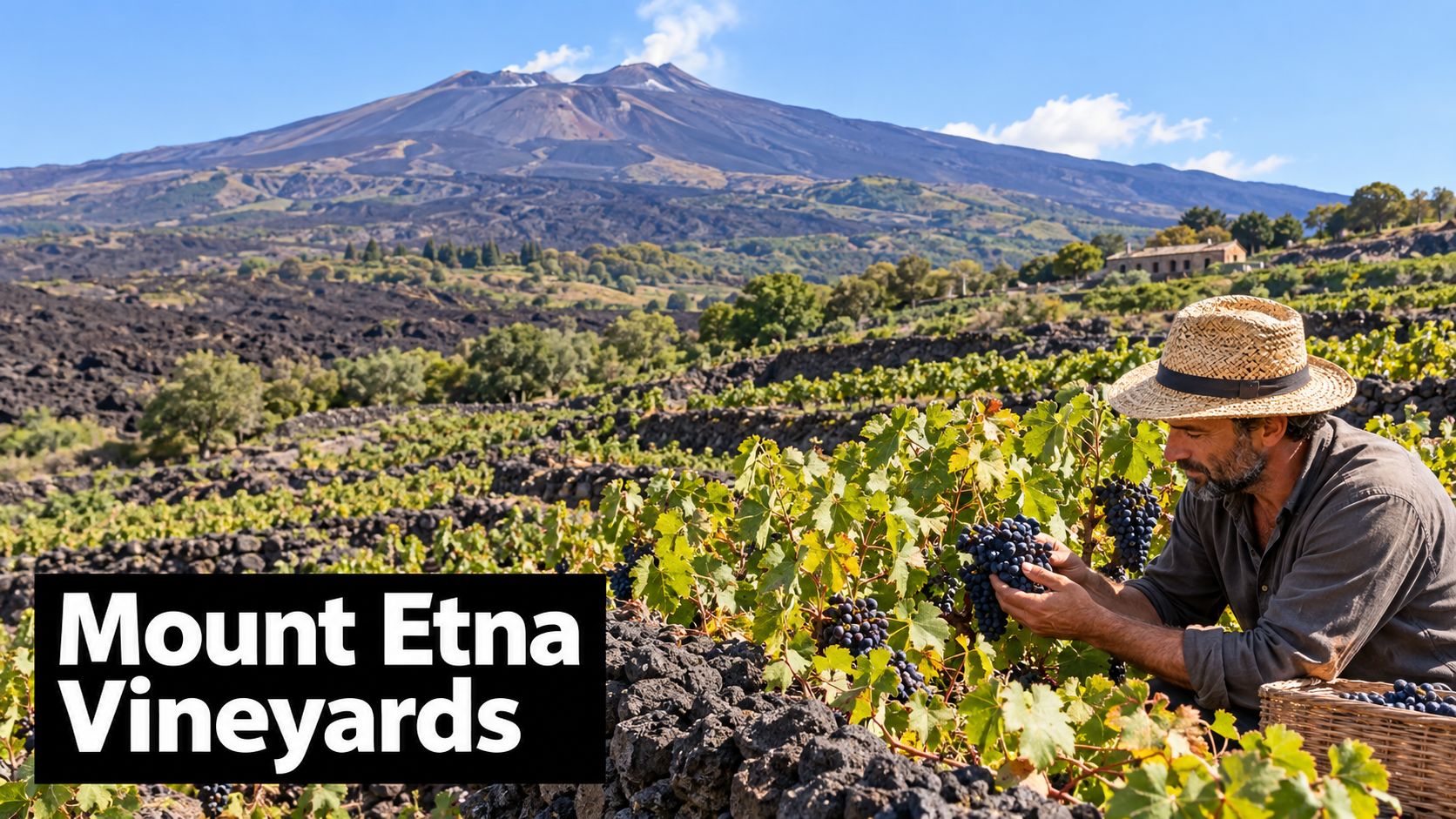
Sicily is the recommendation for travelers who have already seen the headline routes or want an experience with more contrast. Nero d'Avola, Grillo and Mount Etna's volcanic whites offer a different vocabulary from Tuscany and Piedmont. The island combines ancient agricultural traditions with contemporary winemaking, coastal food and dramatic terrain, so the itinerary should feel exploratory rather than overly formal.
Base part of the journey in Palermo if dining, architecture and cultural access matter. Add a private villa on the slopes of Mount Etna when the priority is vineyard immersion and space. Aman Palermo can be considered where the property's location and availability suit the itinerary, while a private villa may offer greater flexibility for families or groups traveling with a chef.
Make the volcano part of the experience
Ask for a geologist-led vineyard explanation if terroir interests you. The point isn't to turn a tasting into a lecture. It's to connect the soil, elevation and volcanic terrain with what's in the glass. Plan private tastings with family-owned wineries, and use a private chef for pasta, seafood and regional produce rather than importing a formal menu that could belong anywhere.
Planeta can suit travelers seeking a broad family estate experience and Nero d'Avola library tasting. A smaller Mount Etna producer may be better for guests who value direct conversation and a lower-profile setting. Don't assume that every prestigious name offers the same level of hosting. A 2025 farm-level study found that high-quality wine producers tend to offer a more diversified range of tourism options, which makes operational breadth an important sourcing criterion.Wine-farm diversification and agritourism
May to June and September to October can provide a more comfortable structure than the height of summer. Harvest participation requires early coordination, especially for travelers who want to observe fermentation or work alongside the estate team. Combine the vineyards with Palermo dining for a complete itinerary, and use HauteBlack's Sicily guide to shape the island portion. Travelers evaluating a longer stay can also explore assessing Sicilian property costs.
5. Private Wine Cellaring and Collecting Programs
A private cellaring program should serve a collecting purpose, not turn travel into another sequence of tastings. The right design links estate access with acquisition, storage, education and the way bottles will be enjoyed across residences.
Begin with a written brief. Decide whether the collection supports entertaining, long-term enjoyment, family succession or a combination of these goals. Have a wine advisor review your existing cellar, preferred regions, buying history and storage arrangements before arranging producer visits. A Ritz-Carlton stay offers a polished setting for private tastings and wine education. Four Seasons, Aman, Rosewood and Belmond properties may suit different locations or stages of a longer itinerary.
Treat travel as research
Each estate visit should answer a collecting question. Compare producers within one appellation, examine several vintages or determine whether a family winery matches your preferred style. Ask about allocations, auction previews and professional storage only after the advisor understands your palate and collecting horizon. A rare label has little value if it does not fit the collection.
Italy's export profile gives collectors a wide field to examine. In 2024, Italian wine exports reached roughly €8.136 billion, while reported export volume was approximately 21.7 million hectoliters.Italian wine exports in 2024 That scale includes familiar international styles and regional producers with less visibility abroad. Use the journey to identify estates worth following, then handle purchasing, provenance checks and storage through qualified professionals rather than treating the visit as the transaction itself.
A serious program also reflects changes in your household. Tell the advisor if you entertain frequently, divide time between homes or want children to inherit the collection. Schedule periodic reviews, retain clear provenance records and request tasting notes that remain useful after the journey.
Choose accommodation for privacy, temperature-controlled service and practical access to the estates, not only for its name. The trip should leave you with a coherent collection and a documented plan for enjoying it.
6. Tuscany Spa and Vineyard Wellness Retreats
Wellness travelers should not force wine into every part of the day. The strongest retreat separates education, tasting and recovery so that each has room to work. Tuscany is particularly suited to this approach because vineyard settings, spa properties, private fitness and regional cuisine can coexist without an aggressive schedule.
Rosewood Castiglion del Bosco can suit guests who want the vineyard setting integrated with a luxury resort experience. A Four Seasons Tuscan spa property may be preferable for travelers who want a different service environment or a stronger focus on structured wellness. Confirm the exact program at booking. Wine-paired treatments and health claims should never be accepted uncritically, and any nutrition discussion should be handled by an appropriately qualified professional.
Keep tasting and recovery distinct
Book wine education in the morning only if the session is light and controlled. Otherwise, place tastings after a treatment or between wellness appointments, with a private vehicle ready for every transfer. Yoga among the vineyards, private fitness and chef consultations can provide a richer experience than trying to fill the itinerary with cellar visits.
A practical schedule might include several days of wellness programming and separate days for estate touring. That structure protects the guest's energy and prevents the retreat from becoming a sequence of obligations. Ask the advisor about fitness levels, dietary requirements, treatment preferences and personal health goals before arrival.
The commercial case for this design is also clear. Italian wine tourism attracts visitors who spend across dining, accommodation, transport and retail, not only at the winery.Italian wine-tourism spending and visitor activity A wellness retreat captures that broader journey without asking every guest to become a wine specialist. It works especially well for couples where one person is passionate about wine and the other values spa, movement and food.
End with a private dinner that explains the pairing rather than overloading the table with bottles. Arrange post-retreat nutrition support only when it serves a real personal objective. Luxury here means control over the pace, not more programming.
7. Multi-Regional Italian Wine Grand Tour
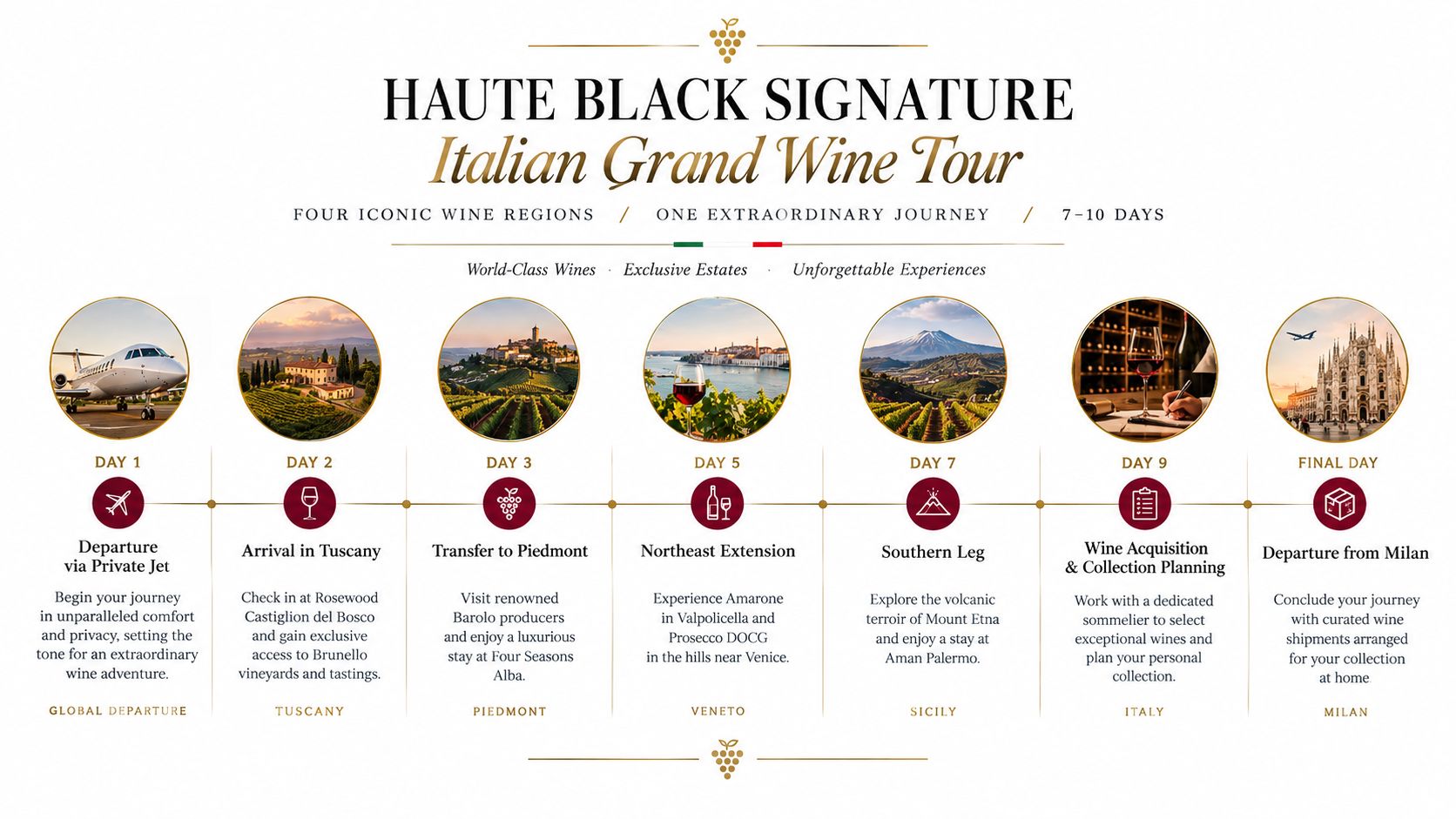
A multi-regional tour works only when each destination earns its place. Combine Tuscany, Piedmont, Veneto and Sicily for contrast in wine, food, terrain and culture, then protect the schedule with private aviation or helicopter transfers where they clearly improve the route. Without that discipline, luxury becomes a series of check-ins.
As an advisor rule of thumb, allow seven to ten days at minimum. Anything shorter compresses Sicily into a transfer day. Use private air logistics for the longest transitions and chauffeured vehicles within each wine region, where slower travel supports estate visits and local meals.
Give every region a role
Assign each stop a distinct purpose. Tuscany should carry the estate and countryside experience. Piedmont should focus on collecting, cellar depth and food. Veneto should provide production contrast and access to cities. Sicily should bring volcanic ground, family hosting and a less predictable final chapter. This structure keeps the itinerary from repeating the same tasting in different rooms.
Match accommodation to the region and the traveler. Four Seasons, Aman, Rosewood and Belmond may suit routes where location, privacy and service align, subject to availability. A preferred property earns its place through logistics: coordinated arrival, room preferences, dining reservations and transfers reduce friction after a long travel day. HauteBlack states that it is a Virtuoso-affiliated agency with preferred-partner recognition at hotels and can coordinate multi-stop European itineraries.HauteBlack's preferred-property and itinerary coordination
Set the brief before booking appointments. Collectors should request fewer estates and longer producer conversations. Executive groups may prefer concise tastings paired with a strong culinary program. Families need private space, age-appropriate explanations and a schedule that respects different energy levels. For multigenerational groups, review guidance on planning cultural travel for seniors before fixing the daily pace.
Request final documentation with producer contacts, wine notes and acquisition recommendations. Use HauteBlack's Italy destination planning to coordinate the route, accommodation and regional transfers around those priorities.
8. Private Family Wine Legacy and Education Programs
A private family wine program should teach culture, not imitate an adult tasting itinerary. Build the day around age-appropriate education, cooking, estate visits, local history and collecting conversations. Younger travelers need active ways to engage, while adults can spend time with producers and family archives.
Choose accommodation around the group's ages and rhythm. A Four Seasons or Rosewood property can work when reliable facilities, service and location matter, subject to availability. For extended families, a private villa often offers better control over meals, downtime and staffing, especially with a dedicated chef. Reserve enough space for relatives to separate by age, then bring everyone together for shared meals and selected estate visits.
Teach by generation
Children can explore grape juice, cooking and the surrounding countryside. Teenagers can learn fermentation, food pairing and responsible wine culture without being pushed into adult tasting rituals. Adults should focus on collecting, producer history and the family's long-term relationship with wine.
Set the purpose before confirming appointments. Education, introducing the next generation to collecting and creating a recurring family tradition require different choices of region, estate and accommodation. Tuscany is the strongest default for family-friendly countryside, cuisine and accessible cultural stops. Sicily suits older children and teenagers who want a more adventurous setting.
A dedicated family advisor should coordinate parallel activities. One group might attend a cooking class while another visits a cellar, then everyone reunites for a farm lunch. Keep transfers private, protect recovery time and schedule technical visits earlier in the day. Family programming belongs at the center of the itinerary because family participation is a substantial part of wine tourism, rather than a niche variation.
Keep a shared record of the family's wine education, favorite producers and future collecting interests. Include tasting notes, questions from younger travelers and estates worth revisiting. That record turns one holiday into a family tradition with continuity.
8-Point Comparison: Luxury Italian Wine Tours
| Experience | 🔄 Implementation Complexity | ⚡ Resource Requirements | 📊 Expected Outcomes | 💡 Ideal Use Cases | ⭐ Key Advantages |
|---|---|---|---|---|---|
| Tuscan Vineyard Estate Experiences with Private Sommelier Access | Medium–High; sommelier scheduling, estate permissions, seasonal coordination | High; luxury lodging, private transport, sommelier fees | Intimate tastings, personalized education, purchase opportunities | Wine education, intimate collector visits, harvest-season immersion | ⭐ Personalized sommelier access; direct family-winery relationships |
| Piedmont Prestige: Barolo, Barbaresco & Langhe Valley Private Excursions | High; terrain logistics, library wine sourcing, specialist guides | Very High; helicopter transfers, rare-vintage procurement, premium hotels | Access to rare aged vintages, strong investment potential, terroir education | Collectors, investment-focused itineraries, truffle + wine pairings | ⭐⭐ Exceptional access to scarce wines and collector networks |
| Veneto Wine & Culinary Immersion: Prosecco, Amarone & Soave Regions | Medium; integrates winemaking demonstrations and culinary classes | High; chef-led classes, Belmond properties, festival VIP access | Broad palate exposure, culinary skills, regional tasting variety | Food-and-wine enthusiasts, culinary-focused luxury travelers | ⭐ Diverse regional styles with strong culinary integration |
| Sicilian Wine Heritage: Nero d'Avola & Mount Etna Volcanic Terroir Experiences | Medium; remote logistics, specialist guides (geologists, winemakers) | Medium; Aman/villa stays, local transport, harvest participation | Discovery of unique volcanic terroirs, emerging-collector opportunities | Emerging-region collectors, cultural explorers, harvest participants | ⭐ Unique terroir-driven wines at generally lower entry prices |
| Ritz-Carlton & Virtuoso Partner Private Wine Cellaring & Collecting Programs | Very High; inventory, legal/tax, cross-border storage and auction logistics | Very High; capital for acquisitions, storage fees, professional advisors | Professionally curated collections, optimized portfolio performance, global access | Serious collectors, multi-residence owners, investment-focused clients | ⭐⭐⭐ Professional cellar management, allocation and auction access |
| Luxury Wine & Wellness Retreats: Tuscany Spa & Vineyard Integration | Medium; coordinates spa protocols with wine programming | High; luxury spa facilities, medical/wellness staff, sommelier involvement | Wellness-focused education, moderated wine enjoyment, stress reduction | Executives, couples, health-conscious luxury travelers | ⭐ Integrates wellness with wine education; small, restorative groups |
| Multi-Regional Italian Wine Grand Tour: 7–10 Day Comprehensive Journey | Very High; complex multi-region logistics and bespoke scheduling | Very High; private jets/helicopters, multiple five-star stays, full-time advisors | Comprehensive regional education, broad acquisition & networking | Intensive collectors, deep-education seekers, high-net-worth travelers | ⭐⭐⭐⭐ All-region access with seamless luxury logistics and advisors |
| Private Family Wine Legacy & Education Programs: Generational Experiences | High; multi-age programming, activity coordination, family logistics | High; family suites, tailored activities, dedicated family advisors | Multi-generational knowledge transfer, family traditions, shared memories | Multi-generational families, legacy-building, educational vacations | ⭐ Creates intergenerational wine education and lasting family traditions |
Design the Italian Wine Journey Around Your Priorities
The right luxury wine tour in Italy starts with a decision about the traveler, not the destination. Choose Tuscany for regional immersion, estate living and a measured countryside rhythm. Choose Piedmont for collecting, producer depth, truffles and serious cellar conversations. Choose Veneto for a layered wine and culinary route that can connect vineyards with Verona, Treviso and Venice. Choose Sicily for volcanic terroir, family-owned estates, coastal cuisine and a more exploratory experience.
Wellness travelers should protect spa time instead of adding tastings until the itinerary becomes exhausting. Families should prioritize private vehicles, flexible meal arrangements and parallel activities for different ages. Collectors should secure producer access, library-vintage preferences and acquisition support before arrival. Travelers seeking breadth should use private aviation or helicopter transfers selectively, then slow down once they reach each region.
The economic context supports this broader design. Italy's wine-tourism activity was estimated at approximately €2.9 billion in 2024, with annual participation estimated at roughly 14 to 15 million wine-related travelers and same-day visitors.Italian wine-tourism market context Visitor spending reaches wineries, restaurants, accommodation, transportation and retail, so a refined itinerary should be evaluated by the total experience rather than the price of a cellar admission. The practical opportunity is to convert a short winery stop into a multi-night destination journey with strong pacing and clear purpose.
Use this planning sequence:
- Define the traveler profile: State whether the journey is for a couple, family, collector, wellness guest or executive group.
- Set the wine objective: Decide whether you want education, producer access, collecting research, harvest participation or memorable food and wine.
- Select regions and season: Match the terrain and climate to the experience, then confirm operating dates with each estate.
- Confirm access before booking hotels: Ask whether the producer offers private hosting, cellar access, vineyard interpretation, dining or harvest participation.
- Match accommodation to the route: Choose an estate, villa or preferred luxury property based on privacy, location and recovery time.
- Secure transfers and contingencies: Confirm chauffeurs, airport connections, helicopter or private aviation options, waiting time and backup plans.
- Document the journey: Request producer contacts, tasting notes, preferred bottles and any acquisition recommendations for future reference.
HauteBlack can coordinate tailor-made Italian journeys that combine vineyard dinners in Tuscany, private winery access, coastal destinations and preferred-property benefits. Its Switzerland-and-Italy planning model also demonstrates how a bespoke itinerary can connect regions and countries rather than follow a fixed package.HauteBlack's bespoke Switzerland and Italy journey Availability, inclusions and hotel benefits should be confirmed at booking, particularly for limited-capacity estates, harvest experiences and high-demand accommodations.
Visit HauteBlack when you know whether your priority is regional depth, collecting, wellness, family education or a cross-country route. Give the advisor your preferred wine styles, travel dates, accommodation expectations and transfer requirements at the start. The best journey is built around those details, then refined until every tasting, room and movement feels intentional.
HauteBlack offers bespoke Italy itineraries with advisor support, preferred-property coordination, private transfers and access planning for vineyard, culinary and cultural experiences. Visit HauteBlack to discuss a luxury wine tour in Italy designed around your priorities, pace and need for discretion.
Explore Our Guides
Signature Experiences