Haute Black Journal
Tour Guides Croatia: Expert Private Tours in 2026

Marlene Azeez
Director, HauteBlack
View all articles →

# Tour Guides Croatia: Expert Private Tours in 2026
Published July 31, 2026 by Marlene Azeez
Most advice about tour guides Croatia gets one thing badly wrong, it treats every licensed guide as roughly equal. They're not. In Croatia, the difference between a polished day out and a flat, forgettable tour often comes down to training depth, territorial rights, and whether the guide knows the exact experience you want, not just the headline destination.
That matters because Croatia is a high-volume tourism market. The national statistics office reported 20.7 million tourist arrivals and 94.8 million tourist nights in commercial accommodation in 2025, with an average stay of 4.6 nights per arrival official tourism statistics. Short stays make guides more valuable, not less. If you only have a few days, a mediocre guide wastes the trip. A strong one compresses access, context, logistics, and local relationships into a tight itinerary.
It also matters because Croatia's guiding market is large, formal, and uneven at the same time. The Ministry of Tourism says there are an estimated 5,500 tourist guides in the country, and that number is rising ministry note on guide day. That sounds reassuring until you look at the training gap and the legal limits on where some guides can work. For luxury travelers, that is where the filtering starts.
Why Most Croatia Guide Recommendations Miss the Mark
The popular advice says to book a “licensed” guide and move on. That's lazy, and in Croatia it can cost you the best part of the trip. A licensed guide is not automatically the right guide for your route, your language, your pace, or your level of service.
The training gap is the first warning sign
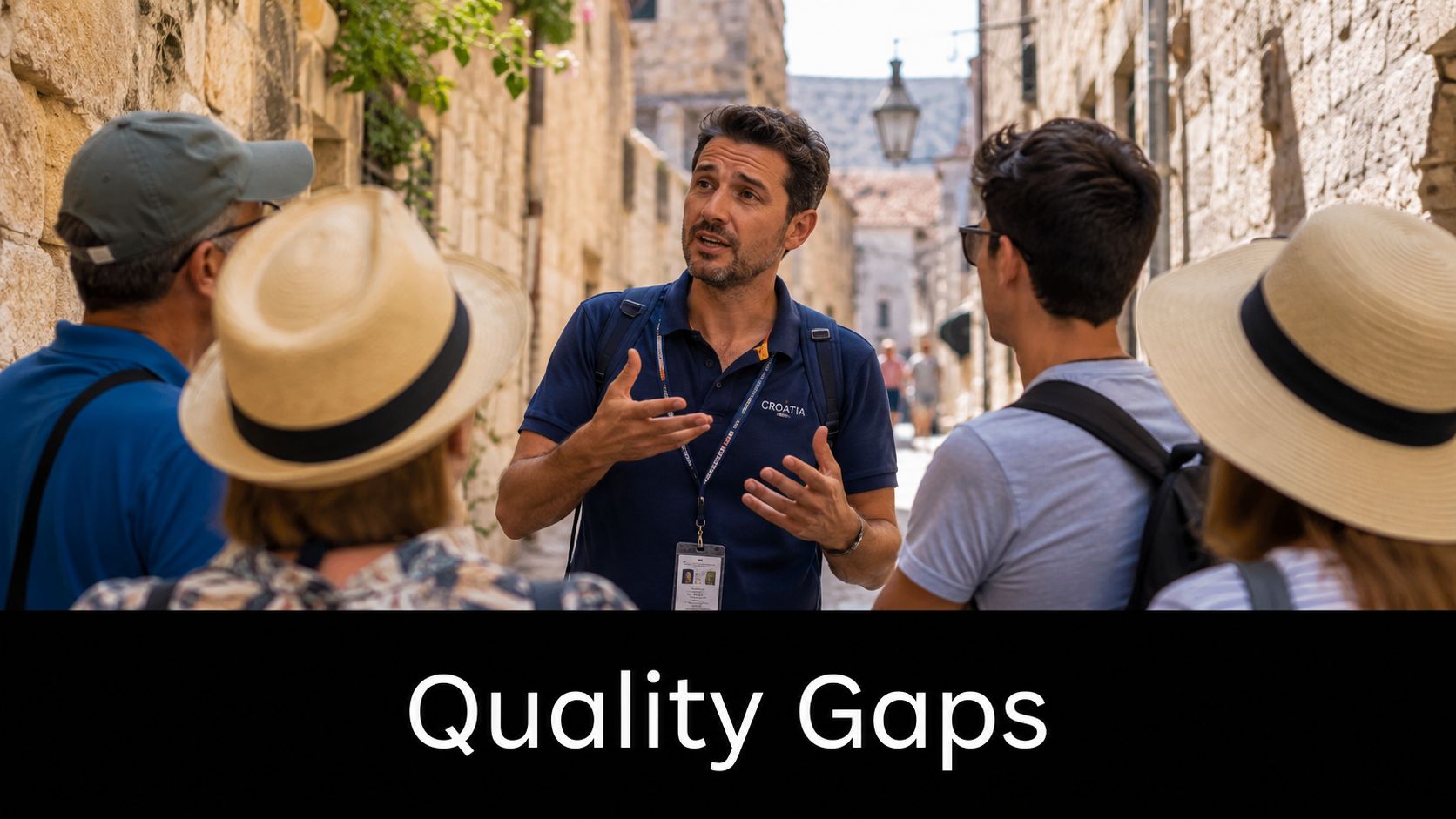
A comparative policy report notes that Croatian guide training can be as low as 18 hours, while Hungary's can run 300 to 400 hours policy report. That gap tells you something important. Certification exists, but the depth of preparation can vary sharply, so the paper credential alone doesn't tell you whether a guide can handle a heritage-heavy walk, a fast-moving island day, or a more technical outing like rafting or canyoning.
Practical rule: if the itinerary is special, the guide should sound specialized before you ever see a quote.
Territorial limits matter more than travelers think
Croatia also has a territorial history to its guide system. The European Commission's mutual-evaluation material says guides were historically tied to the county where they passed their professional exam, and Croatia has 21 counties European Commission document. That old structure explains why some guides still carry deep local knowledge in one area but are weak the moment you move across regions. For travelers, the practical lesson is simple. A guide who is exceptional in Dubrovnik may be mediocre in Istria, Split, or the islands.
Generic directories rarely surface this distinction. They list names, not competence. If your trip includes wine estates, truffle country, offshore transfers, or lesser-known inland villages, you need someone who understands that exact terrain. For a curated trip idea that pairs well with smarter guide selection, Haute Black's Croatia luxury guide is the kind of planning reference worth starting from.
Understanding Croatia's Tour Guide Licensing System
Croatia treats guiding as a regulated profession, and that is a good thing. It creates a baseline. But the baseline is not the finish line. A traveler who understands the licensing structure can ask far better questions and spot a weak fit in minutes.
What the credentials actually mean
For permanent service, a guide must have at least secondary education, pass the certification exam, show B2-level knowledge in the tour language, know enough Croatian, and receive an administrative approval decision Croatian public service guidance. Those requirements are not trivial. The language standard matters because it helps separate guides who can narrate, answer questions, and adapt from those who only memorize script-like commentary.
For protected heritage sites, the bar is higher. Croatian rules distinguish between general guiding and guiding at protected sites, and those sites require the special part of the certification exam tourist guides guidance. If you care about churches, palaces, ruins, or layered historical settings, that detail matters more than the glossy profile photo.
Temporary work and foreign professionals
EU and EEA guides can provide temporary or occasional services without establishing themselves in Croatia, but that does not erase site-specific requirements. Protected sites still demand the special certification exam Croatian public service guidance. Foreign professionals who want to permanently practice a regulated tourism profession in Croatia must also submit a formal recognition request, together with proof of nationality, proof of qualifications, and either a diploma supplement or proof of experience or competence depending on how the profession is regulated at home Ministry of Tourism and Sport.
The takeaway is blunt. A guide can be perfectly legal and still be wrong for your itinerary. Ask whether they hold the right approval for the places you're visiting, not just whether they're “a guide.”
A strong guide in Croatia should be able to tell you exactly where they are licensed, what they can legally cover, and what needs an added certification.
How to Vet Private Tour Guides in Croatia
Stop asking whether a guide is “good.” Ask whether they're good for your specific trip. The right vetting process is short, direct, and slightly uncomfortable, which is exactly why it works.
Start with verification, not charm
Ask for the license number and the specific places it covers. Then ask whether the guide has the special certification for any protected site on your route. If the answer gets vague, move on. A polished website means nothing if the legal coverage doesn't match the day you're buying.
Next, confirm language ability in plain terms. The official standard is B2-level knowledge in the service language Croatian public service guidance, but what you really want is a short live exchange by phone or video. A guide who can handle a real conversation can usually handle detours, weather changes, and client questions.
Test for specialization, not just availability
A serious specialist can describe the route, the pacing, and the access points without sounding rehearsed. Ask for a sample itinerary and one or two backup options. Ask which part of the day they would avoid and why. A guide with real local depth will answer quickly. A generalist will reach for vague superlatives.
Use this checklist:
- Verify license number. Don't rely on a booking page or a directory badge.
- Ask for specialization proof. Look for concrete route knowledge, not generic “local expert” language.
- Request a sample itinerary. You want structure, timing, and contingency planning.
- Confirm insurance coverage. Especially important for any activity involving boats, trails, or physical movement.
- Read verified reviews. Focus on comments about judgment, pacing, and coordination, not just friendliness.
If you're booking through a luxury travel advisor, that screening should already be done for you. Haute Black, for example, works as a travel planning and signature experiences platform, which is useful when you want a pre-vetted recommendation rather than another random marketplace listing. If you're comparing broader destination planning, the best places to stay in Croatia piece is a smart companion read.
Choosing the Right Guide Specialization for Your Trip
Croatia punishes genericism. A guide who is brilliant at palace history in Split may be the wrong choice for truffle tastings in Istria or island logistics in the central Adriatic. Match the specialization to the actual trip style, not the destination name on the brochure.
| Specialization | Best Regions | Ideal For | Key Questions to Ask |
|---|---|---|---|
| Cultural heritage | Dubrovnik, Split, Trogir, Šibenik | Historic walks, palaces, churches, city walls | Which site access do you have, and what stories do you cover beyond the standard script? |
| Culinary and wine | Istria, Pelješac, inland Dalmatia, Korčula | Tastings, vineyard visits, chef-led lunches | Which producers do you know personally, and do you arrange private tastings? |
| Adventure and nature | Plitvice, Krka, inland canyons, rafting areas | Hiking, kayaking, canyoning, active days | What safety coordination do you handle, and what equipment do you expect guests to bring? |
| Maritime and island-hopping | Hvar, Brač, Korčula, Dugi Otok, coastal routes | Boat days, transfers, multi-stop itineraries | How do you manage weather changes, docking, and timing across islands? |
| Photography-focused | Dubrovnik, Split rooftops, islands, scenic inland stops | Couples, honeymoons, editorial-style travel | Which light conditions do you plan around, and where do you know the quieter viewpoints? |
Read the profile like a contract
If a guide claims five specialties, assume none of them are deep until proven otherwise. Real specialists tend to speak in specifics. They name villages, producers, staircases, viewpoints, tide windows, or the right order to hit a route. That precision is what you're buying.
For luxury travelers, specialization often matters more than fame. A well-connected guide can open a family estate lunch, a private tasting room, or a quieter entry sequence at a crowded site. The visible Dubrovnik-Split-Zagreb circuit gets the most attention, but some of the most rewarding experiences sit outside it, including truffle country and less obvious inland pockets that most mass-market listings never mention Croatia underrated travel content.
If a guide can't tell you what changes when the season shifts, they don't know the region well enough for a premium booking.
Regional Guide Expertise Across Croatia's Top Destinations
The same guide can be excellent in one place and underwhelming in another. That's normal in Croatia. The country's tourist geography rewards local networks, and those networks look very different in Dubrovnik, Split, Istria, the national parks, and the islands.
Dubrovnik and Split need different instincts
In Dubrovnik, a strong guide knows how to move around Old Town efficiently, time the flow of the walls, and weave in the city's pop-culture appeal without letting it swallow the historical substance. In Split, the job changes. Diocletian's Palace is not just a monument, it's an entire living urban fabric, so the guide needs architectural context, pacing, and a sense of where to pause and where to push on.
Istria and the islands demand deeper networks
Istria is where a specialist can be worth every euro because the best experiences are often family-run and access-driven. A good guide can steer you toward truffle-focused countryside, hilltop villages, and tastings that never show up on mass booking pages. On the islands, especially places like Hvar, Korčula, and Dugi Otok, the value is logistical as much as interpretive. You need someone who understands ferry timing, boat coordination, and how to avoid dead time.
For a sense of how island knowledge changes the quality of a trip, Haute Black's Dugi Otok island guide fits naturally into the same planning mindset.
National parks are not just scenery
Plitvice Lakes National Park and Krka reward guides who know timing, route choice, and the practical realities of moving guests efficiently through a busy area. One traveler can walk away with a beautiful day. Another can walk away with a guided sequence that feels calm, intelligent, and far less crowded. The difference is rarely luck. It's route discipline.
| Destination | What a specialist adds | What a generic guide usually misses |
|---|---|---|
| Dubrovnik | Better timing, context, and crowd management | How to avoid the worst bottlenecks |
| Split | Palace interpretation and urban flow | The lived-in complexity of the site |
| Istria | Food access and producer relationships | Genuine local culinary access |
| Plitvice and Krka | Pacing and route selection | Efficient movement through busy zones |
| Hvar and Korčula | Marine logistics and island rhythm | Ferry and boat coordination |
The best guides make the region feel legible. The average ones just narrate what you can already see.
Why Luxury Travelers Need a Different Approach to Croatian Guides
Standard booking platforms are built for volume. Luxury travel is built for precision. Those are not the same business model, and they don't produce the same guide quality.
High-end clients usually need tighter timing, more privacy, and cleaner coordination. A group tour can be perfectly adequate for a casual traveler. It is usually the wrong tool for a honeymoon, a family celebration, or an executive trip where every hour has to feel intentional. The guide has to work inside a wider itinerary, not outside it.
That is where a curated network matters. Luxury advisors can pair the guide with the car, the vessel, the restaurant, and the check-in sequence so the day works as a whole. Haute Black does this kind of destination planning through its travel-guidance and signature-experience model, which is useful when the guide is only one piece of a much larger journey. If you want to compare how a similar planning logic works in another destination, planning a trip to Abu Dhabi is a useful external reference point for the value of tightly matched local expertise.
Private travel works when the guide is not improvising the trip in real time.
The other reason luxury travelers need a different approach is trust. A premium client does not want a charming stranger with a generic script. They want someone who knows the route, the access rules, the pace of the day, and the expectations around discretion. That level of fit rarely comes from the cheapest marketplace listing.
Your Complete Croatia Guide Selection Framework
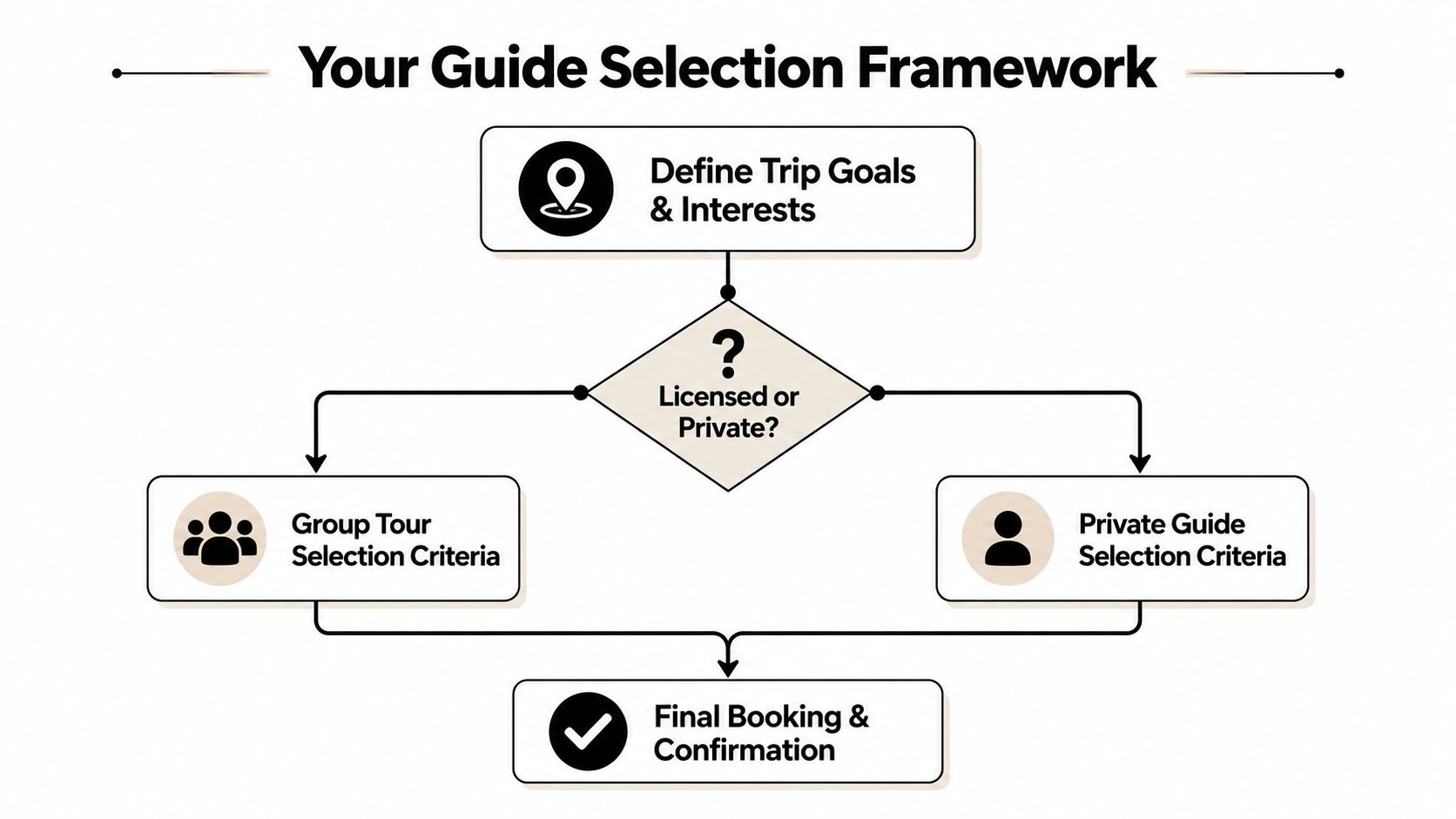
Start by defining the trip type, not the city name. A cultural week, an island-hopping escape, and a food-focused itinerary need different guide profiles. Then decide whether you need one guide for the whole journey or separate specialists for different regions. Croatia rewards that kind of segmentation.
Use this order of operations
1. Define your trip goals. Be specific about food, history, boats, photography, or active travel.
2. Match the region to the specialization. Don't force one guide to cover everything unless they can.
3. Confirm legal fit. Check licensing, language ability, and protected-site authority where needed.
4. Inspect the logistics. Ask who handles timing, transfers, weather changes, and timing gaps.
5. Lock in the format. Decide early whether you need a private guide, a small group, or a mixed itinerary.
Book for timing, not just taste
Croatia's tourism calendar is seasonal and concentrated, so the best guides get pulled into the most visible routes first. If your trip includes multiple regions, coordinate the guide sequence early so one weak handoff doesn't ruin the whole flow. The smartest itineraries often use one guide for a city-intensive segment, then a different expert for islands, food, or inland experiences.
Use the planning comparison in Haute Black as your benchmark for how detailed luxury trip design should feel. If you can't get that level of clarity from a guide, you're not ready to book them.
If you want Croatia planned the right way, with guides vetted for legal fit, specialization, and the kind of access that changes a trip, work with Haute Black and ask for a private itinerary. Visit Haute Black to start a more exacting Croatian journey, one where the guide is matched to the experience instead of the other way around.
Explore Our Guides


Signature Experiences