Haute Black Journal
Summer Vacation Planning for Luxury Travelers

Marlene Azeez
Director, HauteBlack
View all articles →

Only 45% of Americans said they planned a summer vacation with paid lodging in 2026, the lowest level in the prior six years, according to Deloitte's 2026 summer travel survey. Yet intended spending moved in the opposite direction. Travelers planned to spend an average of $4,069 on their longest summer trip, up 17% year over year, suggesting that luxury demand isn't disappearing. It's concentrating in fewer, higher-value journeys.
That shift changes the rules of summer vacation planning for affluent travelers. The objective isn't to find a destination that looks beautiful online. It's to secure the right room, the right access, the right vehicle, and the right people before availability disappears. A successful itinerary protects privacy, preserves energy, and accounts for the practical realities of families, executives, and travelers who expect every transition to feel effortless.
Mastering the Luxury Summer Vacation Planning Timeline
Luxury summer travel rewards precision. A destination can remain available while the preferred suite, villa, guide, transfer, or cancellation terms have disappeared. Research and purchasing require separate decisions, each with its own deadline.
Start with inventory, not inspiration
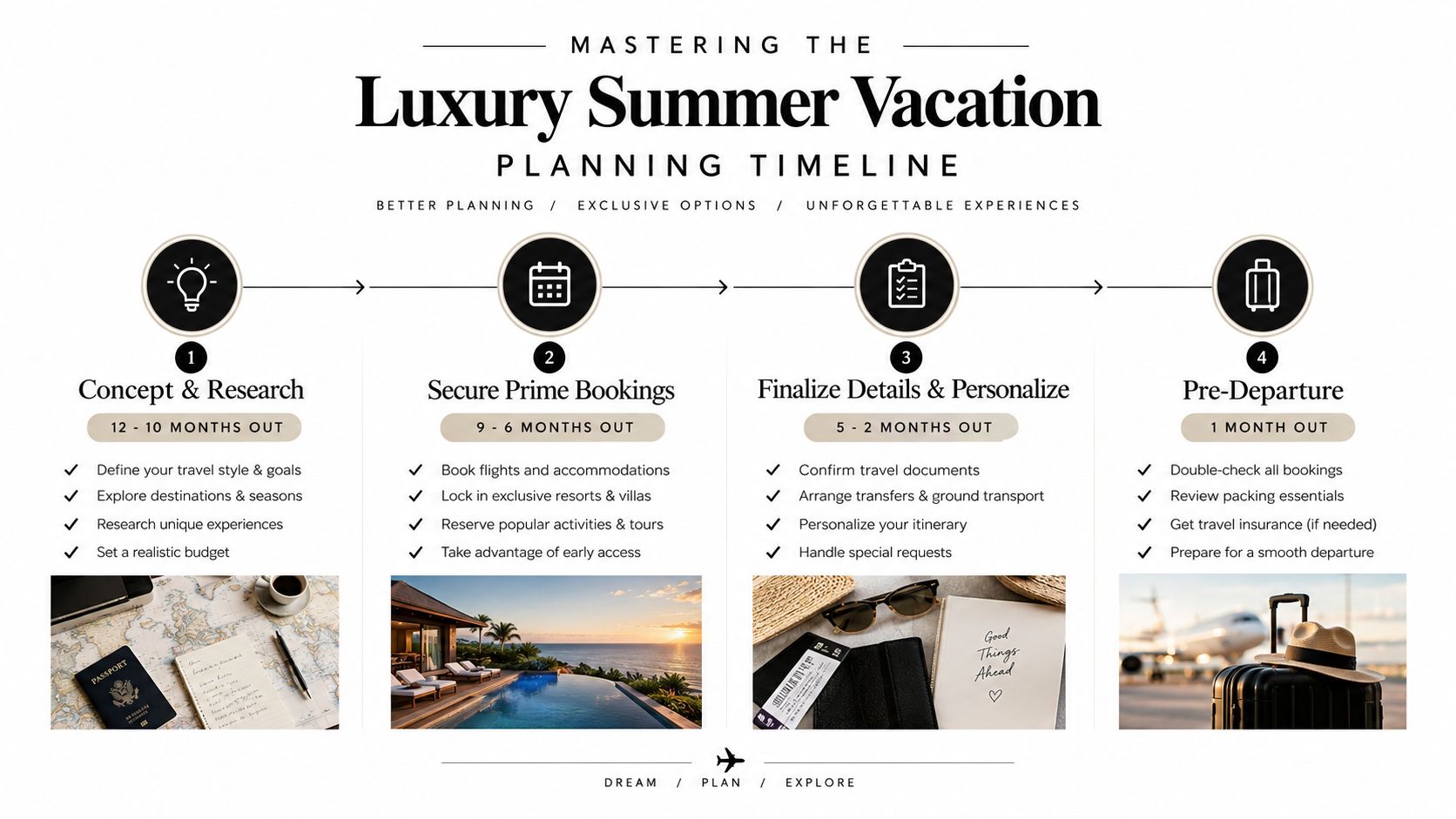
For constrained destinations such as the Amalfi Coast or Greek Islands, begin an inventory review 6 to 12 months before departure. The objective is to test whether properties matching your standards offer the right room categories, adjoining accommodations, private pools, discreet access, and workable cancellation terms. An experienced advisor also checks for unlisted options and early indications of VIP recognition before public availability narrows.
Booking behavior varies. A YouGov survey of British travelers found that 27% booked summer hotel and flight plans more than six months ahead, 23% booked four to six months ahead, 35% booked one to three months ahead, and 15% booked less than a month before departure. The YouGov travel booking analysis supports a two-part approach: inspect scarce inventory early, then preserve flexibility where the market allows it.
High-demand components should be assessed first, with major bookings generally confirmed one to three months before departure, consistent with YouGov's U.S. travel booking research. Compressing the entire process into one short window forces compromises in location, room type, routing, and cancellation protection.
Practical rule: Secure the physical space first. Personalize the experience after the foundation is protected.
Separate the room from the experience
Prioritize what cannot be recreated once sold: the villa, connecting suites, preferred arrival date, aircraft schedule, and transport with limited local capacity. A private museum visit, chef collaboration, sailing itinerary, or specialist guide can usually be refined later, provided the advisor opens those conversations early.
Flights require judgment rather than a fixed rule. Google Flights-based analyses cited by AOL's summer booking guidance commonly place the lower-fare benchmark for summer bookings in a 21-to-60-day window, with late-summer dates frequently offering lower fares. That timing does not suit every luxury itinerary. Peak travel dates, a specific aircraft, nonstop routing, premium cabins, and coordinated multi-generational travel often justify booking earlier.
Use this operating sequence:
- Concept and research: Define the purpose, group dynamics, privacy requirements, and fixed dates.
- Prime bookings: Secure constrained accommodation, premium cabins, private aviation, and scarce transport.
- Personalization: Confirm guides, dining, wellness, childcare, water activities, and cultural access.
- Pre-departure: Reconfirm manifests, dietary details, transfer timing, medical needs, and contingency plans.
The result is an operating plan, not merely a reservation file. It protects the preferred version of summer while giving an advisor room to secure recognition, access, and practical support that ordinary online inventory rarely displays.
Choosing Between Private Villas and Elite Resorts
The accommodation decision sets the trip's rhythm. A private estate gives the household control over space, staffing, meals, and movement. An elite resort gives the traveler a mature hospitality system, immediate amenities, and a social environment that can be activated or ignored.
Neither option is superior. The correct choice depends on whether your group values anonymity and flexibility more than institutional convenience and on-site infrastructure.
When a private villa earns its keep
A fully staffed villa is the stronger choice for multi-generational families, prominent guests, or groups that need the entire day to operate on their own terms. A dedicated chef can serve different meals to different age groups without forcing everyone into a restaurant schedule. An estate manager can coordinate pool service, excursions, housekeeping, childcare, and vehicle movements without turning the principal traveler into the project manager.
Privacy is also architectural. A villa can separate grandparents, parents, children, and staff in a way that a hotel floor often can't. It allows early risers to move through the property without disturbing sleeping guests and gives families a controlled environment for celebrations, security, and downtime.
The tradeoff is responsibility. A villa's service quality depends on the estate team, local suppliers, provisioning, maintenance, and the advisor's ability to intervene quickly. A beautiful house without excellent operations is an expensive inconvenience.
For travelers evaluating estate options, HauteBlack's private villas service is a useful reference point because the accommodation search should include staffing, service structure, access, and logistics, not just photographs.
When an elite resort is the better instrument
A top-tier resort is more efficient for couples, smaller groups, and travelers who want their needs met without managing a private household. Properties such as Aman and Four Seasons can provide spa facilities, dining, children's programming, water access, housekeeping, security, and transportation through one coordinated infrastructure.
Resorts also create useful optionality. One guest can book a treatment while another works out, and a third can meet friends at the bar without requiring a vehicle or escort. That ease matters after a long journey or during a trip where each traveler wants a different pace.
| Decision factor | Private villa | Elite resort |
|---|---|---|
| Privacy | Full property control and discreet movement | Private suites within a larger setting |
| Service | Dedicated staff tailored to the household | On-demand teams and established departments |
| Meals | Custom schedules and private dining | Multiple restaurants and room service |
| Space | Broad communal and private areas | Suites, villas, and resort facilities |
| Social energy | Created by the group | Available through the property |
| Operational burden | Advisor must manage local execution | Resort absorbs much of the coordination |
HauteBlack also published Best Family Vacation Europe: 10 Elite Escapes for 2026, a structured guide centered on 10 European escapes. For a Southern California extension or a shorter coastal experience, travelers may also find value in choosing to book with Another Side Of Los Angeles when a local operator can handle the ground experience with greater fluency.
A villa wins when the household needs control. A resort wins when the household needs effortless breadth.
Designing Bespoke Itineraries for Every Traveler Profile
A luxury itinerary should never be judged by how many reservations it contains. Its quality appears in the transitions, the empty space, and the way each traveler can pursue a different interest without fragmenting the group.
Start by identifying the trip's central purpose. A honeymoon needs privacy and emotional rhythm. A multi-generational holiday needs flexible meal timing, varied mobility requirements, and activities that don't force every generation into the same schedule. An executive workcation needs reliable connectivity and a workspace that doesn't make the guest feel trapped inside a hotel room.
Build the day around energy
Give each day a clear anchor, then protect the hours around it. The anchor might be a private architectural tour, a yacht day, a wellness treatment, or a dinner that requires a fixed departure. Everything else should remain adaptable.
For couples, the strongest design often combines one high-touch experience with unstructured time. After-hours cultural access can create intimacy without the fatigue of moving between multiple public attractions. A private guide should understand when to stop explaining and allow the setting to carry the moment.
Families require a different operating model:
- Young children: Arrange trusted childcare, short transfers, familiar meal options, and flexible cancellation terms.
- Teenagers: Add activities with genuine autonomy, such as water sports, outdoor exploration, creative workshops, or technology-friendly downtime.
- Older relatives: Confirm walking distances, vehicle access, seating, medication storage, and realistic excursion durations before finalizing the schedule.
- Mixed groups: Create parallel options so participation remains voluntary rather than socially compulsory.
The advisor needs candid information. Tell them who wakes early, who dislikes boats, who needs quiet after lunch, who works across time zones, and who will refuse a six-hour excursion. A customized travel itineraries guide can help frame those preferences before they become operational problems.

Make work invisible when work is necessary
Deloitte found that 34% of travelers planned to work during their longest summer trip in 2026, compared with 23% in 2025, as reported in coverage of the survey's findings. For executives, the answer isn't just adding Wi-Fi to a booking. It's designing a discreet work system.
Confirm dependable connectivity, a private desk, acoustic separation, power access, printing or document support, and a schedule that protects calls from excursions. If the property can't guarantee those details, arrange a nearby private workspace or reserve a second suite for working hours.
Luxury is not constant activity. It's the freedom to choose the right level of activity each day.
Set a cancellation decision point for weather-sensitive experiences, and keep one low-friction alternative available. A flexible itinerary protects the trip's emotional quality far better than an overloaded list of supposedly unmissable stops.
Orchestrating VIP Transport and Arrival Logistics
A luxury journey is judged at every handoff, from residence to aircraft, airport, vehicle, and property. A private charter still feels routine if the ground team lacks the passenger manifest, luggage plan, or exact arrival sequence. The advisor's job is to make those transitions predictable before departure.
For an international family arriving at a coastal resort, confirm passenger names, dietary requirements, luggage dimensions, vehicle capacity, security preferences, and the property's check-in protocol in advance. The aircraft operator receives the final itinerary. The receiving team confirms who meets the travelers, where luggage transfers, and whether the group should use a discreet route.
The arrival chain
A controlled arrival assigns responsibility at each touchpoint:
1. Departure coordination: Home pickup aligns with aircraft readiness, taking travelers directly to the terminal or private facility.
2. Aircraft handling: The charter team confirms catering, cabin configuration, special equipment, and passenger documentation.
3. Ground reception: A named representative meets the party and manages the luggage handoff.
4. Transfer execution: Vehicles are staged for group composition, security requirements, child seats, and luggage volume.
5. Property arrival: The resort or estate prepares rooms, preferred amenities, and a defined check-in process.
Every handoff can create friction. A missing suitcase, unsuitable vehicle, or unconfirmed passport detail can drain the energy the traveler paid to protect.
Arrival standard: The traveler should never have to ask who is responsible for the next move.
Complex routes require operational checks, not assumptions based on a polished itinerary. Verify terminal access, local customs procedures, helicopter landing permissions, road conditions, marina transfers, and the property's actual drive time. High-profile travelers may also require discreet security coordination and controlled arrival points.
For a detailed operational reference, HauteBlack's guide to VIP airport transfers explains how airport reception, private vehicles, and property arrival fit into one coordinated plan.
The right transport arrangement stays out of sight. Luggage arrives where expected, vehicles depart on schedule, and travelers reach the suite without resolving a single logistics issue. That level of control matters even more for multi-generational groups, where different mobility needs, luggage volumes, and arrival priorities must be handled without slowing the entire party.
Maximizing Value Through Preferred Partner Programs
Luxury value rarely appears as a headline discount. It comes from turning the same spend into a better room, stronger recognition, useful flexibility, and benefits that improve the stay from arrival onward.
A preferred partner program gives the advisor and property a direct channel for communicating the guest's priorities. That relationship may support a complimentary upgrade when available, a resort credit, personalized arrival amenities, or more flexible handling of changes. None of these benefits is guaranteed, and they do not justify choosing a weaker property. They do, however, strengthen a premium booking when the hotel, terms, and location already meet the brief.
Compare the booking channels
| Benefit category | Standard direct booking | Virtuoso preferred partner |
|---|---|---|
| Room placement | Based on available inventory and standard notes | Advisor advocates for the guest's preferred category and placement |
| Recognition | Guest profile and loyalty treatment | Added advisor relationship and property-level communication |
| Upgrade potential | Subject to the hotel's normal process | Complimentary upgrade when available, subject to terms |
| On-property value | Publicly available offers | Potential partner amenities such as resort credits, according to the property program |
| Changes | Governed by published rate rules | Advisor helps interpret options and negotiate where possible |
| Arrival | Standard check-in process | Coordinated VIP arrival and preference communication |
Preferred partner status produces the strongest return when the traveler defines the desired outcome before booking. Direct the resort credit toward a treatment, private dining, or activity the group already intends to enjoy. Request an upgrade only when the next category solves a specific issue, such as limited space, an obstructed view, insufficient privacy, or unsuitable sleeping arrangements.
The advisor should also confirm the benefit package in writing, including eligibility, expiration rules, blackout restrictions, and whether amenities apply per stay or per room. Clear terms prevent a property credit from becoming a vague promise.
Budget for value, not just rate
Compare the total operating value of the reservation. A lower public rate may prove less attractive if it removes flexibility, separates the group across rooms, or creates extra transport for the experiences that matter. A higher rate can be rational when it secures a preferred suite, stronger cancellation terms, or meaningful on-property benefits.
Timing requires judgment. The 21-to-60-day booking window can serve as a broad pricing reference, while late August may offer lower fares in some flight markets, as noted earlier. Luxury travelers should not chase that window blindly. Premium cabins, villas, and peak dates often sell through earlier, so use the benchmark to test pricing rather than dictate the booking date.
Shoulder-season travel next to peak summer may provide more availability and a calmer operating environment. Compare those advantages against school calendars, weather, event schedules, and the family's ability to change dates. For multi-generational groups, a small shift in timing can protect room configuration and reduce pressure on every other reservation.
The most expensive mistake is paying a premium without defining its required return. Choose whether the priority is recognition, flexibility, privacy, access, or time saved, then select the channel and rate that deliver it.
Leveraging a Private Advisor and Concierge Network
The most valuable asset in a luxury trip is often the relationship behind the reservation. A suite is visible inventory. The advisor's network is the less visible layer that determines whether the guest receives a preferred table, a credible guide, a discreet arrival, or a solution when the original plan breaks.
That distinction matters because public availability doesn't reveal the full operating picture. A property may show no suitable room online while an advisor can identify a release, a partner allocation, a different room configuration, or a neighboring solution that preserves the group's needs. The same principle applies to private dining, cultural access, transportation, and event invitations.
Choose an advisor for execution
Evaluate an advisor by the questions they ask before proposing a destination. A serious professional should want to understand the group's internal dynamics, privacy expectations, medical or mobility considerations, preferred communication style, dining standards, and tolerance for uncertainty.
Look for four capabilities:
- Network depth: Can the advisor reach decision-makers at properties, transport providers, restaurants, guides, and cultural institutions?
- Operational discipline: Do they provide clear ownership for manifests, transfers, confirmations, and contingencies?
- Lifestyle alignment: Do they understand the difference between a social resort, a secluded estate, and a design-led retreat?
- Disruption response: Can they reroute, rebook, and communicate calmly when weather, aircraft, illness, or delays interfere?
A private membership can add another layer of continuity. HauteBlack describes a model in which members receive a dedicated advisor and waived planning fees, while the broader platform coordinates bespoke journeys and access across its travel network. That structure turns summer vacation planning from a one-time purchase into an ongoing travel strategy.
Use the network before the trip begins
Ask the advisor to pressure-test the itinerary, not just confirm it. They should identify where the plan depends on a single boat, guide, vehicle, restaurant, or weather-sensitive activity. They should also establish who has authority to make changes while the traveler is in motion.
For premium-cabin planning, travelers may also consult how to book premium cabins smarter as a practical resource for evaluating flight options and cabin strategy. The advisor's role then extends beyond finding a seat. It includes aligning the flight with the transfer, sleep schedule, arrival time, and onward itinerary.
HauteBlack has also published The Ultimate 2026 Edit: 12 Exceptional Places To Visit In July, a time-specific list built around 12 July destinations. A list can generate ideas, but the advisor determines whether a destination fits the traveler's dates, standards, group, and operational appetite.
The right relationship gives you confidence without demanding your attention. You should know the plan is being monitored, the critical people are briefed, and the right doors can open when the itinerary requires them.
HauteBlack arranges bespoke summer journeys, private villas, VIP transport, preferred-property benefits, and dedicated advisory support for travelers who expect more than a standard itinerary. Visit HauteBlack to begin planning a summer vacation built around your dates, privacy requirements, group dynamics, and preferred level of access.
Explore Our Guides


Signature Experiences


