Haute Black Journal
Romantic Dinner Reservations: How to Secure the Best Tables

Marlene Azeez
Director, HauteBlack
View all articles →

Published August 26, 2026 by Marlene Azeez
You've dressed for the occasion, confirmed the route, and promised your partner an unforgettable evening. Then the restaurant's booking page shows nothing useful, the only available table is at an awkward hour, and the room you wanted appears to have vanished weeks ago. That outcome usually isn't bad luck. It's the predictable result of treating romantic dinner reservations as a calendar action instead of a relationship-driven workflow.
The best tables go to requests that arrive with clear intent, useful flexibility, and the right person behind them. A luxury advisor doesn't ask whether a table exists. They identify which inventory matters, determine who controls it, create confidence around the booking, and keep the request alive until the right seat opens.
Why Most Romantic Dinner Reservations Fail Before They Begin
The couple standing outside a booked-solid tasting room in Paris usually blames timing. They watch the hostess turn pages in a leather-bound reservation book while they wait for a name that isn't there. The dining room glows behind her, the table by the window is occupied, and the evening they planned around one specific restaurant has already become a recovery exercise.
I've seen this happen because the reservation was treated as a single online tap. The couple searched, selected a date, entered two names, and assumed the system had placed them in the same queue as everyone else. It had. That's the problem.
The widget doesn't know your priority
Online booking widgets are useful for ordinary availability, but they rarely communicate why the table matters, how flexible you are, or whether a trusted intermediary is managing the request. A system sees a party size and a time. It doesn't see an anniversary itinerary, a proposal, a hotel stay, or a couple willing to take a counter seat if it means dining in the kitchen.
The cost is undifferentiated demand. Your request sits beside casual diners who may cancel without consequence, even when your occasion deserves more careful handling.
Vague language weakens a strong request
“Romantic dinner” sounds pleasant, but it isn't operationally specific. A maître d' needs to know whether you're celebrating an anniversary, planning a proposal, marking a first visit, or looking for an intimate meal during a rare trip.
That context changes the response. “We're celebrating our anniversary and can dine any time after the first seating” gives a restaurant something to work with. “Can you get us a romantic table?” leaves the request in the same pile as every other broad inquiry.
No relationship means no escalation
The public booking channel is only one route into a restaurant. Hotel concierges, trusted travel advisors, membership networks, and established repeat guests may reach people who can see cancellations, held inventory, or seating options that never appear online.
The reservation is the first service interaction. Treat it like one.
Send the occasion, dates, party size, dietary needs, and acceptable alternatives in one clean message. Don't exaggerate your importance, threaten to take your business elsewhere, or send multiple vague follow-ups. A useful request gives someone a reason to help and enough information to act immediately.
Timing the Booking Window for Coveted Tables
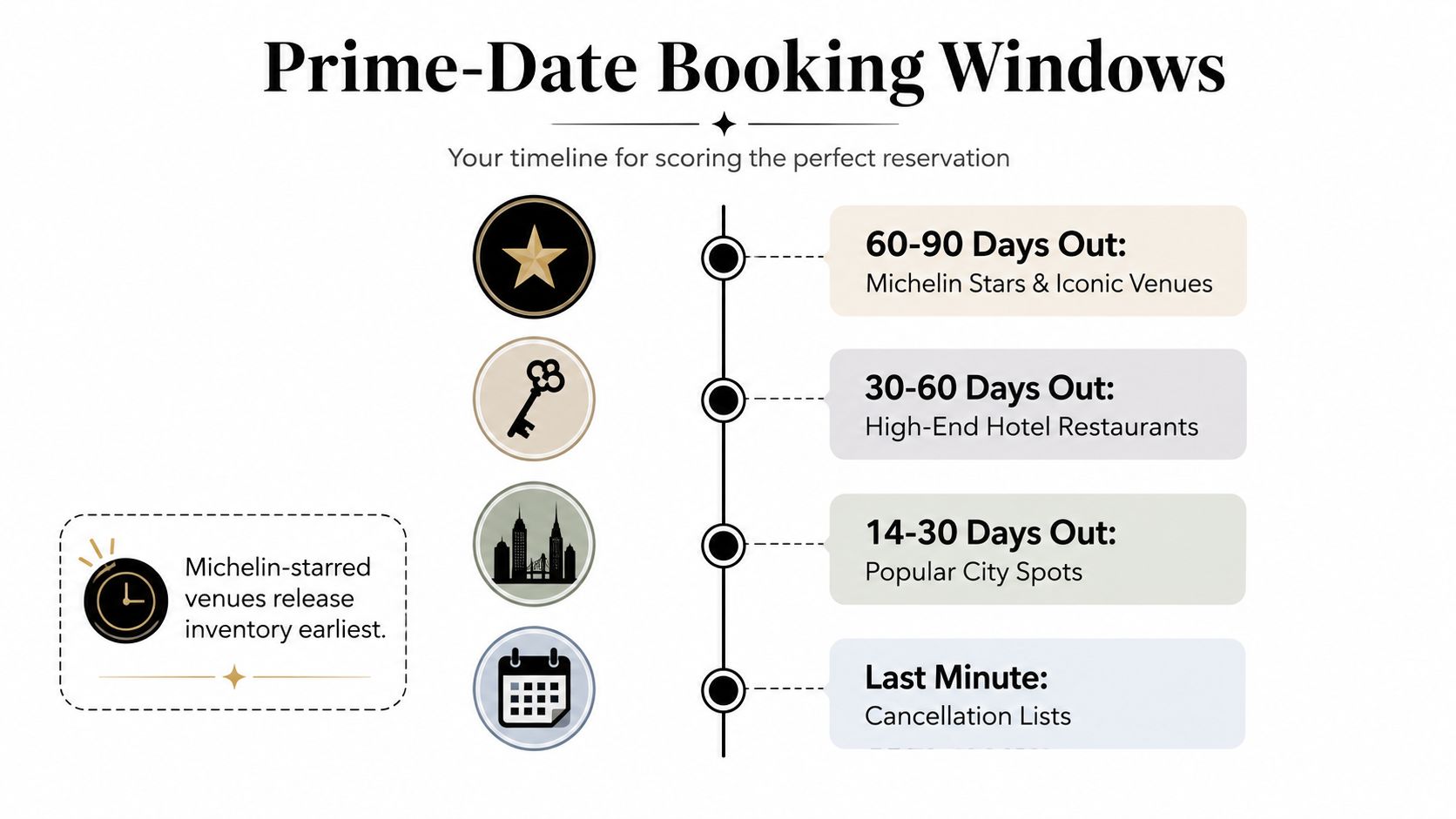
Prime tables are won through lead-time engineering, not hopeful refreshing. Lead time means the interval between making the booking and arriving for dinner. A 2025 dining-out trends report found that most bookings are made within a day of dining, with nearly 30% made up to four hours in advance, which makes rapid confirmation and backfill important when demand is concentrated (2025 dining-out trends report).
For a marquee venue, use a rolling-window approach:
1. Identify the release pattern. Iconic restaurants and Michelin-starred rooms may open dates well ahead of the meal, while hotel restaurants and popular city dining rooms often release inventory on a shorter cycle. Don't assume the booking calendar is complete because it looks full.
2. Target the release moment. Ask the restaurant when its next dates open, then be ready at that time. If you're using an advisor or concierge, give them the release date and your acceptable alternatives before inventory appears.
3. Separate date flexibility from time flexibility. A Tuesday may offer more choice than a Friday, while an early seating or late second sitting can be easier than the peak evening hour. The exact time matters as much as the date.
4. Keep a cancellation strategy active. Restaurants may release returned tables closer to service. Ask to be placed on a cancellation list and provide a phone number that someone will answer.
Choose the sitting that protects the experience
The most desirable time is often the most competitive. If the peak slot has disappeared, ask for the second sitting rather than abandoning the restaurant. You'll still experience the kitchen, service, and room, and you may avoid the pressure of an early table that makes the evening feel rushed.
For major romantic dates, plan earlier than you think. Valentine's Day is the most popular reservation day globally on OpenTable's network, with dinner bookings rising about 500% on average versus a typical day and upscale dinner reservations increasing 228% in the United States (OpenTable's Valentine's Day trends). The same report found that 83% of Valentine's Day reservations in 2025 were for parties of two, so a couple seeking a prime table is competing inside the holiday's most concentrated demand pattern.
If the date is fixed, make the time flexible. If the time is fixed, make the date flexible. Trying to control both is how couples end up outside the door.
The pattern is also highly planned. OpenTable reports that 86% of Valentine's Day reservations were made at least one day in advance, 56% were made one week ahead, and 7 p.m. was the leading booking slot (OpenTable's Valentine's Day trends). For a detailed explanation of how scarce inventory gets released and reclaimed, the Rolex waiting list guide offers a useful parallel. The principle is similar, patience works better when the request remains active and specific.
How Deposits and Card Holds Actually Get You Better Tables
A restaurant's cancellation policy is also an inventory policy. The more certainty a venue has that you'll arrive, the more comfortable its team becomes assigning scarce seats to your booking before service.
Industry reporting cites a typical no-show range of 10% to 20% without a card hold or deposit, compared with roughly 2% to 7% at venues using a payment commitment (restaurant no-show reporting). OpenTable also reports that diners booking through its platform are 40% less likely to no-show than diners booking through search engines, and 28% less likely than website-direct bookings (restaurant no-show reporting). Those figures explain why restaurants pay attention to commitment signals, but they don't mean every prepaid booking receives a superior table. They mean certainty becomes part of the restaurant's operating decision.
Read the policy before you click
| Deposit Tiers and the Access They Unlock | Typical Amount | Priority Tier | Table Access |
|---|---|---|---|
| Card guarantee | No payment hold | Lowest | Standard available seating |
| Per-person deposit | Policy varies by venue | Middle | Greater access to committed inventory |
| Full prepay or tasting-menu commitment | Menu or experience price | Highest commitment | Chef counters, banquettes, or preferred tables when available |
The amounts vary by restaurant, date, and experience. Don't assume a deposit alone guarantees a window table or banquette. It confirms that you understand the venue's rules and are less likely to release valuable inventory casually.
A card guarantee, per-person deposit, and full prepayment also create different cancellation obligations. Read the cutoff, arrival requirements, and modification rules. Couples who miss this detail often spend the evening disputing a charge rather than enjoying dinner.
Use flexibility without abusing trust
If your date is flexible, you can place committed requests at competing venues and release the alternatives as soon as one is confirmed. Do this only when you understand each restaurant's cancellation terms and can cancel responsibly. Holding several scarce tables carelessly damages your credibility with concierges and restaurants, and it prevents another guest from using the seat.
The better mindset is simple: romantic dinner reservations are a commitment game. You're not buying priority with money alone. You're showing the restaurant that your request is reliable, your expectations are informed, and your communication will remain clean.
Working With Concierges and Travel Advisors for Access
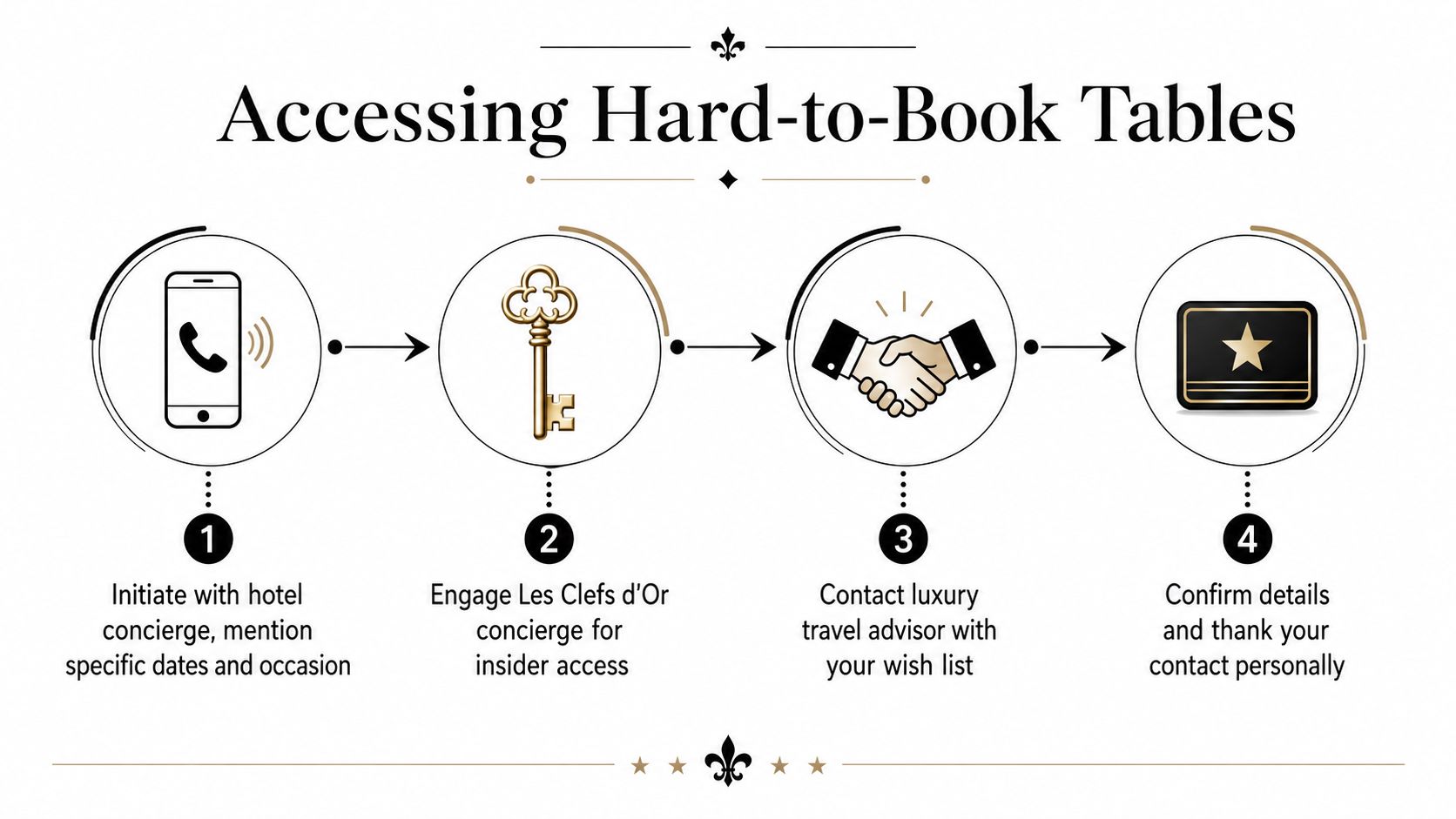
A concierge can help, but only if you give them a request they can execute. “Find somewhere special” forces them to guess. A strong request identifies the occasion, date range, preferred cuisine, party size, dietary restrictions, location, acceptable seating, and the point at which you'd like them to stop searching.
Send a request that can move
Use this structure:
We're celebrating our anniversary during our stay in Paris. We'd like dinner for two on either Thursday or Friday, preferably after the first seating. We're open to a chef counter or banquette, have no dietary restrictions, and would value a room with atmosphere rather than a private room. Please place us on the cancellation list for the preferred restaurant and suggest one comparable alternative.
That message gives the contact a clear objective and permission to solve the problem. Don't lead with “We're VIPs,” insist on a specific table without offering flexibility, or send a long biography. Status is useful only when the person receiving the request can verify and apply it.
Hotel concierges should be your first call when you're staying on property or nearby. A Les Clefs d'Or concierge may have strong local relationships, while an independent luxury advisor can coordinate the restaurant with transfers, hotel recognition, and the rest of the itinerary. Networks such as Virtuoso, Signature Travel Network, and Marriott STARS or Luminous programmes may provide advisor pathways that differ from public booking channels, but no affiliation removes the need for a precise request.
Escalate without creating noise
If the first contact stalls, reply with one useful update. Offer a different night, an earlier or later sitting, or a chef's counter. If the request remains unresolved, ask whether a senior concierge, restaurant relations contact, or travel advisor can review it.
Credit card concierge services can outperform a hotel desk when the restaurant has a strong relationship with the card network or when you're not staying at a hotel. Amex Centurion and Chase Sapphire Reserve services may be useful channels, but don't send the same request to every service at once. Choose a lead channel, keep the others available, and tell each contact if another party has secured the table.
For a broader look at how this kind of coordination fits into luxury travel planning, see HauteBlack's guide to luxury travel concierge services. After the meal, thank the person who helped, mention the successful outcome, and acknowledge excellent work through the appropriate hotel or advisor channel. A thoughtful follow-up strengthens the next request.
Choosing Between Private Dining, Chef's Tables, and Standard Seats
The right seat shapes the evening before the first course arrives. A poor choice can turn a romantic dinner into a performance you observe rather than experience. Private dining, chef's tables, and standard seats create distinct moods, even within the same restaurant.
| Private Dining vs Chef's Table vs Standard Seat | Access Difficulty | Privacy Level | Typical Price Range | Best For |
|---|---|---|---|---|
| Private dining room | High | Highest | Venue-specific | Proposals, sensitive conversations, milestone celebrations |
| Chef's table or counter | High | Low to moderate | Venue-specific | Culinary theatre, first visits, couples who enjoy interaction |
| Standard banquette, window table, or two-top | Moderate to high | Moderate | Venue-specific | Atmosphere, people-watching, relaxed romance |
Private dining
A private room controls sound, pacing, and conversation. It may also separate you from the restaurant's energy, especially when the room is built for business entertaining rather than intimacy. Before accepting it, ask about a dedicated entrance, view, minimum spend, fixed menu, and what the booking includes.
For an intimate event outside regular restaurant service, Fiore's private dinner events offer a useful reference for building the experience around the gathering instead of fitting it into standard seating. Apply that same logic to a restaurant's private room. Confirm whether service, décor, beverages, and timing are included.
Chef's tables
A chef counter, kitchen pass, omakase bar, or communal counter exchanges privacy for theatre. You see the pacing, hear the team, and may speak directly with the cooks. Choose this setting for a couple who wants the meal itself to become the shared activity. It will frustrate partners seeking uninterrupted conversation.
A chef's table can also improve access because it belongs to a separate inventory category. Request counter seating specifically rather than asking for “any table.” For a first visit or a couple fascinated by technique, this choice often creates more connection than a secluded room.
Standard seats
A banquette or window two-top usually offers the strongest balance of atmosphere and discretion. The couple remains part of the room without becoming the centre of attention. Ask for a quiet corner or a window position when the restaurant can accommodate preferences, and keep a standard table as the practical fallback when the occasion matters more than the format.
For couples considering a chef-led meal at home or in a villa, HauteBlack's guide to private-chef dinners and bespoke dining explains how the service model changes privacy, pacing, and personal attention. For a proposal, prioritise a private room with discreet timing and controlled access. For a milestone celebration, choose a chef's counter if shared culinary theatre matters more than seclusion.
Personalisation Tactics That Turn a Meal Into a Memory
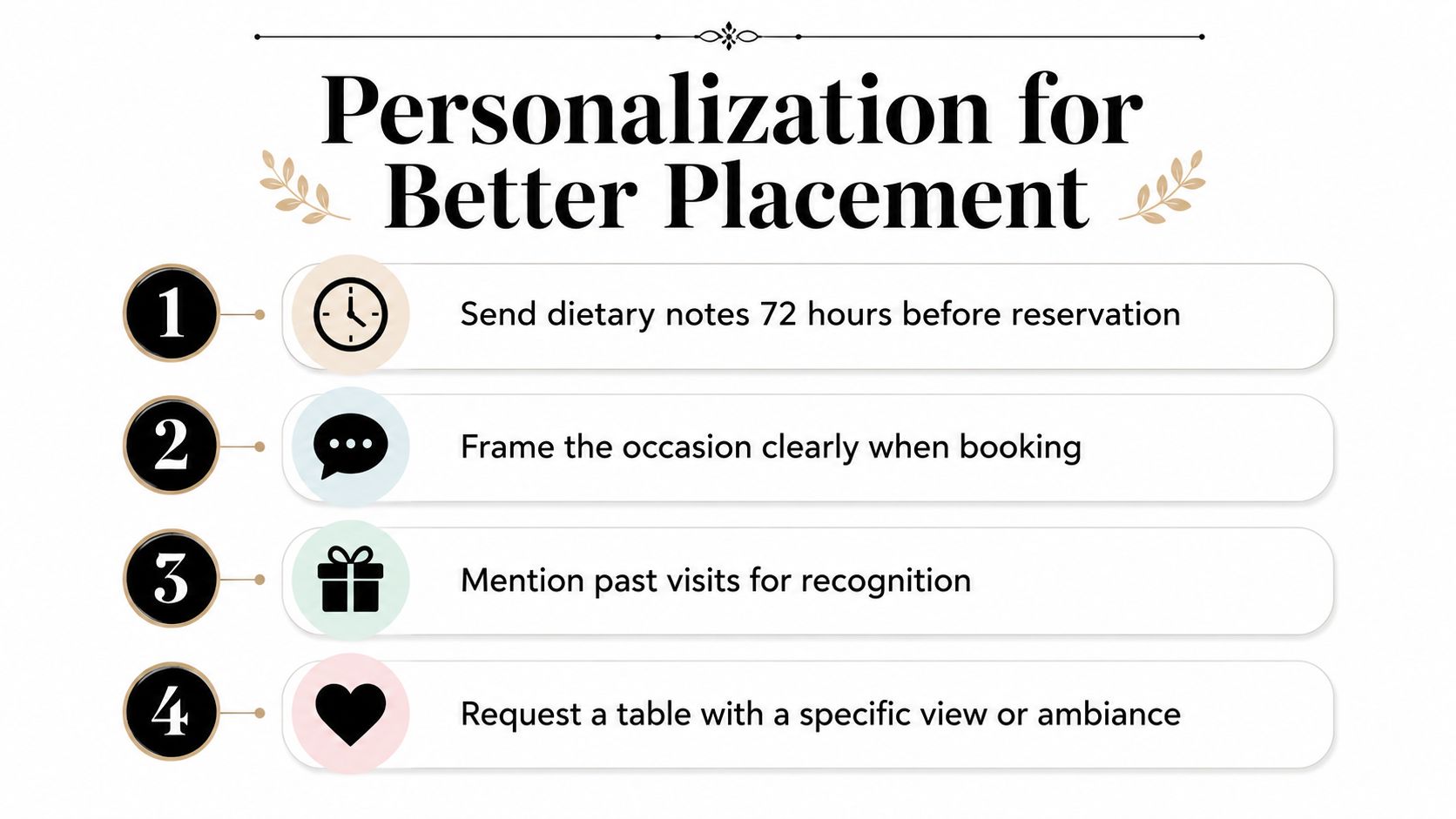
A memorable reservation begins with information the restaurant can use. Give the team the occasion, dietary requirements, and one precise preference. “Something romantic” is too vague to guide seating or service.
Send dietary information early, ideally 72 hours before the reservation, so the kitchen can plan rather than improvise. Separate allergies from preferences. “Severe shellfish allergy” requires a different response from “one guest prefers not to eat shellfish.” Add the details to the reservation, then repeat them to the concierge or hotel if they are coordinating the evening.
Give the maître d' useful context
The best personalisation goes beyond the occasion. Tell the restaurant what will make the evening comfortable: low noise, an unhurried pace, a particular dessert, or discreet handling of a surprise. These details help the team make decisions when the preferred table or timing changes.
For example:
We're celebrating our anniversary and would appreciate a quiet two-top with a view if one becomes available. We prefer no public announcement and are happy to follow the kitchen's recommended pacing.
Keep sensitive proposal details out of a public reservation note if several staff members can see it. Give those instructions to the concierge or maître d' by phone, and confirm exactly who is responsible for the reveal.
Coordinate the gesture
A gift becomes more effective when its arrival is planned. A jeweller can deliver an item to the hotel, flowers can arrive before the couple leaves the room, and a handwritten card can wait at the desk for a controlled reveal. For a polished gift to accompany dinner, review Online Gifts Canada's romantic gifts for her before arranging delivery.
Create a useful guest profile for repeat visits. Tell the advisor or front desk what worked previously, then ask them to attach those preferences to the relevant restaurant or hotel record. A profile containing practical details can help recognition follow you across venues operated by the same hospitality group. Loyalty programmes such as Marriott Bonvoy, Hilton Honors, and Leading Hotels help only when the information attached to the account is specific.
For couples pairing dinner with a destination stay, HauteBlack's guide to planning a romantic getaway shows how dining should fit the arrival, transport, hotel, and emotional rhythm of the trip. Ask the advisor to coordinate those elements rather than treating the restaurant as an isolated booking.
A personalised request earns the restaurant's memory of you, and that memory compounds across visits.
Your Romantic Dinner Reservations Checklist
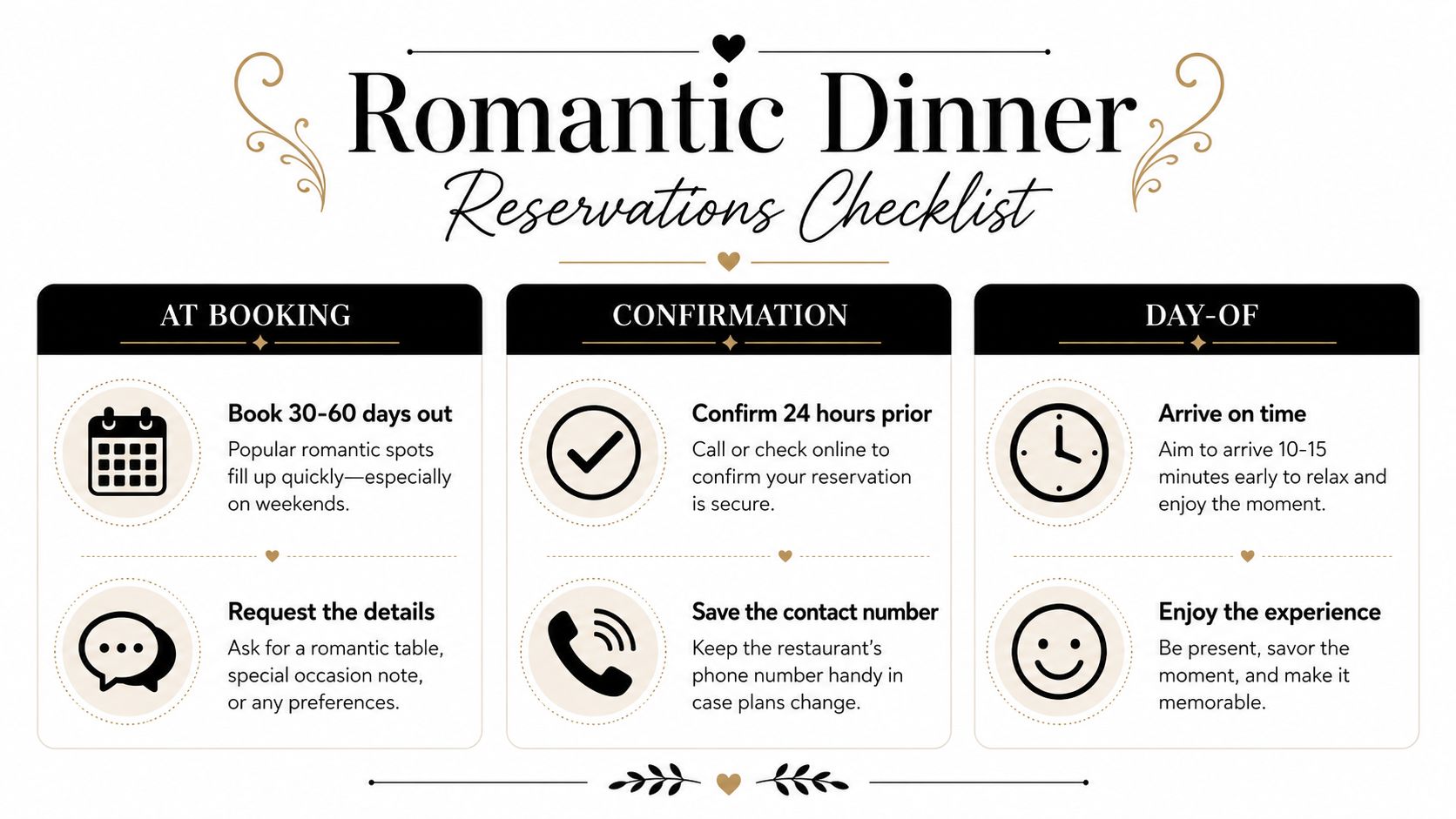
A romantic table is secured through a controlled workflow, not a single calendar entry. Assign one person to own the restaurant request, messages, and follow-up. The other person can confirm the occasion, dietary information, surprise details, and preferred atmosphere. Clear ownership prevents missed calls, conflicting instructions, and forgotten cancellation terms.
At booking
- Define the occasion: State whether dinner marks an anniversary, proposal, first visit, friendship celebration, double date, or solo luxury meal. The restaurant can respond more precisely when it knows what the evening requires.
- Set the flexibility: List acceptable dates, earliest and latest dining times, and seating types you will accept. Flexibility gives a concierge or advisor room to trade time for access.
- Choose the channel: Use the restaurant's booking system for ordinary inventory. For a difficult table, contact the hotel concierge, travel advisor, or card service as soon as the booking window opens.
- Commit deliberately: Read the card guarantee, deposit, prepaid menu, cancellation cutoff, and arrival rules before confirming. A deposit is part of the reservation strategy, not a minor administrative detail.
- Name the room: Request a private dining room, chef counter, banquette, window table, or standard two-top. “Romantic” alone does not identify the seat you want.
Romantic dining includes celebrations beyond couples. OpenTable found that 60% of Gen Z and 41% of Americans overall were likely to celebrate Valentine's Day with friends rather than a romantic partner, while Galentine's Day dining rose 34% year over year (OpenTable research on broader Valentine's celebrations). The same research reported a 35% year over year increase in solo reservations. Apply the same disciplined brief to a double date, friendship dinner, or solo celebration. Precision matters regardless of the guest list.
At confirmation
- Reconfirm the essentials: Check the date, time, party size, menu format, deposit, and cancellation terms.
- Send the personal details: Provide dietary notes early, explain the occasion, and identify any surprise that requires discretion. Ask the restaurant to record these details rather than relying on a verbal promise.
- Keep one communication owner: Tell the restaurant and concierge who will answer calls and messages. That person should remain reachable until the reservation is complete.
- Maintain the waitlist: If you want a better time or table, stay available for cancellations and answer quickly. A waitlist works only when someone can act immediately.
Restaurant Dive's coverage found that Valentine's bookings can rise 433% versus a normal Thursday, while tables for two were projected to increase 764% compared with a typical night (Restaurant Dive's coverage of Valentine's reservation demand). The same reporting noted that prepaid reservations above $200 represented 10.1% of Valentine's bookings in 2025, compared with 7.2% in 2024, and that occupancy can reach 90% or higher on Valentine's Day. Confirm every condition before committing. A full dining room leaves little room to repair an avoidable misunderstanding.
On the day
- Arrive with margin: Allow time for traffic, coat check, and a composed arrival. Rushing changes the mood before the first course.
- Tell the host the occasion privately: Share the relevant context discreetly instead of expecting the service team to infer it.
- Use the room as intended: A chef counter offers interaction and visibility. A private room offers control and privacy. A banquette creates a different experience again, so judge the evening against the seat you selected.
- Close the loop: Thank the concierge, advisor, host, or maître d' who helped, then record what worked for the next request. Useful preferences become valuable when they are documented.
HauteBlack coordinates bespoke travel, concierge dining, Michelin reservations, private chefs, and intimate experiences through advisor relationships and member reservation channels. Visit HauteBlack to plan an itinerary in which the table, hotel, transfers, and personal touches are managed as one experience.
Frequently Asked Questions
Explore Our Guides


Signature Experiences