Haute Black Journal
Private Jet Charter New York City: A Complete 2026 Guide

Marlene Azeez
Director, HauteBlack
View all articles →

August 29, 2026
Teterboro is the default New York City gateway, handling 14,328 private-jet departures in Q1 2026, roughly 12 miles from Midtown with a typical 20 to 30 minute drive. Airport choice and departure timing shape the aircraft available, the ground transfer, the quote, and whether a private flight saves meaningful time.
At 7:15 a.m., a CEO staying at the Waldorf receives a call. A Palm Beach deal needs her in the room before noon. Her executive assistant has already texted the charter desk, the bags are in the car, and the aircraft is being positioned at Teterboro while the 7:42 train from Penn Station is still loading passengers for Babylon.
That tempo defines a private jet charter in New York City. This isn't primarily a leisure market built around relaxed planning. It's a business-led aviation hub where corporate schedules, last-minute changes, dense airspace, and competing airport clusters make aircraft availability and timing more important than the advertised hourly rate.
Teterboro's concentration makes that possible. One recent aviation-tracking dataset recorded 4,594 movements over a trailing 14-day period, or about 328 daily movements, while another recorded 4,315 movements, or about 308 per day. The same source family reported 12,380 monthly movements in June 2026, compared with a monthly average of 11,940 and a +9.5% trend. (Aviation-tracking data on the busiest private jet airports)
The operational consequence is straightforward. New York offers dense scheduling and broad aircraft access, but a ground delay, weather disruption, or late manifest can erase the time advantage you paid for. The planning standard should cover the airport, aircraft, true cost, documentation, safety vetting, and arrival logistics in one coordinated brief. HauteBlack's private aviation services sit within that wider luxury-travel model, while travelers managing sleep on long sectors may also benefit from long-haul sleep guidance from The Sleep Consultant.
Why New York City Private Aviation Feels Different
New York isn't just a large departure market. It's a high-frequency, high-consequence operating environment where the schedule usually belongs to the principal, not the airline.
The regional market recorded about 17,231 private-jet departures in Q1 2026, with Teterboro accounting for 14,328, or 83.2% of the region. Newark recorded 930 departures, and JFK recorded 616 during the same period. (New York private aviation market data)
That concentration creates choice, but it also creates pressure. Teterboro, Newark, JFK, and LaGuardia share a demanding metropolitan airspace system. Traffic queues, weather holds, runway configuration, and aircraft repositioning can affect a trip that looked simple when the assistant first requested a quote.
The rate is not the objective
A low hourly figure can be misleading if the aircraft must be fetched from another city, the departure airport adds a long ground transfer, or the aircraft class can't complete the route without a fuel stop. For a CEO moving between New York and a critical meeting, arrival certainty and usable working time matter more than a nominal rate.
The demand profile supports that conclusion. Midsize and light jets represented 56.7% of New York private-jet activity in Q1 2026, pointing to a market weighted toward short and medium missions rather than only intercontinental flights. (New York airport costs, routes, and market trends)
A disciplined assistant should send the charter desk five details immediately:
- Passenger count: Include adults, children, and any staff who may join later.
- Exact timing: Separate hard arrival deadlines from preferred departure times.
- Destination flexibility: Identify acceptable alternate airports before the search begins.
- Baggage and special requirements: Include golf equipment, pets, medical needs, or security considerations.
- Return pattern: A same-day return, overnight stay, or open itinerary changes aircraft positioning.
Practical rule: In New York, book the operational solution first. The aircraft category and cabin finish come second.
Choosing the Right New York Airport for Your Mission
Teterboro should be the default for most Manhattan principals. It sits about 12 miles from Midtown, and the drive commonly takes 20 to 30 minutes, depending on traffic. The airport has runways measuring 7,000 feet and 6,013 feet, and its 100,000-pound maximum landing-weight restriction can affect heavy-jet compatibility. (Teterboro operating challenges and trip support)
The right field depends on where the principal starts, where the aircraft needs to go, and whether the priority is convenience, parking, or runway capability.
| Airport | Drive from Midtown, no traffic | Max Aircraft Category | Best For |
|---|---|---|---|
| Teterboro, KTEB | About 20 to 30 minutes in typical conditions | Light through heavy aircraft, subject to weight and performance limits | Manhattan and northern New Jersey departures |
| Westchester, KHPN | Longer Manhattan transfer | Most light, midsize, super-midsize, and selected heavy operations, subject to performance | Greenwich, Stamford, Westchester, and upcounty access |
| Linden, KLDJ | About 45 to 60 minutes longer than Teterboro from many Manhattan locations | Light through midsize operations, subject to aircraft and field limits | Overnight parking and repositioning |
| Morristown, KMMU | Longer western transfer | Light through heavy operations, subject to aircraft and performance | Western New Jersey and Bucks County pickups |
| JFK or LaGuardia private terminals | Variable, traffic dependent | Very light jets and turboprops for short sectors | Hamptons shuttles and quick regional hops |
Use the airport as a scheduling tool
Westchester earns consideration when the client is coming from Greenwich, Stamford, or Westchester itself. The longer drive from Midtown can be offset by a cleaner ground experience for a Connecticut-based principal. Linden is more useful for an operator managing an overnight aircraft or a repositioning plan than for a Manhattan executive who values a short transfer.
Morristown suits western New Jersey and Bucks County. JFK and LaGuardia private terminals, including light-aircraft facilities such as BLADE Lounge, generally make sense only for short hops where the aircraft's limited runway and cabin profile match the mission.
Teterboro's Runway 19 is the main private-aircraft departure and arrival runway under noise-abatement procedures, and shared airspace with Newark, JFK, and LaGuardia increases delay exposure. Dispatch should therefore build realistic fuel and timing buffers rather than treating a Teterboro departure like a low-density regional field. (Teterboro trip-support guidance)
If the principal is in Midtown, start with Teterboro. Move to Westchester, Linden, or Morristown only when the origin, aircraft position, or operational plan justifies the extra drive.
Matching the Jet to the Trip
Choose the smallest aircraft that safely and comfortably completes the mission. Larger isn't automatically better. It adds cost, may reduce runway flexibility, and can create unnecessary positioning work.
Start with the route
A light jet such as a Citation CJ3 or Phenom 300 is well suited to Boston, Washington, or Montreal with a small group. It offers efficient access to shorter fields, but it becomes a poor choice for a transcontinental itinerary where cabin endurance and range matter more than a lower entry rate.
A midsize aircraft, such as a Citation XLS+ or Learjet 60, is the practical workhorse for Chicago, Miami, and Caribbean sectors. It gives a larger group more room without carrying the operational burden of a heavy jet.
Super-midsize aircraft, including a Challenger 350 or Citation Sovereign+, are the preferred compromise for longer missions such as Aspen, London, or Tel Aviv. They offer a stand-up cabin and more capable range profile, but they still require a careful runway and payload review.
Heavy jets, including a Gulfstream G450 or Global 5000, earn their premium on missions such as New York to Dubai, Singapore, or São Paulo. Full galleys, larger cabins, and sleeping arrangements matter when the aircraft is effectively serving as a mobile office and bedroom.
Ultra-long-range aircraft such as a G650 or Global 7500 belong on missions where a fuel stop is unacceptable, including New York to Tokyo or Sydney. They're not the sensible answer for a short domestic flight just because the principal prefers a larger cabin.
Then check runway and payload
Teterboro's runway length and landing-weight restriction can narrow the viable aircraft list. A heavy jet may look available in a broker's database but fail the world payload calculation once fuel, passengers, baggage, weather, and runway performance are included.
Westchester's 6,651-foot runway can accommodate many heavy operations with proper planning, but warm-weather payload and performance constraints still need verification. The charter desk should provide an operating answer, not just a category label.
Ask for three confirmations before approving the aircraft:
1. Route capability: Can it complete the route nonstop with the requested payload?
2. Airport performance: Can it depart and land at the selected field under expected conditions?
3. Cabin suitability: Does the layout support the principal's work, rest, baggage, and privacy requirements?
The best aircraft is the one that meets all three without forcing a fuel stop, airport substitution, or last-minute passenger reduction.
How Much a Private Jet Charter Actually Costs
A New York charter quote is a package of operating costs, not a simple multiplication of flight hours by an hourly rate. The assistant comparing proposals should demand the same cost categories from every provider.
The base hourly range supplied for planning is approximately $3,500 to $5,500 for light jets, $5,500 to $8,000 for midsize jets, $8,000 to $12,000 for super-midsize jets, and $12,000 to $18,000 for heavy jets, with ultra-long-range aircraft priced higher. Those figures are only starting points. Aircraft location, date, route, and repositioning can change the final total materially. (Private aviation pricing and route factors)
Read the quote line by line
The major components are:
- Aircraft time: The occupied flight time and any applicable daily minimum.
- Fuel adjustment: A surcharge may apply when Jet-A pricing rises.
- Federal taxes: Domestic legs include the 7.5% Federal Excise Tax. (Private aviation pricing and fees)
- Segment charges: FAA segment fees can apply by passenger and flight leg.
- Airport costs: Landing, handling, parking, and FBO charges vary by field and aircraft.
- Crew expenses: Overnight accommodation, meals, and per-diem enter when the crew stays away.
- Repositioning: The client may pay for the aircraft to reach New York and continue after the trip.
- Seasonal services: De-icing, hangar arrangements, and weather-related handling can add cost.
- Trip extras: Catering, Wi-Fi, security, and ground transport may sit outside the base quote.
A quote isn't comparable until you know where the aircraft is coming from, where it goes next, and which fees the operator has included.
For example, a Teterboro to Aspen super-midsize charter may land between $42,000 and $58,000, depending on positioning. A similar hour-block to Miami may quote between $30,000 and $38,000 because the positioning requirement is shorter. These are planning examples, not guaranteed prices. (NYC private jet route and pricing context)
| Cost Component | Light Jet, for example Phenom 300 | Super-Midsize, for example Challenger 350 | Heavy Jet, for example Gulfstream G550 |
|---|---|---|---|
| Aircraft time | Lower base rate, efficient for short sectors | Higher rate, suited to longer missions | Highest rate, justified by range and cabin |
| Fuel adjustment | Usually smaller in absolute terms | More meaningful on longer sectors | Material on long-haul missions |
| Domestic FET | 7.5% on the domestic leg | 7.5% on the domestic leg | 7.5% on the domestic leg |
| Repositioning | Often decisive on one-way trips | Common factor from New York | Can dominate an otherwise attractive rate |
| Crew overnight | Applies when the itinerary requires it | Applies when the itinerary requires it | Applies when the itinerary requires it |
| Airport and handling | Field and aircraft dependent | Field and aircraft dependent | Field, weight, and handling dependent |
The cheapest hourly number often produces the most expensive trip once fetches, airport substitutions, and schedule friction appear. Ask for an all-in estimate with assumptions stated in writing.
Booking Options From On-Demand to Membership
New York travelers generally choose among four access models. The correct choice depends on annual usage, route consistency, tolerance for peak-day lockouts, and how much work the assistant wants to delegate.
| Booking Model | Best For | Typical Hourly Cost | Notice Required | NYC Peak Protection |
|---|---|---|---|---|
| On-demand charter | Occasional or irregular travelers | Quote varies by aircraft, route, date, and positioning | Flexible, subject to availability | Lowest unless arranged early |
| Jet card | Executives with recurring annual usage | Contracted or fixed structure, subject to program terms | Often defined by the program | Better within guaranteed windows |
| Fractional ownership | Frequent users with consistent city pairs | Share, management fees, and occupied-hour billing | Program-specific | Stronger for allocated access |
| Bespoke membership | Principals needing concierge coordination across operators | Customized, based on itinerary and service model | Advisor-led, subject to aircraft supply | Relationship and planning dependent |
On-demand charter
On-demand is the cleanest entry point. You pay for the trip you need, retain maximum route flexibility, and avoid a long-term commitment. The trade-off is peak-day pricing volatility, less certainty on a preferred aircraft, and greater exposure to positioning charges.
Jet cards suit executives with repeat demand who value predictable pricing and defined availability windows. They can be useful when travel is frequent but not consistent enough to justify fractional ownership. Read the lockout rules carefully. A promise of availability is only useful if it covers the dates and aircraft classes the principal needs.
Fractional ownership becomes more compelling when a traveler has regular city pairs and substantial annual usage. The client takes on a share, management fees, and occupied-hour billing, so the administrative and financial structure needs to match genuine utilization rather than aspiration.
Bespoke coordination
A bespoke membership model is most useful when the principal's travel doesn't fit a single operator's fleet. The advisor can compare multiple aircraft, arrange ground transfers, coordinate hotel and lifestyle elements, and maintain a single preference file for the executive assistant.
HauteBlack's executive private-jet booking guide reflects that concierge-led approach. The company presents private aviation alongside tailor-made luxury travel, VIP recognition, and preferred-partner coordination, rather than treating the aircraft as an isolated transaction.
The harder question is peak protection. Dates around UN Week, Thanksgiving, and Art Basel preparation can compress inventory. No model eliminates aircraft scarcity, but early planning, flexible airport selection, and a clearly documented backup plan reduce the chance of a forced compromise.
Choose on-demand for occasional travel, a jet card for repeat but variable use, fractional ownership for sustained and predictable utilization, and bespoke membership when the principal wants one accountable advisor across aviation and ground logistics.
Documents, Timelines, and Ground Logistics
A private jet booking is unfinished until the FBO, passenger manifest, catering, ground transport, and contingency plan are confirmed. In New York, timing matters more than the advertised hourly rate because an airport change or delayed driver can erase the time advantage.
The booking sequence
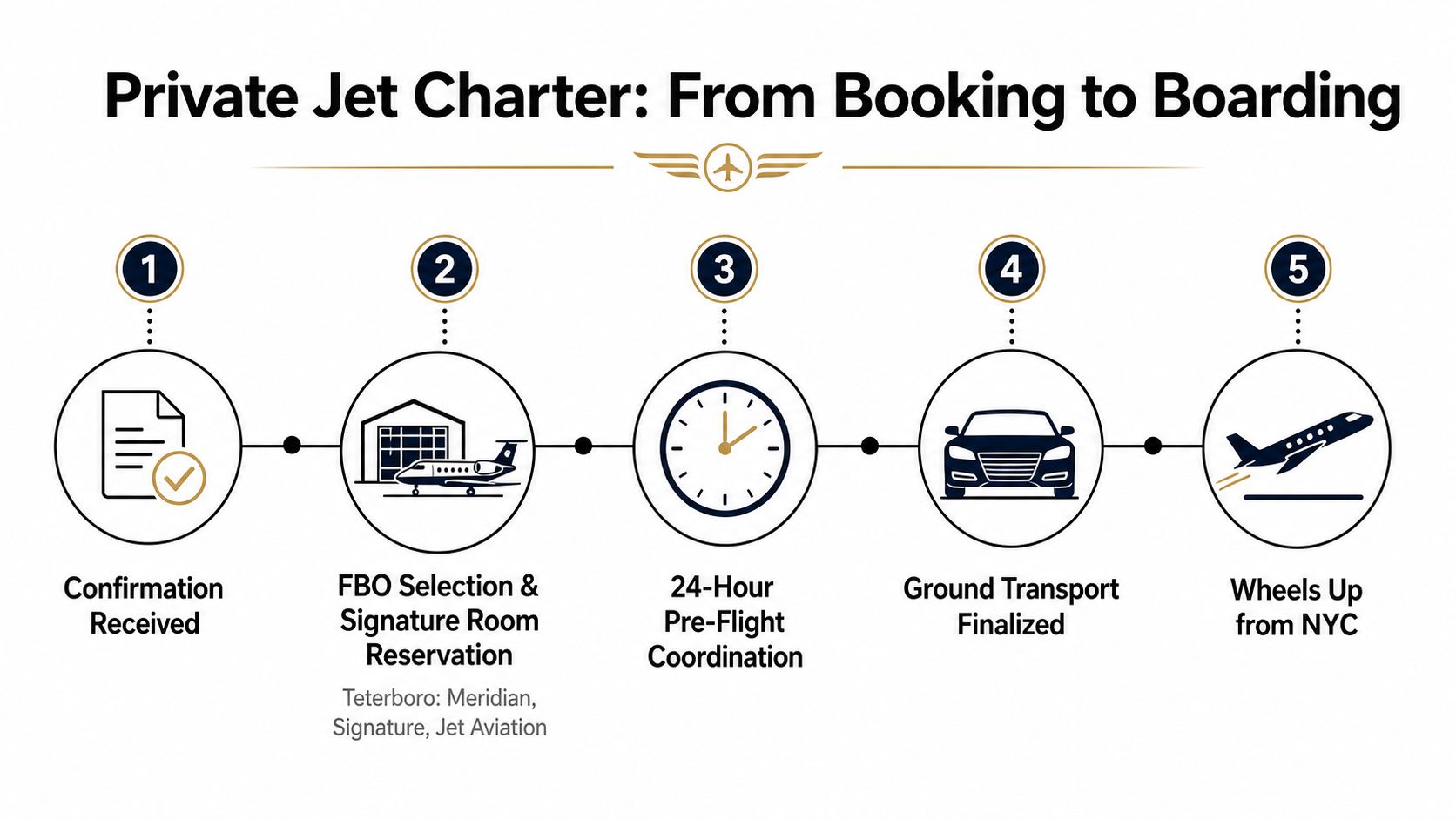
1. Confirmation received: Verify the operating carrier, aircraft type, tail number when available, departure airport, FBO, cancellation terms, and all-in estimate.
2. FBO secured: Reserve the private terminal and confirm its exact location. At Teterboro, common choices include Meridian, Signature, and Jet Aviation. At Westchester, Ross and Million Air may serve the itinerary.
3. Passenger data filed: Domestic travel requires government-issued photo identification. International travel requires valid passports and any required visa evidence, plus each passenger's full legal name, date of birth, and passport details for the manifest.
4. Catering coordinated: Send dietary requirements and service preferences before departure. Do not rely on standard onboard stock for a principal with specific requirements.
5. Arrival transport finalized: Confirm the receiving driver, vehicle, terminal procedure, and contact protocol before the aircraft leaves New York.
Build the clock backward
For a domestic departure, allow 60 to 90 minutes before scheduled departure. International travel deserves 2 to 2.5 hours, especially when customs, APIS, passport review, and New York traffic affect the plan. (Private jet booking and fee guidance)
A helicopter transfer from downtown to Teterboro can reduce the drive to under 20 minutes, but weather and scheduling dependencies remain. Use it as a scheduled transport option, not as a last-minute recovery plan.
For international departures, confirm the customs facility and clearance process before approving the itinerary. Teterboro and Westchester may support international general aviation processing depending on the route and operator arrangements. JFK facilities may be required when the aircraft or customs plan calls for them.
HauteBlack's VIP airport transfer coordination suits principals whose ground service standard extends beyond the aircraft. The receiving driver should have the aircraft details, FBO location, luggage plan, and fallback contact before touchdown.
Same-day disruption protocol
Keep a backup aircraft option, an alternate FBO pair, and a direct operations contact available. If weather or an ATC ground stop compresses the schedule, the executive assistant should be able to approve an airport change or departure adjustment without restarting the search.
Safety, Regulations, and VIP Arrival Standards
Cabin leather is not a safety credential. For a UHNW principal, the premium signal is the operator's certificate, crew, maintenance program, third-party audit, insurance, and willingness to identify the actual operating carrier in writing.
Vet the operator before admiring the cabin
The operator should hold an FAA Part 135 certificate for on-demand charter operations. Ask who operates the flight, whether the aircraft is on that operator's certificate, how the crew is trained, and what happens if a crew reaches its legal duty limit before the return sector.
Third-party programs add another layer of scrutiny. ARGUS Gold reviews operational elements such as crew experience, aircraft maintenance, and operating history. Wyvern Wingman focuses on operational data and crew proficiency. IS-BAO Stage 3 represents the highest level of registry compliance within that safety-management framework. (Questions to ask before booking a private jet charter)
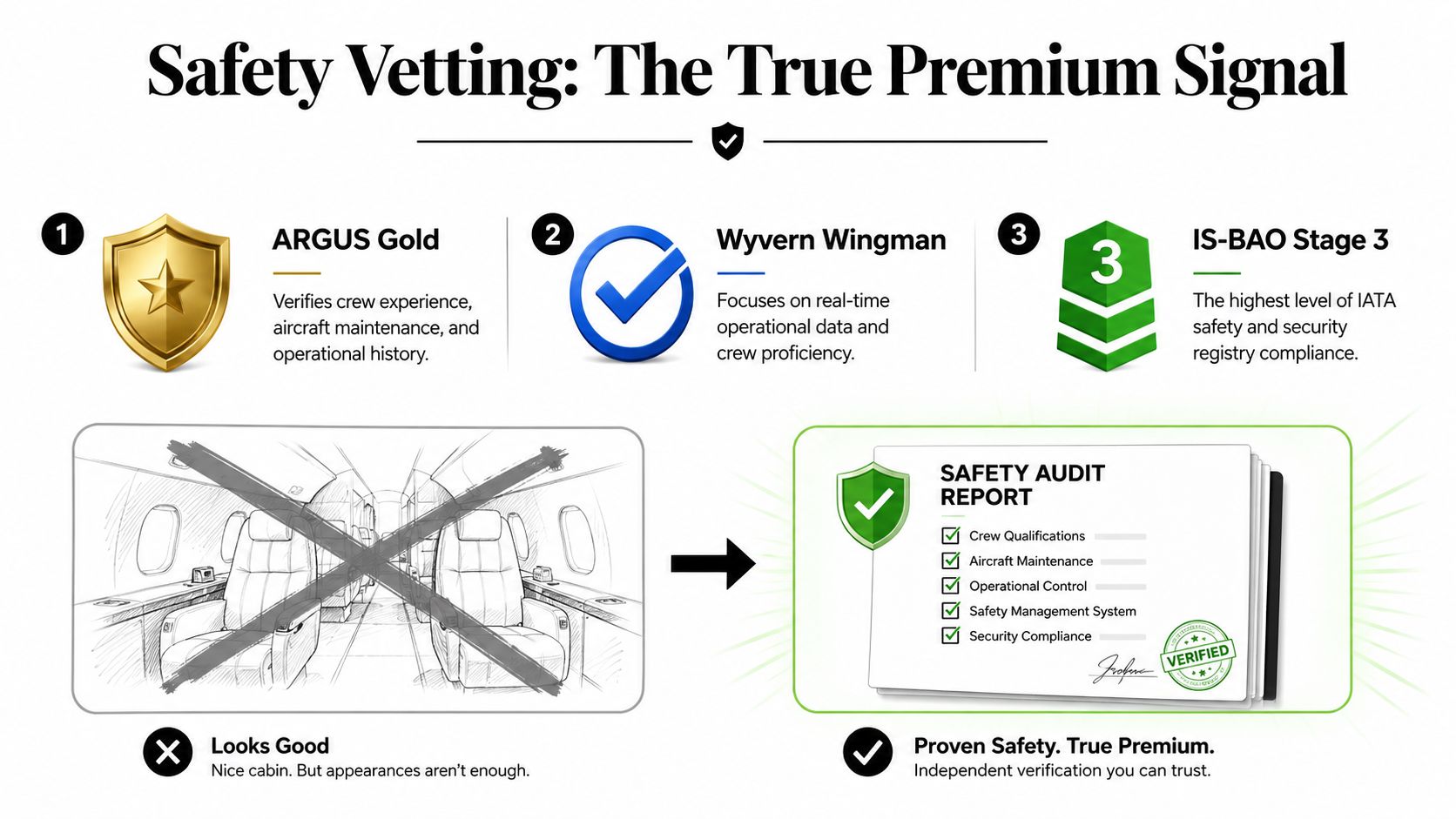
An operator that won't provide meaningful third-party safety information deserves a pass. So does a broker who refuses to name the operating carrier. The booking party needs to know who controls the aircraft, crew, maintenance, and operational decisions.
International compliance is part of the itinerary
For international or Caribbean travel, the flight team must manage APIS passenger data, TSA Secure Flight requirements, passport and visa checks, and customs coordination. The executive assistant should submit accurate legal details early and verify that changes to the passenger list won't trigger a delay or re-clearance problem.
A crew timing out is a practical risk, not an abstract regulatory detail. If the schedule contains a same-day return, a late departure from New York can push the crew beyond duty limits and require a replacement crew or aircraft. That is why a backup plan should be arranged while inventory still exists, not after the first plan fails.
Define the arrival standard
At a high-quality FBO, the principal should move from aircraft to vehicle with minimal exposure to public areas. Depending on the facility and destination, the service plan may include tarmac-to-tarmac transfer, a concealed car-to-cargo-door route, customs assistance, and a driver waiting at the agreed handoff point.
The 8 to 12 minute door-to-door window is a useful executive expectation for a well-coordinated arrival, but it depends on the FBO, customs, baggage, vehicle position, and destination procedures. (Private jet booking and fee guidance)
HauteBlack operates as a bespoke aviation concierge within its broader Virtuoso-affiliated luxury-travel network. Its practical role is to coordinate private aviation, preferred travel partners, and ground services through one advisor who can retain the principal's preferences across Teterboro, Westchester, and Morristown. For a New York traveler, that model can matter on sold-out periods such as UN Week and US Open finals, when access depends on relationships, timing, and willingness to use an alternate field.
Executive-assistant checklist
- Confirm the certificate: Obtain the operating carrier's name and FAA Part 135 status.
- Verify the aircraft: Lock the tail number when available and confirm the actual model.
- Check safety credentials: Request ARGUS, Wyvern, or IS-BAO documentation.
- Secure the FBO: Match the terminal, signature room, customs plan, and arrival vehicle.
- File international data: Submit APIS and passenger information at least 60 minutes before international departure when required by the operating process.
- Hold a backup: Keep an alternate aircraft, slot, airport, or departure window available during unstable weather.
- Maintain payment readiness: Keep a credit facility or approved payment method available for repositioning and itinerary changes.
- Brief the principal: Confirm baggage limits, catering, departure time, arrival procedure, and driver contact.
Short-notice questions
Can a New York charter be booked the same day? Often, yes, if the aircraft, crew, airport slot, and documentation align. Same-day availability doesn't guarantee a favorable price or the preferred aircraft type.
Why does a larger market still feel tight? New York's mature demand base includes strong business travel and shorter booking windows during busy periods. More aircraft activity doesn't mean the exact cabin, runway capability, and departure time are available together.
Should the assistant choose the aircraft first? No. Choose the airport and mission window first, then approve the smallest aircraft that meets the route and payload requirement.
The decision that saves the most trips is simple. When the schedule is tight, choose the airport before you choose the aircraft.
HauteBlack can coordinate private jet charter, helicopter transfers, VIP ground transport, and luxury travel through a single advisor-led process. For a New York departure where timing, aircraft selection, and arrival standards all matter, visit HauteBlack to request a coordinated aviation and travel plan.
Explore Our Guides


Signature Experiences


