Haute Black Journal
Private Club Membership Benefits That Actually Matter

Marlene Azeez
Director, HauteBlack
View all articles →
Most advice about private club membership benefits starts with exclusivity and ends with a glossy list of perks. That's the wrong test. A private club earns its cost only when it saves you meaningful time, recovers real value, creates useful relationships, or removes friction you'd otherwise pay to handle yourself.
A member who travels frequently, books premium properties, attends intimate events, and needs trusted introductions may extract substantial value from membership. A traveler who takes occasional trips, prefers one hotel brand, or rarely joins hosted experiences may be buying theatre. The difference isn't the quality of the club. It's the fit between the membership mechanics and the way you actually live.
Why Most Private Club Benefits Disappear Under Scrutiny
The word exclusive tells you almost nothing. It may describe genuine access, or it may just describe a room, event, or directory that you won't use. The useful question is what happens after enrollment. Does the benefit shorten a planning process, reduce a cost, improve a stay, create a relevant relationship, or solve a problem that ordinary booking channels can't solve?
I use four tests when advising clients:
- Time saved: Does a dedicated advisor remove hours of research, coordination, and follow-up?
- Dollars recouped: Do waived fees, preferred rates, upgrades, and credits offset the membership cost?
- Relationships formed: Are introductions relevant, trusted, and facilitated, or are you receiving passive directory access?
- Conveniences gained: Can the club coordinate difficult details, such as private aviation, villas, transfers, dining, or last-minute changes?
The same benefit can land very differently for two members. A resort credit matters to someone who already plans to dine and use the property. It has no meaningful value if the member wouldn't have spent there. A hosted chef dinner can be memorable and commercially useful for an entrepreneur who enjoys intimate rooms, but irrelevant to someone who prefers private evenings with family.
Private clubs also operate within a substantial service economy. The Club Management Association of America's industry brief identifies approximately 5,659 private clubs nationally and examines 3,887 clubs with annual revenue above $1 million. In 2023, those clubs generated an estimated $32.6 billion in direct revenue, employed 573,000 people, and produced $17.4 billion in payroll. Including indirect and induced activity, the total impact reached approximately $157 billion in revenue, $65 billion in payroll, and 1.5 million jobs.
That scale matters, but it doesn't prove that your membership is worthwhile. It proves that recurring dues, hospitality spending, programming, and capital investment support a serious ecosystem. Your personal calculation still depends on use.
Advisor's rule: Never value a private club by the number of benefits listed. Value it by the benefits you would use repeatedly without changing your habits to justify the fee.
The Four Categories of Private Club Membership Benefits
Every luxury membership benefit belongs primarily in one of four categories. Classifying it makes vague promises easier to compare.
Access and upgrades
This is priority entry, preferred reservations, partner-property recognition, room upgrades when available, resort credits, villas, estates, and other inventory that may be difficult to secure independently. Access is valuable only when the underlying opportunity is scarce or when the club can improve the terms of a booking you were already going to make.
Service and personal execution
Concierge support converts a complicated request into a managed process. A capable advisor can coordinate hotels, transfers, dining, aviation, family preferences, celebration details, and changes across a single itinerary. The value is not the existence of a phone number. It's the judgment, memory, responsiveness, and supplier relationships behind the response.
Community and hosted experiences
Events create the setting for repeated interaction. A small dinner, private cultural evening, or member roundtable can produce more useful contact than a large reception where everyone exchanges names and leaves. Private clubs have historically combined dining, recreation, social interaction, and relationship development, so community is a core product, not a decorative extra.
Value and economic utility
This category includes waived planning fees, preferred rates, credits, avoided research time, and benefits that reduce the cost or effort of travel. It also includes the value of a smoother experience, although you should be careful not to turn every pleasant moment into a financial saving. For a broader explanation of how structured reservations can improve hospitality operations, see why restaurants should take bookings online.
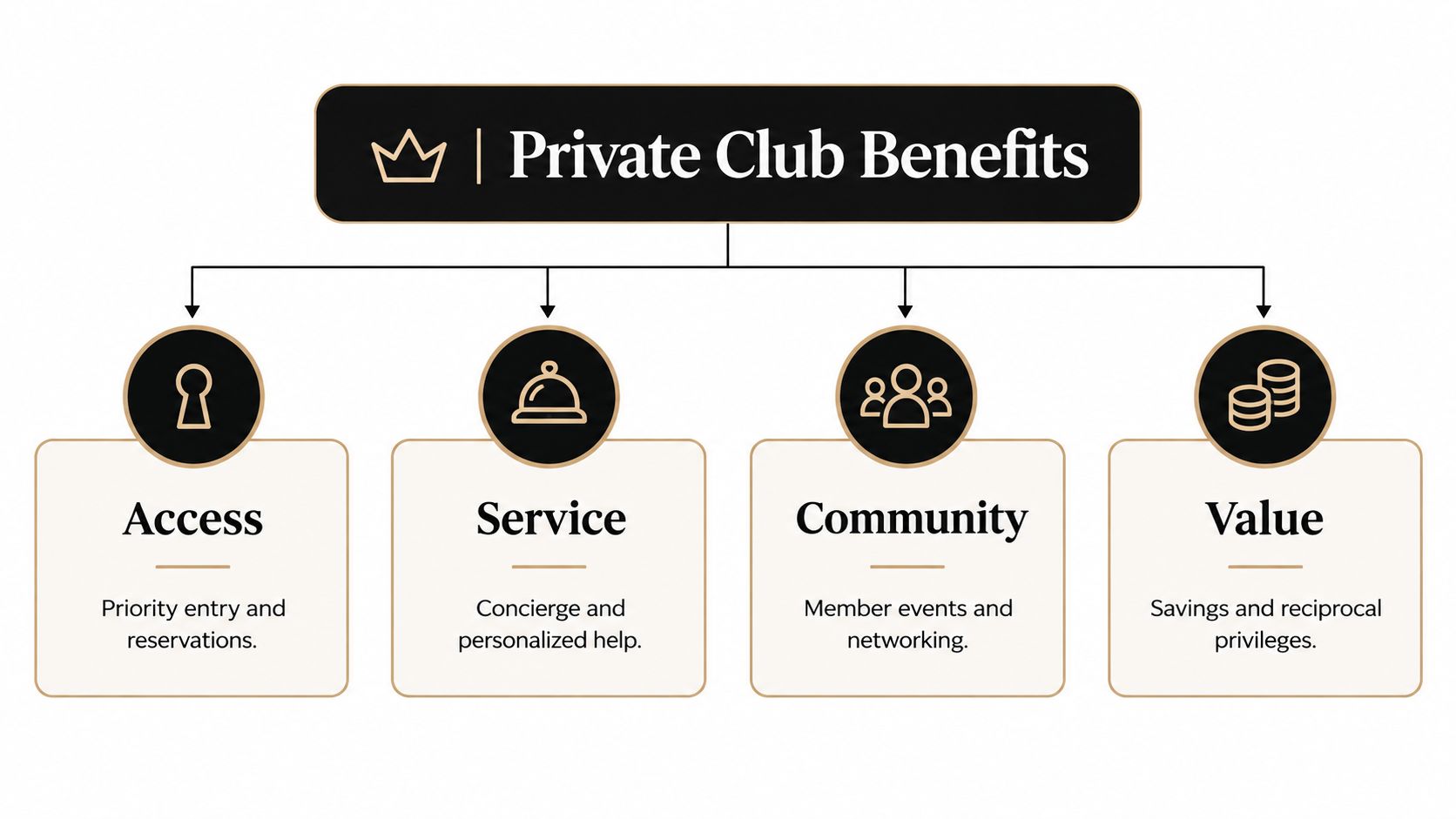
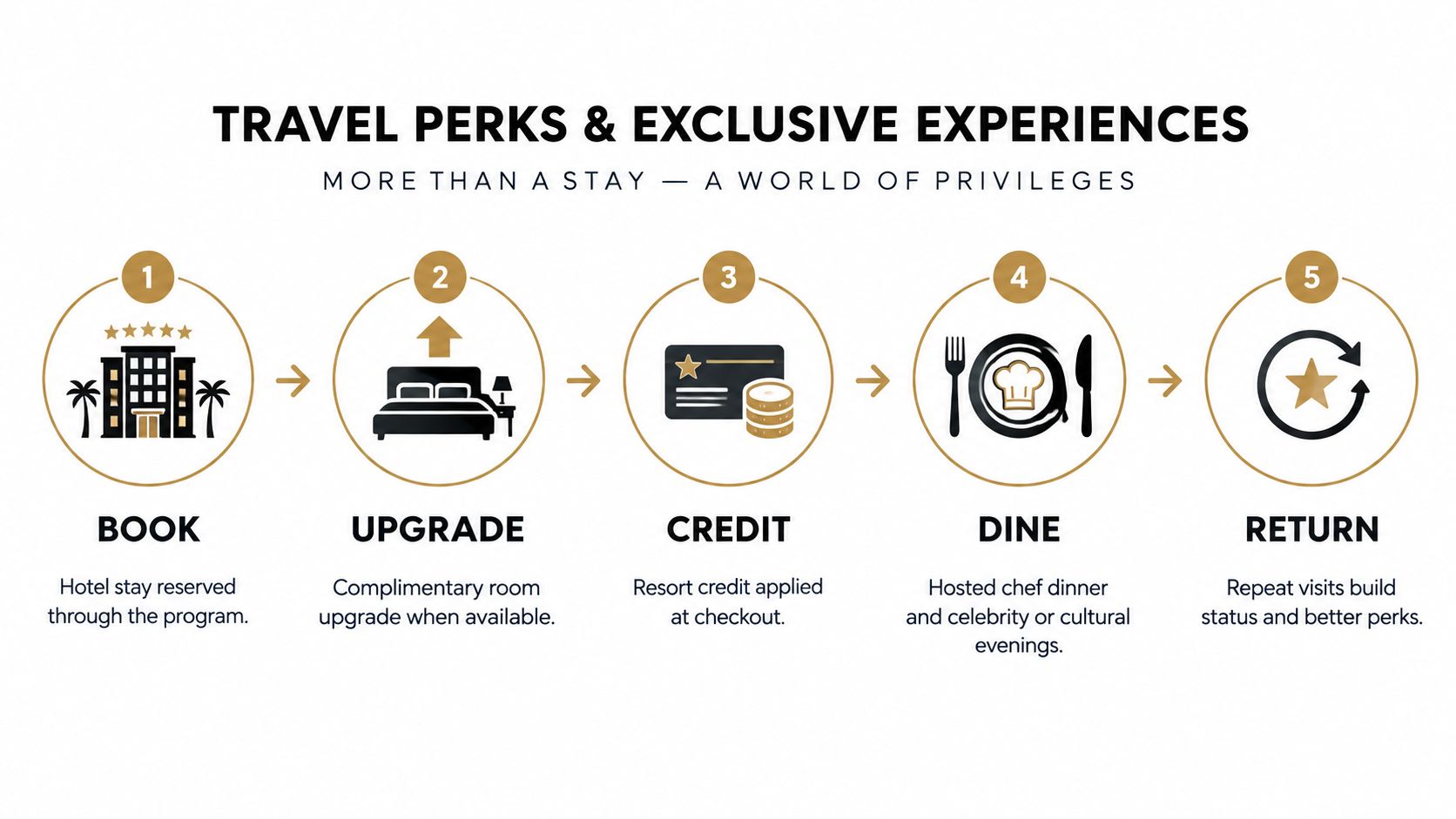
Consider one premium hotel stay arranged through a membership platform. The booking may deliver partner access and a possible upgrade. The advisor may remove planning work and coordinate dining or transfers. A hosted dinner during the trip may create community, while waived fees or a property credit create direct economic value. One itinerary can activate all four categories.
The integration is the point. Buying separate services often leaves you coordinating them yourself. A membership can be worthwhile when the same advisor connects the booking, experience, and relationship rather than handing you a directory of disconnected perks.
The Mechanics Behind Travel Perks, Events, Concierge, and Exclusivity
Luxury travel benefits don't appear by magic. Each one depends on a specific operational link between the member, the advisor, and the supplier.
Why partner status changes a hotel stay
HauteBlack is Virtuoso-affiliated through Andavo Travel and holds preferred partner status at more than 500 properties, including Four Seasons, Aman, Rosewood, Belmond, and Ritz-Carlton, according to its published company information. That relationship is the operational basis for potential upgrades, resort credits, and VIP arrivals.
“Potential” matters. An upgrade is generally dependent on availability, property policy, booking channel, and the quality of the request. The value comes from having the booking placed through a recognized partner relationship, with an advisor presenting the stay properly and communicating the guest's priorities. It isn't a guaranteed free suite.
Why intimate events outperform broad access
HauteBlack curates 80-plus intimate events annually, including private chef dinners involving Nobu, Daniel Boulud, and Thomas Keller, along with celebrity, athlete, and cultural evenings. A smaller format creates better conditions for conversation because guests share a setting, a host, and a reason to interact.
The same principle applies to premium event design generally. A well-produced experience needs purposeful flow, not just an impressive guest list. For ideas on designing engaging branded environments, interactive attractions for trade shows offers useful context, although a private member dinner demands a more discreet and relationship-led execution.
What a concierge actually does
A concierge earns value by taking ownership. The work may include coordinating first-class travel, helicopter transfers, private aviation inquiries, dining, transport, villas, estates, and changes that affect several suppliers at once. The service becomes most useful when the itinerary is complex, time-sensitive, or emotionally important.
An AI-powered network can assist with discovery and matching, but software doesn't replace judgment. The advisor still needs to understand whether an introduction is commercially relevant, socially appropriate, and welcome. For a practical explanation of the role, see what does a concierge service do.
The real test of exclusivity
Exclusivity is useful when it protects privacy, improves access, or introduces you to people you couldn't reach through ordinary channels. It is empty when it merely limits attendance without improving the experience. Ask who is selecting the room, how introductions are made, whether participation is optional, and what happens when a request falls outside the club's strongest relationships.
Access vs Black Card and What Each Tier Actually Unlocks
Tier comparisons become clearer when you separate price, qualification, and usage. HauteBlack's paid HauteBlack Access tier costs $299 per year, while annual travel spend of $25,000 can qualify a traveler for complimentary Access. Annual travel spend of $350,000 can qualify a traveler for a complimentary Black Card for one year, according to the published membership mechanics.
| Tier | Annual Cost | Qualifying Spend | Key Benefits | Best For |
|---|---|---|---|---|
| HauteBlack Access | $299 | $25,000 in annual travel spend can qualify for complimentary Access | AI-powered member network, 80-plus intimate events annually, private chef and celebrity or athlete dinner access, reduced-rate Travel Team assistance, Haute Jets inquiry access, browse-only directory, preferred journey rates, waived planning fees | Travelers who want hosted experiences, travel support, and member access without Black Card-level travel volume |
| Black Card | Complimentary for one year when qualifying travel spend is $350,000 | $350,000 in annual travel spend | Higher-tier membership access associated with extensive travel planning, private aviation inquiries, villas, estates, and broader relationship-led support | Travelers whose existing spend already reaches the threshold and who will use high-touch planning and premium access |
The distinction between a browse-only directory and a broader member network matters. Seeing names is not the same as receiving a relevant introduction, participating in a private roundtable, or having an advisor facilitate contact. Ask how the club moves you from visibility to interaction.
Access can also matter outside travel. Collectors who care about timed opportunities may appreciate the mechanics behind browsing pre-owned Rolex VIP access, where early access is more concrete than a generic promise of exclusivity. The same standard should apply to a travel membership.
For additional context on how the model works, review what is an exclusive travel club. My rule is straightforward: choose Access when your travel is light to moderate but you'll use events, planning support, and preferred benefits. Pursue Black Card status only when your existing travel spend already qualifies and your pattern includes private aviation, villas, estates, or full-service itinerary management. Don't increase travel spending merely to earn a badge.
Three Real Member Scenarios That Put Benefits to Work
Membership value becomes obvious when matched to a real travel pattern. These are representative situations, not claims about individual member results.
A honeymoon couple books a carefully planned journey across several destinations. Their highest-value benefits are waived planning fees, a dedicated advisor, partner-property recognition, and access to a private dinner that gives the trip a distinctive emotional anchor. They don't need a member directory or frequent networking, and they may never use aviation services. For them, the membership works only if the planning complexity and preferred treatment justify the cost around a single high-stakes trip.

A CEO receives a travel request with little notice. The advisor coordinates flights, hotel placement, ground transport, and a tightly timed dinner while the executive works. During available downtime, the member may use the AI-powered network to identify relevant founders, investors, or executives, but the value depends on accurate matching and a human-led introduction. The CEO isn't buying event attendance. The CEO is buying compressed decision time and fewer points of failure.
A multi-generational family needs a private villa or estate, age-appropriate activities, dining that works across preferences, and trusted help after arrival. The family may use hosted events selectively, but villa access, transport coordination, and an advisor who remembers household details carry more weight. A directory has limited value unless it helps locate a relevant local connection or trusted service.
The pattern is consistent:
- Honeymooners prioritize: planning relief, recognition, and memorable hosted experiences.
- Executives prioritize: speed, discretion, coordination, and relevant introductions.
- Families prioritize: space, flexibility, dependable logistics, and multi-person service.
A member who joins for one category should not pretend to value the others. The best decision starts by naming the two benefits you'll use, then ignoring the rest.
When Membership Becomes a Bad Deal
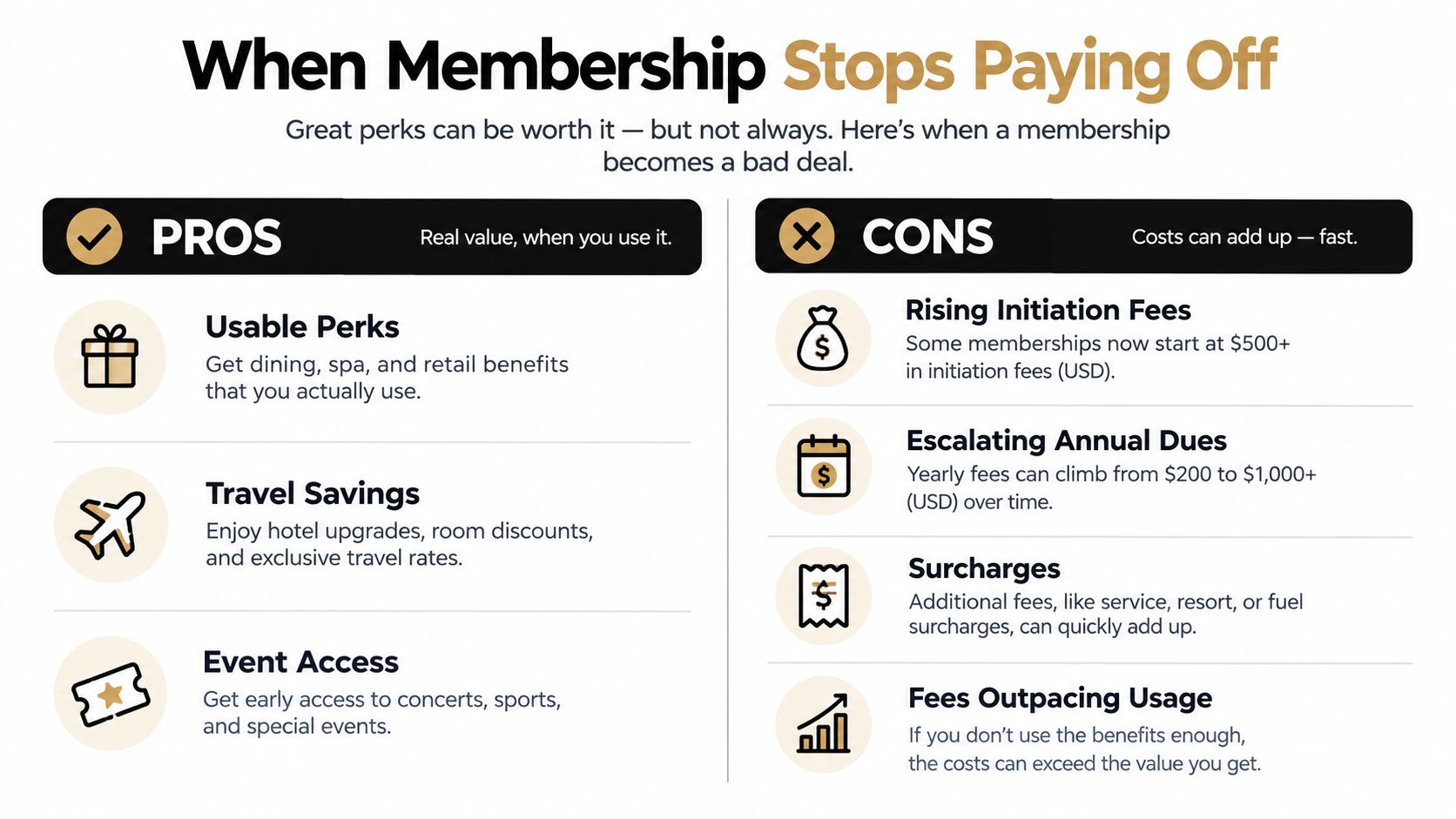
A membership becomes a bad deal when its recurring cost exceeds the value of your actual behavior. The most common mistake is counting every possible benefit, including events you won't attend, upgrades you wouldn't have booked, and services another household member will use instead of you.
The cost base can also rise. Recent industry data reports average initiation-fee increases of 8.7%, operating-dues increases of 6.2%, and capital-dues increases of 12.5%. The same CMAA analysis reports that 44% of members identified increased dues as a concern, while 34% said decreased service levels can diminish the experience.
That creates a simple warning. A club can charge more while delivering less, and status won't repair inconsistent service.
Build your own cost model before joining:
- Fixed cost: Include initiation fees, annual dues, capital assessments, and any service charges.
- Expected use: Estimate the trips, stays, events, dinners, and planning projects you will realistically undertake.
- Realized value: Count only upgrades, credits, waived fees, preferred rates, and time savings you can reasonably expect to use.
- Household fit: Check who will in fact attend events, occupy rooms, request planning, or use the amenities.
- Exit risk: Review renewal terms, cancellation rules, assessments, and what happens if your travel pattern changes.
Decline membership if you travel infrequently, return to one property brand, can't access useful dates, or mainly pay for amenities used by someone else. Decline it if you dislike hosted social settings, don't want introductions, or prefer handling reservations personally. The private club membership fees insider's guide is useful background, but your own usage forecast matters more than any published list.
A Practical Framework for Choosing the Right Membership
Start with your calendar, not the brochure. A membership makes more sense when your travel is frequent enough for planning support and partner benefits to recur, your stays involve premium properties, and your trips carry enough complexity that mistakes are expensive in time or experience.
Answer these questions:
1. How often do you travel? Frequent travel strengthens the case for an advisor and repeat supplier relationships. Occasional travel puts more pressure on one or two high-value journeys to justify membership.
2. What do you book? Premium hotels, villas, estates, and complex transfers create more opportunities for recognition and coordination than simple point-to-point bookings.
3. Who travels with you? Families need space, flexibility, and logistics. Couples may care more about privacy and memorable experiences. Executives often value speed and discretion.
4. How many trips are high stakes? Honeymoons, milestone celebrations, family reunions, and sensitive business travel justify more planning support than routine weekends.
5. Will you attend hosted experiences? HauteBlack curates 80-plus intimate events annually, including private chef dinners with Nobu, Daniel Boulud, and Thomas Keller, plus athlete and celebrity evenings. If those rooms don't interest you, don't assign them paper value.
6. Do you want curated introductions? A network is useful only when you're willing to participate and can define the type of relationship you want.
HauteBlack fits a traveler who values waived travel-planning fees, preferred rates, potential partner-property upgrades, Haute Jets inquiries, yachts, private villas, estates, and a dedicated advisor. Complimentary Access can be tied to $25,000 in annual travel spend, while complimentary Black Card eligibility can be tied to $350,000, so the spend thresholds should be treated as qualification mechanics, not reasons to travel more.
The cleanest test is to book one meaningful journey, judge the advisor's execution, and calculate the value you actually received before expanding your commitment.
HauteBlack combines member events, hosted culinary and cultural experiences, dedicated travel support, preferred partner access, and planning benefits for travelers who will use them. Visit HauteBlack to review the membership model and decide whether its access, service, community, and value align with your real travel pattern.
Explore Our Guides


Signature Experiences


