Haute Black Journal
Private Club Membership Fees: The Insider's Guide

Marlene Azeez
Director, HauteBlack
View all articles →

Median U.S. private-club initiation fees rose from approximately $29,000 in 2019 to about $50,000 by the end of 2022, a roughly 72% increase in three years. That means a realistic private club budget starts with the total cost of ownership, not the advertised joining fee.
The initiation payment is only the entry point. Annual dues, capital assessments, food-and-beverage commitments, guest charges, usage costs, transfer restrictions, and the possibility of paying for access you rarely use can determine whether a club is a smart lifestyle purchase or an expensive status symbol. For ultra-high-net-worth individuals, the right question isn't “Can I afford the initiation fee?” It's “What will this membership cost me over five years, and how much value will I extract from it?”
Understanding the Anatomy of Private Club Fees
Analysts at RLA Global's private members' club analysis describe a club model built on multiple revenue streams, not a single joining price. That is the right way to assess membership. If you collapse everything into one headline number, you miss the underlying commitment and the underlying risk.
Private club fees usually break into three financial layers: initiation capital, operating dues, and assessments. Keep them separate. Each one funds something different, follows different rules, and affects your five-year cost in a different way.
The initiation fee works more like a capital contribution than a straightforward access charge. Clubs may direct that money toward debt service, deferred maintenance, or long-term facility plans. Annual dues cover recurring expenses such as labor, programming, groundskeeping, dining operations, and administration. That distinction matters because a large initiation payment does not guarantee a well-funded operation, and modest dues can only postpone the bill.
The three payments you must separate
Initiation fees are usually paid once at entry. The terms matter more than the headline amount. Find out whether the payment is refundable, partly refundable, transferable, tied to equity, or fully forfeited when you resign. A refundable structure can still trap your money if repayment depends on a waiting list or a replacement member.
Annual dues are the recurring operating commitment. They are the easiest figure to compare and the easiest figure to misunderstand. Dues rarely capture the full cost of belonging, and they tell you nothing about how efficiently the club is run. Judge them alongside service levels, reservation access, upkeep, and the club's history of special billing.
Capital assessments are separate charges for major repairs, renovations, or expansion projects. Many buyers are surprised here. A club can look reasonably priced on paper while carrying aging facilities, deferred maintenance, or an ambitious redevelopment agenda that pushes extra costs onto members.
Practical rule: Ask for five years of dues history, any current assessments, planned capital projects, and the exact treatment of your initiation payment before you judge the lifestyle upside.
Usage-dependent costs sit on top of all three layers. Food-and-beverage minimums, guest fees, events, lockers, golf carts, lessons, spa services, and taxes can materially change the ownership picture. Apply the same total-cost lens when you compare a traditional club with a travel-focused alternative. Start with what an exclusive travel club provides, then measure required payment, included access, variable charges, and how often you will realistically use it.
Typical Price Ranges by Club Type
“Typical” is a dangerous word in private clubs. The market includes accessible athletic and social clubs, established country clubs, resort-linked memberships, and invitation-only institutions where entry costs move into six or seven figures. The average can therefore obscure more than it reveals.
A current U.S. benchmark places average initiation fees around $58,000, with a median near $34,000, while average annual operating dues are approximately $10,700 and median dues about $9,100 (Golf Course Guide's country-club cost analysis). The median dues figure equates to roughly $758 per month, before capital dues, assessments, usage fees, or minimum-spend obligations.
| Club Type | Avg. Initiation Fee | Median Annual Dues |
|---|---|---|
| Broad U.S. private-club benchmark | $58,000 | $9,100 |
| Premium U.S. club benchmark | $100,000 or more | $14,000–$22,000 |
| Florida country and comparable private clubs | $129,000 | $18,600 |
| Mid-tier resort-affiliated beach club | $5,000–$50,000 | $5,000–$15,000 |
| Top-tier private beach club | $100,000–$1 million or more | $20,000–$50,000 or more |
The ranges in the beach-club categories come from HauteBlack's guide to elite family resorts, which also identifies food-and-beverage minimums and guest charges as separate components. Those figures aren't interchangeable with golf-club benchmarks, but they show why club type and service model matter more than a generic national average.
How to read the distribution
Approximately 42% of clubs reportedly charge initiation fees below $25,000, while top-quartile clubs can exceed $100,000 and charge roughly $14,000 to $22,000 in annual dues (Golf Course Guide). Industry reporting also indicates that approximately 8% of clubs charge more than $165,000 to join, while about 33% fall between $5,000 and $24,999 (RLA Global).
Geography changes the equation too. Florida country clubs and comparable private clubs reportedly averaged a $129,000 joining fee and $18,600 in annual dues in 2023, positioning them well above the broad U.S. median (RLA Global). Golf-club buyers researching another market should also review this practical guide to UK golf membership pricing, because British clubs often structure access, subscriptions, and joining requirements differently from U.S. private clubs.
For a resort or beach lifestyle, exclusive beach-club memberships deserve separate analysis. A beach club may charge less to join than an elite golf club while imposing more spending through dining, events, and guest usage. The correct comparison isn't initiation fee against initiation fee. It's annual access cost divided by meaningful use, adjusted for flexibility and location.
Comparing Value Between Traditional Clubs and Luxury Networks
The rewritten paragraph is as follows:
A member who uses one club weekly can get strong value from a fixed property. A member who splits time across cities can overpay for that same model very quickly. The core comparison is total cost of ownership: initiation fee, annual dues, required spending, guest use, travel friction, and the likelihood that your routine will still support the membership a year from now.
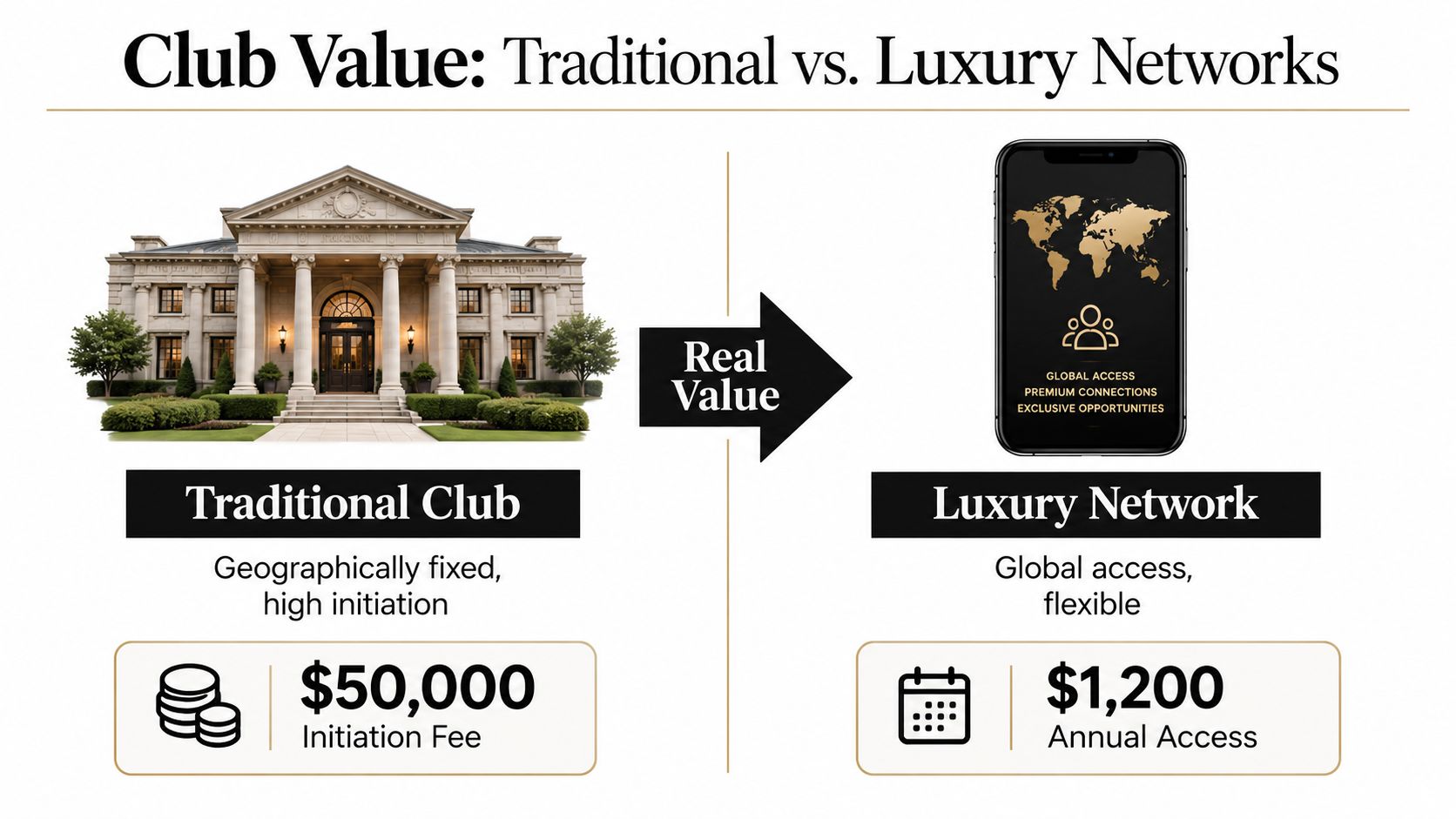
A traditional private club sells access tied to one address. A luxury network sells access that travels with you. That difference matters more than the label “exclusive,” because value comes from use, not status.
A country or athletic club usually concentrates benefits in one place. If you live nearby and build your week around it, that can work extremely well. You get recurring dining, sport, wellness, children's programming, and a familiar social base. If your residence changes or your calendar keeps you away, the economics weaken fast. You are still paying for a fixed asset in your life, whether you show up or not.
A portable network fits a different buyer. For an executive or family office principal who moves between cities, spends long stretches abroad, or entertains in multiple markets, access that follows the member can be the smarter purchase.
What traditional clubs do well
Traditional clubs win on repeated local use. Families often benefit most, especially when the club becomes part of the weekly routine rather than an occasional indulgence. Dining, golf, tennis, swimming, fitness, children's activities, and private entertaining all become more valuable when they are used consistently and close to home.
They also provide something networks usually cannot replicate: a stable physical community. Members see the same people, build local relationships, and use the clubhouse as an extension of home or office.
The trade-off is rigidity.
You carry the cost through quiet periods, travel-heavy seasons, and lifestyle changes. Some memberships are also hard to transfer, hard to resign from cleanly, or difficult to recover any value from if priorities shift. That is where headline pricing misleads buyers. The initiation fee is only the opening number. The actual expense is what you keep paying to maintain a membership that no longer fits.
What luxury networks change
A modern private network can prioritize portability, recognition, curated events, and travel support. That suits members who value introductions, multi-city access, and flexible use more than a single clubhouse. In the right case, one network membership can replace the need to carry several underused local memberships.
HauteBlack's membership guide lists HauteBlack Access at $299 per year. Its invitation-only Black Card is limited to 500 members globally and costs $10,000 per year plus a $2,500 initiation fee. Listed benefits include priority event access, priority seating at private dinners, a dedicated Haute Jets specialist, private roundtable rooms, and member-directory connectivity.
Those tiers should be judged against the life you lead. A country club may deliver daily amenities and a dependable local setting. A luxury network may deliver travel coordination, event access, introductions, and recognition across destinations. They are different ownership models with different return profiles.
The better value is the one you use across the places and routines that define your life.
A sharper decision test
Choose a traditional club if you live nearby, expect frequent use, want a recurring community, and care about physical amenities. Choose a portable network if you travel often, divide your time among cities, host internationally, or want curated access without carrying a fixed local base.
Before you sign, ask four direct questions:
- Where will I use it? Count realistic visits and destinations, not aspirational ones.
- What access is guaranteed? Separate written benefits from informal promises.
- What does my household need? Guest, partner, family, and business use can change the economics quickly.
- What happens if my routine changes? Review cancellation, transfer, refund, and resale terms before you commit.
Strategies for Negotiating and Transferring Memberships
Private clubs don't all negotiate the same way, but buyers often leave value on the table by treating the published initiation fee as untouchable. Your advantage usually comes from timing, membership availability, category demand, and the club's need for the right type of member.
Start with the membership office
Request the complete current package in writing. It should identify the initiation fee, dues, assessments, minimums, guest policies, taxes, transfer rules, resignation process, and waiting-list mechanics. Ask which amounts are payable immediately and which can be scheduled.
Don't negotiate before you understand the category. A golf membership, social membership, athletic membership, and resort access plan may have different approval standards and transfer economics. Paying for privileges your household won't use is a more expensive mistake than failing to obtain a modest discount.
Use timing and structure
Negotiation is more productive when you discuss the total commitment, not just the joining payment. Potential points include an installment schedule, a reduced initiation amount for a specific membership category, credited dues during a transition, or clarity around assessment exposure.
The club may protect its headline price while offering flexibility elsewhere. A buyer with substantial financial capacity can also strengthen the application by presenting a complete profile, clear references, and a credible usage plan. Clubs care about community fit, payment reliability, and member behavior, not net worth alone.
Ask for concessions that improve liquidity. A payment schedule or clear assessment cap can matter more than a small reduction in the initiation fee.
Evaluate a transferred membership carefully
A secondary-market or member-to-member transfer can appear attractive because the seller may accept less than the current new-member price. That discount only matters after you confirm:
1. Club approval. Determine whether the buyer must pass an interview, financial review, or membership committee process.
2. Transfer charges. Identify every administrative, legal, processing, and initiation-related payment.
3. Category continuity. Confirm that the transferred membership carries the same access, voting rights, guest privileges, and renewal terms.
4. Refundability. Establish whether the original member's terms transfer or whether the buyer receives a different economic interest.
5. Exit mechanics. Ask whether resignation triggers a refund, a waiting period, a forfeiture, or a resale obligation.
A low purchase price can be misleading if the transferred membership carries inferior rights or creates a difficult exit. Compare the full five-year cost and liquidity profile with a new membership, not just the seller's asking price.
Hidden Fees and Assessments: The Complete Cost Picture
A membership that looks manageable at signing can become materially more expensive within months. The headline initiation fee gets attention. Your long-term cost comes from recurring dues, minimum-spend rules, guest pricing, and capital calls that keep showing up after the welcome package is forgotten.
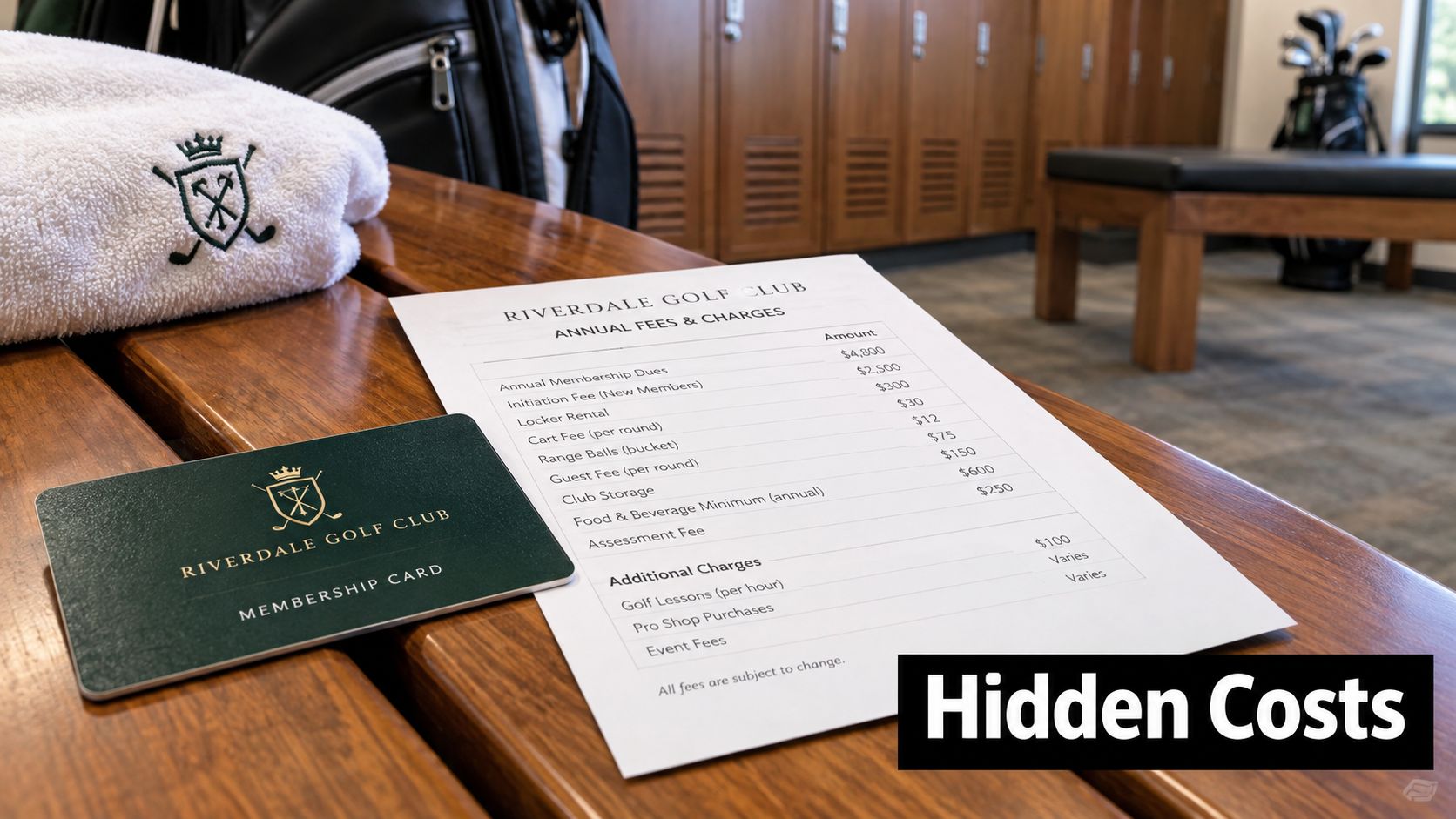
Start with the food-and-beverage minimum. Earlier examples from HauteBlack showed annual minimums ranging from $1,500 to $4,000 at a mid-tier resort-affiliated club and $5,000 to $15,000 or more at a top-tier private club. If your household does not naturally spend through that requirement, the minimum is not a perk. It is prepaid consumption, and unused portions can turn into waste.
Guest charges deserve the same discipline. Clubs often present them as incidental, but they add up fast for members who entertain clients, host friends for a weekend, or bring adult children and their partners regularly. Treat guest access as part of the membership's operating budget, not as a rare exception.
The walkthrough below shows how these line items accumulate on a real club statement.
The costs that change the verdict
Look past dues and list every likely add-on. Include locker fees, event charges, dining above the minimum, taxes, golf carts, lessons, equipment storage, spa treatments, transportation, and special assessments. Some of these are easy to forecast because they track your habits. Assessments are different. They arrive when the club needs capital, often on the club's timeline, not yours.
Ask hard questions before you join. Request the club's assessment history, current capital plan, reserve position, and any major projects already under discussion. If management hesitates, treat that as a warning sign.
The broader pricing climate supports this caution. The CMAA board brief reports that median initiation fees increased between 2020 and 2025 at nearly twice the rate of general inflation, with pricing tracking home-price appreciation more closely than consumer-price inflation (CMAA board brief). Rising entry prices make future capital exposure more important, not less.
For perspective, compare club economics with other elite access models. This guide to how private jet memberships are priced shows the same pattern. Attractive entry pricing often masks recurring charges and usage-based costs. Apply that standard here. Demand the full fee schedule, then decide whether the membership earns its place in your lifestyle.
Calculating Five-Year Commitment for HNWIs
Five years is the right test because that is usually long enough for dues, minimums, and surprise charges to outweigh the headline joining fee. Use a simple standard:
Five-year cash outlay = initiation fee + 60 months of dues + mandatory minimums + expected usage costs + assessments + taxes and transfer-related charges.
Using the benchmarks established earlier, the point is clear. The sticker price gets attention, but the decision sits in the recurring burden and the terms attached to leaving. A private club is not just an entry purchase. It is an ownership-style commitment with operating costs, contingent liabilities, and uncertain resale or refund value.
That is why a high-net-worth buyer should build a personal model, not rely on market averages.
Build the personal version
Start with expected visits. Use the number you will make after travel, school calendars, business obligations, and seasonal habits reduce your ideal schedule. Inflated usage assumptions are the fastest way to justify a weak purchase.
Then model household usage. Include partner, children, and regular guests, because the membership decision is rarely individual in practice. Add minimum spending next. If the club requires food-and-beverage spend, treat it as cash out the door whether or not you value every dinner, event, or casual stop.
Include capital exposure with a hard eye. Record any announced assessments. Then add a conservative allowance for future projects, because clubhouse renovations, course work, and reserve shortfalls tend to arrive on the club's schedule, not yours.
Be equally strict on exit value. Refundable, partially refundable, transferable, and waitlist-dependent are not the same thing. Until the club confirms the mechanics, timing, and conditions in writing, assign a discounted value to your exit. In many cases, the practical resale value should be treated as uncertain rather than assumed.
This is the discipline behind what is total cost of ownership. For private clubs, it means separating sunk entry capital from recurring expense, variable use, capital calls, and exit risk. That framework matters more than average pricing tables because two memberships with similar dues can produce very different real outcomes over five years.
The comparison also gets sharper if you travel often. A fixed club can be excellent value when you use it heavily and consistently in one place. It loses appeal fast when your lifestyle is split across cities or seasons. In that case, review membership options for luxury travelers beside the economics of a geographically bound club.
My recommendation is direct. Join a traditional private club only when your five-year model still works under conservative usage assumptions, with modest exit expectations and room for assessments. If those inputs make the numbers look thin, skip the prestige story and keep your flexibility.
Explore Our Guides


Signature Experiences