Haute Black Journal
Vacation Membership Club: A Guide for Luxury Travelers

Marlene Azeez
Director, HauteBlack
View all articles →
# Vacation Membership Club: A Guide for Luxury Travelers
July 8, 2026
You can book the penthouse. You can secure the villa. You can call the hotel GM directly. And yet your travel still carries friction.
Your assistant is chasing availability across four properties that all look excellent online. The suite type you want isn't clearly confirmed. Airport transfers are fragmented. Restaurant access is uncertain. The property promises VIP treatment, but you won't know what that means until arrival. Luxury is no longer the issue. Coordination, confidence, and access are.
That's where a Vacation Membership Club enters the conversation. Not as a mass-market discount product. Not as a gimmick for free nights. As a strategic tool for people who value time, continuity of service, and a higher probability of getting the right outcome on the first attempt.
For an ultra-high-net-worth traveler, the primary question isn't whether a club can shave a few dollars off a hotel rate. It's whether it can compress decision-making, improve execution, and make available experiences that aren't reliably available through public channels. That's the standard. Anything less is marketing.
Beyond First Class The New Frontier of Luxury Travel
A familiar pattern plays out every holiday season. The traveler has the means to go anywhere, but the process still feels inefficient. One property has the right location but inconsistent service. Another has the right service but weak privacy. A third offers prestige but no real flexibility for family logistics, dietary requests, or itinerary changes.
That traveler doesn't need more options. They need a better filter.
The old markers of luxury travel, first class tickets, oceanfront suites, private transfers, no longer create distinction on their own. They're available to anyone willing to pay retail. The frontier now is trusted access. Who can open doors quietly, resolve problems before arrival, and shape a trip around your life rather than forcing your life around inventory?
Luxury travel at the top end isn't about booking capacity. It's about reducing friction.
A well-structured Vacation Membership Club can do that. The best versions combine curation, continuity, and relationship-based service. They don't only offer places to stay. They offer a vetted ecosystem that can include preferred inventory, planning support, and a standard of recognition that public booking channels rarely deliver consistently.
What wealthy travelers actually buy
The purchase is not a room night. It's not even a destination.
They're buying:
- Time returned: Fewer decisions, fewer back-and-forth emails, fewer failed options.
- Service consistency: One relationship that understands preferences across multiple trips.
- Access quality: Better rooms, better handling, and better on-property treatment.
- Privacy and control: Less exposure to generic booking funnels and sales pressure.
That's the correct frame. If you evaluate a vacation membership club as if it were a coupon program, you'll miss the point and likely choose badly.
Decoding the Vacation Membership Club Model
Think of a Vacation Membership Club as a private access platform for travel. It works less like buying property and more like joining a club where entry grants a level of service, curation, and booking capability that public channels don't provide.
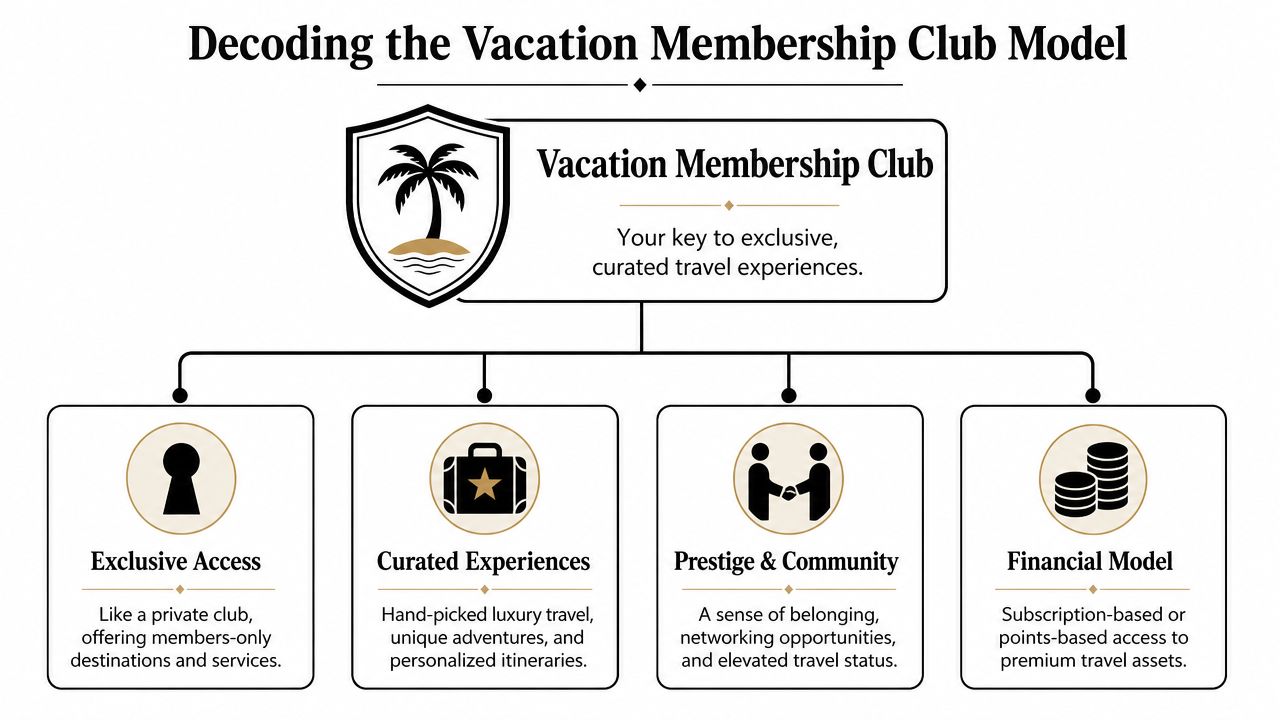
The economics are straightforward. A membership often involves a one-time initiation fee from $15,000 and annual dues around $5,500, in exchange for access to a network of destinations and services, according to AAA's guide to travel club models. That matters because you are not buying deeded ownership. You are buying access rights and service infrastructure.
What you're actually paying for
The cleanest way to understand the model is to break it into three layers.
| Layer | What it means | Why it matters |
|---|---|---|
| Access | Entry into a private travel ecosystem | You see inventory, experiences, or service tiers not positioned like retail travel |
| Service | Advisors, concierge support, booking assistance | Execution quality improves when one team handles the trip end to end |
| Buying power | Aggregated member demand | Clubs can negotiate benefits or rates individual travelers may not secure consistently |
The strongest clubs don't pitch ownership. They pitch orchestration.
That distinction separates a serious travel platform from a legacy product dressed up with modern branding. If the offer sounds like “buy now, vacation forever,” walk away. If it sounds like “join a network that improves how you travel,” now you're in the right category.
Why clubs exist at all
A club exists because individual luxury travelers, even wealthy ones, are still fragmented buyers. One family books a villa in St. Barts. Another books suites in Tokyo. Another wants a yacht extension in the Med. Separately, each booking has limited bargaining power. Together, that demand becomes commercially useful.
That's the business model. Members fund a platform that can negotiate, curate, and maintain a level of service. In return, members hope to receive a smoother experience and privileged access.
If you want a consumer-level explainer, Haute Black's view on exclusive travel clubs captures the access-first logic well. The point isn't to own vacation real estate. The point is to move through travel with less waste and more precision.
The right club behaves like a family office service line for leisure travel.
Comparing Timeshares Loyalty Programs and Membership Clubs
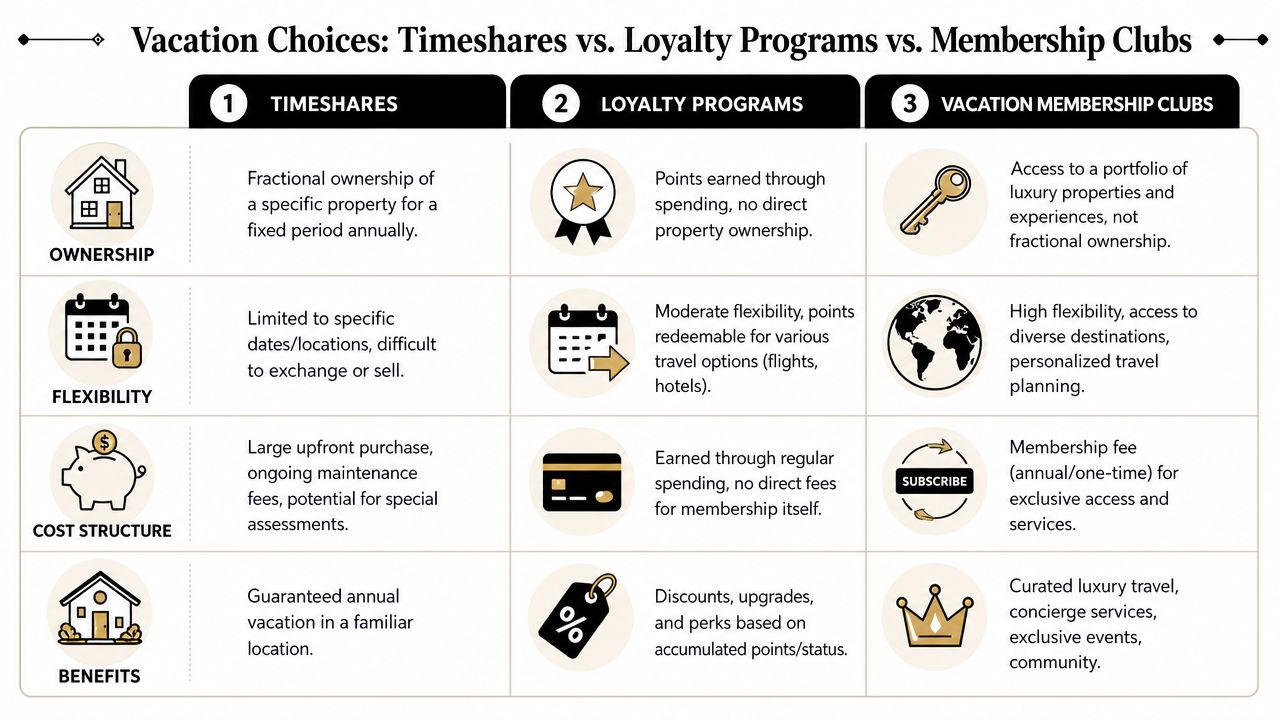
Most buyers confuse three different products because the sales language overlaps. That confusion is expensive.
Timeshares are about commitment
The timeshare industry is large and persistent. The global timeshare market is projected to reach $20.71 billion in 2026, with over 10 million memberships worldwide, according to Research and Markets' timeshare outlook. That same model relies on recurring revenue such as an average annual maintenance fee of $1,480 per interval, which is exactly the kind of continuing obligation many travelers want to avoid.
Timeshares work for people who want repeat use in a narrow pattern. Same resort family. Similar destinations. Predictable cadence. That can suit some households.
It usually doesn't suit discerning travelers who want optionality.
A timeshare creates attachment. A vacation membership club should create freedom.
Loyalty programs are about transaction volume
Hilton Honors, Marriott Bonvoy, airline status, premium hotel points ecosystems, these are effective tools. They reward repeat behavior. They can produce upgrades, free nights, and useful recognition.
But they are still mass systems. Their logic is transactional. Spend more, stay more, earn more. That works if your travel behavior already maps neatly to one hospitality network.
For a UHNW traveler, that can be too narrow. You may prefer Aman in one market, Four Seasons in another, Rosewood for city stays, a private villa elsewhere, and a yacht charter for summer. Loyalty programs don't unify that world. They fragment it.
Membership clubs are about relationship quality
A Vacation Membership Club sits in a different lane. It isn't trying to reward repeat spend with one brand. It's trying to improve your total travel life across brands, destinations, and trip types.
Here's the clean comparison:
- Timeshare: Asset-like commitment with recurring obligations.
- Loyalty program: Points-based incentives tied to spend and status.
- Membership club: Access-and-service model built around curation and execution.
A timeshare asks you to adapt to the product. A good club adapts the product to you.
Where premium cards fit
Cards like Amex Centurion can be useful. They offer perks, reservations support, and occasional access advantages. They belong in a UHNW travel stack.
They are not substitutes for a serious membership model.
Why? Because card programs are broad by design. They serve many use cases at once. A true club should know your preferences, your tolerance for risk, your preferred room orientation, your wellness requests, your security expectations, and your household dynamics. That requires a relationship, not just a benefits desk.
If you're deciding between the three, use this filter:
- Choose timeshare only if you want repeat use and can tolerate rigid obligations.
- Use loyalty programs as tactical tools, not strategic ones.
- Consider a Vacation Membership Club if your priority is smooth execution, curation, and access across a wide range of luxury options.
The UHNW Calculus Benefits and Risks
At this level, the evaluation is not emotional. It's portfolio logic applied to leisure.
A Vacation Membership Club is worth considering when it improves one or more of the following: time efficiency, access quality, privacy, or consistency of service. If it doesn't improve those, it's decorative.
Where the upside is real
The strongest benefit is time. Not abstract convenience. Actual decision compression.
A well-run club can narrow the field to a handful of correct choices, align logistics, and reduce the odds of travel mistakes that wealthy travelers still encounter all the time. Wrong room category. Weak family setup. Overhyped property. Poor transfer coordination. Generic “VIP” notation with no operational follow-through.
There's also the value of off-menu handling. Public booking channels are built for volume. High-touch travel often requires nuance. Split stays. Last-minute itinerary shifts. Multi-generational privacy. Hard-to-get dining. Positioning flights around private aviation. The best clubs can manage these variables with more continuity than a rotating hotel reservation desk.
Then there's access. Sometimes that means preferred inventory. Sometimes it means better treatment on arrival. Sometimes it means impossible tables, hidden villas, or a trusted point of escalation when something goes wrong.
The net cost paradox
Now the blunt part. Many clubs oversell savings and undersell the carrying cost.
A key risk is the net cost paradox. Promised discounts can be offset by annual dues, and a $7,800 membership may not break even for travelers who don't use high-cost inventory, a nuance missing in 90% of guides, as discussed in this traveler analysis of Unlimited Vacation Club economics.
That's not a niche issue. It goes to the heart of whether the model works.
If a club only makes financial sense when you book properties you wouldn't otherwise choose, or forces you into specific usage patterns to “justify” the fee, then it's not serving you. You're serving the membership.
Investment test: If the membership changes your travel behavior in unnatural ways, the ROI is weak.
For some travelers, the math is irrelevant because their return comes from service quality and time saved. That can be valid. But you should admit that explicitly. Don't let anyone dress up a lifestyle purchase as a guaranteed cost saver.
A similar logic applies in adjacent luxury sectors. For example, private jet charter membership structures often look compelling on access, but its value depends on how often and how specifically you use the platform.
The trust problem
The second major risk is contract opacity. Sales teams often pitch aspiration first and mechanics second. That is backward.
A club can sound elegant on the phone and still bury critical limits in usage rules, blackout periods, inventory controls, cancellation terms, and redemption formulas. If you can't explain the economics and restrictions in plain English after one review, don't sign.
The right response isn't cynicism. It's disciplined due diligence.
How to Evaluate a Vacation Membership Club
Treat the decision the way you'd vet a long-term service provider. Because that's what this is. Not a travel toy. Not an impulse luxury purchase. A service relationship that touches your calendar, family time, privacy, and capital.
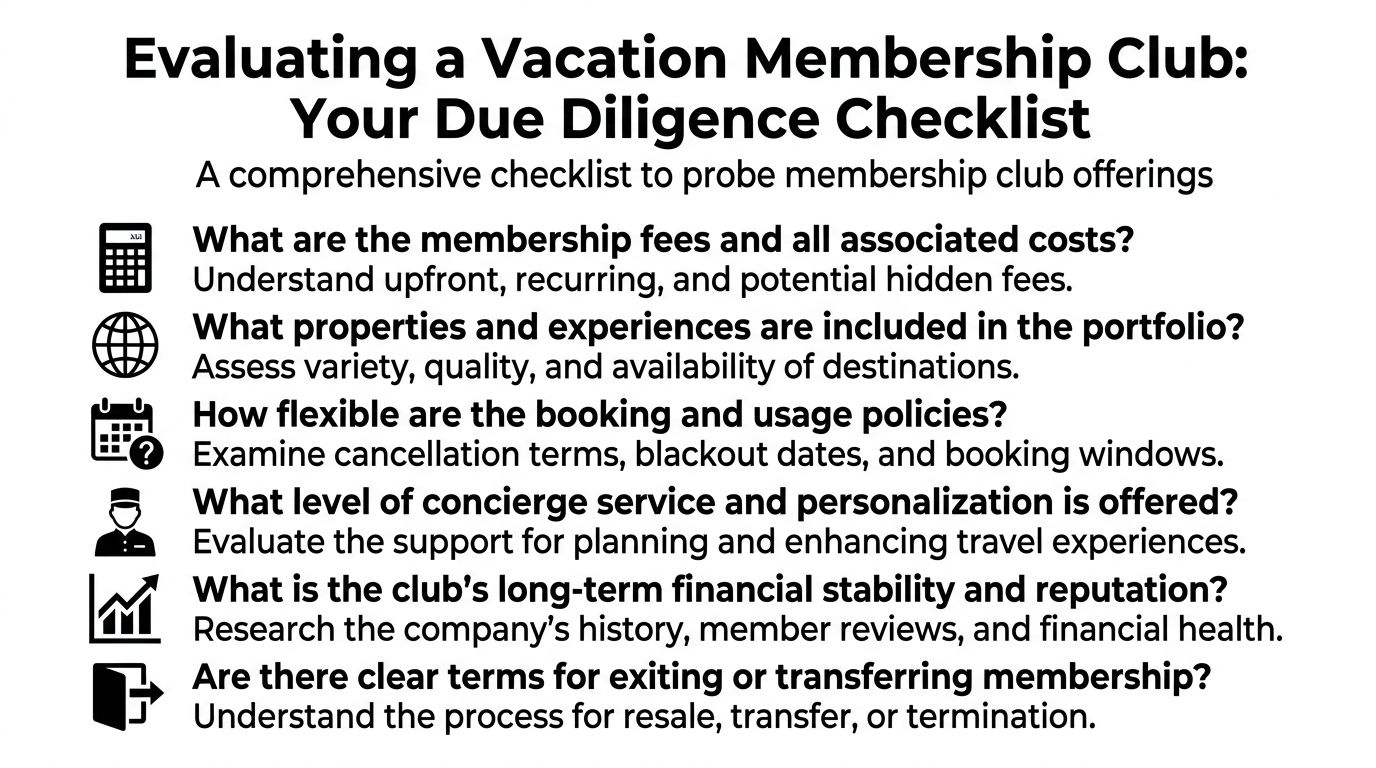
Start with the visual checklist.
Read the contract like an investor
The headline fee means almost nothing on its own. You need the full structure.
Ask for clarity on:
- Upfront economics: Initiation fee, annual dues, add-on charges, and whether planning or service fees sit outside membership.
- Usage rules: Booking windows, cancellation penalties, peak-date controls, and whether high-demand inventory is realistically obtainable.
- Exit rights: Transferability, termination terms, refund policy, and any continuing liability after resignation.
If a salesperson resists giving direct written answers, that's your answer.
A useful warning sits in public user complaints. A trust and transparency gap often arises from sales pitches, and user forums show 40% of negative reviews stem from misunderstanding that “premier nights” are not free weeks but depend on redemption rates and location availability, according to this member discussion around UVC redemption confusion.
Audit the portfolio, not the brochure
Clubs love glossy destination lists. Ignore the brochure aesthetic and ask operational questions.
| Due diligence area | What to ask |
|---|---|
| Property quality | Are the hotels and villas aligned with your standard, or just “luxury” in marketing language? |
| Availability | Can they show actual access on the dates and room types you'd realistically request? |
| Geography | Does the portfolio match your travel pattern, or force you into destinations you don't need? |
This video is useful context for evaluating how these offerings are framed in the market.
Test the service before you commit
A premium travel model lives or dies on execution quality. Ask for a live planning interaction. Give the team a complex brief and see how they respond.
Use a scenario that includes moving parts:
1. A multi-stop family trip with different arrival times.
2. A privacy-sensitive stay requiring discreet handling and security awareness.
3. A last-minute holiday request in a constrained market.
You're not testing friendliness. You're testing judgment.
If the team answers with generic options instead of tailored strategy, the club is not premium. It's packaged.
Finally, evaluate the community dimension carefully. Events, introductions, and private access can be meaningful. But only if they align with your social and professional life. Prestige without relevance is just noise.
Illustrative Example The Haute Black Membership
One useful way to understand the top end of this category is to look at a model built around service and community rather than simple rate arbitrage.

A strong premium membership structure should answer the exact questions discerning travelers ask. Who is handling the relationship? Are planning fees still layered on top? Is there senior access when something important needs fast judgment? Does the platform create value beyond hotel bookings?
In that context, Haute Black membership starts at $10,000 annually and includes waived planning fees, direct access to directors, and entry into 75+ exclusive members-only events, according to the Haute Black media kit. That positions the model around high-touch service and community, not just discounted stays.
Why that structure matters
This is the difference between a commodity club and a relationship platform.
A fee can be rational when it removes nickeled-and-dimed planning charges, creates a direct line to decision-makers, and extends into a broader private ecosystem. For the right member, value may come as much from cultural access, introductions, and continuity as from any individual trip booking.
That's especially relevant for travelers who don't want to manage a patchwork of separate providers for hotels, villas, events, aviation, and on-the-ground logistics. In that case, the club becomes an organizing layer.
The real benchmark
The benchmark isn't whether a membership feels exclusive. Many products can manufacture that feeling.
The benchmark is whether the service model produces better outcomes over time. Better rooms. Better handling. Better judgment. Better use of your time.
For readers who want to inspect the model directly, Haute Black membership details show how a modern luxury membership can be structured around ongoing advisory access rather than fixed-use vacation inventory.
Is a Vacation Membership Club Your Next Strategic Investment
A Vacation Membership Club is not automatically smart because it sounds elite. It is not automatically foolish because it carries annual dues. It's useful when it does one thing exceptionally well. It improves how you travel, not just where you sleep.
For ultra-high-net-worth travelers, the right lens is simple. Don't ask whether the membership saves money in isolation. Ask whether it saves time, reduces friction, improves access, and raises the quality of execution across your travel life.
That's where the primary return sits.
If you travel occasionally and enjoy hunting rates yourself, a club may be unnecessary. If your calendar is dense, your standards are high, your trips are complex, and your tolerance for booking friction is low, the right membership can be an intelligent purchase.
The bad versions trap you in fees, vague promises, and usage patterns designed to favor the seller. The good versions operate like a trusted advisory layer with significant influence, judgment, and discretion.
The final question is the only one that matters. When you travel, what are you trying to optimize? If the answer is price, keep shopping. If the answer is time, certainty, and access, then a well-structured vacation membership club deserves serious consideration.
If you want a membership model built around bespoke travel planning, insider access, and a private community rather than generic discount promises, explore Haute Black. It's designed for travelers who value relationship-driven service, VIP recognition, and a broader luxury ecosystem that extends well beyond the hotel stay.
Explore Our Guides


Signature Experiences


