Haute Black Journal
Private Boat Tours: The Luxury Insider's Complete Guide

Marlene Azeez
Director, HauteBlack
View all articles →
August 27, 2026
You've probably stood on a marina dock, looked at a row of polished hulls, and wondered which one could deliver the day you want. The answer rarely comes down to the newest yacht or the most recognizable name. A memorable private boat tour depends on the fit between vessel, captain, route, timing, provisions, and the people aboard.
That distinction matters because private boating has become a durable luxury travel category, not a seasonal novelty. The global leisure boat market is projected to reach $49 billion in 2026, compared with about $41 billion in 2022, while the global yacht charter market was valued at $11.4 billion in 2022 and is projected to reach $20.2 billion by 2032, according to industry data on leisure boating and yacht charters. The U.S. alone has more than 87 million recreational boating participants each year, which helps explain why expectations around private service, safety, and personalization keep rising.
What a Private Boat Tour Is
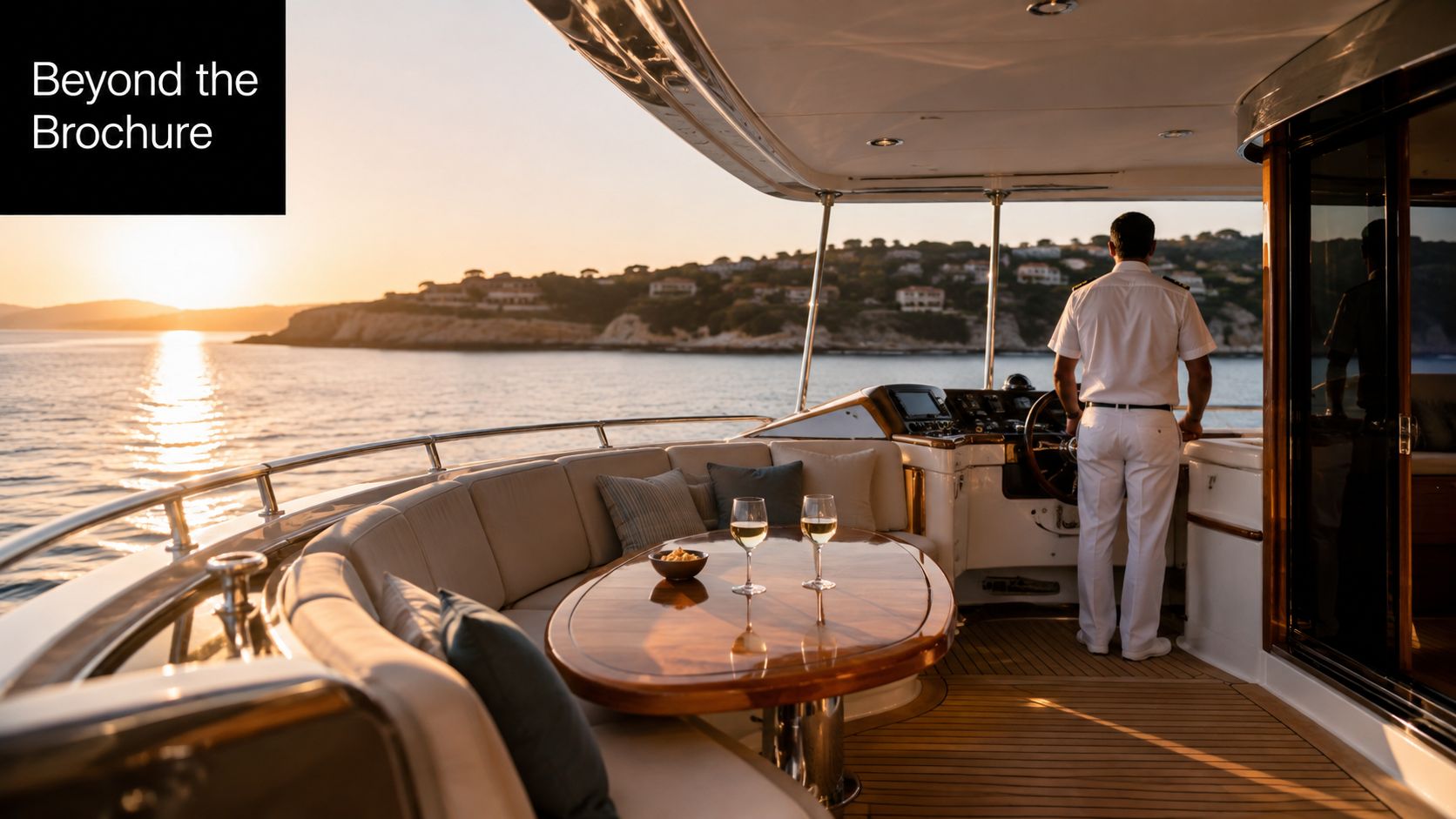
At golden hour, the aft deck tells you whether the day was planned well. The wake has softened, the captain has found a quiet anchorage, and a chilled glass arrives without interrupting the conversation. You stop noticing the vessel's length or engine configuration. The day feels natural because someone handled the details before you stepped aboard.
A private boat tour is a fully crewed, itinerary-built experience created for one party. The vessel, route, pace, meals, water activities, transfers, and shore time should reflect the guests, not a generic operating schedule. A Virtuoso-affiliated agency such as HauteBlack treats those choices as the luxury product, matching the captain and onboard program to the brief rather than presenting a hull for hire.
The charter formats
A day charter is the clearest introduction. You board for several hours or a full day, return to the same port, and use the boat as a floating base for swimming, lunch, snorkeling, sightseeing, or a sunset sail.
A term charter runs across multiple days, usually with overnight accommodation and a route that can respond to weather, restaurant availability, and guest energy. An expedition-style voyage goes farther, prioritizing remote coastlines, wildlife, diving, or cultural access over polished marina-hopping. In that format, logistics and vessel capability shape the experience as much as the itinerary.
The base package generally covers the vessel, captain, crew appropriate to the operation, navigation, and standard onboard amenities. Added layers can include customized provisioning, a private chef, diving or snorkeling equipment, shore excursions, airport transfers, marina fees, customs handling, and special events. Require every inclusion and supplement in writing before confirming.
Advisor's rule: Private means your party controls the experience. The sea, weather, and vessel safety limits still set the boundaries.
First-time bookers often misunderstand the word “private.” It does not promise unlimited passengers, speed, destinations, or changes. A licensed captain may be competent yet poorly suited to a luxury itinerary. Marina proximity also reveals little about the coastline, anchorage, swimming water, or crew.
If diving anchors the trip, compare the charter with a specialist operator offering customized private diving experiences. Build the day around the activity you want to remember, then select the boat, captain, route, and programming that can deliver it.
The Three Vessels You Will Be Choosing Between
The right vessel is dictated by itinerary and party size, not brand prestige. A fast yacht that spends the day idling outside one cove may be the wrong purchase. A beautiful sailing catamaran can disappoint guests who want to cover long distances. Choose the platform for the water time you intend to use.
Motor yachts
Motor yachts suit travelers who want speed, range, generous interior volume, air-conditioned salons, cabins, formal dining areas, and multiple entertaining zones. Larger examples can support overnight programs, while smaller yachts work well for coastal day cruising.
The trade-off is operational. Motor yachts consume more fuel than sailing vessels, and their draft and size can limit access to shallow bays or informal landing points. They also tend to rely more heavily on marina infrastructure, especially when guests expect polished embarkation, shore-side dining, and reliable provisioning.
Sailing catamarans
Catamarans offer level decks, broad outdoor living areas, shallow draft, and a stable platform for swimming and sun-focused itineraries. They're particularly effective for families, couples traveling together, and groups that want to move between bays rather than spend the day racing between ports.
Their twin-hull layout creates excellent social space, but the interior feel varies widely by design. A catamaran built for relaxed day sailing won't deliver the same privacy, crew separation, or storage as a high-spec charter model. Sailing also introduces a different rhythm. You trade some speed for quiet movement and a closer relationship with wind and water.
Powerboats
Powerboats, including RIBs, day cruisers, and sport yachts under 24 metres, excel at short-hop coastal runs, snorkeling excursions, cliff-jumping days, and beach access. Their agility lets the captain adjust quickly when the best swimming cove changes with wind or swell.
The compromise is space. Open powerboats can be exhilarating but offer limited shade, storage, bathroom access, and overnight comfort. A serious operator will match the boat to the passenger profile, not place the largest available engine beneath the group.
For a useful pre-booking review, examine vessel insurance requirements in Florida, especially if your charter begins in the United States. Insurance is only one part of due diligence, but it prompts the right questions about commercial use, passenger limits, and operator responsibility.
Private Boat Tour Vessels Compared
| Vessel Type | Best For | Typical Capacity | Comfort Trade-off |
|---|---|---|---|
| Motor yacht | Longer coastal itineraries, entertaining, overnight luxury | Depends on vessel and certification | More interior comfort and range, with greater fuel and marina dependence |
| Sailing catamaran | Swimming, relaxed island-hopping, family days | Depends on layout and certification | Stable, spacious decks, but generally slower and less formal |
| Powerboat | Short coastal runs, snorkeling, beach access, active days | Depends on vessel and certification | Agile and fast, with less shade, storage, and overnight comfort |
Never accept a capacity figure without asking whether it refers to legal passengers, sleeping berths, or the broker's preferred comfort level. Those are different numbers.
Where the Best Private Boat Tours Happen
The strongest destinations each offer a different version of private boating. The Mediterranean layers coastline with restaurants, villages, ruins, and regional cuisine. The Caribbean prioritizes warm water, reef access, and winter sun. The South Pacific rewards travelers willing to accept longer logistics for less developed cruising grounds. The U.S. coastline offers easier domestic boarding and strong regional character.
Mediterranean
The Amalfi Coast, Balearics, Cyclades, French Riviera, and Italian Riviera are ideal for travelers who want the sea to connect a broader cultural itinerary. A morning swim can lead to lunch in a waterfront village, followed by an architectural or culinary stop ashore.
Greece often becomes more attractive outside the busiest summer period, particularly for guests who value calmer ports and a slower rhythm. The French and Italian Rivieras offer polished infrastructure, while the Cyclades demand more attention to wind, exposure, and route flexibility. An advisor earns the fee here by distinguishing a rewarding route from a sequence of famous names.
For current destination planning, HauteBlack's guide to the top places to visit on the French Riviera is a useful companion to a charter conversation.
Caribbean
The British Virgin Islands, St. Barts, and the Grenadines remain anchor destinations for private boat tours because they combine clear water, reef snorkeling, protected bays, and a strong winter-sun proposition. The BVI is especially straightforward for island-hopping, while St. Barts suits guests who want a more social, design-conscious shore experience. The Grenadines reward a slower route and a willingness to spend more time away from major ports.
The key question is whether your group wants activity or atmosphere. A family may prefer easy tender access and sheltered swimming. A couple may prioritize quiet anchorages, a beach lunch, and an unhurried sail between islands.
South Pacific
French Polynesia, Fiji, and the Solomon Islands deliver the most untouched-feeling seascapes in this comparison. They also present the most limited infrastructure, which raises both the upside and the logistical demands.
Here, vessel autonomy, crew competence, provisioning, communications, and medical planning deserve serious attention. The reward is a charter shaped around lagoons, wildlife, village encounters, diving, and remote anchorages rather than a predictable marina circuit.
U.S. coastline
New England fall runs, the Florida Keys, and the Pacific Northwest give travelers domestic boarding with distinct regional identities. New England offers a compelling combination of coastal towns, seafood, historic architecture, and seasonal atmosphere. The Florida Keys suit warm-water activities and casual island movement. The Pacific Northwest is about scenery, wildlife, protected waterways, and a more exploratory feel.
A Virtuoso-level agency adds the most value when the region is unfamiliar, the itinerary crosses multiple jurisdictions, or the group has competing needs around comfort, access, dining, and activity.
Top Private Boat Tour Regions at a Glance
| Region | Peak Season | Signature Activity | Charter Infrastructure |
|---|---|---|---|
| Mediterranean | Warm-weather cruising period, with attractive shoulder-season options | Coastal dining, cultural stops, island-hopping | Strong across major Riviera, Italian, Greek, and Spanish ports |
| Caribbean | Winter-sun cruising period | Reef snorkeling, swimming, beach visits | Well established in anchor destinations, with variation between islands |
| South Pacific | Destination-dependent warm-weather window | Lagoon cruising, diving, remote exploration | More limited, requiring careful provisioning and logistics |
| U.S. coastline | Region-dependent coastal season | Domestic cruising, wildlife, seafood, and shore excursions | Mature in major coastal markets, with strong regional variation |
How Private Boat Tour Pricing Really Works
The quoted base rate is only the starting point for understanding total charter cost. A reliable quote shows how that rate connects to operating expenses, guest preferences, and the route. Read the cost structure before you compare boats.
Start with the base rate
The base rate covers use of the vessel for the agreed period. Depending on the operator, it may include the crew, standard equipment, and selected onboard services. Other quotes use a plus-expenses structure, leaving fuel, food, dockage, and certain services outside the headline price.
Ask one direct question: “What does this quote include, and what remains variable?” The answer matters more than the first figure on the page.
Understand the APA
The Advance Provisioning Allowance, or APA, is a working fund for fuel, food, beverages, dockage, and other trip expenses, reconciled after the charter concludes. The captain or management team draws from it during the trip, records expenditure, and returns or requests the balance according to the agreed process.
Request the expected expense categories, payment timing, handling process, and reconciliation method before signing. A vague APA creates avoidable friction at the end of the charter.
Fuel deserves close review. Distance, cruising speed, sea conditions, and repositioning can change the final cost. A route that appears modest on a map may require repeated high-speed legs or additional port movements, pushing fuel use higher than expected.
Separate service from extras
Crew gratuity, provisioning, dockage, transfers, customs handling, shore excursions, water sports, and private dining may appear as separate charges. Some Mediterranean and Caribbean operators include more within an all-inclusive structure. Others prefer a transparent base-plus-expenses model.
Neither format wins automatically. A clear plus-expenses quote can provide better control than an all-inclusive figure built around restrictive assumptions. Compare the inclusions line by line, especially for dining, port use, and activities.
Private Boat Tour Pricing Breakdown by Vessel Type
| Cost Component | Yacht, 80 to 130 ft | Catamaran, 50 to 70 ft | Powerboat, 45 to 65 ft |
|---|---|---|---|
| Base charter rate | Driven by vessel specification, crew, season, and itinerary | Driven by layout, crew model, and destination | Driven by performance, age, equipment, and operating area |
| APA | Fuel, provisioning, dockage, and trip expenses can be material | Usually shaped by route length, food program, and port use | Often sensitive to fuel consumption and coastal repositioning |
| Fuel | Larger engines and longer passages increase exposure | Sailing can reduce engine use, though motoring remains necessary | Fast coastal routing can raise fuel consumption |
| Crew gratuity | Considered separately unless expressly included | Varies with crew size and service level | Usually reflects captain and onboard service |
| Provisioning | Formal dining and larger menus require advance planning | Strong fit for relaxed meals and water-focused days | Best handled around shorter day itineraries |
| Optional experiences | Transfers, tenders, diving, shore programs, and private chefs | Water sports, beach access, and local dining | Snorkeling, fishing, transfers, and active excursions |
Before accepting a quote, request the cancellation terms, weather policy, fuel assumptions, overtime rules, dockage responsibilities, and treatment of unused APA funds. Have the agency model the expected total against the route and guest brief. Compare the total expected cost, not the most attractive first line.
Why Booking Through a Bespoke Agency Changes Everything
The vessel is visible. The luxury product is the invisible coordination behind it.
Booking direct with an operator can work when you know the exact boat, route, captain, and service standard you want. It becomes less attractive when the fleet is unfamiliar, the itinerary is complex, or the group has precise expectations around food, privacy, accessibility, and contingency planning.
Direct booking versus agency booking
| Consideration | Direct with Operator | Bespoke Agency |
|---|---|---|
| Vessel selection | Usually limited to one fleet | Broader market comparison |
| Captain matching | Based on operator availability | Matched to itinerary and guest profile |
| Itinerary design | Often based on standard routes | Built around pace, interests, and logistics |
| Provisioning | Managed through the operator's process | Preferences coordinated across crew and suppliers |
| Disruption support | Operator handles its own operation | Advisor can advocate across parties |
| Added travel services | May be separate | Can be coordinated with transfers, hotels, dining, and shore programs |
A Virtuoso-affiliated agency such as HauteBlack can bring preferred partner relationships, captain matching, vetted crew selection, shipyard visits, and access to vessels that aren't displayed on public charter platforms. The practical value lies in the advisor's ability to translate a personal brief into operational decisions.
A couple who says “quiet and romantic” may need a different captain and route than a family that says “active and flexible,” even if both request the same yacht. A discreet executive group may care more about boarding logistics, schedule control, and communications than about a prominent brand on the hull.
Advocacy matters when plans change
Weather, mechanical issues, marina restrictions, and service failures don't respect the brochure. The operator has a direct interest in protecting its asset and schedule. An independent advisor can focus on the client's position, press for a fair remedy, and coordinate alternatives without leaving the guest to negotiate from the aft deck.
That doesn't mean an agency can override a captain's safety decision. It means the client has someone managing the commercial and logistical consequences when the itinerary changes.
HauteBlack's editorial perspective on a luxury travel agency for bespoke vacations reflects the broader principle. A private boat tour should sit inside a complete journey, with hotels, transfers, dining, and land arrangements designed to support the time on the water.
Designing the Experience Beyond the Boat
Luxury on the water isn't measured by how much you can fit into a day. It shows in what the itinerary leaves out.
A polished charter may include a private chef tasting, a dawn swim, locally guided snorkeling, or a quiet evening at anchor. None of those experiences requires theatrical excess. They require timing, judgment, and a crew that understands when to offer structure and when to disappear.
Slow beats crowded
The best captains recommend routes according to wind, swell, current, anchorage conditions, and season. Instagram fame is a poor navigation strategy. A celebrated cove can feel ordinary when crowded, while a less famous bay may deliver better swimming, shade, privacy, and lunch conditions.
Plan a sea day around one strong experience rather than collecting stops. Leave enough margin for a long swim, an unhurried meal, or a conversation that doesn't need to end because the next waypoint is approaching.
Design for the whole party
Mixed groups require deliberate pacing. Older travelers may need easy boarding, stable decks, shade, and a practical restroom. Children may need shorter passages and varied activity. Guests who are motion-sensitive may prefer sheltered water and a route that avoids unnecessary speed.
Ask about tender access, swim ladders, flotation equipment, shade, and boarding surfaces before you book. Commercial passenger operations carry formal responsibilities that go beyond recreational boating. In Canada, any vessel carrying at least one passenger for payment is treated as a passenger vessel, and vessels carrying more than 12 passengers are inspected annually under the applicable transport-safety framework, as explained in Canada's passenger-vessel guidance.
Environmental care is also part of good experience design. Anchors and accidental groundings can disturb coral and seagrass, while propeller wash and wake can resuspend sediment and stress marine life, according to academic research on commercial tour-boat impacts. Use mooring buoys where available, respect no-anchor zones, and approach shallow areas at reduced speed.
For an evening built around food rather than spectacle, consider how a private chef dinner and bespoke dining experience could complement the charter. The most luxurious thing aboard may be uninterrupted time in a beautiful place.
Your Private Boat Tour Planning Checklist
A memorable charter starts with an experience brief, not a boat search. Define what the day must deliver, then give the broker enough detail to build the right operation around your guests.
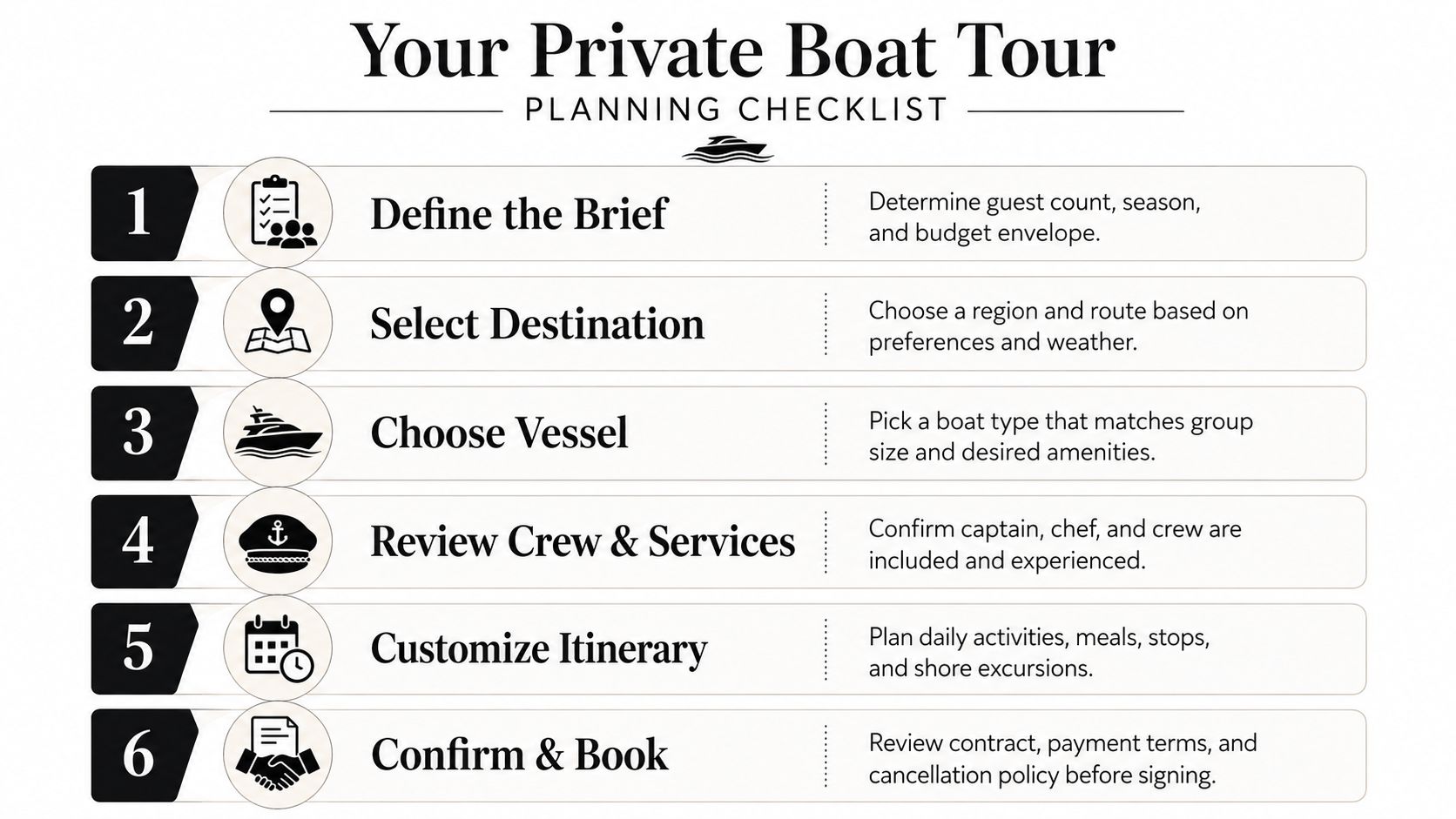
Define the brief
Record the guest count, preferred season, budget envelope, desired pace, and the memory you want the group to take home. Add guest-specific information at this stage, including dietary requirements, mobility needs, swimming confidence, preferred activity pace, and tolerance for time underway. That profile gives the captain and agency a working brief rather than a vague request.
Shortlist destinations
Select two or three regions, then match each to the intended experience. A family focused on easy swimming needs a different setting from a couple seeking remote anchorages or a group combining restaurants with cultural stops. Assess transfer time, access to protected water, port logistics, and the quality of shore-side options before committing.
Request matched vessel options
Ask for two or three vessel options with specifications matched to your itinerary, then compare them side by side. Review deck layout, draft, cruising speed, shade, cabins, tender arrangements, swim access, and storage for the equipment your programme requires. The right choice is the hull that supports the route and guest profile without forcing compromises into the day.
Request comparable quotes
Use a specialist agency or broker who can compare vessels beyond one operator's fleet. Require every quote to identify crew, fuel treatment, APA expectations, provisioning, dockage, transfers, taxes, cancellation terms, and weather procedures. Ask for the operating assumptions behind each price, not just the headline figure.
Interrogate the safety plan
Commercial tour operations carry specific obligations. In Norway, boats carrying 12 passengers or fewer must meet dedicated rules for vessels under 24 metres, including requirements related to construction, master qualifications, risk assessments, radio communication, and lifesaving equipment, according to Norwegian maritime safety guidance. Ask who is licensed, what equipment is carried, how passenger limits apply, and who makes the final call if conditions deteriorate.
Lock in preferences and contingencies
Send dietary requirements, preferred music, watersports interests, swim ability, shade needs, mobility considerations, tender access, and relevant medical information early. Confirm the response if weather changes, a guest becomes ill, the vessel develops a fault, or a planned port becomes unavailable. Put the agreed route, captain, onboard programme, and fallback plan in writing.
Final planning test: If the quote does not explain who does what when the plan changes, it is not finished.
A Virtuoso-affiliated agency such as HauteBlack can coordinate vessel selection, routing, captain requirements, onboard programming, hotels, transfers, and dining around the guest profile. Visit HauteBlack with your preferred destination and the kind of day you want the crew to create.
Explore Our Guides
Signature Experiences