Haute Black Journal
Private Aviation Catering: A Practical 2026 Guide

Marlene Azeez
Director, HauteBlack
View all articles →
Your principal is wheels-up in three hours. The flight departs from Farnborough, an assistant is chasing the omakase menu served last week in Teterboro, and the originating kitchen still can't confirm whether the rice will hold its texture and temperature in the aircraft galley. That isn't a restaurant reservation problem. It's a coordination problem involving aircraft capability, food safety, crew execution, airport access, and a passenger who expects memory rather than repetition.
Private aviation catering succeeds when the meal, packaging, handover, and service plan work as one system. A beautiful menu that arrives late, reheats poorly, or carries incomplete allergen information is a failed service. The recommendations below focus on the operational details that determine whether bespoke dining performs across repeat flights and different geographies.
Why Private Aviation Catering Demands a Different Playbook
Private aviation catering has moved beyond a niche luxury add-on. One market estimate valued the sector at USD 1.42 billion in 2024 and projects USD 2.35 billion by 2033, with a 5.7% CAGR from 2025 to 2033. Another estimate places the broader market at USD 6.619 billion in 2024, rising to USD 14.08 billion by 2031 at a 13.1% CAGR. The gap between these estimates reflects different market definitions, but the commercial message is clear: bespoke onboard dining has become a meaningful service line across private jets and VIP charter operations. (private jet catering market estimate)
The aircraft changes the food
A private aircraft isn't a restaurant with wings. Galley ovens top out at approximately 350°F, there's no proper salamander or restaurant-style broiler, cooling capacity is limited, and service space is restricted. A dish that depends on a crisp crust, delicate foam, or last-second searing may look impressive on paper but disappoint once the crew has to reheat and plate it in the cabin.
Cabin pressure also changes taste perception. Strongly seasoned, aromatic, or heavily alcoholic pairings can behave differently in the air, while lighter dishes often serve passengers better on longer sectors. I'd rather approve one hot course that reheats cleanly and arrives with its intended texture than promise seven courses and compromise half of them.
Practical rule: Design for the galley you have, not the kitchen you wish you had.
Commercial airline catering relies on scale and repeatable uniformity. Private aviation catering runs on preference recall. A principal may expect the same tea, rice preparation, portion size, mineral water, or pastry on repeated flights, while an executive assistant may need to coordinate changing preferences across family members, guests, and rotating crew. High-net-worth travelers also compare specific dishes, chefs, and providers across airports. Consistency at one favored FBO isn't enough.
The operational playbook must therefore cover menu engineering, dietary discipline, cold-chain control, lead times, cost transparency, and VIP communication. A useful starting point is to align catering with the wider private aviation service, so aircraft preferences, ground handling, and onboard dining are managed as one passenger brief rather than separate requests.
Building a Menu That Travels Well
The strongest inflight menu begins with constraints. Ask for the aircraft type, galley equipment, passenger count, flight duration, service timing, and whether the crew will plate or passengers will self-serve. A private jet may support only a modest number of covers per service, often around 10 to 12, so a menu that works for a large dining room may be impractical onboard.
Start with dishes that tolerate reheating
Choose the main course first. Braised short rib, lamb shoulder, and poached salmon can retain quality when prepared, chilled, transported, and reheated correctly. Delicate fried items, fragile pastry, and dishes that depend on a live flame need more caution.
Build each course around its final service state:
- Hot course: Use a braise, gentle roast, or sauce-based preparation that can be reheated in an oven-safe ramekin.
- Ambient course: Add bread, cured products, composed vegetables, or a room-temperature grain preparation that doesn't depend on cabin equipment.
- Cold course: Use salads, seafood, fruit, or dessert elements assembled close to departure and protected from condensation.
- Finishing elements: Keep herbs, sauces, oils, and garnishes separate when they'll lose freshness or texture during transport.
| Course Category | Reheat Method | Texture Risk | Recommended Plating |
|---|---|---|---|
| Braised meat | Covered oven-safe ramekin | Low to moderate | Sauce underneath or separately, garnish added onboard |
| Poached fish | Gentle covered reheating | Moderate | Keep sauce separate and finish immediately before service |
| Fried preparation | Limited oven reheating | High | Avoid unless the crew can serve immediately |
| Salad | No reheating | Low, if kept chilled | Seal dressing separately |
| Dessert | Ambient or chilled service | Low to moderate | Portion in a sealed vessel, garnish at service |
Choose the chef route carefully
Celebrity and Michelin-trained chefs can add provenance, but not every chef understands aviation. Ask whether the chef has designed food for a restricted galley, approved reheating instructions, and tight airside delivery windows. A chef who plates beautifully in a private dining room may still reject dishes that won't survive transport.
There are three practical routes. First, commission a chef willing to adapt a signature menu for aviation. Second, use a vetted private chef who can travel to the FBO or prepare at a nearby approved kitchen. Third, select a specialty operator with curated menus and established aviation packaging, such as the bespoke dining options connected with private chef dinners.
Treat provenance as an operational request
Destination-led sourcing makes a menu memorable, but it creates paperwork. Kobe beef routed through Osaka, burrata from Andria, or caviar associated with the Caspian region may require customs review, origin documentation, or CITES-related checks. Ask the provider to identify those requirements before approving the menu. Don't let the passenger discover at the FBO that a prized ingredient can't cross the border.
For a transatlantic departure, I'd build a menu around one hot, one ambient, and one cold course. Consider braised lamb as the hot course, a seasonal vegetable and grain preparation at ambient temperature, and a chilled seafood or fruit course. That combination gives the passenger variety while limiting reheating exposure, preserves texture, and leaves room to highlight provenance without making every plate dependent on a fragile technique.
Handling Dietary Restrictions and Allergen Discipline
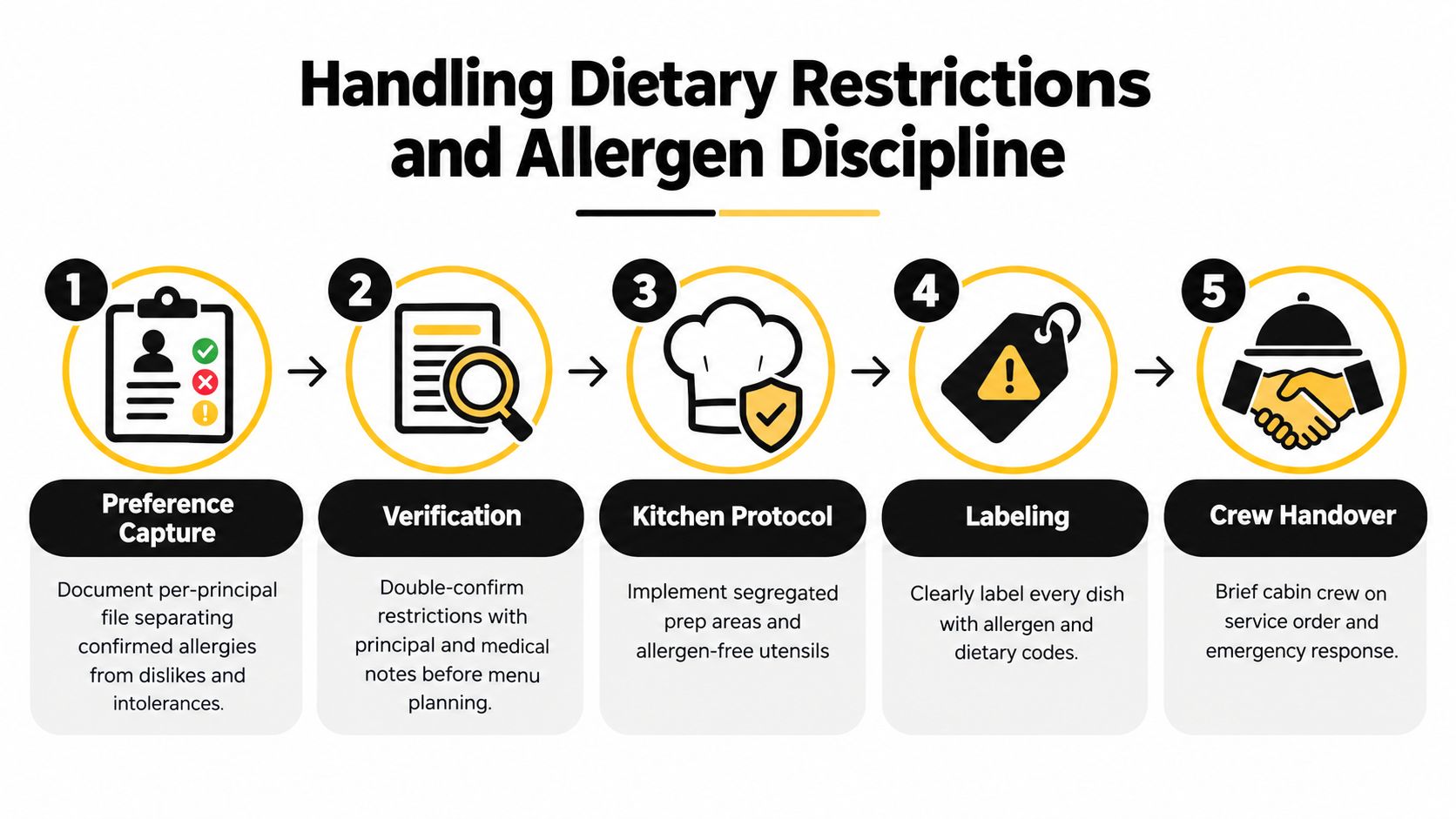
Allergen management should live in a structured passenger workflow, not in a casual note that says “no nuts.” The first document should separate confirmed allergies, intolerances, dislikes, ethical choices, religious rules, and lifestyle preferences. Record severity clearly, including anaphylactic risk where the passenger has provided that information.
Build a principal profile
A preference file should follow the principal across repeat flights and remain accessible to the approved travel, catering, and cabin teams. It should distinguish “won't eat,” “must avoid,” and “medical emergency.” Those categories aren't interchangeable. A dislike can guide menu design. A confirmed allergy changes kitchen controls, packaging, labeling, and crew handover.
Send a written catering brief to every provider and relevant crew member 72 hours before departure when the itinerary permits. At handover, require verbal confirmation that the catering team and cabin crew received the same information. This matters when crews rotate, kitchens change during a multi-leg itinerary, or an international FBO uses a different language for the briefing.
Use a written control chain
Require segregated preparation, sealed transport, and utensils reserved for allergen-safe dishes. The provider should name an accountable kitchen contact, delivery contact, and cabin handover contact. Labels should identify the passenger, dietary status, principal allergens, and service instructions without relying on memory.
A practical brief can use this format:
- Passenger: Name and seat or service position
- Restriction: Confirmed allergy, intolerance, religious rule, ethical choice, or preference
- Severity: Anaphylactic, intolerance, or non-medical avoidance
- Excluded ingredients: List specific ingredients and derivatives
- Cross-contact requirement: State whether segregated preparation is required
- Approved substitutions: Record replacements already accepted by the passenger
- Emergency contact: Approved operational contact and onboard procedure
At boarding, the flight attendant or concierge should ask four direct questions:
1. “Can you confirm the ingredients you need us to avoid today?”
2. “Is this a confirmed allergy, an intolerance, or a personal preference?”
3. “Have any symptoms or sensitivities changed since the menu was approved?”
4. “Would you like us to identify each dish before service?”
The most damaging failures often happen between providers. A kitchen may receive the allergy note, while the driver, FBO, or crew doesn't. Allergen discipline is the area where a provider's reputation can be won or lost permanently, so insist on named ownership and repeated confirmation.
The Cold Chain, Packaging, and Ramp-Side Logistics
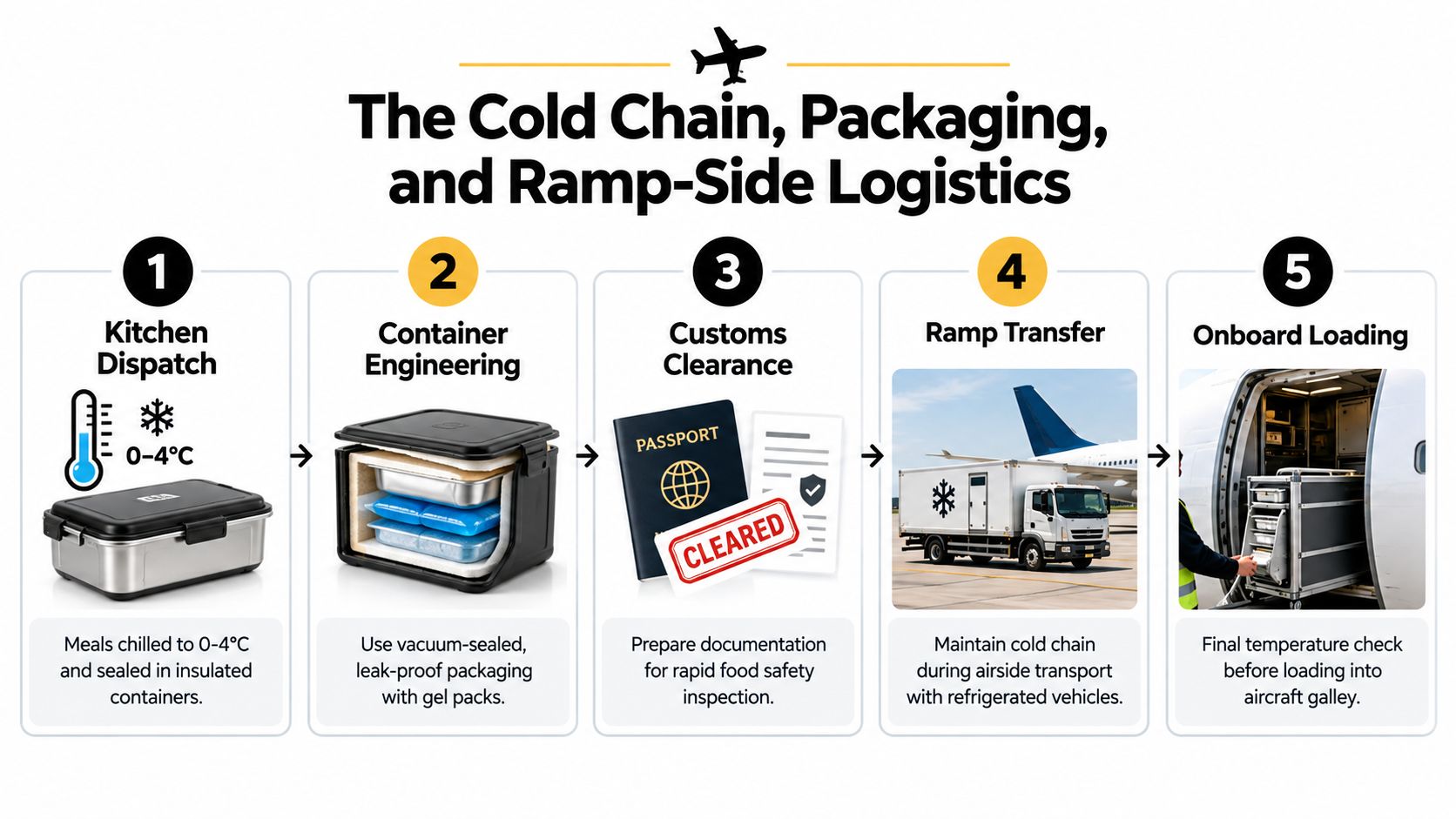
A beautifully prepared tray can still fail before it reaches the cabin. Once food leaves the kitchen, temperature control, packaging, and each handover determine whether it remains safe and serviceable. Require a documented cold-chain and HACCP plan that records temperatures at pack-out, loading, and aircraft handover, following aviation food-safety and HACCP guidance.
Cold food should remain below 5°C or 40°F. Hot food should remain at or above 57°C or 135°F, with 60°C or 140°F also identified as a hot-holding benchmark. Treat these figures as control points. If perishable food remains in the danger zone too long, discard or rework it. Reheating later does not erase poor handling.
Use a documented timing window
For a repeat flyer, the provider should lock the menu and operational notes 24 to 48 hours before departure. Production starts roughly 12 hours before departure, quality control and temperature logging take place around 3 to 4 hours before departure, and airside handover occurs approximately 90 minutes before flight. Keep these milestones in the trip file, then carry the passenger's established preferences into the next booking instead of rebuilding the brief from memory.
Packaging must suit the aircraft and service plan. Use sealed, leak-resistant containers for turbulence, oven-safe ramekins for reheating, and instructions specifying time, temperature, and oven mode. Cabin pressure changes, secure stowage limits, turbulence, and tight turnarounds make ordinary restaurant containers a poor choice.
Plan for the ramp, not just the kitchen
Airport-side customs inspections, secure ramp access, local food-import rules, and inconsistent FBO procedures can delay an otherwise ready order. Opaque lids may slow inspection. Every shipment needs a traceable chain of custody from dispatch through loading, especially when crossing jurisdictions.
Require thermal bags, airside-cleared drivers, delivery timestamps, and signed handover records. Aviation food-safety logistics guidance places significant attention on logistics, aircraft-specific containers, materials, and reheating instructions. Marketing claims matter less than whether a provider can repeat that process across airports.
For assistants building an aviation operations network, an aviation job listing on MAJC offers context on the ramp-side coordination behind reliable handovers.
The video below shows how aircraft operations and catering execution connect.
Lead Times, Cost Factors, and Contingency Planning
The cheapest private jet catering order is the one that doesn't fail because someone ignored lead time. I recommend a tiered protocol: 72 hours minimum for standard menus, 12 hours for premium or chef-led requests, and a documented 4-hour emergency window only for principals with standing agreements and a provider prepared to act.
Those windows aren't arbitrary. They allow the team to confirm the aircraft, source ingredients, approve substitutions, prepare labels, clear the delivery route, and resolve customs questions. Same-day requests may work at major FBOs, but they should never be treated as the default for an important flight.
Separate the price from the promise
Private aviation catering quotes vary according to the number of passengers, sourcing origin, chef attendance, packaging, branded disposables, seasonal availability, and airport logistics. Published estimates place catering at approximately USD 230 to USD 2,000 per flight leg, depending on menu and passenger count. (private jet catering cost range)
For planning purposes, use the following working tiers:
| Service Tier | Minimum Lead Time | Typical Per-Head Cost (USD) | Best Use Case |
|---|---|---|---|
| Standard domestic short-haul | 72 hours | $150–$400 | Reliable breakfast, lunch, dinner, or snack service |
| Premium transcontinental | 72 hours or earlier | $400–$900 | More complex sourcing and multi-course service |
| Chef-led concept | 12 hours minimum | Starts at $1,200 before logistics | Principal-led dining concept or chef-specific menu |
| Emergency service | 4 hours with standing agreement | Quote-based | Last-minute changes with approved fallback options |
The figures above are planning anchors, not promises. A chef-led request can cost more once travel, staffing, sourcing, and delivery are included. A simpler menu at a difficult airport can also generate a higher logistics charge than a complex menu at a well-supported hub.
Put the fallback in writing
Approve a backup menu before departure. Contract a second supplier in the same metro where possible, and record an escalation contact at the FBO. The contingency document should state what happens if an ingredient is unavailable, the aircraft changes, the departure time moves, or customs delays the original shipment.
Operational standard: A backup menu isn't a concession. It's part of the catering deliverable.
The VIP Service Standard and What to Expect From Your Provider
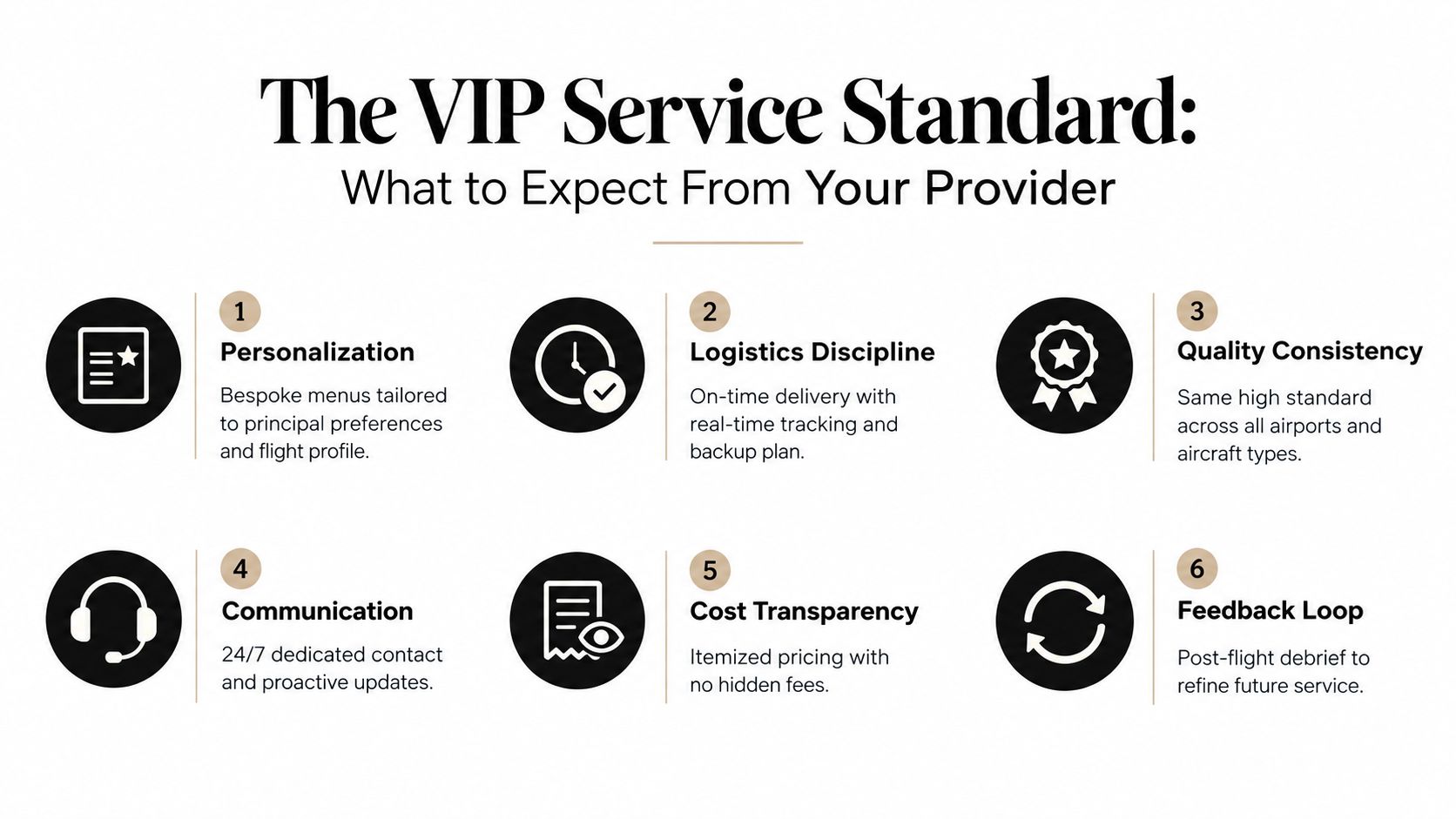
A serious private aviation catering partner should provide more than a menu PDF and an invoice. The provider needs a named account manager with direct mobile access, a preference profile that travels with the client, and a clear method for adapting menus to destination, aircraft, dietary status, and service style.
The first test is communication. I expect written confirmation within 30 minutes of a complete request, followed by a pre-flight checklist sent to the cabin crew. If something goes wrong, the provider should complete a post-flight debrief within 24 hours and update the passenger profile rather than treating the incident as isolated.
Judge the provider by repeatability
Ask for evidence of the operating system, not just photographs of finished dishes. You should be able to review:
- Preference continuity: The principal's approved likes, dislikes, allergies, portions, beverages, and service preferences
- Aircraft adaptation: Reheating instructions and packaging matched to the assigned aircraft
- Logistics visibility: Delivery status, handover records, and temperature documentation
- Geographic coverage: A process for customs, local sourcing, and airport-side differences
- Cost clarity: One itemized quote covering food, staffing, packaging, delivery, and contingency
- Feedback handling: A post-flight process that records what changed for the next trip
Small details can extend beyond the meal itself. If the flight is part of a broader executive itinerary, a thoughtful personalized corporate gift strategy can coordinate the onboard welcome with the passenger's preferences without confusing gifting with catering.
Request a trial flight on a short leg before committing to a multi-leg charter series. Also insist on one statement of work that covers menu, staffing, logistics, dietary controls, and contingency. A provider that can't present those elements together is still operating as a vendor. The right partner behaves more like an extension of the travel office, supported by a clearly briefed cabin team and an appropriate private flight attendant role.
HauteBlack coordinates private aviation travel with in-flight customization, including gourmet catering and premium wines selected for flight preferences. If you want one advisor to align aircraft arrangements, passenger preferences, and bespoke dining, visit HauteBlack and discuss your next itinerary before the catering window closes. Share the aircraft, route, passenger profile, and dietary requirements, and ask for a complete menu and contingency plan rather than a generic catering quote.
Explore Our Guides


Signature Experiences


