Haute Black Journal
Personalized Travel Recommendations for Luxury Travelers

Marlene Azeez
Director, HauteBlack
View all articles →

# Personalized Travel Recommendations for Luxury Travelers
August 8, 2026
You're probably already tired of generic trip-planning that treats every client like they want the same overwater villa, the same restaurant list, and the same airport transfer. That approach wastes time and misses the point. Personalized travel recommendations at the luxury tier should feel like a trusted advisor shaping the right room, the right timing, and the right access around your life.
A recent Amadeus study summary reported that AI tools are already changing how travelers plan, because they save time and surface suggestions that feel closer to actual habits. That is useful, but high-end travel does not get better when AI flattens the advisor relationship into a list of algorithmic options. It gets better when AI supports a human who already knows the client, the property, and the partner network, including the kind of status-driven access that matters in Virtuoso-style arrangements.
What Personalized Travel Recommendations Mean at the Luxury Tier
Two travelers ask for the same Maldives escape. One gets a clean list of beach villas and flight options. The other gets a proposal that already knows they want a quieter arrival, a room close to the spa, a dinner that doesn't feel staged, and a return that avoids a punishing connection after a long week. Same destination. Completely different level of thought.
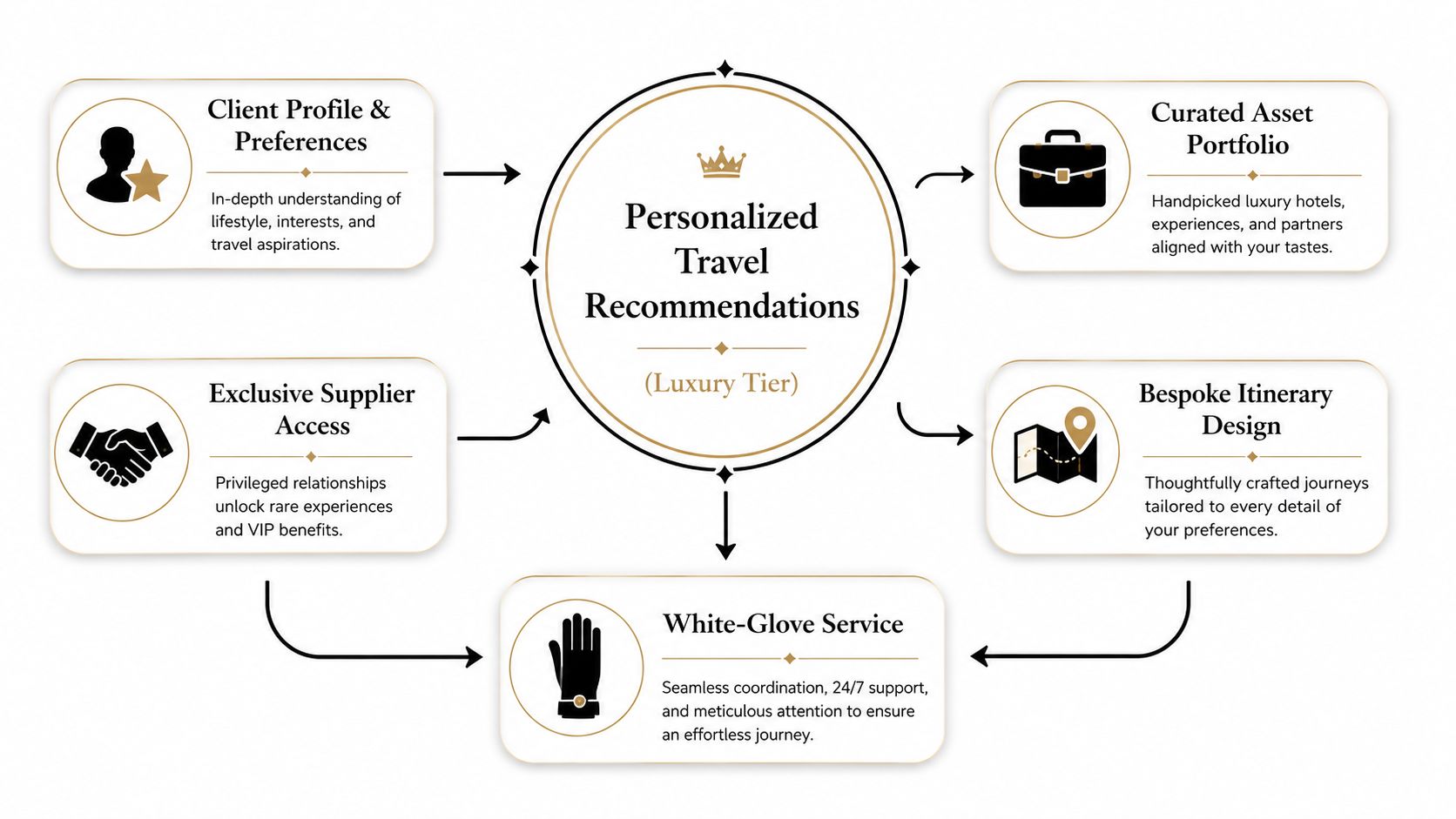
That second version is what personalized travel recommendations mean in luxury travel. It is not a filter on a booking site. It is the deliberate blend of stated preferences, observed behavior, and contextual signals, then interpreted by a human advisor who knows how to turn that information into an itinerary that works. At this tier, the best recommendation is not merely “best rated.” It is the one that fits the client's pace, privacy needs, travel pattern, and social calendar.
Why luxury personalization is structurally different
Mass-market personalization usually stops at destination similarity or price matching. Luxury personalization goes deeper because the advisor is working with fewer clients, a longer preference history, and a client who expects to be recommended to rather than forced to self-serve. That changes the service model completely.
The travel industry literature on AI-driven personalization points to a market that is becoming core infrastructure, not a novelty. A recent industry report estimated the AI-driven travel experience personalization market at USD 3.61 billion in 2024 and projected it to reach USD 18.01 billion by 2032, a 22.34% CAGR from 2025 to 2032 (market projection). For a luxury client, that matters because relevance is now expected, not applauded.
Haute Black's customized package tours are the kind of offer that makes this point concrete. The value is not in bundling more items together. It is in shaping the trip around how the client wants to move, rest, dine, and be handled.
Practical rule: if a provider can only describe your trip in terms of destination and dates, they are selling logistics, not personalization.
The test is simple. A luxury provider should know what to do with your past trips, your preferred tempo, and your tolerance for friction. If they do not, you are not getting personalization. You are getting a prettier booking engine.
The Three Layers Behind a Bespoke Recommendation
Luxury recommendations work best when three layers do the job together, and each one has a clear role. The human advisor reads the brief, the AI layer surfaces the strongest matches, and the partner network turns a promising idea into an actual experience with support behind it. Leave out any one of those layers, and the result becomes thinner quickly.
The human advisor still carries the load
A serious advisor does the first and hardest work. They turn “we want something private, but not boring” into a sequence of stays, transfers, and experiences that makes sense. They also know when to stay quiet and not suggest a property at all. That restraint matters more than endless choice.
The advisor layer is where two decades of supplier relationships pay off. A hotel can look perfect on paper and still be wrong for a particular client if the arrival window, room category, or experience flow is off. Human judgment catches those mistakes before they turn into expensive corrections.
AI should rank, not replace
The technology earns its place. Modern recommendation systems work best when they combine behavioral history with contextual signals, not static preferences alone. Research on travel recommendation models shows the strongest systems look at route data, timing, location, duration of stay, upcoming attractions, and historical points of interest, because travel intent changes across the planning lifecycle (TMS-Net study).
A separate travel recommendation paper describes a hybrid pipeline that uses collaborative filtering, content-based matching, and ranked output based on user-item interactions (hybrid recommender paper). That is the right architecture for luxury travel too. AI can flag which properties, suites, or experiences fit your pattern. It cannot know whether your spouse hates a long buggy transfer or whether your assistant needs a cleaner arrival sequence.
The partner network is where access shows up
The last layer is the one clients feel most clearly. A Virtuoso-affiliated agency with preferred status at 500+ properties such as Four Seasons, Aman, Rosewood, Belmond, and Ritz-Carlton has a different kind of influence at the front desk. That can mean smoother recognition, better room positioning, and a stronger chance that the property treats the booking as a relationship, not a transaction.
That same network effect is why purely algorithmic recommendations fall short at the luxury tier. The system can surface a property. It cannot deliver the quiet confidence of a general manager who already knows the booking is coming from a trusted advisor.
For clients who want one example of a provider built around this model, How to choose a VIP travel agency is the right place to start, and Haute Black operates in that advisor-plus-network format. Use it as a benchmark, not a shortcut.
What HNW Clients Actually Get From True Personalization
The visible benefits are the easiest part to understand. Complimentary room upgrades when available, resort credits, late checkout, VIP arrival amenities, and pre-arrival itinerary briefings are not decorative extras, they're the baseline deliverables a high-end traveler should expect when the relationship is real. If a provider can't talk clearly about those categories, they're still operating at brochure level.
The less visible benefits matter even more. A strong advisor can coordinate private aviation, helicopter transfers, and ground transport so the trip works as one movement instead of a pile of disconnected bookings. That matters when the client's time is scarce and their tolerance for delay is close to zero. It also matters for families, where one late arrival can throw off an entire weekend.
What should be on the invoice of value
The right question isn't whether you got “special treatment.” It's whether the trip was designed around the actual shape of your life. That includes room blocking for multi-generational travel, timing that avoids unnecessary congestion, and a pre-arrival briefing that tells the property what matters before you show up.
The most valuable part is often the quiet advantage. An advisor who can pick up the phone to a general manager can solve problems that email chains never fix. That is the difference between a reactive booking and a curated relationship.
Luxury clients should expect their preferences to be converted into operational details, not logged and forgotten. If you already know what kind of room, arrival, pace, and dining rhythm you want, the provider should know how to use that information without asking you to repeat yourself.
The best personalization feels invisible because the mistakes were removed before you ever saw them.
If you want a practical reference point for how curated trip design can be packaged, the service model behind customized package tours shows how the pieces can be assembled around a client brief rather than a fixed itinerary.
How to Evaluate Providers and Membership Programs
Choose the provider by structure, not by sales language. Ask who owns your account, how long that person has worked in luxury travel, what property relationships they hold, and what benefits membership provides versus a single booking. If they cannot answer those questions directly, the personalization claim is thin.
Ask for proof, not promises
Start with advisor tenure and direct property relationships. You want someone who has spent real time in the luxury lane and can name the hotels, GMs, and on-property contacts they work with. You also want to know whether the person pitching your trip is the one building it.
Then examine the membership structure. Some clients need a dedicated advisor and waived planning fees because they travel constantly. Others only need signature journeys or tailor-made trips on an occasional basis. Both can work, but the model should be clear before you commit. For a useful benchmark on the kind of provider setup worth comparing, see how to choose a VIP travel agency in 2026.
Privacy posture matters more than many advisors admit
A serious provider should explain how much information it requires before it can be useful. Some travelers will share plenty. Others want personalization without handing over medical, family, or spending data. Research on travel personalization points to privacy-preserving personalization as a real gap, and recent work also shows that modern systems are increasingly able to work with live signals rather than just static profiles (privacy and minimal-disclosure angle).
That is the question high-end clients should ask outright. Can the provider personalize well with limited disclosure and strong user control? Around half of travelers are comfortable sharing past or current travel plans if it makes the experience more personalized (Phocuswright update). You should expect that threshold to be handled intelligently, not pushed past.
Ask this directly: what data do you require from me, and what can stay private?
A provider that treats preferences like a firehose usually hides weak service behind a friendly interface. Look for disclosure of partner affiliations, a clear explanation of how requests are prioritized, and recent references that show repeat booking behavior. Privacy posture is a critical, yet often overlooked, aspect of service.
Members Versus Non-Members and What Each Path Unlocks
There are really two ways to engage a luxury travel provider. You can book a signature journey or tailor-made trip when needed, or you can step into a membership model with a dedicated advisor and the broader relationship layer. The right choice depends on how often you travel and how much continuity you want.
| Engagement Layer | Signature Journey Booking | Private Membership |
|---|---|---|
| Advisor relationship | Transactional or trip-specific | Dedicated and ongoing |
| Planning fees | Usually tied to the booking | Often waived as part of the relationship |
| Recognition | Good when the booking is clean | Repeatable, because the provider knows you |
| Speed to shortlist | Fast for a single trip | Faster over time because preferences are retained |
| Best fit | Occasional high-end travel | Frequent travelers, families, executives |
| Access layer | Limited to the trip at hand | Broader network and more consistent follow-through |
That table is the trade-off. Transactional booking gives you flexibility. Membership gives you continuity. If you travel once a year and want a beautiful trip, a one-off arrangement may be enough. If you move often, travel with family, or need an advisor who already understands your standards, membership is the stronger structure.
The analogy with other premium clubs is useful here. A well-run private membership should feel like the difference between a single good bottle and a cellar you trust. If you want a related example outside travel, browse our wine club shows how curation and continuity change the experience when the provider knows your taste over time.
For clients weighing the relationship model, travel club members guide elite access 2026 is the right kind of comparison point. The question is not whether membership sounds luxurious. The question is whether it gives you more recognition, less repetition, and better outcomes than booking from scratch every time.
High-End Scenarios That Show the Difference
A honeymoon couple says they want seclusion, but they don't want dead quiet. They want privacy with a pulse. A smart advisor pairs an Aman-style hideaway with a Nobu private chef evening so the trip feels intimate without becoming repetitive. The property matters, but the sequence matters more, because the dinner and the stay have to feel like one story.
A multi-generational family needs a different kind of intelligence. Grandparents want calm mornings and easy access. Parents want flexibility. Children need parallel experiences that don't drag the adults through a theme-park version of luxury. A strong advisor builds that around one property, blocks the right rooms, and organizes the days so each person gets a version of the trip that feels made for them.
When the client is moving between worlds
The executive scenario is where service either proves itself or falls apart. A good travel advisor weaves a Haute Jets private flight, a helicopter transfer, and a same-week cultural roundtable into a single itinerary without forcing the traveler to manage the seams. That's not just convenience. It's operational competence.
The value is in the coordination. Private aviation gets the client close. Helicopter transfer removes the last friction point. The roundtable creates the reason for the trip beyond the meeting itself. If the provider can't integrate those pieces, they're not really handling luxury travel.
For clients who care about dining and spa moments as part of the trip, best spas in Mauritius 2026 is a useful external reference point when you're comparing resort-level experiences. A good advisor should be able to translate that kind of research into a live itinerary, not just send you a list.
The difference between luxury and true personalization is whether the provider thinks in rooms, or in outcomes.
These examples all point to the same truth. True personalization is not a prettier shortlist. It's a provider who can move from preference to plan to execution without making you repeat the same sentence three times.
The Signals That Separate Bespoke From Booked
A bespoke provider has named property relationships, not vague “preferred access.” They can tell you where they've stayed, which suite types work, and which arrivals need advance coordination. That's the first signal.
The second signal is physical familiarity. If an advisor has never inspected the suites they recommend, they're guessing from a screen. That might be fine for ordinary travel. It isn't fine when the client expects precision. The third signal is integration with private aviation and ground partners, because luxury travel falls apart at the transfer points first.
Intimate cultural and culinary access is the last proof. Mass platforms can list restaurants. They can't build a night around the right chef, the right room, and the right moment. If something goes sideways, the test is who picks up the phone, and how quickly they can open doors.
Before you book, ask these questions. Which properties do you know personally? Who handles my account after the sale? What happens if my flight changes? What benefits are available to me, and which ones are just marketing copy?
A provider that answers clearly is worth your time. A provider that hedges is selling the word personalization without the service behind it.
Haute Black is built for travelers who want personalized travel recommendations to come from a real advisor relationship, not a generic platform. If you want access to bespoke itineraries, VIP recognition, and the kind of partner network that turns planning into service, visit Haute Black and see how a high-touch travel program should work.
Explore Our Guides


Signature Experiences