Haute Black Journal
Travel Club Members: A Guide to Elite Access in 2026

Marlene Azeez
Director, HauteBlack
View all articles →
# Travel Club Members: A Guide to Elite Access in 2026
Your assistant has airline status, the villa is paid for, the car is arranged, and the restaurant still says no. Then a storm moves through Europe, one flight cancels, the connection falls apart, and your so-called VIP line routes you to a call center reading from policy.
That's the moment most affluent travelers realize an uncomfortable truth. Public luxury isn't private access. First class, elite tiers, and premium cards can make travel more comfortable. They rarely make it controlled.
The people who travel best don't rely on perks alone. They rely on relationships, partner recognition, and one person who can solve problems when the polished system stops working. For travel club members, that distinction matters more than lounge access ever will.
Beyond First Class The Limits of Conventional Luxury
A familiar scenario plays out every season. A couple is heading to Dubai for a short stay before moving on to the Maldives. They've booked a premium suite, hold top-tier hotel status, and assume the arrival will be smooth. Then the room category they expected isn't available, the restaurant they wanted is full, and the transfer company treats them like any other well-paying guest.
That isn't a failure of spending. It's a failure of access.
Why premium status stops short
Mass-market loyalty programs are built for scale. They reward volume, not priority of relationship. If you're one of thousands of "top" customers, you're still one of thousands. During disruptions, sold-out periods, and high-demand moments, the system protects inventory first. It doesn't protect your time.
That's why polished add-ons can become distractions. The car may be exceptional, the suite may be expensive, and the booking may still lack real advocacy behind it. If you're arranging a high-visibility arrival in the UAE, a practical example of what polished ground experience looks like is Uptown Rent A Car's VIP car guide. It's useful because it shows the visible layer of luxury. What it doesn't solve is the invisible layer, who can still open doors once the obvious pieces are booked.
The ceiling of conventional luxury appears when everyone with money is trying to buy the same thing at the same time.
What serious travelers actually need
High-net-worth travelers don't need more apps, more points, or another card promising premium treatment. They need three things:
- A decision-maker behind the reservation who can push for priority handling when plans shift
- Partner recognition at the property level so requests are heard before arrival, not improvised at check-in
- A trusted human filter who knows which "exclusive" experiences are worth the effort and which are retail theater
True private membership begins to separate itself. The value isn't theoretical. It appears in the moments when generic premium service runs out of authority.
The World of Travel Clubs Explained
The term "travel club" gets used too loosely. It can mean a points program, a vacation subscription, a destination club, or a private advisory membership. Those are not variations of the same product. They are different business models aimed at different travelers.
The market is large enough now that the distinction matters. The global travel club membership market was valued at $28.6 billion in 2025 and is projected to reach $54.3 billion by 2034, with a 7.4% CAGR, according to Dataintelo's travel club membership market report. That growth reflects demand for curated access and bespoke itineraries, especially among affluent travelers.
Four categories that matter
Most travel club members fall into one of these groups:
| Category | Core value | Best for | Limitation |
|---|---|---|---|
| Airline and hotel loyalty programs | Points, status, upgrades when available | Frequent travelers with predictable patterns | Benefits are standardized and inventory-driven |
| Mass-market membership clubs | Discounts, packaged perks, member pricing | Price-conscious travelers who book often | Service is usually broad, not highly personalized |
| Destination and residence-style clubs | Access to homes, resorts, fixed inventory | Families who return to similar places | Flexibility can be constrained |
| Private advisory memberships | Relationships, planning, access, recognition | UHNWIs, executives, families with complex needs | Value depends on advisor quality and partner network |
Where most buyers get confused
People compare these categories as if they were competing on the same metric. They aren't. A points program is about accumulation. A private membership is about elimination. It removes friction, reduces decision fatigue, and increases the chances that the right room, table, transfer, or introduction is handled before you ask twice.
If you're comparing private clubs more broadly, this piece on finding the right club membership is useful because it frames membership as a fit question, not a status purchase. The same principle applies in travel.
For a closer look at the private category, what an exclusive travel club actually is lays out the model clearly. That's the category serious travelers should evaluate separately, not lump in with consumer rewards.
Advisor's view: If a club leads with discounts, it's usually a buying program. If it leads with relationships, it may be a service business. Those are very different propositions.
The practical takeaway
If you travel constantly and don't mind managing the details, public programs can be enough. If your travel time is scarce, your standards are high, and your plans tend to involve peak dates, multiple moving parts, or sensitive logistics, then you need a club built around intervention, not just perks.
Consumer Perks Versus Private Access
Most coverage of travel club members treats all memberships as if they solve the same problem. They don't. Consumer clubs help you extract value from public inventory. Private memberships help you operate within a relationship-driven ecosystem where access, recognition, and judgment matter more than rebate logic.
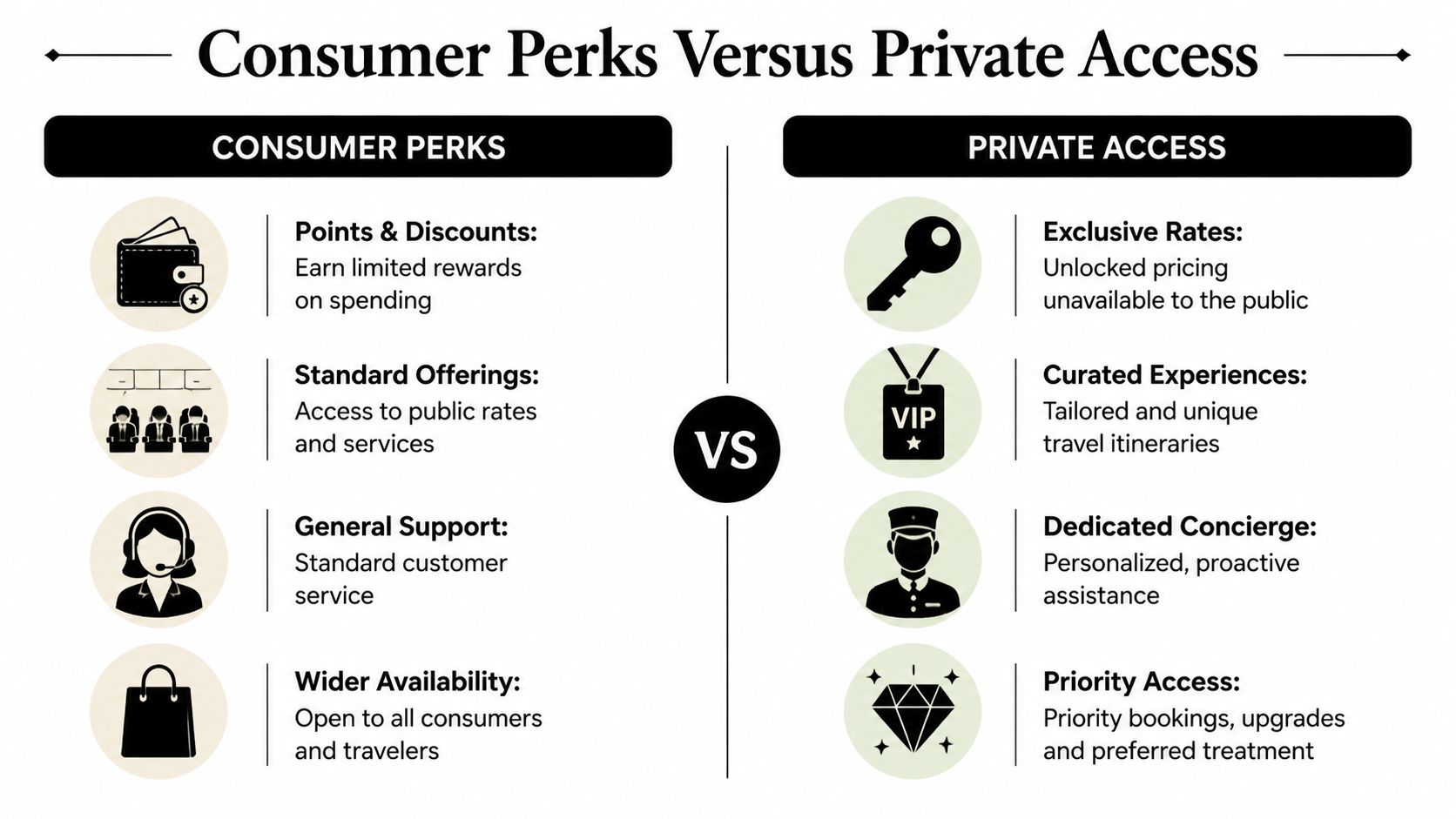
Two models with different priorities
Here's the cleanest way to explain it:
| Consumer perks | Private access |
|---|---|
| You earn benefits after spending | You receive support before, during, and after booking |
| Value is measured in points, credits, and tier status | Value is measured in time saved, doors opened, and problems prevented |
| Service is reactive and policy-led | Service is proactive and relationship-led |
| Inventory is public, even when labeled premium | Inventory and treatment may reflect behind-the-scenes partner advocacy |
The problem for affluent but infrequent travelers is obvious. A lot of public programs reward repetition. That works if you're on the road every week. It's a weak model if you take only a few important trips a year and expect each one to run flawlessly.
That gap is real. A cited market snapshot notes that the global HNWI population reached 22.8 million, with 38% seeking personalized luxury travel, while much of the available advice still focuses on mass-market clubs rather than the stronger access economics of luxury networks, including 20% to 30% higher upgrade rates in that segment, as summarized in this travel club industry write-up.
What private members are actually buying
Private members are not buying "better perks." They're buying a different operating model.
- Dedicated judgment: An advisor who knows your preferred brands, pace, privacy thresholds, and essential requirements.
- Waived planning fees in some memberships: That matters less for the money than for the signal. The advisor is there to plan, not meter every touchpoint.
- Priority advocacy: Requests are made through partner relationships, not anonymous notes in a booking field.
- Contextual recommendations: The itinerary reflects who you are, not what's available to everyone.
If you want the service layer broken down in practical terms, this guide to luxury travel concierge services is a useful benchmark. It captures the difference between order-taking and true advisory work.
Private membership rule: If the club can't explain who handles your trip, how they work with partner hotels, and what happens when plans collapse, it isn't a private access model. It's branded booking.
My recommendation
Don't compare a private membership to a points scheme on annual fee alone. That's the wrong lens. Compare them on control, speed, and quality of intervention. Once you do that, the categories stop looking interchangeable.
The Tangible Returns of a Private Membership
You see the difference at the moments that expose weak service. A sold-out arrival. A misfiring connection. A hotel that has your reservation but none of your context. Private membership earns its fee when those moments are handled well, fast, and without dragging you into operations.

What this looks like in practice
Take a peak-season family stay at a top resort. Anyone with money can book the room. The membership value sits in what happens around that booking: the right room location, confirmed dining strategy, pre-arranged family preferences, airport handling, and staff briefed before arrival so nothing important has to be repeated at check-in.
That is the actual product.
A second example is disruption. A principal is crossing three cities in four days, one flight falls apart, and public support channels collapse under volume. A private advisor starts rerouting flights, shifting transfers, protecting hotel check-in windows, and preserving the trip's commercial purpose while the traveler stays focused on meetings, not damage control.
The engine behind the scenes
Strong private memberships combine human judgment with memory. The advisor knows your preferences, but the system should also record them with precision and improve over time. Simon Data's case study on how Travel + Leisure Co. used integrated data for 1:1 personalization shows how better data infrastructure sharpens recommendations instead of broadening them into generic "luxury" suggestions.
That distinction matters. A mediocre club remembers that you like beach resorts. A serious private membership remembers that you prefer quiet inventory, short transfers, strong wellness, family logistics that work on day one, and a property team that understands discretion.
Your advisor should remember your standards before you restate them.
Where the return is measured
UHNW clients should judge ROI in three areas:
- Time recovered: fewer decisions, fewer follow-ups, fewer service failures to correct
- Friction removed: tighter coordination across air, hotel, transfers, dining, and on-site requests
- Access gained: preferred room allocation, priority handling, and experiences that do not appear on public booking paths in the same form
This is not about chasing upgrades as a hobby. It is about buying a better operating result. If your advisor saves ten hours of coordination on a complex trip, protects one high-value itinerary from disruption, and improves the quality of each stay across a year, the fee becomes easy to justify.
Measure outcomes with discipline. Did the advisor improve the stay in ways you could feel? Did they protect your schedule under pressure? Did they get access, recognition, or flexibility that a direct booking would not have produced?
Haute Black is one example of this category. It operates as a luxury travel and private membership platform with bespoke itineraries, VIP recognition across partner hotels, dedicated advisor access for members, and trip planning across more than 120 countries. Judge that type of offering by service infrastructure, response quality, and partner strength. That is where private membership proves its worth.
The New Frontier of Elite Networking
Luxury travel used to be about privacy, comfort, and access. Now it includes selective connection. For a certain kind of traveler, that may be the most valuable layer of all.

A good private club doesn't just move you well. It places you in the right rooms with the right people. That might mean a private dinner with a chef, a cultural evening with a serious host, or a members-only gathering where founders, investors, executives, and creators are there because they were invited carefully, not marketed to broadly.
Why this matters now
The networking layer is no longer a side perk. It's becoming a core reason affluent people join private memberships. A cited 2025 PwC data point reports that 62% of UHNWIs prioritize meaningful connections in their travel, and the same verified source notes that clubs such as Haute Black host 80+ intimate annual events, with 25% membership growth in 2025 tied to that model of AI-assisted matchmaking and curated gatherings, as referenced by Travelers' Century Club.
That changes the membership equation. The fee is no longer only about trips. It can also support introductions, community filtering, and environments where high-value conversations happen without the noise of large public events.
What separates curated networking from social fluff
Not all event calendars are useful. Many clubs confuse access with crowd size. Serious members should want the opposite.
- Verification matters: The room should be screened, not open-ended.
- Context matters more: The club should know whether you want investors, operators, cultural figures, or peers from a specific industry.
- Privacy is part of quality: The best introductions feel natural and low-friction, not staged.
A useful example of this shift appears below.
Some memberships save you time. The right one can also improve the caliber of the people you meet while you travel.
My view on the trend
Modern private travel memberships are becoming more intelligent. They're moving from trip orchestration into selective life infrastructure. For founders, investors, athletes, and executives, that's not indulgence. It's a strategic advantage.
How to Evaluate a Private Travel Membership
Most buyers ask the wrong first question. They ask what the membership costs. Ask what it changes.

In the global market, individuals account for nearly 49% of total revenue in travel club memberships, driven by demand for hyper-personalized experiences and 1:1 personalization powered by AI and behavioral data, according to Market Intelo's travel club membership report. That means the market is already telling you what discerning buyers want. They want relevance, not volume.
The five questions that matter
When you evaluate travel club members services at the private end of the market, ask these directly:
1. Who will handle my travel?
If the answer is vague, walk away. You want a named advisor or team structure, not a rotating support desk.
2. Which hotel and travel partners do you work with meaningfully?
Don't accept a logo parade. Ask what tangible benefits appear at brands you use.
3. How do you handle last-minute changes and multi-leg disruptions?
Marketing language won't help here. Ask for real examples, described qualitatively if needed, of how the team intervenes.
4. What does membership improve that I can't get by booking directly?
This is the heart of the evaluation. Recognition, planning depth, access, and advocacy should all be clear.
5. Is there a member platform or process that fits how I travel?
Some travelers want discreet advisor-led planning. Others want a digital layer as well. Both can work if the service remains high-touch.
Red flags you shouldn't ignore
- Too much emphasis on discounts: That usually signals a consumer model dressed up in luxury language.
- No clarity on privacy practices: If a club talks about personalization, it should also explain how member information is handled.
- Heavy inventory talk, light relationship talk: Inventory matters. Relationships change outcomes.
- Event hype without curation: If everyone is invited, the network probably isn't the point.
A practical way to assess fit is to review the actual membership structure and benefits of any club you're considering and compare them against your travel pattern, your preferred brands, and how much complexity you delegate.
Decision test: If a membership doesn't reduce your cognitive load, improve your access, and raise the quality of your travel days, it's overhead.
My recommendation
Choose the club that can answer operational questions without slipping into slogans. The right private membership should sound less like marketing and more like a chief of staff for travel.
Frequently Asked Questions for Prospective Members
Do private travel club members still need airline and hotel status
Yes. Keep the status. Use it as a baseline, not a strategy. Public loyalty still has value for seat selection, baggage handling, and some on-property benefits. It just shouldn't be your only layer of protection.
Is a private membership worth it if I only take a few major trips each year
Often, yes. Infrequent travelers can benefit more than road warriors because each trip carries more importance. If you're taking fewer trips, the standard for each one is usually higher, and the tolerance for friction is lower.
What should an executive assistant ask before enrolling a principal
Ask who handles urgent changes, how after-hours support works, which partners matter most, and how special preferences are captured. Also ask how the club deals with privacy, family travel, and tightly sequenced itineraries.
Are these clubs mainly about hotel upgrades
No. Upgrades are visible, so people fixate on them. The deeper value is in planning judgment, partner recognition, smooth recovery during disruptions, and access that changes the quality of the trip.
How much of the value depends on the individual advisor
A lot of it. The platform matters, but the advisor matters more. The strongest memberships combine both. Good systems retain preferences and context. Great advisors use them with taste.
What about privacy and discretion
You should expect both. A serious private membership should handle sensitive preferences, family details, and high-profile travel with restraint. If a club is loose with member identity, event visibility, or communication protocols, that's a hard no.
Can a private club help beyond leisure travel
Yes. The strongest ones can support executive travel, family celebrations, cultural access, transport coordination, villa bookings, and selected member events. The more complex your life is, the more this matters.
If you're deciding whether a private travel membership belongs in your life, don't ask whether it sounds luxurious. Ask whether it gives you more control, better access, and less friction when the trip matters. Haute Black is one place to start if you want a confidential conversation about bespoke travel, dedicated advisor support, and private-member access across leisure, family, and executive travel.
Frequently Asked Questions
Explore Our Guides


Signature Experiences


