Haute Black Journal
Multi Generational Space Travel: A Luxury Guide

Marlene Azeez
Director, HauteBlack
View all articles →

You're sitting around a dinner table after a flawless family trip, three generations still talking over each other, and someone says it half as a joke: next time, we should go to space. The grandparents laugh. The teenagers immediately start searching. Then you realize nobody means the same thing. One person wants a capsule ride you'll all remember forever. Another is asking about ships that travel for centuries. That's the split at the heart of multi generational space travel, and they require very different answers.
Two Families Dreaming About Space
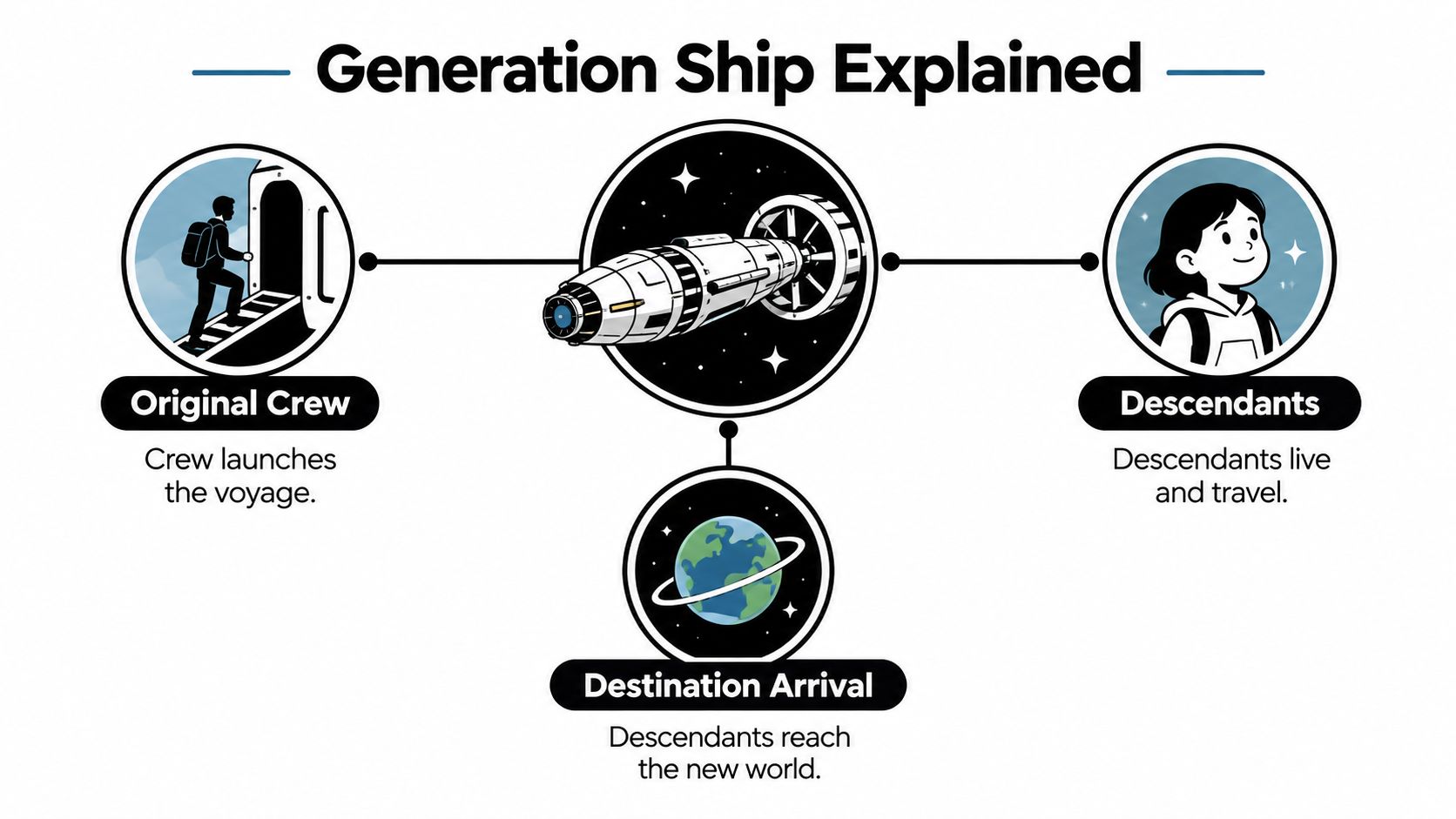
The first family is dreaming backward from a distant star. They've read about a vessel so large and self-sufficient that the people who launch it will never arrive. Their children will be born in transit, learn their jobs in transit, and raise children of their own in transit. The destination belongs to descendants who never chose the departure.
That family isn't really shopping for a vacation. They're asking whether a society can survive inside a machine long enough for the machine to matter. Food, water, oxygen, medicine, schooling, law, and purpose all have to be produced onboard, generation after generation. That's why the science fiction framing frustrates me. The hard part isn't imagining a bigger rocket. It's imagining a town that can't fail, can't resupply, and can't let its citizens leave.
The second family is asking a far more practical question. Can a grandparent, two parents, and adult children share a real spaceflight in this lifetime, safely and together? They don't want to colonize anything. They want one defining experience, planned with the same care they'd bring to a private island buyout or a milestone safari, and structured so every generation participates at the level that's right for them.
Two searches, one phrase
Both families type the same words into a search bar. The first needs honesty about timescales, engineering, and ethics. The second needs honesty about training, medical screening, availability, and cost structure. Conflating the two serves nobody. It makes the bookable experience sound trivial and the theoretical one sound imminent.
My position is simple. Treat the generation ship as the idea that gives this category its meaning, and treat today's private spaceflight as the product you can plan around. One is a philosophical horizon. The other is a milestone trip that belongs inside a broader family itinerary. A good advisor doesn't sell the horizon. A good advisor builds the trip that exists, explains its limits clearly, and helps your family decide whether the dream, in its real present form, is worth pursuing.
What a Generation Ship Actually Means
A generation ship is a spacecraft designed for a journey so long that the original crew's descendants, not the original crew, reach the destination. That's the whole definition, and everything difficult follows from it. The ship must function as a permanent home for people who will be born, educated, and buried without ever arriving anywhere.
The cleanest analogy is a cruise ship with no ports, no rescue, and no final docking during your lifetime. Except a cruise ship can still take on food, parts, doctors, and new passengers. A generation ship can't. It carries its ecology, its workforce pipeline, its culture, and its government with it, sealed inside the hull.
Now measure that idea against what humanity has demonstrated. The longest single human mission remains cosmonaut Valeri Polyakov's 437 days, 17 hours, and 58 minutes aboard Russia's Mir station, set out in NASA's history of long-duration space station missions. That's under 1.2 years. Travel to even the nearest star system beyond the Sun would require many decades or longer using propulsion technologies currently demonstrated in space.
The International Space Station narrows the gap less than people assume. By March 2020, it had hosted 170 long-duration crewed flights ranging from 48 to 340 days, with most lasting five to seven months, per the same NASA history referenced above. Those missions produced real evidence on muscle loss, radiation exposure, psychological strain, and life-support reliability. They also relied on resupply, constant communication with Earth, and medically selected adults. None of that resembles a self-sustaining community raising children across decades.
Why the timescale changes the category
Year-scale habitation is expeditionary spaceflight. Multi-decade autonomy is permanent migration. Between those two sits everything a generation ship would need that no program has demonstrated together. Closed ecosystems, onboard education, governance, reproduction, and cultural continuity aren't amenities you add after the propulsion works. They're the mission.
That's why generation ships remain a thought experiment rather than a funded pathway you can reserve a berth on. Understanding that doesn't diminish the idea. It clarifies what families who love it can do now, which is experience real spaceflight at human scale while the interstellar version stays where it belongs, in serious research and serious fiction.
The Engineering and Ethics of Closed Voyages
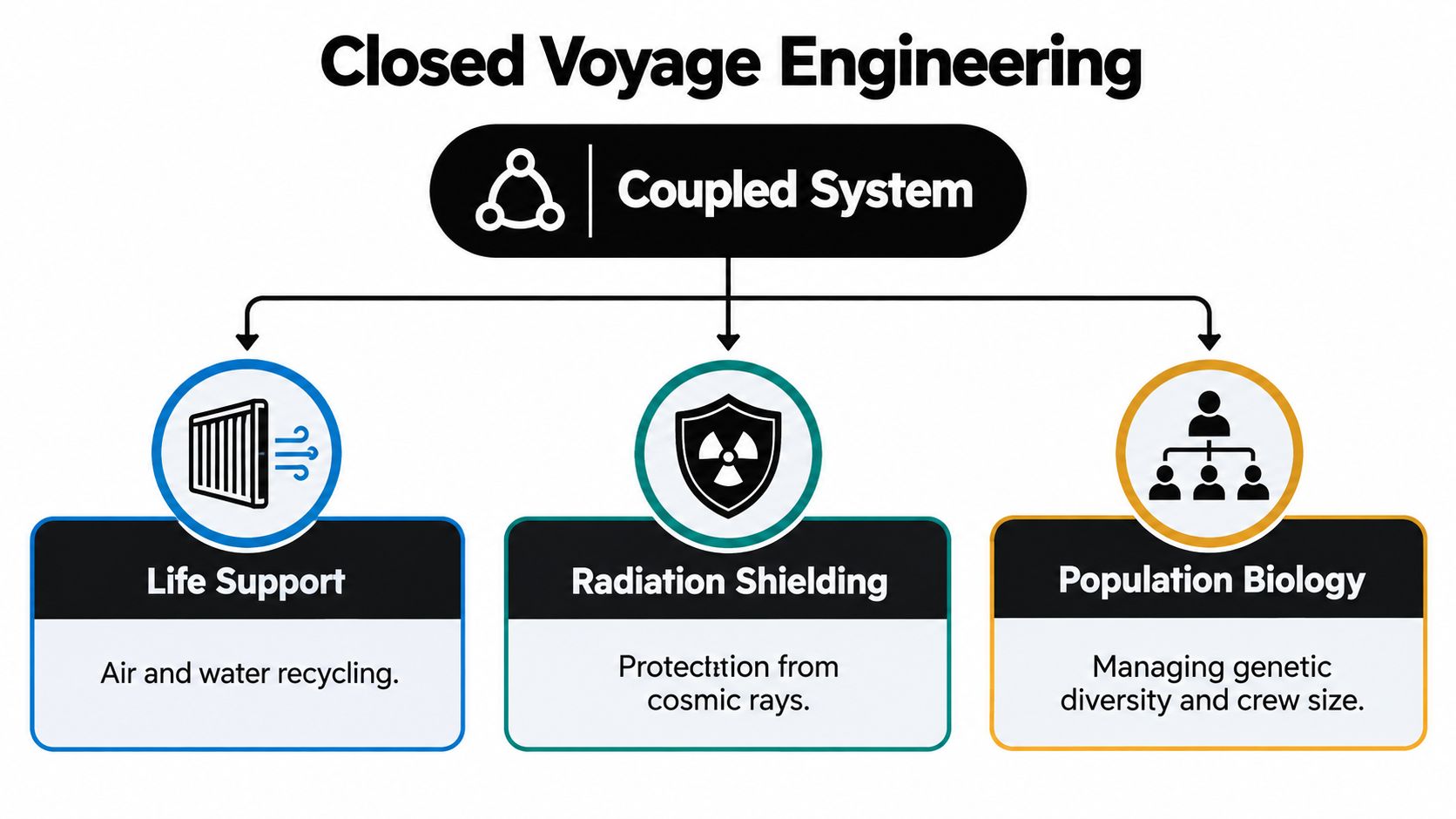
Stop picturing three separate problems. On a closed voyage, life support, radiation, and population biology form one coupled system. A decision in any one area loads the other two. A larger population improves genetic resilience and workforce redundancy, but it also consumes more water, food, and shielding mass. A smaller population eases the recycling burden while magnifying medical and social fragility.
ESA's MELiSSA program shows what serious life support looks like. As described in ESA's overview of the MELiSSA life support project, it models recycling as a compartmentalized ecological system combining microbial bioreactors, wet oxidation, filtration, and higher-plant chambers, targeting close to 100% closure. Compartmentalization matters because it isolates failures. If one microbial or plant process degrades, it doesn't immediately become an oxygen crisis for everyone aboard.
There's a catch planners can't engineer around on paper. Organisms may behave differently in microgravity, so the recycling loop has to be tested progressively in space before anyone commits families to it for decades. Repairability matters the same way. On a ship that can't order parts, the ability to fabricate components onboard becomes life-support infrastructure, which is why it's worth understanding current space-grade 3D printing options from American Additive Manufacturing as part of the wider manufacturing picture, not as a novelty.
Radiation is a generational problem, not a trip hazard
Beyond low Earth orbit, galactic cosmic radiation is the dominant concern, and the National Academies chapter on radiation risk for long-duration missions associates chronic exposure with increased risks of cancer, cardiovascular disease, cataracts, tissue degeneration, and possible central nervous system effects. NASA's current career framework limits radiation-attributable cancer mortality risk to no more than 3%, while long-duration missions are likely to exceed a proposed effective-dose standard of 600 mSv, according to that same National Academies discussion.
Thin walls don't solve this. A credible design combines shielded sleeping and communal areas, hydrogen-rich water or polyethylene mass around living quarters, storm shelters for solar particle events, continuous exposure monitoring, and strict allocation of high-radiation work. Shielding mass, habitat geometry, reproductive policy, and medical capability have to be designed together.
The consent problem nobody can engineer away
Descendants born aboard can't meaningfully consent to the mission. They inherit an enclosed habitat and, in practice, no realistic alternative to continuing the voyage. A 2024 bioethical analysis of generation ship missions argues that autonomy may become family-centered, mission success can override non-maleficence, and justice may deteriorate as resources and opportunities distribute unequally.
Biology compounds the governance question. Interdisciplinary work in Frontiers in Space Technologies on multi-generational spaceflight health raises the possibility that epigenetic changes may persist across cellular generations, with cumulative effects from radiation, altered gravity, stress, and nutrition still unresolved.
A ship can be technically self-sustaining and still be ethically unsustainable. That is the sentence most popular coverage avoids.
Constitutional rights, independent oversight, rotating authority, transparent population controls, and protected dissent aren't political decoration here. They're survival systems, no different in importance from the water loop. Who has legitimate authority to bind people not yet born to a centuries-long travel plan remains unanswered, and any family romanticizing the concept should sit with that question first.
What Multigenerational Families Can Actually Book
Bring the conversation back to Earth and the options sort into three tiers. None of them is a generation ship. All of them can anchor a genuine family milestone if you match the tier to the people flying.
Real Spaceflight Options for Multigenerational Families
| Tier | Duration | Training Required | Age Range Realistically Possible |
|---|---|---|---|
| Suborbital flight | Minutes of spaceflight within a short flight profile | Lowest of the three, focused on safety and flight preparation | Broadest, subject to operator medical screening |
| Short orbital mission | Days in orbit | High, with sustained preparation and evaluation | Narrower, driven by medical and mission-readiness standards |
| Future private station visit | Weeks, where supply exists | Highest, closer to professional mission preparation | Most restricted, with very limited availability |
| Generation ship | Decades or longer, theoretical | Lifelong, societal rather than individual | Not bookable at any age |
Duration misleads families most often. A suborbital flight is brief, but the training, the launch-day ritual, and the Earth-side celebration around it aren't. An orbital mission looks more substantial on paper, but it demands far more from each participant and excludes more of a typical three-generation group through medical and readiness screening. The longest option is rarely the most inclusive one.
How to choose between tiers
- Choose suborbital first: Pick it when the goal is the widest possible family participation and a shared, bounded experience everyone can prepare for together.
- Consider orbital selectively: Pick it when one or two family members want depth and can commit to serious preparation, while others participate from the ground.
- Treat station visits as scarce: Plan them as exceptional, supply-constrained opportunities rather than a default family format.
That tiered thinking mirrors how strong land-based family trips already work. The planning logic in HauteBlack's multigenerational family vacation guide for 2026 starts from the group's real capabilities rather than the most ambitious headline option, and spaceflight rewards exactly that discipline. Stop asking whether everyone can go. Ask which version of going fits your family's ages, health, appetite for training, and tolerance for waiting.
Decision rule: If the point is togetherness, optimize for the tier that includes the most generations. If the point is depth, accept that fewer people will fly.
How a Luxury Advisor Plans a Family Spaceflight
The flight itself is the shortest part of the engagement. Most of my work happens before anyone signs with an operator, and it starts with an uncomfortable feasibility conversation. Who wants to fly, who wants to witness, and who is being volunteered by family enthusiasm? Those are three different groups, and a plan that ignores the distinction falls apart at medical screening.
This view of a luxury resort base illustrates the Earth-side half of the product, where most of the family experience takes place.

Demand for this kind of shared trip isn't speculative. A survey cited in the HauteBlack multigenerational guide linked earlier found that 71% of respondents had taken a multigenerational trip during the previous three years, while 44% said they were likely to take one during the following three years. Families already know how to travel together. Spaceflight raises the stakes on screening and sequencing.
Feasibility screening by generation
Children and grandparents fail screening for opposite reasons, and both need early, private assessment rather than a group announcement followed by disappointment. Younger family members run into operator age rules and maturity requirements for training. Older members run into cardiovascular, mobility, and endurance considerations that a standard travel medical doesn't address. Parents in the middle usually clear easily and then become the default caregivers, which is its own planning problem.
Understanding what a luxury travel advisor actually does day to day matters, because the value isn't booking a seat. It's sequencing medicals, training blocks, insurance placement, and contingency roles so nobody's exclusion feels like a verdict delivered in public.
Structure the trip like the trips that already work
The same HauteBlack guide recommends designing multigenerational trips around a three-to-seven-day duration, built from one full-family day, one day of parallel activities for different age groups, and one intentionally unstructured day. I use that exact skeleton around a launch. Training and briefings become the parallel-activity track. Launch day is the full-family day. The day after stays deliberately empty, because emotional and physical recovery are real.
Coordination makes that structure work. The staffing model in HauteBlack's private island resorts guide assigns a dedicated activity coordinator to organize shared experiences while arranging separate adventures by age group, inside a self-contained setting where children can play and adults can find quiet. A spaceflight trip needs the same role, managing flyers, non-flying family, and media or privacy preferences without forcing everyone onto one schedule.
Watching a crewed flight profile before committing helps families calibrate expectations far better than brochures do.
Insurance and documentation come last in conversation but shouldn't come last in process. Coverage for participants, coverage for delays that ripple through a multi-generational itinerary, and clear authority for medical decisions across three generations all need signatures while everyone is still calm and enthusiastic.
The Real Cost of Sharing Space as a Family
I'll state my position directly. A family spaceflight is a milestone, not a destination, and pricing it like a standalone trip is the fastest way to misbuy it. The seat is the headline cost, but the seat was never the whole product.
This image of a family watching Earth from a capsule window captures the moment you're purchasing, and it's measured in minutes.

Build the budget in layers. Seats for whoever flies come first, at a level that varies sharply between suborbital and orbital tiers. Training travel, medical evaluations, and repeat trips for preparation sit on top. Then come the costs families forget to model: moving non-flying grandparents and grandchildren to the launch region, housing everyone through weather delays, private ground programs while flyers train, and the celebration architecture that makes the flight a family story rather than an individual's anecdote.
High-touch planning more than doubles the line-item price of the flight itself, and that's not inefficiency. It's the difference between a ticket and an experience three generations share. Families who understand what drives private jet charter cost beyond the flight hour already grasp this logic. Positioning, timing, and support infrastructure dominate the true cost of any scarce aviation product, and spaceflight behaves the same way, only more so.
Buy the anchor, build the journey
The right structure treats launch day as the anchor of a multi-destination journey, not the entire journey. Use the parallel-activities mechanic from the multigenerational playbook discussed earlier. Flyers train while grandparents enjoy a slower program nearby. Everyone converges for launch. The group then decompresses somewhere restorative, where the unstructured day does its quiet work and the story settles into family memory.
- Anchor destination: Choose a base with strong hotels and private touring, so delays extend the trip instead of breaking it.
- Parallel programming: Fund the non-flyers' experience properly. Spectators who feel sidelined become the trip's unwilling narrators.
- Delay buffer: Budget flexible nights and repositionable transport from the start, not as an emergency add-on.
Buy it this way and the economics make sense. You're not paying an extraordinary sum for minutes. You're paying for the one experience your family will reference at every gathering for the rest of your lives, wrapped in a trip that respects every generation in it.
From Generation Ship to Private Capsule
These two ideas aren't competitors. They're the ceiling and the floor of the same human impulse, which is to go somewhere extraordinary together and bring the people who matter most.
The generation ship is the philosophical ceiling. It asks whether a sealed society can sustain its ecology, its genetics, and its legitimacy across centuries, and whether anyone has the right to commit unborn descendants to the attempt. Those questions have no operational answers yet. The endurance record, the recycling research, and the radiation evidence all point the same way. Humanity has demonstrated year-scale habitation with resupply, not multi-decade autonomy without it.
Today's private capsule is the practical floor. Minutes to weeks of real spaceflight, real training, and real risk management, supported by the Earth-side luxury infrastructure families already know how to use. The floor is solid enough to stand on. The ceiling is worth looking up at, because it explains why even a brief flight carries such emotional weight for the families who pursue it.
Plan for the floor with the ceiling in view. Book the tier that includes the most generations you can safely include. Structure it with the three-to-seven-day rhythm, parallel activities, and dedicated coordination that already make multigenerational trips succeed on Earth. Then let the generation ship do its proper job, which is to remind your family that traveling together has always been about continuity. Every family trip is a small act of handing the world to the next generation. Multi generational space travel raises that handoff to altitude.
Questions Affluent Families Ask Advisors
How young is too young to fly? There's no universal family answer because each operator sets its own age and readiness rules, and medical screening sits behind them. Assume young children will participate from the ground, and treat any operator flexibility for older teenagers as a case-by-case evaluation, never a promise you make to the child in advance.
How safe is private spaceflight? It's a young industry with a short operational history, which means safety conversations should focus on the specific vehicle, its flight record, its abort systems, and its training rigor rather than industry-wide reassurance. Any advisor who waves the question away is selling. Ask for the operator's own disclosures and read them together.
How do deposits and payments usually work? Expect staged commitments that escalate as training, medical clearance, and flight assignment approach, with refund terms that tighten at each stage. Get the schedule, the transfer rights, and the delay provisions in writing before the first wire, and clarify what happens if one family member fails medical screening after others have paid.
Where do we start? With a private feasibility conversation, not a deposit. Establish who wants to fly, who can plausibly clear screening, which tier fits, and how the flight anchors a broader family itinerary. That single conversation prevents most of the expensive mistakes I see.
If your family is ready to turn the space conversation into a real plan, HauteBlack can coordinate the feasibility screening, operator selection, Earth-side itinerary, and multi-generational logistics around your flight as one unified journey. Visit HauteBlack to start a private conversation with an advisor who'll tell you what's bookable today and build the trip around it.
Explore Our Guides


Signature Experiences


