Haute Black Journal
Machu Picchu Weather January

Marlene Azeez
Director, HauteBlack
View all articles →
You're looking at January dates because they work for work, school, or a honeymoon you don't want to delay. Then you search Machu Picchu weather in January and get two unhelpful answers. One says don't go. The other shows blue skies and says rain is brief. Neither tells you how to design the trip so weather doesn't decide it for you.
That's the right lens. January isn't a verdict. It's an itinerary-design problem, and it has practical solutions if you plan for the place you'll be, not a single forecast number.
What January Means for Your Visit
You step off the train in the valley expecting the sharp Andean postcard, then watch cloud spill over the ridge and take the citadel with it. Your guide stays calm. You walk a lower circuit while rain beads on your hood and the steps turn slick. Twenty minutes later the cloud lifts enough to reveal terraces in wet layers, greener than any dry-season photograph.
That is January in one scene: conditions change the order of the day faster than they ruin it.
The Season You're Entering
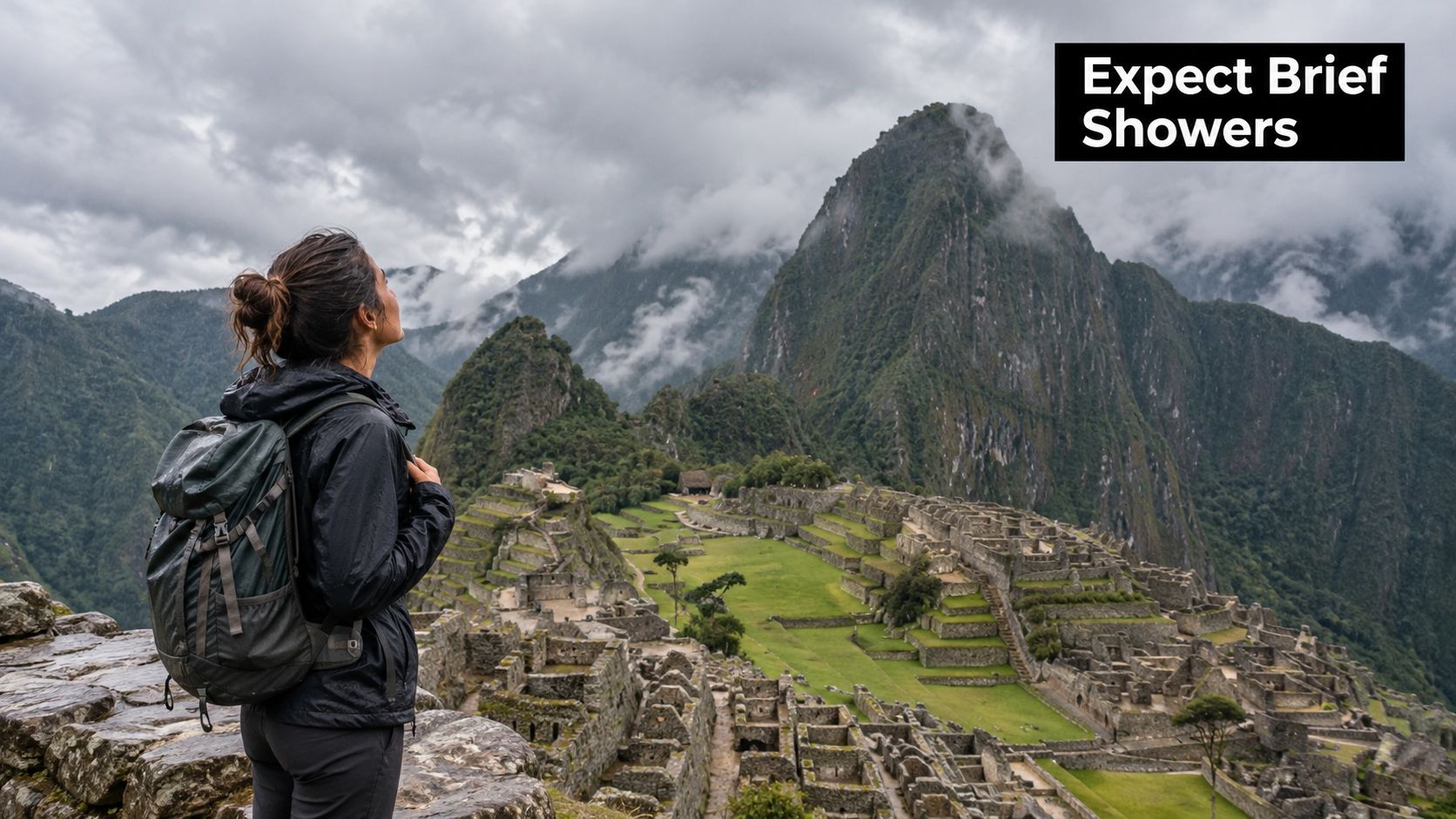
January and February sit at the peak of rainfall in Peru's Andes, within a highland rainy season that runs from November through April. Plan for a real chance of rain, low cloud, wet stone, and brief visibility. Build the emotional payoff around a beautiful window you work toward, not a promise of sunshine at dawn.
The trade still favors prepared travelers. Days stay mild rather than cold, the hillsides look saturated, and gaps between showers can be superb. Couples and multigenerational groups do well when everyone expects movement in the schedule, from the citadel's exposed viewpoints down to Machu Picchu Pueblo, from train timing along the valley to muddier trekking routes outside a standard visit.
Treat flexibility as part of the luxury in January. It is what keeps weather from making the decisions.
What Success Looks Like
Success is a plan with two chances to see the sanctuary, private guiding that can reorder circuits when fog sits on the upper terraces, and enough slack that a slow wet morning does not become a missed departure. If your group needs one fixed sunrise to justify the trip, choose different dates. If you can give Machu Picchu time, let your guide read the cloud, and accept that the best hour may arrive after lunch, January can feel quieter, greener, and oddly private.
Book the buffers first. Then choose the dates.
How Wet January Really Is
January is wet enough to change the design of the day. Treat the month as a routing problem: when to enter, where to wait, which viewpoint can hold a group in light rain, and how the train, town and trail each absorb disruption.
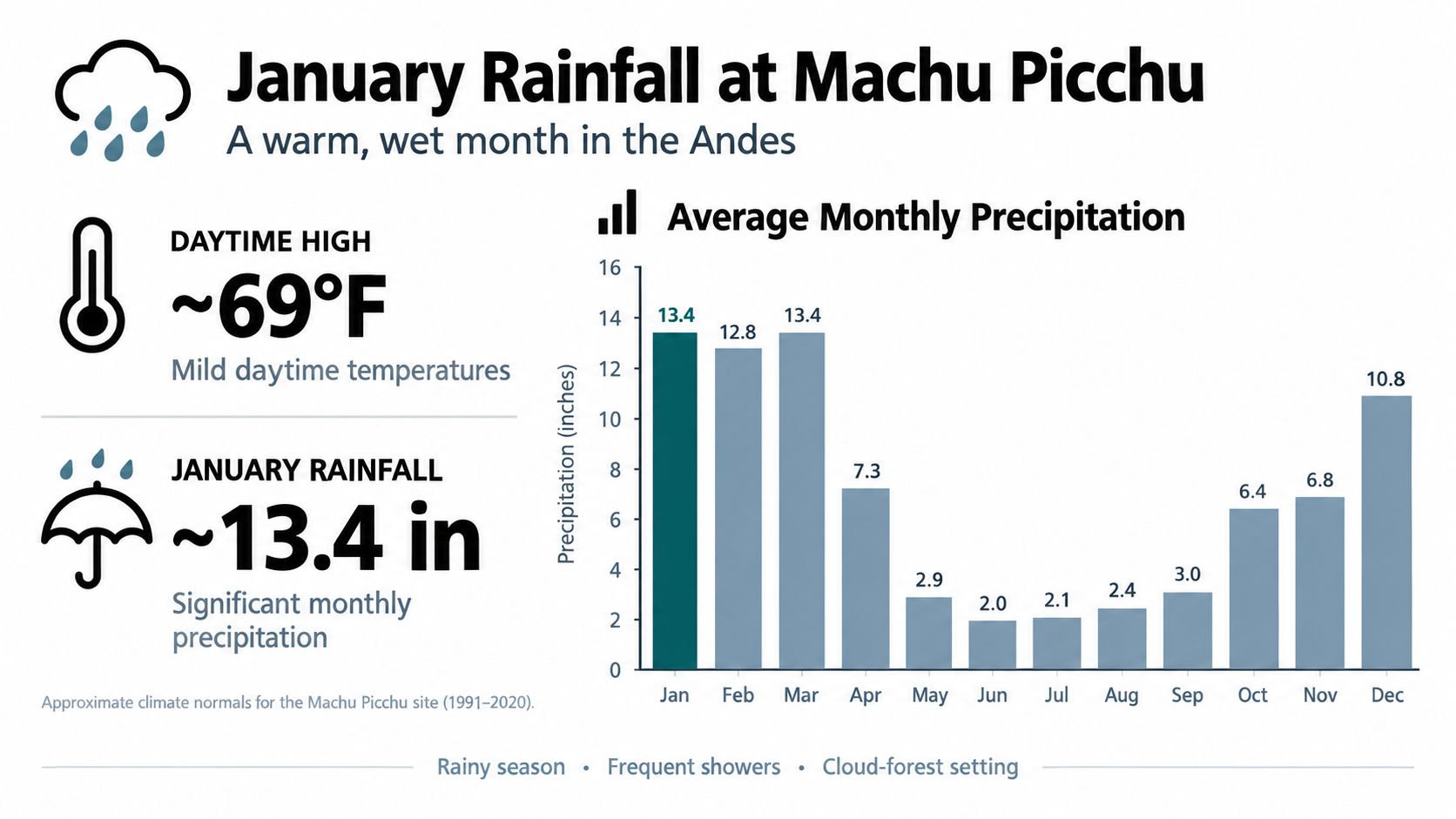
[Weather observations from 1992 to 2021 report average January precipitation of 150.2 millimeters, an average high of 20°C, an average low of 8°C, and a mean temperature of 14°C for Machu Picchu Pueblo, with January ranked as the wettest month](https://www.timeanddate.com/weather/peru/machupicchu/climate). Read that as a planning floor for the lower town. The sanctuary sits higher and more exposed, so cloud, wind and wet stone can feel sharper even when the gauge reads modest.
Averages still mislead if you stop at the high. 20°C is gentle in a dry plaza; it is less kind at dawn on the upper terraces or during a slow queue for buses. Machu Picchu Pueblo can feel sheltered while the upper lookout is in mist, and the rail line can keep moving through rain that makes a viewpoint poor for an hour. For sequencing Lima, the valley and the Andes around that pattern, use the rainy season in Peru guide for luxury travel in 2026 as context rather than a promise for one entry slot.
This short video helps you visualize how quickly conditions shift around the citadel.
Turn the Wet Month Into a Design Choice
- Give the citadel two windows: morning for faster access, afternoon for light that can break after showers.
- Separate town and site expectations: a dry breakfast in Machu Picchu Pueblo can still mean slick steps above.
- Protect exposed hours: viewpoints, photography and outdoor celebrations need covered fallback space.
- Keep treks honest: routes outside a standard visit demand more margin than the citadel.
Place your best moments where a passing shower cannot erase them.
Why Visibility Changes So Quickly
Visibility is the variable travelers care about most, and it's the one a temperature forecast explains least. January combines subtropical mountain humidity with frequent cloud formation. Warm, moist valley air meets cooler mountain slopes, cloud forms, and the view changes while you're standing in it.
Think of a curtain that someone keeps drawing and opening. You get a spectacular reveal, lift your camera, and the peaks vanish. Ten minutes later they return, sharper, with wet stone dark against green terraces. Neither moment was January. Both were.
How Often Rain Enters the Picture
[One climatological estimate describes January as humid, with roughly 154 millimeters of precipitation occurring on about 26 days, or approximately 84% of the month](https://www.whereandwhen.net/when/south-america/peru/machu-picchu/month/january/). That doesn't mean rain falls all day on those days. It means you should expect precipitation to feature in most days, often intermittently, and plan your clothing and timing accordingly.
Cloud can obscure the citadel without heavy rain, and rain can pass while visibility stays workable. Don't confuse an overcast forecast with a lost day.
Use Early Access Without Betting on It
Early entry remains valuable because conditions change fast and you'll have more of the day to work with. It doesn't guarantee a clear sunrise. Don't sell sunrise to your partner or your parents as a certainty.
- Protect cameras and phones: Use dry bags and keep a lens cloth reachable, not buried.
- Allow slower movement: Wet stone and trails change your pace, especially for older travelers.
- Keep a second viewing window: One entry is a gamble in January. Two entries are a strategy.
Practical rule: Photograph what the mountain gives you now. Don't wait for a perfect clearing that may not come.
The reward for patience is the scenery itself. January rain sustains exceptionally green vegetation, and clearing cloud over wet terraces photographs beautifully if your equipment stays dry.
Why Location Changes the Forecast
Two websites give you different January rainfall totals and you assume one is wrong. Usually neither is. They're measuring different places.
The comparison below shows why you need to ask which location a forecast describes.
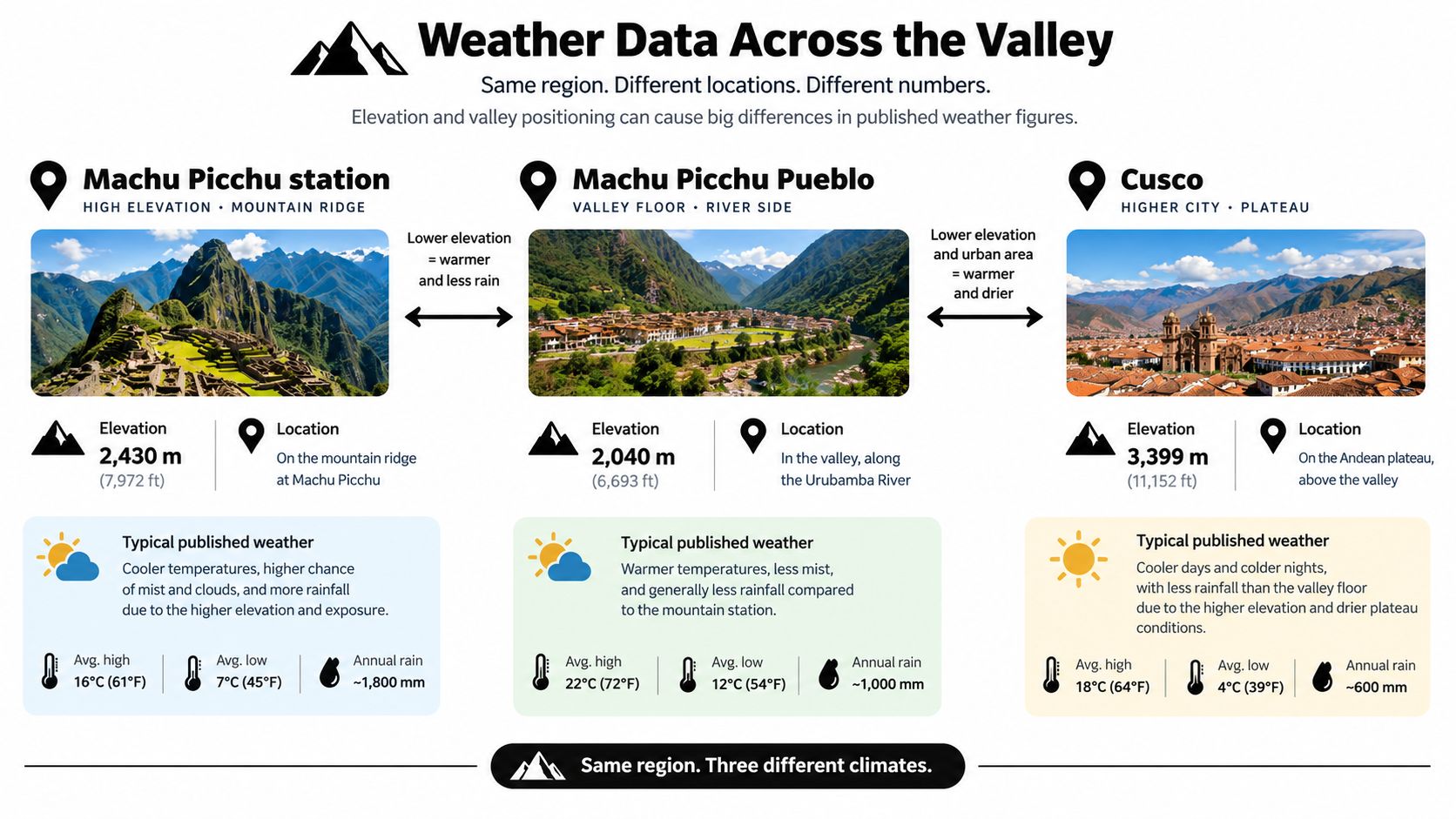
[Machu Picchu station normals report approximately 21°C daytime, 12°C nighttime, and 341 millimeters of January rain, while Machu Picchu Pueblo records report about 20°C, 8°C, and 150.2 millimeters because the locations have different microclimates](https://www.machupicchu.world/en/blog/machu-picchu-weather-by-month). Read that as a map, not a contradiction.
Four Places, Four Experiences
| Place | What January tends to feel like |
|---|---|
| Machu Picchu Pueblo | Warmer, humid valley air around your hotel and restaurants |
| The sanctuary | More exposure, faster cloud changes, wet stone underfoot |
| High viewpoints and trails | Cooler, damper, slower going in rain |
| Cusco and higher routes | A different, higher Andean microclimate, not a proxy for the citadel |
Machu Picchu sits lower than Cusco, so it feels warmer and wetter rather than cold in a high-altitude sense. Your hotel breakfast can feel mild while a viewpoint above the terraces feels raw in wind and drizzle. Both experiences happen on the same morning.
Ask Better Questions
Don't ask only whether it'll rain. Ask what conditions will feel like at your hotel, on the train, at the sanctuary, and on your specific trail. That question changes what you pack, when you enter, and how much hiking you promise the group.
For honeymooners, it also changes where you stay. A valley hotel with good drying space, strong showers, and flexible dining matters more in January than a marginal view you may not see through cloud.
Plan Around Rain and Access Disruptions
The January failure I plan around is the missed connection that turns a timed entry into a lost morning. Your itinerary is only as strong as its weakest handoff: train, transfer, entry slot, trail, return train, flight home. Leave slack at each handoff, and one wet afternoon stays an inconvenience.
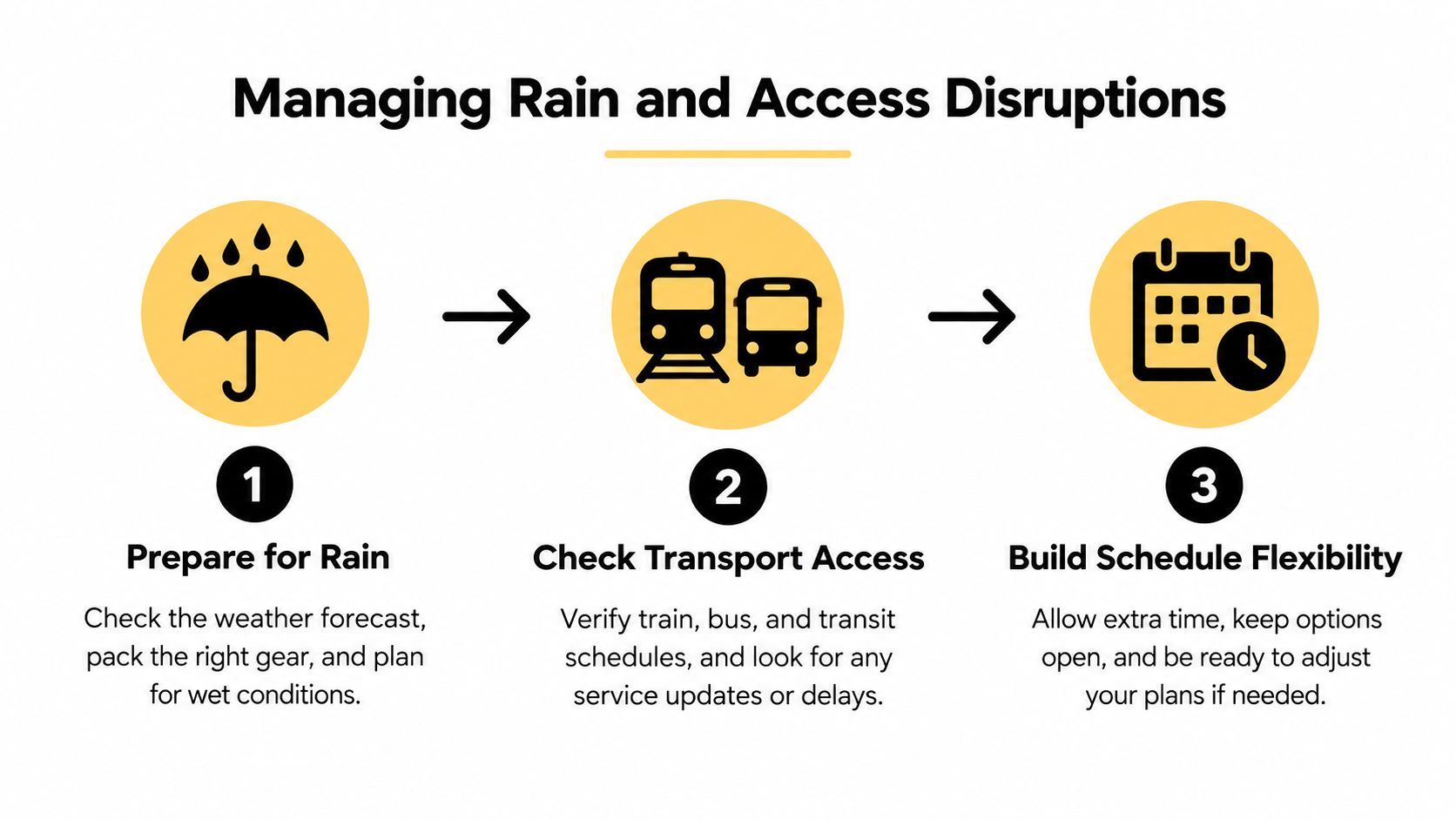
Sequence the Sanctuary Early
Put Machu Picchu early in your January stay, with a second viewing opportunity after it. If cloud or rain spoils the first entry, you still have a recovery day. Keep a buffer before any international departure, and never place a nonrefundable long-haul flight immediately after a tightly timed return from the valley.
If you're weighing routing and overall trip costs across a longer South America journey, check Mazurly's country cost rankings to sanity-check how Peru compares with other stops before you lock the order of countries.
Choose Resilient Transport
Favor rail over a long overland approach where you have the choice. [A historical study cited for Machu Picchu estimates January rainfall of 372.5 millimeters, and recent coverage reported a 2026 mudslide-related suspension of pedestrian access from Hidroeléctrica](https://enperu.org/machu-picchu/best-time-to-visit). Treat that report as a warning about access points. Pedestrian routes, trails, and mountain roads can close even when the citadel itself remains open.
A favorable forecast is planning input, never a promise of uninterrupted access. For routing that pairs Lima with the sanctuary, a 2026 luxury guide to Lima to Machu Picchu tours is a useful starting point for comparing approaches.
Protect the Experience, Not Just the Schedule
Hold back enough time for wet stone, slower viewpoints, and a covered backup activity you want. Book a private guide who will reorder the day around conditions, move the group before the heaviest shower, and save the best terrace light for the first clear window.
Pack for Rain and Bright Sun
Pack for two weathers in one excursion. You'll move between humid valley air, cooler exposed viewpoints, a shower, and a bright interval that feels strong the moment cloud breaks. Your clothing system has to handle all four without a hotel stop in between.
The proven combination is layers, a waterproof outer shell, sun protection, comfortable walking shoes, and a small daypack. Each piece earns its space, as noted earlier when we covered access planning.
The Core System
- Layers you can add while moving: A breathable base, a light insulating layer for damp viewpoint stops, nothing bulky.
- Waterproof outer shell: It protects you from rain and from wind during long, wet waits.
- Comfortable walking shoes with grip: Wet stone is the hazard that matters. Smooth soles will punish you.
- Small daypack: It carries the shell, water, and dry protection without turning you into a porter.
Sun Protection Still Matters
Clear intervals bring strong sun, and wet skin plus altitude exposure is a poor combination. Carry sun protection even under morning cloud. If labels confuse you, this guide to broad spectrum SPF explained clarifies what you're buying before you pack it.
Reapply after rain. A shell hood doesn't replace coverage for your face and neck once the sun returns.
Protect What Rain Ruins First
Put phones, cameras, passports, and entry documents in dry bags inside the daypack, not loose in pockets. Add lens cloths where you can reach them with wet hands. Choose fabrics that stay tolerable when damp, and keep a dry layer sealed for the train ride back.
Skip the gear catalog. January rewards adaptable clothing and dry electronics, not specialized equipment you'll carry unused through humid air.
Choose Between January and a Luxury Alternative
January suits some premium itineraries beautifully and others not at all. Be honest about which traveler you are before price or availability decides for you.
January Works When You Value These Things
Choose January if you want vivid green scenery, you can enjoy cloud movement as part of the scene, and your schedule can absorb a reordered day. It also works if your dates are fixed by a wedding, school calendar, or board schedule, and you'd rather design around rain than postpone Peru entirely.
Luxury helps most here when it buys operational speed. A private guide who can change entry sequencing, a driver who isn't locked to a group departure, and a hotel that can move dinner earlier all protect the experience. Service layered onto a rigid schedule doesn't.
Choose Another Window When Certainty Is the Point
Travel outside the rainy season if you require a guaranteed sunrise view, uninterrupted trail access, or a proposal, anniversary shoot, or family portrait that can't be repeated. Also reconsider if your plans are tightly sequenced and nonrefundable, with Machu Picchu placed at the end and an international flight immediately after.
For a fuller picture of how a high-touch visit can be structured in a drier window, read about luxury travel to Machu Picchu and compare that certainty against January's greener, quieter trade.
Don't pay a premium to make a rigid January itinerary feel luxurious. Pay for flexibility, or change the month.
The Middle Option
Many travelers should choose the adaptive version of January rather than abandoning it. Stay near the sanctuary, protect two entry opportunities, keep one indoor or covered experience in reserve, and use trusted local coordination that can react the same morning. That plan preserves the romance and the photography without pretending the weather is something it isn't.
A Flexible Decision for January
Make the call by itinerary design. Go in January if your plan treats weather as a variable: citadel entries with a fallback slot, a night near Machu Picchu Pueblo rather than a same day sprint, train timing with room to slide, and a viewpoint goal that can change with the cloud. That version can be superb.
Skip it when the trip has no recovery margin. If one sunrise must deliver the photograph, one trek must stay open, and the rail connection feeds straight into a flight, choose a drier window.
What Good Support Does
Good support buys speed and options. A private guide can reorder the circuit when a ridge clears, a coordinator can protect a second entry, and a driver can leave before the crowd instead of waiting for a group slot. HauteBlack describes bespoke itineraries supported by private guides, VIP recognition, custom planning, and luxury travel services across many countries. In a month like this, custom planning means contingency thinking built in from the first draft, before the first closure forces the issue.
January will still rain. Design decides whether that rain ruins the day or gives it atmosphere.
Explore Our Guides


Signature Experiences


