Haute Black Journal
A Luxury Tour to Madagascar: The 2026 Insider's Guide

Marlene Azeez
Director, HauteBlack
View all articles →

# A Luxury Tour to Madagascar: The 2026 Insider's Guide
May 22, 2026
Madagascar defeats the usual luxury travel instinct. The wrong way to plan it is to begin with a wish list of lemurs, baobabs, beaches, and lodges. The right way is to start with movement. On this island, logistics shape experience more than almost anywhere else.
That may sound unromantic, but it's exactly what makes a great tour to Madagascar feel so rare. Madagascar is the world's 4th largest island, with more than 4,800 km of coastline, and its scale turns one trip into a sequence of distinct worlds rather than a single destination. It also holds a remarkable concentration of life found nowhere else, including roughly 92% of its mammals, 89% of its plant species, and 95% of its reptiles according to Bunnik Tours' Madagascar facts. If you want to move through that breadth in comfort, you need an itinerary designed like a private expedition, not a standard holiday.
Introduction The Eighth Continent Awaits
Madagascar rewards disciplined planning more than almost any other island destination on earth.
It is often described through its wildlife and scenery, but the key difference between an ordinary tour to Madagascar and an exceptional one lies in how the journey is engineered. Distances are long. Regional connections are imperfect. Road days can be far more demanding than a map suggests. Travelers who begin with a list of sightings usually end up sacrificing comfort, time, or both.
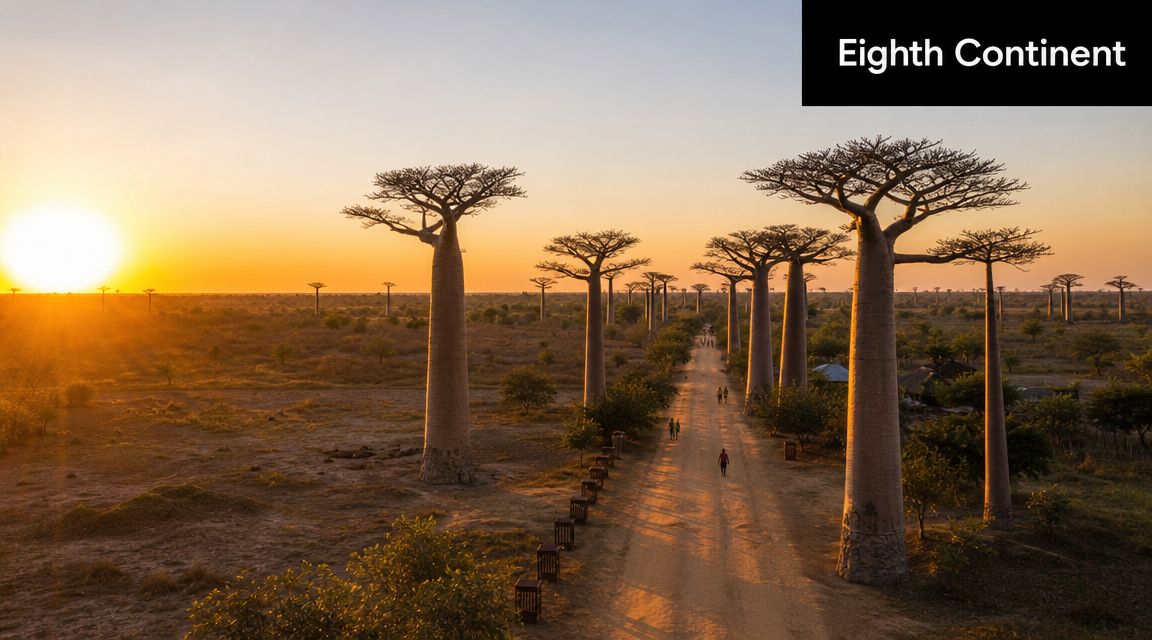
That is why Madagascar behaves less like a classic island holiday and more like a private expedition with luxury touches added in the right places. The island holds dramatically different environments, distinct cultural regions, and a pace of travel that demands editorial discipline. A refined trip is not built by adding more stops. It is built by choosing the right circuit, protecting time on the ground, and accepting that comfort here comes from smart sequencing rather than constant motion.
The appeal is real. So is the complexity.
A few extra nights in the correct region can transform the experience. An overambitious route can dilute it just as quickly. I often advise clients to choose one strong overland arc, then pair it with one contrasting finish, perhaps rainforest and coast, or highlands and the west, rather than trying to collect the whole island in a single pass. Madagascar rewards depth.
Its biodiversity and visual drama matter, of course, but they should shape the route only after the transport logic is sound. Internal flights do not always connect in the way travelers expect. Drive times can expand. Weather and road conditions can narrow what is realistic. Standard tours tend to treat these as minor details. In Madagascar, they are the framework.
The best itineraries respect range without being seduced by it. They create rhythm, protect energy, and leave room for the moments that make the island unforgettable: dawn in the forest with an expert guide, late light among baobabs, a beautifully run lodge after a demanding transit day, and the rare pleasure of feeling that a difficult destination has been handled intelligently.
Decoding Madagascar When to Go and Where
The first serious decision isn't where to stay. It's when the island will cooperate with your route.
Weather in Madagascar doesn't just influence comfort. It affects access, road reliability, the natural environment's character, and how ambitious you can be with regional combinations. Travelers who treat the island like a single climatic zone often end up with a mismatched itinerary.
The island in regions, not one destination
A refined tour to Madagascar begins by separating the island into travel personalities.
The central highlands give you Antananarivo and the cultural frame of the country. Many journeys originate here, and travelers begin to understand Madagascar as more than a wildlife destination.
The east leans rainforest. It's the realm of humid forests, dense vegetation, and wildlife experiences that reward patience, early starts, and a good guide.
The west is more architectural in feeling. Dry forests, baobab country, and dramatic scenery lend themselves to photographic routes and stronger visual contrast.
The north and nearby islands suit a softer finish. This is often where a demanding overland journey gives way to sea, slower mornings, and privacy.
The south feels more elemental. It's for travelers who want striking terrain, longer drives, and a sense of remoteness that's harder to soften.
Cultural depth matters as much as geography
Madagascar's history gives shape to the journey even when wildlife is the headline. Its written history begins in the 7th century with Omani trading posts. European contact followed in 1500, France annexed the island in 1896, and independence came in 1960, as summarized in the history of Madagascar. That sequence matters because it explains why a Madagascar trip can move convincingly between Indian Ocean trade legacies, French influence, and living Malagasy identity.
A polished itinerary should leave room for that texture. Even a nature-heavy trip benefits from time in the highlands, thoughtful market visits, architecture, craft, and conversations that connect the land to culture.
Madagascar is more rewarding when you stop asking only where the animals are and start asking how people have lived across these landscapes for centuries.
How I'd match traveler type to region
If the trip is led by wildlife obsession, favor the east plus one contrasting region.
If the trip is led by visual drama, the west tends to outperform expectations.
If the trip is led by recovery and privacy, a northern finish usually works better than trying to force too much overland ambition to the end.
A practical perspective:
- For first-timers: Pair the highlands with one major nature region and one coast or dry-land contrast.
- For repeat Africa travelers: Choose a stronger thematic route, such as rainforest and conservation, or western terrain and private beach time.
- For honeymooners: Keep transitions limited. Madagascar can be astonishingly romantic, but only if the routing protects energy.
What works better than the usual checklist
The smartest planning approach is seasonal rather than aspirational. Start with access. Then choose regions. Then choose lodges and experiences. Doing it in reverse is how travelers end up with elegant bookings attached to punishing transfers.
This is also why experienced planners talk about Madagascar in clusters. The island doesn't reward random point-to-point ambition. It rewards coherent circuits.
Signature Experiences for the Discerning Traveler
Luxury in Madagascar isn't defined by thread count. It's defined by access, timing, and the ability to make the island feel intimate rather than difficult.
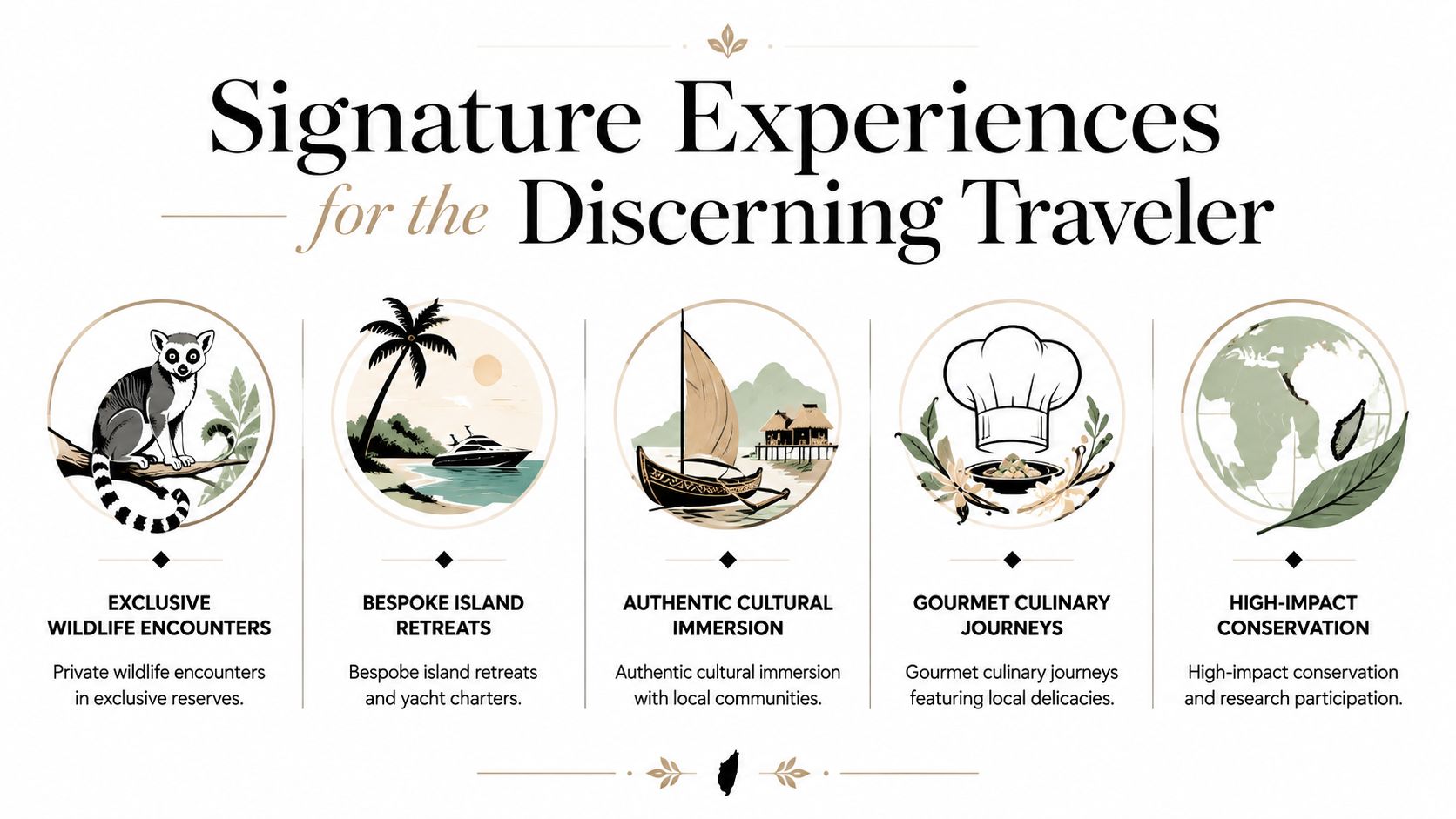
The most memorable journeys don't just upgrade the room. They change how you encounter the country. A private dawn departure into the forest feels different from joining a standard departure window. A remote lunch after a helicopter transfer feels different from arriving tired after a full day on the road. The distinction is not cosmetic. It alters the entire emotional tone of the trip.
Experiences that justify going well
Some of the finest moments in Madagascar happen at the margins of the day.
A private nocturnal walk with the right specialist guide can transform the rainforest from scenery into theater. You hear before you see. Eyeshine catches in the beam. Chameleons appear where a casual eye sees only branches. This sort of outing works best when it's paced slowly and not folded into an already exhausting transfer day.
A helicopter approach over limestone formations and remote terrain changes your understanding of scale. Madagascar often hides its grandeur behind difficult access. Airborne arrivals reveal the structure of the land in a way road travel never can.
A chartered island or coastal sailing day suits travelers who've already invested in the harder inland portions of the trip. It creates release. After forest and road, sea and silence feel earned.
Later in the journey, this perspective on deeper travel becomes useful: learn how to live a place. Madagascar rewards exactly that mindset.
What high-end travelers should ask for
The usual request is “the best of Madagascar.” That's too vague to be useful. Better requests produce better itineraries.
Ask for:
- Private guiding with subject knowledge: The difference between a competent escort and a field-savvy naturalist is enormous in Madagascar.
- After-hours feeling, not just premium pricing: Early access, flexible pacing, and room to linger matter more than labels.
- A design language for the trip: Do you want expedition energy, castaway elegance, conservation access, or romantic seclusion?
For travelers balancing Madagascar with a broader Africa portfolio, it can also help to compare expectations with other big-ticket journeys. This guide to an African safari for first-timers is useful because it clarifies how differently Madagascar behaves from a classic safari structure.
Here's a visual sense of the destination before the finer planning begins:
The trips people remember most
The strongest luxury journeys in Madagascar tend to mix five elements rather than overcommitting to one.
- Wildlife immersion: Not a rushed park hop, but concentrated time with excellent tracking and interpretation.
- Coastal decompression: Time by the sea after inland effort.
- Cultural contact: Markets, craft, music, food, and lived context.
- Aerial problem-solving: Used selectively, not performatively.
- Space: Empty horizons, fewer interruptions, and enough time to absorb the island.
Madagascar is one of the few places where exclusivity can still feel like discovery rather than display.
Bespoke Itineraries Crafting Your Perfect Journey
The best itinerary for a tour to Madagascar isn't the one with the longest list of stops. It's the one whose movement pattern protects the experience.
Rough Guides recommends allowing at least 14 days and advises travelers to focus on 2–3 regions because the island is roughly the size of France and transit can consume far more time than expected. For high-end travel, that advice is foundational. A luxury itinerary should remove friction, not package it elegantly.
Sample Madagascar luxury itineraries at a glance
| Itinerary | Duration | Ideal For | Key Regions | Primary Focus |
|---|---|---|---|---|
| Highland and rainforest escape | 7 days | Couples | Antananarivo, eastern rainforest | Wildlife, intimacy, low-friction pacing |
| South and west adventure circuit | 10 days | Families with older children | Highlands, southern landscapes, western baobabs | Scenery, adventure, variety |
| Grand private Madagascar journey | 14 days | Private groups | Antananarivo plus 2 to 3 regions | Depth, contrast, logistical efficiency |
The 7-day version for couples
A short luxury trip works only if it stops pretending to be complete.
For a week, I'd keep the route tight. Arrive in Antananarivo, settle properly, then move into a strong rainforest region with a lodge that gives you immediate access to guided walks, night outings, and slower mornings. End with one atmospheric final night back near the capital or, if routing allows smoothly, a brief coastal finish.
This works because couples usually value flow over coverage. A week in Madagascar can be romantic, but not if you spend too much of it repacking. The shorter the trip, the more aggressively you need to edit.
What usually doesn't work in seven days:
- Trying to add both west and east: It creates a fragmented trip.
- Overland bravado: Long drives consume the very energy you came to protect.
- Hotel-hopping for status: Madagascar rewards immersion more than constant upgrading.
The 10-day version for families with older children
Ten days gives you enough room for contrast, provided the children are old enough to handle movement days well and enjoy nature-led travel.
A strong family route often begins in the highlands, then shifts into one major wildlife zone where guides can hold attention with active spotting, short walks, and night excursions. After that, a westward or southern scenery shift can work beautifully, especially if the final segment has visual drama and room to breathe.
The key is variety of stimulus. Families do well when each stop feels different in mood. Forest. Open terrain. Coast, if feasible. But the route still needs internal discipline.
Don't design family travel in Madagascar around what adults can tolerate. Design it around where energy drops, then cut before that point.
If the family has a strong interest in animals and conservation, it can also be worth exploring adjacent ideas such as volunteer with animals overseas, not to turn the trip into a project, but to sharpen the lens through which children engage with wildlife destinations.
The 14-day version for private groups
Here, Madagascar starts to make full sense.
With two weeks, you can build a route around 2–3 regions and let each one breathe. I'd usually shape it with a capital arrival for recovery and orientation, one eastern or central nature segment for wildlife density, then one western, southern, or coastal contrast depending on the group's appetite for movement and style of finish.
This is also the point where selective private aviation, helicopter transfers, or carefully chosen domestic connections become highly beneficial rather than indulgent. They buy back days. That extra time is often the difference between merely reaching a place and experiencing it properly.
A private group route benefits from role clarity:
- One region for biodiversity
- One region for visual drama
- One region for exhale
That's the formula. Not because it's fashionable, but because it creates emotional progression.
For travelers who want a clearer sense of how custom journeys are built around those principles, this overview of customized package tours is a useful companion.
How to choose among the three
Choose the 7-day plan if your priority is intimacy and you accept that Madagascar will remain partially unresolved.
Choose the 10-day plan if you want contrast and can tolerate a moderately active rhythm.
Choose the 14-day plan if you want the island to unfold properly and don't want every movement decision to feel like a compromise.
The mistake I see most often is travelers trying to force a 14-day vision into a shorter frame. Madagascar doesn't reward that kind of compression.
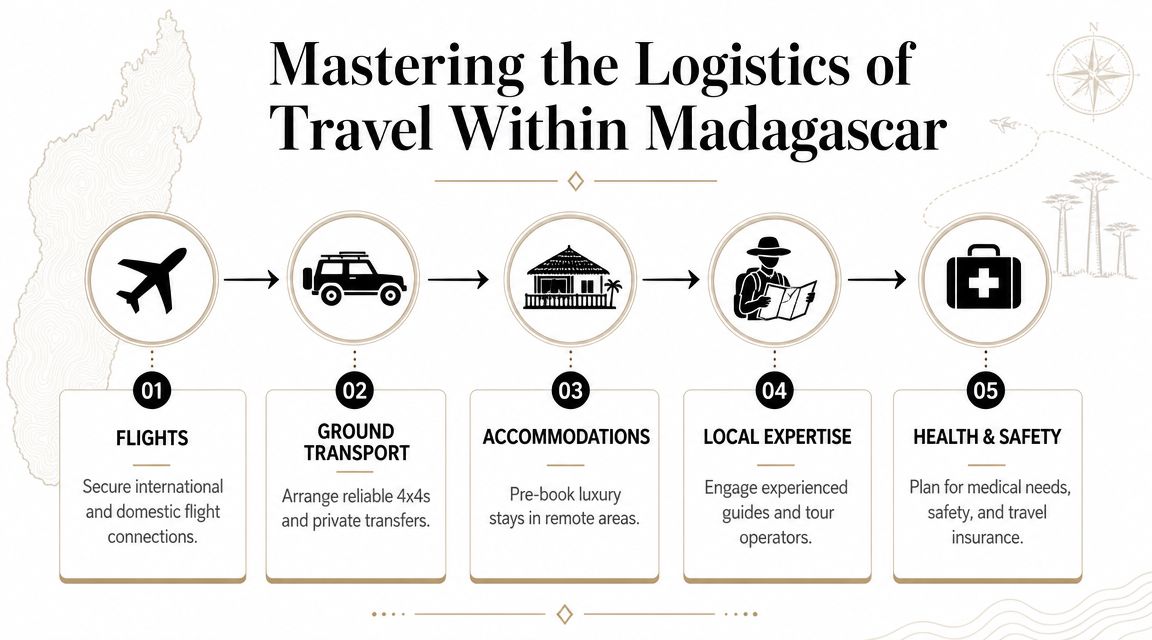
Mastering the Logistics of Travel Within Madagascar
The single most important fact about Madagascar is also the least glamorous. The trip succeeds or fails on logistics.
Travel the Unknown notes that Madagascar's defining travel constraint is infrastructure, particularly slow road networks and limited domestic flight capacity. That's why the island must be planned around logistical efficiency rather than simple point-to-point movement. First-time visitors are often surprised by this. Experienced planners are not.
Why standard planning breaks down
Many travelers assume luxury can be layered on top of a standard route. In Madagascar, that assumption fails quickly.
A beautiful lodge doesn't solve a poorly sequenced itinerary. Nor does a private guide compensate for too many transfer days. What works is designing the route around transport realities from the start, then choosing the accommodation and experiences that fit that skeleton.
That means asking hard questions early:
- Will this region be reached by road, scheduled air, or charter?
- Does this stop deserve the transit cost?
- What happens if a connection shifts?
- Where should the itinerary carry flexibility?
The transport hierarchy that actually works
In Madagascar, I plan transport in layers, not categories.
International arrival and recovery first. Don't land and immediately force a difficult onward connection unless the timing is unusually clean. A recovery night can protect the whole trip.
Domestic flights as strategic tools, not assumptions. They can save a route, but they shouldn't be treated as frictionless. Build contingencies and avoid fine-tuned domino planning.
Private 4x4s where overland travel is the point. If you're going by road, comfort, suspension, air-conditioning, and a calm, experienced driver are not luxuries. They are structural necessities.
Helicopter or private air only where they change the trip meaningfully. The best use of premium air isn't spectacle. It's time recovery and access improvement.
Travelers who prioritize resilience often also like a simple backup layer for communications and safety. A tool framed as Your safety net wherever you go. can be a sensible addition, especially when multiple remote sectors are involved.
Health, money, and practical readiness
The polished version of Madagascar travel still requires old-fashioned preparedness.
Carry a health kit that reflects your own medical needs, not a generic packing list. Have a plan for insect protection. Understand your medication routine before departure. Keep important items in your carry-on, particularly for internal travel days.
For money, treat Madagascar as a place where redundancy matters. Don't assume every property, transfer point, or remote stop will behave like a major international hub. Build margin into how you carry and access funds.
For documentation, check entry requirements well ahead of departure and align them with your routing, not only your passport.
The elegant version of Madagascar isn't the trip with no complications. It's the trip where complications never reach the traveler.
What separates a smooth trip from a draining one
A good itinerary asks, “What can we see?”
A great itinerary asks, “What can we see without eroding the trip?”
That difference is subtle on paper and enormous on the ground. Some routes look brilliant in a draft and exhausting in reality. Others seem restrained until you travel them and realize they leave room for weather, serendipity, proper guiding, and the occasional long lunch with a view.
For travelers using premium air support as part of the solution, this look at air travel services helps explain why aviation decisions should sit inside the itinerary logic rather than outside it.
The Art of Packing and Cultural Etiquette
Packing for Madagascar means dressing for variation, not one look. The island can ask for breathable layers in humid forest, something sharper for a high-end dinner, and warmer pieces for cooler mornings or evenings in the highlands.
A concise luxury packing list usually includes:
- Lightweight field clothing: Neutral tones, easy layering, and pieces that handle humidity well.
- A polished lodge wardrobe: Nothing overly formal, but enough to feel put together at dinner.
- Proper footwear: One pair for walking and one lighter pair for downtime.
- Binoculars and camera kit: Madagascar rewards attentive looking.
- Sun and rain protection: Both can matter on the same trip.
- A soft day bag: For transfers, game drives, guided walks, and aircraft weight flexibility.
Etiquette matters just as much as wardrobe. Madagascar is not a place to move through casually with a camera and an extraction mindset. Ask before photographing people, especially in villages and markets. Let your guide lead interactions. Take local customs seriously, including fady, the local taboos or prohibitions that can vary by community and region.
If you bring gifts, keep them thoughtful and discreet. Don't improvise distributions to children from a vehicle window. That rarely lands well over time.
The most elegant travelers in Madagascar are the ones who move with curiosity and restraint. They don't try to dominate the experience. They let the place reveal itself.
Elevating Your Journey with Haute Black
Madagascar rewards precise planning. Haute Black specializes in exactly that.
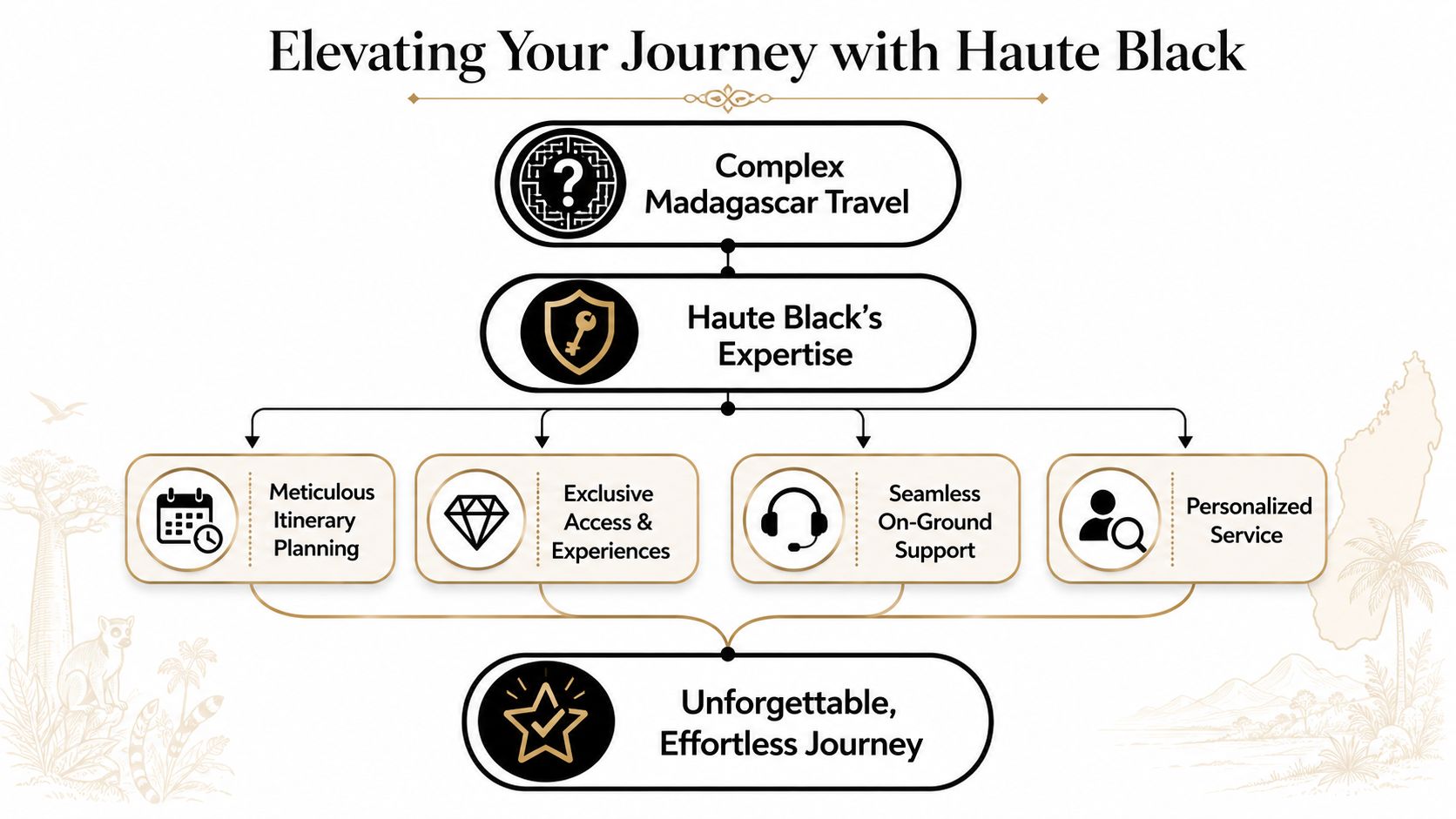
Our work is most valuable for travelers who want the island handled with judgment, not guesswork. We design Madagascar journeys around flight schedules, regional fit, lodge standards, transfer realism, and the pacing required to keep the experience comfortable from beginning to end.
That can include:
- Strategic itinerary design: Routes built around what operates well together, not what looks close on a map.
- Premium transport planning: Private aviation, helicopter support, and best-fit commercial air options where they improve comfort and save meaningful time.
- Lodge and guide coordination: Strong properties, reliable ground teams, and clear standards across every stop.
- Contingency preparation: Back-up options and active trip oversight when conditions shift.
The difference shows up in the finished journey. Better flow. Less dead time. Stronger access to the Madagascar you want to experience.
If you are considering a tour to Madagascar and want it planned with this level of care, Haute Black can curate the trip with bespoke itinerary design, premium air strategy, and on-the-ground coordination shaped by the realities of the island.
Explore Our Guides


Signature Experiences