Haute Black Journal
Luxury Ground Transportation: The Ultimate Guide

Marlene Azeez
Director, HauteBlack
View all articles →
You've just landed after a long overnight flight. Your phone is full of messages, your schedule has no room for a delay, and the next destination is still an hour away. The difference between a standard car service and luxury ground transportation becomes clear before the vehicle even moves: someone is monitoring the arrival, handling the luggage plan, confirming the correct terminal exit, and ensuring the chauffeur knows exactly where the journey continues.
For high-net-worth travelers, the vehicle is only one part of the product. Reliability, discretion, contingency planning, and precise coordination determine whether a transfer feels like a natural continuation of the trip or an avoidable source of friction. The best operators make complex movement appear simple, while weaker providers expose every handoff, delay, and assumption.
The Art of the Arrival
The ideal arrival has no visible seams. After a long flight, an ultra-high-net-worth traveler leaves the aircraft, moves through the terminal with an agreed assistance plan, and finds a professional chauffeur who already understands the luggage, the destination, and the preferred level of interaction. There's no frantic search for a curbside pickup, no uncertainty about whether the car is waiting, and no need to explain the itinerary twice.
That standard begins before landing. The provider should confirm flight details, terminal information, passenger names, luggage requirements, preferred contact method, and the destination's arrival protocol. For travelers who want to reduce friction before meeting the chauffeur, practical guidance on smooth airport security tips can complement the transfer plan.
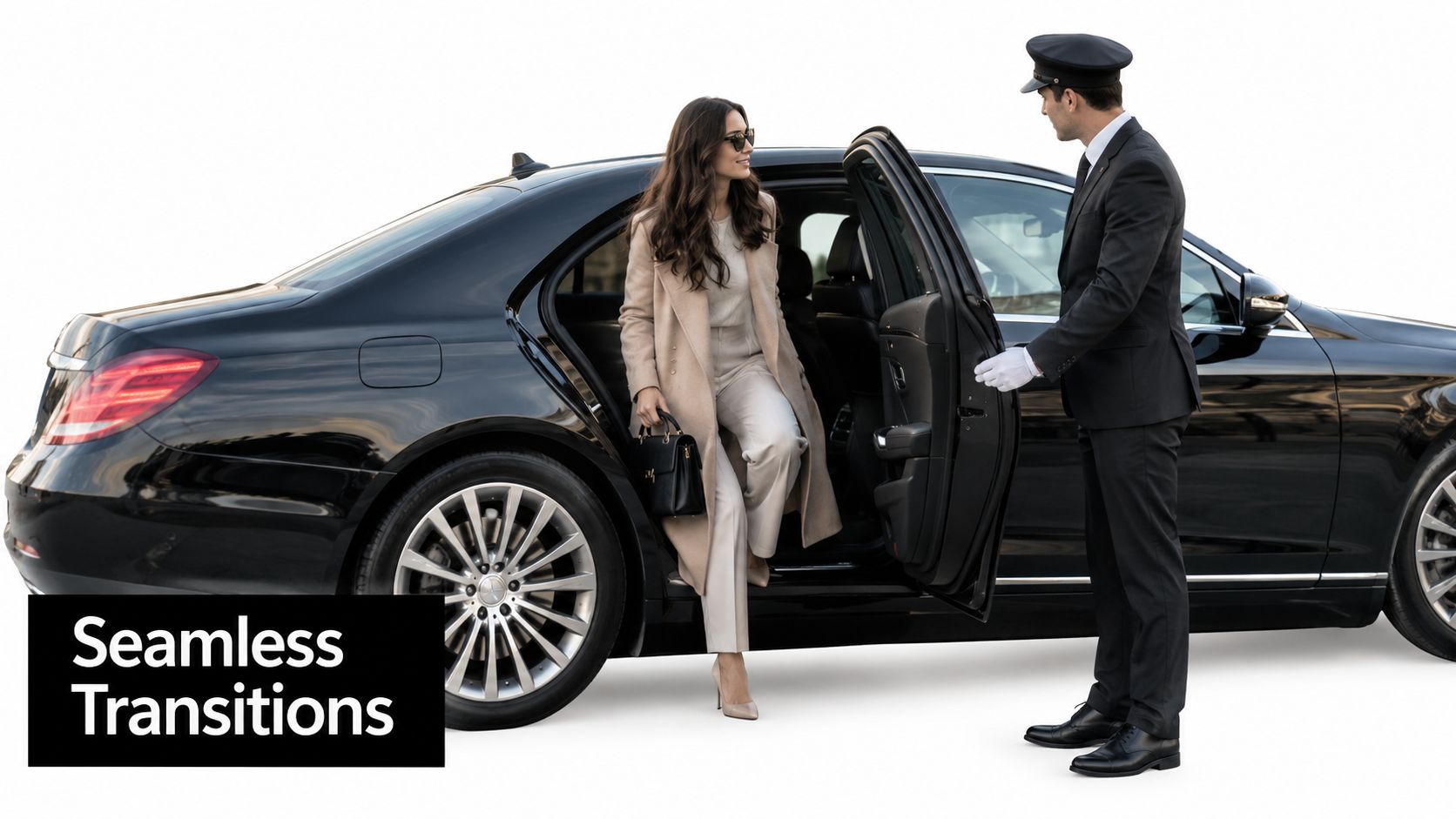
The invisible work behind a calm handoff
A polished airport transfer depends on details most passengers never see. The chauffeur needs accurate pickup instructions, the operations team needs a live view of the flight, and the vehicle must be positioned for the actual terminal rather than a generic airport meeting point. If the traveler is connecting to a yacht, private residence, business meeting, or onward flight, the transfer manager should understand the next handoff too.
The seamless VIP airport transfers premium guide is useful for travelers assessing how meet-and-greet, luggage support, and onward coordination fit together.
Practical rule: A premium arrival should feel quiet, prepared, and unhurried, even when the itinerary itself is tightly timed.
Luxury transportation becomes part of the travel experience when the provider anticipates needs without becoming intrusive. The chauffeur opens the door, handles the appropriate luggage, confirms the destination discreetly, and gives the passenger control over conversation, temperature, music, and stops. The journey doesn't compete with the hotel, villa, meeting, or event. It prepares the traveler for it.
Understanding Service Categories
The right vehicle depends less on badge value than on how the traveler intends to use it. A chauffeured sedan may be the most discreet and efficient choice for an executive moving between meetings. A large SUV may be more comfortable for a family with substantial luggage, while a limousine can suit a formal event where presentation matters as much as transport.
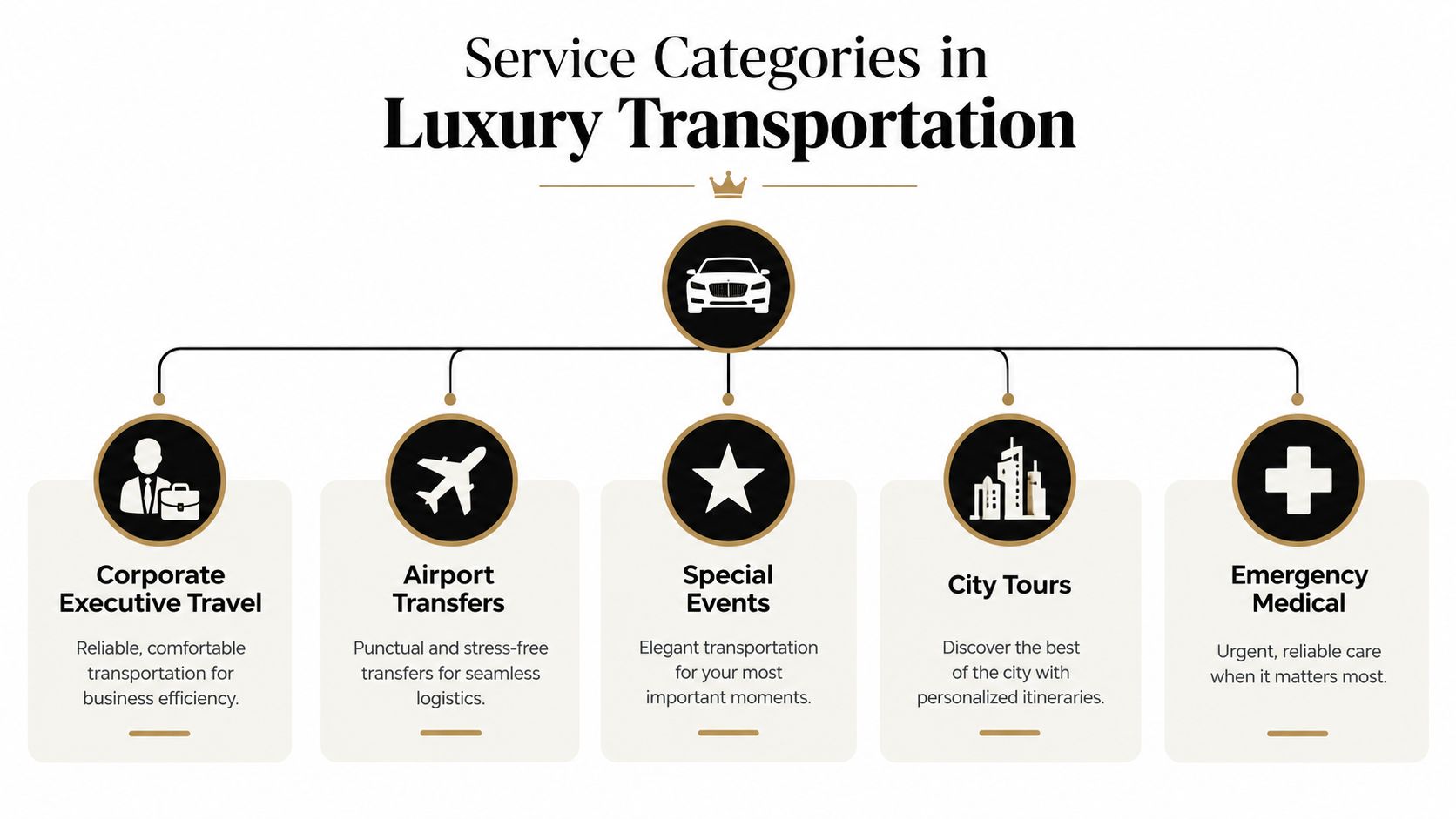
Match the category to the itinerary
Chauffeured sedans remain the workhorse for corporate travel, airport transfers, restaurant reservations, and city movements where a restrained profile is preferable. The best sedan service is defined by punctual dispatch, clean presentation, and a chauffeur who understands executive etiquette, not just by the vehicle's manufacturer.
Luxury SUVs earn their place when passengers need more cabin space, luggage capacity, higher seating, or added flexibility on mixed road conditions. They're often the practical choice for families, ski equipment, shopping itineraries, and longer transfers. A large vehicle isn't automatically luxurious, however. Poorly planned loading, an awkward third row, or an inexperienced chauffeur can undermine the benefit of extra space.
Limousines work best for ceremonial occasions, premieres, weddings, formal dinners, and moments where the arrival itself carries social meaning. They're less suitable for every business transfer, especially when the passenger values discreet access and easy movement through narrow urban streets.
Luxury vans help groups stay together without forcing passengers into several vehicles. They're useful for family travel, executive delegations, production teams, and multi-stop touring. The operator should confirm interior configuration, luggage space, charging access, and whether the vehicle can reach each property entrance.
Exotic car transfers serve a narrower audience. They can turn a scenic drive or destination experience into an event, but they're rarely the sensible choice for airport logistics, heavy luggage, or a day with frequent stops. The experience depends on route design, weather, road conditions, and the passenger's willingness to trade utility for distinction.
A luxury provider should explain those trade-offs plainly. If every request produces the same oversized vehicle, the company is selling inventory rather than designing transportation around the traveler.
The following video offers another visual perspective on how service categories can support different travel purposes:
Standards That Define True Luxury
An expensive vehicle can still deliver an ordinary service. True luxury appears in the operating system behind the car, including dispatch discipline, chauffeur conduct, vehicle readiness, and the provider's ability to recover when conditions change.
One industry KPI source identifies 99.5% or higher on-time performance as the target standard for premium chauffeur businesses, as outlined by this chauffeur KPI guidance. Punctuality matters disproportionately in luxury travel because a transfer may connect an airport arrival with a private aviation departure, a secure event entrance, a board meeting, or a tightly timed dinner reservation. A small delay can disrupt several later commitments.

The operational signals worth checking
A professional operator should be able to explain how it measures punctuality, handles flight changes, assigns backup vehicles, and records service incidents. “Our chauffeurs are reliable” is weaker than a clear description of dispatch procedures and escalation contacts.
Vehicle age and condition also matter. Independent guidance recommends newer vehicles, usually under three years old, together with documented licensing, commercial liability and passenger insurance, pre-trip inspections, and rigorous maintenance and cleaning protocols, as described in this premium ground transportation guide. Newer vehicles can offer more current safety and comfort technology, but the documentation and inspection process remains just as important.
Sustainability introduces a more difficult test. A provider can advertise an eco-friendly fleet, yet still struggle with range, luggage capacity, cold-weather performance, or airport standby readiness. Environmental regulation is pushing electrification in airport operations, including European Union mandates for zero-emission airport ground vehicles by 2035, while luxury operators must preserve the consistency passengers already expect.
Airport transfers illustrate the tension particularly well. One market report estimates that airport transfer services represented 22.8% of 2025 revenue share and carried a 34% price premium over on-demand urban transportation, because buyers pay for predictability, routing control, and readiness. The relevant question isn't whether an electric vehicle sounds progressive. It's whether the selected vehicle can complete the actual itinerary without compromising comfort or contingency capacity.
Safety and Privacy Considerations
Safety begins with documentation, not polished branding. Before booking, ask whether the operator holds the required commercial licensing, passenger insurance, and local permissions for the route. A legitimate provider should be comfortable explaining what protection applies to the passenger, the vehicle, and the chauffeur during the journey.
A practical safety review
Start with the vehicle. Newer models with current safety technology are preferable, but condition matters just as much. Ask how often the operator completes pre-trip inspections, who records maintenance, and how the company removes a vehicle from service when a defect appears.
Then examine chauffeur standards. Reputable providers should use licensing checks, background screening, route familiarity, professional training, and ongoing performance review. Training should address defensive driving, airport procedures, client interaction, luggage handling, emergency response, and the boundaries of appropriate conversation.
A serious operation also maintains a contingency plan. The provider should know what happens if a vehicle develops a fault, a road closes, a flight diverts, or a passenger's schedule changes. A backup plan that exists only in a sales conversation isn't a plan at all. Ask who makes the decision, how quickly the client is informed, and whether the replacement vehicle meets the original standard.
Privacy is part of safety
High-profile travelers often need information security as much as physical protection. Chauffeurs should understand confidentiality expectations, avoid discussing passengers in public areas, and follow clear rules for photographs, social media, itinerary details, and personal data. Non-disclosure agreements may be appropriate for particularly sensitive movements, but a signed document can't replace sound operational culture.
Vehicle privacy features may include tinted glass, discreet pickup points, partition options, and controlled communication. The provider should also limit itinerary access internally, giving each team member only the information needed to perform the assignment.
A useful test: Ask the provider how it protects passenger information when the booking involves a residence, a public appearance, or a confidential business meeting. The quality of the answer often reveals more than the vehicle brochure.
Pricing Models and Cost Drivers
Luxury ground transportation is priced around capacity, time, readiness, and responsibility, not just mileage. A point-to-point transfer can look simple, but the provider may also be reserving a specific vehicle, positioning a chauffeur, monitoring an arrival, accommodating waiting time, and protecting a narrow arrival window.
The market context is substantial. One industry report estimated the global luxury ground transportation market at $42.6 billion in 2025, with a projection to reach $78.3 billion by 2034, implying a 7.0% CAGR from 2026 to 2034. The same report identified chauffeur services as the largest category, representing 38.4% of the market in 2025. These figures are reported in the luxury ground transportation market analysis.
| Pricing Model | Typical Use Case | Key Cost Drivers |
|---|---|---|
| Point-to-point | Airport, hotel, residence, or meeting transfer | Vehicle class, route, airport procedures, luggage, traffic exposure |
| Hourly reservation | Meetings, shopping, touring, and multi-stop days | Reserved time, minimum booking period, vehicle class, route changes |
| Daily package | Full-day sightseeing, events, or executive programs | Chauffeur availability, total itinerary, standby time, distance, overnight requirements |
| Specialty movement | Events, difficult terrain, or complex access | Specialist vehicle, additional coordination, permits, equipment, and contingency planning |
Airport pricing often exceeds a basic urban ride because the chauffeur may need to monitor the flight, wait through baggage collection, manage terminal rules, and remain ready for a changed arrival time. The passenger is paying for a controlled handoff, not merely the distance between two addresses.
For a location-specific point of comparison, a guide to chauffeur hire London prices can help travelers understand how local market conditions influence quotes. The useful comparison isn't the lowest headline figure. It's whether each proposal includes waiting, tolls, parking, airport fees, vehicle substitution, cancellation terms, and after-hours support.
A fair quote should make assumptions visible. If one provider offers a lower figure but excludes waiting and terminal charges, the apparent saving may disappear once the itinerary changes. Ask for an itemized proposal and compare the operating commitment behind each price.
Vetting Providers Effectively
The inquiry process is the first service test. A provider that answers quickly but avoids direct questions may create more stress during the actual journey. A provider that gives clear options, identifies constraints, and confirms assumptions is showing the same discipline you'll need on travel day.
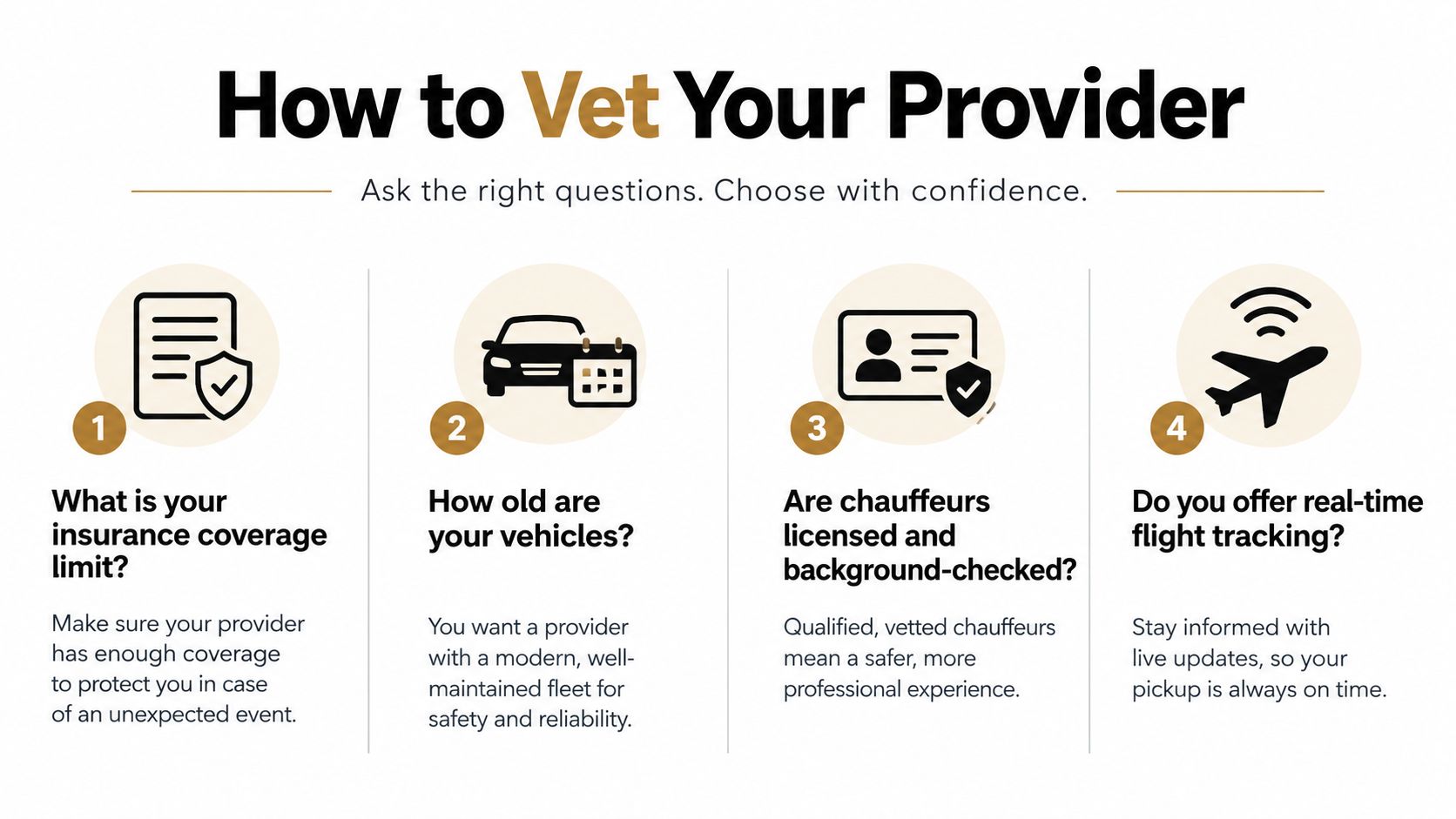
Questions that deserve precise answers
Ask for the insurance coverage and the entity responsible for the booking. Confirm vehicle age, maintenance procedures, licensing, chauffeur screening, and whether the operator owns the fleet or subcontracts the assignment. Subcontracting isn't automatically a problem, but the provider should disclose it and explain how it controls standards across partners.
Use the booking conversation to test operational maturity:
- Request clarity: Ask for the full inclusions, exclusions, waiting policy, cancellation terms, and airport procedure in writing.
- Test contingency planning: Ask what happens after a flight diversion, vehicle failure, road closure, or delayed luggage collection.
- Confirm communication: Establish the operations contact, chauffeur contact method, and escalation process before the journey.
- Match the vehicle: Verify the actual model or an agreed equivalent, luggage capacity, seating configuration, and access requirements.
- Check network relationships: Recognized travel networks and established destination partnerships can indicate that the provider works within a broader service framework.
Red flags include a quote with no vehicle specification, reluctance to provide insurance evidence, vague answers about chauffeur screening, unexplained cash-only requirements, and a promise that “everything will be fine” without a documented plan. A polished website can't compensate for missing operating detail.
Evaluate the partner, not the photograph
The most capable provider may recommend a different vehicle from the one you initially requested. That's a positive signal when the recommendation reflects luggage, road access, passenger privacy, or schedule pressure. A company that only upsells the most expensive option may understand pricing better than travel design.
The best inquiry response reduces uncertainty. It tells you what the provider knows, what it still needs, and how it will protect the itinerary if conditions change.
Bespoke Integration Examples
A luxury transfer works best when it's designed as one movement within a larger itinerary. Consider a traveler arriving by private aircraft, transferring to a resort, and continuing to a remote experience. The ground vehicle must align with the aircraft's arrival, the property's access rules, the luggage plan, and the traveler's preferred pace.
In Iceland, for example, travelers commonly choose between two distinct models. HauteBlack's Iceland guide describes a privately guided luxury vehicle, often a high-spec Super Jeep or comparable all-terrain setup, for routes where road quality, weather, and access conditions matter. Others choose rotary-wing movement when they want time compression and direct scenic transfer rather than a road journey.
Two itineraries, two rhythms
A Super Jeep itinerary turns the transfer into part of the destination. The guide can adjust the route, respond to changing conditions, and stop where the terrain warrants it. The trade-off is time. Road travel preserves discovery but takes longer and remains sensitive to weather and access.
A helicopter movement prioritizes directness and visual impact. It can compress the journey and connect locations that would otherwise require a long overland route. The trade-off is flexibility on the ground, weather dependency, and the need to coordinate landing access and onward transport.
The same logic applies in urban travel. A sedan may move an executive from a private aviation terminal to a boardroom, while an SUV waits nearby for the family's later transfer to a villa. The service feels bespoke because each vehicle has a defined role, rather than because every leg uses the same category.
For travelers combining private aviation and ground movement, the private jet luxury travel guide provides useful context for coordinating those handoffs. The goal is an itinerary with no awkward gaps between aircraft, vehicle, hotel, and experience.
The Elite Provider Advantage
The most valuable ground transportation partner understands that a transfer can affect the entire trip. A chauffeur who knows the property's preferred entrance, a travel advisor who understands the client's room preferences, and an aviation team that shares the correct arrival details can prevent small operational errors from reaching the traveler.
Established luxury travel companies also bring relationships that a standard car service usually doesn't manage. Preferred partner status can support VIP recognition, available upgrades, resort credits, and a more informed arrival experience. HauteBlack operates as a Virtuoso-affiliated agency with preferred partner relationships at over 500 properties, including Four Seasons, Aman, Rosewood, Belmond, and Ritz-Carlton. Those benefits matter most when the transportation team and hotel team work from the same itinerary.
One point of contact, fewer exposed seams
A single advisor can coordinate sedans, SUVs, airport meet-and-greet, private aviation, helicopter transfers, villas, dining, and special events. That doesn't mean every service must come from one company. It means someone owns the handoffs and knows which details can't be left to assumption.
Travelers comparing executive options may also find it useful to review guidance on a fixed-price limo for executives, particularly when budget predictability matters. Fixed pricing can help, but it should still be evaluated alongside vehicle standards, waiting terms, contingency support, and the provider's ability to manage a changing schedule.
HauteBlack's ground transportation service brings chauffeured vehicles and related transfer coordination into a broader travel-planning framework. The practical advantage isn't just access to a polished car. It's the ability to connect transportation with the traveler's complete itinerary, preferences, privacy requirements, and destination relationships.
HauteBlack arranges chauffeured sedans, luxury SUVs, limousines, VIP airport support, and helicopter transfers as part of bespoke travel planning across worldwide destinations. Visit HauteBlack to discuss a journey where reliable ground transportation is coordinated with the flights, properties, and experiences around it.
Explore Our Guides


Signature Experiences


