Haute Black Journal
Luxury Air Travel: The Complete Guide for UHNW Travelers

Marlene Azeez
Director, HauteBlack
View all articles →
The most popular advice about luxury air travel is wrong. Champagne, private suites, and caviar aren't the reason experienced travelers pay for premium aviation. They pay to protect a meeting, avoid an unreliable connection, keep a family moving together, or turn an exhausting transfer into usable time.
The right question isn't, “Which cabin looks most impressive?” It's, “Which transport plan produces the best door-to-door result for this itinerary?” First class, private jets, and helicopter transfers solve different logistical problems. Choosing the wrong tier can leave you paying heavily for comfort while gaining little time, flexibility, or privacy.
Luxury travel also sits inside a changing market. WingX data reported 3,878,836 global private jet flights in 2025, up 4.6% from 2024 and 113,901 flights above the previous record set in 2022 (Forbes analysis of WingX data). The growth matters, but it doesn't mean private aviation is automatically rational. It means more travelers are testing whether flexibility and time control justify the premium.
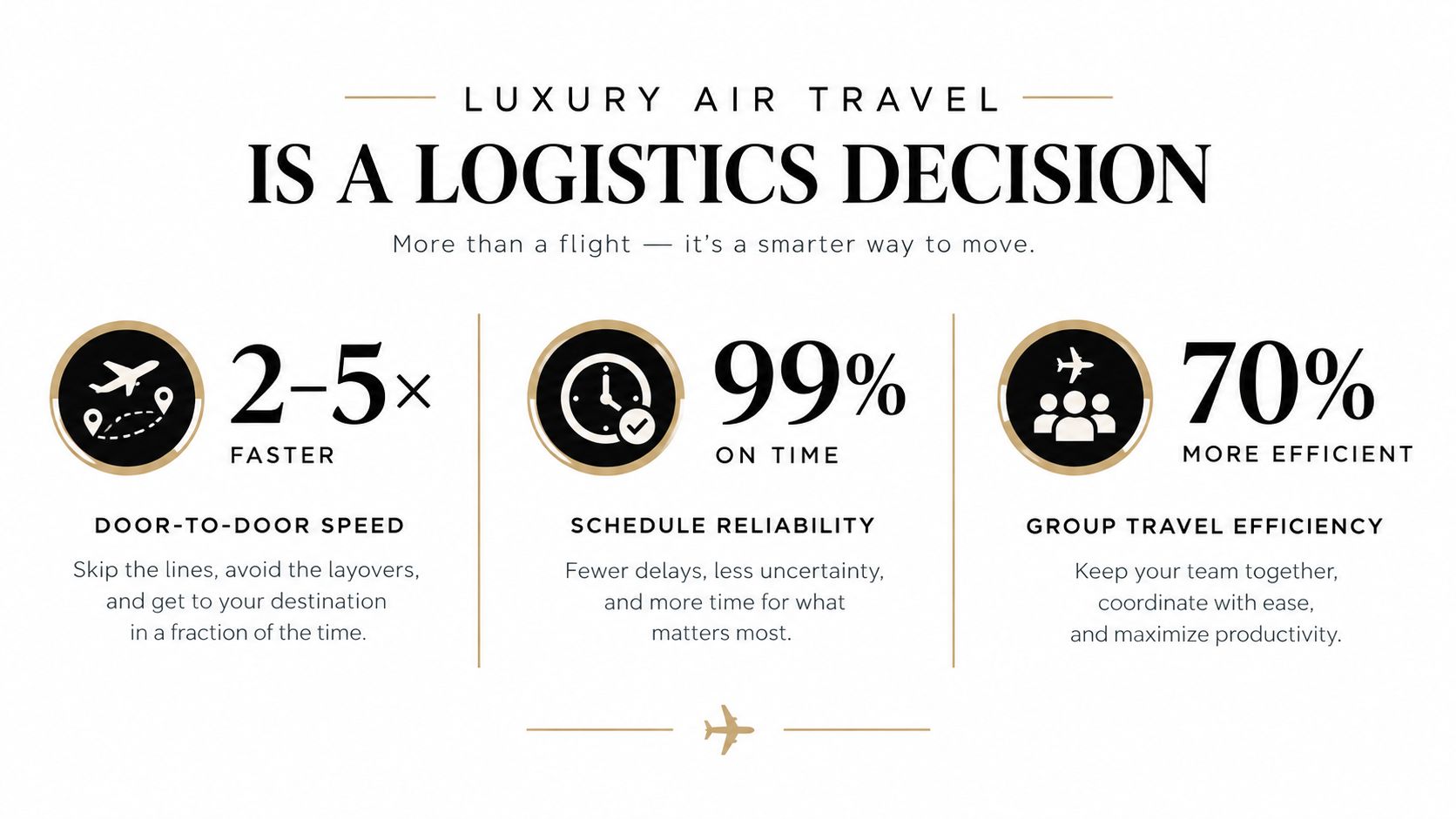
Why Luxury Air Travel Is a Logistics Decision, Not a Status Symbol
A first-class seat can be superb and still be the wrong purchase. The useful comparison is door to door: the drive to the airport, terminal procedures, lounge time, boarding, baggage collection, ground transfers, and any connection risk. For a principal with an afternoon commitment, those hours matter more than the wine list.
Private aviation earns its place when it changes the day's structure. A founder visiting several cities may need to leave as soon as a meeting ends, not when an airline timetable permits. A family traveling with five or more people may gain more from one coordinated departure, one cabin, and one ground plan than from separate premium seats. An executive crossing time zones may choose a smaller airport because the shorter transfer protects the meeting itself.
The decision is economic as much as experiential. Calculate the time recovered, the number of travelers moving together, and the cost of losing flexibility. If a direct commercial flight already fits the schedule and the airport transfer is simple, first class may be the disciplined choice. If the itinerary involves several stops, remote destinations, or a tight meeting sequence, a private aircraft can justify its premium through control rather than prestige.
European business aviation demand also remains above its pre-pandemic level, with 555,254 business jet flights in 2025 compared with 523,653 in 2019, according to WingX figures reported by Forbes (WingX data reported by Forbes). The figures show sustained use, not automatic value. Each itinerary still needs its own door-to-door calculation.
Practical rule: Calculate the trip from residence to final destination, not from runway to runway.
Airline premium cabins remain commercially important on established routes. McKinsey found that premium cabins across several major route categories generated a growing share of passengers and an even faster-growing share of revenue from 2019 to 2025 (McKinsey analysis of premium-cabin profitability). That strengthens the case for first or business class where schedules work. It also demands discipline: premium has become more common, while its price can rise faster than the practical benefit.
The Three Modes of Premium Air Service
Start with the itinerary, then choose the aircraft or cabin. Don't begin with a loyalty program, a favorite brand, or a photograph of a suite.
First class for predictable routes
First class is usually the rational choice for one or two travelers flying between major cities with a strong nonstop schedule. You get an airline's lounge network, onboard service, established baggage systems, and a known arrival airport. The trade-off is fixed departure timing, commercial security, airport congestion, and limited control over the route.
Choose it when the traveler can tolerate the airline's schedule and the main objective is rest. It also works well when the route has a mature premium product and the airport transfer is straightforward. Lower-altitude aircraft can improve the experience on long-haul routes. Typical cabins are pressurized to a 5,000 to 8,000 foot equivalent altitude, while newer composite aircraft such as the Boeing 787 and Airbus A350 can hold cabin altitude closer to 6,000 feet, a factor associated with reduced fatigue and dehydration effects (medical and aerospace review).
Private jets for control
A private jet becomes more compelling when the group is larger, the route is complicated, or the departure time can't bend around an airline timetable. Families may need flexible baggage, pets, child-friendly cabin arrangements, and access to airports closer to a villa or event. Founders and C-suite travelers may need several legs in one day, with the aircraft waiting while meetings take place.
Private aviation is also a logistics product for groups. Recent Jet Linx reporting described nearly a third of summer flights carrying five or more passengers, alongside a shorter median booking window, which reinforces the role of private flying in group coordination and short-horizon planning (Jet Linx data reported by Resident).
Helicopters for the broken connection
Helicopter transfers solve a narrower problem, but often solve it exceptionally well. They're designed for the gap between a city center, resort, island, or remote property and a major airport or fixed-base operator. The best use is a short, congested ground connection where the road transfer threatens the itinerary.
HauteBlack's air-travel coverage treats private jets, first class, and helicopter transfers as separate services, which is the correct way to think about them (HauteBlack's commercial and private travel guide). A helicopter isn't a substitute for a long-haul cabin. It's a precision tool that protects the first or final segment of the journey.
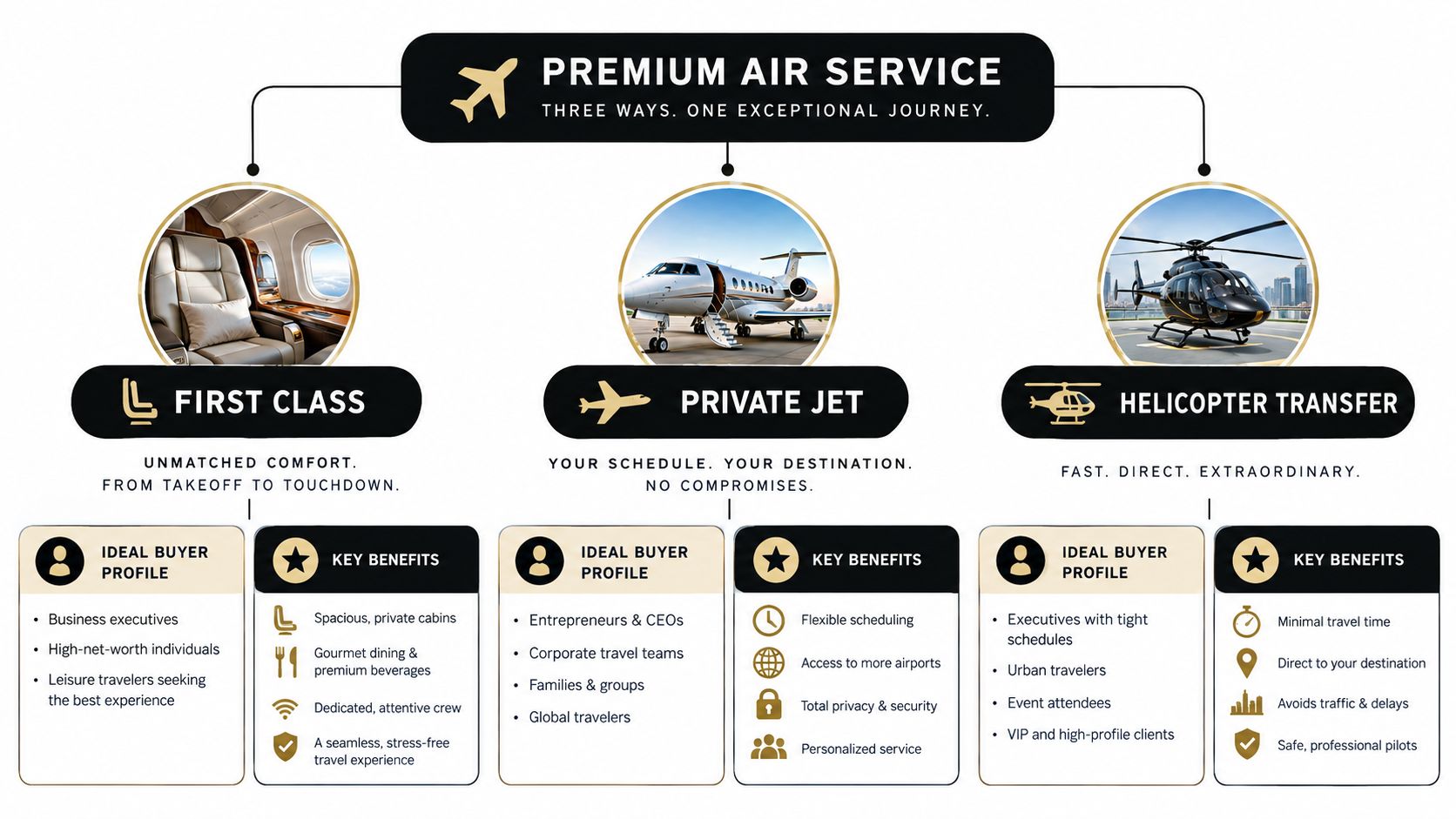
The most useful operational question is simple: which segment is creating the delay? If the answer is the intercontinental flight, consider first class or a private jet. If it's the city-to-airport transfer, consider a helicopter.
First Class, Private Jet, and Helicopter Compared
The comparison becomes clearer when you separate cabin comfort from itinerary control. First class improves the commercial experience. A private jet changes the operating model. A helicopter improves a specific transfer.
I won't pretend there is a universal cost answer. Prices depend on route, aircraft availability, positioning, season, airport, catering, and contract terms. The table below is a decision aid, not a quote.
Luxury Air Travel Options Compared
| Mode | Typical Cost | Time Savings vs Commercial | Flexibility | Privacy | Best Use Case |
|---|---|---|---|---|---|
| First class | Premium long-haul ticket pricing varies by route and fare conditions | Limited to the airline schedule and airport process | Low to moderate | Moderate | Solo or paired travelers on established nonstop routes |
| Private jet | Cost varies by aircraft, route, positioning, and operator terms | High when smaller airports and custom departure times remove ground or connection delays | High | High | Families, founders, C-suite itineraries, complex multi-leg travel |
| Helicopter transfer | Cost varies by aircraft, landing permissions, route, and operator | High on congested city-to-airport or resort transfers | Moderate, subject to weather and landing approvals | High | The first or final connection where ground time threatens the itinerary |
First class makes the most sense when you can use the published schedule without compromising the day. Private aviation deserves scrutiny when you can fill the cabin, add multiple legs, or access a materially better airport. Helicopter transfers make sense when a short airborne segment protects a longer commercial or private itinerary.
The correct upgrade is the one that removes the largest operational constraint, not the one with the most luxurious brochure.
For a focused look at helicopter planning, landing logistics, and the role of this mode in a broader itinerary, review HauteBlack's private helicopter charter guide. Treat helicopter availability as operationally specific. Weather, permissions, landing-site approval, and local restrictions can override an otherwise elegant plan.
What You Are Actually Paying For
Every premium invoice contains several different purchases. The seat or aircraft is only one of them.
On a first-class ticket, you're paying for the seat, catering, crew, lounge access where included, airport handling, the airline's network, and the cost of operating a scheduled service. The ticket may also buy a better sleep environment and a smoother disruption process, but it rarely buys full control over departure time or routing.
A charter invoice has a different cost stack. Crew, fuel, aircraft positioning, maintenance, hangar requirements, insurance, permits, ground handling, catering, and repositioning all contribute. Some charges are visible. Others appear in the contract as minimum flight time, waiting, overnight, de-icing, or changes to the agreed routing.
Cost Components by Premium Air Mode
| Cost Component | First Class (Share of Ticket) | Mid-Size Jet (Share of Charter) | Heavy Jet (Share of Charter) |
|---|---|---|---|
| Aircraft or seat access | Scheduled cabin and fare inventory | Aircraft time and availability | Aircraft time, range, and availability |
| Crew and operations | Embedded in airline fare | Crew, duty time, and operational support | Larger crew and long-range operational requirements |
| Fuel and positioning | Embedded in network economics | Route fuel and possible repositioning | Greater fuel demand and long-range positioning |
| Ground handling | Airline terminal and lounge systems | FBO, ramp, permits, and handlers | FBO, international handling, and larger-aircraft support |
| Flexibility | Fare rules and airline disruption policy | Contract terms and operator availability | Contract terms, aircraft availability, and route complexity |
| Comfort and privacy | Premium seat and cabin service | Private cabin and tailored service | More space, range, and cabin capability |
A comparison such as a high-priced first-class round trip against a substantially higher private charter can be misleading if it compares only seat price with aircraft price. The private option may serve a group, remove a connection, use a closer airport, and protect a same-day schedule. The first-class option may be vastly better value for a solo traveler on a direct route.
The danger is premium inflation. Enclosed suites, direct aisle access, lie-flat seats, and upgraded lounges have become increasingly standardized on long-haul routes, while strong demand and constrained capacity can push premium fares upward (Forbes Travel Guide's 2026 premium-air-travel analysis). Paying more for a familiar cabin architecture isn't automatically irrational, but it demands a sharper question.
Read the contract before comparing the headline figure. Fractional programs may impose occupancy or idle-day charges. Jet cards may apply peak-day rules and overage rates. A broker may quote a low base figure before adding repositioning, handling, or catering. HauteBlack's guide to private jet charter costs is useful as a checklist of the factors that shape a quote.
Ask the operator or advisor: what portion of this invoice buys recovered time, certainty, privacy, or genuine comfort, and what portion is just brand markup?
How to Book and Manage the End-to-End Itinerary
Premium booking fails in the handoffs. The aircraft can be excellent, yet the itinerary breaks because the car arrives at the wrong terminal, the luggage exceeds the cabin limit, or the international clearance plan was never confirmed.
Start with the advisor and operator
Choose an advisor who understands both scheduled premium cabins and charter operations. Membership in professional networks such as Virtuoso or Traveller Made can help establish a relationship, but it doesn't replace route-specific diligence. Ask whether the advisor has direct charter authority or acts as a broker, and request the name of the actual operating carrier.
For an operator, verify the current safety and insurance documentation, aircraft type, crew arrangements, and cancellation terms. Don't accept a generic fleet presentation as proof that the proposed aircraft is available for your dates.
Compare the quote, not just the aircraft
For a charter, request at least three operator quotes when timing allows. Compare the total invoice, aircraft year and configuration, repositioning, crew expenses, overnight provisions, catering, ground transport, and change terms. For first class, compare a published fare with a private-fare bid where available, then examine flexibility rather than choosing on price alone.
The best quote is often the one with the clearest assumptions. If a broker can't explain the aircraft's positioning, the cancellation window, or the contingency plan, the low figure isn't useful.
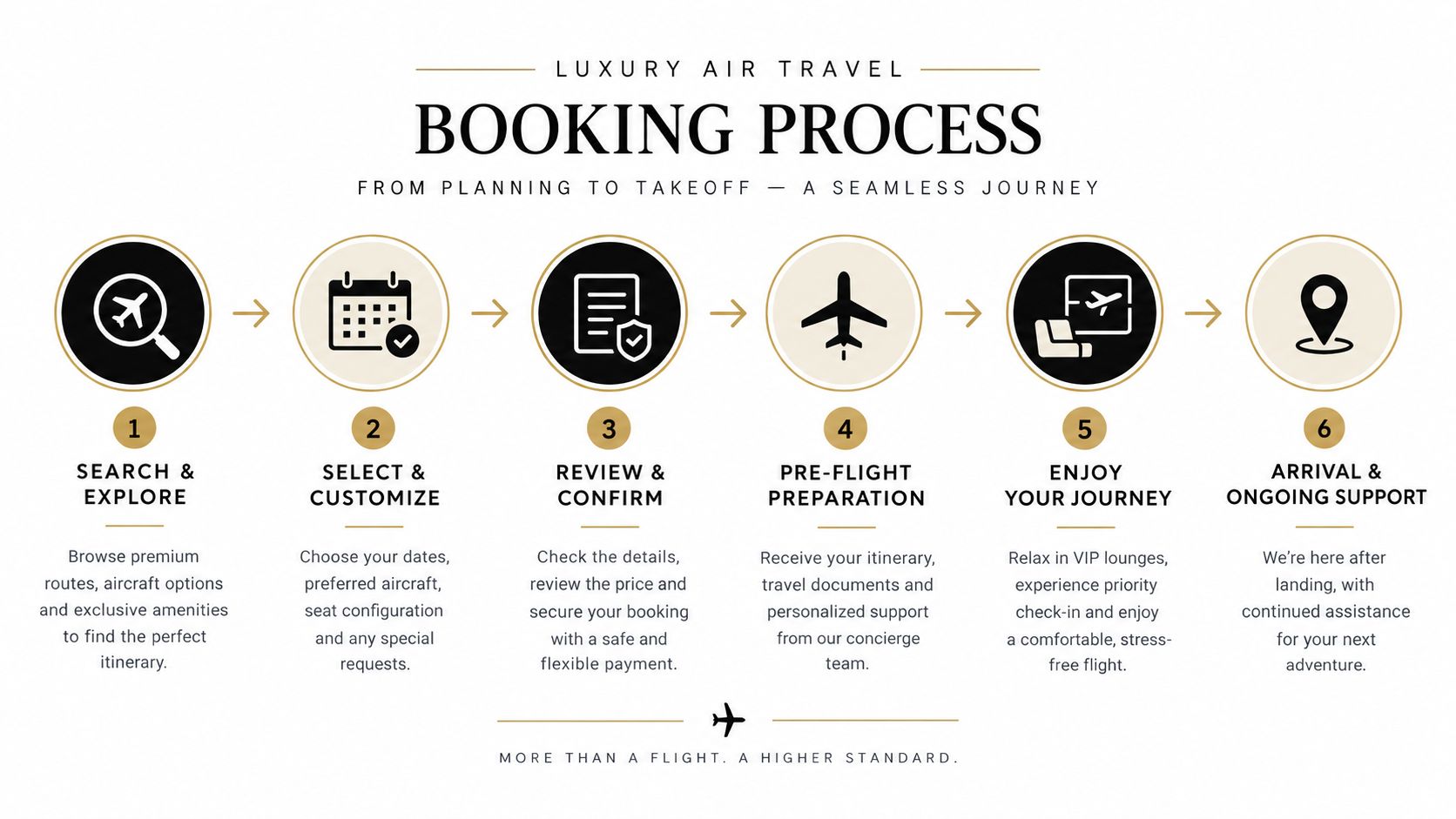
Build the ground layer
At an FBO, confirm chauffeur dispatch, curbside procedures, baggage assistance, and the exact terminal address. For an airline itinerary, distinguish between ordinary ground transport and a first-class meet-and-greet service. BLADE, Wheels Up shuttle services, and VIP terminal operators such as Signature Flight Support may fit different portions of the plan, but availability and route coverage must be confirmed for the actual trip.
Luggage deserves its own line in the planning document. Light jets may have stricter weight and dimension limits than travelers expect. International FBOs need a clear customs plan, and multi-leg travelers may save time by shipping specialist equipment or excess baggage ahead.
Protect the traveler and the support team
Use TSA PreCheck and Global Entry where eligible, while recognizing that private terminal screening follows a different process. Coordinate enrollment and documentation for staff and family members traveling with the principal. A principal's smooth departure is not enough if the accompanying team is delayed at screening or customs.
HauteBlack describes its air-travel offering through private aviation, first-class arrangements, and helicopter transfers, making its air-travel service relevant when one advisor needs to coordinate multiple modes rather than book an isolated flight.
When Private Aviation Becomes the Rational Choice
Consider a multi-generational family traveling from Aspen to London for a wedding. Four adults and three children may need several first-class seats, coordinated airport transfers, baggage planning, and a schedule that works for the youngest travelers. A private cabin can consolidate the group and simplify the journey, particularly when the aircraft can use airports that reduce the ground burden.
The decision still needs arithmetic. If the route is a straightforward nonstop with a highly reliable premium cabin, first class may remain the better purchase. If the family needs unusual baggage, flexible timing, pets, or a remote final destination, private aviation gains practical value because the group isn't just buying seats. It's buying coordination.
The founder's same-day itinerary
A founder traveling from New York to Boston for a board meeting, then Boston to Washington for an investor dinner, then home faces a different problem. Commercial schedules may make the sequence impractical or force an overnight stay. A suitably sized private aircraft, with the operator holding it at the FBO, can turn the day into a manageable operating schedule.
That doesn't mean every dense calendar justifies a charter. Meetings can move, participants can join remotely, and a first-class ticket may be adequate for a single direct leg. Private aviation becomes rational when the value of preserving the sequence exceeds the incremental transport cost and when the aircraft's availability is contractually clear.
The solo traveler test
A single traveler on a major airline hub-to-hub route with a strong first-class product should usually buy the premium ticket. Add lounge access, a good transfer, and enough schedule margin. Private aviation's economics emerge more clearly with groups, difficult routing, short booking horizons, access to smaller airports, or a day that cannot absorb a connection.
The private aviation market's logistics appeal is visible in recent reporting. Jet Linx reported jet card sales up 65% year-to-date, summer flight activity up 5.8% year over year, and the median booking window falling from 13 days to 10 days (Resident's report on Jet Linx data). Those figures don't make a charter automatically sensible. They do show why travelers with compressed planning windows increasingly treat aircraft access as a scheduling tool.
Safety, Sustainability, and Operator Verification
Luxury presentation doesn't equal operational quality. A reputable advisor starts with the operator, not the cabin finish.
Ask for current ARG/US or Wyvern audit information where applicable, IOSA registration for relevant scheduled carriers, insurance limits, aircraft registration, maintenance responsibility, and pilot experience requirements. Review the operator's safety management system and ask how the company handles reporting, incidents, weather diversions, maintenance substitutions, and crew duty limitations.
Questions worth putting in writing
- Who operates the flight? Confirm the legal operating carrier, not only the broker or membership brand.
- Which aircraft is contracted? Ask what happens if the named aircraft becomes unavailable.
- What insurance applies? Review liability limits and exclusions.
- How are pilots assigned? Ask about training, recency, duty limits, and minimum experience.
- What is the contingency plan? Require clarity on substitutions, delays, cancellations, and refunds.
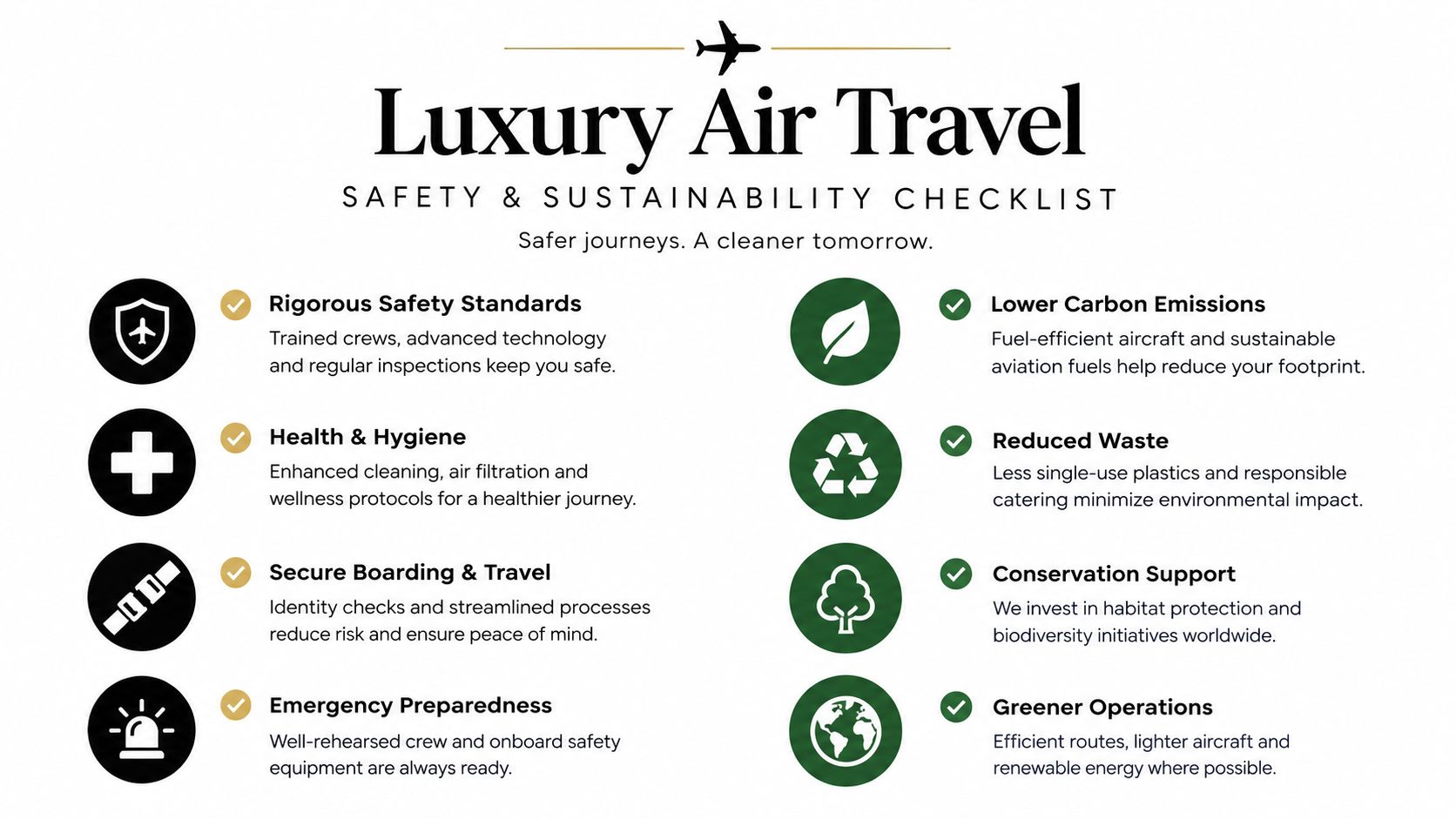
Sustainability needs the same direct treatment. Private jets generally create more emissions per passenger than a full commercial cabin because the aircraft carries fewer people. Offsets can support climate projects, but they don't erase the physical emissions from the flight. Ask whether sustainable aviation fuel is available for the specific operator or departure airport, what accounting method supports any environmental claim, and whether the proposed alternative changes the route or aircraft.
Electric and hydrogen concepts may reshape short-range aviation over time, but they aren't a reason to misrepresent current capability. Book the aircraft that meets the safety and route requirement now, then examine credible SAF and verified environmental programs separately.
A Practical Decision Framework for Your Next Booking
Use five filters before you compare cabins: group size, route complexity, time sensitivity, airport access, and privacy requirement. Those filters tell you more than the aircraft photograph.
| Itinerary Type | Recommended Tier | Indicative Cost / Hour | Key Trigger |
|---|---|---|---|
| Solo traveler on a direct major route | First class | Fare-dependent | Strong schedule and manageable ground transfers |
| Couple on a long-haul route | First class or business class | Fare-dependent | Sleep and service matter more than routing control |
| Family with complex baggage or pets | Private jet | Quote-dependent | Group coordination and cabin-specific needs |
| Founder with several same-day legs | Private jet | Quote-dependent | Meetings can't follow airline schedules |
| City center to airport transfer | Helicopter | Route and operator dependent | Ground congestion threatens the itinerary |
| Frequent, predictable private travel | Jet card or fractional structure | Contract-dependent | Repeated demand and clear usage pattern |
| Occasional complex trip | On-demand charter | Quote-dependent | Flexibility matters for one itinerary |
Before signing, write down the departure airport, final destination, passenger list, baggage profile, pets, preferred departure window, customs requirements, transfer plan, and contingency timing. Ask whether the quote includes positioning, catering, ground transport, de-icing, overnight crew costs, and aircraft substitution. For commercial first class, check fare rules, lounge access, connection protection, and the actual arrival time at the property.
HauteBlack's news page publishes travel intelligence daily across destinations, seasonal timing, property reviews, cultural events, and insider access strategies in 120+ countries (HauteBlack news). Its dated 2026 Ultimate Guide to Private Jet Luxury Travel also shows that its editorial coverage includes dedicated air-travel planning rather than only destination inspiration (HauteBlack private jet guide).
The final test is blunt: if the itinerary doesn't need flexibility, privacy, group coordination, or a meaningful reduction in door-to-door friction, don't buy the most expensive tier. Put the money into the parts of the journey that change the day.
HauteBlack can coordinate private aviation, first-class travel, helicopter transfers, and bespoke ground arrangements as one connected itinerary rather than isolated bookings. For a trip where timing, family logistics, or executive commitments matter, visit HauteBlack and request an itinerary built around the outcome you need, not just the cabin you want.
Explore Our Guides


Signature Experiences