Haute Black Journal
Incentive Travel Planning That Actually Works

Marlene Azeez
Director, HauteBlack
View all articles →
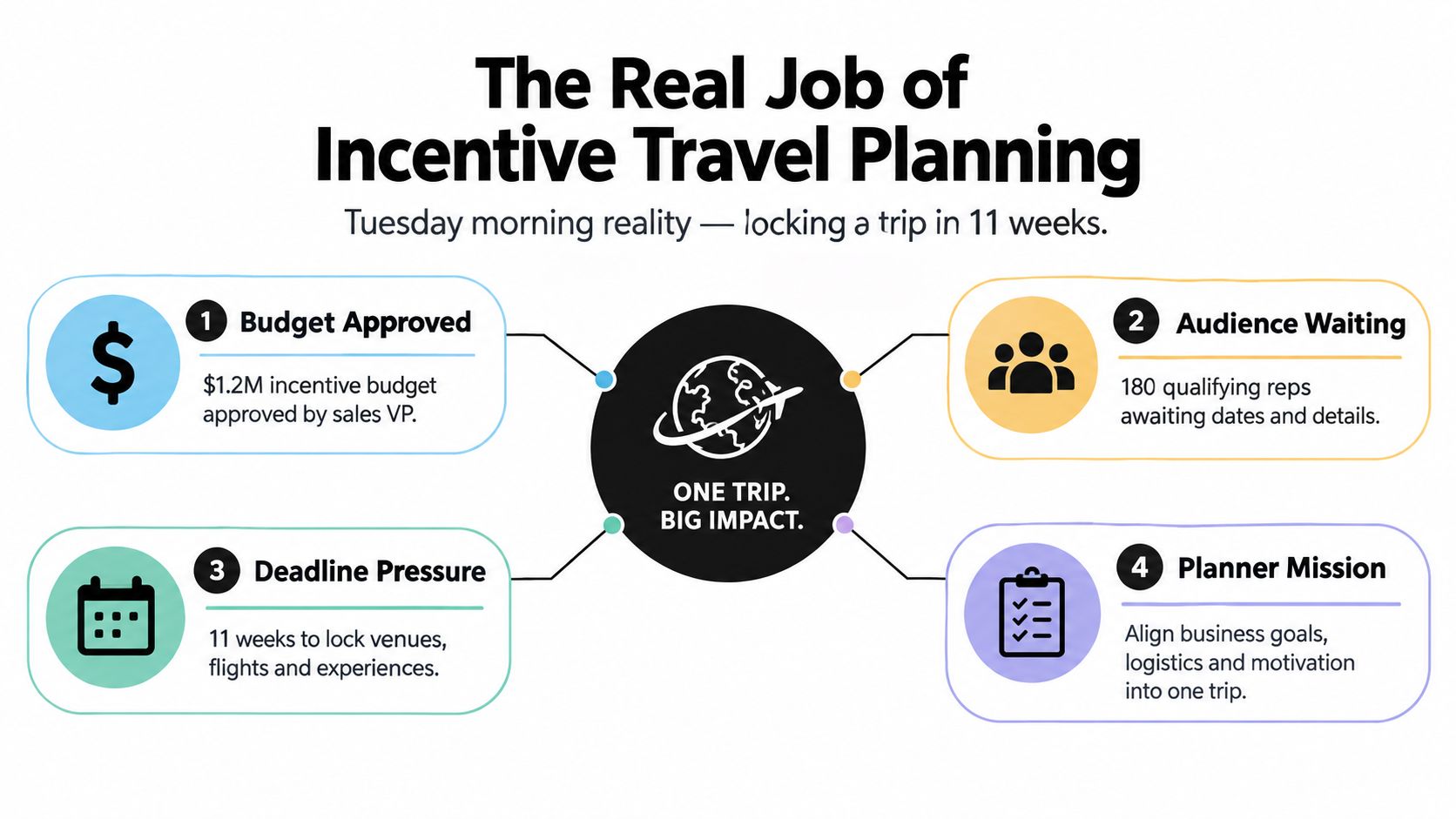
The sales VP has approved the budget. Qualifying employees are waiting for dates. Executive assistants are already asking about passports, room preferences, and whether a guest can join. Meanwhile, the preferred resort has limited suite inventory, airfares are moving, and the trip needs to be locked before the program loses its negotiating position.
That's the Tuesday-morning reality of incentive travel planning. You aren't assembling a pleasant itinerary. You're converting a business objective into a controlled performance program, then delivering it with the precision of a luxury operation.
The Real Job of Incentive Travel Planning
A strong incentive trip starts with a commercial question, not a destination brochure. Are you trying to accelerate qualified pipeline, retain top performers, deepen dealer loyalty, increase account expansion, or reinforce a certification program? Pick one primary KPI. “Motivation” is too vague to guide a budget, a room block, or a post-trip report.
The scale of the category supports treating the program as a serious business tool. The Incentive Research Foundation's U.S. business-use research reported that 74% of U.S. businesses use non-cash rewards, while 46% of businesses running non-cash programs include incentive travel. The research placed annual U.S. incentive-travel spending at about $22.5 billion, within a broader non-cash rewards economy of $76.9 billion.
Set the objective before sourcing
Write the objective in a form finance can audit. “Increase qualified pipeline generated by the channel team during the program period” is useful. “Reward high performers” describes the audience, not the business result.
A SMART objective changes the entire design:
- Revenue lift: Build qualification around booked revenue, then measure the eligible group against a defined pre-trip baseline.
- Retention: Focus the experience on employees or accounts whose continued relationship has strategic value.
- Qualified pipeline: Use CRM-tagged opportunities and require a clear qualification definition before announcing the reward.
- Dealer certification: Tie attendance to completed training, partner commitments, or a measurable commercial milestone.
The destination must serve the objective. A sales-acceleration program may need a schedule with productive networking and protected downtime. A retention program may justify stronger personalization, better room categories, and guest flexibility. A dealer program may require private product education, account meetings, and an experience that makes the commercial relationship feel valued.
Four pressures will shape every decision:
1. Cost per attendee versus perceived luxury. Guests remember service consistency more than an expensive centerpiece surrounded by compromises.
2. Novelty versus accessibility. A new destination loses appeal if air connections and transfers create fatigue.
3. Group cohesion versus VIP individuality. Shared moments build energy, but executives and top-tier qualifiers still need privacy and choice.
4. Speed versus brand standards. A compressed timeline demands faster approvals, not lower standards.
Segment the audience before building the rooming list
Qualification criteria should reflect the business case. A top 10% revenue-contributor cohort, as an example, requires different handling from a broad employee-recognition group. A strategic-account program may include decision-makers above a defined commercial threshold. A rising-star cohort might be selected by managers using performance and leadership potential. Channel partners may qualify through multi-year commitments or completed certifications.
Consider how each audience changes operations:
- Top-performing sales cohort: A group of about 20 senior contributors, many with established careers and partners joining them, usually needs strong suite availability, premium dining, and optional activities with varying physical intensity.
- Rising-star cohort: A group of about 40 newer employees, often traveling with a guest for the first time, may value social programming, flexible room categories, and clear guidance more than formal executive hosting.
- Strategic-account cohort: A group of about 12 client leaders with different company policies and travel preferences needs discreet billing, careful data handling, and a schedule that separates relationship-building from sales pressure.
- Channel-partner cohort: A group of about 30 representatives with varied tenure and household structures may require more dietary planning, broader activity choices, and explicit guest eligibility rules.
Mixing tiers without a visible service architecture dilutes exclusivity. Separate programs are cleaner. If that isn't possible, differentiate through private dinners, suite allocations, arrival handling, host coverage, and optional experiences without publicly labeling guests by rank.
For destination-specific operational context, planners coordinating a high-touch program can also review Cape Town corporate event planning as a practical resource while assessing local event infrastructure.
Operator's rule: The trip should feel generous to every guest, but it shouldn't feel identical to every tier.
Building the Per-Attendee Budget
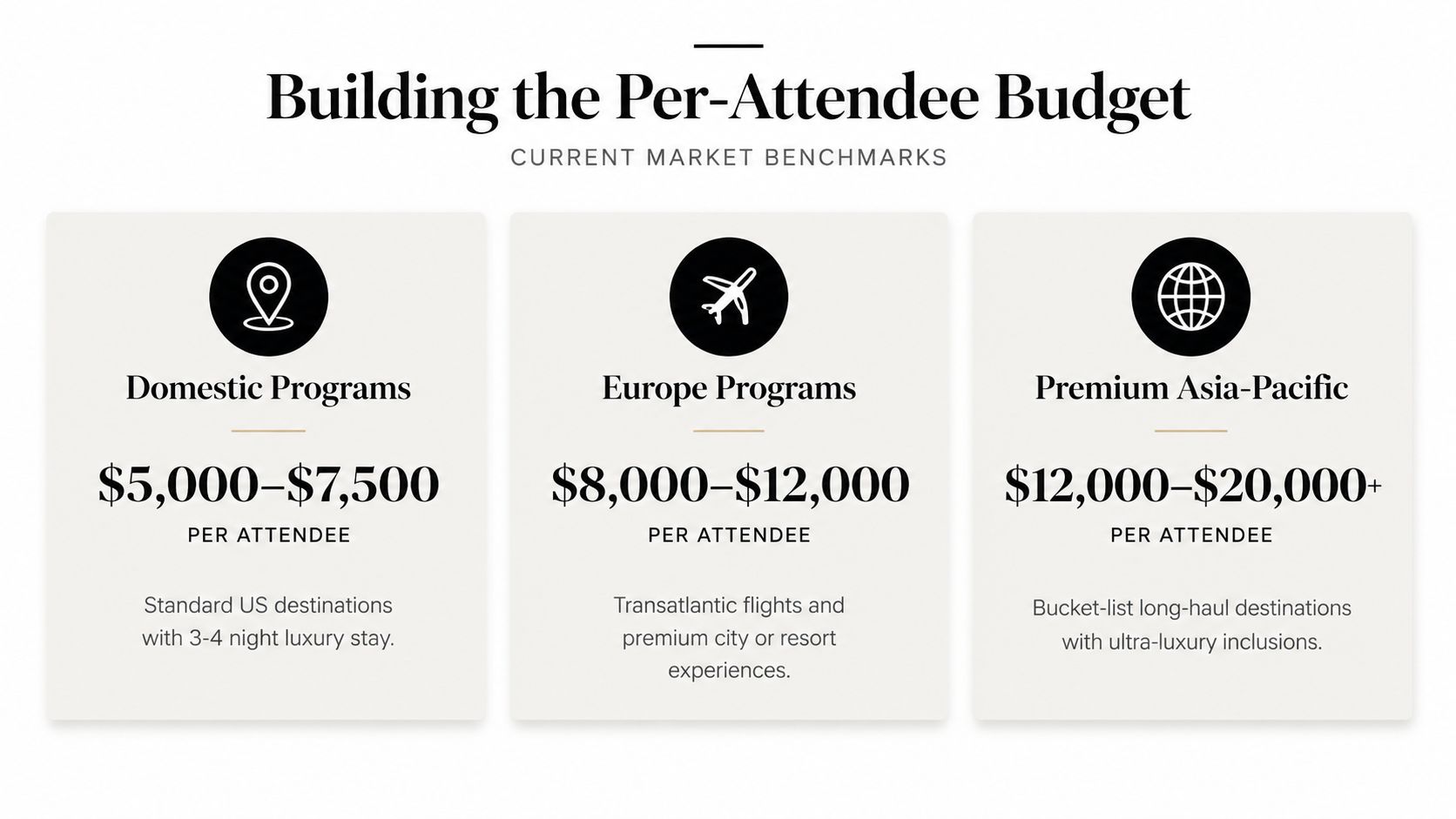
Budget from the room block and air quotes outward. Start with room nights, taxes, service charges, transfers, staffing, and the actual flight markets. Only then add dining, activities, production, and gifts. This approach exposes feasibility before a dramatic dinner or private excursion consumes money that the core operation needs.
The latest industry index summarized by MeetingsNet's incentive travel ROI data reports average spend of $4,900 per participant, with a typical mix of 27% hotel, 21% air, 18% food and beverage, 13% activities, and 4% gifting. The same source reports that 54% of respondents planned to spend more in 2025 than in 2024, and 55% expected to spend more again in 2026.
Use the mix as a control model, not a promise. Hotel attrition clauses create exposure when pickup changes. Air caps can become unrealistic as inventory disappears. Food and beverage minimums can expand quickly when attendance shifts or the group adds hosted functions.
Budget discipline: Protect the arrival and signature dinner before adding another mid-trip activity.
A contingency belongs in the working budget even when leadership dislikes the line. Supplier repricing, rooming changes, special meals, transfer adjustments, and late approvals all create pressure. A buffer protects the experience from being stripped down when costs move.
The Incentive Travel Foundation's 2026 trends reporting places average per-person spend at $5,100, up 4% year on year, with North America at about $6,000 and Europe at roughly $3,200 after a 20% drop. That regional contrast is why a single headline budget can mislead. Destination, routing, and service expectations determine what the guest feels.
Choosing Destinations That Balance Novelty and Cost
Destination selection should begin with a tension, freshness versus operational ease. The 2025 Incentive Travel Index reports that nearly 70% of buyers seek destinations they haven't used before, 63% have new destinations booked for 2026 or 2027, and 44% are choosing shorter-haul destinations.
That demand makes novelty valuable, but novelty doesn't excuse poor routing. If more than 40% of attendees are paying for premium-cabin upgrades, prioritize a destination with nonstop routes and at least two hotels capable of offering suite upgrades. A destination with one perfect property and fragile air access is a single point of failure.
| Destination Type | Air Cost Index | Novelty Score | VIP Infrastructure | Transfer Time | Best For |
|---|---|---|---|---|---|
| Emerging hotspot, such as Albania's Riviera | Variable | High | Developing | Longer or less predictable | Experienced groups seeking discovery |
| Established luxury classic, such as Paris | High | Moderate | Extensive | Short within core areas | Executive groups needing reliable service |
| Shorter-haul regional property, such as the Florida Keys | Lower | Moderate | Strong at selected resorts | Moderate | Domestic programs with premium leisure |
| Direct-air-access city, such as Dubai | Variable | High | Extensive | Usually manageable | International groups prioritizing connectivity |
| Off-season gem, such as Portugal's Alentejo | More favorable in the right window | High | Selective | Longer regional transfers | Smaller groups that value privacy |
The “cheaper” city can cost more operationally if guests spend hours in transfers, arrive exhausted, or find that the hotel can't support private dining and flexible room upgrades. Mexico may offer attractive resort access, but resort fees and à la carte inclusions need comparison against an all-inclusive model such as the Maldives. The correct question isn't which quote is lower. It's which destination preserves energy, access, and perceived value after every mandatory cost is included.
For a focused review of executive retreat options, use HauteBlack's elite executive retreat locations for 2026 as one input, then validate air schedules, room inventory, and DMC capacity before presenting the destination.
Selecting Suppliers and Extracting VIP Value
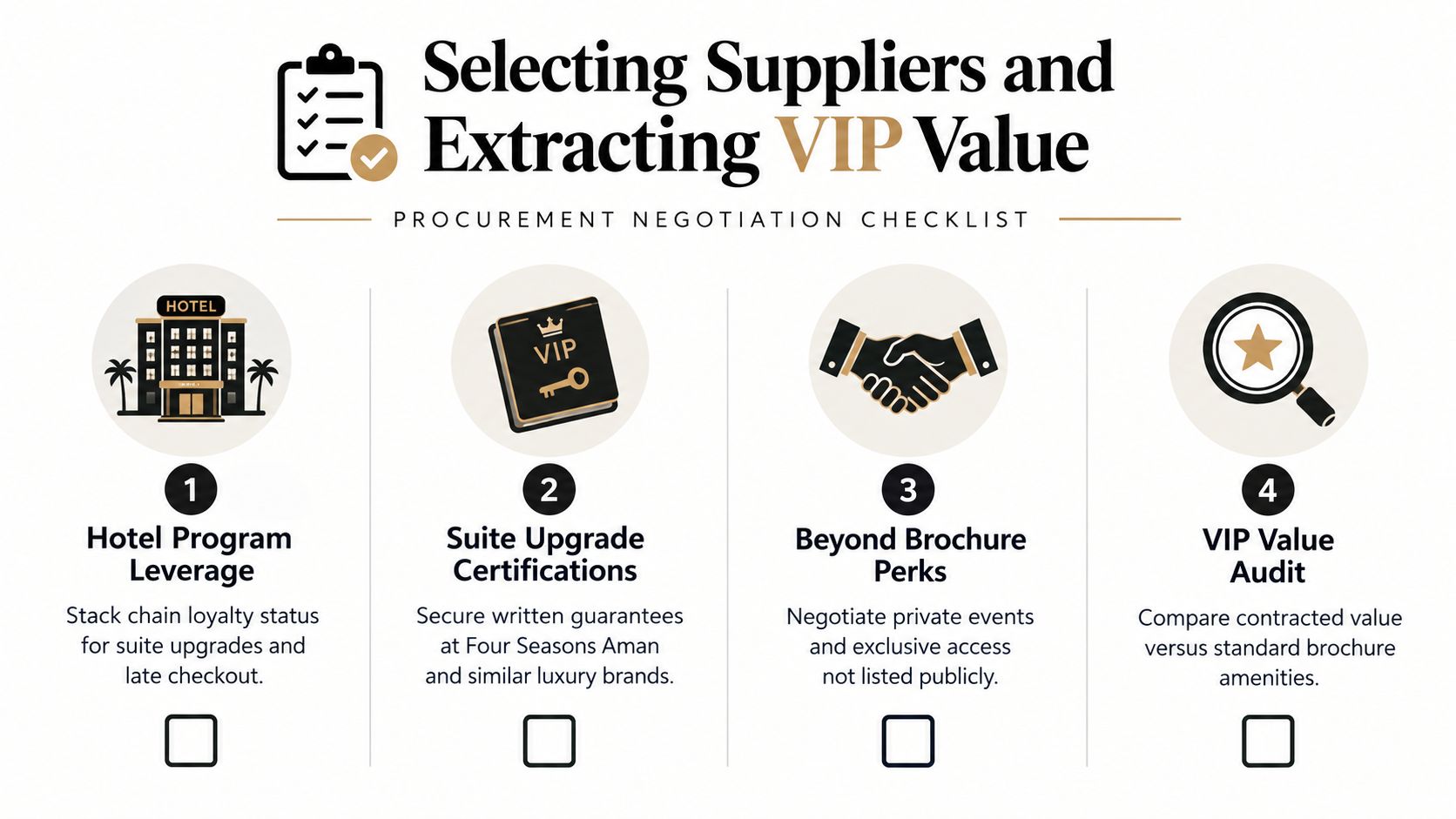
Treat supplier sourcing as procurement. Brochure amenities are the starting point, not the negotiation result. Ask what the partner can guarantee in writing, what happens when the preferred inventory disappears, and who has authority to solve a problem onsite.
Hotel leverage works best when you combine preferred-partner benefits with the group's commercial value. Chain loyalty status can support late checkout, recognition, and upgrades, but status alone doesn't guarantee a suite. Request written language covering upgrade priority, VIP arrival handling, amenity placement, and the process for resolving a rooming discrepancy. Four Seasons, Aman, and Rosewood may each offer a different path to improved treatment, so compare the contracted benefit rather than the brand name.
A boutique hotel can be the better choice when a single owner-operator can authorize a private buyout, alter dining flow, or approve a custom arrival without sending the request through several corporate layers.
Vet the DMC before signing
Require three reference programs from the past 18 months, then speak with the clients directly. Check financial stability, staffing depth, emergency escalation, and whether the contract names backup arrangements for vehicles, guides, venues, and key activities.
Ask every potential VIP partner three questions:
1. Who makes the decision when the promised inventory or service fails?
2. Which benefits are guaranteed in the contract, and which depend on availability?
3. What's your backup plan if the primary venue, vehicle, guide, or aircraft becomes unavailable?
Private aviation belongs in the same model. Don't buy it as a status symbol. Compare the total charter cost per attendee with first-class fares, airport handling, transfers, and lost time. A shared charter can make sense when six or more attendees travel together on a flight of under five hours, but the calculation must include repositioning and empty-leg exposure.
For a water-based group experience, a planner can evaluate options such as corporate boat tours on the Big Island while testing vessel capacity, weather backup, privacy, and transfer timing.
HauteBlack's luxury travel concierge services guide is also relevant when the program needs dedicated coordination beyond standard hotel and airline fulfillment.
Designing Branded VIP Experiences and Logistics
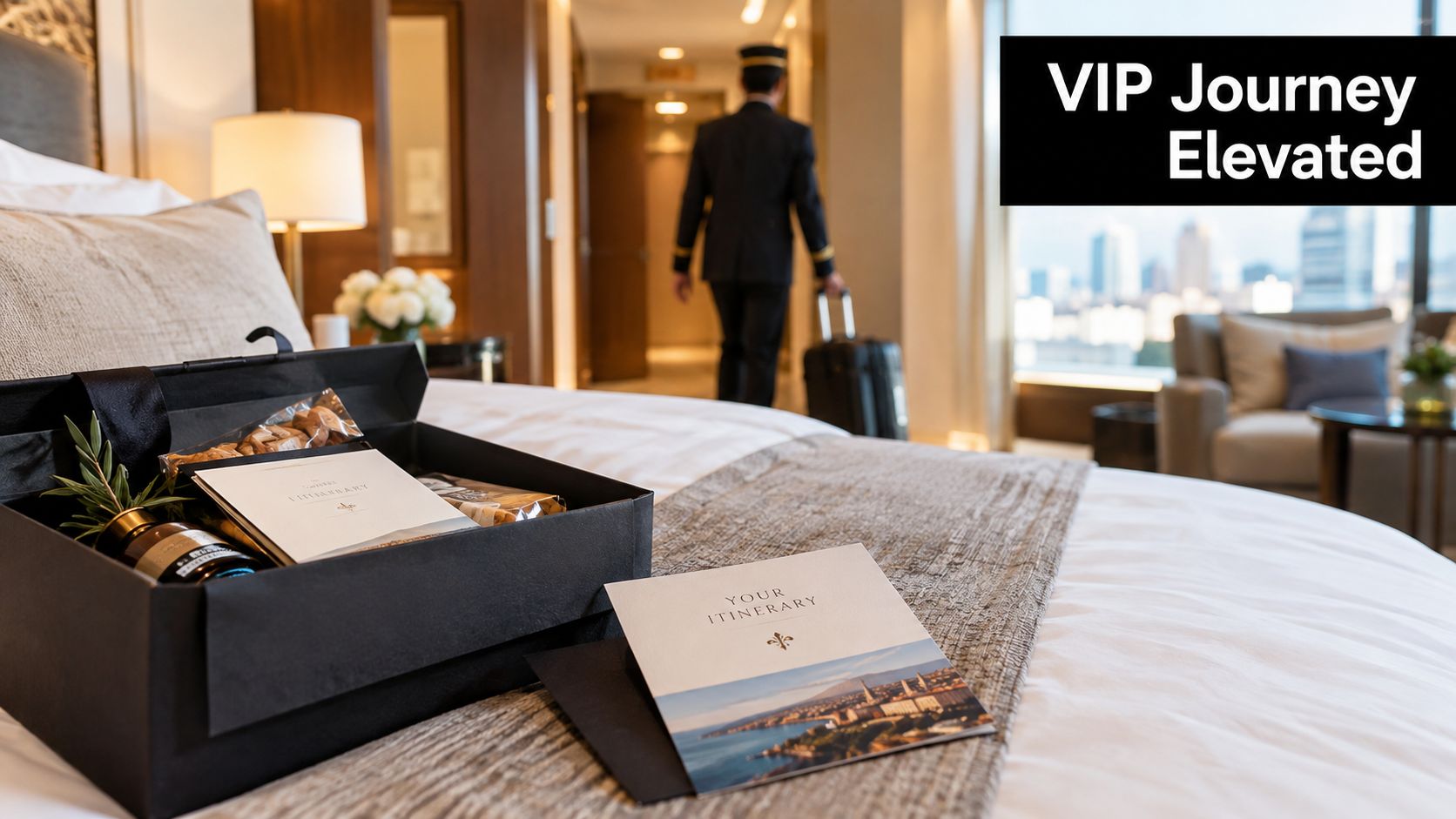
The strongest programs make guests feel considered before they arrive. A branded arrival should survive the entire journey from airport to suite, not stop at a sign near baggage claim.
A practical sequence looks like this:
1. The executive assistant confirms arrival windows, guest names, dietary needs, and room preferences through one secure intake process.
2. The transportation lead receives the final manifest and assigns vehicles by arrival wave.
3. The hotel receives room assignments grouped by performance tier, without exposing the hierarchy to attendees.
4. Staff place the itinerary and welcome gift at suite level before the guest reaches the property.
5. A host meets the guest at the right handoff point, rather than forcing the traveler to locate a registration desk.
6. The welcome reception begins with enough breathing room for arrival recovery.
7. One unexpected detail, such as a private cultural access moment or a personally relevant gift, becomes the story guests repeat afterward.
Design around the cohort, not the itinerary template
A multi-day program might begin with a quiet arrival, follow with a private dinner led by a Michelin-caliber chef, then offer a choice of wellness, culture, or adventure experiences. The group can reconvene for one substantial shared event, while executives retain space for private meetings or recovery.
Spend more attention on the first 90 minutes and the final night. Those moments establish the service standard and determine the emotional close. Mid-trip programming should be edited, not inflated. Guests are already absorbing the destination, the group, and the schedule, so another elaborate production can create fatigue instead of value.
Transportation is where a polished concept often fails. Review specialist options for upgrading resort guest transportation when the program depends on quiet vehicles, premium transfers, consistent dispatch, and a brand presentation that matches the hotel.
The final-night program should feel like a conclusion, not another obligation. Use one well-produced dinner, a short recognition moment, and enough space for guests to enjoy the setting. A crowded finale makes the trip feel unfinished.
Measuring ROI and Reporting Results
Measurement begins before the first invitation. Define the three to five KPIs that support the primary objective, establish the pre-trip baseline, and identify the systems that will supply the data. Last year's program is a weak comparison if the audience, market, qualification rules, or commercial environment changed.
A sales program might track revenue lift, qualified-pipeline acceleration, conversion, and account expansion. A retention program may focus on retention rate, regrettable departures, and employee sentiment. A relationship program may combine renewal activity with a post-trip experience score.
| Program Objective | Primary KPI | Data Source | Report Cadence |
|---|---|---|---|
| Sales acceleration | Qualified pipeline and conversion | CRM-tagged opportunities | Immediate review, then 60-day and 90-day reports |
| Retention | Retention and regrettable departure indicators | HRIS and employee survey | Immediate sentiment review, then 60-day and 90-day analysis |
| Dealer loyalty | Renewal, certification, and account activity | Partner system and CRM | Seven-day debrief, then 60-day commercial read |
| Executive relationship | Account expansion and relationship score | Account plans and survey | Seven-day debrief, then 90-day reconciliation |
Use a fixed reporting rhythm
Within seven days, capture the operational debrief and attendee reaction while details are fresh. Use a pre and post survey scored on a 1 to 10 scale, then segment the responses by cohort rather than hiding different experiences inside one average.
At 60 days, review conversion, retention, opportunity movement, and account behavior. At 90 days, reconcile the incentive spend against incremental revenue impact. For top-quartile sales programs, a defensible multiplier may sit at 3x to 5x, but finance must approve the attribution method and assumptions before the report reaches leadership. The source for these measurement benchmarks is the supplied research material, but it doesn't provide a verified link for that specific claim, so treat the multiplier as an internal planning assumption, not an industry fact.
Measurement warning: Don't attribute organic growth to the trip simply because it followed the trip. Tag opportunities, define the comparison period, and account for the cost of capital.
Your executive summary should fit on one page. Pair hard ROI with softer outcomes such as share of voice, account expansion, internal brand lift, and the three trade-offs that shaped the program. A credible report doesn't pretend every benefit has the same monetary value. It shows what happened, what can be attributed, and what remains directional.
Working with Executive Assistants and Final Checklist
Executive assistants often determine whether a luxury program feels effortless. They hold the practical information that hotels, airlines, and DMCs need, but they shouldn't be forced to coordinate five separate vendors.
Start with a secure intake form covering passport details, dietary restrictions, seating preferences, arrival windows, guest information, and accessibility needs. Keep the data permissioned and limit distribution to the people who need it. Assign one point of contact, then publish a countdown calendar with three touchpoints during the final month.
A shared spreadsheet can work for a smaller program if it has controlled access, version history, and clear ownership. A simple property-management or registration module can be more suitable when rooming, guest changes, and manifest data need structured handling. Delegate data collection and confirmation. Retain approval of VIP treatment, supplier escalation, final rooming logic, and the decision on what gets cut when the budget tightens.
The final operating checklist
- Send welcome amenities pre-arrival: Confirm suite placement with the hotel and photograph the finished setup before the first guest enters.
- Confirm ground transfers 72 hours out: Recheck vehicle assignments, driver contacts, flight updates, and backup coverage.
- Brief the hotel general manager personally: Provide a concise VIP preference sheet and identify the person authorized to resolve service failures.
- Handle rooming changes centrally: Let one owner update the master list, then distribute only the relevant change to each supplier.
- Keep EA emails short: Put the decision, deadline, and response method at the top. Don't send a 200-word operational puzzle.
- Never promise an upgrade you can't guarantee: Say what's contracted and explain what remains subject to availability.
- Protect the final night: Don't stack competing programming on the one evening guests need to absorb the experience and say goodbye.
For a dedicated workflow reference, review HauteBlack's executive assistant travel planning guide for 2026, then adapt the process to your organization's privacy and approval requirements.
On Monday morning, send the post-trip survey, archive supplier contacts and final contracts, record unresolved issues, and schedule the debrief while the team still remembers the small failures and the moments that worked. The next budget request will be stronger when it includes both the financial reconciliation and the operational evidence behind it.
HauteBlack can build and manage bespoke incentive programs with dedicated advisor support, preferred luxury-property relationships, VIP arrivals, private aviation, and dining and transport that fit your needs. Visit HauteBlack to discuss your audience, objective, destination shortlist, and the operational detail required to make the trip perform.
Explore Our Guides


Signature Experiences


