Haute Black Journal
Hiking in Argentina: Your Ultimate Adventure Guide

Marlene Azeez
Director, HauteBlack
View all articles →
# Hiking in Argentina: Your Ultimate Adventure Guide
Published July 26, 2026 by Marlene Azeez
You're probably sitting on the edge of booking the obvious Patagonia trip, then hesitating because you don't want a beautiful mess. You want the right lodge, the right trail, the right season, and a trip that feels controlled from the moment you land. That's exactly why hiking in Argentina belongs on a serious traveler's shortlist, because the country gives you real choice, not just one famous route with a different hotel at the end.
Argentina is not a single hiking destination. It's a whole trekking country with granite, ice, forest, high desert, and windblown southern terrain, which means you can match the experience to your stamina, your comfort level, and your tolerance for friction. If you do it well, the trip feels private even when the trail is known.
Why Argentina Belongs on Every Serious Hiker's Map
A private client steps off a charter, meets a lodge host in Patagonia, and never has to think about a bus timetable, a trailhead parking lot, or where the luggage went. That is the core appeal of Argentina for a premium hiker. The country works when the logistics disappear, and that matters more than any postcard view.
The scale is real too. A national survey commissioned by AICACYP and conducted by Aresco found that around 10 million people in Argentina hike, trek, or walk, and the report says that is 21.4% of the population. It also identifies Córdoba as the most chosen province for these activities, which is the clearest proof that this is not just a Patagonia story. It is a domestic outdoor market with depth, regional demand, and a developed culture around it. Argentina camina
The country gives you five different hiking moods
Patagonia may be the headline, but it is only one chapter. Argentina also gives you high-altitude trekking around Aconcagua, forested lake walks in the Lake District, wind-and-ice drama in Tierra del Fuego, and the colored ridges of the Northwest. That range matters because luxury hiking is not about doing the hardest thing, it is about doing the right thing in the right window with the right base.
Practical rule: The best Argentine hike is usually the one that fits the weather, the permits, and the lodge you want to stay in.
Argentina suits a luxury approach because the strongest trips can be built around good properties, private transfers, and flexible guide support. That is what turns a hiking holiday into a high-comfort journey instead of a camp-and-suffer exercise.
A private client who wants a cleaner operating model should start with the lodge and the access plan, then choose the trail. That order matters. It is the difference between a trip that feels controlled and one that feels improvised. For a broader sense of how a wilderness trip can be built around comfort and access, Approved Experiences Amazon guide shows the kind of high-touch planning standard that belongs in this category. For a closer look at the Patagonia side of the equation, this Patagonia wilderness experience guide shows the level of structure that serious travelers should expect.
The Five Signature Trekking Regions
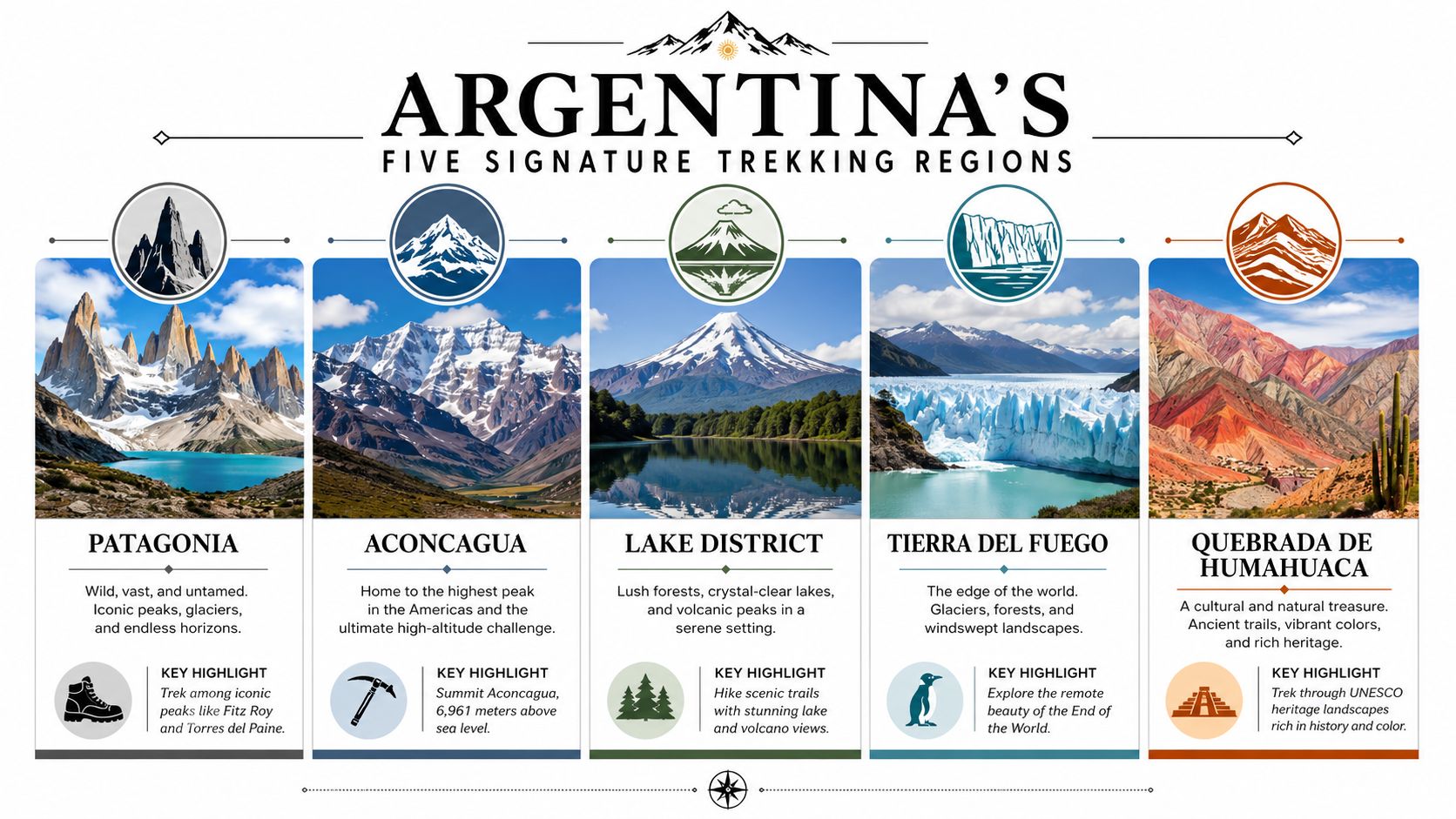
Argentina's best hiking regions are not interchangeable, and that's the point. If you choose by scenery alone, you can easily end up in the wrong place for the season or the wrong style of trip for your tolerance for weather and effort. If you choose by fit, the country becomes far easier to enjoy.
Patagonia
Patagonia is the region people mean when they say Argentina, but they rarely mean it precisely enough. The best-known terrain is granite spires, glacier-fed valleys, and long approaches that reward patience. For a luxury traveler, the value is not only the scenery, it's the basecamp quality. Explora Patagonia and Eolo are the sort of properties that make a remote hike feel civilized, because you return to a serious lodge instead of improvising recovery.
The classic pull here is El Chaltén and Los Glaciares, where trail access is direct and the walking is world-class. Patagonia should be selected when you want iconic scenery and are willing to respect the wind, the seasonal crowding, and the fact that this is still wilderness even when the hotel is polished. For a curated approach, see Haute Black's Patagonia wilderness page.
Aconcagua Region
Aconcagua is for travelers who want altitude without committing to a technical climbing agenda. That alone makes it different from most mountain destinations. The region pairs best with Park Hyatt Mendoza and vineyard stays, because the town anchor matters when you're managing permits, acclimatization, and transport into the park.
The draw is scale. Aconcagua is the high-altitude, big-sky option where the mountain feels like the destination from the first hour. It's the right choice if you want a serious mountain experience without moving into full expedition mode.
Lake District
The Lake District around Bariloche and Villa La Angostura is the most comfortable hiking region for travelers who want variety without extremity. Forests, water, gentler circuits, and better protection from the severe southern exposure make this a different category of trip. Llao Llao is the obvious anchor, and the region also suits newer design-forward hideaways that let you combine hiking with a softer resort rhythm.
This is the region to choose when you want a premium nature trip that still feels restorative. It's not about bragging rights. It's about days that are active, beautiful, and easy to recover from.
Tierra Del Fuego
Tierra del Fuego gives you the true end-of-the-world feeling, which is not a marketing line, it's a geographic mood. Trails here are about isolation, maritime weather, and the edge-of-continent atmosphere. In winter, helicopter-linked ski lodges add another layer of access and make the region relevant even beyond hiking season.
It's best for travelers who like remote, dramatic, and slightly unruly terrain. The reward is atmosphere more than summit logic.
Quebrada De Humahuaca
The Northwest is completely different. The Quebrada de Humahuaca gives you colored ridges, high-altitude villages, and restored colonial estates, which makes it ideal for a slower, more cultural hiking circuit. It's the region where the scenery feels painted rather than carved.
Choose it when you want mountain walking with texture, history, and less crowd pressure than the southern circuit. It's also one of the smartest options for travelers who prefer comfort with a sense of place.
Approved Experiences Amazon guide is a useful comparison point if you like the idea of remote travel shaped around a strong itinerary spine rather than a single hotel stay. That same logic applies here.
A Seasonal Calendar That Actually Helps You Decide
The standard advice is to head south in summer without a second thought. That's lazy advice. The better move is to choose by region, then narrow by shoulder weeks, crowd pressure, and how much weather volatility you're willing to tolerate.
Patagonia and El Chaltén
El Chaltén is best from October to April, but December and January are the windiest months, with gusts often exceeding 80 km/h, and late December daylight can reach 16 hours 26 minutes. That combination is useful, but it isn't automatically ideal. Long days are a gift, yet the wind can turn exposed ridges and passes into the limiting factor even on hikes that are not technical. El Chaltén weather guide
For clients who want Patagonia at its most usable, I prefer the shoulder edges of the season when the trail is active but not at full summer pressure.
Aconcagua and the Lake District
Aconcagua's trekking season runs from spring through autumn, and the provincial government's season balance for Aconcagua notes that more than 80,000 visitors passed through the Horcones Visitor Center in a single season, which is the kind of volume that tells you the infrastructure is real and the routing is seasonal. Aconcagua season balance The Lake District is best from November through May, with warm to hot days and ongoing rain risk, so packing and route choice need to reflect that. Lake District hiking guidance
Best move: If you want calmer lodges and fewer moving parts, book the shoulder weeks, not the peak weeks.
The Northwest
The Quebrada works best in two cleaner windows, April to June and August to October, when the colors are strong and the pressure is lighter. That makes it one of the most underrated hiking regions in the country for travelers who care about atmosphere and lower friction. It's also the easiest region to combine with Mendoza or Salta without forcing your trip into one seasonal mold.
The season that looks best on paper is not always the season that feels best on the ground. A smart advisor shifts you toward the week where the lodge is quieter, the guides are fresher, and the weather window is less stubborn.
For a more detailed seasonal lens on the south, this Patagonia timing guide is the right companion read before you lock dates.
Matching the Trek to the Traveler
Not every strong traveler should book the hardest hike, and not every easy route deserves a premium itinerary. The right match depends on exposure, altitude, and how much of the day you want to spend recovering versus walking.
Entry luxury
This is for travelers who want beautiful terrain without a punishing load. Laguna de los Tres, shorter Lake District circuits, and selected day hikes in the south belong here. These routes make sense when the guest wants the iconic view but does not want a multi-day grind.
The luxury version of entry-level hiking is not “easy” in the casual sense, it's highly efficient. You walk, you see the scenery properly, and you still feel like dinner matters later.
Signature challenge
The Huemul Circuit is the cleanest example. It is a 64 km point-to-point trek with about 2,740 m of elevation gain over four days, averaging 15 to 18 km per day. That profile is serious enough to feel like a real achievement, but still manageable for experienced hikers who want one meaningful challenge rather than an expedition. Huemul Circuit profile
High-altitude expedition
Aconcagua basecamp approaches and Plaza Argentina-style trekking belong in this bracket. The point here is not technical mountaineering, it's altitude management, pace, and a willingness to let the mountain dictate timing. These trips are for guests who understand that the smartest luxury is not pushing harder, it's turning back before the itinerary gets foolish.
A private guide earns their fee by adjusting the day in real time. That means shortening a route when the wind rises, moving you to a safer viewpoint, or downgrading the day without making the guest feel like the trip has failed.
Permits, Safety, and the Logistics Most Guides Skip
The glamorous part of the trip is easy to sell. The unglamorous part is what decides whether it works. In Argentina, the bottleneck is often not the trail, it's the reservation window, the access rules, or the transfer chain between airport, lodge, and trailhead.
Book the access, not just the room
Aconcagua Provincial Park requires advance planning through the official permit system, and high-altitude routes commonly involve proof of accommodation and medical clearance. That is not bureaucratic theater, it's a reality of operating in controlled mountain terrain. If you ignore that, you don't have a trip, you have a wish.
Some Los Glaciares campsites also require advance booking, which means the most famous hikes can become booking puzzles if you wait too long. The smartest travelers solve the reservation structure first, then choose the route.
Treat safety as part of the luxury
Satellite communicators, helicopter evacuation coverage, and descent decisions based on weather are not accessories. They're the difference between confidence and risk. On exposed Patagonian terrain, especially when the wind and ridge exposure become the limiting factor, a guide's willingness to change plans is a feature, not a failure.
For practical access and route design, one academic review on hiking tourism in Argentina explicitly recommends better promotion of circuits, improved public transport to trailheads, and clearer signage and visitor information, which is a polite way of saying that last-mile mobility is a structural weak point, not a niche inconvenience. Academic review on hiking tourism in Argentina
Rule of thumb: If a trail can't be reached cleanly without a car, solve that before you choose the hotel.
Private transfers, regional flights into El Calafate or Bariloche, and lodge-arranged 4x4s are how premium hiking in Argentina becomes comfortable. That's the logistical invisibility you should insist on.
Private Guides, Helicopters, and the Lodge-to-Lodge Operating System
The best Argentine hiking trips don't feel like tours. They feel like a sequence of clean decisions executed by people who already know where the friction would have been.
Certified UIAGM/AGMP mountain guides are central to that system. They manage pace, reading of weather, route variation, and the basic judgment calls that keep a strong traveler moving comfortably without overreaching. When booked through properties such as Explora or Eolo, the experience becomes much more customized because the guide is working with the lodge's operational rhythm, not against it.
Helicopters are a tool, not a trophy
In remote Patagonia, helicopter access can save time, connect otherwise awkward terrain, or rescue the day when weather closes a planned crossing. It's also how some estancias and remote camps become usable for a short high-end stay. I prefer it as a tactical tool, not a gimmick.
For travelers considering that level of access, this private helicopter charter guide is a useful reference for understanding how aerial transfers fit into a broader premium itinerary.
Point-to-point works because the luggage disappears
The lodge-to-lodge model is what makes hiking feel polished. Your main bag moves ahead by vehicle, your overnight kit is pared down, and you walk with a light daypack while the route unfolds. Sometimes overnight bags go by 4x4 or mule, sometimes by a support vehicle that meets you later, but the principle is the same. You should feel like you're traveling, not carrying your life on your back.
The best itineraries look spontaneous because they're scripted months in advance. That's the meticulous work, route by route, weather window by weather window, lodge by lodge.
Packing, Health, and High-Altitude Preparation
Pack like a person who wants comfort, not like a person trying to prove something. A light trail load is the luxury standard in Argentina, even when your checked luggage is generous.
What goes in the bag
Start with layered clothing, a merino base, an insulating mid-layer, and a windproof shell. Add broken-in boots, gaiters for mud and scree, and trekking poles you know how to use. If you're doing point-to-point or supported hiking, keep the daypack clean and let the luggage do the heavy lifting elsewhere.
What changes at altitude
Hydration matters more than enthusiasm. If you're heading above 3,500 m, altitude protocol becomes part of the plan, not a backup conversation, and any use of Diamox should be decided with your clinician. Aconcagua routes are the place where medical clearance and pacing should be treated as mandatory, not theoretical.
The regional details matter too. Forested Lake District trails bring tick-borne considerations, and the Quebrada's higher UV exposure means sun protection is essential. That's not a reason to worry, it's a reason to pack properly and walk intelligently.
A good client packing list is short, exact, and unsentimental. If it hasn't earned its place on the trail, leave it at the lodge.
Sample Itineraries and Concierge Tips for the Final Decision
A Patagonia flagship should start in Buenos Aires, move by private transfer to El Calafate, and spend three nights at Eolo with day hikes into Los Glaciares. If weather allows, add helicopter access, then continue to El Chaltén for Laguna de los Tres and, for the right guest, the Huemul Circuit. Finish at Explora Patagonia and let the trip end with comfort instead of exhaustion.
The alternative is the Northwest and Aconcagua circuit. Land in Mendoza, stay at Park Hyatt Mendoza with vineyard tastings, go by ground transfer into Aconcagua Provincial Park for a Plaza Argentina-style basecamp experience, then continue north to Purmamarca and the Quebrada. It's the smarter choice if you want mountain scale, wine, and color without committing to a purely southern itinerary.
Choose your region, choose your season, choose the route intensity, choose the lodge style, and decide whether a helicopter day improves the trip or just complicates it. If you want one advisor to coordinate guides, permits, transfers, and the right property relationships, that's the job Haute Black is built to do.
If you want Argentina planned properly, with the hiking, lodging, transfers, and timing all working together, start with Haute Black. We'll shape the route around your comfort level, your calendar, and the kind of access that turns a good trek into an exclusive private journey.
Explore Our Guides

Signature Experiences