Haute Black Journal
Europe Weather in March: A Region-by-Region Luxury Guide

Marlene Azeez
Director, HauteBlack
View all articles →

# Europe Weather in March: A Region-by-Region Luxury Guide
Published August 15, 2026 by Marlene Azeez
You're looking at a March itinerary and asking the question that matters: will this be a ski trip, a city escape, or an early taste of the Mediterranean? The answer depends less on the month than on the route. In Europe, March can bring late-winter conditions in Iceland, Scandinavia, and the Alps, while southern Spain, Italy, and Greece begin to feel distinctly springlike.
That contrast is the opportunity. Europe weather in March is a climate gradient, not a single forecast, and luxury travel works best when the itinerary respects that gradient. Choose the right regions, build in flexible transitions, and March can deliver privacy, strong availability, and a more unhurried version of Europe than the high season permits.
Why Europe in March Is a Strategic Month, Not a Compromise
March is often treated as an awkward interval, too late for winter and too early for summer. That view misses the point. It's one of the few months when a carefully designed European itinerary can combine alpine snow, uncrowded cultural capitals, and the first convincing warmth along the southern coast.
The key is to stop planning around a continent-wide idea of spring. Northern and eastern Europe can remain close to winter, western and central Europe usually transition toward cool spring conditions, and southern Europe can support outdoor days without delivering dependable beach weather. Copernicus recorded March 2025 as Europe's warmest March on record, with an average land surface air temperature of 6.03°C, or 2.41°C above the 1991–2020 March average (Copernicus climate report). That warmth doesn't create uniform conditions. It makes regional planning more important.
The strategic advantage
A March journey rewards travelers who want to control pace rather than chase a single weather promise. The Mediterranean can offer terrace lunches and quiet archaeological sites, while the Alps still support snow-focused days. London, Paris, Vienna, and Rome work particularly well for travelers who prioritize galleries, restaurants, private shopping, and performance calendars over long hours outdoors.
The month also offers a useful privacy advantage. Popular coastal destinations are generally less pressured than they are later in the year, and urban attractions can feel more manageable outside the busiest travel periods. That said, shoulder season isn't a synonym for effortless access. Seasonal restaurants, ferries, mountain roads, and outdoor venues may operate on reduced schedules, so the itinerary needs an advisor who understands what's open.
Practical rule: Choose the experience first, then select the region whose March climate supports it.
Combining two of the three
The most successful March itineraries usually combine ski and city or city and shore. Ski and shore can work too, but only when transfers are handled with precision and the route avoids unnecessary border crossings. A few days in the Alps followed by southern Italy or Andalusia creates a dramatic contrast, but the journey should be sequenced around reliable airports, private ground handling, and flexible dining reservations.
March isn't a fallback. It's a month for travelers who value contrast, discretion, and a well-engineered itinerary.
Reading the Climate Map by Region
A single European average has little practical value when Reykjavík can remain wintry while Rome begins to feel mild. Reference city data place March averages at approximately 3°C/-2°C in Reykjavík and 17°C/4°C in Rome, demonstrating the continent's wide spread between winter-like and spring-leaning conditions (European March temperature averages).
Use the map below as a planning tool, not a promise. These are broad regional planning ranges, and individual cities, coastlines, islands, and mountain valleys can diverge sharply.
| Region | Typical March High / Low °C | Precipitation Range | Traveler Implication |
|---|---|---|---|
| Scandinavia | About -2°C to 8°C / -10°C to 1°C | About 30 to 80 mm | Snow-capable transport, insulated layers, and short-notice weather flexibility remain essential. |
| British Isles | About 7°C to 12°C / 2°C to 6°C | About 40 to 80 mm | Expect wind, rain, damp streets, and sudden bright intervals. Waterproof outerwear matters more than heavy formal coats. |
| Benelux | About 8°C to 12°C / 2°C to 5°C | About 40 to 70 mm | City touring works well with layers and rain protection, but canals, gardens, and cycling plans need alternatives. |
| Central Europe | About 8°C to 14°C / 1°C to 5°C | About 30 to 60 mm | Museums, restaurants, and historic interiors are dependable anchors; outdoor plans should remain adjustable. |
| Alps | About -2°C to 8°C / -10°C to 0°C, depending on altitude | About 40 to 80 mm | Conditions vary by elevation. Snow gear, road monitoring, and flexible transfers are non-negotiable. |
| Mediterranean | About 12°C to 18°C / 6°C to 11°C | About 30 to 80 mm | Outdoor dining is possible, but wind, rain, and cool evenings can interrupt coastal plans. |
| Iberia | About 14°C to 20°C / 6°C to 11°C | About 30 to 70 mm | Southern Spain and Portugal are among the stronger choices for springlike touring, with rain still possible. |
| Eastern Europe | About 5°C to 12°C / -1°C to 4°C | About 30 to 70 mm | Late-winter conditions can linger. Build around cultural experiences and use flexible transport. |
How to apply the gradient
Scandinavia and the Alps belong on the winter side of the map. Snow, ice, fog, and transport disruption can still shape the day, especially outside major cities. The British Isles, Benelux, and Central Europe sit in the changeable middle, where a polished itinerary needs both outdoor ambition and indoor depth.
The Mediterranean and Iberia offer the strongest case for a spring-oriented escape, but “warm” should mean comfortable for sightseeing, not guaranteed swimming weather. Rainfall varies significantly by location. Copernicus found that March 2025 was wetter than average across southern Europe, including the Iberian Peninsula, southern France, Italy, and the western Balkans, while the UK, Ireland, and a broad central European corridor were drier than average (regional March precipitation analysis).
For a useful comparison with the next month's conditions, keep this April Europe temperatures guide nearby when deciding whether your priorities require March's snow or April's broader spring profile.
Ski, City, or Shore, Choosing Your March Posture
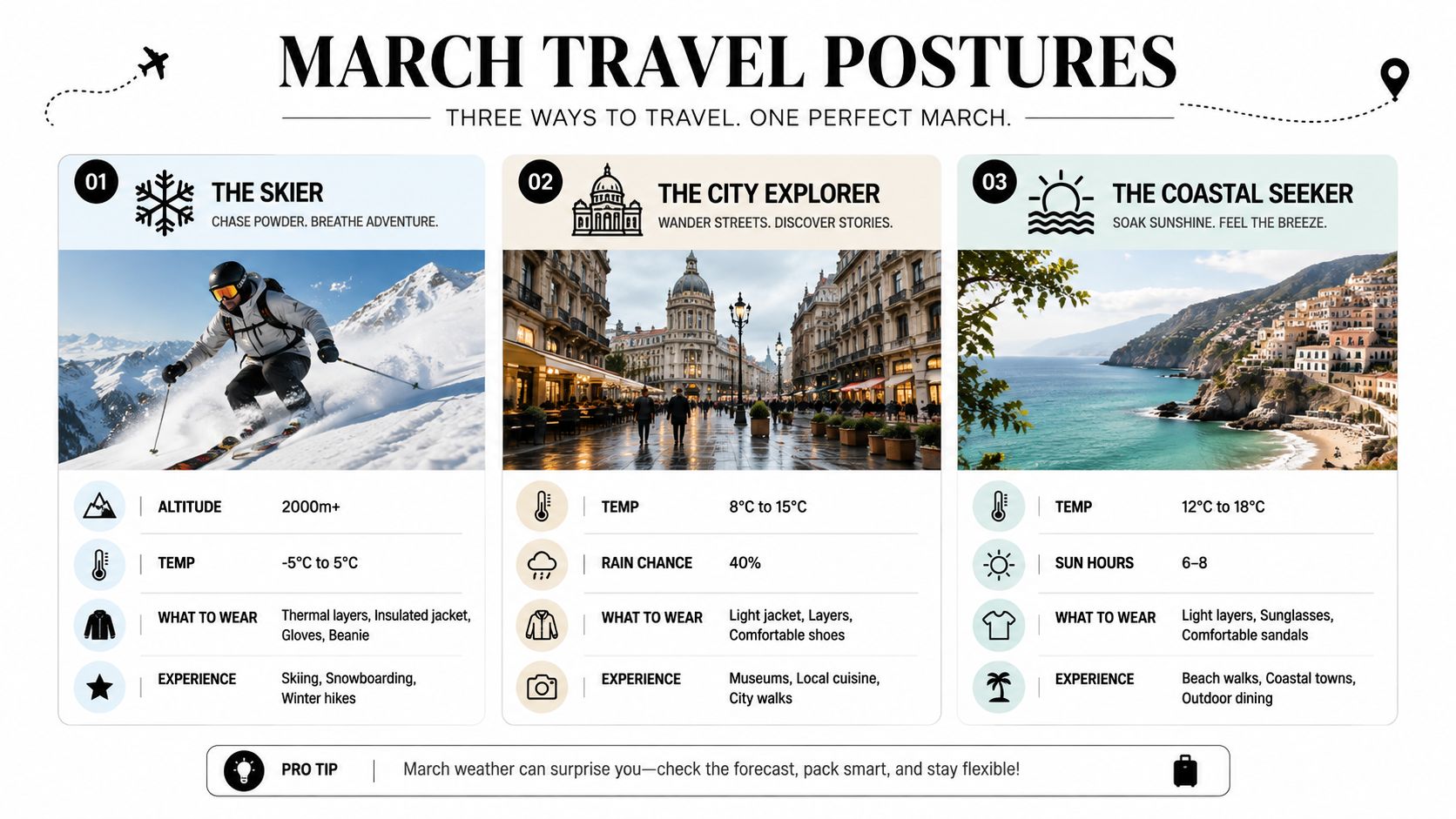
March travel becomes easier when you choose a posture before choosing a destination. Each posture has a different relationship with weather, availability, and pace.
The skier should head to the Alps when snow time is the central purpose of the journey. Higher-altitude resorts can still offer a serious winter environment, while sunny afternoons create the classic rhythm of morning skiing followed by a long lunch. The tradeoff is operational: snow conditions and road access deserve daily monitoring, and lower-elevation alternatives should be ready.
The city explorer gets the most dependable luxury experience. London, Paris, Vienna, and Rome offer deep cultural infrastructure, excellent dining, and substantial indoor programming when rain arrives. The weather may be cool, but the itinerary doesn't depend on a clear sky. This is my strongest recommendation for executives and first-time March visitors who want variety without making every day weather-sensitive.
The coastal seeker should focus on Andalusia, Portugal, southern Italy, Mallorca, or selected Greek and Adriatic destinations. The reward is space, early-season atmosphere, and the possibility of outdoor dining. The limitation is that coastal operations can be seasonal, and the sea may remain too cold for a conventional beach holiday.
The combined approach
A split itinerary works when the two halves serve different purposes. Pair the Alps with Milan, Rome, or the Italian Lakes, or combine Paris with Andalusia. Avoid attempting too many countries just because private aviation makes movement possible. The point is to reduce friction, not create a more expensive version of a rushed tour.
Travelers refining a ski-first route may also find these travel advisor ski recommendations useful for comparing resort styles and mountain logistics.
Choose the skier if snow is the reason you're traveling. Choose the city explorer if you want reliability and cultural density. Choose the coast if privacy and a first taste of spring matter more than swimming. Choose two only when the transfer itself won't consume the trip.
Packing and Wardrobe Strategy for Variable March Days
March punishes single-season packing. A suitcase designed only for spring will fail in the Alps, while a winter wardrobe can feel cumbersome in Seville, Rome, or Mallorca. The winning strategy is a compact layering system that changes character across regions.
Start with fine merino or silk base layers, a cashmere sweater, and a lightweight insulating jacket. Add a collapsible rain shell that fits over fitted clothing. For cities, bring water-resistant leather loafers or polished walking shoes with enough traction for wet cobblestones. For the Mediterranean, include one elegant dinner outfit that works with a jacket after sunset, because mild afternoons can give way to cool evenings.
Pack for the route, not the forecast
Alpine mornings can remain below freezing even when afternoons soften. Bring proper technical ski layers, polarized sunglasses for snow glare, gloves, and footwear that handles hotel-to-transfer movement without forcing you into mountaineering gear.
The British Isles and northern Europe require a different emphasis. A compact waterproof layer, scarf, and gloves will earn more use than a heavy formal overcoat. In southern Europe, a cashmere wrap, fine cardigan, and light trench create enough flexibility for restaurants, terraces, and evening drives.
A refined March kit includes:
- Water-resistant luggage: Protects clothing and electronics when transfers involve wet platforms, tarmacs, or cobbled arrivals.
- Silk or merino base layers: Adds warmth without the bulk of multiple thick sweaters.
- A polished rain shell: Keeps the silhouette appropriate for restaurants and galleries while handling sudden showers.
- Polarized sunglasses: Useful for alpine glare and bright coastal conditions.
- One adaptable evening look: Works with loafers and a blazer in the city, then gains warmth from a wrap outdoors.
For women who prefer one elegant layer that can move from aircraft cabin to dinner terrace, the Cedar & Lily Clothier travel wrap is a practical reference point. The best packing shortcut is not owning less. It's choosing pieces that perform across temperature changes without looking technical.
Where to Be in March by Destination
March rewards destinations with either a strong seasonal identity or a deep indoor culture. The best choices aren't just the warmest places. They're the places where a cool or wet day still feels worthwhile.
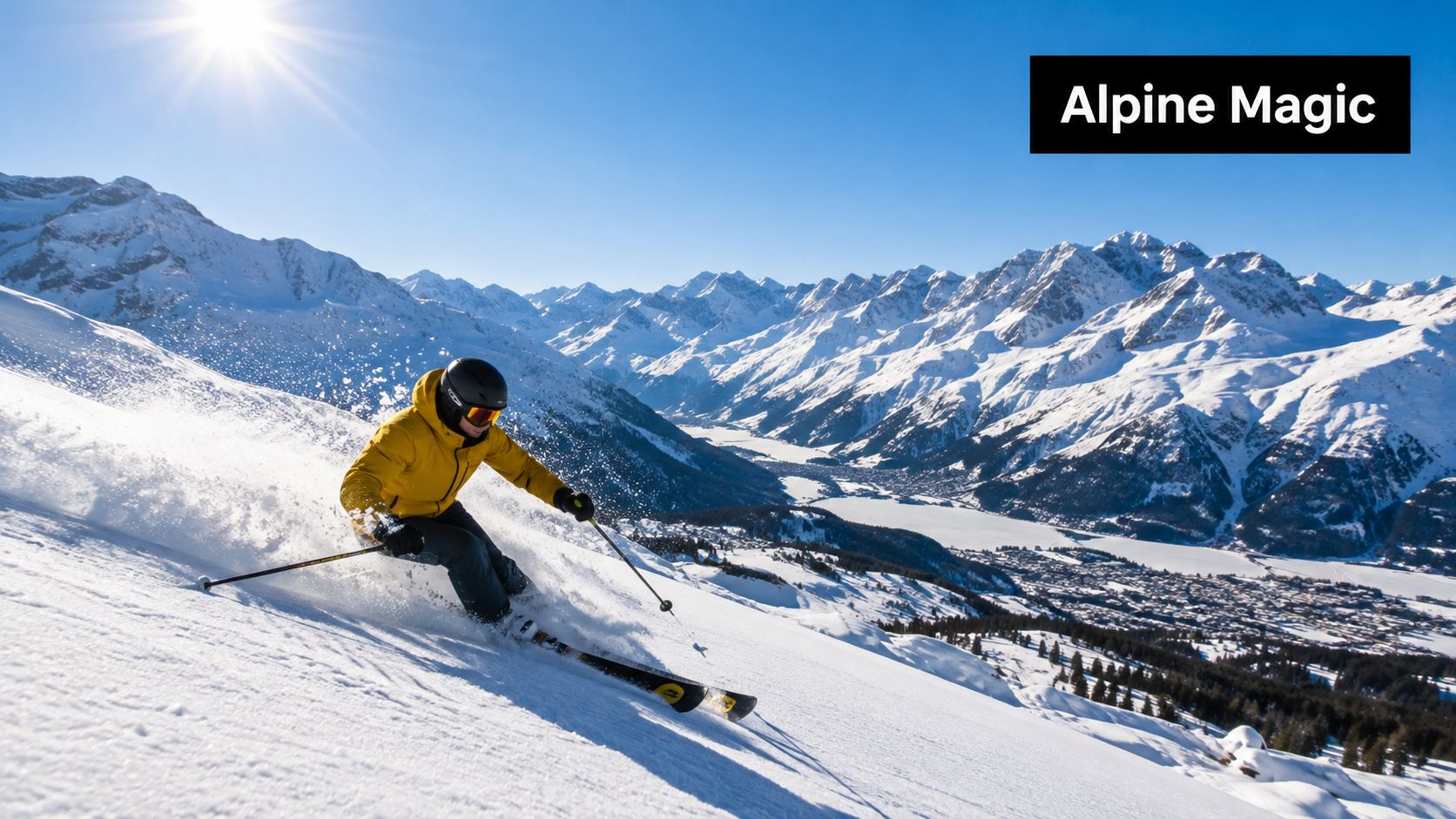
Cortina and St. Moritz remain the clear alpine choices for travelers who want ski access with polished hospitality, high-level dining, and an established après-ski culture. Book these for a snow-led itinerary, and keep the schedule loose enough to absorb a weather day.
London, Paris, and Vienna are better for cultural immersion than for climate. Their strength is density. A private collection visit, a chef-led lunch, an opera performance, and a well-chosen hotel can carry the day even when rain makes a long walk unattractive.
Rome belongs in the same conversation, particularly for travelers who want ancient sites, galleries, and long lunches without the intensity of summer. The city's March profile can be mild, but evenings still justify a proper layer.
Southern Europe and the islands
The Amalfi Coast can be beautiful and quiet before its busier period, but it requires a careful property check. Some hotels, restaurants, and boat operators may not run their full seasonal program, so confirm the operational calendar before committing.
Mallorca works for travelers who want villas, cycling, architecture, and food rather than guaranteed sea swimming. The Costa del Sol is one of the more convincing choices for outdoor touring, particularly around Málaga, Marbella, and the white villages, where a flexible day can move between gardens, galleries, and long lunches.
The Douro Valley suits a slower food and wine itinerary, while the Cyclades and Dalmatian Coast offer atmospheric vistas with far less seasonal pressure than later in the year. Expect quiet beauty rather than a full summer operating rhythm.
For a colder, more dramatic brief, choose Iceland or the Lofoten Islands. March can support aurora-focused travel and snow scenery, but the itinerary must respect wind, road conditions, and limited daylight flexibility. That's a specialist journey, not a casual add-on.
A destination's March appeal should be judged by what happens when the weather changes. The strongest candidates still offer exceptional food, architecture, or wellness without requiring every hour to be sunny.
The visual below is useful for travelers who want to see how a snow-first March itinerary can be paced around alpine conditions.
Booking Windows, Private Aviation, and VIP Logistics
“Shoulder season” creates false confidence. Travelers often assume that March means every suite, chalet, guide, and transfer remains available. The most desirable inventory still concentrates around the dates that matter most, particularly in elite ski resorts and the better Mediterranean properties.
Secure the backbone of the itinerary first. For an alpine journey, that means the preferred chalet or suite, ski guides, equipment fitting, and airport transfer. For a coastal journey, confirm which hotels, restaurants, beach clubs, boats, and villa services are operating before you build the route around them. A property may accept reservations while its full experience remains seasonal.
Build flexibility into the expensive parts
Private aviation can reduce exposure to conventional connection schedules, but it doesn't remove weather. Snow, wind, fog, and local airport restrictions still matter. Use private aircraft and helicopters selectively, with ground alternatives and enough time between major experiences to avoid turning every delay into a crisis.
The broader private aviation service belongs in the planning conversation when the itinerary combines remote ski access, islands, or multiple countries. The value isn't speed alone. It's the ability to choose a more coherent route and preserve time for the experiences that justify the journey.
Preferred hotel relationships can also improve the quality of a March stay. At properties such as Four Seasons, Aman, Rosewood, Belmond, and Ritz-Carlton, benefits may include upgrades when available, resort credits, flexible amenities, and a more informed arrival. Those advantages matter most when weather forces a change, because the hotel team can help reshape dining, spa, and excursion plans quickly.
My preferred sequencing is simple: place the most weather-sensitive experience in the middle of the itinerary, not on the final day. Finish in a city with strong air connectivity and substantial indoor programming. That way, a delayed mountain transfer or cancelled boat doesn't jeopardize the journey home.
The March Risk You Should Plan Around
March is becoming more variable, and warmer averages can create a false sense of security. Copernicus reported in its March 2026 climate assessment that March 2026 was 2.27°C above the 1991–2020 European average, making it the second-warmest March on record. Yet near-average or slightly below-average conditions remained in areas including Türkiye, southern Europe, Sicily, eastern Spain, and Iceland (March 2026 climate assessment).
That contrast should shape the itinerary. A warm spell can accelerate snowmelt, weaken lower-altitude ski conditions, and sit alongside sharp differences between wet and dry regions. In its March 2026 precipitation and humidity analysis, Copernicus reported that relative humidity has declined across Europe since the 1980s, linked more to faster land warming than to reduced precipitation (March 2026 precipitation and humidity analysis). A springlike afternoon still offers no guarantee against disruption.
Where the risk lives
The greatest operational exposure comes from itineraries dependent on ferries, mountain roads, exposed coastal dining, or one outdoor event. Ski conditions can change quickly with elevation. Southern Europe can move from warm spells to sustained rain, while snow and ice may still disrupt Nordic transfers.
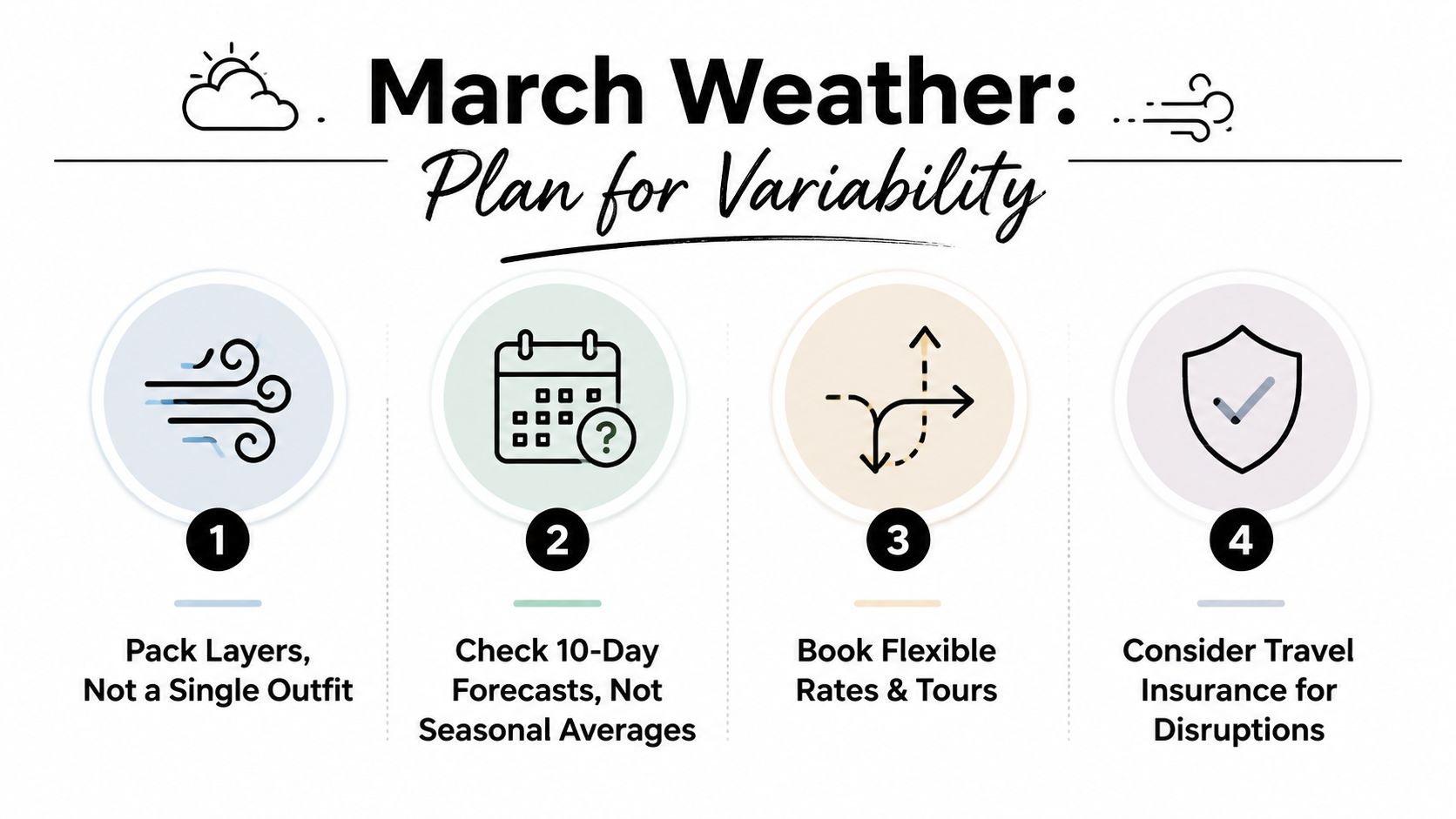
Use this three-part risk framework:
- Highly reliable: City-led itineraries built around museums, restaurants, shopping, and performances.
- Strategically strong: Alpine trips with altitude options, or southern European journeys with indoor alternatives.
- Plan-B essential: Island-heavy routes, ferry-dependent travel, low-altitude skiing, and itineraries built around one outdoor event.
Check the short-range forecast before every transfer. Keep cancellation terms visible, and require the advisor to rebook rather than merely explain a disruption. That discipline makes March manageable while preserving the ski-versus-shore choice dictated by the regional climate gradient.
Three Bespoke Itineraries for Different Travelers
For honeymooners, choose six nights split between Seville and Mallorca. Begin in Seville with private architecture, intimate dining, and unhurried city walks, then move to a secluded Mallorca property for a villa-led stay focused on food, natural beauty, and quiet mornings. This route favors southern Europe's spring profile while keeping enough flexibility for rain or cool evenings.
For a multigenerational family, choose the Alps followed by northern Italy. Spend several nights in a high-altitude resort with ski instruction, spa time, and non-ski activities for different generations. Continue to Lake Como or the Dolomites, where the family can trade snow logistics for scenic drives, culinary experiences, and comfortable indoor programming. The Italian Lakes and Dolomites experience offers a natural planning reference for this transition.
For executives, choose London, Paris, and Rome. Keep each stop focused, with private access, strong dining, and direct rail or air connections where practical. This is the most resilient March pattern because the value comes from cultural density rather than dependable sunshine. Schedule the most important meetings and events in cities with multiple indoor alternatives, and avoid adding a remote coast to make the itinerary appear more ambitious.
Members can use dedicated advisor support and waived planning fees to refine these patterns around preferred hotels, private events, aircraft, villas, and dining access. Non-members can also commission a journey, but the planning standard should remain the same: match the route to the regional climate, protect the key experiences, and leave room for March to behave like March.
Haute Black designs bespoke European journeys around the conditions of March, from alpine stays and private aviation to VIP hotel recognition, villas, cultural access, and carefully sequenced city-and-coast itineraries. Visit Haute Black to speak with an advisor about building a March journey that gives you the right weather posture, the right rooms, and a credible Plan B.
Explore Our Guides
Signature Experiences