Haute Black Journal
Downton Abbey Trips: A Guide to Ultimate Luxury Travel

Marlene Azeez
Director, HauteBlack
View all articles →
# Downton Abbey Trips: A Guide to Ultimate Luxury Travel
July 5, 2026
The first time the gates open and Highclere appears at the end of the drive, the mistake most travelers make becomes obvious. They've planned a site visit when what they wanted was entry into a world.
An Invitation to the Downton Abbey Era
A proper Downton Abbey journey begins long before the first stately home. It begins with intent. Some clients want to stand where scenes were filmed. The more interesting ones want to understand why those rooms, gardens, staircases, and villages still exert such pull years after the credits first rolled.
That distinction matters because Downton Abbey trips are rarely satisfying when treated as a checklist. The series officially ran for six seasons and later expanded into two feature films, and that sustained popularity has fueled film-induced tourism across Britain, turning heritage sites into destinations of emotional pilgrimage for viewers around the world, as detailed in this research on the Downton Abbey Effect. In practice, that means visitors don't merely arrive to see architecture. They arrive carrying memory, atmosphere, and expectation.
What separates a visit from a journey
The ordinary version is easy to spot. A coach from London. Fixed timing. A rushed sweep through the principal rooms. A stop in the gift shop. Departure just as the place begins to settle around you.
The improved version has a different rhythm:
- Space to absorb the estate rather than race through it
- Private context from a guide who understands both the production history and the house itself
- Rural pacing that leaves room for gardens, village lanes, and lunch that feels chosen, not assigned
- Design continuity so transport, hotel, dining, and access all belong to the same story
The best heritage travel doesn't imitate the past. It borrows its manners.
That broader sensibility is why nearby and kindred properties can deepen the experience even if they aren't central to the series itself. For travelers who appreciate the wider language of English country grandeur, these Brodsworth Hall details from Battle Abbey Weddings offer a useful reference point for the style of formal gardens, period interiors, and estate atmosphere that so often appeals to Downton admirers.
Why the series still travels so well
The appeal was never just costumes and plot. The series gave viewers a polished, emotionally legible version of Britain's country-house tradition. Silver, roses, gravel drives, bell pulls, libraries, and rituals of arrival all became part of the fantasy. What strong planning does is convert that fantasy into something personal and credible.
That's why the best itineraries don't ask, “How many filming locations can we fit in?” They ask, “Which moments deserve privacy, which deserve commentary, and which deserve silence?”
The Crown Jewels of Downton Filming Locations
The center of any serious itinerary is obvious. Start with Highclere Castle, then build outward only if each added stop strengthens the mood rather than diluting it.
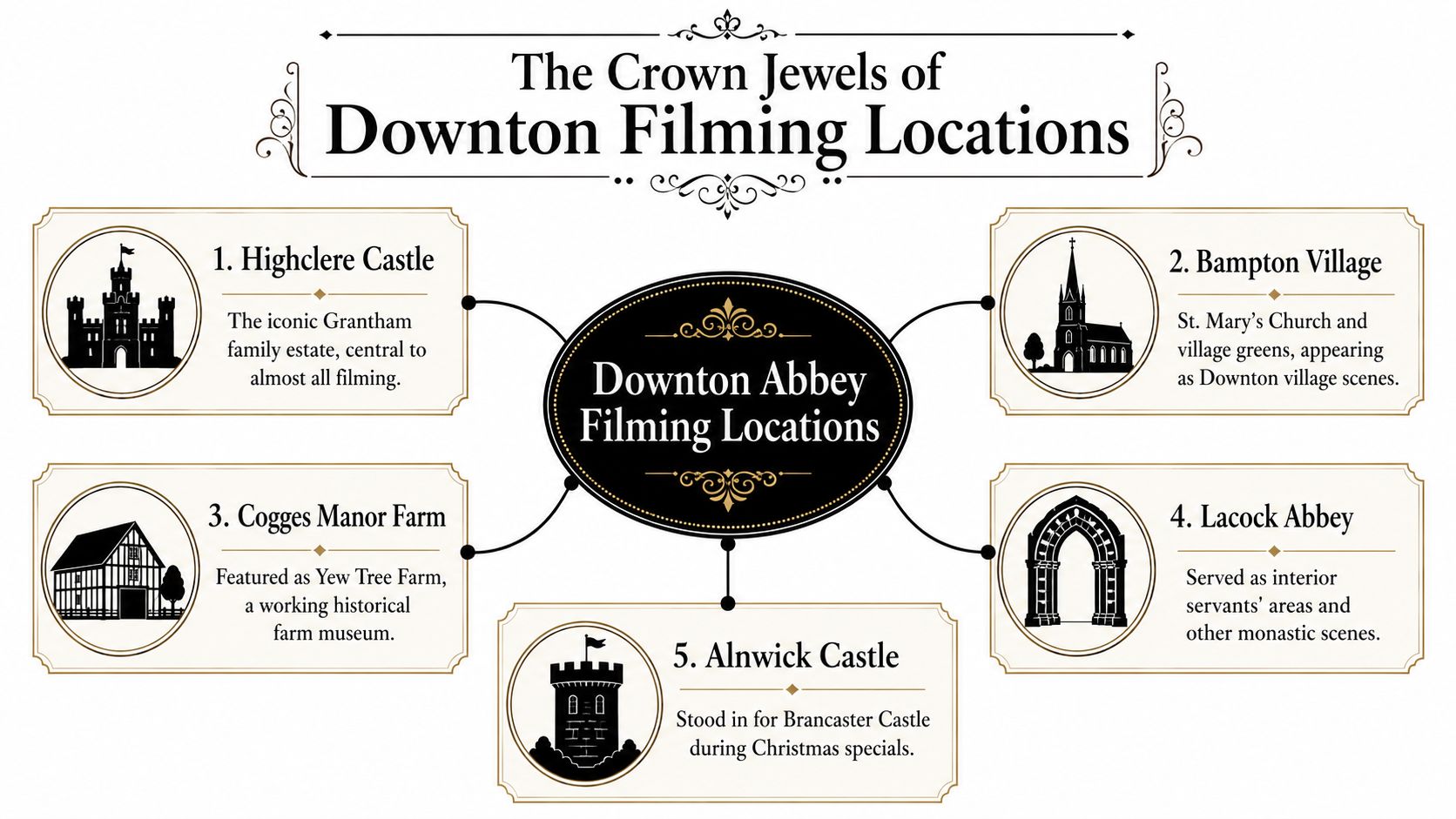
Highclere Castle
Highclere isn't merely a backdrop. It is the visual and emotional anchor of the entire Downton universe. The estate spans 1,100 acres, and public access is deliberately controlled through 45-minute guided tours of the ground floor and selected state rooms, with the human footprint kept to less than 2% of the property in service of preservation, according to this Highclere overview and filming location guide. That same source notes that the castle's visitor economy generates approximately £4.2 million annually, with 78% seasonal occupancy during peak summer months, and that visibility from over 100 million viewers has been linked to a 300% increase in international visitor bookings from North America and Asia since 2012.
Those numbers explain the practical reality. Access is limited because the house can't absorb endless traffic without losing what made it compelling in the first place.
Practical rule: At Highclere, scarcity is not a flaw in the experience. It is part of what protects the experience.
If you want a smarter regional framework for reaching the estate and surrounding sites, this Southern England luxury travel page is a useful starting point for understanding how the area is best paired and paced.
Bampton and the village scenes
Bampton in Oxfordshire gives many travelers the sense of stepping most directly into the series. The church, streets, and village spaces provided the grammar of “Downton village,” and the appeal is different from Highclere's. It's not grand. It's intimate.
That intimacy is also where planning goes wrong most often. Group tours tend to treat Bampton as a quick photographic stop. A better approach is to arrive when the village feels like itself, walk slowly, and let a knowledgeable guide connect specific corners to scenes without turning the village into a scavenger hunt.
Other locations worth including, selectively
Not every filming location deserves inclusion in every itinerary. A few work especially well when they fit the traveler's pace and interests:
- Cogges Manor Farm offers a more rustic counterpoint and is known to viewers as Yew Tree Farm.
- Lacock Abbey adds monastic character and atmosphere, particularly for travelers who enjoy interiors with layered historic texture.
- Alnwick Castle is best used as part of a broader northern journey rather than squeezed into a southern day plan.
What works and what doesn't
A concise comparison makes the trade-offs clear:
| Approach | Works best for | Usually falls short when |
|---|---|---|
| Single-site day focused on Highclere | First-time visitors who care most about the central house | The day is padded with generic stops |
| Highclere plus Bampton | Clients who want both grandeur and recognisable village scenes | Timing becomes too rigid |
| Multi-stop filming circuit | Dedicated fans with stamina and patience for road time | The itinerary prioritizes quantity over atmosphere |
The mistake is trying to “complete” Downton. The wiser move is to curate it.
Curated Itineraries for the Discerning Traveller
The strongest Downton Abbey trips feel effortless from the guest's side and tightly edited from the planner's side. That usually means building around one of two patterns: a polished day from London or an unhurried countryside stay that lets the world of the series unfold gradually.
The ultimate London day
Leave London after breakfast in a chauffeured car rather than surrendering the day to a coach timetable. The route out matters. A quiet cabin, proper legroom, and a driver who knows the rhythm of country arrivals will keep the transition elegant instead of transactional.
By late morning, the estate visit should be the centerpiece, not one stop among many. At this level, the right approach is measured. There's time to appreciate the drive, the facade, the grounds, and the key rooms without hearing a guide talk over every beat.
After Highclere, continue to Bampton rather than trying to crowd in a third major house. Bampton rewards restraint. A slow village walk, a pause at the church, and a good lunch nearby create contrast after the formality of the castle.
A successful day trip has one principal note and one secondary note. Once you add a third, the composition usually collapses.
Dinner can wait until London if the clients prefer to return in black-tie shape for evening plans. If they don't, hold the car and reserve a countryside table where the meal extends the mood instead of breaking it. The point isn't to maximize stops. It's to preserve tone.
For travelers who want a planning philosophy centered on coherence rather than accumulation, this guide to customized travel itineraries and bespoke journeys aligns closely with how high-touch cultural days should be built.
The multi-day Cotswolds immersion
The second pattern suits couples, honeymooners, and families who don't want their Downton experience reduced to one long day on the road. Base the stay at a serious country house hotel. Unpack once. Let the region do the work.
On the first day, arrive for a late lunch, settle in, and keep the afternoon intentionally light. A garden walk, a private drawing-room tea, or time by the fire often does more to establish the trip than another landmark ever could.
The next day belongs to Highclere and its surrounding grounds. The day after can turn toward village scenes, local antique shops, and a private garden or estate-focused excursion. For equestrian families, a countryside riding session can complement the aristocratic atmosphere without becoming costume drama. For design-minded travelers, a private architectural lens works better than a fan lens.
Two models, two temperaments
A simple way to decide between them:
- Choose the London day if time is tight, the trip has a broader city focus, or the travelers want one polished country interlude.
- Choose the multi-day immersion if the goal is emotional texture, slower mornings, and enough space to let houses and villages register fully.
- Avoid hybrid overreach when clients try to do London, Highclere, Oxfordshire villages, and multiple stately homes in one compressed sequence.
What consistently works is narrative discipline. Every inclusion should answer one question: does this deepen the sense of entering the Downton world, or is it there because someone felt obliged to add it?
Where planners earn their keep
The logistical difference between ordinary and exceptional often hides in the seams:
1. Timing arrivals around atmosphere, not only around opening hours
2. Pairing sites with the right dining style, whether formal, rustic, or celebratory
3. Building recovery space so no one feels processed
4. Keeping room for spontaneity, especially when weather transforms an estate or garden
That's the part guests remember. Not that a location was “covered,” but that the day moved with confidence and never once felt crowded, rushed, or overexplained.
The Art of Arrival and Private Transfers
Transport decides the emotional quality of a Downton journey before the first estate comes into view. If the day begins with a crowded departure point, a late coach, and a rigid route, the tone is already broken.
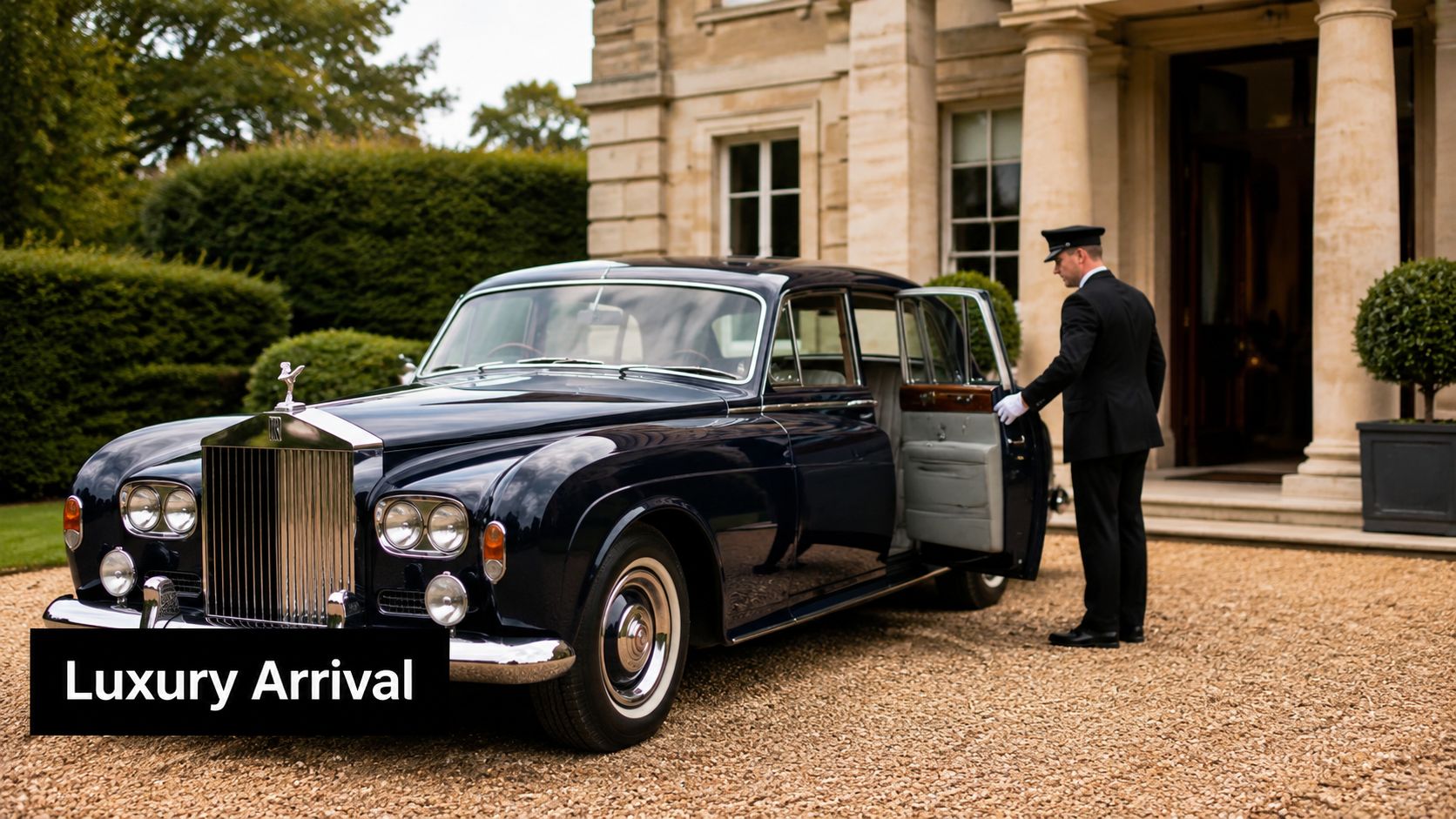
Private touring changes more than comfort. It changes pace, discretion, and control. A published example of this approach appears in this private Downton tour profile, which notes that specialist operators use vehicles such as Mercedes, BMW, Bentley, and Rolls-Royce Phantom so guests travel without being grouped with other tourists.
Why cars matter more than people think
For this style of trip, the vehicle is part of the setting. A Bentley or Rolls-Royce Phantom feels right outside a country estate in a way a standard executive van never will. That isn't vanity. It's continuity.
The other benefit is subtler. With a dedicated chauffeur, you can shift lunch, linger in a village, reroute for weather, or preserve quiet when clients don't want commentary. None of that is possible on a fixed group coach.
If you're comparing baseline rail access into the capital before upgrading onward arrangements, Split My Fare's London page is a practical reference for the ordinary transport layer many travelers start from before deciding they'd rather handle the countryside privately.
What to choose for different styles of trip
Not every transfer needs the same solution. The right fit depends on temperament.
- Executive saloon suits solo travelers and couples who want understatement.
- Bentley or Rolls-Royce Phantom works best for celebratory itineraries where arrival itself is part of the theatre.
- Luxury SUV or spacious people carrier is the sensible answer for families, wardrobe changes, or photography equipment.
- Helicopter transfer is worth considering when time compression matters and the clients value dramatic efficiency.
For a broader view of how high-end ground movement should be designed, this private transfer services and luxury ground transport guide offers a useful framework.
A short visual reference captures the tone of arrival well:
What doesn't work
The common misstep is assuming transport is the easiest part to economize. It isn't. Once clients are tired, delayed, or confined to someone else's timetable, every later element suffers.
Clients rarely complain that the car was too good. They do remember when the journey felt ordinary.
For Downton Abbey trips at a serious level, transfer planning isn't a support service. It's production design.
Exclusive Stays and Partner Hotel Benefits
A Downton itinerary rises or falls on where the guests sleep. The hotel should continue the world of the trip, not reset it. That means choosing properties with British character, refined service, and enough privacy that the return each evening feels like an arrival, not a hotel check-in.
The right kinds of hotel for this journey
Country-house hotels work best when the estate portion of the itinerary is dominant. They preserve the mood, reduce road fatigue, and make breakfast feel like part of the experience rather than a staging exercise before departure.
For some travelers, a polished rural base in Hampshire offers the cleanest access. For others, a celebrated Oxfordshire property with a gastronomic reputation is the stronger anchor, especially when dining is as important as filming locations. London hotels remain relevant when the trip is folded into a wider urban stay, but then the country day must be timed with more precision.
What a preferred booking actually changes
For affluent travelers, the booking channel matters. A good advisor relationship at the hotel level can affect room placement, upgrade priority when available, breakfast inclusion, property credits, and the quality of the welcome on arrival. Those details are rarely dramatic in isolation. Together, they shape whether the stay feels recognized or merely confirmed.
A practical screen for choosing the hotel is this:
| Priority | Best style of property |
|---|---|
| Closest access to Highclere | Hampshire country-house hotel |
| Food-led romantic escape | Oxfordshire manor with destination dining |
| London plus one country excursion | Top-tier London hotel with seamless transport planning |
| Multi-generational comfort | Resort-style country estate with strong grounds and activities |
Beyond hotels, when a private house is the better answer
Some families and long-stay guests are better served by a staffed villa or private estate. That's especially true when security, entertaining space, or intergenerational privacy matters more than daily hotel traffic.
For owners and investors who think carefully about how luxury homes perform as hospitality assets, this perspective on maximizing luxury rental income gives useful context on what distinguishes premium residential stays from generic short-term rentals.
The best base is the one that keeps the fantasy intact at 7 a.m. and at 10 p.m., not only at check-in.
The wrong hotel creates friction. The right one gives the entire trip a second residence.
The Haute Black Difference Beyond the Velvet Rope
The ultra-luxury gap in this market is easy to identify. Most Downton trips still operate on a sightseeing model, even when they use better cars or smaller groups.
That misses the core issue. Discerning travelers don't object only to crowds. They object to anonymity, inflexibility, and commentary that never moves beyond the obvious. A market review of current Downton-focused travel notes exactly that problem, with traveler frustration centered on rigid group formats, while 78% of tour participants desire more personalized engagement, and very few providers offer genuinely private, curator-led access suited to the ultra-luxury segment, as discussed in this analysis of the gap in Downton travel experiences.
What standard luxury still gets wrong
Even an upgraded small-group tour often comes with the same structural limits:
- You keep the group's clock, not your own
- You hear a generalized script, not insight specific to your interests
- You share space at the key moments, exactly when privacy matters most
- You move on too soon, because the day has been sold as a route, not designed as an experience
That's why the highest level of planning has to go beyond premium packaging. What matters is access. After-hours possibility. Estate context from someone who knows the house beyond its public narrative. Meals and pauses that don't feel publicly available.
Where private design changes the result
The difference beyond the velvet rope isn't always flamboyant. Sometimes it's a quieter arrival window. Sometimes it's a guide chosen for historical fluency rather than performance energy. Sometimes it's a schedule with enough flexibility to let one room, one view, or one conversation become the memory of the trip.
The strongest planners understand a simple truth. Privacy is not a decorative add-on for this category of travel. It is the medium through which the place becomes legible.
Once a guest stops feeling managed, the house begins to feel alive.
That's the standard serious travelers should use when evaluating any Downton Abbey trip.
Begin Your Chapter in the Downton Legacy
The enduring appeal of Downton has never been about fandom alone. It rests on a rarer promise: that history, beauty, ritual, and comfort can still be experienced as a coherent whole if the journey is designed well enough.
Done poorly, these trips become crowded circuits of famous places. Done properly, they become something far more satisfying. A private drive through the countryside. A measured arrival at Highclere. A village that's given time to breathe. A hotel that extends the atmosphere rather than interrupting it. Every detail working toward a single feeling of entry.
That's why the best Downton Abbey trips aren't found on a departures board. They're composed. The route matters, but so do the silences, the table choices, the timing of the gates, and the quality of the welcome.
If your aim is not merely to see where the series was filmed, but to inhabit its world with discretion and style, the next step is a conversation about access, pacing, and the version of the story you want to live.
If you'd like to design a Downton-inspired journey with private access, refined transport, and a stay that feels fully suited to you, speak with Haute Black.
Explore Our Guides


Signature Experiences


