Haute Black Journal
Your Trip to South of France: An Expert's Luxury Guide

Marlene Azeez
Director, HauteBlack
View all articles →
# Your Trip to South of France: An Expert's Luxury Guide
June 26, 2026
A trip to the South of France is often ruined by chasing the postcard and neglecting the machinery. That's backwards. In 2025, France welcomed over 102 million international visitors, and the Provence-Alpes-Côte d'Azur region recorded 57.2 million total tourist stays in 2023, including 22.5 million from non-residents according to France tourism data. In a destination this crowded and this desired, logistics aren't a footnote. They are the experience.
I've seen the difference play out repeatedly. One traveler lands in Nice, waits on bags, argues with a driver who can't access the hotel entrance, arrives to a warm room, then learns the terrace table they wanted is gone. Another is met on arrival, transferred without friction, checked into a suite that's ready, and seated that evening exactly where they should be. Same coastline. Completely different trip.
A polished trip to the South of France isn't about adding more. It's about eliminating drag. The right season, the right routing, the right hotel-villa decision, the right reservations, the right transport chain. That's what creates elegance. Everything else is decoration.
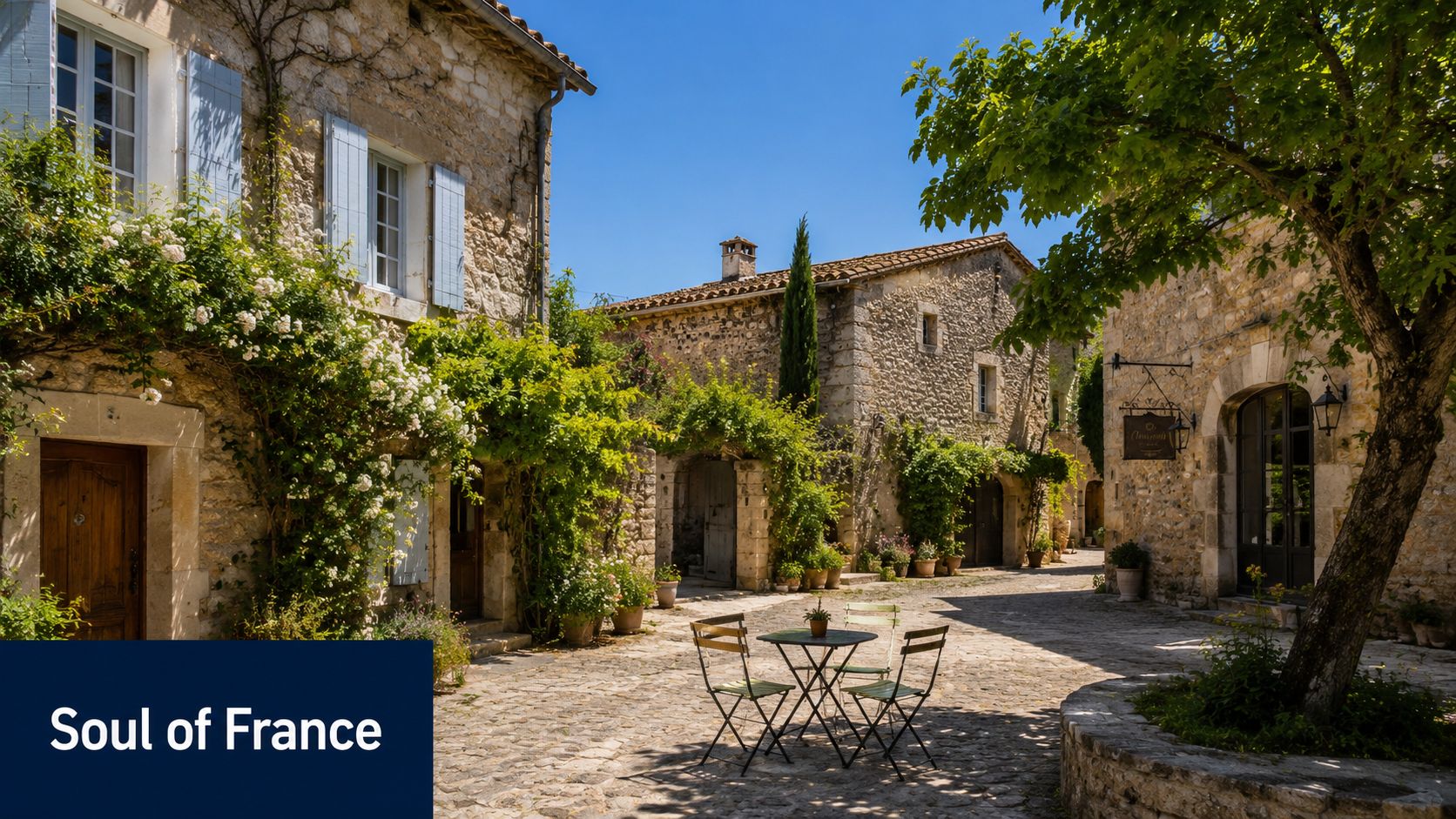
The Soul of the South of France
The South of France has been flattened by cliché. Lavender. Rosé. Linen. Beach clubs. All lovely. None of them, on their own, amount to luxury.
What matters here is rhythm. The region rewards people who move well through it. A rushed transfer into Saint-Tropez can sour an afternoon. A badly chosen base can turn a supposedly glamorous escape into a parade of road delays, noisy lobbies, and impossible dinner times. The most impressive travelers aren't the ones spending indiscriminately. They're the ones whose days unfold without visible effort.
What sophistication looks like on the ground
A standard trip looks busy. You bounce between Nice, Cannes, Antibes, Èze, Saint-Paul-de-Vence, and Saint-Tropez because someone online told you to “see everything.” You spend your best hours in transit. You discover too late that the Riviera punishes spontaneity at the top end.
A refined trip chooses fewer anchors and executes them perfectly. That might mean Cap-Ferrat and Èze for a couple who wants privacy and altitude, or Antibes and Ramatuelle for a family that wants sea access and room to breathe. It might mean a hotel with social voltage, or a villa with full staff and no witnesses.
Why the destination still pulls the world's elite
The South of France has range. It can be cinematic and quiet in the same day. A stone village lunch, a polished beach arrival, a boat at golden hour, a serious cellar at dinner. Very few destinations offer that much tonal variation without asking you to sacrifice standards.
That's why it keeps drawing global demand. The scale of visitation proves the point, but the distinction is more subtle. This region can still feel intimate if someone has designed it with intelligence.
The South of France isn't impressive because it's famous. It's impressive because, when handled properly, it still feels private.
For clients who want that handled well, the better starting point isn't another generic roundup of hotspots. It's a sharper editorial lens on access, timing, and service, like this French Riviera expert guide from Haute Living's travel coverage.
Mastering Your Arrival and Timing
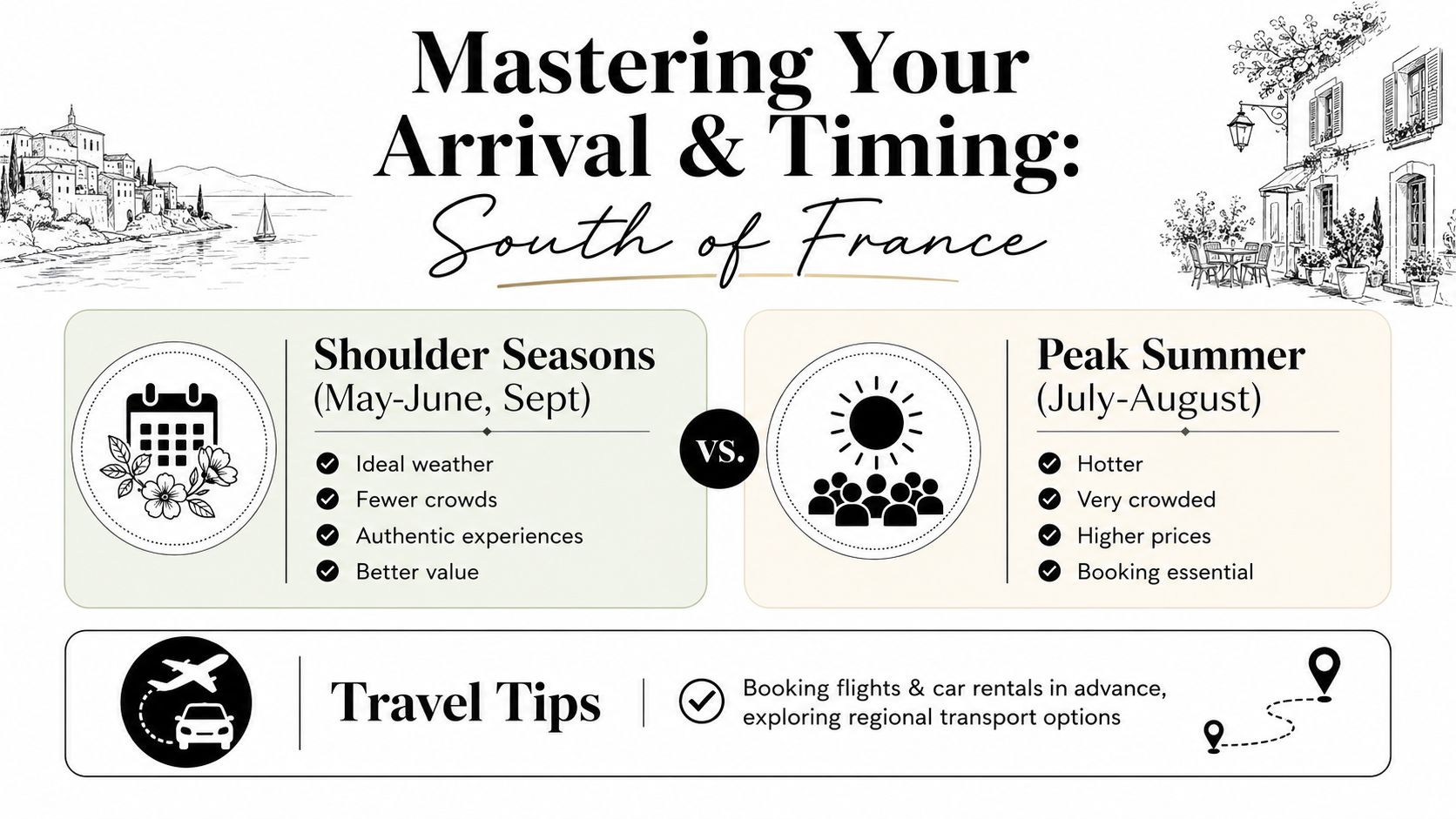
August is for being seen. It is not the month for a trip that runs beautifully.
If you want privacy, sharp service, and a Riviera that still feels responsive, book late May, June, or September. Those windows give you the version of the South of France that discerning travelers want. Staff are still fresh, roads are more manageable, and top tables do not feel like a competitive sport before noon.
Choose the season that respects your standards
Late spring has brightness and energy. Beach clubs are open, terraces are lively, and the coast still has breathing room. September is the insider's choice. The water is warm, the light is flattering, and the entire region feels more composed.
July and August demand a different operating model. If school holidays or social calendars force your hand, buy back convenience before you arrive.
- Lock key reservations early: beach clubs, lunch tables, marina berths, spa appointments, and villa staff should be confirmed well before departure.
- Reduce hotel changes: every extra transfer introduces friction, delay, and wasted prime hours.
- Build a transport buffer into every day: one slow coastal route can unravel lunch, docking times, and dinner.
Arrive like someone who understands logistics
A polished Riviera trip is won or lost on arrival day. Commercial terminals, taxi lines, and improvised transfers are a poor use of time. Nice Côte d'Azur works for broad access across the coast. Cannes Mandelieu is often the smarter choice for western Riviera stays and shorter ground movements.
Then make the next decision properly. Road transfer, helicopter hop, or both. The answer depends on where you are sleeping, what hour you land, and whether that drive steals time from the best part of the day.
The cleanest arrival sequence usually looks like this:
1. Private jet into the airport that best suits your base
2. Tarmac handling arranged in advance
3. Helicopter transfer if road traffic will cost you too much time
4. Dedicated chauffeur retained for the full stay
A retained driver changes the quality of the trip. The Riviera is geographically close and operationally awkward. Parking is tedious, popular addresses bottleneck fast, and a lunch that runs long can derail the rest of the day if no one is managing the cadence for you.
For flight logistics, private air travel planning through Haute Black is one practical option for private jet routing and related coordination.
Don't improvise ground transport
Rail has limited value if your priority is discretion and control. It can work for a straightforward coastal movement, and SNCF's TER network in the Provence-Alpes-Côte d'Azur region covers practical stops along the Riviera. That matters for casual sightseeing. It does not solve for wardrobe changes, shopping collections, security preferences, or a last-minute shift from Cap-Ferrat to Cannes.
Use trains only when the day is intentionally simple. Use chauffeured transport when the day carries any consequence.
Practical rule: The shortest transfer on the map is often the one that costs you the lunch reservation, the yacht departure, or the light you planned the afternoon around.
If you want a useful framework for timing around chokepoints, this piece on avoiding cruise port traffic delays makes the right operational point. Different coast, same discipline. Build margin before the road network turns against you.
Hotels of Stature and Villas of Seclusion
Your accommodation is not a backdrop. It is the operating system for the trip.
Choose badly and everything becomes slightly annoying. Choose well and the South of France starts to feel coherent. Many travelers often get seduced by photographs, ignoring temperament. A legendary hotel and a private villa can both be magnificent. They just serve different kinds of people.
When a grand hotel is the right move
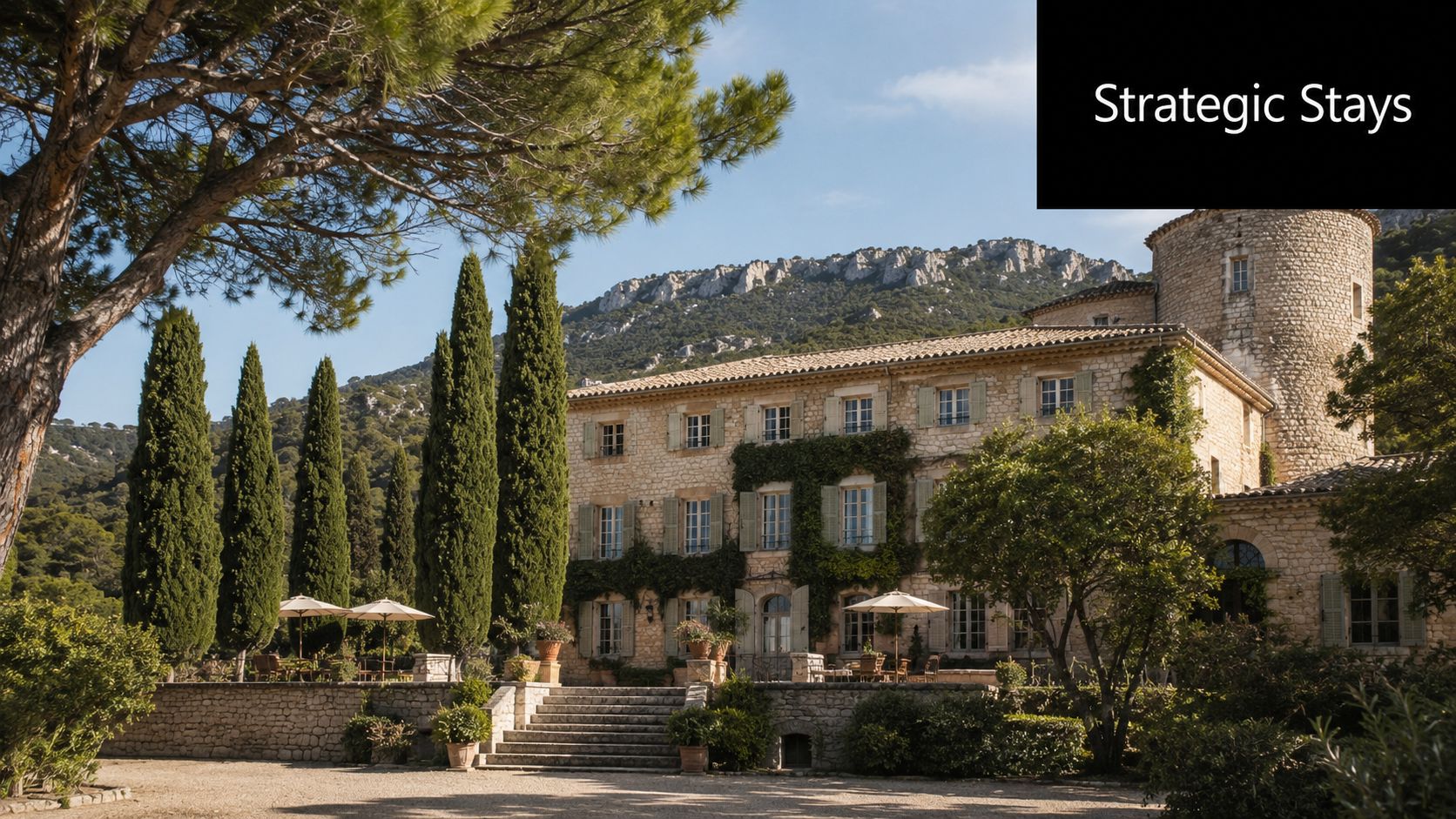
A palace-style hotel works when you want atmosphere on tap. You want to step into a social scene, not manufacture one. You want a concierge desk, a polished spa, established dining, and the subtle theater of arrival that only iconic properties deliver well.
Hotel du Cap-Eden-Roc and Grand-Hôtel du Cap-Ferrat represent that model beautifully. They aren't just places to sleep. They're self-contained ecosystems. Lunch, cocktails, marina views, people-watching, beach clubs, and a room service tray that arrives exactly as ordered. For couples, social travelers, and clients who value immediate service density, hotels make life easier.
That ease matters if your schedule is fluid. A hotel absorbs changes better than a standalone property. If dinner shifts late, if guests join for drinks, if you want a treatment arranged in an hour, the machine is already in place.
When a villa is the superior answer
A villa wins on silence, space, and control. In Ramatuelle or Cap d'Antibes, a fully staffed property lets you choreograph the day instead of entering someone else's rhythm.
That's particularly powerful for:
- Multi-generational families: Different wake times, dietary needs, and energy levels can coexist without friction.
- High-profile guests: Fewer public interactions, fewer eyes, fewer compromises.
- Longer stays: Villas get stronger over time because routines settle in.
The best villas also solve the hidden problem of luxury travel, which is overexposure. Some clients don't want to perform their holiday in a lobby. They want breakfast on their own terrace, fittings in private, a trainer at the house, and dinner prepared to preference rather than menu.
The real trade-off
Hotels excel at immediacy. Villas excel at ownership of space.
| Stay style | Strength | Best for |
|---|---|---|
| Grand hotel | Full-service energy, social scene, dining and spa in-house | Couples, short stays, travelers who want visible glamour |
| Private villa | Privacy, space, personalization, discretion | Families, longer stays, executives, security-conscious guests |
A common mistake is choosing a villa when the travelers want stimulation, or choosing a hotel when they need retreat. Be honest about your social appetite. The South of France amplifies whatever choice you make.
One of the clearest ways to understand the villa side of the equation is to watch how these properties are positioned and serviced in practice.
If you're debating hotel versus villa, ask a blunt question. Do you want access to a scene, or freedom from one?
Curated Itineraries for the Discerning Traveler
The best trip to the South of France is never generic. The region is too nuanced for that. A honeymoon, a family holiday, and an executive retreat shouldn't share the same structure, even if they overlap geographically.
The sharper approach is to design around tempo, privacy, and purpose. That's where bespoke planning becomes useful. One option for customized route design and on-the-ground experiences is a curated South of France journey collection.
Three itineraries worth taking seriously
The romantic escape begins with altitude and intimacy. A couple bases near Èze, where the mood is quieter and the views do the work. Days unfold slowly. A long lunch, a scenic drive, an art-rich afternoon in Saint-Paul-de-Vence, then dinner somewhere that understands pacing. This version of the Riviera isn't about showing off. It's about choosing places with emotional charge.
The family sojourn needs more operational discipline. Antibes works well because it gives you old-town charm and marine access without the performative frenzy of some neighboring enclaves. From there, the family can split naturally. Beach clubs in Pampelonne for one group, a boat day for another, a museum stop or market walk for grandparents, then a house dinner or easy terrace meal in the evening. The point isn't to keep everyone together every minute. It's to prevent the day from collapsing under competing preferences.
The executive retreat has no patience for wasted motion. Monaco makes sense when meetings, social visibility, and controlled leisure need to coexist. You arrive efficiently, hold conversations in the right rooms, then pivot into a yacht afternoon, a private tasting, or a dinner with enough discretion to be useful. The best executive itineraries in the South of France feel relaxed from the outside and highly engineered underneath.
| Traveler Type | Key Locations | Signature Experience |
|---|---|---|
| Romantic Escape | Èze, Saint-Paul-de-Vence, Cap-Ferrat | Intimate dining and art-led days with dramatic coastal views |
| Family Sojourn | Antibes, Pampelonne, Ramatuelle | Private boat day balanced with beach time and cultural flexibility |
| Executive Retreat | Monaco, Cap d'Ail, Riviera coastline | Efficient high-level meetings paired with controlled leisure |
The lavender problem most guides ignore
Lavender is where amateur planning shows immediately. Everyone talks about bloom. Almost no one talks about access.
Many guides fail to address the 2024-2025 permit restrictions for private vehicles in key villages like Gordes and Roussillon, and the need for advance planning to secure the private, non-tourist access that 78% of high-net-worth inquiries specifically request, according to this lavender logistics advisory. That single detail changes the quality of the day.
If lavender matters to you, handle it like this:
- Lock the timing first: Bloom windows matter less than access conditions on the specific day.
- Treat vehicle permissions as part of the itinerary: Don't assume a driver can roll through every village zone.
- Build the experience around privacy: The right field access and photography timing matter more than ticking off multiple stops.
What each traveler should avoid
For couples, don't over-schedule. Romance dies in the back seat of a car.
For families, don't choose a base that requires constant repacking and long day trips. Children and grandparents punish inefficient routing.
For executives, don't confuse glamour with utility. If the room, the boat, or the restaurant doesn't support conversation, it's decorative, not valuable.
Unforgettable Access Yachting and Culture
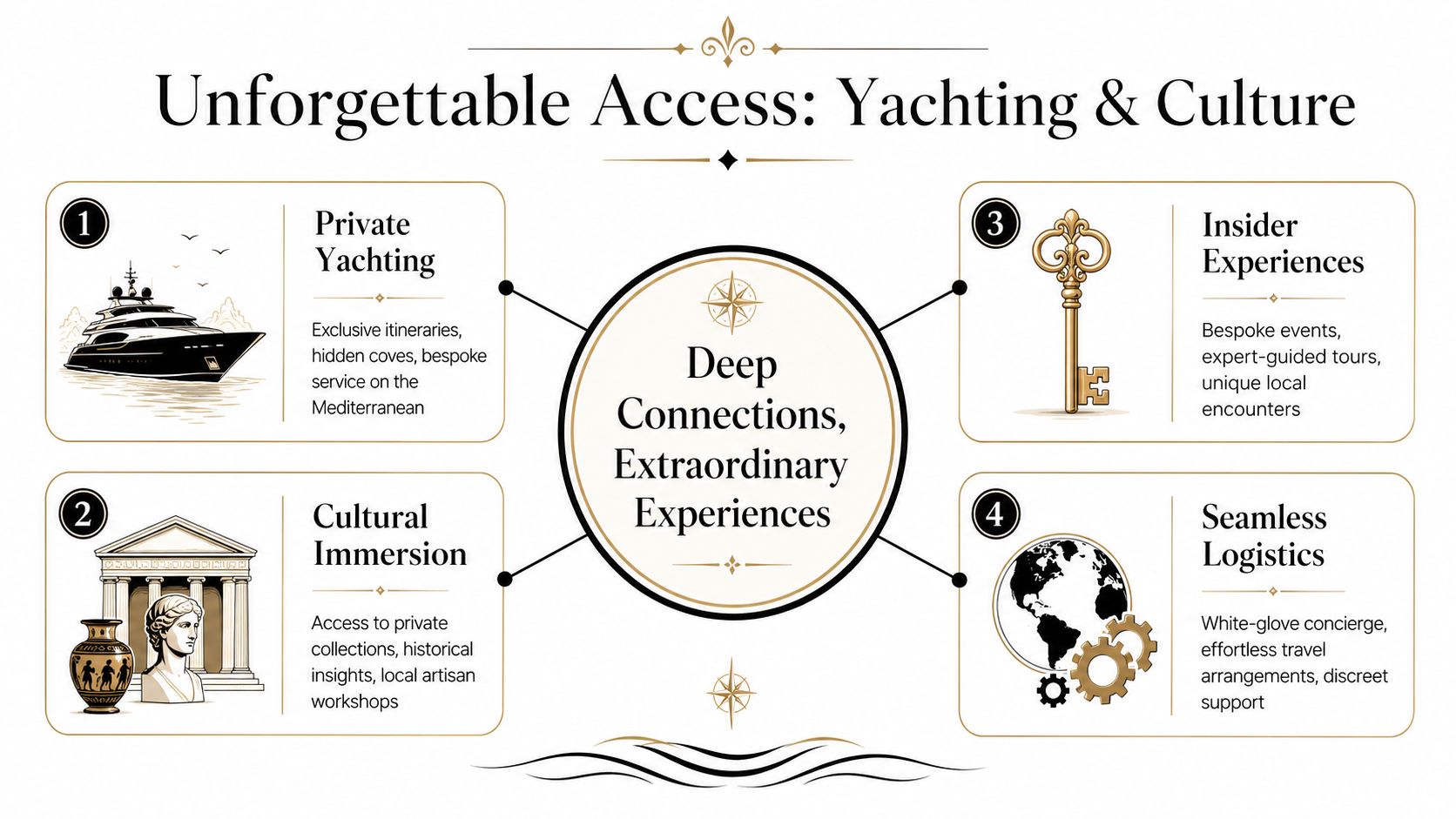
The South of France rewards choreography. Travelers who treat boating, dining, art, and ground transport as separate bookings end up with a disjointed trip. The polished version is operational. Your yacht departure, beach club table, gallery visit, tender landing, and evening arrival should function as one coordinated sequence.
A yacht is often the smartest transport decision on the coast. It gives you privacy, protects the mood of the day, and bypasses the most tedious part of Riviera glamour, road congestion, parking friction, and crowded arrivals. Culture works the same way. Anyone can enter a museum. Very few travelers arrange the conditions that make it memorable.
Why yachting changes the trip
A well-chosen day yacht is enough for most itineraries. Use it to reach the Îles de Lérins, swim in clearer water, and arrive for lunch with some ceremony rather than appearing flustered from a car transfer. Multi-night charters serve a different client. They suit travelers who want the coast to unfold privately, without repeatedly returning to hotel rhythms and public-facing logistics.
Execution matters more than size. A beautiful boat with a weak captain, poor routing, or no lunch strategy is wasted money.
Use these standards:
- Choose the boat for the coastline, not for photographs: A nimble day vessel often works better than an oversized statement yacht in busy Riviera harbors.
- Set the route around one anchor moment: A swim cove, a long lunch, or a sunset return. Three headline moments in one day usually means too much moving and too little pleasure.
- Control the arrival sequence: Confirm berth access, tender timing, and restaurant coordination in advance. The quality of a yacht day often depends on the fifteen minutes before and after lunch.
- Keep the afternoon loose: A rigid minute-by-minute schedule ruins the point of being on the water.
Cap d'Antibes is a good example. From the road, it can feel performative. From the water, it regains proportion, beauty, and calm. The same is true of waterfront dining. Approaching by tender changes the tone before you even sit down.
Why cultural access matters just as much
The coast alone is too superficial for a serious trip. The South of France gets its depth from places such as Saint-Paul-de-Vence, the Fondation Maeght, private ateliers, serious galleries, and houses shaped by artists, collectors, and patrons rather than beach traffic.
The difference lies in access conditions. Go early or after hours. Use a guide with intellectual range, not a script. Ask for private handling where it exists. A curator-led visit, a collector's perspective, or a well-timed appointment in an atelier will stay with you far longer than another crowded promenade.
Some of the strongest days combine both worlds. Start on the water. Come ashore for a deliberate lunch. Spend the late afternoon inland with art, architecture, and quiet. That contrast is what gives the Riviera its texture.
Dining follows the same rule. The famous address is easy to identify. The right table, at the right time, with the right arrival plan, is where skill shows. Places such as La Colombe d'Or are not difficult because they are obscure. They are difficult because demand is concentrated, capacity is limited, and regulars book early.
The reservation rule wealthy travelers ignore
Handle top tables and private cultural appointments as fixed infrastructure, not optional extras. If a restaurant, foundation, or collection matters to you, reserve it weeks in advance and build the day around it. Waiting to decide from the back seat of a car is how good itineraries become mediocre ones.
The South of France still favors people who arrive prepared. That is the true marker of luxury here. Not display. Control.
Understanding the Investment and Maximizing Value
Luxury travelers don't need a lecture on cost. They need clarity on what they're buying and where value sits.
A credible budget anchor helps. Luxury travel packages for the South of France, covering Bordeaux, Provence, and the Côte d'Azur, start at $14,170 per person excluding flights, according to this South of France luxury package reference. That's useful not because it defines your trip, but because it sets a baseline for a serious itinerary.
What drives the spend
The first lever is accommodation. Hotel tier, suite category, or villa staffing structure will shape the budget faster than almost anything else. The second is transport, especially if you want private air, helicopter segments, or full-time chauffeur support. The third is access. Boats, hard restaurant reservations, private guiding, and behind-the-scenes cultural arrangements don't just add polish. They change the economics of the trip.
This is how one should consider it:
| Investment area | What you're paying for | Where value shows up |
|---|---|---|
| Accommodation | Position, privacy, service level | Better sleep, better location, fewer compromises |
| Transport | Time protection and ease | Fewer delays, smoother days, stronger arrival experience |
| Access | Reservations, guides, special entry | Experiences that can't be improvised on site |
Value is rarely the cheapest option
Ultra-high-net-worth travelers make the same mistake everyone else makes, just at a higher price point. They assume booking direct is naturally more efficient. It often isn't.
The reason is simple. In luxury travel, value isn't confined to headline rate. It appears in room priority, upgrade consideration, daily breakfast, on-property credits, VIP recognition, flexibility, and the ability to solve problems before they become visible. Those details can outweigh minor rate differences very quickly.
That's especially true in the South of France, where the margin for error is small. A poor room location in a busy hotel, a weak transfer plan, or a missed reservation can degrade an expensive trip with surprising speed.
Where an advisor earns their place
An expert advisor isn't there to search inventory. They're there to shape outcome.
That usually means three things:
- Sequencing the trip correctly: Fewer bad transfers, better pacing, stronger base selection.
- Opening preferred channels: Better treatment at hotels and restaurants.
- Protecting your time: Solving changes, waitlists, and friction behind the scenes.
Key consideration: The most expensive South of France trip is the one that looks luxurious on paper and feels chaotic in motion.
The strongest itineraries aren't built around maximal spend. They're built around selective spend. Put money where it removes friction or secures something that can't be replicated casually. Ignore the rest.
Your Journey Begins Here
The South of France rewards precision and punishes casual planning.
A beautiful hotel cannot rescue a poor arrival plan. A headline villa cannot fix a weak base. A coveted beach club reservation means very little if your day is built around traffic, tender delays, and badly timed transfers. In this part of the world, status is expressed through control. The trip should run cleanly from runway to resort, from marina to table, from checkout to departure lounge.
Haute Black, a luxury travel club by Haute Living, arranges Virtuoso perks, suite upgrades, VIP treatment, private jet charters, fully staffed villa rentals, Michelin reservation access, and chauffeur services for Cannes, Antibes, Saint-Tropez, and Monaco. Those are not decorative extras. They are operating tools that protect your time and sharpen the entire experience.
Who should never DIY this trip
Honeymooners need rhythm and privacy, not administrative work. Families need every handoff handled correctly because one missed transfer can derail the entire day. Founders, executives, athletes, and principals with compressed calendars need an itinerary that runs without constant supervision.
That is why serious clients use support built for time-poor travelers. This perspective on dedicated travel support for busy professionals captures the logic well. Delegation is not indulgence. It is discipline.
The standard to insist on
Expect more than attractive bookings. Ask for correct flight timing, airport strategy, helicopter or road transfer decisions made in advance, restaurant reservations that fit the geography of your day, and a hotel or villa chosen for how you live. The best South of France trips feel calm because the difficult parts were solved before you arrived.
The region is easy to admire and easy to mishandle. The clients who get it right do not ask for more spectacle. They ask for better execution.
If you want your trip to the South of France arranged at that level, start with Haute Black. Real luxury here comes from access, timing, and flawless logistics.