Haute Black Journal
What Private Beach Access Really Means for Luxury Travel

Marlene Azeez
Director, HauteBlack
View all articles →

You've found a villa that promises private beach access, the photographs show empty sand, and the booking page suggests a level of seclusion suited to a honeymoon, family retreat, or discreet executive escape. Then someone on your team asks the question that the brochure doesn't answer: does “private” mean the resort owns the beach, controls the path, reserves the loungers, or sits beside a quieter stretch of public shoreline?
That distinction shapes the entire experience. It affects where guests may walk, whether non-guests can appear at the water's edge, which amenities are reserved, and how confidently a property can promise privacy. In luxury travel, the most valuable form of exclusivity is rarely a legal claim to every grain of sand. It's the combination of lawful access, thoughtful design, controlled hospitality, and precise pre-arrival planning.
The Allure of the Private Beach
Your guests arrive at a villa expecting an empty stretch of sand, only to find that the property controls the entrance while the shoreline remains open to others. That scenario is common because private beach access describes several different arrangements, not one guaranteed legal status. For a milestone trip, the difference can matter more than the room category.
A resort may promote private access even when public rights apply along the shore. A villa may offer a gated route to the water without authority to exclude people from the intertidal zone. A beach club can still provide a highly private-feeling experience on shared coastline through controlled entry, reserved seating, attentive service, and careful spacing.
The phrase describes an experience before it describes a title.
Before approving a high-value booking, confirm who controls the entrance, which areas are reserved, and whether the public may walk along the water. Ask whether cabanas, loungers, parking, and beach service are included. Clarify whether the property offers an exclusively private cove or a well-managed route to a public shore.
The legal position and the guest experience should be assessed separately. Ownership, access, and atmosphere are separate products, and a property may excel at one while offering little of another. A legally private beach with weak service can feel exposed. A public shoreline, supported by discreet architecture, controlled arrival, and well-trained staff, can feel remarkably intimate.
The setting also changes the practical answer. Coastal rules differ by destination, and the advertised boundary may not match the area guests can reserve. Ask for a site plan or a precise description of the usable beach area, rather than relying on promotional wording.
HauteBlack's editorial coverage places private beach access within the wider luxury-travel context, alongside guides to bespoke island stays, curated beachfront destinations, and exclusive beach club memberships. The useful question is whether the arrangement delivers the quiet, convenience, and control your party expects.
Decoding Private Beach Access Types
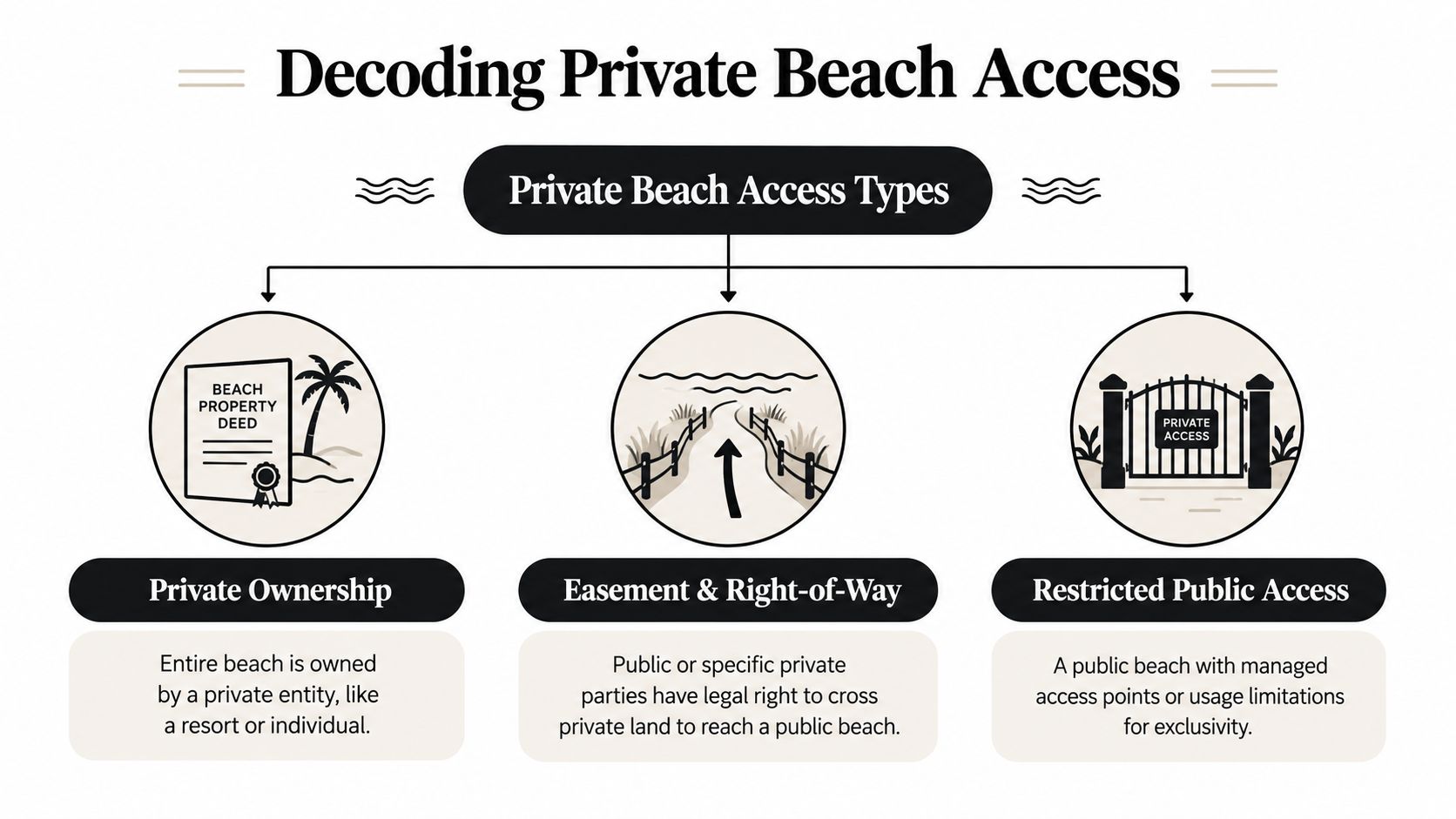
Think of beach exclusivity as a layered system rather than a single label. Ownership is the foundation, access rights form the route, and hospitality creates the experience. A property can offer one layer, two, or all three.
Private ownership
The rarest arrangement involves a private entity holding title to the relevant dry-sand area, sometimes as part of a large estate, resort compound, or private island. Even here, ownership may not extend over the entire shoreline. In the United States, the public-trust boundary often limits private control below the mean high-water line, and state rules can extend public rights differently.
For a traveler, private ownership matters most when it governs the dry sand where guests want to place chairs, dine, swim ashore, or spend an afternoon away from the water's edge. The title still needs examination. A phrase such as “private beach” doesn't tell you whether the property owns the sand, holds an easement, or merely manages amenities.
Easement and right-of-way
An easement grants a defined party the right to cross land or use a particular route. It can provide a resort, villa owner, association, or the public with a lawful path to the shoreline without transferring ownership of the land itself.
This arrangement often produces excellent convenience. Guests may use a coded gate, private boardwalk, or reserved crossover, while the beach beyond remains subject to separate legal rights. The scope matters. An easement might cover walking but not parking, guests but not commercial visitors, or access but not the placement of furniture.
Restricted public access
A public shoreline can still feel exclusive when a property controls the practical gateway. A resort may manage its own entrance, reserve cabanas, provide beach attendants, and limit services to registered guests. The public may retain rights along the shore, but the resort's frontage can remain quieter because the main access route and amenities are curated.
This is why a private beach club can be more valuable than a technically private strip with no infrastructure. Membership can provide a controlled arrival, reserved seating, food and beverage service, and a staff member who knows your preferences. HauteBlack's 2026 guide to exclusive beach club memberships is a useful reference for travelers comparing membership-led access with resort-managed beach service.
There's also a security and operations dimension. Controlled gates, credential checks, visitor management, and carefully designed entry points determine whether exclusivity works in practice. For a broader explanation of how access environments are structured, Wisenet Security's system guide offers useful context, even though a beach resort applies those principles in a hospitality setting rather than a conventional facility.
Before booking, ask the property to identify the category it's selling. “Private ownership,” “deeded access,” “resort access,” and “beach club access” shouldn't be treated as interchangeable terms.
The Legal Realities of the Shoreline
A resort can offer a quiet stretch of sand, staffed service, and direct water access while lacking the legal power to exclude everyone from the shoreline. The boundary that often matters is the mean high-water line, a survey-based tidal marker separating public intertidal land from privately owned upland dry sand. In many coastal states, land below that line is public, while the dry sand above it may belong to a private owner. The exact rule depends on the jurisdiction, so a property's title does not automatically control every area visible from the resort.
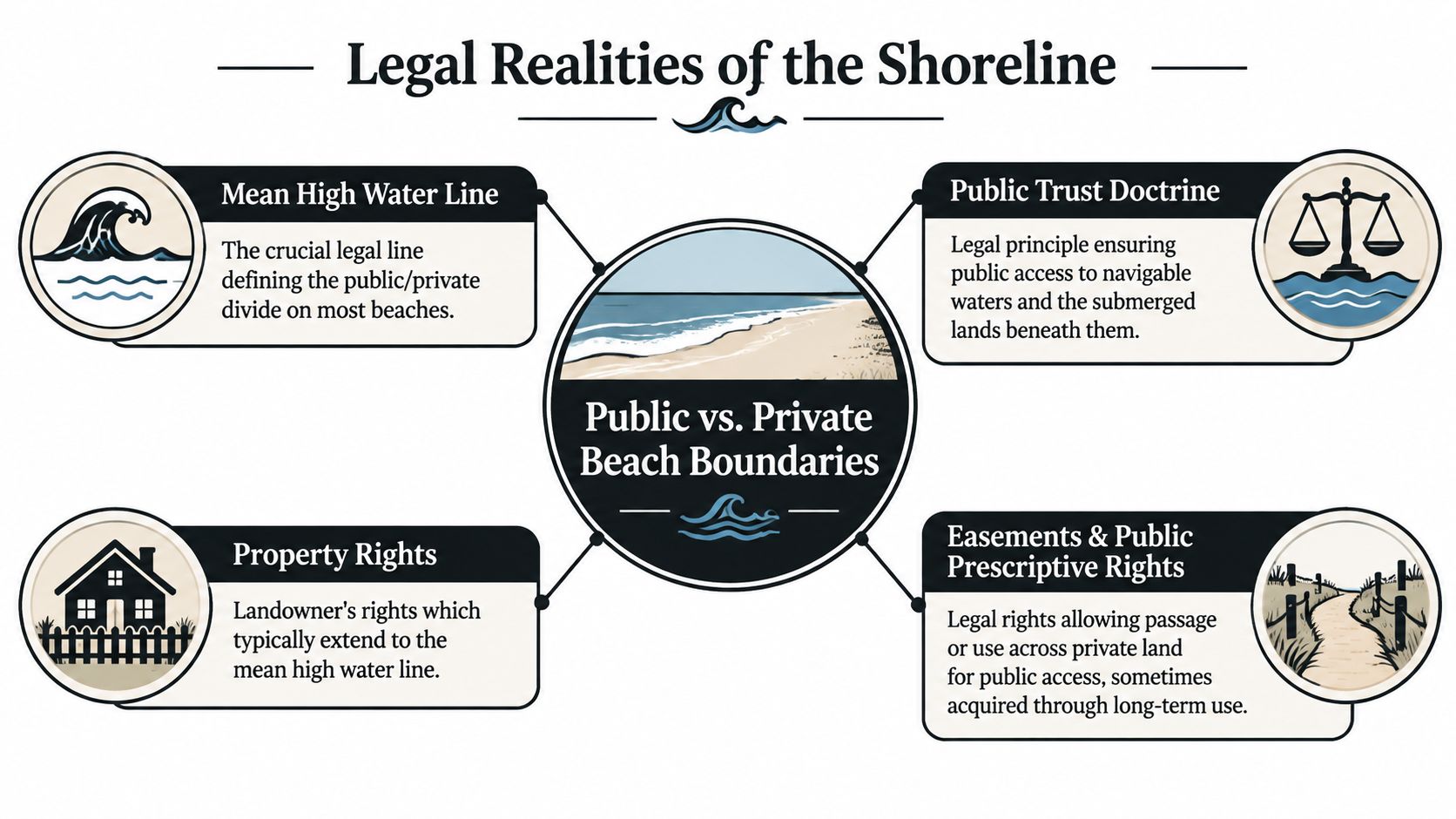
The guest experience can therefore change by a few feet. A resort may permit guests to reach the water via its managed path, walk through the intertidal zone, and swim, while requiring permission to place a chair on privately controlled dry sand. The shoreline appears continuous, but access rights, permitted activities, and enforcement authority can differ across each section.
California and Hawaii
California demonstrates how strong public-access protections can limit private-beach marketing. California Coastal Act Section 30211 states that development must not interfere with the public's right of access to the sea where that access was acquired through use or legislative authorization, including dry sand and rocky coastal beaches to the first line of terrestrial vegetation. The California Coastal Commission's public-access guidance explains how long-term public use can establish a permanent public easement through a prescriptive right of access.
For a luxury traveler, the distinction is practical. A California resort can define a polished guest zone with loungers, attendants, dining, and private facilities, yet an established public route may remain protected. Any promise of complete shoreline exclusion deserves careful scrutiny.
Hawaii follows a different but equally important framework. State guidance recognizes public access along beaches and shorelines below the “upper reaches of the wash of the waves,” while counties hold primary authority and responsibility for developing and maintaining public shoreline access. The guidance also states that obstructing existing public rights-of-way can result in a remedy and a penalty of up to $2,000. That structure allows a resort to feel secluded while the shoreline remains publicly protected. Review the Hawaii public-access guidance if beach privacy is a central reason for choosing the property.
State-by-state differences
Massachusetts shows why a general statement that a beach is public may mislead. On private tidelands, public rights may cover fishing, fowling, and navigation, without necessarily extending to walking, sunbathing, or other recreation. The state's legal overview explains why visible access to the water does not automatically grant permission to use every part of the shore for leisure.
Historic rules can also influence current disputes. Massachusetts's Body of Liberties of 1648 extended certain private ownership rights from the mean high-water line toward the mean low-water line, or 100 rods from the mean high-water line, whichever was less. That history helps explain why coastal access questions require local legal analysis rather than a single national assumption.
New Jersey applies a balancing approach in contested situations. Public access across privately owned dry sand may be allowed when it is essential or reasonably necessary to enjoy public-trust rights. Courts may weigh proximity to the foreshore, public demand, available public upland sand, and the owner's use of the beach.
For a luxury booking, ask a narrower question than “Is the beach private?” Confirm which activities are permitted, where the property's control ends, and which public or private route reaches the water. Those details reveal whether the exclusivity is a legal right, a managed service zone, or merely well-executed hospitality.
How True Exclusivity Is Delivered
A resort doesn't need to own the entire shoreline to create a private-feeling experience. It needs to control the moments that shape a guest's day, from arrival at the beach path to the final drink as the light changes.
The first layer is access design. A discreet boardwalk, thoughtfully designed entrance, or guarded gate reduces casual foot traffic without making the property feel fortified. Geography helps too. A cove, peninsula, private-island setting, or naturally screened frontage can create separation that legal ownership alone can't guarantee.
The second layer is spatial planning. Properties may reserve the most desirable area for guests, arrange loungers with generous spacing, and position cabanas away from public circulation. Architecture can conceal service routes and frame the horizon, while vegetation can screen neighboring properties without blocking the view.
The third layer is human service. A beach attendant who remembers a preferred shade position, keeps towels dry, monitors changing conditions, and arranges lunch delivers a level of privacy that a sign reading “private beach” cannot create. Exclusivity is felt through the absence of friction.

That distinction also matters when assessing residences. A villa may offer direct frontage, but the valuable question is how guests move from the house to the sand, whether the frontage is screened, who maintains the access, and whether staff can serve the beach without crossing the guest's private space. Travelers comparing coastal homes may find professional media for Sanibel luxury listings useful for evaluating how visual presentation communicates privacy, frontage, and setting.
Legal disputes reinforce the importance of operational context. In New Jersey, courts can weigh public demand, proximity to the foreshore, available alternatives, and the owner's use when considering access across privately owned dry sand, as discussed in the cited New Jersey beach-access report. A property's location and surrounding access points can therefore affect how durable an exclusivity promise is.
For destination inspiration, HauteBlack's guide to private island resorts reflects the strongest version of this model. Private-island geography may reduce incidental contact, but the guest experience still depends on staff discipline, arrival logistics, beach setup, and the property's ability to preserve calm throughout the day.
Securing Your VIP Beach Experience
The most reliable way to secure private beach access is to stop treating it as a decorative listing phrase. Put the question into the booking process early, and require precise answers from the advisor, villa manager, or resort.

Start with the access mechanism. Ask whether the route is deeded, resort-managed, association-controlled, or membership-based. Then confirm who may use it, whether children or additional guests require registration, whether access operates at all times, and whether parking, beach chairs, umbrellas, cabanas, and food service are included.
Questions that protect the booking
- Ask for the exact beach arrangement: Request a plain-language description of what the property owns, what it manages, and what remains public.
- Confirm the guest pathway: Find out whether the route uses a key, code, wristband, attendant, shuttle, or reserved boat transfer.
- Clarify the sand itself: Ask where guests may place furniture, dine, sunbathe, and walk without crossing into a restricted area.
- Verify service inclusions: Establish whether loungers, umbrellas, towels, refreshments, water equipment, and attendants are part of the rate or require separate payment.
- Test the privacy promise: Ask about neighboring resorts, public access points, beach clubs, seasonal crowds, and sightlines from nearby properties.
- Get the answer in writing: Have the access terms recorded in the proposal, confirmation, or villa agreement rather than relying on an informal assurance.
Regional law deserves equal attention. A property that works perfectly for a barefoot walk in California may offer a different set of recreational rights in Massachusetts. In some destinations, the public may reach the water but not use the dry sand for ordinary recreation. In others, a resort's exclusive feeling depends mainly on its controlled path and reserved amenities.
The overlooked issue is where access ends. Most travel content answers whether a beach is technically public or private, but travelers need to know what they can do once they arrive. Massachusetts is a useful warning: private-tideland rights may cover fishing, fowling, and navigation, while walking and sunbathing aren't included under the same public rights. That practical distinction is summarized by Massachusetts beach-rights guidance.
A preferred travel partner can help by asking these questions before the property is shortlisted, then verifying the answer with on-site contacts. HauteBlack, for example, arranges bespoke itineraries, private villas and estates, VIP recognition, and access through preferred relationships with luxury properties. It should be evaluated alongside other specialist advisors, local villa managers, and destination experts according to the complexity of the trip.
When a property is being considered for purchase rather than a short stay, the diligence needs to be more formal. Review the deed, survey, easements, association rules, and any beach-club terms with qualified local professionals. Recorded access may permit passage but not parking, may apply to owners but not unlimited guests, or may require maintenance obligations that aren't visible during a viewing.
A useful property comparison should include more than distance to the shoreline. Note the actual walking route, the entrance's security, the availability of guest credentials, the beach's exposure to neighboring traffic, and the service standard at the water. For buyers and investors assessing coastal opportunities, Emerald Coast properties can provide a starting point for comparing beachfront locations, but the access terms still require direct verification.
Here's a practical sequence for a high-value booking:
1. Define the desired experience. Decide whether the priority is legal seclusion, low foot traffic, a private cabana, child-friendly service, water access, or complete villa privacy.
2. Separate the rights from the amenities. Ask which benefits come from title, which come from an easement, and which depend on the property's operating team.
3. Check the destination rules. Have the advisor identify the relevant shoreline boundary and the activities permitted on public and private areas.
4. Confirm the operational details. Verify credentials, hours, parking, guest limits, weather closures, and beach-service inclusions.
5. Plan for change. Coastal access can become contested when development, renourishment, public demand, or local policy changes. An advisor with current destination relationships can flag issues that a static listing may miss.
HauteBlack's luxury beachfront villa buying guide is relevant for travelers considering ownership, while a full-service advisor remains valuable for translating legal and operational details into an experience your family or executive team can use confidently.
The Ultimate Luxury Is a Curated Experience
The finest private beach access doesn't begin with the word “private.” It begins with a clear understanding of the shoreline, the access route, the permitted activities, and the service surrounding them.
A deed can establish an important right, but it can't place a chilled drink beside the lounger, prevent avoidable interruptions, or make a family arrival effortless. A public shoreline can still feel wonderfully secluded when the property sits in the right location, manages its approach discreetly, spaces its amenities intelligently, and employs staff who understand the difference between attention and intrusion.
That's why experienced luxury travelers assess legal durability and operational execution together. They want to know whether access depends on a public path, a private easement, a resort concession, or a club membership. They also want to know whether the promised experience survives peak periods, changing local rules, neighboring development, and the practical needs of every guest.
The strongest advisors don't repeat marketing language. They translate it. They can tell a honeymooning couple whether “private” means an intimate cove or a reserved pair of chairs, explain an executive assistant's access questions before arrival, and identify when a villa's direct frontage offers less usable privacy than a well-run resort.
The horizon is the product, but the details determine whether you can enjoy it. True exclusivity is a carefully managed experience, supported by accurate legal and logistical advice.
HauteBlack arranges bespoke stays, private villas and estates, preferred-property benefits, and discreet itineraries for travelers who want beach access matched to their expectations rather than a vague marketing promise. Visit HauteBlack to discuss a coastal journey where the access, privacy, and service are verified before you arrive.
Explore Our Guides


Signature Experiences


