Haute Black Journal
Luxury Beachfront Villas: Your 2026 Buying Guide

Marlene Azeez
Director, HauteBlack
View all articles →

# Luxury Beachfront Villas: Your 2026 Buying Guide
August 3, 2026
You're likely sitting on a shortlist that looks flawless on paper. Three luxury beachfront villas, all with polished photography, a reassuring sales deck, and a team of people asking for a decision before the dates vanish. That's exactly where bad bookings happen, not because the villa is poor, but because nobody forced the shortlist to answer the right questions about privacy, resilience, access, staffing, and the actual cost of living there for a week or two.
The Booking Decision Most Travelers Get Wrong
A UHNW client rarely loses a villa booking to a better property. They lose it to a better narrative. One villa has the cleaner deck shots, another has the grander sunset angle, and the third sounds more exclusive because the agent used the word private three times in a row. The problem is that none of that tells you whether the stay will run smoothly once luggage lands, children arrive, staff start moving, and the weather turns.
The real decision is verification
If you're choosing among luxury beachfront villas, treat the process like due diligence, not inspiration shopping. The question isn't which listing looks richest. It's which one can prove privacy mechanics, coastal resilience, service quality, arrival choreography, and true total cost before anyone signs.
Practical rule: If a villa team can't answer specific operational questions quickly, assume the property is more fragile than the photos suggest.
The best clients I work with force every shortlist through the same filter. Is there genuine sand access or just a scenic view? Is the building engineered for salt, wind, and heat? Who staffs the villa, and who owns the response when something fails? What happens if the schedule changes, the chef is unavailable, or the sea state affects the transfer?
The seven lenses that matter
You only need seven lenses, and they're the same ones I'd use on a six-figure booking:
- Privacy mechanics. Verify access, sightlines, and buffers.
- Building performance. Check the envelope, glazing, cooling, and terrace detailing.
- MEP resilience. Look at power, hot water, backup systems, and redundancy.
- Season fit. Match the destination to the weather window, not the brochure.
- Arrival logistics. Confirm transfer, baggage, marina, and aviation sequencing.
- Hidden cost stack. Ask what sits outside the nightly rate.
- On-the-ground control. Know who owns the outcome if plans change.
If a villa can survive those questions, it's worth your time. If it can't, the view isn't enough. The market for these properties is too tight, and your time is too expensive, to rely on vibes.
Why Beachfront Inventory Is the Scarce Asset
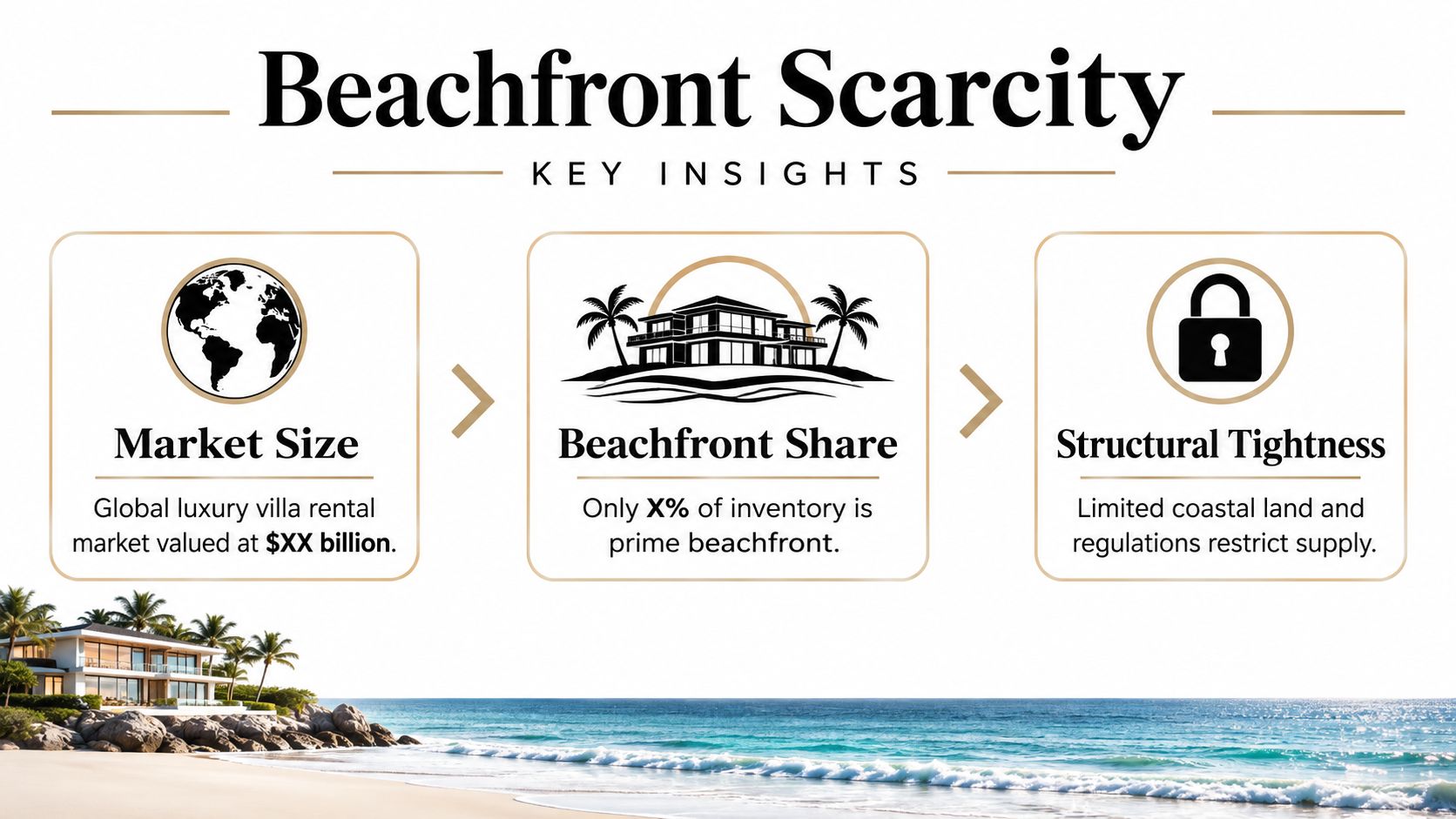
The macro picture explains why beachfront villas are so aggressively priced and so hard to replace. The global luxury villa rental market was valued at $19.4 billion in 2025 and is projected to reach $38.7 billion by 2034, according to Dataintelo's luxury villa rental market report. Within that market, beach villas held the largest property-type share at 38.5% in 2025 and generated about $7.5 billion in revenue, which makes beachfront inventory the single biggest luxury-villa segment worldwide.
Scarcity is structural, not temporary
Beachfront supply is constrained by geography, regulation, and the fact that the best coastal land is already occupied or protected. That's why the strongest inventory doesn't just feel rare, it is rare. A buyer who hesitates on a strong villa is usually competing against another buyer who understands the same thing.
Dubai is a useful example of how scarcity reinforces pricing power. Villa prices rose more than 20% in 2024 to Dh2,009 per square foot, and the market price stood 38.1% above the previous 2014 peak. Knight Frank also reported that homes available for $10 million or more fell 40% to 2,491 in 2024, while listings for $25 million or more dropped 85% to just 86 properties. The Dubai villa market coverage from The National makes the point clearly, scarcity lifts premium assets and leaves less room for casual indecision.
What this means for the buyer
Scarcity changes your advantage. The buyer who books first and books cleanly usually wins the best version of the villa, the better dates, and sometimes the better terms. The buyer who dithers often ends up choosing from what's left, not from what was ideal.
In coastal luxury, delay is rarely neutral. It usually costs you the waterfront position you actually wanted.
That's why I'd rather see a client commit to the right property at a defensible price than stretch for perfection while the market moves underneath them. You're not buying square footage alone. You're buying access, privacy, and a limited slice of shoreline that can't be reproduced on demand.
The Privacy Question Most Listings Avoid
Most beachfront listings are lazy about the one issue wealthy travelers care about most, privacy. They'll say “private beach” or “exclusive waterfront,” but that language doesn't tell you whether the villa opens directly onto sand, whether a public path cuts through the frontage, or whether the terrace is visible from the next property. The operational question is simple, does the setting give you control, or just the appearance of control?
A useful definition comes from independent beachfront-villa guidance that distinguishes true beachfront homes as those opening directly onto sand with no road or resort between the villa and the sea. Another guide emphasizes that seclusion depends on natural surroundings and separation from beach traffic and neighboring sightlines. That's the standard I'd use. If the villa can't meet it, don't let the marketing language distract you.
Ask the questions brochures skip
I'd ask every operator the same set of questions before I'd even consider a site visit:
- Is the beach in front of the villa shared with a hotel, resort, or public access path?
- Can anyone walk past the front boundary without passing through controlled space?
- Do neighboring properties overlook the terrace, pool, or primary suite?
- Is there a public road or visible access point that exposes the shoreline?
- What blocks the view from the beach, the path, and the adjoining land?
The answers matter more than the adjective on the listing. A true waterfront retreat should feel like it was designed to keep outsiders out of your visual field as much as possible.
For clients who want the security layer handled with the same rigor, Sacramento patrol for luxury homes is a useful example of how high-net-worth residential protection is framed around access control and perimeter awareness. The point isn't that every beach villa needs the same setup. The point is that privacy is a system, not a slogan.
Grade the listing before you inspect it
I use a simple private-access score in my own evaluation process. If a villa has direct sand access, no public right-of-way, strong sightline buffers, and no crowd pressure on the waterline, it stays in play. If two or more of those fail, I push the client to a different property, no matter how strong the interior design looks.
What a High-Spec Beachfront Villa Includes
Luxury in a beachfront villa should be measurable, not decorative. A serious coastal property starts with the envelope, because salt, heat, and wind punish weak construction quickly. Independent technical specifications for a beachfront villa project call for 15 cm mineral wool external-wall insulation, aluminum frames with thermal-break double glazing, a waterproofed terrace assembly with thermal insulation and protective screed, and reinforced-concrete frames and slabs for durability. Those are not architectural flourishes. They are the difference between a villa that stays comfortable and one that bleeds cooling load and moisture.
Specification literacy beats amenity counting
If you are reviewing a shortlist, check what the building does, not just what it offers on the surface. A villa that looks glamorous but lacks proper insulation, thermal-break glazing, and terrace waterproofing can become expensive and uncomfortable in a humid coastal climate. That is why design references like the Invilla Architecture design guide are useful, they show how coastal form has to answer the elements, not just frame the view.
The same logic applies to the mechanical systems. One branded oceanfront villa listing specifies underfloor-heating provision, VRV/VRF air-conditioning, solar PV of 5–8 kW, EV charging infrastructure, sound and thermal insulation, and private-beach access. A separate villa specification adds heat-pump domestic hot water, fan-coil cooling, and a 300-liter hot-water boiler. These systems matter because they reduce dependence on unstable local conditions, improve part-load efficiency, and support the way luxury families live, multiple bedrooms, heavy shower use, and indoor-outdoor living all day.
High-spec service planning matters just as much. A beachfront villa needs staff quarters, a kitchen that can handle a private chef, secure perimeters, multi-generational bedroom planning, wellness space, and reliable connectivity. Those are not extras. They are what make a villa operational for families, security teams, and assistants who need the stay to function without friction. For clients who want that service layer handled properly, HauteBlack villas services is the kind of briefing point that should sit alongside the building spec, because service layout and property design have to work together.
Rule of thumb: If the villa cannot explain its power, hot-water, and cooling redundancy in plain language, it is not ready for serious occupancy.
The service layout must match the engineering
A high-spec beachfront villa also needs staff quarters, a kitchen that can handle a private chef, secure perimeters, multi-generational bedroom planning, wellness space, and reliable connectivity. Those are not nice extras. They are what make a villa operational for families, security teams, and assistants who need the stay to function without friction.
Here is the checklist I would use on a serious shortlist.
| Category | What to Verify | Why It Matters |
|---|---|---|
| Building envelope | Insulation, thermal-break glazing, waterproof terraces, concrete structure | Controls heat, moisture, and durability |
| Cooling and power | VRV/VRF, hot-water system, solar, backup support | Keeps occupancy comfortable and stable |
| Privacy design | Setbacks, sightline control, controlled entry | Protects the guest experience |
| Staff and service | Chef-ready kitchen, staff quarters, service circulation | Keeps operations discreet |
| Family fit | Suite mix, child-safe zones, wellness or gym space | Supports multi-generational use |
| Security and access | Perimeter control, gates, lighting, arrival handoff | Reduces disruption and exposure |
If a villa cannot satisfy both the technical and experiential rows, it is not a premium asset, it is a glossy shell. For a six-figure booking, that is not enough.
How Pricing Really Compounds at the Waterline
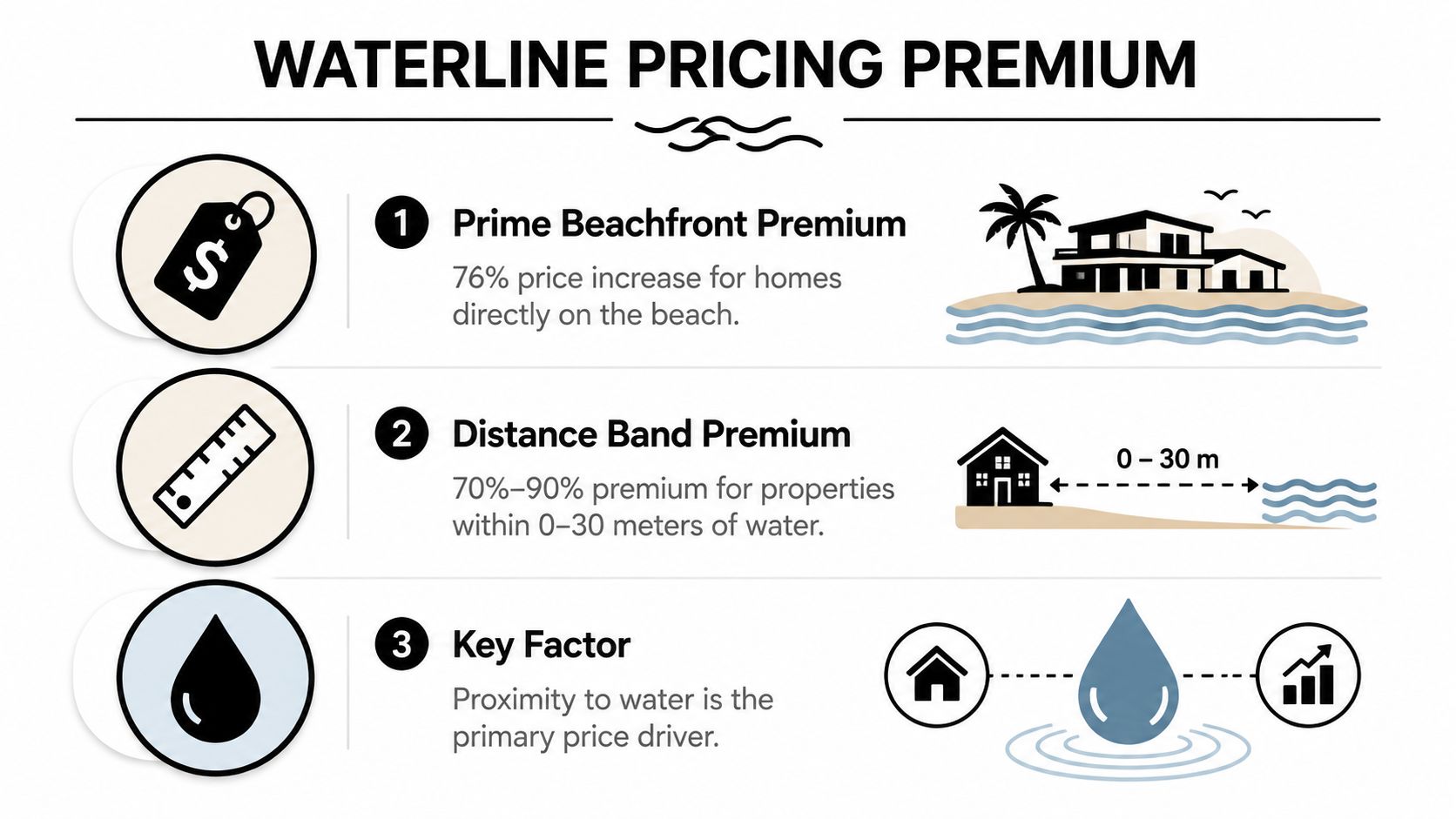
Beachfront pricing looks simple until you map it against distance. A Knight Frank Global Waterfront Index summary says prime beachfront homes average a 76% premium over comparable inland assets, and the advantage is concentrated within a coastal band of less than 200 meters from the mean high-water mark, according to this waterfront distance study. The same source says properties in the 0–30 meter zone can reach 70%–90% premium levels, while zero-meter positioning can lift nightly rental pricing by as much as 45% versus villas just across a coastal access road.
Proximity is the pricing engine
That distance premium changes how you should negotiate. A villa that is technically “beachfront” but set farther back from the water may still be strong, but it shouldn't price like a true waterline property. If an operator claims top-tier beachfront status, ask exactly where the structure sits relative to the shore and what sits between the villa and the water.
The beach-villa market itself shows how wide the rate spread can be. One market report pegs average nightly rates for beach villas at $2,200 to $6,800, and premium oceanfront villas in destinations such as the Caribbean and Maldives can reach $6,800 to $8,900 per day, according to Marketintelo's luxury villa rental report. That range tells you the market already prices location, service level, and rarity into the stay.
The contract is bigger than the nightly rate
The number on the rate card is not the actual budget. Seasonality changes the quote, minimum-stay rules can trap you into extra nights, and the rest of the bill often hides in plain sight. Food and beverage provisioning, staff gratuities, security retainers, event fees, and aviation positioning all sit outside the headline price in many premium bookings.
A good advisor will force the full stack onto one sheet before you commit. If the villa is marginally better but materially more expensive once you add transfers and service overhead, it may not be the better buy. In luxury coastal travel, the cheapest appearing option can become the most expensive once the operational line items surface.
Choosing the Right Coast for the Right Season
The best beachfront villa is useless if you book it in the wrong weather window. Independent research from the World Meteorological Organization said 2024 was the warmest year on record and the first calendar year to exceed 1.5°C above pre-industrial levels, which makes heat, flooding, and coastal weather risk more relevant to travel planning than most glossy villa guides admit. The IPCC has also documented that sea level rise and heavier precipitation increase coastal flooding risk in many low-lying areas, so the destination itself has to be screened, not just admired.
Match the property to the season
I'd map every shortlist against the destination's storm, monsoon, cyclone, or peak-heat period before I'd accept the dates. A villa with a perfect beach can still be the wrong choice if the shoreline erodes, the access road floods, or the transfer becomes unreliable in the month you want to go. That's not pessimism, it's planning.
Ask the operator four direct questions. What's the climate history for the travel window? How has the property handled past weather disruption? Is there backup power and water resilience? Will your preferred staff be in place during that period? Those answers tell you more than the main brochure ever will.
Practical rule: When the weather is uncertain, the villa that works in shoulder season is the better asset, even if the peak-season photos are less dramatic.
Timing is part of the product
Seasonal pricing and seasonal experience are tied together. A destination that books out during peak months may still be a weak choice if the same coast becomes uncomfortable or operationally fragile outside that window. The best client decisions account for the family's actual travel flexibility, not the property's marketing calendar.
For Caribbean planning, I'd also keep a tight eye on destination-specific timing, which is why HauteBlack's Caribbean private villas guide is worth reading alongside a shortlist. The point is to choose a coast that performs when you can travel, not only when the brochure looks brightest.
Logistics, Aviation, and the Quiet Choreography of Arrival
The villa itself is only half the experience. The rest is transfers, timing, customs, dockage, and how smoothly the property team can absorb your arrival. A beautiful oceanfront house can still feel disorganized if the aviation routing is vague, the vehicle handoff is clumsy, or the host doesn't know who arrives first and who needs privacy first.
Sequence the arrival before you confirm the stay
For a serious booking, I want the arrival plan locked in layers. The private aviation route should be understood early, especially if the final transfer depends on slots, aircraft size, or a regional connection. If the estate sits on water, marina or dock logistics need to be verified before anyone assumes a tender or boat transfer will be easy. If the property expects events, drone use, or special service requests, the permits and pre-clearance need to be handled well ahead of arrival.
The cleanest operators sequence the work in advance, then rehearse the details before the trip. By the time the family arrives, nobody should be improvising on the driveway or at the dock.
The arrival chain should feel invisible
A well-run arrival usually follows three moves. First, the plane lands and the routing makes sense. Second, customs and transfer are handled without friction. Third, the villa host meets the party, gives the key information, and leaves the family alone.
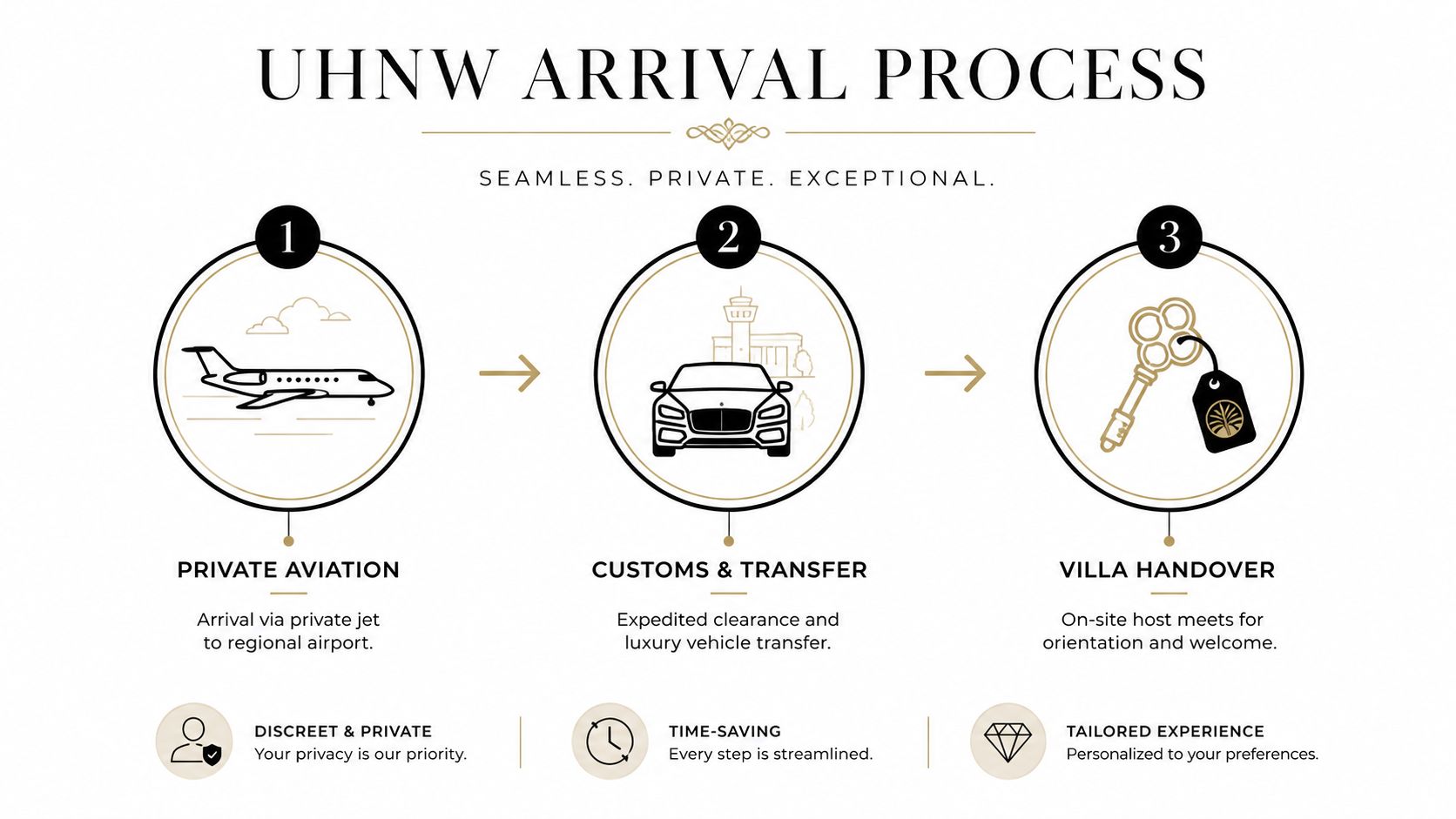
That sounds basic, but the details are what make it work. Dietary pre-clearance matters if the villa is provisioned in advance. Security coordination matters if children, principals, or sensitive guests are arriving together. Tech provisioning matters because nobody wants to discover weak connectivity after check-in.
For travelers who want to understand how aviation planning supports this kind of trip, the training guide from DuBois Aviation is a useful window into the discipline behind private flight operations. You don't need to be a pilot to understand the point. Arrival is choreography, and the better the choreography, the less visible the work becomes.
HauteBlack's private jet charter services guide also fits naturally here because air and ground coordination belong in the same booking conversation. If the transfer chain is weak, the villa loses value before anyone gets to the terrace.
A Working Pre Arrival Checklist and How HauteBlack Delivers It
Before money moves, I'd want one document that answers every key question. Is the beach private, or just well photographed? Does the villa have the right envelope, cooling, and power support? Does the season fit the coast you're targeting? Are the hidden charges and arrival logistics fully mapped? If any of those are unclear, the booking isn't ready.
The checklist you should hand to an assistant
- Privacy verification. Confirm direct access, no public right-of-way, and real sightline buffers.
- Specification audit. Check insulation, glazing, terrace waterproofing, power, cooling, and hot water.
- Season and climate review. Match the destination to your travel window and weather tolerance.
- Pricing breakdown. Separate the nightly rate from provisioning, gratuities, security, and transfer costs.
- Arrival protocol. Lock aviation, transfer, handoff, and contact names before departure.
- On-the-ground ownership. Know who fixes problems, who answers at night, and who escalates when plans change.
That's the framework. The service layer is the execution.
HauteBlack operates as a luxury travel and private membership platform with access across 120+ countries, preferred partner status at over 500 properties, and services that include private villas and estates, private aviation through Haute Jets, first-class and helicopter transfers, and curated access to intimate events. For clients booking beachfront homes, that means the villa search, the transfer plan, and the trip management can live inside one advisor relationship instead of being split across separate vendors.
If you want a beachfront villa booking handled with less guessing and more verification, start with HauteBlack. Bring the shortlist, and the right advisor can pressure-test the privacy, climate, logistics, and pricing before you commit.
Explore Our Guides


Signature Experiences


